
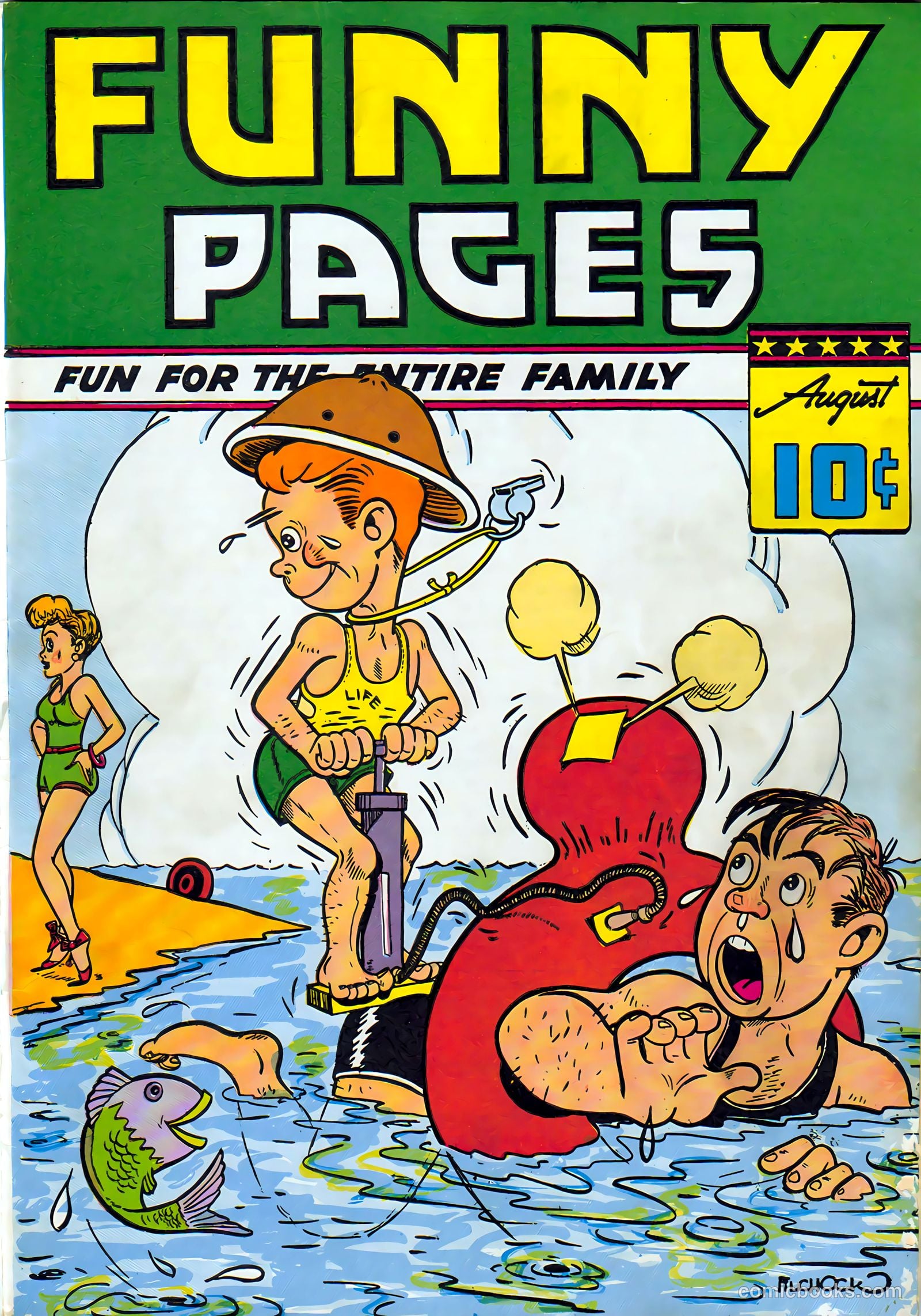
Funny Pages #6
☆ Be the first to review + Add to your collection — Join freeFunny Pages #6 (November 1936, Comics Magazine Company) holds a pivotal place in Golden Age history as one of the two simultaneous debut appearances of The Clock — widely recognized as the first fully-masked hero to appear in American comic books, arriving on newsstands roughly 18 months before Superman's Action Comics #1. Created by George Brenner, The Clock embodied a critical evolutionary bridge between the pulp-fiction archetypes of The Shadow and The Green Hornet and the costumed vigilantes who would dominate comics by decade's end, making this issue part of the foundation on which the entire superhero genre was built. The issue also marks the formal rechristening of the title from The Comics Magazine to Funny Pages, a small but telling editorial pivot that reflected CMC's ambitions to carve out a distinct identity in a rapidly crowding market. Historians further credit CMC's short-lived run — of which this issue is a centerpiece — with originating the concept of the single-theme comic book, predating Detective Comics #1 (March 1937) in that regard.
Funny Pages #6 is an anthology comic featuring multiple stories and joke sections. The "Crusaders" feature presents the historical account of David Livingstone (1815–1877), a Scottish boy who rose from poverty working in a cotton mill to become a thoughtful young man devoted to alleviating human misery, eventually being examined and accepted by the London Missionary Society before arriving in Cape Town in 1841 to begin his missionary work. The issue also includes a "Jest Jokes" page filled with brief humorous exchanges and puns, and a "Guau and Nibble" animal comic strip in which the titular cat and mouse characters encounter an apple jack trap and encounter a tiger while attempting to avoid the old cat and save the mouse children from danger.
ComicBooks.com Value
Show all 15 grades ▾
Find on ebay
Read it digitally
Sell my copy
Have this issue — or a whole collection? Get a fair offer from us, skip the marketplace fees and the hassle.
We Buy Collections ▸History
Comics Magazine Company was founded in early 1936 by William H. Cook and John F. Mahon, the managing editor and business manager, respectively, who had departed — under contentious circumstances — from Major Malcolm Wheeler-Nicholson's National Allied Publications, the direct forerunner of DC Comics. The pair launched their first title, The Comics Magazine, in May 1936, reportedly seeding its early issues with inventory content taken from NAP — content some have described as payment in lieu of wages — and brought along several NAP artists, including Jerry Siegel and Joe Shuster. With issue #6, the series was formally retitled Funny Pages, a change that had been telegraphed on covers as far back as issue #3, where the words 'Funny Pages' were already rendered more prominently than the main title. Entrepreneur Everett 'Busy' Arnold provided unspecified financial assistance to Cook and Mahon during this period, a relationship that would later prove significant when Arnold's Quality Comics acquired The Clock after CMC folded in mid-1937.
Trivia · 8 facts
- Published November 1936 by Comics Magazine Company (CMC); cover-dated the same month as Funny Picture Stories #1, making it one of two simultaneous debut vehicles for The Clock.
- Contains the first appearance of The Clock — created by writer-artist George Brenner — the first fully-masked crime-fighting hero in American comic book history, predating Superman, Batman, and most other Golden Age costumed heroes.
- The Clock's Funny Pages story ('The Clock Strikes') is a two-page feature, shorter than the Clock story in the simultaneously published Funny Picture Stories #1; some historians have argued the Funny Pages installment may represent slightly earlier-drawn material based on its rougher artwork.
- Newsstand-priority debate: A November 23, 1936 photograph of a newsstand published in Life Magazine shows Funny Pages #6 displayed alongside Funny Picture Stories #2, suggesting Funny Picture Stories #1 likely reached stands first — making the priority of first appearance between the two issues actively disputed among historians.
- This issue marks the formal title change from The Comics Magazine (Funny Pages) to simply Funny Pages, continuing numbering from the earlier title rather than restarting at #1.
- CMC was founded by William H. Cook and John F. Mahon, ex-employees of Malcolm Wheeler-Nicholson's National Allied Publications (precursor to DC Comics); the company's creative roster overlapped significantly with early DC, including work by Siegel and Shuster.
- The Clock's secret identity — revealed in later issues — is Brian O'Brien, a wealthy former district attorney turned masked vigilante who operates from a subterranean lair and leaves a calling-card reading 'The Clock Has Struck.'
- After CMC folded in 1937, the Clock migrated to Quality Comics' Feature Funnies #3 (December 1937), where Brenner continued the strip; by some accounts The Clock was a direct influence on Will Eisner's The Spirit, and the character was later revived by Malibu Comics in 1992 and referenced in Dynamite's Masks miniseries (2013).
Full credits
Reprints
Reprinted in Gwandanaland Comics #2005 (2018)
Reviews
Reader reviews
No reader reviews yet.