
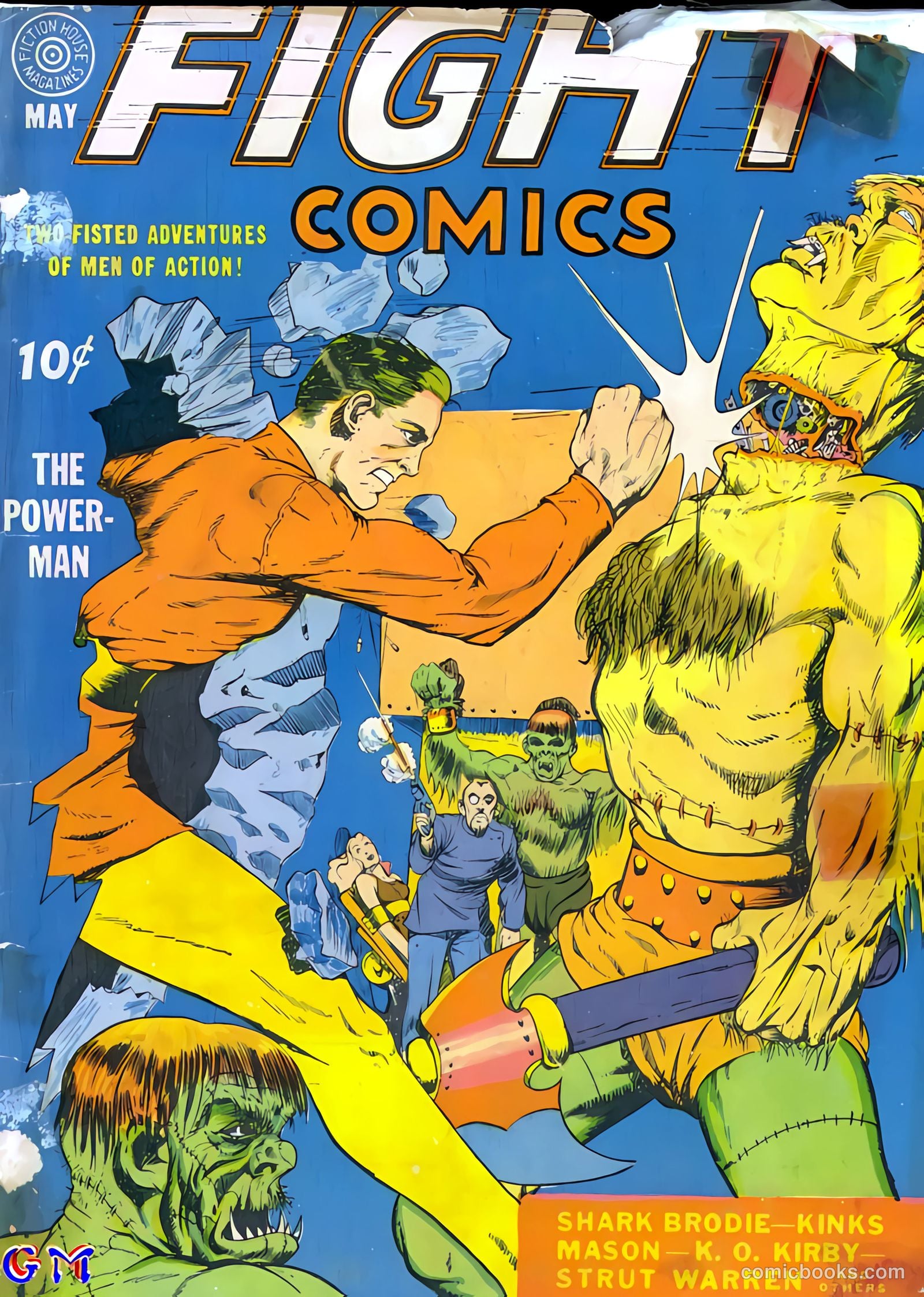
Fight Comics #5
☆ Be the first to review + Add to your collection — Join freeFight Comics #5 (May 1940) is a well-preserved snapshot of Fiction House's anthology formula at its earliest and most energetic — a title that was one of the very few at the publisher to run a costumed superhero in an era when Fiction House stubbornly preferred two-fisted pulp adventurers over caped figures. The continuing Rip Regan / Power Man feature, introduced two issues earlier, made the series a rare exception to that house style, and issue #5 deepens that experiment with John Celardo's pencils scripted by Herman Bolstein pitting the super-strength-suited soldier against a mad scientist and a gorilla. Alongside it, the Eisner-Iger-produced Spy Fighter strip continued its unusually prescient science-fiction premise — set in a dystopian 1997 dominated by three superpowers — in one of the more imaginative pre-war futurism concepts in Golden Age comics. Together these strips make #5 a representative document of how Fight Comics bridged straight pulp adventure, proto-superhero narrative, and speculative fiction in a single ten-cent package.
Fight Comics #5 is an anthology featuring multiple action-oriented stories. "The Power-Man" shows a costumed hero battling giant monsters and enemy forces, ultimately defeating them in a climactic explosion and rescuing a captive woman. "Kinks Mason" follows the adventures of a spy fighter who uses jujitsu against alien link people and underwater foes. "Strut Warren" depicts a secret agent infiltrating a spy ring operating from a coastal cave, where twenty foreign agents plan to smuggle operatives into the United States before being confronted during a gunfight at their hideout.
John L. Sullivan, history's most beloved fighter, claws his way from humble Boston beginnings to the heavyweight championship through sheer ferocity and iron will. This true-life account chronicles his rise through the ranks, his triumphal victory over champion Paddy Ryan, and his bitter rivalry with the cunning Charley Mitchell—a nemesis who would haunt Sullivan across continents and through some of the most brutal bouts ever fought. Watch as the great warrior's confidence and unbeatable fists carry him through a legendary career, tested again and again by challengers who emerge from the shadows to test his dominance.
Chip Collins infiltrates a mysterious temple in the Malayan Peninsula to track down missing American agents, only to discover an elaborate conspiracy hidden within a towering bronze idol. When the priestess guarding the temple tries to stop him, Chip must fight his way through secret passages and mechanical traps to rescue the captives before Wong's forces can silence him. It's a race against time as bullets fly and an arsenal of heavy guns threaten Chip's escape into the skies above.
Cpl. Strut Warren draws sentry duty in the Virgin Islands—a punishment for going AWOL—when he stumbles upon a sinister plot unfolding in the darkness. Forced into a desperate game of cat-and-mouse with enemy agents, Strut must use his wits and grit to stop a dangerous smuggling operation before it reaches the mainland. This 1940 tale from Fight Comics proves that sometimes the best guard is one who refuses to stand down, no matter the odds.
ComicBooks.com Value
Show all 21 grades ▾
More listings for this title
Read it digitally
Sell my copy
Have this issue — or a whole collection? Get a fair offer from us, skip the marketplace fees and the hassle.
We Buy Collections ▸History
Fight Comics launched in January 1940, the same month as Fiction House's Planet Comics, as part of publisher Thurman T. Scott's expansion from pulp magazines into comics — a transition driven by a working arrangement with the Eisner-Iger shop, which packaged the content. Issue #5, published in May 1940, was produced under that same arrangement, with Malcolm Reiss as credited editor, Will Eisner as art director, and S. M. Iger as feature editor — a triumvirate that governed the early run. The cover was pencilled by Will Eisner (with inks attributed by the GCD to Lou Fine), continuing the high-caliber cover art that defined the series' first year, while interior stories were handled by the shop's stable of artists, including John Celardo (who would later draw the Tarzan syndicated newspaper strip) and the cult-favorite outsider artist Fletcher Hanks, working under his pseudonym 'Charles Netcher' on the Big Red McLane feature.
Trivia · 8 facts
- Published May 1940 by Fiction House (indicia publisher: Fight Stories, Inc.); cover-pencilled by Will Eisner, with inks attributed to Lou Fine per the Grand Comics Database.
- Editorial trio: Malcolm Reiss (editor), Will Eisner (art director, credited as William E. Eisner), and S. M. Iger (feature editor) — the Eisner-Iger shop that packaged the series for Fiction House.
- Continues the Rip Regan / Power Man feature introduced in Fight Comics #3: Regan, a soldier given a 'power suit' by scientist Dr. Austin that grants super-strength, was one of only a handful of costumed superheroes Fiction House ever published across its entire line.
- Rip Regan story scripted by Herman Bolstein, pencilled and signed by John Celardo (later the longtime artist on the Tarzan newspaper syndication strip); the GCD notes possible Sid Greene inking assistance on this installment.
- The Spy Fighter / Saber strip continues its pre-war science-fiction premise — a 1997-set future divided among three superpowers ('Russmany,' 'Mongo,' and 'Greater America') — with Saber facing the Prussanians, one of the series' recurring futurist villains.
- Fletcher Hanks — working as 'Charles Netcher' — contributed the Big Red McLane lumberjack story; Hanks, rediscovered decades later as an eccentric Golden Age auteur, is one of the most discussed creative presences in the early Fight Comics run.
- The Chip Collins aviation-adventure segment is flagged by the GCD as possibly drawn by a young Nick Cardy, based on stylistic analysis in 'The Art of Nick Cardy' — though this attribution remains unconfirmed.
- The issue was reprinted as part of PS Artbooks' Golden Age Classics: Fight Comics Volume 2 (2021), which collected issues #4–6 and brought the Power Man era of the series back into print for modern readers.
Full credits
Reprints
Reprinted in Captain Flight Comics #4 (1944), Phantom Lady #3 (1955), You Shall Die by Your Own Evil Creation! #[nn] (2009), Fletcher Hanks : œuvres complètes #[nn] (2018)
Key issues in Fight Comics
Reviews
Reader reviews
No reader reviews yet.