
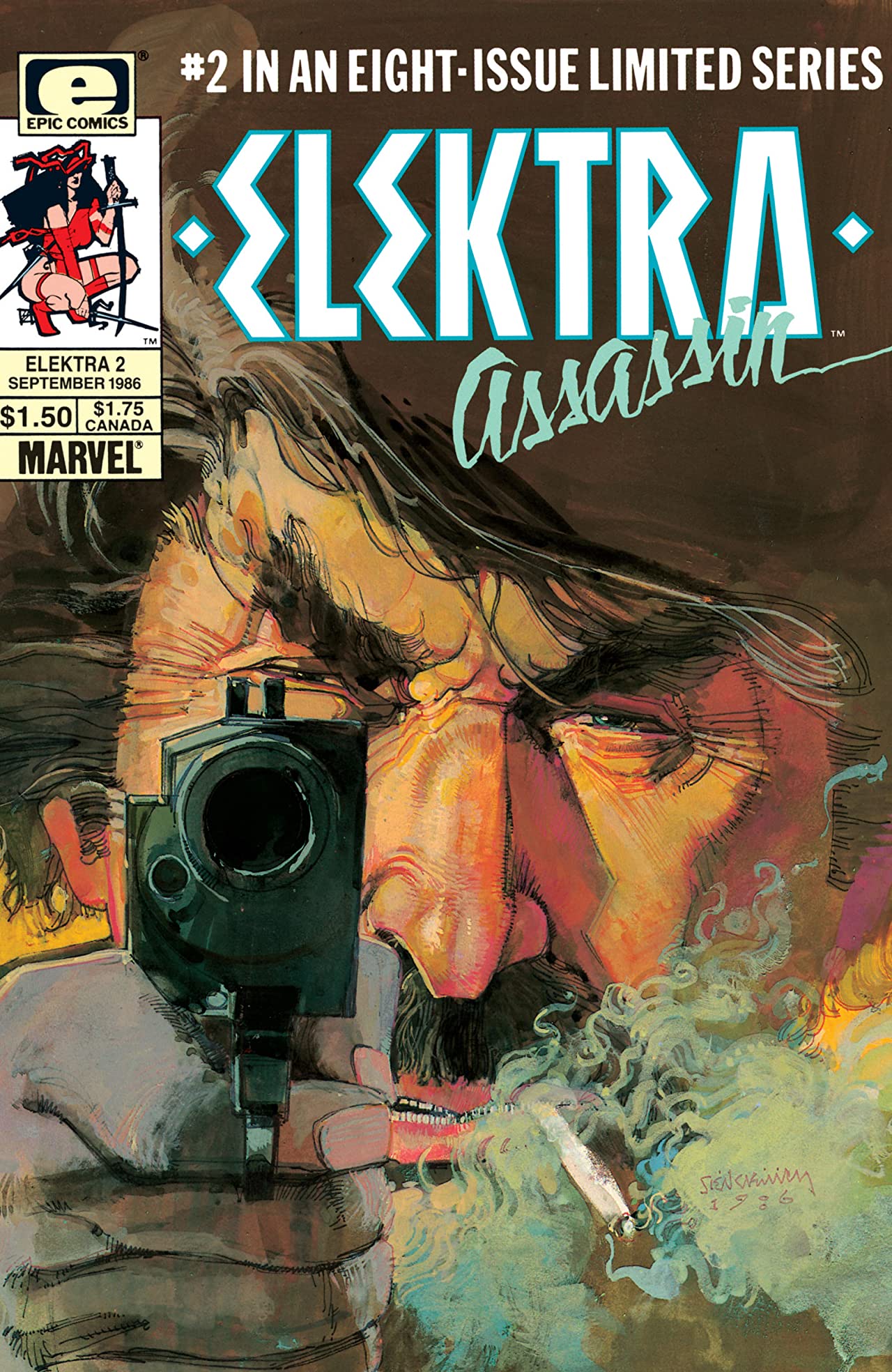
Elektra: Assassin #2
☆ Be the first to review + Add to your collection — Join freeElektra: Assassin #2 — titled 'The Ugly Man' and released with a cover date of September 1986 — marks the formal introduction of S.H.I.E.L.D. agent John Garrett, the alcoholic, lumbering foil whose cat-and-mouse pursuit of Elektra drives the series' darkest comedy and whose eventual cyborg transformation becomes one of the book's most durable contributions to Marvel lore. As the second chapter of a miniseries that stands alongside The Dark Knight Returns and Watchmen as a defining text of the 1980s comics maturation movement, the issue deepened Bill Sienkiewicz's radical mixed-media experiment — shifting registers from painterly naturalism to expressionist cartoon within a single sequence — establishing a visual grammar that critics and subsequent artists, from Dave McKean to David Mack, would cite as a direct influence. The series' deliberate freedom from Comics Code Authority oversight, enabled by its publication under Marvel's Epic imprint, made each issue a proving ground for adult-oriented storytelling in mainstream superhero comics, and this second chapter is where that anarchic creative energy — Miller's non-linear full-script satire colliding with Sienkiewicz's genre-defying art — first fully locked into gear.
ComicBooks.com Value
Show all 7 grades ▾
This exact issue on ebay
CGC 9.6 ▾ $49.99–$57.99 2 listings
Raw — VF/NM ▾ $3.99–$8 2 listings
Raw / ungraded ▾ $1–$25 30 listings
Read it digitally
Sell my copy
Have this issue — or a whole collection? Get a fair offer from us, skip the marketplace fees and the hassle.
We Buy Collections ▸History
The project's roots stretch back to 1982, when Epic Comics editor Mary Jo Duffy approached Frank Miller — fresh from his transformative Daredevil run — to create something new for the imprint. Miller already had Sienkiewicz in mind as his collaborator, a pairing both Duffy and Executive Editor Archie Goodwin enthusiastically endorsed after seeing the two work together on Daredevil: Love and War. Miller used the same full-script method he had employed on Ronin and Born Again, though a notable part of the creative dynamic was Sienkiewicz's latitude to depart from those scripts: editor Duffy confirmed in her introduction to the 2008 omnibus that Miller often rewrote pages after seeing Sienkiewicz's finished artwork, meaning the art genuinely shaped the final narrative. The book was produced specifically for direct-market specialty shops — bypassing the Comics Code entirely — which freed both creators from content restrictions and signaled Marvel's broader ambition to reinvigorate Epic as a home for mature-reader Marvel Universe stories.
Trivia · 8 facts
- Issue title: 'The Ugly Man'; cover-dated September 1986, released August 5, 1986, as the second of eight issues in the limited series.
- First appearance of John Garrett, the unstable S.H.I.E.L.D. agent whose pursuit of Elektra and subsequent cybernetic rebuilding form the emotional spine of the entire miniseries; he later appeared in Marvel's Agents of S.H.I.E.L.D. television series.
- Written by Frank Miller, with all pencils, inks, and cover art by Bill Sienkiewicz — Sienkiewicz serving as his own inker throughout the series, a creative choice that amplified his mixed-media approach.
- Published under Marvel's Epic Comics imprint, which distributed solely through direct-sales comic shops and carried no Comics Code Authority seal, giving the creative team unrestricted freedom over content.
- Miller and Sienkiewicz both described the Elektra-and-Garrett dynamic in issues #2 and #3 specifically as comedic — Sienkiewicz compared it to Chuck Jones's Road Runner cartoons, a comparison Miller publicly endorsed.
- The series — with #2 as a key chapter in its critical recognition — earned Sienkiewicz the 1987 Kirby Award for Best Artist, the 1986 Yellow Kid Award (Lucca, Italy), and a 1988 Eisner Award nomination for Best Limited Series.
- The complete series has been collected across at least six trade paperback editions, including the 2008 Frank Miller Elektra Omnibus hardcover and a 2012 Marvel Premiere Classic hardcover, keeping all eight issues continuously in print for decades.
- Critics Jim Casey and Stefan Hall have identified Elektra: Assassin — with issue #2 establishing the series' tonal template — as a primary creative inspiration for David Mack's Kabuki (1994), illustrating its downstream influence on the subsequent wave of painted, literary-style comics.
Full credits
Reprints
Reprinted in Elektra: Assassin #[nn] (1987), Elektra: Assassin #[nn] (1987), Corto Maltese #1 [64] (1989), Elektra #2 (1989), Elektra #1 (1989), Los Comics de El Sol #22 (1990), Los Comics de El Sol #17 (1990), Elektra #5 (1991), Daredevil / Elektra: Love and War #[nn] (2003), Elektra by Frank Miller Omnibus #[nn] (2008), Elektra: Assassin #[nn] (2012), Elektra by Frank Miller Omnibus [Second Edition] #[nn] (2016), Daredevil / Elektra: Love and War Gallery Edition #[nn] (2019), Daredevil by Frank Miller #[6] (2019)
Key issues in Elektra: Assassin
Reviews
Reader reviews
No reader reviews yet.