
EC Archives: Weird Science #1
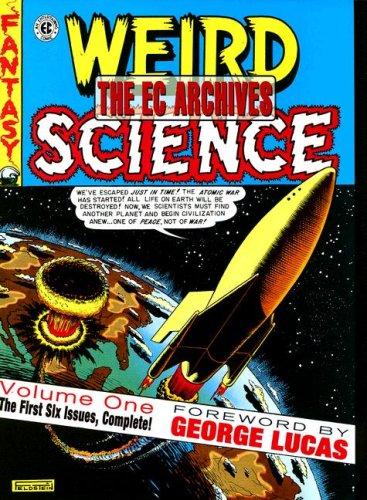
☆ Be the first to review + Add to your collection — Join free"Lost in the Microcosm" from EC Archives: Weird Science #1 (2006) delivers a haunting, surreal tale from Harvey Kurtzman’s legendary early work, with full art, inks, and lettering by the master himself, and colors by Joshua G. Harris. Set in a world reshaped by nuclear aftermath, it follows Luis and Rosa, survivors of a devastating explosion, whose fates diverge in heartbreaking ways—Rosa giving birth to their son Pedro before her passing, and the child, altered by radiation, rising to lead the nation as its youngest Prime Minister. The cover, a striking piece by Al Feldstein, captures the story’s eerie, otherworldly tone.
In "Lost in the Microcosm," Karl stumbles upon a bizarre scientific legacy when he recounts his time working under the enigmatic Professor Einstadt, whose shrinking solution accidentally transforms him into a tiny traveler. Swept into a hidden world beyond scale, Karl encounters a civilization where Professor Dreeben—himself a figure from his own past—narrates a tale that mirrors his own strange journey.
In "Experiment... in Death," two scientists push the limits of life and death, testing their revival process on a dog after fifteen minutes of clinical death—only to discover the horrifying consequences of a mind irrevocably altered by the process. The story unfolds with a chilling precision, probing the fragile boundary between life and what comes after.
In "Things" from Outer Space! from EC Archives: Weird Science #1, a scientist and his assistant uncover mysterious metal in the desert, leading them to a shocking discovery: an alien visitor who looks human—except for a third eye concealed on its forehead. When the alien reveals that its kind have already infiltrated Earth with plans to take over, the two must confront the terrifying truth of what's been hiding in plain sight.
In "The Flying Saucer Invasion," a dismissive Secretary of Defense scoffs at reports of UFOs across the country—unaware that a fleet of alien craft is silently descending upon Earth as he speaks. The story builds tension with a quiet, creeping dread as the truth of the sightings begins to unfold, far beyond the reach of official denial.
In "The Meteor Monster," a sudden impact on a quiet farm sets off a chain of eerie events when a strange creature emerges from the fallen meteor. As the alien begins to hypnotize everyone it touches, one person—Jo, the blind neighbor—remains unaffected, unaware that her lack of sight makes her a rare threat to the creature’s plans.
In "The Micro-Race," a reclusive scientist observes a tiny, self-sustaining civilization he's created, marveling as they progress from simple life forms to a complex society. As their technology advances, they begin to build weapons—until their own innovation leads to their world’s sudden, explosive end.
In "The Man Who Raced Time," Julius, spurned after losing the Physics Department chair to Bruce, channels his bitterness into a desperate experiment with his Spherical Accelerator. When he uses it to alter time and sabotage Bruce’s wedding to Christine, the consequences spiral beyond his control—leaving the future irrevocably changed.
In "The Sounds from Another World!" from EC Archives: Weird Science #1, a curious gardener pauses mid-trim when a professor stops him with a startling claim: his invention can hear the silent cries of plants. The professor recounts how his machine revealed that trees and flowers scream in agony when harmed—turning the quiet garden into a chorus of suffering.
In "Machine from Nowhere," Professor Donalson is summoned to his friend Dave’s home to examine a mysterious device born from dreams and untested theory. As Dave recounts how his nocturnal visions sparked the invention, the professor finds himself drawn into a puzzle that blurs the line between science and the inexplicable.
When radio host Carson Walls broadcasts a fictional alien invasion, the line between fiction and reality blurs—just as a real Jupiter-born threat descends upon Earth. Listeners, already primed by the broadcast, scramble in panic, unable to tell what’s real. A chilling twist on the classic "War of the Worlds" panic, this story plays with fear, perception, and the power of the airwaves.
In the aftermath of an atomic blast, a dying man and his wife struggle to survive, only for her to return home and give birth to their son, Pedro, before passing away. The child, born under the shadow of radiation, grows into a startling genius—so extraordinary that the President himself takes notice and appoints him the nation’s youngest Prime Minister.
In "Gargantua!", a well-intentioned scientist attempts to help a small man by altering his pituitary gland, only to trigger an uncontrollable growth spurt that sends him soaring to a staggering 700 feet tall. The story unfolds with a mix of scientific curiosity and escalating wonder, as the man's transformation spirals beyond prediction.
In "Made of the Future!", a heartbroken man stumbles into a group of time-traveling tourists from 2150, drawn to the quirks of the 1950s. Impressed by their advanced technology, he uses it to craft the ideal companion—then brings her back to his own era, where the past and future collide in unexpected ways.
In "Return," a group of space travelers journeys to a distant world their ancestors once called home—only to find it frozen in time, still wracked by the same endless atomic war that drove them from it millennia ago. The story unfolds with quiet dread as the visitors confront a past that refuses to stay buried.
In "The Last War on Earth," Arthur challenges Professor Harlow’s belief that humanity’s nature ensures perpetual conflict—until the professor suggests a radical idea: what if an alien threat from Mars could finally unite all of Earth’s nations, ending war forever? When that very threat arrives, the planet’s fate hangs in the balance.
In "Spawn of Venus," astronauts return from a mission to Venus with a seemingly harmless flower, unaware that its bloom will unleash a terrifying creature on Earth. Written by a team of EC Comics legends and illustrated with their signature blend of eerie precision and pulpy dread, this 8-page tale turns a quiet botanical sample into a chilling harbinger of alien horror.
In "Man and Superman!" from EC Archives: Weird Science #1, Neils is deep in his lab, chasing a scientific breakthrough that could redefine matter—while his brother Charlemagne has other plans, more focused on muscle than mind. When Charlemagne finally agrees to visit the lab, curiosity gets the better of him, and a moment of exposure to Neils’ mysterious rays unlocks a power beyond human limits—only to reveal that such strength comes at a cost no one could foresee.
In "Sinking of the Titanic!" from EC Archives: Weird Science #1, a grieving British physicist named George builds a time-travel machine to save his parents, who perished aboard the Titanic—only to find his attempt accidentally triggers the very disaster he sought to stop. The story unfolds with a haunting blend of personal loss and scientific ambition, where one man’s desperate bid to rewrite history leads to a twist both tragic and strangely redemptive.
In "Divide and Conquer," a desperate scientist’s paranoia takes a horrifying turn when he discovers his wife plans to murder him—so he retaliates by injecting her with a serum that splits her into countless tiny duplicates. As the miniature versions multiply, he begins to crush them one by one, each step a chilling escalation of control and fear.
ComicBooks.com Value
Find on ebay
Where to buy
Read it digitally
Sell my copy
Have this issue — or a whole collection? Get a fair offer from us, skip the marketplace fees and the hassle.
We Buy Collections ▸Full credits
Reprints
↩ Reprints Weird Science #12 (1950), Weird Science #13 (1950), Weird Science #14 (1950), Weird Science #15 (1950), Weird Science #5 (1951), Weird Science #6 (1951)
Variants (1)
Reviews
Reader reviews
No reader reviews yet.