
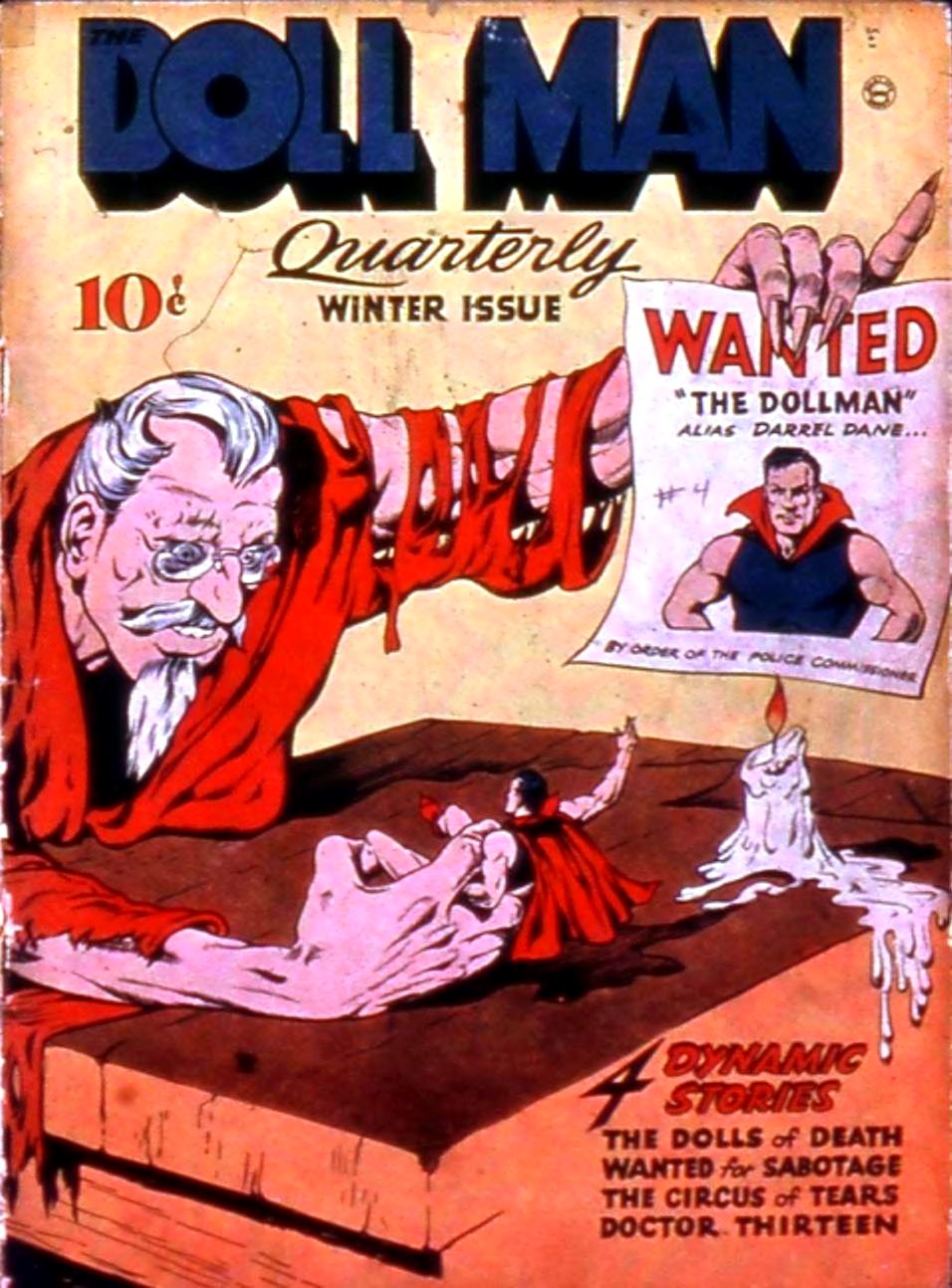
Doll Man #4
☆ Be the first to review + Add to your collection — Join freeDoll Man #4 (Winter/December 1942) represents a well-seasoned entry in what was then comics' only ongoing solo series for a shrinking superhero — a concept that would not be revisited by either DC or Marvel for roughly two decades. As part of the wartime issues of a quarterly that Quality Comics clearly invested in heavily, the issue reflects the full flower of the character's WWII-era storytelling mode: Darrel Dane pitted simultaneously against domestic crime lords, Nazi saboteurs, and new recurring villain archetypes. The debut of a villain called The Night — used as the issue's cover hook — and the introduction of the sinister Doctor Thirteen (who evades capture, left at large to return) show Quality's writers experimenting, mid-war, with the kind of serialized, unresolved villainy that would become genre standard. The issue also carries the 'Dragon' backup strip by Fred Guardineer, an ongoing wartime adventure feature that ran as Doll Man's principal co-star throughout the quarterly's early years.
This Winter Issue of Doll Man Quarterly is an anthology featuring multiple stories. "The Circus of Tears" follows the malevolent Laugho the Great Clown, who is cursed so that every circus show he performs in results in at least one death; Doll Man must stop Laugho's deadly performances. Another story involves a magician named Murko the Great who uses enchanted dolls in his stage act that come to life and dance, which Doll Man investigates and thwarts. The issue also includes "Doctor Thirteen," "Wanted for Sabotage," and "The Dolls of Death" stories, all featuring the pint-sized hero facing various supernatural and criminal threats.
Doll Man finds himself framed for sabotage when the mysterious villain known as The Night uses him as the perfect fall guy—each time Doll Man gets close to stopping the saboteur's explosions, he's knocked unconscious by dream gas only to wake up arrested at the crime scene. Now wanted by police and facing wartime execution, Doll Man must outmaneuver The Night's scheme and prove his innocence before the next attack. With the cards stacked against him and his reputation in ruins, the tiny crime-fighter races to clear his name and expose the real traitors.
Doll Man finds himself framed for sabotage when a villain known as the Night uses him as cover for a series of explosions targeting American factories, leaving the hero wanted by police while the real saboteurs continue their destructive plot. Trapped between clearing his name and stopping the Night's scheme, Doll Man must outwit both the criminals and the law to expose the truth before more vital war production is destroyed.
The Dragon orchestrates a daring nighttime assault on enemy aircraft, using cunning and sabotage to ground a squadron before they can mount a defense. When rescue efforts are pinned down by enemy fire, he fights to free prisoners of war and rally his allies for a decisive strike. This wartime tale of heroism and payback captures the urgency of 1942 combat.
When a mysterious stranger offers his bizarre living dolls to magician Murko for an army benefit show, Doll Man [Darrel Dane] attends with his fiancée Martha Roberts—only to witness the dolls turn deadly during the performance, killing General Caldwell in front of the horrified audience. With the magician silenced and a Nazi spy still at large, Doll Man must race to protect the next target: General Taggert, who holds secrets vital to the nation's defense. Written by the creative team behind this 1942 thriller, the story pits the pint-sized hero against an enemy plot that strikes at the heart of America's military leadership.
When Judge Kabal and his manager Leopard Miller decide to run a circus in the notoriously haunted old opera house, they're betting the public's hunger for mystery will overcome a grim history: every show held in the building has claimed a life. As Doll Man arrives to investigate the curse before opening night, he discovers that the tragedy plaguing the venue may be far more deliberate than supernatural—and that jealousy, forbidden love, and revenge simmer beneath the big top's canvas. With acrobats, a conflicted clown, and dark secrets all colliding under one cursed roof, Doll Man must untangle the truth before the next body falls.
ComicBooks.com Value
This exact issue on ebay
Raw / ungraded ▾ $7.99–$9.79 3 listings
- Arcane Comics · Shoreline, WA4 on eBay ↗
- Amazing Comics & Cards · 2 locations2 on eBay ↗
- The Time Capsule · Seekonk, MA2 on eBay ↗
- Rebel Base Comics & Toys · Charlotte, NC1 on eBay ↗
- World's Best Comics and Toys · Sacramento, CA1 on eBay ↗
Read it digitally
Sell my copy
Have this issue — or a whole collection? Get a fair offer from us, skip the marketplace fees and the hassle.
We Buy Collections ▸History
Doll Man as a character was created by Will Eisner — Quality Comics' first super-powered hero — and had graduated from his Feature Comics origins to his own quarterly title beginning in 1941, published by Quality's Everett 'Busy' Arnold. By issue #4, the title was a stable quarterly with Rudy Palais handling interior Doll Man art duties and Fred Guardineer scripting and drawing the Dragon backup, a recurring wartime military adventurer. The PS Artbooks archival reprint series (Doll Man Volume 2, 2024) confirms that issues #4–6 form a distinct artistic phase of the run, with Al Bryant and Rudy Palais as the dominant interior artists and Guardineer providing the backup strip — a different creative configuration than the Reed Crandall-dominated early issues.
Trivia · 8 facts
- Published Winter/December 1942 by Quality Comics as part of their quarterly Doll Man series, the fourth issue of a run that would reach 47 issues total (1941–1953).
- Introduces Doctor Thirteen as a new villain — he escapes Doll Man at the story's end and is left explicitly at large, marking one of the title's early attempts at a serialized, unresolved antagonist.
- Introduces The Night as an antagonist, who is depicted on the cover holding a wanted poster for Doll Man — making the cover itself a piece of in-universe propaganda imagery.
- Contains a Nazi-sabotage storyline in which an unnamed enemy agent deploys animated, instruction-following dolls whose mysterious life force Darrel Dane cannot explain even after the spy is captured — a wartime sci-fi thriller plot that directly mirrors the character's own uncanny nature.
- The Dragon backup strip, written and drawn by Fred Guardineer, continued its run in this issue — Guardineer's wartime military adventurer was the sole co-feature throughout Doll Man's early quarterly issues.
- Interior Doll Man art in this period was handled by Rudy Palais, part of a rotation of Quality Comics artists that included Reed Crandall (who had dominated the earlier issues) and Al Bryant.
- Throughout all its wartime issues, Doll Man — 'The World's Mightiest Mite' — is depicted fighting Axis forces while also battling domestic crime, reflecting Quality Comics' consistent dual-front storytelling across its superhero line.
- DC Comics later acquired all Quality Comics characters, including Doll Man, when Quality ceased operations in 1956, and the character was eventually brought into DC continuity through Justice League of America #107 (1973) as a founding member of the Freedom Fighters.
Full credits
Key issues in Doll Man
Reviews
Reader reviews
No reader reviews yet.