
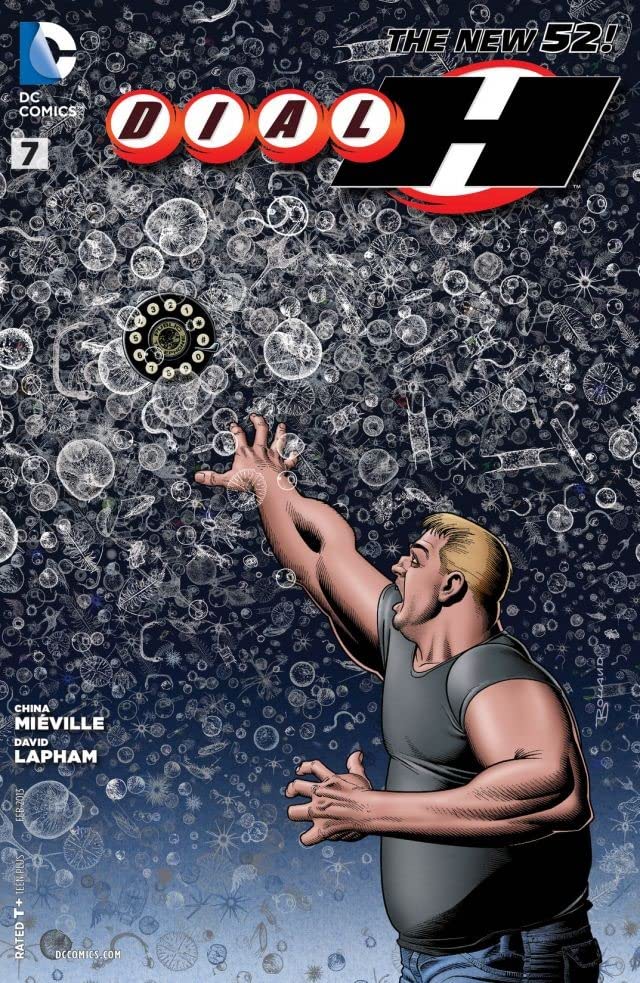
Dial H #7
Dial H #7 marks the narrative pivot from the series' debut arc into its second and final chapter, the 'Exchange' story, which deepens China Miéville's mythology around the H-Dial's cosmic origins and introduces The Centipede as the series' most consequential villain. As the first issue penciled by Alberto Ponticelli as the book's ongoing interior artist, it also signals the visual shift that would define the run's final two-thirds. The issue is notable for planting Nelson and Roxie inside Gotham City — threading established DC characters like Batman, the Joker, Catwoman, and Two-Face through Miéville's surrealist framework — a rare moment where the dial-verse makes direct, deliberate contact with mainstream DC continuity. For collectors of New 52-era oddities, it represents the opening chapter of a run that critics singled out as one of that initiative's most ambitious literary experiments.
ComicBooks.com Value
This exact issue on ebay
Raw — VF/NM ▾ $1–$6.69 4 listings
Raw / ungraded ▾ $1.59–$9.99 15 listings
More listings for this title
Read it digitally
Sell my copy
Have this issue — or a whole collection? Get a fair offer from us, skip the marketplace fees and the hassle.
We Buy Collections ▸History
Dial H was conceived when Miéville, a lifelong fan of the original Silver Age concept, approached DC about reimagining the property for The New 52's Second Wave launch in May 2012. By issue #7 (cover-dated February 2013), the book had transitioned its primary interior artist from Mateus Santolouco — who established the visual language of the first arc — to Alberto Ponticelli, whose background on gritty titles like Unknown Soldier gave the second arc a harder, more grotesque texture. The series was ultimately cancelled as part of DC's sixth wave of New 52 cancellations, concluding with issue #15 in 2013, which meant Miéville had to compress what reviewers observed were several planned arcs into the remaining issues after #7.
Trivia · 8 facts
- Issue #7 opens the 'Exchange' story arc, the second and final arc of China Miéville's Dial H run, collected in Dial H Vol. 2: Exchange (issues #7–15 and Justice League #23.3).
- Alberto Ponticelli steps in as the book's primary interior penciler beginning with this arc, replacing opening-arc artist Mateus Santolouco; Dan Green provided inks. Brian Bolland continued as cover artist throughout the run.
- The Centipede — a Canadian government operative with time-displacement powers, able to create independently acting temporal copies of himself — is introduced in this arc as Nelson and Roxie's chief antagonist.
- The issue places protagonists Nelson Jent and Roxie Hodder (Manteau) in Gotham City, generating appearances by Batman (Bruce Wayne), the Joker, Catwoman (Selina Kyle), and Two-Face (Harvey Dent) as backdrop or cameo presences within Miéville's weird-fiction framework.
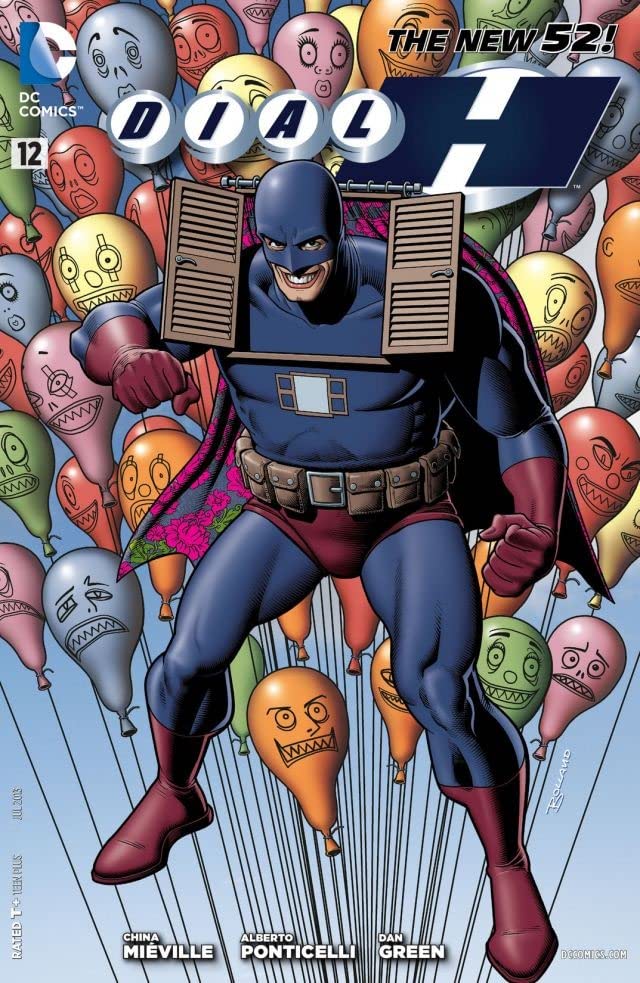
- Among the dialed hero identities catalogued across this issue are Asphaltman, Cardamom, Cuttlefist, Daffodil Host, Shark Mage, Super-Woodlouse, and Tree Knight — all original Miéville creations existing nowhere else in the DC Universe.
- Vernon Boyne (alias Floyd Bergson / Brian Roche) appears as a recurring antagonist figure who has been surveilling Nelson and Roxie and becomes entangled with The Centipede's mission.
- The full run — including this issue — was collected in both the two-volume trade paperback format (Vol. 2: Exchange, ISBN 978-1401243838) and the Dial H Deluxe Edition hardcover.
- Dial H was cancelled as part of DC's sixth wave of New 52 title cancellations; the series concluded with issue #15 and an epilogue in Justice League #23.3 (Villains Month: Dial E).
Cast · 18 characters
Full credits
Reprints
Reprinted in Dial H - Bei Anruf Held #2 (2014), Dial H #2 (2014), Dial H: The Deluxe Edition #[nn] (2015)
Key issues in Dial H
Reviews
Reader reviews
No reader reviews yet.