
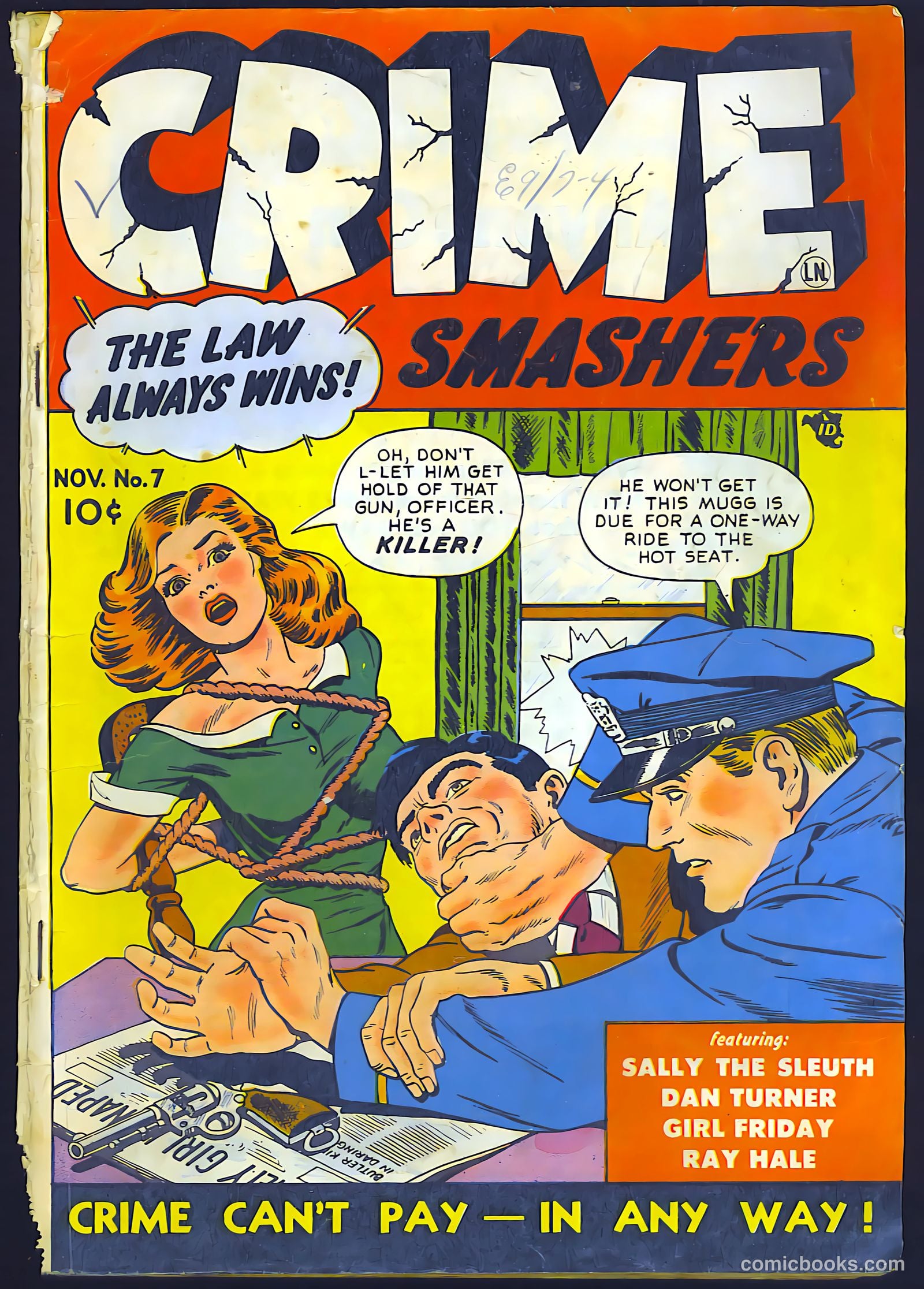
Crime Smashers #7
☆ Be the first to review + Add to your collection — Join freeCrime Smashers #7 is an anthology featuring multiple crime stories. "Girl Friday: The Clutch of Evil" by Keats Petree follows Gail Ford, secretary to Inspector Marion of the Homicide Squad, who is kidnapped by a criminal gang while shopping; she is rescued by police after a shootout, and a man named "Soapy" is credited with helping her escape. The issue also features stories starring Sally the Sleuth, Dan Turner, and Ray Hale, with the tagline "Crime Can't Pay—In Any Way!" appearing on the cover.
When blackmail notes start appearing in the dressing rooms of young actresses at Monarch Pictures, director "Baldy" Boyd brings Hollywood detective Dan Turner onto the case—but before the investigation can gain traction, a prop knife during a staged fight scene finds its way into Boyd's chest. Turner must unravel which member of the film crew turned killer and what the blackmail scheme has to do with the murder. The detective's search for answers takes him through a maze of suspects, from the actresses caught in the extortion plot to the various technicians working the set.
Sally the Sleuth and her boss the Chief are hired to investigate a wealthy woman's troubled daughter, Marcia, who's been gambling with dangerous characters—and when the trail leads to a bowling alley that might be a front for illegal operations, Sally goes undercover to uncover what's really happening behind closed doors. When a murder erupts in the back room, Sally must navigate gunfire and accusations to expose the real killer before an innocent person takes the fall. It's a tense game of cat-and-mouse where one wrong move means curtains, and the alleys become a deadly battleground in this 1942 crime tale by Max Plaisted.
Gail Ford, Inspector Madson's trusted secretary, is snatched off the street by "Lump" Lonigan's gang and held hostage in a warehouse hideout—they're using her as leverage to free a captured gang member from police custody. With the clock ticking and Gail's life hanging in the balance, the Inspector and his detectives race to locate the hideout before the criminals make good on their threats. The investigation takes an unexpected turn when a street informant uncovers the gang's location, setting the stage for a desperate rescue.
ComicBooks.com Value
Show all 22 grades ▾
Find on ebay
Read it digitally
Sell my copy
Have this issue — or a whole collection? Get a fair offer from us, skip the marketplace fees and the hassle.
We Buy Collections ▸Trivia · 8 facts
- Published November 1951 by Trojan Magazines — the series ran October 1950 to March 1953 for 15 issues total.
- The issue carries a 'bondage cover' and contains a story involving a female heroin addict, content that put the series in the crosshairs of anti-comics critics of the era.
- Recurring cast includes Sally the Sleuth, Dan Turner (Hollywood Detective), Ray Hale (News Ace), and Gail Ford (Girl Friday) — all pulp-originated characters adapted from Culture Publications titles including Spicy Detective and Hollywood Detective.
- Series editor and co-artist Adolphe Barreaux (also credited as Charles Barr) created Sally the Sleuth in the 1930s for Spicy Detective pulp; his continued stewardship of the character through Crime Smashers represents a nearly two-decade creative continuity.
- Trojan Magazines was founded by Harry Donenfeld, co-owner of DC Comics, making Crime Smashers an unusual footnote: a 'notorious' crime comic produced by a publisher directly connected to the home of Superman and Batman.
- The series — not just this issue — was singled out by Fredric Wertham's Seduction of the Innocent (1954), with Crime Smashers #1 providing the infamous 'Jeepers!' panel; the series' ongoing presence in that controversy gives every issue historical context in the comics-censorship debate.
- A public-domain reprint of Crime Smashers #7 was issued by Golden Age Reprints (ISBN 9781979635356), confirming the issue's public-domain status and ongoing reader interest.
- Despite its lurid title and cover imagery, contemporaneous and modern analysts note the series functioned more as mystery/detective anthology than true 'crime comic,' consistently centering law-enforcement heroes who bring criminals to justice — a tension that made Wertham's critiques of it particularly contested.
Reprints
↩ Reprints Super-Detective #3 (1950), Hollywood Detective #4, Private Detective #3
Reprinted in Wally Wood: Eerie Tales of Crime and Horror #[nn] (2013)
Reviews
Reader reviews
No reader reviews yet.