
Crime Does Not Pay #22
☆ Be the first to review + Add to your collection — Join freeCrime Does Not Pay #22 (cover-dated July 1942) is the founding document of an entire comic book genre — widely recognized as the first dedicated 'true crime' comic book series, it redirected the medium away from superhero fantasy toward ripped-from-the-headlines stories of real gangsters, lawmen, and outlaws. By treating newspaper crime reportage as raw material for sequential storytelling, Charles Biro and Bob Wood demonstrated that comics could sustain a mass adult readership beyond the cape-and-cowl crowd, a proof of concept historian Gerard Jones called 'the first nonhumor comic to rival the superheroes in sales.' The series that launched here would eventually help trigger the Senate Subcommittee hearings on juvenile delinquency and the creation of the Comics Code Authority, making this debut issue a direct ancestor of the censorship battles that reshaped the entire industry.
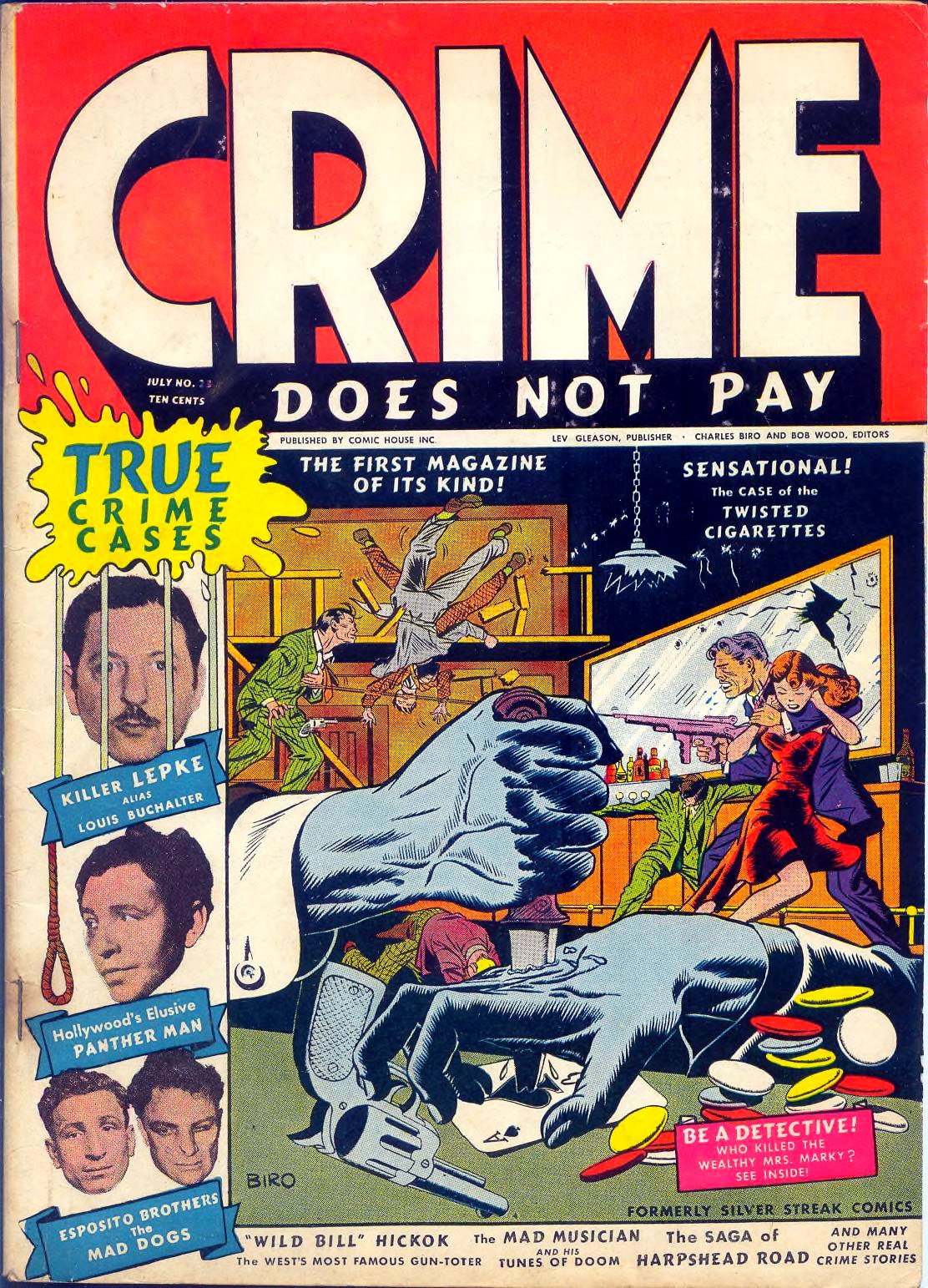
In the 1942 crime anthology Crime Does Not Pay #22, the story "The Real Story Behind Lepke, Mad Dog of the Underworld" delivers a gritty, real-world tale of vengeance and redemption. Written and illustrated by Alan Mandel, it follows the rise of Bill Reed, a man paralyzed in childhood who, after years of struggle, builds wings to walk again and dedicates his newfound mobility to fighting crime—until he faces the dangerous and vengeful Wrench, a war-scarred adversary with a personal grudge. The cover, by Charles Biro, captures the tension of the era’s crime drama, a 10-cent snapshot of wartime suspense.
Louis "Lepke" Buchalter rose through the ranks of organized crime from strongarm work in Kid Dropper's gang to controlling the multi-million-dollar fur racket through intimidation and violence, but his empire of brutality eventually drew the attention of the F.B.I. As the net tightens and resources dwindle, Lepke and his associate Gurrah find themselves hunted through the underworld's darkest hideouts in this hard-hitting account of one of America's most ruthless criminals.
Wild Bill Hickok takes the marshal's position in Abilene, determined to enforce a strict no-guns ordinance and clean up a town run wild by gamblers and hardened gunmen. When local gamblers grow tired of his iron-fisted methods, they hire the notorious gunslinger Wes Harding to challenge him—but as Harding grows drunk on confidence waiting for a showdown that never comes, he finds himself tangled in Hickok's carefully laid plans. It's a frontier tale of reputation, reflexes, and one lawman's unyielding grip on order.
Officer Edward Maher patrols the streets of New York during a brutal crime spree perpetrated by the Esposito Brothers, two ruthless killers leaving a trail of blood across Fifth Avenue. When a payroll robbery turns violent, Maher responds to desperate cries for help—only to face the deadly consequences of confronting armed murderers willing to kill without hesitation. This 1942 crime story honors the memory of a cop who gave everything in the line of duty.
In Utrecht, Holland, the cruel and despicable Jon Overs—a retired ferryman who rules his household with violence and contempt—hatches a scheme to discover who among his servants and family might actually be loyal to him. When he stages his own death to test their true feelings, the plan spirals into an ironic tragedy that exposes the darkest consequence of his own brutality.
A phantom pianist leaves a trail of dead women across Chicago, his crimes marked only by mysterious clues that baffle detectives Slater and Davis—until a monogrammed handkerchief points them toward Zilla, a talented musician with a deadly obsession. As the killer evades capture and flees to Ohio, the detectives must devise an elaborate trap to finally corner their elusive quarry.
A twisted cigarette stub becomes the linchpin in solving a murder when Dick Williams is brought in for questioning over the death of Ross Arnold in Florida's swamplands. As detectives piece together evidence from the crime scene—a bloodstained car, a discarded shirt, and three peculiar cigarette butts—they realize the killer's nervous habit may be the key to his conviction. But Dick insists he's innocent, even as the evidence mounts against him.
Mrs. Marky, a wealthy but compassionate woman living on Hudson Hill, throws a blackout party during the city's wartime air-defense exercises, hoping to bring joy to those around her—but her gathering of guests (some with sinister designs) turns tragic when she's found dead after the lights go out. Can you unravel the mystery of her murder before the truth is lost in the darkness?
In "null," wealthy Bill Reed, paralyzed since childhood and humiliated by a college rival, finds new purpose when he develops wings and learns to walk again. Over two years, he transforms into a vigilante who fights hijackers and criminals, dedicating himself to justice—until the Wrench, a war-scarred enemy from the First World War, emerges to threaten the S.S. Atlantic.
ComicBooks.com Value
Show all 22 grades ▾
Find on ebay
Read it digitally
Sell my copy
Have this issue — or a whole collection? Get a fair offer from us, skip the marketplace fees and the hassle.
We Buy Collections ▸History
When Lev Gleason hired Charles Biro and Bob Wood in 1941 to edit his flagging Silver Streak Comics, he sweetened the deal with an unusual profit-sharing arrangement and gave them cover credit — an unprecedented move for the era. As Silver Streak's sales slid, Biro and Wood conceived a replacement built around dramatized real-crime cases drawn from newspaper archives, with ordinary police officers standing in for the costumed heroes of the day. The new title took over Silver Streak's numbering directly with issue #22, and Gleason pre-sold the launch with promotional ads placed in his other titles; the series title itself was borrowed from an existing radio and MGM film franchise. The origin of the concept is disputed: Biro reportedly claimed inspiration from a chance encounter with a criminal in a bar, while publisher Arthur Bernhard credited Gleason himself with the core idea.
Trivia · 8 facts
- Recognized as the first dedicated 'true crime' comic book: #22 launched the series that defined and named the entire crime comics genre, taking over the numbering of Silver Streak Comics with a July 1942 cover date.
- Cover and stories by Charles Biro; co-written by Bob Wood — the issue's creative team also included Dick Briefer, Harry Lucey, Bob Montana, George Tuska, Norman Maurer, Carl Hubbell, Woody Hamilton, and Alan Mandel.
- Lead story profiles real-life mobster Louis 'Lepke' Buchalter, head of the Murder Inc. killer-for-hire operation, labeled 'Disgrace to the Human Race #1' — with Baby Face Nelson already teased as installment #2 in the following issue.
- Wild Bill Hickok and a supporting cast of real historical outlaws appear alongside Lepke, establishing the series' dual gangster/frontier-criminal anthology format from the very first issue.
- First and only appearance of the superhero War Eagle (Bill Reed), a polio survivor who builds prosthetic wings — an odd genre holdover that reveals the title had not yet fully committed to its true-crime identity in issue #1.
- Issue #22 also launches the recurring Chip Gardner feature, which would run throughout the series.
- A cover numbering error shipped on newsstands: the cover reads '#23' while the indicia correctly states '#22' — a production anomaly confirmed across multiple sources.
- Reprinted the same year in the Complete Book of True Crime Comics (Wm. H. Wise & Co., 1944), which bound the contents of #22 and #24 under a new cover; reprinted again in Dark Horse's Crime Does Not Pay Archives Vol. 1 (2012), which collected issues #22–25 and was part of a series nominated for an Eisner Award for Best Archival Collection.
Full credits
Reprints
Reprinted in Complete Book of True Crime Comics #[nn] (1944), The Comic Book in America: An Illustrated History #[nn] (1989), Crime Does Not Pay Archives #1 (2012), Men of Mystery Comics #115 (2020), Tops: The Complete Collection of Charles Biro's Visionary 1949 Comic Book Series #[nn] (2022)
Key issues in Crime Does Not Pay
Reviews
Reader reviews
No reader reviews yet.