
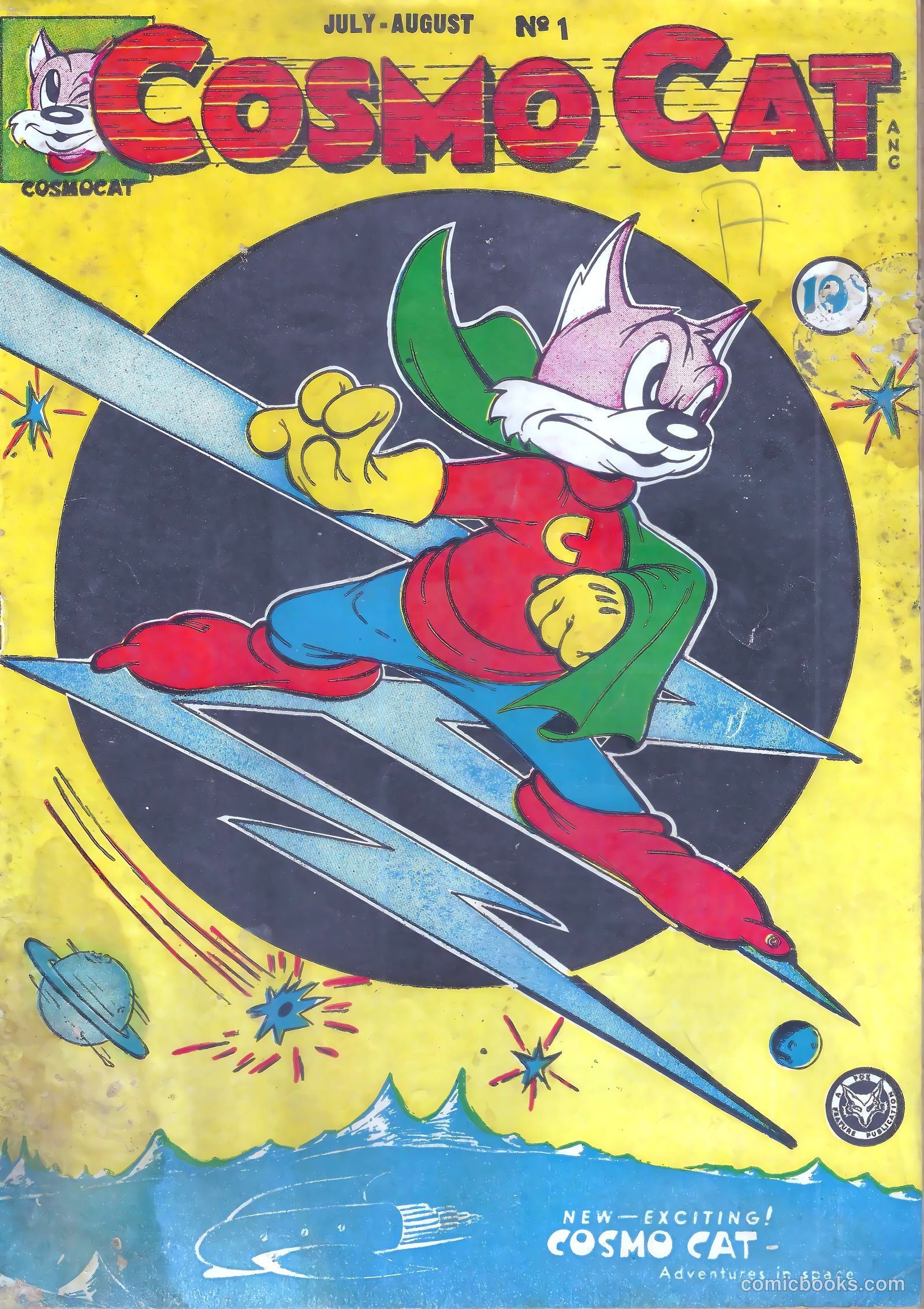
Cosmo Cat #1
☆ Be the first to review + Add to your collection — Join freeCosmo Cat #1 (Fox Feature Syndicate, July–August 1946) launches the solo ongoing series for one of the Golden Age's most distinctive funny-animal superheroes — a character who fused the nascent superhero template directly onto anthropomorphic-animal comedy at a moment when both genres were competing for newsstand space. The series is a clear example of Fox Feature Syndicate's post-war strategy of chasing dual trends simultaneously, packaging atomic-age origin mythology (a defense-plant cat accidentally detonates a uranium bomb and gains superpowers) inside a format aimed squarely at younger readers. As the first dedicated vehicle for a character who had already debuted in All Top Comics #1 that same spring, this issue formally established Cosmo as a franchise centerpiece with his own title, his own recurring rogues, and a moon-based headquarters — narrative infrastructure that gave the series a consistent sci-fi identity unusual for funny-animal books of the period. The title ran for ten issues through late 1947, making it one of the more sustained funny-animal superhero experiments of the Golden Age before the superhero craze receded.
Cosmo Cat #1 (1946) introduces young Dick, a boy with the rare gift of speaking to animals, in a quiet, heartfelt tale that blends wonder and survival. When he rescues a deer from a hunter, a year and a half later, the deer’s fawn returns the favor by guiding Dick home when he’s lost in the woods. The story’s gentle magic is brought to life by Ellis Chambers’ expressive cover art, capturing the bond between boy and beast.
ComicBooks.com Value
Show all 16 grades ▾
Find on ebay
Read it digitally
Sell my copy
Have this issue — or a whole collection? Get a fair offer from us, skip the marketplace fees and the hassle.
We Buy Collections ▸History
Cosmo Cat first appeared in All Top Comics #1 (spring 1946), a Fox Feature Syndicate anthology, where he quickly became the lead feature across all seven humor-format issues of that series. Fox's publisher Victor Fox — who had built his operation on opportunistic genre imitation since the late 1930s — greenlit a dedicated Cosmo Cat title by mid-1946, with the first issue on sale in July–August of that year per the Catalog of Copyright Entries. Art credits across the run include Ellis Chambers, Pat Parrish, E. O. Alexander, Howie Post, and Pat Adams, reflecting the rotating studio freelancer model typical of Fox's in-house production. The character also appeared concurrently in Fox's Wotalife Comics anthology, suggesting the publisher had genuine commercial ambitions for him before the superhero market contraction of 1947–1948 ended all three of his series simultaneously.
Trivia · 10 facts
- Published by Fox Feature Syndicate Inc., on sale July–August 1946 per the Catalog of Copyright Entries, 1946–1947 Periodicals.
- Cosmo Cat's first-ever appearance predates this issue: he debuted in All Top Comics #1 (spring 1946), making Cosmo Cat #1 his solo-title launch, not his absolute first appearance.
- The character's origin — an ordinary cat working at a munitions factory trips and detonates a Uranium-235 bomb, gaining superpowers — reflects the immediate postwar atomic-age anxieties permeating 1946 popular culture.
- Cosmo's power set is a deliberate Superman analogue: flight, super-strength, and immunity to bullets and radiation; he operates from a lunar laboratory and patrols space in a personal rocket equipped with a Crime Detector.
- Issue #1 features multiple stories including Cosmo pursuing thief 'Dirty Dog' (who escalates from drowning attempts to cannons and a depth bomb), a butterfly-collecting adventure, and supporting strips including Roscoe Bear — a wordless comedic strip.
- Art in the issue is credited to Ellis Chambers, Pat Parrish, and E. O. Alexander across its various features.
- The series ran for 10 issues (July 1946 – October 1947); Cosmo also ran concurrently in Wotalife Comics and had crossed over with Fox's Ribticklers anthology.
- Later Cosmo Cat stories were recycled without authorization by Star Publications (as 'Super Cat' in Frisky Animals, 1953) and Green Publishing (Animal Crackers, 1956), with the logo on Cosmo's chest crudely altered — confirming the material's public-domain trajectory and its recognizable visual template.
- Norlen Magazines released two comics in 1959 reusing original Fox cover art under the Cosmo Cat name, but neither issue contained any actual Cosmo Cat stories.
- The entire Cosmo Cat series has since fallen into the public domain and is available via Comic Book Plus and in a print-on-demand reprint collection (Cosmo Cat: The All Top Comics Files).
Full credits
Reprints
Reprinted in Cosmo Cat Comics #6
Reviews
Reader reviews
No reader reviews yet.