
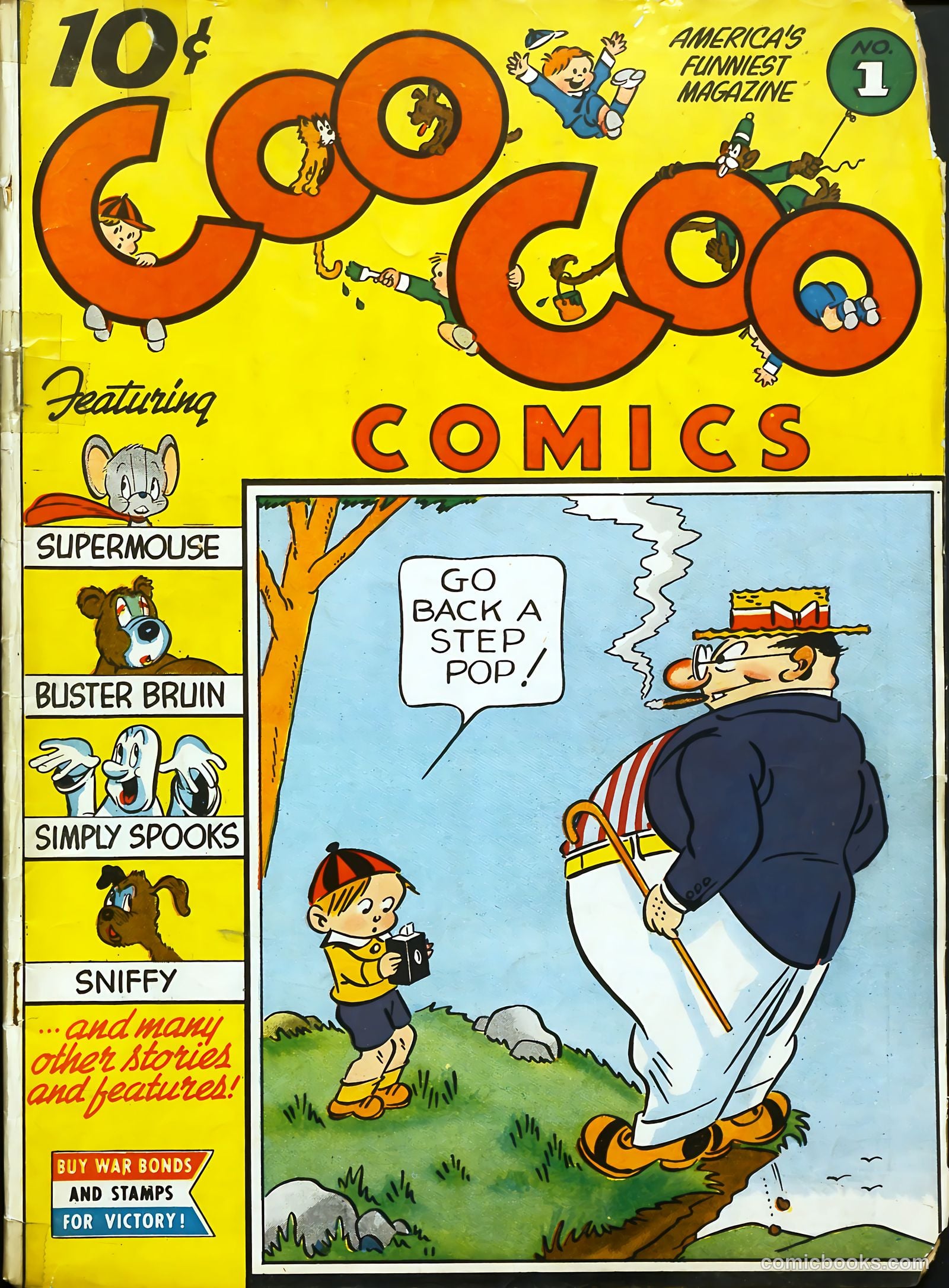
Coo Coo Comics #1
☆ Be the first to review + Add to your collection — Join freeCoo Coo Comics #1 — in its original 1942 American incarnation from Nedor/Better Publications — holds a genuine place in Golden Age history as the debut vehicle for Supermouse, the earliest funny-animal superhero published in comic book form. The H. John Edwards edition represents the title's reach into the Australian market, where wartime import restrictions and postwar tariffs had created a thriving local reprint industry; Edwards carried Standard/Nedor material to readers who had little or no access to the American originals. As one of the Sydney-based reprints of a proven American property, this edition is a modest but real data point in the story of how mid-century US comic culture propagated into the Pacific, reaching a generation of Australian children through domestically printed editions.
An anthology featuring multiple comic strips: "Supermouse" confronts a giant cat trying to kidnap a child; a story about a man with a dog of blue-blood pedigree who must hide it from his wife who hates dogs; and "Simply Spooks," in which a child ghost repeatedly insists it is not a ghost while being chased through various rooms by the skeptical child character, ultimately causing confusion about whether the ghost will believe in itself.
ComicBooks.com Value
Find on ebay
Read it digitally
Sell my copy
Have this issue — or a whole collection? Get a fair offer from us, skip the marketplace fees and the hassle.
We Buy Collections ▸History
H. John Edwards, born in Victoria in 1913, entered comics publishing through a partnership with Peter Huston (1944–1947) before establishing his own Sydney-based company, H. John Edwards Co. Pty. Ltd. His line was built on licensed reprints of American material — principally from Standard/Nedor, Fiction House, and MLJ/Archie — alongside a smaller body of original Australian content. The Coo Coo the Bird-Brain reprint series he issued carried copyright credits to Animated Cartoons Inc. of New York, confirming proper licensing. Edwards operated in a publishing environment shaped by Australian tariffs on American magazines that ran from 1939 to 1959, which made locally printed reprints commercially viable and culturally significant for that period.
Trivia · 8 facts
- The title 'Coo Coo Comics' originated with Nedor/Better Publications in the United States, with issue #1 cover-dated October 1942 (on-sale date recorded as July 31, 1942 in copyright records).
- Coo Coo Comics #1 (1942) featured the first comic book appearance of Supermouse — a super-powered mouse who gained his abilities by eating 'super cheese' — scripted by Richard E. Hughes with art by Milton (Milt) Stein, under editor/publisher Ned Pines.
- Supermouse's debut preceded or coincided with the Terrytoons animated 'Super Mouse' theatrical short (The Mouse of Tomorrow, October 1942); Nedor's prior copyright of the name reportedly caused Terrytoons to rename their character 'Mighty Mouse' in 1944.
- H. John Edwards, a Sydney-based Australian publisher active from 1944 into the late 1950s, reprinted Nedor/Standard material — including the Coo Coo / Coo Coo the Bird-Brain series — under license from Animated Cartoons Inc. of New York.
- Edwards published his reprints under multiple corporate names, including H. John Edwards Co. Pty. Ltd., Action Comics Pty. Ltd., and Popular Publications Pty. Ltd., all operating out of Sydney.
- Australian tariffs on imported American publications (1939–1959) created commercial space for publishers like Edwards to issue domestic reprints; his line also included original Australian comics by artists such as Larry Horak, John Dixon, and Jeff Wilkinson.
- The Frazetta connection: in the original American run, Frank Frazetta contributed interior illustrations across seventeen consecutive issues (#34–50) of Coo Coo Comics, giving the series an early career footnote for one of the medium's most celebrated artists.
- Supermouse graduated from Coo Coo Comics to his own eponymous title (Supermouse, November/December 1948), which ran through 1955–1956, underlining the character's sustained commercial appeal across the full span of the Golden Age.
Reviews
Reader reviews
No reader reviews yet.