
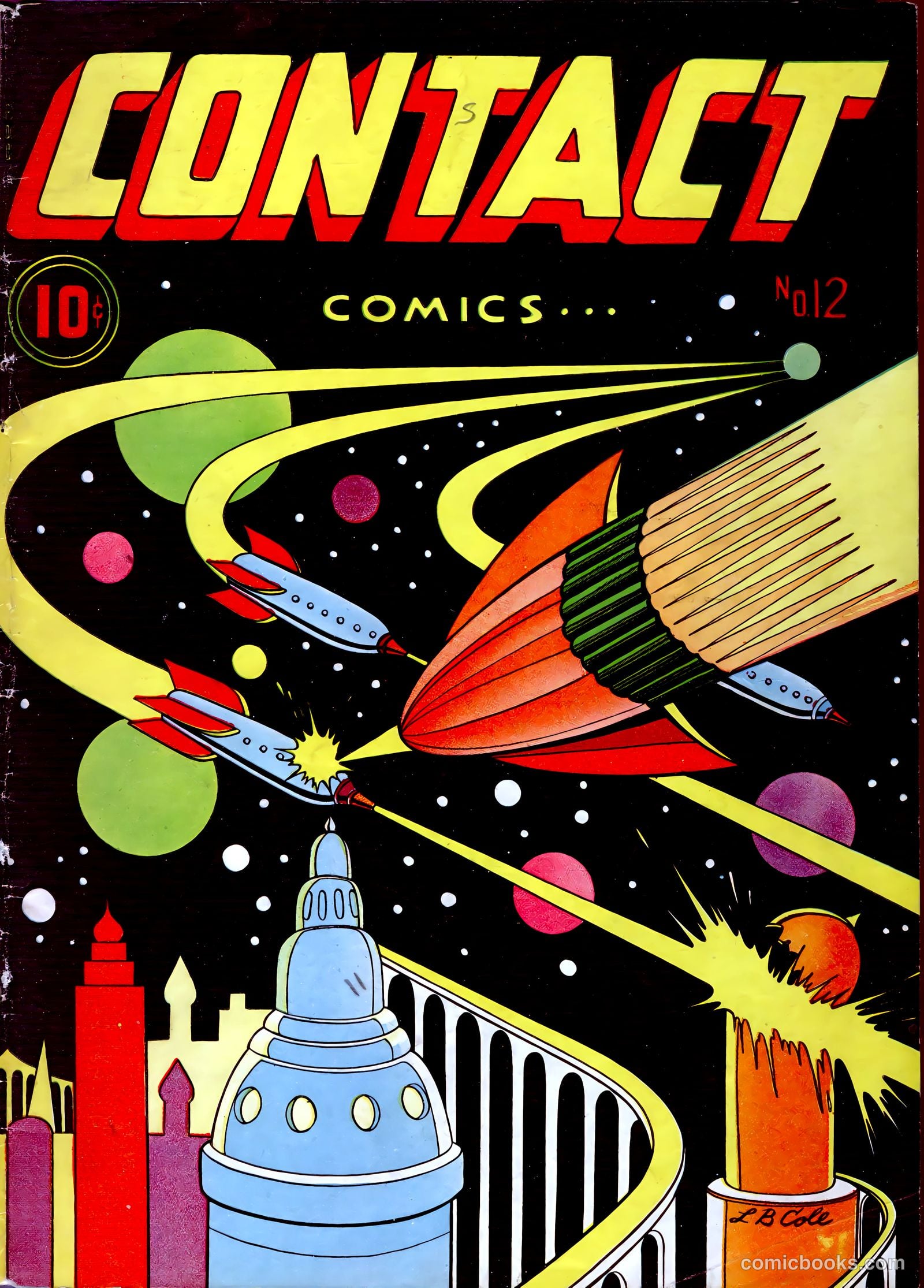
Contact Comics #12
☆ Be the first to review + Add to your collection — Join freeContact Comics #12 (July 1946) holds a special place in Golden Age history as the final issue of Aviation Press's only comics title — a fitting capstone to a run that began squarely in wartime and ended in the optimistic glow of the post-war jet age. What elevates this particular issue above its eleven predecessors is L. B. Cole's cover, which dispensed almost entirely with the contemporary-aviation mandate of the series and instead blazed rocket ships across a stark black backdrop — a deliberate, sci-fi-inflected intrusion that art historians and collectors alike now cite as one of the defining early examples of Cole's 'poster color' aesthetic. The issue also carries a notable internal tension: while Cole's cover gazes toward an imagined space age, the interior features a moon-rocket educational story speculating how a lunar mission might be achieved before 1950, placing the book at a genuine cultural crossroads between Golden Age pulp adventure and the science-fiction wave about to reshape American popular culture. As the series' final number, #12 also marks the quiet end of one of the few Golden Age titles built entirely around the theme of aviation.
Contact Comics #12 is an anthology featuring multiple stories. One story depicts scientists and engineers planning an experimental moon rocket, discussing the logistics and costs of building a spacecraft capable of reaching the moon and eventually Mars. Another story focuses on aviation instruction, demonstrating aircraft stall recovery techniques with detailed diagrams showing how pilots should manipulate control surfaces to escape a spin. A third story involves a child with a toy plane who encounters a real aircraft and becomes involved in a chase sequence at an airfield.
A sweeping chronicle of humanity's centuries-long dream of reaching the moon, from Cyrano De Bergerac's fanciful schemes through Jules Verne's predictions to Dr. Goddard's decades of desert experimentation and the rocket pioneers of 1930s Berlin—all leading to the breakthrough that atomic power might finally make lunar travel possible. Rocket expert Willy Ley walks readers through the technical challenges, failed approaches, and the ingenious design that could send an unmanned vessel on a voyage around the moon and back within the next few years. It's a stirring blend of scientific history and visionary speculation that shows how humanity's oldest fantasies might soon become reality.
When sabotage strikes the Svenlo Oil Wells in the Middle East, flying detective Ace Diamond races to investigate—only to find himself shot down by hostile aircraft before he even lands. At the refinery, Diamond discovers a deadly conspiracy: members of the management team are being systematically eliminated, and the wells themselves are set ablaze in what appears to be a final, desperate strike by unseen enemies determined to reclaim control of the oil operation.
This 1946 non-fiction account follows American airmen as they prepare to operate aircraft in conditions that would ground most flights—using newly installed instrument approach equipment at key airports across the nation. When a severe snowstorm blankets New York, an F.B.I. team arrives at the airport with an urgent, mysterious mission, and a pilot faces a perilous flight despite zero visibility. The story demonstrates how ultra-high frequency radio signals and marker beacons guide planes safely down to the runway when pilots can't see the ground.
This instructional feature walks you through the fundamentals of aircraft take-off, climb, turning, and gliding techniques as part of Contact's ongoing flight education series. The lesson breaks down each maneuver step-by-step—from throttle control and rudder work through the initial lift-off, coordinated turns, and proper glide techniques—and even includes practical guidance for building a home practice control set to rehearse the movements safely on the ground.
This 1946 educational feature breaks down the fundamental principles of flight in clear, accessible terms—exploring how air pressure, Newton's laws, and Bernoulli's theorem work together to keep an aircraft aloft. From lift and drag to thrust and weight, the story methodically explains the five forces a pilot must balance, illustrating each concept with practical examples like a swimmer's stroke and real-world testing at Langley Field's wind tunnel. Whether you're curious about what keeps a plane in the sky or just love seeing how mid-century comics tackled science, this straightforward aerodynamics lesson delivers genuine insight without the mystique.
The Air Kids get their chance to test their new jet-propelled model plane when a robbery at the airfield throws their usual hideout into chaos—and gives them an unexpected way to help catch the crook. With quick thinking and their prized invention, the kids race to turn the tables before the desperate thief makes good his escape.
ComicBooks.com Value
Show all 20 grades ▾
Find on ebay
Read it digitally
Sell my copy
Have this issue — or a whole collection? Get a fair offer from us, skip the marketplace fees and the hassle.
We Buy Collections ▸History
Contact Comics launched in July 1944 under Aviation Press, a small publisher whose entire output was this single title, with L. B. Cole serving as both editor and cover artist across all twelve issues. Cole ran his own comics packaging studio from 1942 to 1948, and Contact Comics was one of his central clients during that period; by the time issue #12 arrived in July 1946, the series had pivoted noticeably away from its wartime combat roots — the post-VJ Day market was cooling rapidly on war-themed content — and the issue's blending of aerial-adventure fiction, flight-instruction features, and proto-science-fiction reflected that broader industry shift. Interior art duties were shared among Rudy Palais, Paul Parker, and George Appel, all regulars on the title, with Cole contributing the signed cover. The series ended with this issue, a casualty of the same post-war contraction that shuttered many fighting-themed comics.
Trivia · 8 facts
- Published July 10, 1946 by Aviation Press; the twelfth and final issue in the Contact Comics run, which launched in July 1944.
- Cover art by L. B. Cole, who also served as the series' editor; the cover depicts rocket ships against a black background — a subject unrelated to the contemporary-aviation mandate of the title.
- Cole's cover for #12 is specifically cited across multiple sources (Wikipedia, Lambiek, GoCollect) as one of the defining early examples of his 'poster color' style: bold primary colors over jet-black backgrounds.
- Interior art by Rudy Palais, Paul Parker, and George Appel; stories include 'Aerial Adventure,' 'Moon Express,' 'Rendezvous With Fire,' 'Instrument Approach,' and the text story 'Ceiling Zero.'
- The 'Moon Express' feature presents a speculative, semi-educational scenario explaining how a rocket could reach the Moon before 1950 — one of the earlier such pieces in a mainstream Golden Age comic.
- The Grand Comics Database records both 'Johnny Mace and Company' and 'Ace Diamond' as making their only appearance in comics with this issue — both features debuted and ended here.
- The issue also continued a recurring flight-instruction segment ('The Take-Off'), described by the GCD as the second installment of a series teaching readers basic flight principles.
- A modern limited-reprint edition of the issue was produced by Robo Picto Comics, hand-numbered with reimagined colors, indicating ongoing collector and preservation interest in the original.
Full credits
Reprints
Reprinted in Black Light: The World of L. B. Cole #[nn] (2015)
Key issues in Contact Comics
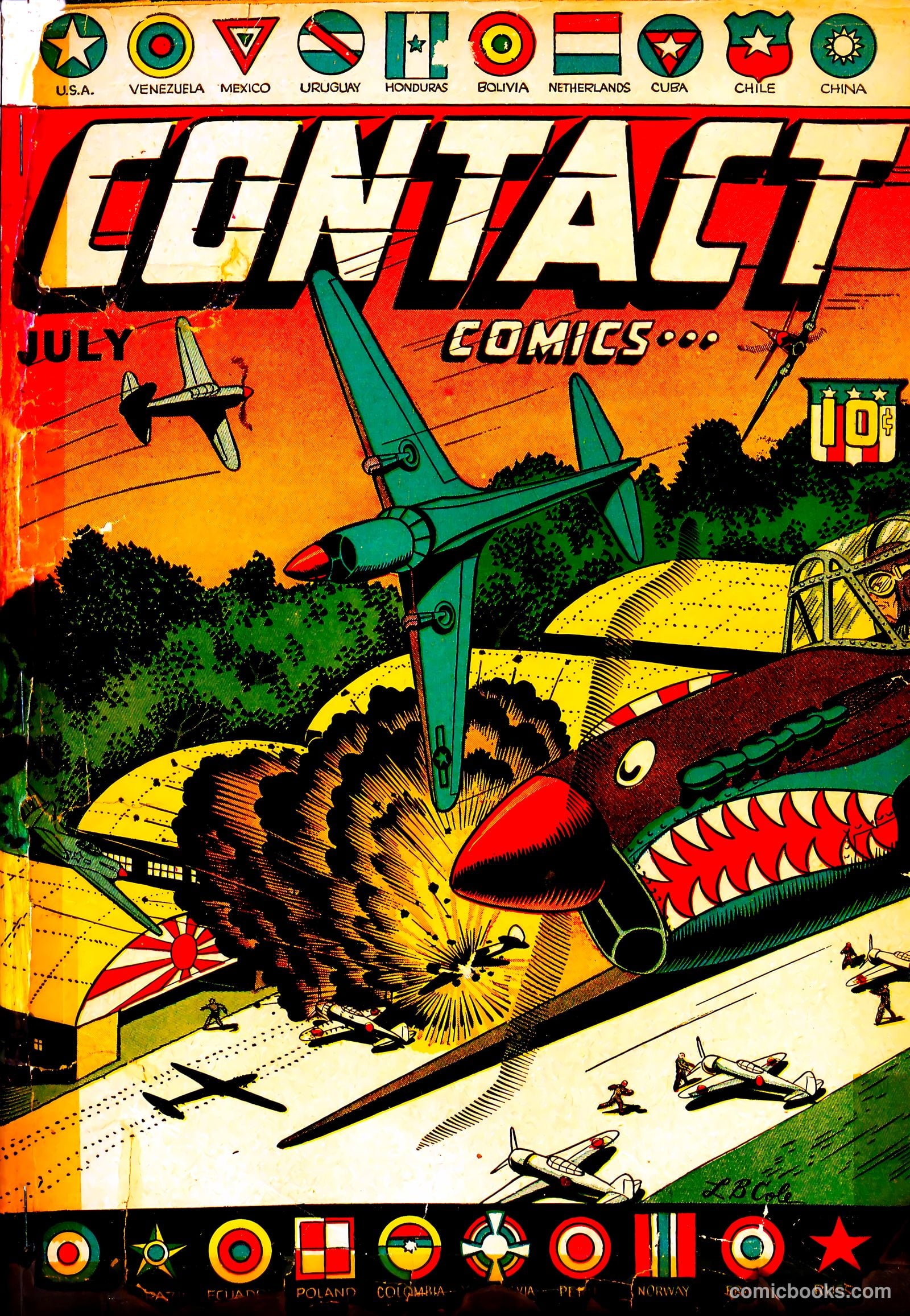
Reviews
Reader reviews
No reader reviews yet.