
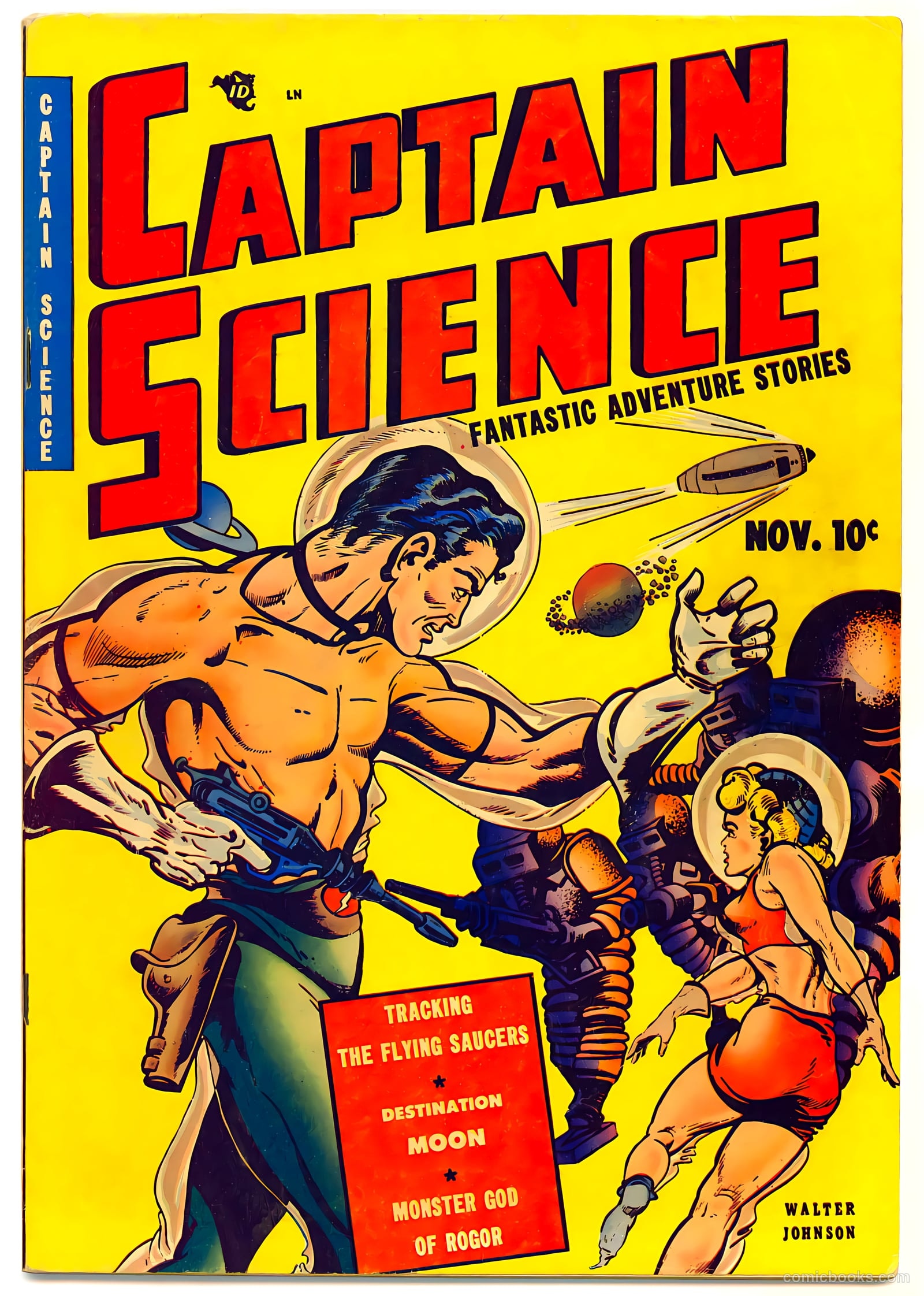
Captain Science #1
☆ Be the first to review + Add to your collection — Join freeCaptain Science #1 is the debut of one of early 1950s comics' most earnest attempts to fuse pulp science fiction with the superhero formula — arriving in November 1950 just as a full-blown sci-fi publishing boom was reshaping American newsstands. The issue introduced Gordon Dane, a physicist transformed into a costumed science-hero by an alien AI brain, an origin whose DNA — chosen earthman empowered by a dying alien and tasked with defeating a galactic evil — would resonate structurally in later superhero lore, most notably in the Silver Age Green Lantern mythos. Beyond its narrative significance, the book captures an electrifying, barely-controlled moment in the career of Wally Wood, a year before he became the defining sci-fi visual voice at EC Comics, making it a measurable benchmark in one of the medium's most consequential artistic trajectories. The series' entire seven-issue run was folded into the Youthful lineup under changing titles, underscoring how fluid and commercially experimental the early-50s sci-fi genre comics landscape truly was.
This is an anthology issue featuring three science fiction stories. "Tracking the Flying Saucers" follows Captain Science and his team as they use thought helmets and a device called the Cortexon to locate and infiltrate a fortress of evil beast-men from the planet Rak in the Himalayas, who threaten to conquer Earth. "Destination Moon" involves young explorer and archaeologist Tayne Whitney's discovery of a mysterious carved crystal from the Mindanao Deep, which a museum curator believes may be a remnant of an ancient civilization with incredible powers. "Monster God of Rogor" depicts three space travelers who encounter reptilian beings from Saturn that have established themselves on a hostile planet; the creatures declare the travelers will be examined, questioned, and psyched before being killed and displayed in a museum.
When physicist Gordon Dane and his young assistant Rip Gary witness a flying saucer crash in the New Mexico desert, they discover its pilot—an alien named Knur—who reveals a terrifying threat: the beast-men of Rak are enslaving worlds across the galaxy and could soon turn their sights on Earth. Knur entrusts Gordon with a mechanical brain that will grant him the knowledge and power to defend humanity, setting him on a mission that transforms him into Captain Science. This is the story of how one man becomes Earth's champion against an invasion from the stars.
Captain Science and his young assistant Rip, armed with a laboratory built from recovered alien technology, detect a sinister plot unfolding in a hidden Himalayan fortress—former World War II war criminals, now under the control of the Beast-Men of Rak, are preparing a devastating superweapon for global conquest. Captain Science must infiltrate the fortress alone to locate and destroy their central power source before their six-week countdown to attack reaches zero.
In "The Monster God of Rogor," archaeologist Tayne is thrust into a mysterious realm after a cut on his hand triggers an ancient crystal. Welcomed as a prophesied savior by the people of this world, he’s quickly captured and condemned to death—only to discover the idol of Rogor is powered by blood. With time running out, Tayne must use his wits and the crystal’s deadly secret to turn the tide before it’s too late.
When leading scientist Thomas Varn, his daughter Crystal, and Jrld Anders investigate a mysterious mass drifting near Saturn, their ship is pulled toward the strange planetoid Hasst—home to the reptilian Spawn of Saturn, a emotionless race exiled from their mother planet. Captured and faced with certain doom, the three must find a way to outwit their cold-blooded captors and escape the planet's grip. This 1950 sci-fi tale pits human cunning against alien science in a desperate race for survival.
ComicBooks.com Value
Show all 21 grades ▾
Find on ebay
Read it digitally
Sell my copy
Have this issue — or a whole collection? Get a fair offer from us, skip the marketplace fees and the hassle.
We Buy Collections ▸History
The series was published by Youthful Magazines Inc., a minor Golden Age outfit with reported connections to early DC Comics figures in its ownership circle, and was shepherded editorially through Adolphe Barreaux's Majestic Studios, which supplied production services across several Youthful titles. The creative team for the debut issue brought together cover artist and interior penciler Walter Johnson alongside interior artists Wally Wood and Gustav Schrotter — an anthology-style stable typical of small 1950s publishers working fast to exploit genre trends ignited by flying-saucer hysteria, atomic anxiety, and the rush of Hollywood sci-fi films. Wood's contribution to issue #1 was still noticeably raw, with critics noting his early struggles with figure drafting even as his instincts for bold light-and-shadow contrast were already evident; within a year, collaborating with Joe Orlando on later issues, that style would crystallize into something genuinely ahead of its time.
Trivia · 8 facts
- First appearance and origin of Captain Science (real name Gordon Dane), a physicist who witnesses a flying-saucer crash in New Mexico and is given a mechanical AI 'robot brain' containing an alien species' entire knowledge base, along with a young companion Rip Gary.
- Published November 1950 by Youthful Magazines Inc.; cover price 10 cents; 32 pages, full color.
- Cover and primary interior art by Walter Johnson; interior story 'The Monster God of Rogor' (featuring archaeologist Tayne Whitney) illustrated by a very early Wally Wood — one of his first published works and among the earliest examples of his distinctive inking style.
- A second interior strip, 'The Spawn of Saturn,' also contains early Wally Wood art, making the issue one of just three in the entire Captain Science run to feature his work.
- The issue includes a two-page photo-illustrated text feature tied directly to George Pal's landmark 1950 science-fiction film Destination Moon, reflecting how tightly early sci-fi comics were marketed alongside contemporary pop-culture sci-fi.
- The origin story's premise — a dying alien selecting a human champion against a conquering galactic empire (the Rak) and granting him an alien supercomputer — has been noted by critics as structurally anticipating the origin of DC's Silver Age Green Lantern (1959).
- The series ran for seven issues (1950–1951) before Youthful continued its numbering under the title Fantastic (beginning at #8, 1952), which itself later mutated into a horror title called Beware and then Chilling Tales.
- Wood's art from this issue has been collected in Wally Wood: Strange Worlds of Science Fiction (Vanguard Productions, January 2012) and reprinted in the German anthology Fremde Welten (ilovecomics, 2019), attesting to sustained scholarly and collector interest in his earliest professional pages.
Full credits
Reprints
Reprinted in Captain Science #1 (1950), Wally Wood: Strange Worlds of Science Fiction #[nn] (2012), Fremde Welten #9 (2019), Centaurus #2
Reviews
Reader reviews
No reader reviews yet.