
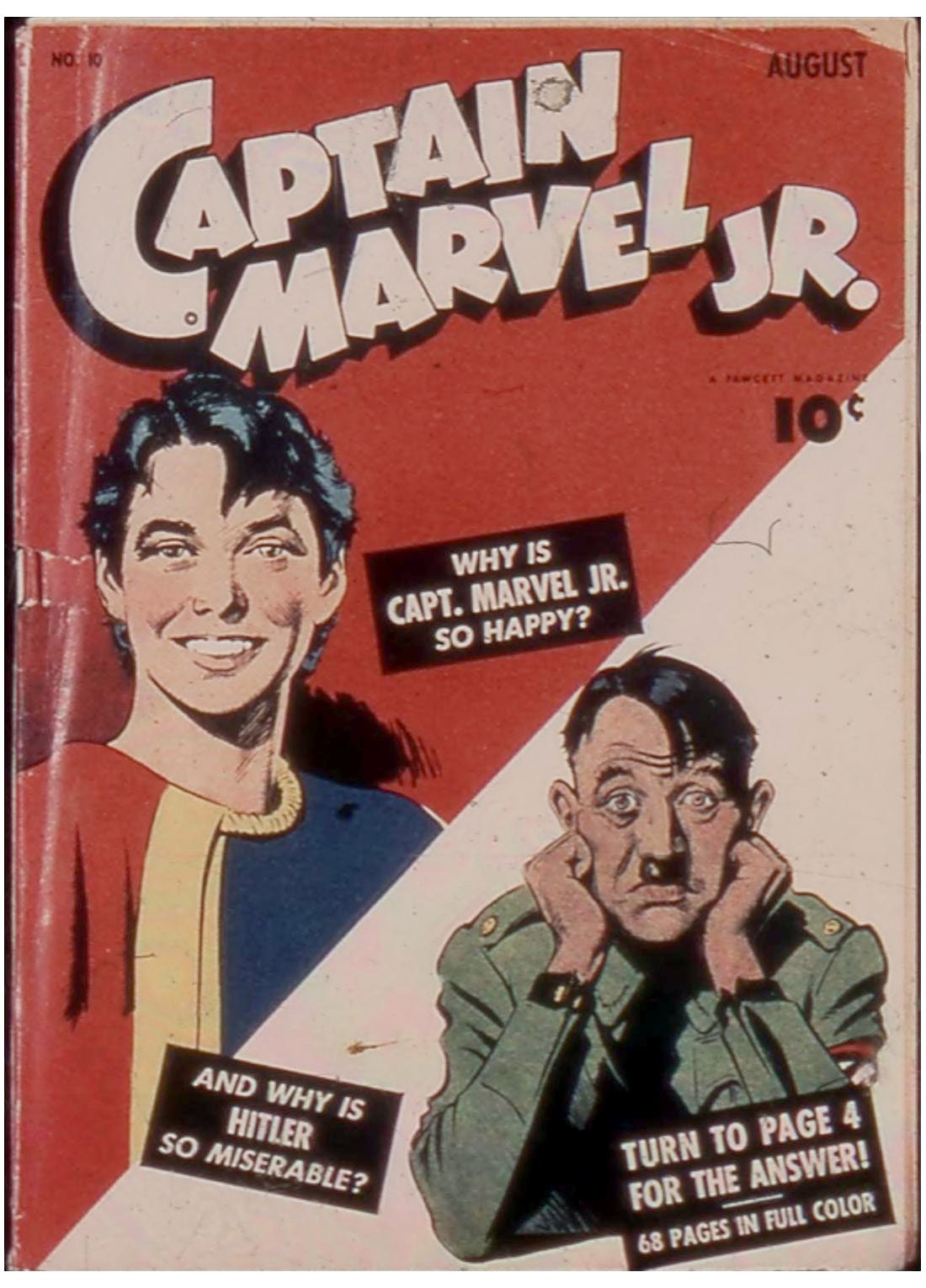
Captain Marvel Jr. #10
☆ Be the first to review + Add to your collection — Join freeCaptain Marvel Jr. #10 arrives at the creative and commercial peak of Freddy Freeman's solo title — the Grand Comics Database records 1943 as the series' single highest-circulation year, and this August-cover-date issue exemplifies the bold dual-genre storytelling Otto Binder had perfected for the book: a WWII-front adventure pitting Junior against a coalition of Hitler, Goebbels, and Göring alongside the debut of a new cosmic antagonist, the Moon Man, followed by a time-travel thriller that drops Freddy and arch-villain Sivana into the American Revolution. The issue also showcases the storytelling range that set the Captain Marvel Jr. title apart from its parent book — grittier, more politically immediate wartime scenarios woven together with the fantastical, all under Mac Raboy's cinematically detailed cover art. As a chapter in the larger Fawcett wartime comics universe, it represents the sustained creative ambition that made the series one of the defining superhero books of Golden Age America.
In "The Moon Menace," Japanese scientist Kursyu unleashes a sinister formula that turns Caucasians into loyal Japanese agents under Imperial Japan’s control. When General Otis becomes his first victim, Captain Marvel, Jr. must step in—only to face the same threat, forcing Freddy Freeman to use his powers to outwit Kursyu and steal the White Serum to reverse the transformation. Written by Otto Binder and illustrated by Mac Raboy, this 1943 Fawcett classic features dynamic art by Raboy on both interior and cover, capturing the wartime tension and heroism of the era.
In "The Yellow Curse," a sinister formula developed by Japanese scientist Kursyu threatens to transform Caucasians into loyal subjects of Imperial Japan, starting with General Otis. When Captain Marvel, Jr. steps in to stop the experiment, Freddy Freeman becomes the next target—only to use his powers to outwit Kursyu and steal the White Serum to reverse the transformation.
ComicBooks.com Value
Show all 21 grades ▾
This exact issue on ebay
More listings for this title
Read it digitally
Sell my copy
Have this issue — or a whole collection? Get a fair offer from us, skip the marketplace fees and the hassle.
We Buy Collections ▸History
By mid-1943, Fawcett's Captain Marvel Jr. solo series — which had launched in November 1942 — was being written primarily by Otto Binder, whose background in science fiction gave the book a harder dramatic edge than the whimsical Captain Marvel Adventures. Binder developed an entire working-class neighborhood and social milieu for Freddy Freeman's adventures, consciously grounding them in the economic realities of wartime America. Mac Raboy, whose earlier experience with the Works Progress Administration informed his realist draftsmanship, supplied the covers; interior art for issue #10 was handled by Raboy and Al Carreno. By early 1943, Fawcett's comic art staff had largely shifted to freelance status, meaning each issue was assembled from contributors working off-site rather than in a single bullpen.
Trivia · 8 facts
- Cover-dated August 1943, published on sale in June 1943 by Fawcett Publications; part of the Captain Marvel Jr. Volume 1 series that launched in November 1942.
- Lead story is titled 'The Moon Menace' and features the first appearance of Moon Man, a new villain who operates alongside Adolf Hitler, Josef Goebbels, and Hermann Göring as antagonists.
- A second story features a Japanese-loyalist scientist who sabotages a wartime blood drive — a direct engagement with home-front anxieties of the period.
- A third story introduces a Sivana time-travel plot: the villain hijacks a broadcast to lure Captain Marvel Jr. into a time machine that sends both characters back to 1780, where Sivana attempts to forge an alliance with Benedict Arnold; Captain Marvel makes a cameo appearance.
- Written by Otto Binder, with cover art and interior pencils/inks by Mac Raboy and Al Carreno — the regular creative team assembled around the series' launch.
- Mac Raboy's cover style for the series — a realist, almost painterly approach influenced by his WPA art training — was widely imitated by other artists on the book and on related Fawcett titles; Roy Thomas and other later historians have noted its distinctiveness compared to C.C. Beck's more cartoonish work on Captain Marvel.
- The Captain Marvel Jr. series hit its all-time circulation peak in 1943 (over 4.3 million copies, per GCD data), making issue #10 part of the book's commercial high-water mark.
- Elvis Presley is reported by comics historians, including Roy Thomas, to have modeled his signature hairstyle on Mac Raboy's depiction of Captain Marvel Jr. — a pop-culture legacy that extends far beyond comics.
Full credits
Reprints
Reprinted in Captain Marvel Jr. #6 (1947), Take That, Adolf!: The Fighting Comic Books of the Second World War #[nn] (2017)
Reviews
Reader reviews
No reader reviews yet.