
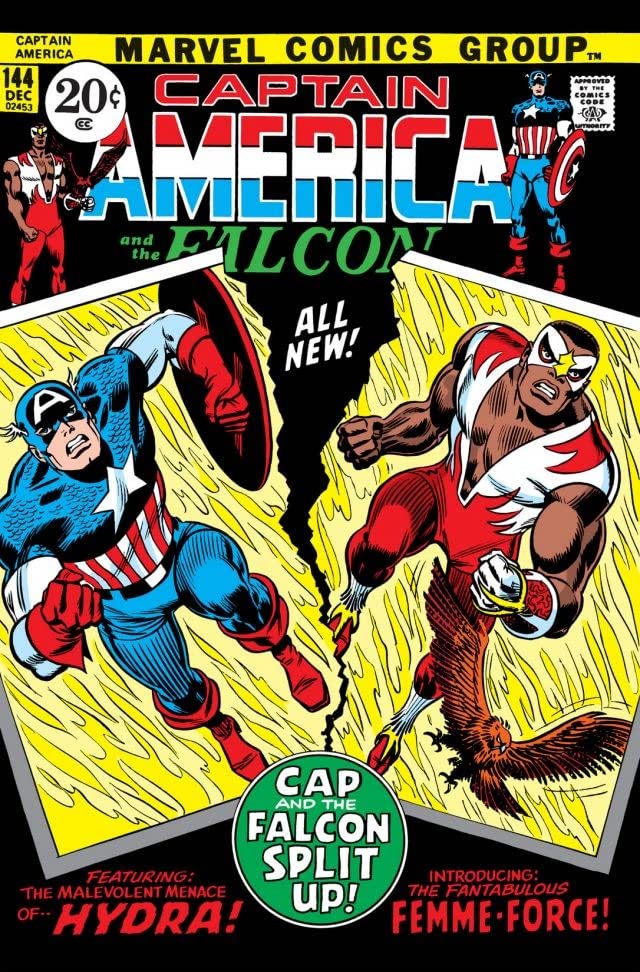
Captain America #144
☆ Be the first to review + Add to your collection — Join freeCaptain America #144 is a pivotal Bronze Age issue on multiple fronts: it marks the in-story debut of the Falcon's red-and-white costume — the look that would define the character for decades and become his most recognized visual identity — and it simultaneously introduces Femme Force, S.H.I.E.L.D.'s all-female combat unit, making both debuts feel like the book was actively reshaping its own cast. The issue also engages substantively with the social politics of 1971, using Sam Wilson's declaration of independence from Cap as a vehicle for examining what it meant for a Black superhero to operate in and for his own community rather than as an adjunct to a white hero. Both of these threads — the Falcon's visual reinvention and Marvel's earnest if uneven attempt to grapple with race and gender in a mainstream superhero title — give this issue a historical weight well beyond its individual story.
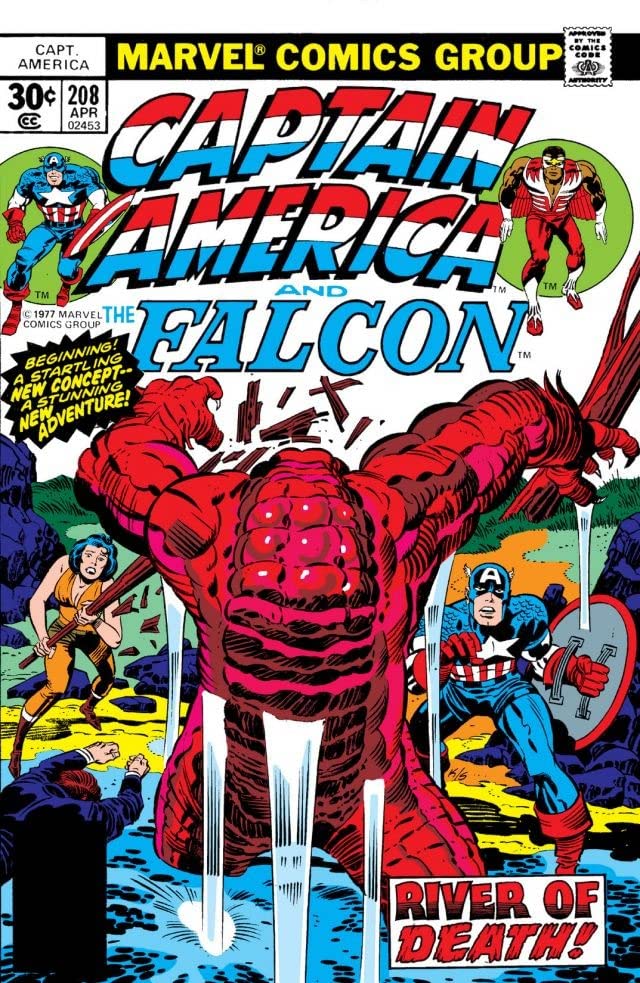
In "HYDRA Over All!", Captain America faces a turning point as Falcon officially steps away from their partnership, choosing instead to focus on becoming a hero for his community. Written by Gary Friedrich and illustrated by Gray Morrow and John Romita, this 1971 issue captures a pivotal moment in the duo’s dynamic, with the cover by John Romita showcasing the shift in their alliance.
In "The Falcon Fights Alone! Chapter Two," Jo takes a bold step forward, stepping away from Captain America’s shadow to stand as a hero on his own. With rising tensions in the streets and danger closing in, he confronts threats head-on, determined to prove his worth and serve his community without a partner.
ComicBooks.com Value
Show all 16 grades ▾
This exact issue on ebay
CGC 9 ▾ $90–$125 2 listings
Raw — VERY FINE ▾ $29.99–$30 2 listings
Raw — FN+ ▾ $24.99–$44.99 3 listings
Raw / ungraded ▾ $7.06–$35 13 listings
More listings for this title
Read it digitally
Sell my copy
Have this issue — or a whole collection? Get a fair offer from us, skip the marketplace fees and the hassle.
We Buy Collections ▸History
By the time issue #144 went on sale in September 1971 (cover-dated December 1971), the Captain America creative team had recently turned over almost entirely: Stan Lee had stepped back from scripting the title around issue #142, handing the writing chores to Gary Friedrich, while Gene Colan's lengthy run as artist had already given way to John Romita Sr. with issue #140. Friedrich wrote both stories in the issue, with Romita handling the lead 'Hydra Over All!' chapter and Gray Morrow penciling and inking the backup 'Falcon Fights Alone! Chapter Two,' with Romita providing alterations throughout and drawing the final panel himself. Collector-historian analysis (per researcher Nick Caputo, cited in the Grand Comics Database) suggests the issue may have originally been planned at an expanded page count similar to the previous issue's 48-page format, a production circumstance that likely explains why it ends abruptly and has no letters page. John Romita Sr. separately produced the costume design artwork for the new Falcon look, which became the character's definitive Bronze Age silhouette.
Trivia · 8 facts
- First appearance of Femme Force, S.H.I.E.L.D.'s all-female special combat unit, led by Agent 13 (Sharon Carter) with Contessa Valentina Allegra de Fontaine as a charter member.
- First appearance of the Falcon's red-and-white costume — designed by John Romita Sr. — replacing his original green-and-brown outfit; this look remained the character's signature for years.
- The Falcon formally dissolves his partnership with Captain America in this issue, declaring his intention to defend his community without a white hero's involvement — a story beat directly engaging the racial politics of the early 1970s.
- Written by Gary Friedrich; art on the lead story ('Hydra Over All!') by John Romita Sr., with Gray Morrow penciling and inking the backup chapter ('The Falcon Fights Alone! Chapter Two') and Romita contributing alterations and the final panel.
- President Richard Nixon and Vice-President Spiro Agnew both appear as characters — Nixon promises SHIELD continued funding consideration — giving the issue an unusual degree of real-world political texture for a superhero comic.
- Released on sale September 7, 1971 with a December 1971 cover date; published under the 'Captain America and the Falcon' cover logo that had been introduced with issue #134.
- The issue has been collected in Essential Captain America Vol. 3 (2006), Marvel Masterworks: Captain America Vol. 6 (2012), and the Captain America Omnibus Vol. 2 (2016); it also received a French-language reprint in Captain America (Arédit-Artima, 1979 series) #8.
- The Contessa Valentina Allegra de Fontaine, though she had debuted in Strange Tales #159 (1967), makes her first appearance in the Captain America title here as a Femme Force member — a role that later became integral to her long-running comics history and to her MCU adaptation.
Full credits
Reprints
Reprinted in O Homem-Aranha (Edição especial em cores) #5 (1974), Captain America #8 (1980), Essential Captain America #3 (2006), Captain America and Falcon #1 (2011), Marvel Masterworks: Captain America #6 (2012), Captain America Omnibus #2 (2016), Captain America Omnibus #2 (2016), Captain America Epic Collection #4 (2018), Biblioteca Marvel: Capitán América #9, Capitan America #56
Key issues in Captain America
Reviews
Reader reviews
No reader reviews yet.