
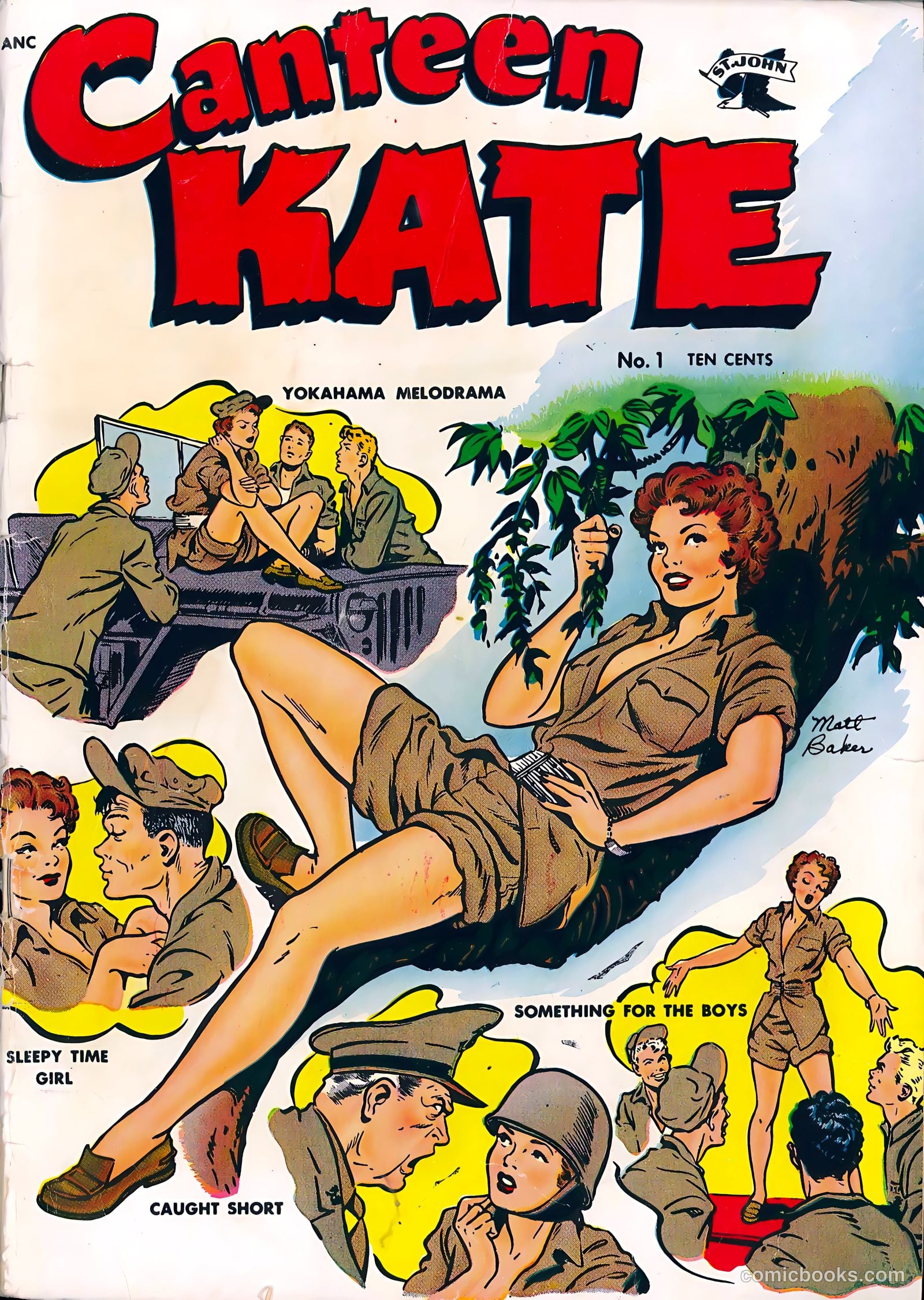
Canteen Kate #1
☆ Be the first to review + Add to your collection — Join freeCanteen Kate #1 is the solo debut issue of one of the earliest recurring female comedy leads in American war comics — a genre almost entirely dominated by male protagonists during the Korean War era. The character's screwball, romance-inflected take on military life offered a deliberate counterpoint to the jingoistic tone of most contemporary war titles, demonstrating that humor and a female perspective could sustain a standalone series. The issue also stands as a showcase for Matt Baker, one of the first known African-American artists to achieve mainstream success in the comic-book industry, whose draftsmanship gave the series a warmth and visual wit that distinguished it from every other war book on the newsstand. That the entire run was collected and studied decades later — and nominated for an Eisner Award — confirms the issue's lasting place in Golden Age historiography.
Canteen Kate, a shapely military entertainer, becomes entangled in various comedic escapades during wartime. In "Yokahama Melodrama," Kate attempts to help soldiers escape by hiding a bugle in a barracks bag and later devises a plan to follow two men with knowledge of a new tank. In another story, "Calamity Cake," Kate accidentally ruins Major Herringbone's birthday cake and must bake a replacement before the mess sergeant discovers the substitution. The issue consists of lighthearted, soldier-focused humor featuring Kate's resourcefulness and charm in military settings.
Canteen Kate is determined to crash a military flight to Yokohama after her Marine buddy Al gets a two-day leave, and she'll use every trick in the book—stowing away in trucks, borrowing uniforms, and bluffing past sentries—to sneak aboard the transport. What she doesn't realize is that this particular plane isn't headed for a casual shore leave, and her resourcefulness lands her in a situation far more chaotic than a simple romantic reunion. A hilarious romp through military mishaps and one woman's refusal to be left behind.
When Al complains that the early-morning bugler is keeping him exhausted, Canteen Kate hatches a scheme to hide the bugle so he can finally sleep—but her plan spirals into chaos when the instrument ends up in Major Herringbone's jeep and a telltale t-shirt threatens to expose the whole caper. This 1952 humor story follows Kate and Al as they scramble to retrieve the bugle before the Major discovers who's behind the mischief, only to discover that the "solution" comes with an ironic twist.
When Canteen Kate and her pal Al stumble onto a secret military installation during a peacetime picnic, they accidentally intercept stolen blueprints for a new tank—but what starts as a wild chase to recover the plans turns into a madcap scramble that neither the spies nor the Marines quite see coming. This 1952 humor romp is a fast-paced tangle of mistaken identities, physical comedy, and plenty of Kate's characteristic chaos as she barrels through a restaurant stakeout, a high-speed pursuit, and a climactic arrival at the base.
Private Able joins a patrol stuck behind enemy lines with all the latest military hardware—but no way to reach the fortified enemy position ahead. When the Sergeant challenges him to find a solution, Able dusts off an ancient warfare tactic and some creative improvisation to turn the tide. This 1952 humor tale proves that sometimes the oldest tricks in the book beat even the newest gadgets.
When a young woman picks up the mail at a military base, she becomes instant catnip—surrounded by eager servicemen in a frenzy of attention. What starts as a quick errand turns into a chaotic popularity contest that leaves her rethinking what "popular" actually means.
When Canteen Kate accidentally destroys Major Herringbone's birthday cake, she attempts a quick fix by baking a replacement—but a mix-up with similar-looking cans turns her rescue mission into a comedic catastrophe. With the Major's party looming and chaos mounting at every turn, Kate and Al race against time to prevent disaster from literally exploding in their faces.
ComicBooks.com Value
Show all 18 grades ▾
Find on ebay
Read it digitally
Sell my copy
Have this issue — or a whole collection? Get a fair offer from us, skip the marketplace fees and the hassle.
We Buy Collections ▸History
Canteen Kate debuted as a back-up feature in St. John's war anthology Fightin' Marines #2 (October 1951), drawn entirely by Matt Baker, who handled both the cover and interior art for every installment she ever appeared in. Her popularity through Fightin' Marines issues #2–9 and #14–15 was sufficient for St. John to give her a three-issue solo title beginning in June 1952 — a notably rare promotion for any character, let alone a comedic female one, during the Korean War period. Baker — trained at Cooper Union and a veteran of the Jerry Iger Studio — brought the same 'good girl' draftsmanship he had honed on Phantom Lady to a lighter, more broadly comic register for the character. The series ran only three issues (June–November 1952) before folding, though Kate continued to appear in Anchors Andrews #1 (1953) before her adventures concluded.
Trivia · 8 facts
- Canteen Kate #1 was published by St. John Publishing Company in June 1952, cover-dated and priced at ten cents; it ran for 36 full-color pages.
- The character Canteen Kate (full name Kate Revere) first appeared in Fightin' Marines #2 (October 1951) as a comedic back-up feature — Canteen Kate #1 is her solo title debut, not her first-ever appearance.
- All cover and interior art across the entire Canteen Kate solo run was produced by Matt Baker, who also drew every one of the character's 22 published stories across all her appearances.
- Matt Baker (Clarence Matthew Baker, 1921–1959) was one of the first known African-American artists to achieve success in the mainstream comic-book industry and was posthumously inducted into the Will Eisner Comic Book Hall of Fame in 2009.
- The series' three recurring principals are Kate Revere (the canteen worker and schemer), Private Al Smith (her enlisted boyfriend and comedic foil), and Major Herringbone (the perpetually irate authority figure).
- The tone of the stories deliberately blended romance, slapstick, and light crime-solving rather than combat — an uncommon approach described by Picture This Press as 'morale-boosting screwball fun' versus the jingoistic war comics typical of the period.
- Kate's appearances span Fightin' Marines #2–9 and #14–15, Canteen Kate #1–3, Anchors Andrews #1, and Approved Comics #11, making this solo series the centerpiece of her total publication history.
- The complete Canteen Kate stories — all 22 installments — were collected in 'The Lost Art of Matt Baker Volume 1: The Complete Canteen Kate' (Picture This Press, 2013), restored and enlarged 20% over original size; a separate Matt Baker's Canteen Kate hardcover collection was nominated for a 2014 Eisner Award.
Full credits
Reprints
Reprinted in The Lost Art of Matt Baker #1 (2013)
Reviews
Reader reviews
No reader reviews yet.