
Boy Comics #10
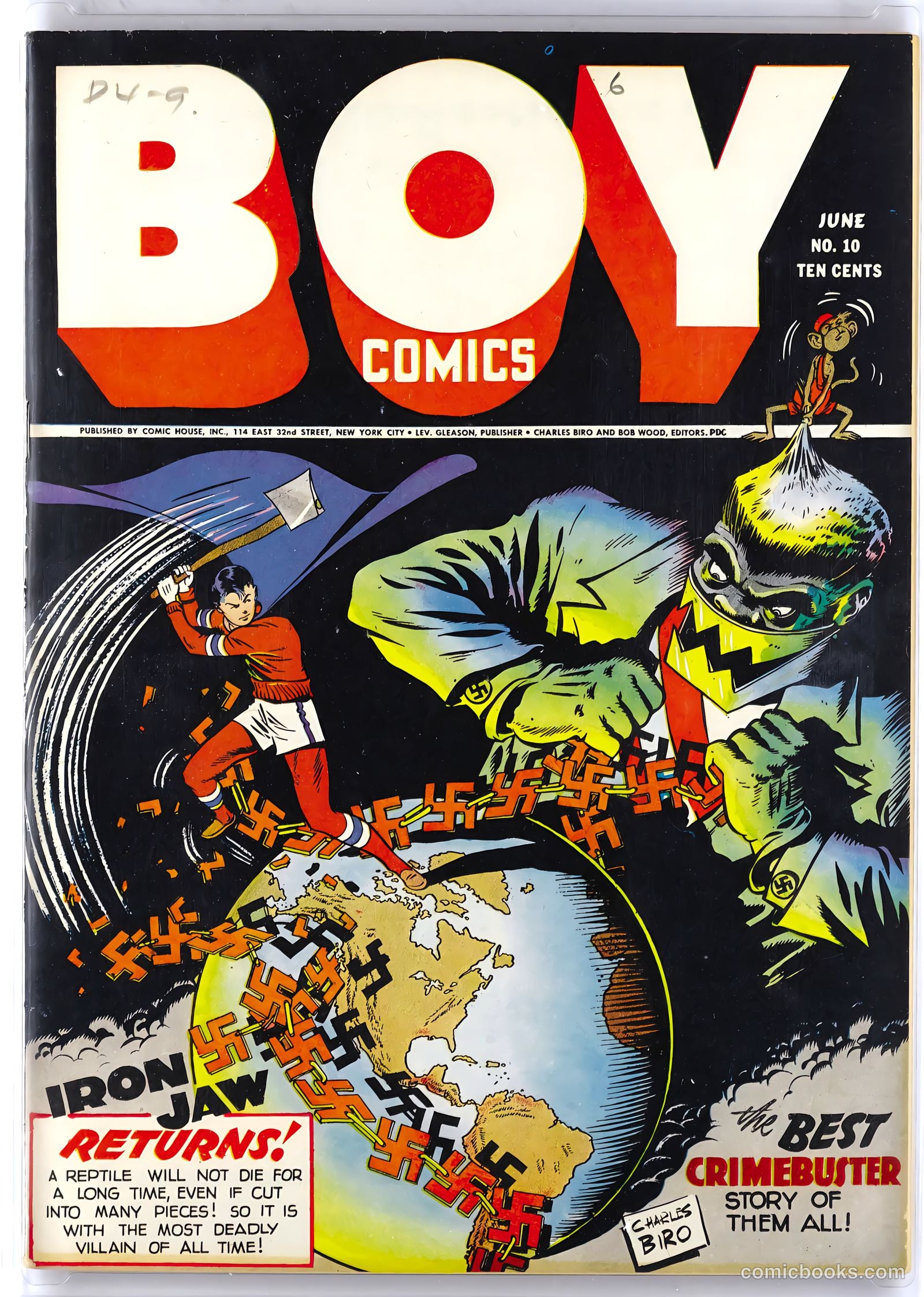
☆ Be the first to review + Add to your collection — Join freeBoy Comics #10 (June 1943, Comic House Inc./Lev Gleason Publications) is a notable wartime Golden Age anthology showcasing Charles Biro's storytelling at full tilt, with its lead story — 'Iron Jaw Returns' — demonstrating one of the earliest sustained villain comeback arcs in American comics: Iron Jaw, Crimebuster's metallic-jawed Nazi nemesis, was killed in a prior issue only to be resurrected here, establishing a narrative template for the serial supervillain that would echo across the medium for decades. The title was part of Lev Gleason's influential stable at a moment when Biro was redefining how action-adventure comics could handle emotionally grounded, morally driven boy heroes. Crimebuster himself — described in The World Encyclopedia of Comics as 'arguably the best-handled boy's adventure feature ever to appear in comics' — was already building the continuous multi-issue storyline momentum that set Boy Comics apart from most of its contemporaries.
Boy Comics #10 is an anthology featuring multiple stories. "Iron Jaw Returns!" depicts the villain Iron Jaw threatening global conquest with Nazi swastika symbols covering Earth, as a young hero in red and white attempts to stop him. "Swoop Storm" follows Swoop and Winkie as they encounter a Nazi plot involving a character called "Baby Face" Adolph at a military airfield in North Africa. "Case #1009" tells of Earl "Speedy" Feehan, the fastest driver in Little Neck, whose reckless driving nearly costs him his life until his uncle Sam intervenes. The final visible story features a confrontation between a young hero in orange and blue and Nazi soldiers, culminating in the death of a character named Pierre Durand, a French resistance fighter whose sacrifice is presented as a symbol of French resistance against Nazi occupation.
ComicBooks.com Value
Show all 22 grades ▾
Find on ebay
Read it digitally
Sell my copy
Have this issue — or a whole collection? Get a fair offer from us, skip the marketplace fees and the hassle.
We Buy Collections ▸History
Boy Comics launched in April 1942 under publisher Leverett Gleason, with Charles Biro and Bob Wood serving as editors and primary creative forces; Biro handled covers, scripts, and editorial direction while a rotating bullpen including Dick Briefer, Norman Maurer, Dick Wood, and others supplied interior stories. By issue #10, the series was published under the 'Comic House Inc.' publisher brand — one of several imprint names Lev Gleason cycled through during 1943–1944 — and appeared on a bi-monthly schedule. The cover for #10, like virtually every issue of the run, was produced by Biro, whose sensationalist, eye-catching cover style was considered a major driver of the series' newsstand appeal.
Trivia · 8 facts
- Published June 1943 by Comic House Inc. (a publisher brand of Lev Gleason Publications); the series ran bi-monthly.
- Lead story is titled 'Iron Jaw Returns,' in which Crimebuster's arch-nemesis — a Nazi villain with a metallic prosthetic lower jaw — comes back after apparently being killed in an earlier issue, making this one of the earliest documented villain-resurrection arcs in superhero comics.
- Crimebuster (Chuck Chandler) was created by Charles Biro and Bob Wood and first appeared in Boy Comics #3 (April 1942); by issue #10 he was already an established lead character with an ongoing continuity.
- Crimebuster is depicted wearing a hockey uniform and cape, accompanied by his performing monkey sidekick Squeeks — a deliberately non-powered hero whose stories centered on personal loss, wit, and physical grit rather than superpowers.
- Issue #10 is a multi-feature anthology also containing stories starring Swoop Storm (whose subplot involves a Nazi spy called 'Baby Face Adolph' / Ginger Doll), Yankee Longago, Little Dynamite, Daredevil, Young Robinhood, and the Squeeks one-pager.
- Cover art and editing credited to Charles Biro; interior art credits include Dick Briefer, Dick Wood, Bob Wood, Norman Maurer, Sam Burlockoff, Alan Mandel, Virginia Bloch, and Frank Volp.
- Boy Comics ran 119 total issues (including two predecessor issues as Captain Battle Jr.) from 1942 to March 1956 — one of the longest-running Golden Age anthology titles not published by the major superhero houses.
- The series was published under multiple Lev Gleason imprint names over its run, including Comic House Inc. and Magazine House Inc., reflecting the company's shifting corporate structures during the early 1940s.
Reviews
Reader reviews
No reader reviews yet.