
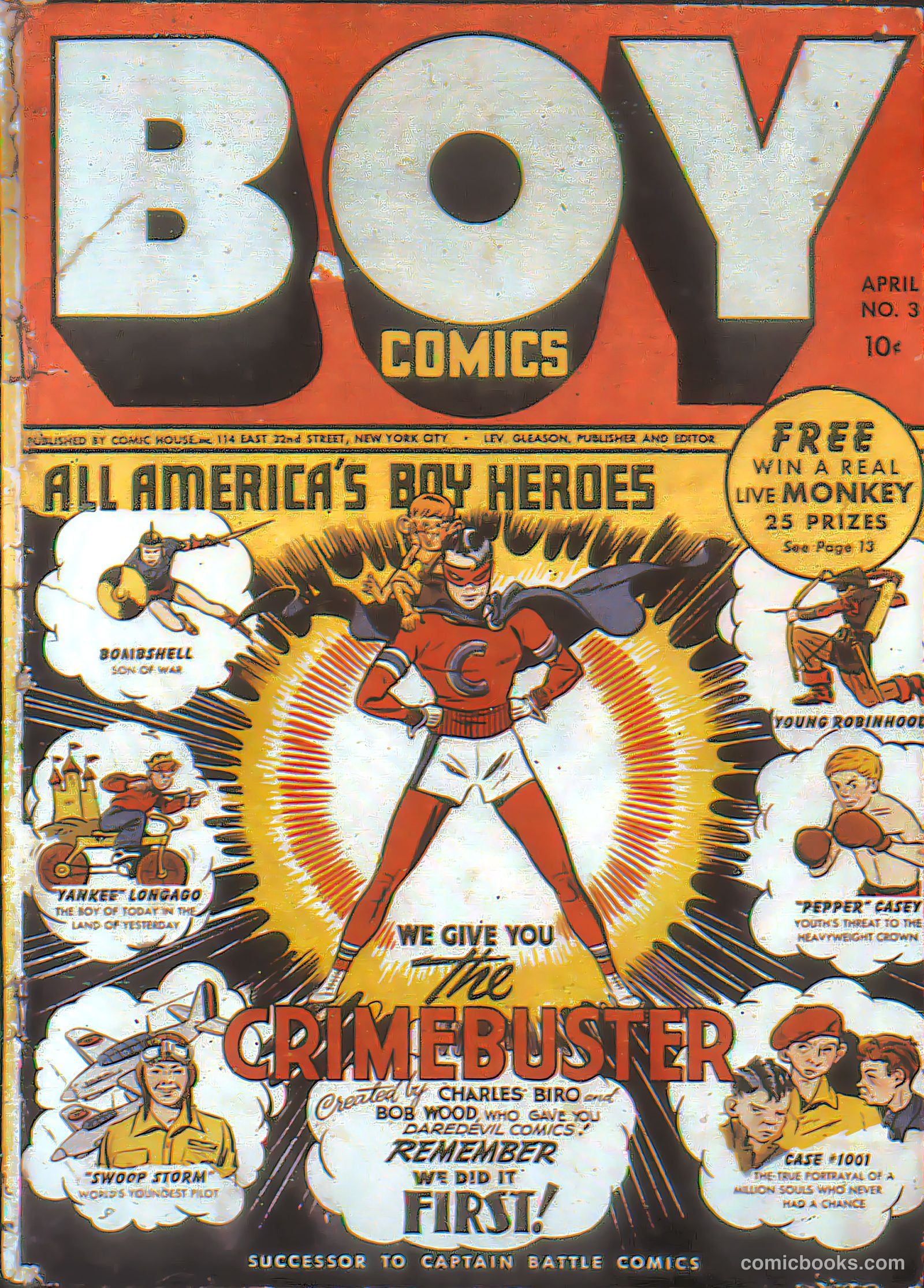
Boy Comics #3
☆ Be the first to review + Add to your collection — Join freeBoy Comics #3 (April 1942) is the effective launch issue of one of the Golden Age's most durable anthology titles, introducing two characters who would anchor the series for its entire fourteen-year run: Crimebuster, the non-powered teenage hero Chuck Chandler, and his arch-nemesis Iron Jaw, a prosthetic-jawed Nazi agent who ranks among the era's most viscerally menacing villains. Crimebuster's deliberate design — a hockey uniform and a military-school cape rather than a fantastical costume — marked a pointed departure from the omnipotent supermen then crowding newsstands, giving Golden Age readers a relatable, grief-driven protagonist whose motivation was moral rather than cosmic. The series that grew from this debut ran 117 issues under the Boy Comics banner (plus two earlier as Captain Battle Jr.), lasting until March 1956, outliving most of its contemporaries and adapting across the postwar shift from wartime adventure to domestic crime drama — a testament to the staying power of the characters introduced here.
An anthology featuring "The Crimebuster," created by Charles Biro and Bob Wood, as the lead story. Young Robin Hood uses his wits to escape from a hanging flag and pursue criminals across rooftops. George Longago attends a stage show where he encounters theatrical intrigue, discovers an empty theater, and becomes involved in a chase sequence involving a red station wagon and criminals fleeing across the countryside after robbing a bank. Additional features include Bombshell, Yankee Longago, Pepper Casey, Swoop Storm, and Case #1001, all presented as "All America's Boy Heroes."
ComicBooks.com Value
Show all 16 grades ▾
Find on ebay
Read it digitally
Sell my copy
Have this issue — or a whole collection? Get a fair offer from us, skip the marketplace fees and the hassle.
We Buy Collections ▸History
The title arrived at its third issue with a new identity: the series had previously run two issues as Captain Battle Jr. before being retitled Boy Comics, making issue #3 the first under that banner and the true creative starting point. Charles Biro — serving simultaneously as Lev Gleason's editorial director, head writer, and cover artist — wrote and drew the Crimebuster origin story entirely himself, while Bob Wood, his longtime collaborator and co-editor, is co-credited on the cover; sources disagree on how precisely to divide creative credit between the two. Biro incorporated deliberately autobiographical touches into Crimebuster, sharing the hero's initials, a love of hockey, and a fondness for pet monkeys — details he reinforced in reader-facing materials throughout the run. The issue was published by Lev Gleason's Comic House Inc. imprint and featured a wide supporting anthology line alongside Crimebuster, with contributions from artists including George Mandel (Young Robin Hood) and Edd Ashe (a Bombshell story).
Trivia · 8 facts
- First appearance and complete origin of Crimebuster (Chuck Chandler), a non-powered military cadet who adopts his school's hockey uniform and cape as a crime-fighting costume after Nazi agent Iron Jaw murders his father and causes his mother's death.
- First appearance of Iron Jaw (Sergeant von Schmidt), a Gestapo operative whose lower jaw was destroyed and replaced with a steel prosthetic; he serves as Crimebuster's central antagonist through Boy Comics #15, where he is killed, though he later returns.
- First appearance of Squeeks, Crimebuster's performing-monkey sidekick — the issue also ran a reader contest to name the monkey, with the winner to be awarded a live monkey.
- First appearance of the superhero Bombshell and the debut of the Young Robin Hood feature, both of which became recurring anthology strips in the title.
- Issue #3 is the first issue published under the Boy Comics title; the preceding two issues (Captain Battle Jr. #1–2) were rebranded, making this the effective launch of the 117-issue Boy Comics series (1942–1956).
- Scripted, pencilled, and inked by Charles Biro for the lead Crimebuster story, with Biro also designing the logo; the cover is co-credited to Bob Wood.
- The Crimebuster origin was reprinted — in a redrawn form closely matching the original — in Boy Comics #30 (October 1946), demonstrating early editorial awareness of the character's foundational importance.
- Crimebuster's cultural reach extends beyond comics: pop artist Mel Ramos used the character as the basis for a 1962 painting (titled 'CrimeBusters'), which Rage Against the Machine adapted — with the 'C' changed to a lowercase 'e' — for the cover of their 1996 album Evil Empire.
Reviews
Reader reviews
No reader reviews yet.