
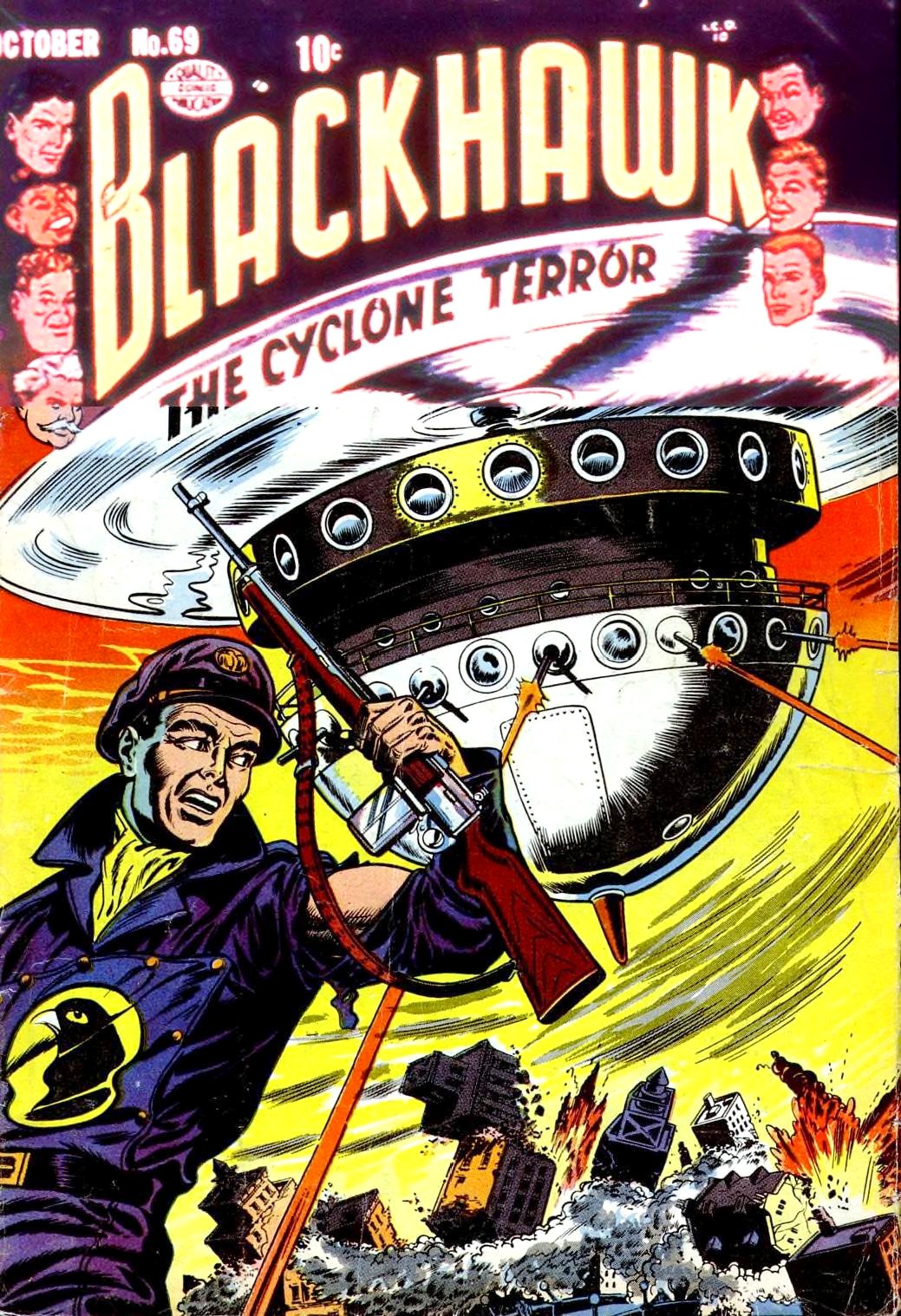
Blackhawk #69
☆ Be the first to review + Add to your collection — Join freeBlackhawk #69 (October 1953) sits at a genuine inflection point in the series' long history: it is among the first issues published without Reed Crandall, whose near-decade-long run had, in Jim Steranko's assessment, turned the title into 'a work of major importance and lasting value.' With Crandall gone to EC Comics following a falling-out with Quality's owner Busy Arnold, the issue marks the post-Crandall creative transition at a moment when the entire aviation-adventure genre was struggling to find a post-World War II identity. Narratively, the issue captures the series deep in its Cold War pivot — replacing Axis villains with Communist-bloc threats — a storytelling shift that reflects the anxieties of 1953 America as starkly as the earlier wartime issues had reflected those of 1942. As part of Quality's uninterrupted flagship title (the only Quality property to survive the publisher's eventual 1956 collapse without missing a single issue), every issue of this run carries the weight of that remarkable continuity.
In "The Cyclone From Hell!", the Blackhawks defend Costonya’s uranium mines from the Iron Men, whose sabotage forces a daring pursuit to an abandoned prison. There, they face off against the robot king Vorga and the mysterious Robot X-12, only to uncover the true villain—a towering circus freak behind the mechanical menace. Penciled by Dick Dillin and inked by Chuck Cuidera, this 1953 adventure blends Cold War intrigue with pulp action, while Irvin Steinberg’s cover captures the chaos of the cyclone-themed showdown.
In "The Cyclone From Hell!", Duke Pardo, exiled from the U.S. after his crimes, returns to his unnamed homeland with a deadly new weapon: the Tornado Top, designed by the enigmatic Doctor Dragos. With a fanatical plan to seize power, Pardo unleashes chaos—only to face the relentless resistance of the Blackhawks. As his empire crumbles and the skies ignite with destruction, Pardo's final stand ends in a desperate fall from a collapsing aircraft.
In "null," Chop Chop trades his usual antics for a taste of frontier life after spotting a TV ad for the Dowdy Doody Dude Ranch. His attempt to become a cowboy goes hilariously awry when he’s roped into a wild ride on the notoriously ornery horse Ornery—only to accidentally save a train from derailing by stopping it right before a crumbling track. After the chaos, Chop Chop decides the life of a cowboy isn’t quite his style and heads back home, leaving the ranch behind.
In "The King of the Iron Men!", the Blackhawks defend Costonya’s uranium mines from a mysterious force known as the Iron Men, who sabotage their jets and steal the precious ore. When the team tracks the attackers to an abandoned prison, they face off against a mechanical tyrant—Vorga, the so-called King of the Iron Men—only to discover the true mastermind behind the scheme is a massive, grotesque former circus performer.
In "The Conference of the Dictators," the Blackhawks are sent to Moscow on a high-stakes mission to uncover the secrets behind a gathering of world communist leaders. With help from a United World submarine and the Russian Underground, they infiltrate the conference only to be captured and forced to endure brutal trials with the Chameleon Machine—testing their resolve and ingenuity.
ComicBooks.com Value
Show all 15 grades ▾
Find on ebay
Read it digitally
Sell my copy
Have this issue — or a whole collection? Get a fair offer from us, skip the marketplace fees and the hassle.
We Buy Collections ▸History
The Blackhawk series had been created in 1941 by Chuck Cuidera, Bob Powell, and Will Eisner for Quality Comics, debuting in Military Comics #1 as a tale of multinational ace pilots resisting Axis tyranny. By 1942 Reed Crandall had taken over the art and shaped the visual identity of the feature for over a decade, but his final contribution appeared in Blackhawk #67 (August 1953), two issues before this one — his departure stemming from a professional dispute with Quality publisher Everett 'Busy' Arnold. With Crandall now at EC Comics, the art duties on the title shifted to artists including Bill Ward and Dick Dillin, who would carry the book through Quality's end and into the DC era. The post-Crandall creative team faced the challenge of sustaining a wartime property in a peacetime, Cold War world, leaning into Communist-threat storylines and globe-trotting espionage in place of the Axis-versus-squadron formula that had driven the title to its peak popularity.
Trivia · 8 facts
- Cover-dated October 1953; published by Quality Comics as part of the self-titled Blackhawk ongoing series.
- Lead story is titled 'The Cyclone Terror'; a second story in the issue depicts the Blackhawk squadron disrupting a convocation of Communist dictators — including named figures Mao Tse-Tung, Kim Il Sung, and Malenkov — reflecting the series' full pivot to Cold War antagonists.
- Published just two issues after Reed Crandall's final work on the title (Blackhawk #67, August 1953), making #69 part of the first wave of post-Crandall issues; Crandall's departure followed a falling-out with Quality publisher Busy Arnold.
- Crandall's successor on art duties was primarily Bill Ward, with Dick Dillin eventually becoming the most prolific penciler of the title's later Quality and early DC years.
- The Blackhawk series was Quality Comics' top-selling and longest-running property; it was the only Quality title to continue publication uninterrupted when DC acquired the line in 1956–57, picking up at issue #108 without a break in numbering.
- The Columbia Pictures 15-chapter film serial Blackhawk: Freedom's Champion (1952), starring Kirk Alyn, had debuted the year before this issue, keeping the property in the broader popular culture.
- The Blackhawk series as a whole holds the distinction of being one of only five comic book characters published continuously in their own title from the 1940s through the 1960s, alongside Superman, Batman, Wonder Woman, Captain Marvel, and The Phantom.
- The issue falls within the broader Quality era (ending with #107), after which DC Comics continued the numbering through issue #273 (November 1984) — a combined publication run of nearly four decades.
Full credits
Reprints
↩ Reprints Modern Comics #99 (1950), Blackhawk #44 (1951)
Reprinted in PS Artbooks Softee: Blackhawk #13 (2024)
Reviews
Reader reviews
No reader reviews yet.