
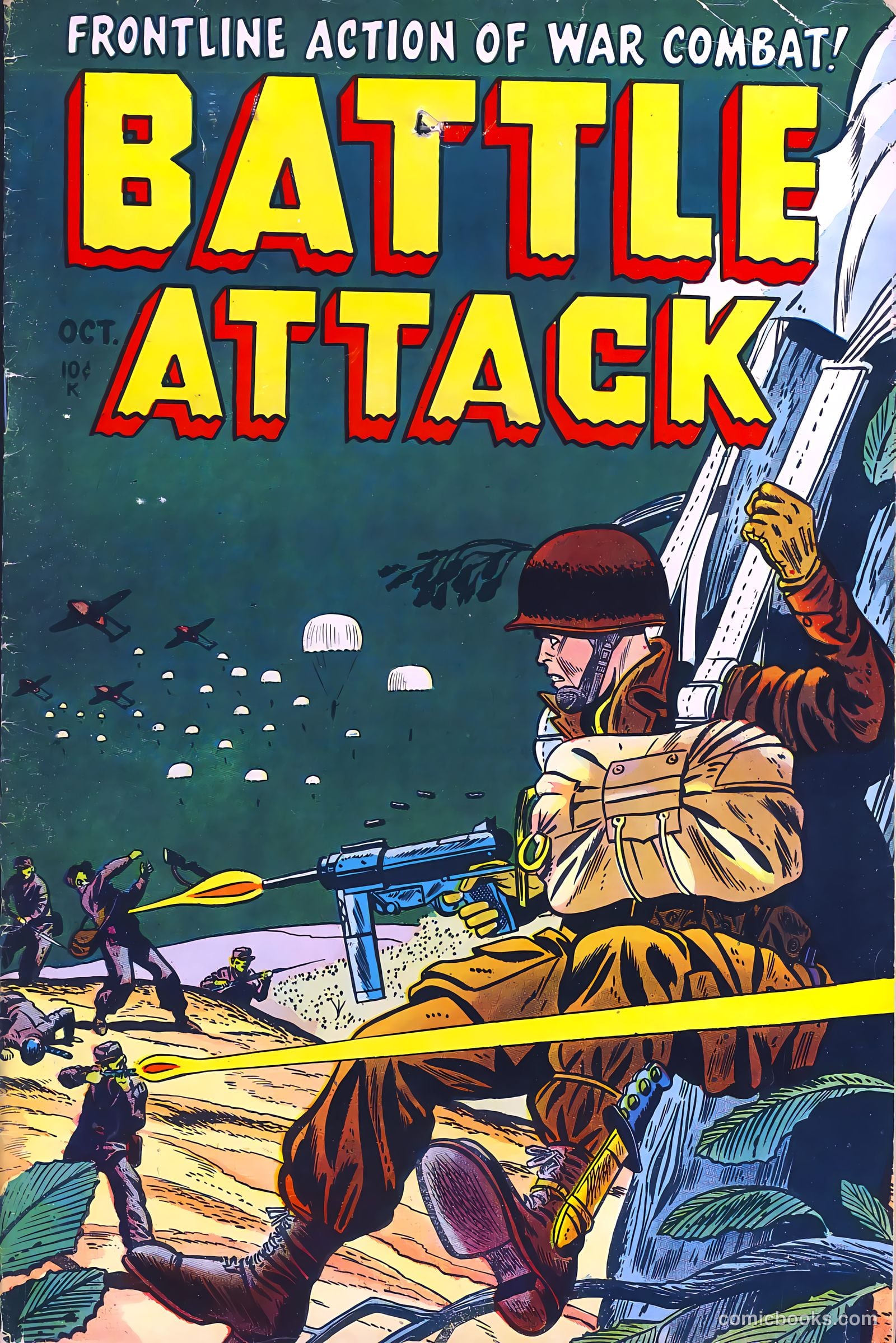
Battle Attack #1
☆ Be the first to review + Add to your collection — Join freeBattle Attack #1 (October 1954) marks the debut of one of Stanley P. Morse's Stanmor Publications war anthology titles, launched at precisely the moment the Comics Code Authority was reshaping the entire industry. Its arrival is a small but telling data point in the Golden Age war-comics boom: Morse chose to expand his combat lineup even as the Code squeezed out the horror and crime content he had built his empire on, demonstrating that war anthologies occupied a regulatory middle ground that publishers were eager to exploit. The series belongs to a dense cluster of Stanmor war titles — alongside Battle Cry and Battle Squadron — that together document how independent mid-1950s publishers responded to both audience appetite for Korean-War-era storytelling and the post-Code commercial landscape.
A general assigns a military unit a bombing mission targeting an enemy tank factory. The flyboys successfully complete their aerial bombardment run, destroying the factory with their B-17 bombers. Ground forces then move in to secure the fortifications and eliminate remaining enemy resistance in the devastated area.
America's mastery of machinery—from telephones to bombers—takes center stage as a B-17 squadron receives orders to strike a German tank factory at Hahn. When enemy fighters intercept the mission, the clash between two nations' wartime machines becomes devastatingly personal, reminding us that in an age of equipment and industry, the cost of victory can reach home.
A young Marine lieutenant and a grizzled sergeant clash over what truly wins battles—cutting-edge machinery or the fighting spirit of soldiers themselves—when they're tasked with rooting out Japanese forces dug deep into island caves. As tanks, artillery, and aircraft prove insufficient against an entrenched enemy, the debate shifts from philosophy to survival, and the real answer emerges from the chaos of combat.
A quiet gunner aboard a bomber called the Eagle's Wrath earns the ironic nickname "Chatterbox" not for talking, but for letting his actions speak louder than words—selflessly giving credit to a boastful crewmate and performing heroics across multiple roles during a harrowing mission. When enemy fighters force the crippled plane down into the Bay of Biscay, Chatterbox's courage in the face of danger becomes unmistakably clear, cementing his legacy as a soldier who communicated through bravery rather than words.
Joe Lerner is a powerfully built soldier haunted by an unusual fear: the sound of gunfire sends him into a panic, threatening to undermine his effectiveness in combat. When his only friend in the unit is killed by enemy fire, Joe's rage transforms his crippling phobia into raw determination, and he discovers an unconventional way to turn the tide of battle. A 1954 war story that explores how grief and anger can overcome even our deepest fears.
ComicBooks.com Value
Show all 15 grades ▾
Find on ebay
Read it digitally
Sell my copy
Have this issue — or a whole collection? Get a fair offer from us, skip the marketplace fees and the hassle.
We Buy Collections ▸History
Battle Attack was published by Stanmor Publications, Inc., one of several imprints operated by Stanley P. Morse out of 175 Fifth Avenue, New York. Morse ran a high-volume, low-overhead shop: his titles shifted imprints frequently as he navigated creditors and editorial partners, and production corners were cut wherever possible — including recycling cover art from different issues and rearranging existing interior panels when an artist or story fell through. The series launched in October 1954 on a bi-monthly schedule, the same month the Comics Code took formal effect, and artist Eugene E. Hughes — who contributed pencils and inks across multiple Stanmor war books — appears throughout the run as the title's most identifiable artistic voice. At Morse's peak in 1955, his combined imprints were simultaneously publishing 56 comic books across 18 titles, a volume that exceeded better-remembered contemporaries such as EC Comics and Prize Comics.
Trivia · 8 facts
- First issue cover-dated October 1954, published bi-monthly by Stanmor Publications, Inc., 175 Fifth Avenue, New York — confirmed by the indicia reproduced in GoCollect and GCD records.
- The issue contained five named stories: 'The Gambler,' 'Machinery!,' 'A Modern Army!,' 'Chatterbox!,' and 'Gunfire!' — a standalone anthology format with no recurring characters in issue #1.
- The cover features a parachute/airborne imagery motif, consistent with the action-forward visual language Stanmor used across its war line.
- The series ran for eight issues total (October 1954 – December 1955), placing it squarely within the compressed lifespan typical of Stanmor's war titles.
- Eugene E. Hughes was the primary penciler and inker documented across later issues of the run; creator credits for issue #1 specifically are unverified in currently indexed GCD records.
- Battle Attack #1 launched the same month the Comics Code Authority took formal effect — making it one of the first Morse war comics to operate (at least nominally) under Code-era conditions.
- Stories from other issues in the series were later reprinted in Australian and British-market publications, including Battle Stations (Magazine Management, 1959) and Battle Heroes (Stanley Morse, 1966), indicating the material had export and reprint utility beyond its original print run.
- Stanmor was one of Morse's several rotating imprints — others included Aragon, Gillmor, and Key Publications — used interchangeably as business circumstances demanded, giving Battle Attack a publisher identity that shifted at the corporate level even while the content remained consistent.
Full credits
Reprints
↩ Reprints Battle Cry #3 (1952), Battle Cry #4 (1952)
Reviews
Reader reviews
No reader reviews yet.