
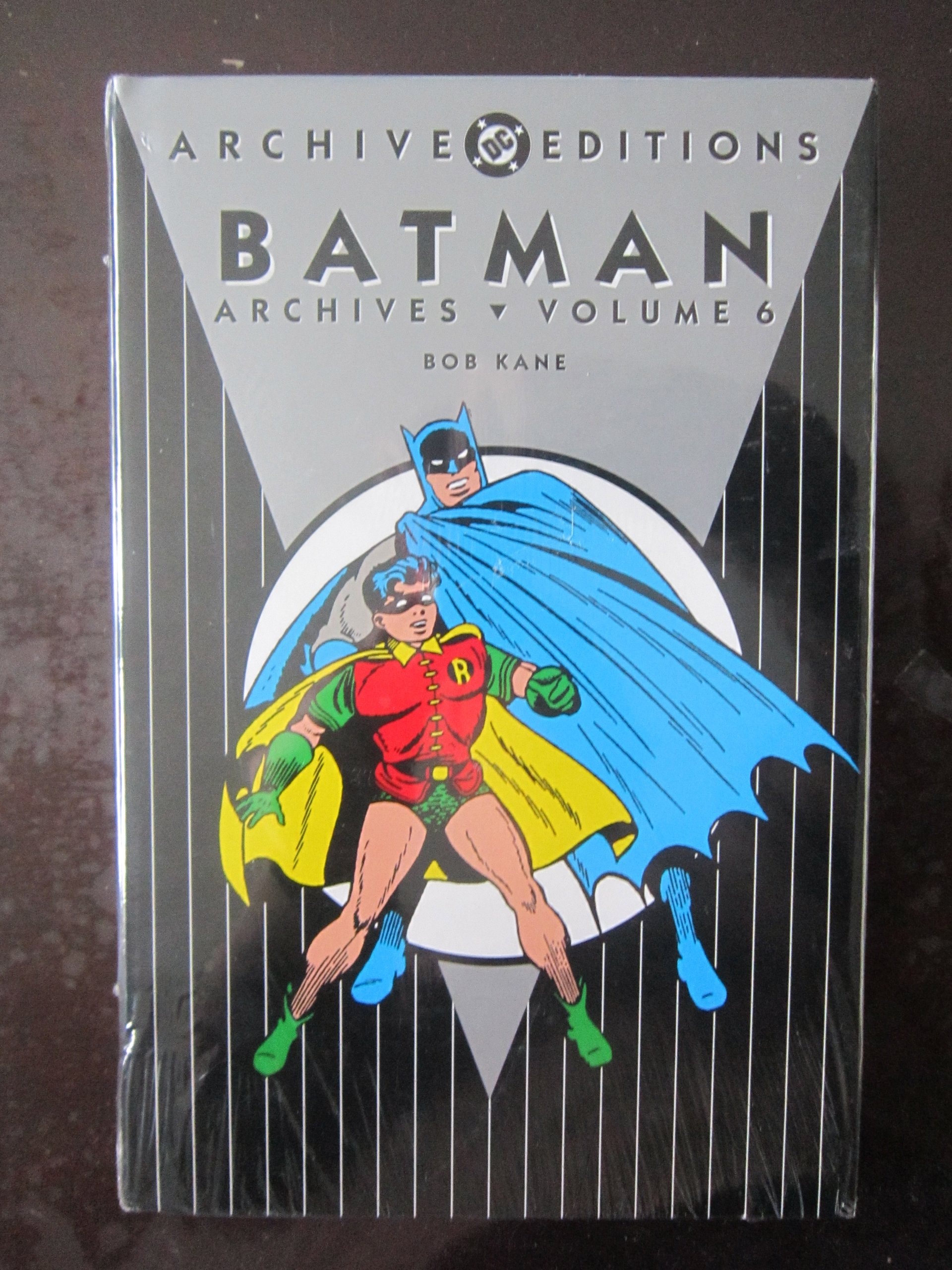
Batman Archives #6
☆ Be the first to review + Add to your collection — Join freeThis volume collects early Batman stories from Detective Comics #82-86 and Batman #20-23, originally published in 1944-1945. Featuring work by artists like Dick Sprang and writers such as Don Cameron, these Golden Age tales showcase the Dark Knight battling classic foes like the Joker and Two-Face, as well as lesser-known villains, in the signature Archive Editions' high-quality hardcover format.
In "Fowl Play," the Penguin, newly freed from prison, enlists the help of an unsuspecting bird enthusiast, turning the man’s prized collection of rare birds into tools for crime—and launching a twisted scheme that puts Batman and Robin in a deadly avian trap. With cunning and chaos, the duo orchestrates a series of daring heists, all while the birds themselves become key players in a game of cat-and-mouse that’s as unpredictable as it is perilous.
In "Commissioner Gordon Walks a Beat," Gotham’s finest face a seismic shift when the mayor’s son loses a high-stakes bet to a notorious gangster, triggering a chain of events that strips Commissioner Gordon of his rank and sends him back to the streets as a patrolman—while Batman’s partnership with the GCPD hangs in the balance.
In "The Dawn Patrol Crimes," a shadowy radium smuggling ring exploits the skills of early aviation pioneers—known as "The Dawn Patrol"—who unknowingly transport dangerous contraband across the skies. With the city's streets and skies under threat, Batman must unravel a mystery that ties modern crime to the daring spirit of aviation's golden age.
In "The Citadel of Crime," Batman takes on a mystery when a string of high-profile cons vanish from prison, leaving Commissioner Gordon desperate for answers. Going deep undercover, the Dark Knight uncovers a hidden network where the criminal mastermind the Thinker is assembling a rogue army of former inmates to build something far more dangerous than mere theft.
In "Pigmies in Giantland," a disgruntled scientist proves his shrinking gas works by trapping a group of skeptical investors in a colossal room, making them believe they’ve been reduced to tiny size—only to exploit their panic and demand money to reverse the effect. The story unfolds with tense, claustrophobic flair as the line between illusion and terror blurs, all within a single, unnervingly oversized space.
In "The Isle of Yesterday," Batman and Robin are stranded on a remote island owned by a reclusive judge, a man so grief-stricken by the loss of his daughter that he has banned all modern technology. As the duo navigate the island’s isolated, anachronistic world, they must unravel a mystery that ties the judge’s past to the very thieves they’re chasing—before the island’s secrets consume them both.
In "The Box," a cryptic artifact in Batman’s Hall of Trophies unfolds the chilling tale of the Diamond King, a grieving father whose son was murdered by gangsters. When the evidence against them vanished and the killers walked free, he turned to the box to enact a calculated, personal justice—one crime at a time.
In "The Underworld Surgeon," Steve Travers finds himself trapped between loyalty and justice, forced to use his surgical skills to help criminals vanish from the law—by giving them new faces. As the line between healer and accomplice blurs, the weight of his choices begins to take a toll, even as the city's shadows grow darker.
In "The Man Who Could See the Future," a clairvoyant’s chilling forecasts draw Batman into a high-stakes game of fate, as his latest vision claims the Dark Knight will die aboard an ocean liner—leaving the hero to question whether the future is written or merely a challenge to be defied.
In "The Umbrellas of Crime," the Penguin, thwarted when a lightning strike destroys his arsenal of trick umbrellas, dares Batman to stop him—claiming he’ll still carry out his crimes, only this time with umbrellas that aren’t umbrellas at all. With his schemes shifting into the unexpected, the Dark Knight must unravel a mystery where every shade and shadow could be a weapon.
In "The True Story of Frankenstein," Professor Nichols uncovers a chilling document claiming the legend of Frankenstein is real, prompting him to journey back in time to uncover the truth. With the help of the Caped Crusaders, he ventures into the past, where the line between science and horror begins to blur.
ComicBooks.com Value
Find on ebay
Where to buy
Read it digitally
Sell my copy
Have this issue — or a whole collection? Get a fair offer from us, skip the marketplace fees and the hassle.
We Buy Collections ▸Full credits
Reprints
↩ Reprints Detective Comics #120 (1947), Detective Comics #121 (1947), Detective Comics #122 (1947), Detective Comics #123 (1947), Detective Comics #124 (1947), Detective Comics #125 (1947), Detective Comics #126 (1947), Detective Comics #127 (1947), Detective Comics #128 (1947), Detective Comics #129 (1947), Detective Comics #130 (1947), Detective Comics #131 (1948), Detective Comics #132 (1948), Detective Comics #133 (1948), Detective Comics #134 (1948), Detective Comics #135 (1948)
Reviews
Reader reviews
No reader reviews yet.