
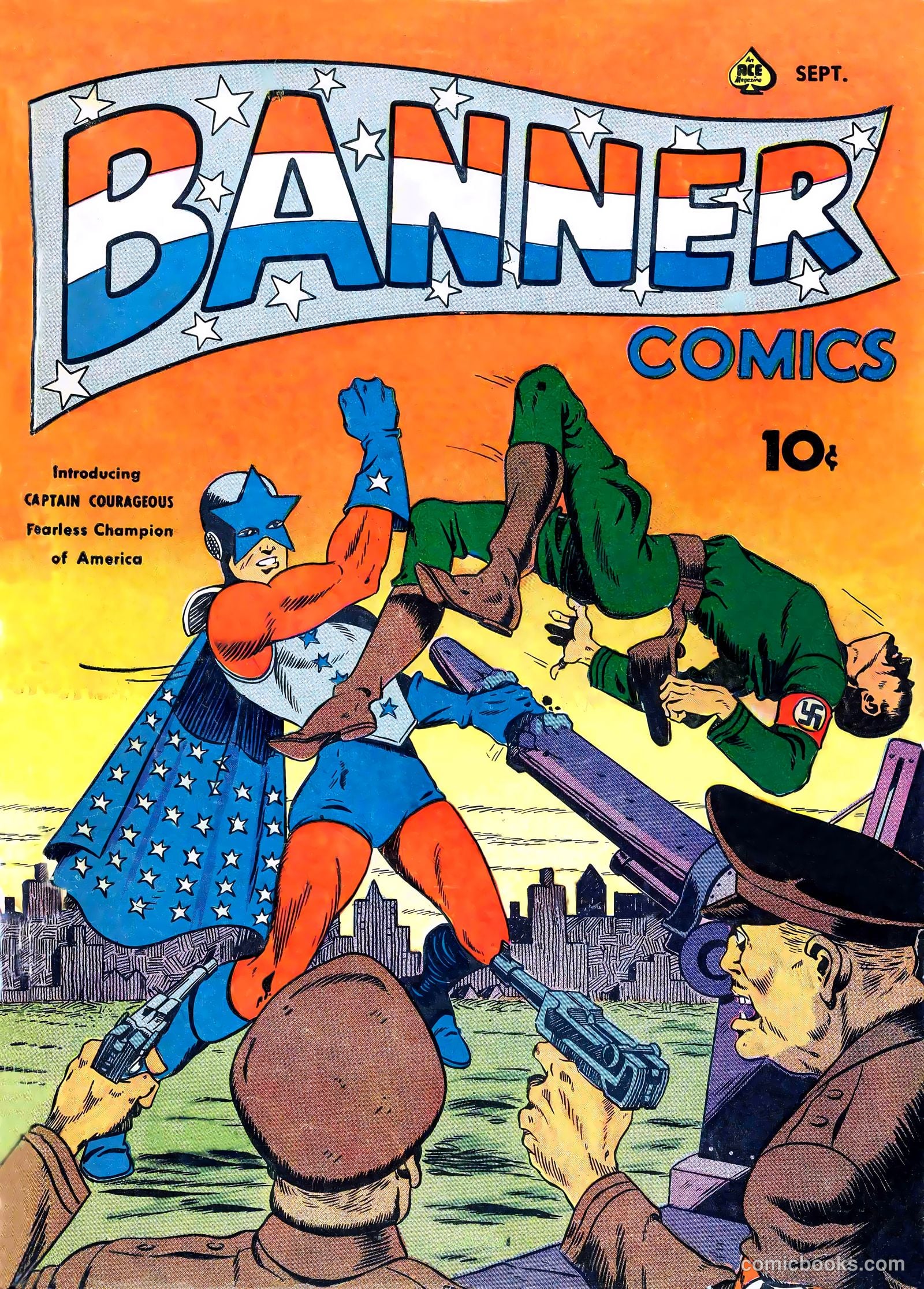
Banner Comics #3
☆ Be the first to review + Add to your collection — Join freeBanner Comics #3 (September 1941) holds a firm place in Golden Age history as the first appearance of Captain Courageous, a supernatural patriotic hero who functioned not as a costumed mortal but as an omnipresent spirit of courage that manifested to defend democracy — a conceptual departure from the muscle-and-serum model dominating the wartime superhero boom. The issue is also Ace Periodicals' effective debut in comic books, marking the publisher's pivot away from its pulp-fiction roots into sequential art, and its dense anthology format — packing Captain Courageous, the Lone Warrior, Tyson Typhoon, Kay McKay, and Paul Revere Jr. into a single 68-page package — captures the generalist ambitions of second-tier Golden Age publishers with unusual clarity. As a pre-Pearl Harbor wartime superhero book that had its lead story reprinted in Fantagraphics' 2017 scholarly anthology Take That, Adolf!: The Fighting Comic Books of the Second World War, the issue has received renewed critical attention as a document of how smaller publishers channeled national anxiety into four-color fiction months before the U.S. formally entered the war.
In "American Trail Blazers," Paul Sr.'s fiery newspaper America Awake sparks tension with the shadowy Fifth Column known as The Thorns, setting off a quiet but determined resistance. His son Paul Jr., along with friends Patrick and Betsy, carries on the fight through their namesake club, standing firm against threats both inside and out. The story unfolds with grounded urgency, drawn with crisp detail by George Wilson, while Jim Mooney’s cover captures the era’s patriotic tension in bold lines.
In "null," the Lone Warrior finds himself stationed near the boys' camp where his kid brother is staying, setting the stage for an unexpected reunion. When sabotage threatens the Army base, the two brothers must team up to uncover the hidden hand behind the attacks—the Dictator's Shadow.
In 1919, pilot Jack Knight signed up with the new Air Mail Service, first flying routes from New York to Chicago before being assigned to the Omaha-Cheyenne run—and his courage was tested when canyon winds forced him down into deep snow on a mountainside. When bad weather cancelled a scheduled night mail flight in 1921 and the relief pilot had already gone home, Knight took to the skies anyway, navigating by roadmap and flashlight to deliver the mail to Chicago. This is the true story of one of aviation's early heroes and the grit it took to keep America's mail flying.
In a quiet town where whispers of dissent stir beneath the surface, Paul Jr. and his friends Patrick and Betsy stand firm as members of the America Awake club—fighting to protect their community from shadowy forces known as The Thorns. When their father’s newspaper dares to speak out against isolationism, the danger grows real, and the club must prove that courage isn’t inherited—it’s chosen.
ComicBooks.com Value
Show all 21 grades ▾
Find on ebay
Read it digitally
Sell my copy
Have this issue — or a whole collection? Get a fair offer from us, skip the marketplace fees and the hassle.
We Buy Collections ▸History
The series carries the oddity of launching at issue #3 — issues #1 and #2 were never published under the Banner Comics banner, and no predecessor title on the Ace timeline cleanly explains the numbering gap, a mystery that remains unresolved in comics scholarship. The book was published under the Periodical House Inc. indicia by Aaron A. Wyn, who, along with his wife Rose Wyn, had been running pulp magazines since 1928 before turning to comics in 1940. The early Ace comic line was edited by Frederick Gardener, a longtime pulp editor who had previously worked for Fawcett, Centaur Publications, and Teck Publications. The Lone Warrior story in the issue is scripted by Otto Binder — later celebrated as a key Captain Marvel writer and co-creator of Supergirl — a credit sourced from Bails's *Who's Who of American Comic Books*; the cover and Captain Courageous story art is signed by Jim Mooney, though the question of who actually created the Captain Courageous character concept remains open.
Trivia · 8 facts
- First appearance of Captain Courageous, a supernatural patriotic hero dressed in a red-and-blue star-adorned costume with a star-shaped mask, whose powers include super-strength, flight, limited invulnerability, and the ability to survive underwater.
- First appearance of the Lone Warrior (Stan Carter) and his brother Dicky Carter, a Captain America/Bucky-inspired duo who gain super-strength via a 'Power Elixir' serum administered by their scientist father.
- First appearance of the villainous Dictator's Shadow, the hooded enemy mastermind who organizes Axis fifth-column activity against the United States throughout the Banner Comics run.
- The issue is the effective first issue of Banner Comics — issues #1 and #2 were never published; the series launched directly at #3 with no corroborated explanation for the numbering.
- Cover and interior Captain Courageous art is signed by Jim Mooney (per the Grand Comics Database); the Lone Warrior story script is credited to Otto Binder via Bails's *Who's Who of American Comic Books*.
- The Captain Courageous lead story was reprinted in Fantagraphics' 2017 hardcover *Take That, Adolf!: The Fighting Comic Books of the Second World War*, edited by art historian Mark Fertig.
- The issue also debuts Kay McKay: Air Hostess and Paul Revere Jr., rounding out an anthology that spans superhero, spy-adventure, and prose-fiction genres across 68 full-color pages.
- After Banner Comics #5, the title was renamed Captain Courageous Comics for its final issue (#6, March 1942); the character then migrated to Ace's Four Favorites, where he appeared from issue #5 through #21. In 2008 he was revived in Dynamite Entertainment's Project Superpowers continuity.
Full credits
Reprints
Reprinted in Take That, Adolf!: The Fighting Comic Books of the Second World War #[nn] (2017)
Reviews
Reader reviews
No reader reviews yet.