
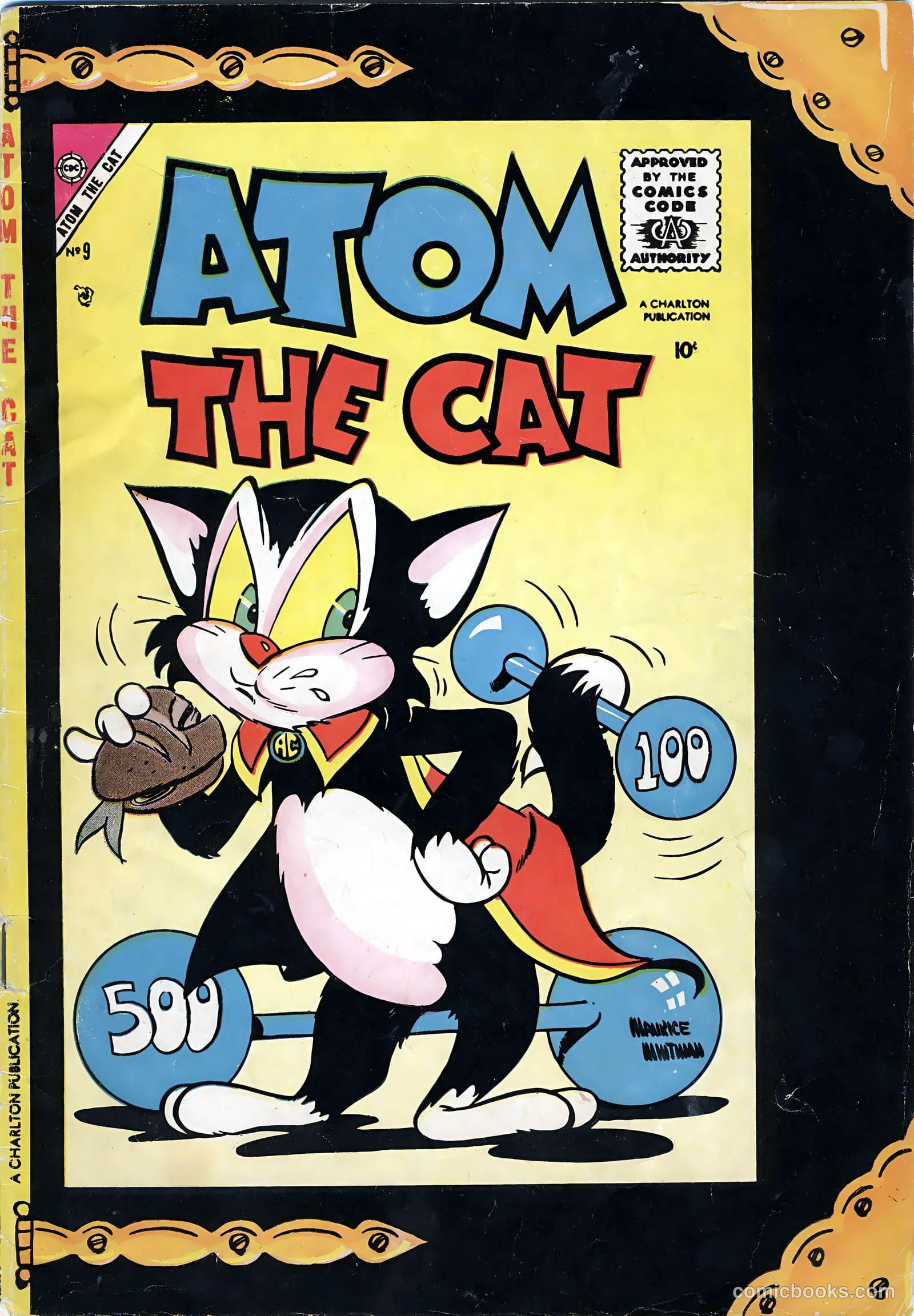
Atom the Cat #9
☆ Be the first to review + Add to your collection — Join freeAtom the Cat #9 (October 1957) is the debut issue of Charlton's atomic-powered feline superhero and the first appearance and origin of Atom the Cat — the stray alley cat transformed by an accidental laboratory explosion into a superpowered champion. The issue captures Cold War America's nuclear anxiety filtered through the light-hearted funny-animal genre that Charlton had been cultivating alongside Atomic Mouse and Atomic Rabbit, completing a trio of radiation-powered animal heroes unique to any Silver Age publisher's lineup. As the inaugural chapter of a title that ran through 1959, it marks a deliberate editorial pivot by Charlton — renaming and reconceiving an existing series (Tom Cat) around the superhero concept that was beginning to reshape the industry. The issue is also a small but genuine artifact of how mid-century comics packaged atomic science as entertainment for child readers still living in the shadow of Hiroshima.
"Atomic Mouse" features Atom the Cat coming to the aid of several farmers whose crops are dying from lack of rain. After the farmers initially refuse his help, Atom constructs wooden houses by the beach using horse hair and straw as building materials. When the farmers discover that Atom has built nests rather than houses, they initially despair, but Atom helps them identify which nest belongs to which bird by examining the materials used—horse hairs, straw, and bird feathers—allowing them to distinguish their babies. The grateful farmers thank Atom and offer their assistance in return.
Atom the Cat tries to convince Cora the Cat not to go on a diet by sharing a cautionary song about a kitten who became so thin she slipped through a lemonade straw. It's a silly, lighthearted tale about vanity and well-meaning advice delivered with genuine cartoon charm.
A scrappy alley cat's chance encounter with an open laboratory door during an atomic experiment transforms him into Atom the Cat, granting him incredible superhuman powers. As the newly empowered feline discovers what he's capable of, the scientists who accidentally created him must teach him the difference between using his abilities for good and causing chaos. It's a humorous take on the superhero origin story, where even the best intentions can lead to unexpected complications.
Atom the Cat discovers he possesses surprising powers after an accidental sneeze, but when he falls into an extended nap high above the ground, a nationwide search begins to find him and teach him to harness his abilities. When authorities finally locate him and demonstrate his incredible strength, Atom the Cat becomes convinced of his newfound power—and eager to put it to use, though perhaps not quite in the way the military had in mind.
When Atom the Cat catches Shadow red-pawed near an apple stand, the accused thief insists he's actually trying to do something quite different—but convincing Atom of his true intentions proves trickier than expected. This 1957 tale from Atom the Cat #9 serves up a quick dose of misunderstanding and comeuppance in just two pages.
When a storm sweeps through the forest, Atomic Mouse springs into action to help everyone in need—from Mrs. Spider to a trapped bee to a beaver dam full of stranded residents. But when the chaos settles, he faces a puzzle that muscles alone can't solve: two mothers, Mrs. Cheep and Mrs. Chirp, have lost their babies in the disaster and can't tell the look-alike chicks apart. Can a true hero use brains instead of super-strength to reunite these feathered families?
Atom the Cat has lost his atomic powers, and a team of scientists desperately tries to restore them by attempting to recreate the original experiment—until a discarded Geiger counter reveals the surprising truth: his powers return when he eats fish. Now fully recharged and ready for action, Atom must tackle an ambitious list of world projects assigned by the Atomic Commission, but the cat has other ideas about what comes after work.
Shadow faces judgment before a stern judge who must decide on an appropriate sentence, but when the judge asks what kind of sentence Shadow wants, the answer takes a delightful turn—this quick-witted one-pager plays a clever joke on the word itself. A charming bit of wordplay that shows why "The Sentence" was a staple of Atom the Cat's 1957 humor comics.
ComicBooks.com Value
Find on ebay
Read it digitally
Sell my copy
Have this issue — or a whole collection? Get a fair offer from us, skip the marketplace fees and the hassle.
We Buy Collections ▸History
The series grew directly out of Charlton's existing Tom Cat title (1956–1957), whose numbering was carried forward into Atom the Cat; issue #9 is simultaneously the first issue of the new title and the logical continuation of the old one. Art and covers for the launch issue were handled by Maurice Whitman, who remained the primary visual voice of the series, with lettering by Jon D'Agostino. Scripts are attributed — with some uncertainty across sources — to Charlton's workhorse staff writer Joe Gill, who during this same period was writing an estimated 100 or more pages per week across genres for the Derby, Connecticut publisher. Charlton's low-overhead, in-house production model allowed it to spin up concept-driven titles like this quickly, and Atom the Cat fit neatly into the publisher's stable of atomic animal properties it had been cultivating since Al Fago launched Atomic Mouse in 1953.
Trivia · 8 facts
- First appearance and origin of Atom the Cat, published by Charlton Comics, cover-dated October 1957.
- Issue #9 is simultaneously the debut issue of the Atom the Cat title and a direct numbering continuation of the predecessor series Tom Cat (Charlton, 1956), which ended with issue #8.
- Origin story: an unnamed alley cat wanders into a laboratory during an atomic-ray experiment, absorbing the radiation and gaining superhuman strength, durability, and flight — after which the scientists dub him 'Atom the Cat.'
- Atom's powers are tied to eating fresh fish; they fade if he goes without and are fully restored once he eats again — a quirky power mechanic that distinguishes him from Charlton's other atomic animal heroes.
- Cover and interior art by Maurice Whitman (signed); lettering by Jon D'Agostino; scripting attributed (with uncertainty) to Joe Gill.
- The issue is a 36-page, full-color, saddle-stitched comic published bimonthly at a cover price of ten cents, carrying Comics Code Authority approval.
- Stories from this issue were reprinted in the British anthology Super Mouse (Alan Class) — specifically in issues #1 and #2 of that 1960 series — giving the character transatlantic exposure.
- The series ran nine issues total (#9–#17, October 1957–August 1959), with George Wildman joining Whitman on art duties in later issues; the character also appeared in Giant Comics #3.
Full credits
Reprints
Reprinted in Super Mouse #1 (1959), Super Mouse #2 (1959), Just Dennis #4 (1967), Atom the Atomic Cat [Atom the Cat] #1 (1998), Just Dennis #5
Reviews
Reader reviews
No reader reviews yet.