
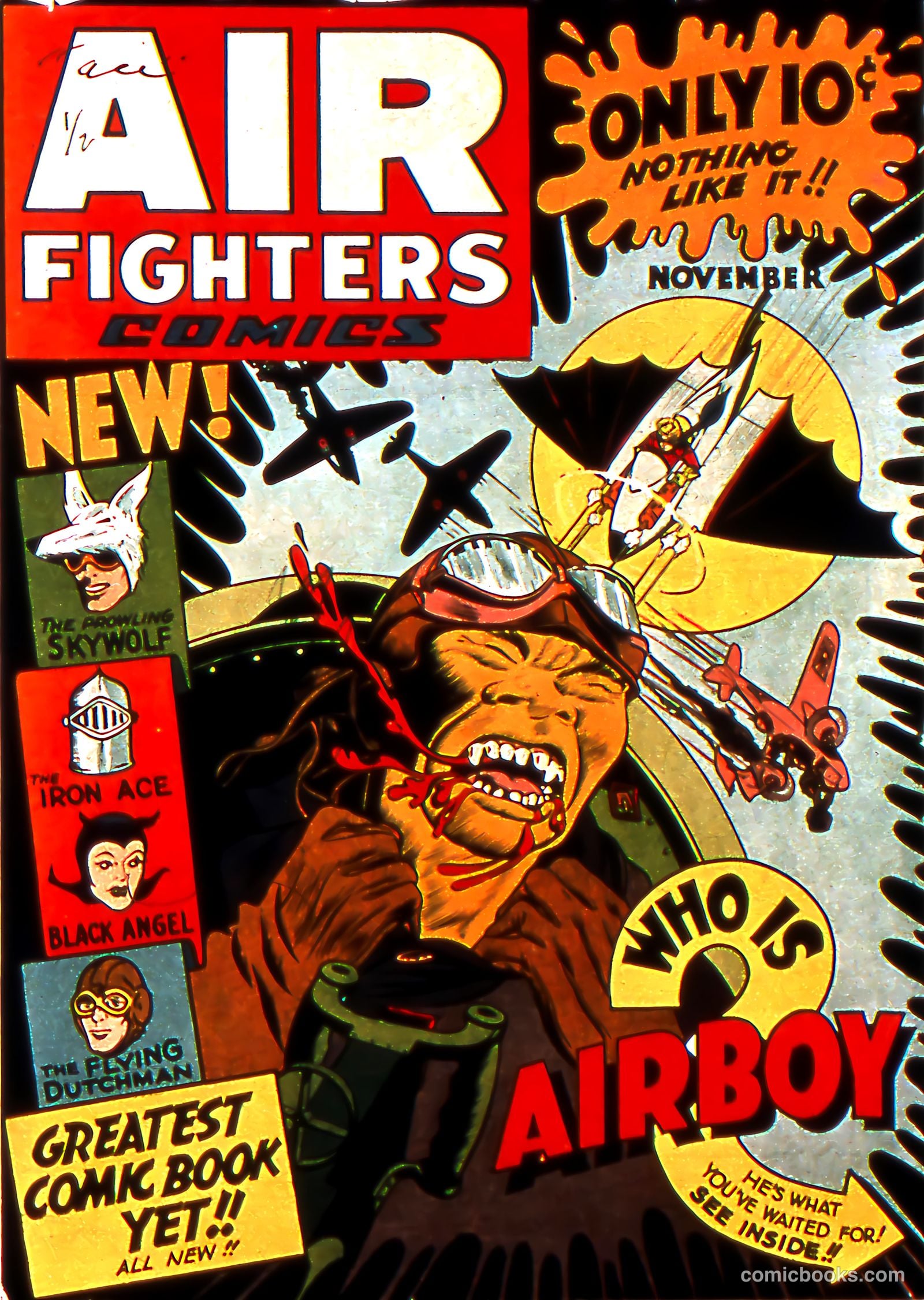
Air Fighters Comics #2
☆ Be the first to review + Add to your collection — Join freeAir Fighters Comics #2 (November 1942) is the single most consequential issue in Hillman Periodicals' publishing history, simultaneously introducing Airboy — one of the Golden Age's most enduring non-superhero aviator characters — along with five other entirely new aviator heroes in a single anthology package. The issue effectively launched a shared universe of wartime fliers that would sustain the title for over a decade, eventually prompting the series to be renamed Airboy Comics in the character's honor. Airboy himself was a notable creative departure from the caped-hero formula: a tech-savvy teenage orphan whose heroism derived from ingenuity and skill rather than supernatural powers, and who was deliberately written to age in something approaching real time — an unusual narrative choice for the era, reportedly inspired by the newspaper strip Terry and the Pirates. The characters and stories born in this issue remained culturally alive long past Hillman's closure in the 1950s, seeding a public-domain revival at Eclipse Comics in the 1980s and multiple subsequent publisher reinterpretations that continue to the present day.
Air Fighters Comics #2 is an anthology that includes "The Sky Wolf," featuring the masked pilot battling Nazi forces climbing for altitude while his squadron engages enemy aircraft in heavy dogfight action. The issue also contains "Fire Over Benghazi" by Nathaniel Nitkin, in which Lieutenant Commander Johnny Burns of Fighting Squadron Nineteen launches from the converted carrier U.S.S. Osprey to intercept an Italian luxury liner and encounters German Messerschmitt fighters over Benghazi, ultimately destroying one in aerial combat. Additional stories feature The Iron Ace, Black Angel, and The Flying Dutchman, along with a Baldeagle adventure involving parachutists and combat with enemy forces.
ComicBooks.com Value
Show all 20 grades ▾
Find on ebay
Read it digitally
Sell my copy
Have this issue — or a whole collection? Get a fair offer from us, skip the marketplace fees and the hassle.
We Buy Collections ▸History
Charles Biro, already building his reputation as one of the most innovative editor-writers in the early comics field, co-created Airboy for Hillman Periodicals around 1941, with the character debuting in the second issue of the Air Fighters Comics series in November 1942. Biro crafted the scripts alongside writer Dick Wood, while artist Al Camy handled the initial interior story art; Biro himself drew the cover. The issue was edited by Hillman's Ed Cronin and filled 68 full-color pages at a cover price of ten cents, featuring eight distinct stories with a roster of contributors that included Mort Leav, Fred Kida, Harry Sahle, and Bob Fujitani — an unusually large creative team that gave the anthology its breadth. Notably, the first issue of Air Fighters Comics (1941) had featured an entirely different cast of characters who never appeared again, making issue #2 the true creative relaunch of the title under the new Airboy-centered direction.
Trivia · 8 facts
- First appearance and complete origin of Airboy (David 'Davy' Nelson II), including the introduction and death of his mentor, Franciscan monk Brother Francis Martier, and the origin of the wing-flapping plane Birdie.
- First appearances of five other aviator heroes also debut in this same issue: Black Angel (Sylvia Manners), Iron Ace (Captain Ronald Britain), Skywolf (Larry Wolfe), Bald Eagle (Jack Gatling), and the Flying Dutchman — making this one of the densest single-issue debut packages of the Golden Age.
- Airboy's origin story, as laid out in this issue, establishes him as a California orphan raised at Mission San Juan Capistrano; Padre Martier's bat-wing-inspired aircraft design — reportedly tracing its conceptual lineage to Renaissance-era flight ideas — is sabotaged, killing Martier, and Davy inherits both the plane and a mission.
- Birdie, the signature aircraft, is armed with dual machine guns, has grasping landing gear capable of seizing other planes, and can be summoned via a radio remote control concealed under Airboy's lapel.
- The issue was written and drawn by a large collaborative team: cover by Charles Biro; story art by Al Camy, Mort Leav, Fred Kida, Harry Sahle, Bob Fujitani, and others; scripts by Biro, Dick Wood, Harry Stein, and Nathaniel Nitkin; edited by Ed Cronin.
- The Airboy lead story in this issue was reprinted in Air Fighters Classics #1 (Eclipse Comics, November 1987), part of a six-issue bimonthly reprint series Eclipse produced from original vintage copies after the Hillman copyrights lapsed.
- The cover of this issue, depicting a Japanese fighter falling from the sky, became a frequently reproduced artifact of Golden Age wartime propaganda imagery, appearing in at least two Fantagraphics reference volumes: Action! Mystery! Thrills! (2011) and Take That, Adolf! (2017).
- Airboy's deliberate real-time aging — beginning as a roughly 12-year-old boy and maturing to a young adult by the series' end in 1953 — was a creative policy reportedly credited by artist Fred Kida to the influence of Milton Caniff's newspaper strip Terry and the Pirates.
Reviews
Reader reviews
No reader reviews yet.