
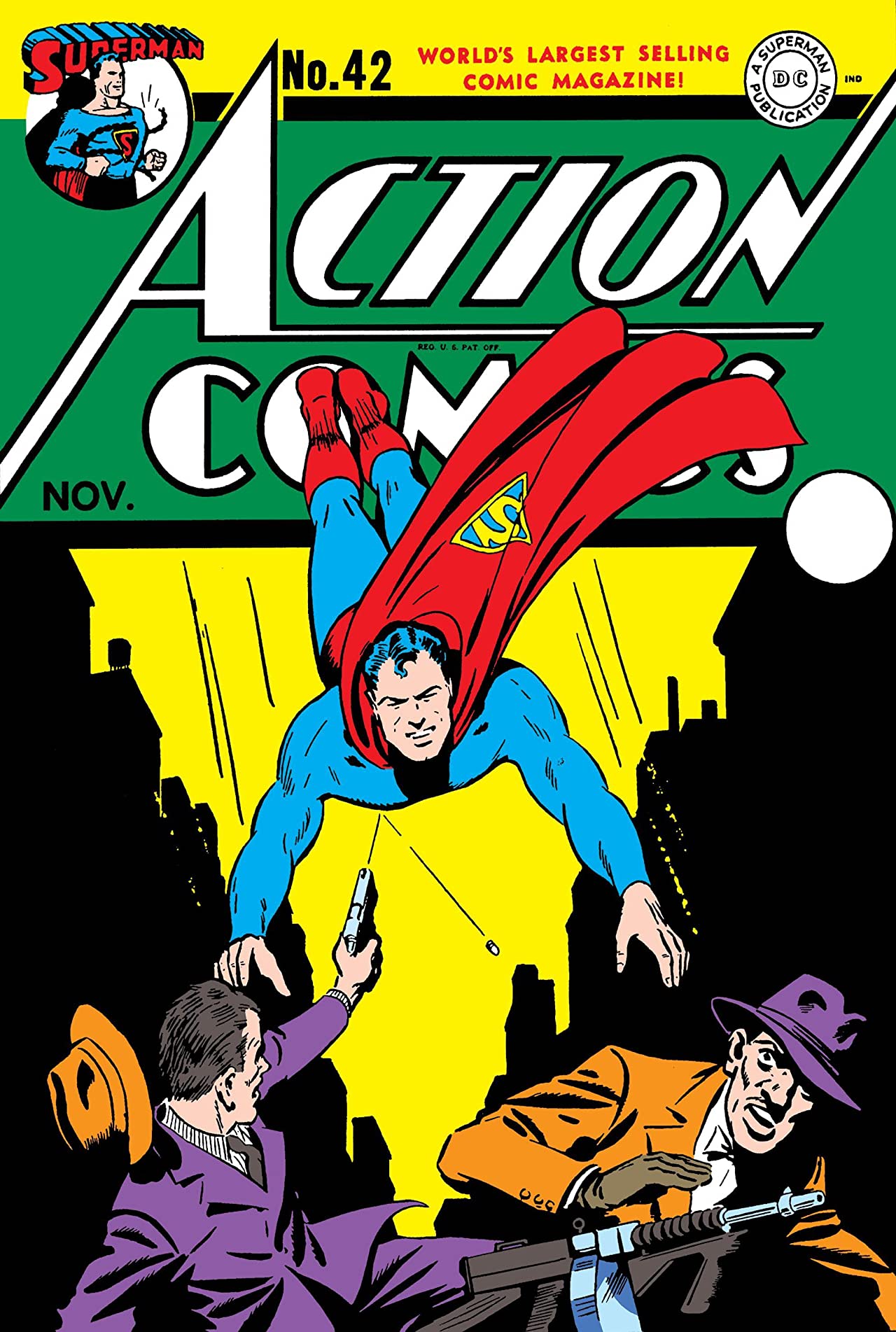
Action Comics #42
Action Comics #42 is a genuine turning point in DC's Golden Age anthology lineup: it introduces the Vigilante (Greg Sanders), a singing cowboy hero who blended Western archetypes with the urban superhero formula in a way no DC character had before. The Vigilante's debut backup strip proved so popular that it ran continuously through Action Comics #198 (1954), a span of 157 consecutive stories that made it the single longest-running backup feature in the title's history — outlasting Zatara, Tommy Tomorrow, the Legion of Super-Heroes, and even Supergirl. The same issue also marks the final installment of Sheldon Moldoff's Black Pirate in Action Comics before that series migrated to the newly launched Sensation Comics #1, making this a hinge point between two eras of DC's anthology publishing. As a snapshot of the early-wartime comic book, it captures DC at maximum anthology density, with seven separate features sharing one 68-page package.
In "City in the Stratosphere," the Vigilante takes on a new threat when the seemingly executed Killer Kelly returns—only to be revealed as a cunning fraud who faked his death. As Greg Sanders, a rodeo man turned vigilante, teams up with blues singer Betty Stuart, he races to stop Kelly’s chaos at a high-society costume ball, where the line between performer and predator blurs. Written by Mort Weisinger and illustrated by Mort Meskin, with a striking cover by Fred Ray, this 1941 classic blends crime, deception, and daring heroism in a tale that’s as sharp as its 10-cent price tag.
In "City in the Stratosphere," Superman investigates a string of mysterious disappearances in Metropolis, only to be ambushed by a deadly ray after questioning mobsters. His search leads him to a shocking revelation: Lex Luthor has constructed a massive city in the sky, and from its heights, he begins to manipulate the Man of Steel with hypnotic control.
In the dusty frontier town of 1941, rodeo rider Greg Sanders takes up the mantle of the Vigilante after a chilling warning from the condemned Killer Kelly. When a blues singer named Betty Stuart reveals Kelly’s escape, Greg dons the iconic costume and races to stop the criminal at Van Ardsley’s lavish costume ball—where chaos erupts and the vigilante must act fast.
When the Aces' flight back from South America takes a sudden turn over Central America, they’re pulled into a raging revolution—only to have their planes seized by a local rebel leader named Miguel Miranda. Now stranded and facing a battle they didn’t sign up for, the Aces must outthink their way out before they’re left grounded in the middle of chaos.
In the heart of the jungle, Congo Bill stumbles upon a shocking scene: a white man being buried alive by a native, only to learn he’s just ruined a take on a jungle adventure film. As the production grinds on under director Hugo Von Eller, tensions rise and strange mishaps plague the crew—until Jo agrees to step in for a sick actress, plunging the cast deeper into chaos.
In "The Man Who Could Control Minds," Zatara finds himself chasing the elusive Tigress and her partner Frosty Parke after they attempt a bank heist. When Frosty’s mysterious experiment grants him the ability to control minds, he escapes and teams up with Tigress for a new wave of criminal activity—forcing Zatara to uncover the source of Frosty’s power before it’s too late.
ComicBooks.com Value
Show all 18 grades ▾
More listings for this title
Read it digitally
Sell my copy
Have this issue — or a whole collection? Get a fair offer from us, skip the marketplace fees and the hassle.
We Buy Collections ▸History
The issue went on-sale September 19, 1941, under editor Whitney Ellsworth (credited on the indicia as F.W. Ellsworth), with Mort Weisinger and Murray Boltinoff serving as uncredited assistant editors — a notable arrangement given that Weisinger himself wrote the Vigilante debut story he was also helping to edit. The Vigilante eight-pager was scripted by Weisinger and both penciled and inked by Mort Meskin, who signed the story; the fluidity of Meskin's figure work was remarked upon even at the time as standing apart from the other strips in the issue. The Superman lead story, 'The Empire in the Sky,' was written by Jerry Siegel and drawn by Leo Nowak, with a cover by Fred Ray; the issue was published by Detective Comics, Inc., the predecessor imprint to the modern DC Comics.
Trivia · 8 facts
- First appearance and origin of the Vigilante (Greg Sanders / Greg Saunders), a singing cowboy radio star who moonlights as a masked, lasso-wielding crime-fighter — created by writer Mort Weisinger and artist Mort Meskin.
- The Vigilante backup ran in every subsequent issue of Action Comics through #198 (November 1954) — 157 consecutive stories, the longest backup feature run in Action Comics history, surpassing Zatara, Tommy Tomorrow, the Legion of Super-Heroes, and Supergirl.
- Final appearance of Sheldon Moldoff's Black Pirate (Jon Valor) in Action Comics; the strip immediately continued in Sensation Comics #1 (January 1942).
- The Superman lead story, 'The Empire in the Sky,' features Lex Luthor disguised as an interplanetary explorer named 'Zytal,' operating a floating sky-city — his eighth recorded scheme and his first appearance since Superman #13.
- First appearance of the villain Queen Bee in the Mr. America story, and origin of Fatman (Bob Daley, Tex Thomson's supporting character) in the same strip; first appearance of Frosty Parke in the Zatara story.
- Cover art by Fred Ray; interior art credits include Mort Meskin (Vigilante), Leo Nowak (Superman), Bernard Baily, Sheldon Moldoff, Chad Grothkopf, and Joseph Sulman — edited by Whitney Ellsworth with Mort Weisinger and Murray Boltinoff as uncredited assistant editors.
- The Vigilante origin story was reprinted in Secret Origins #4 (DC, 1973) and again in Action Comics: 80 Years of Superman: The Deluxe Edition (DC, 2018); the Superman story was reprinted in Superman: The Action Comics Archives Vol. 3, Superman Chronicles Vol. 7, and Superman: The Golden Age Omnibus Vol. 2.
- The Vigilante made his live-action debut in the 1947 Columbia film serial The Vigilante, played by Ralph Byrd, and later appeared in Justice League Unlimited (voiced by Nathan Fillion) and Batman: The Brave and the Bold (voiced by John DiMaggio).
Full credits
Reprints
Reprinted in Secret Origins #4 (1973), Superman in Action Comics #1 (1993), Great American Comic Books #[nn] (2001), Superman: The Action Comics Archives #3 (2001), The Superman Chronicles #7 (2009), Superman: The Golden Age Omnibus #2 (2016), Action Comics 80 Years of Superman: The Deluxe Edition #[nn] (2018), Superman: The Golden Age #4 (2018)
Key issues in Action Comics
Reviews
Reader reviews
No reader reviews yet.