
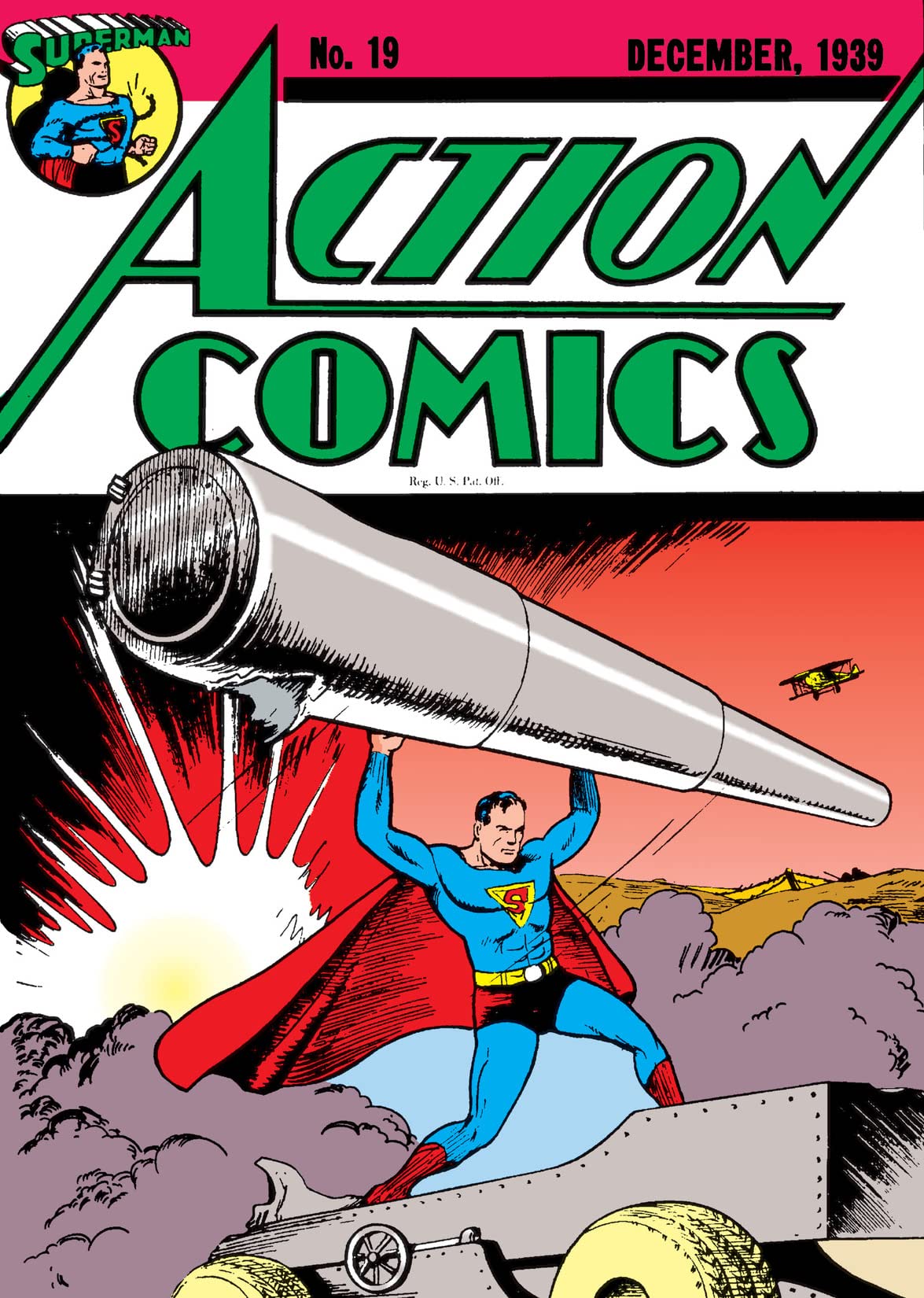
Action Comics #19
Action Comics #19 is a pivotal chapter in Superman's earliest mythology because it delivers the fourth and apparently conclusive confrontation between the Man of Steel and the Ultra-Humanite — widely regarded as the first recurring supervillain in comic-book history, predating Lex Luthor by roughly a year. The story's climax, in which Ultra's own electric gun seemingly destroys him, set in motion the villain's body-transference concept that would define his character for decades and influence how comics writers constructed 'death-proof' antagonists. At the same time, the issue marks the point at which DC committed to placing Superman on every cover going forward — a direct editorial response to newsstand demand — cementing the character's dominance over the anthology format. The issue thus captures the precise moment Action Comics pivoted from a pulp variety book into a de facto Superman title.
In "The Purple Plague," Pep faces a wave of criminal chaos after a mysterious iron bar blocks his path home, triggering a train heist and a dangerous game of cat-and-mouse. Written by Gardner Fox and illustrated by Gene Baxter, this 1939 installment of Action Comics delivers a gripping early adventure featuring a hero whose quick thinking and local fame prove crucial in outwitting a persistent gang. The cover by Joe Shuster and Paul Cassidy captures the tension of the moment, a striking visual that hints at the danger lurking just beyond the rails.
In "The Purple Plague," a mysterious violet disease ravages Metropolis, leaving Superman racing against time to protect Dr. Travers—the only one who knows the antidote—from the sinister Ultra-Humanite, who seeks to weaponize the plague. With lives hanging in the balance, the Man of Steel must outwit a foe who thrives in shadows and science.
In "The Train Robbery," Pep finds himself caught in a dangerous game when a stolen iron bar blocks the tracks, leading to a daring robbery attempt by a gang of thugs. With quick thinking and a note to the station man, Pep sets a trap that sends the criminals fleeing—only for a new threat to emerge when his past actions come back to haunt him.
In "The Boot Thieves," Chuck finds himself caught in a twist of fate when an outlaw steals his boots and tosses him a fresh pair—only to land him in trouble when a storekeeper recognizes the stolen footwear as proof of his guilt. With the law closing in, Chuck must outwit both the sheriff and deputy to clear his name and track down the real culprits behind the robbery.
In "The Ivory Safari, Part 1," daredevil adventurer Kenye Clip takes on a perilous mission to escort a shipment of ivory through hostile territory after a series of raids by the infamous bandit "Wolf" Lupo. When an assassination attempt leaves him facing a deadly cobra, and the safari is ambushed by cannibals, Clip's quick thinking and unexpected use of harmonicas turn the tide—offering a surprising, peaceful solution to a life-threatening standoff.
In "The Zombies [Part 1]," famed actor John Barryless enlists Tex to find his missing son Bart, last seen in the Sudan. When Tex and Bob arrive at the remote outpost, they discover a frantic note cut short—“I am being attacked by zombies Bar---”—and soon fall into a hidden pit where they find Bart, trapped with the locals. As the tribal chief prepares to inject them with a mind-sapping chemical, the trio faces a terrifying ordeal in the heart of the African wilderness.
ComicBooks.com Value
Show all 20 grades ▾
More listings for this title
Read it digitally
Sell my copy
Have this issue — or a whole collection? Get a fair offer from us, skip the marketplace fees and the hassle.
We Buy Collections ▸History
The Superman lead story — titled retroactively 'Superman and the Purple Plague' — was written by Jerry Siegel and drawn under Joe Shuster's studio banner; by late 1939 Shuster was relying on assistants including Paul Cassidy to meet the pace demanded by simultaneous Action Comics and Superman quarterly output. Vin Sullivan served as editor throughout this run. The issue was published by Detective Comics, Inc. — the corporate entity that by 1940 would be commonly identified as DC Comics — and went on sale October 24, 1939.
Trivia · 8 facts
- Cover date: December 1939; on-sale date: October 24, 1939; publisher: Detective Comics, Inc. (pre-DC branding).
- The Superman lead story — retroactively titled 'Superman and the Purple Plague' — features the Ultra-Humanite's fourth overall appearance (previous appearances: Action Comics #13, #14, and #17) and his apparent death when his own electric gun explodes in his face.
- Ultra-Humanite, created by Jerry Siegel and Joe Shuster, was Superman's first recurring nemesis and is considered among the earliest true recurring supervillains in comic-book history — debuting in Action Comics #13 (June 1939), a full year before Lex Luthor.
- The issue's plot turns on Ultra unleashing a manufactured 'Purple Plague' on Metropolis, attempting to mind-control Superman into spreading the disease, and ultimately being foiled when Superman feigns mind-control and destroys the villain's plague stockpile.
- Action Comics #19 represents the first issue from which DC made Superman's cover appearance a consistent, ongoing commitment — a policy shift driven by reader demand for the Superman-cover issues.
- The anthology backup lineup includes: Pep Morgan ('The Train Robbery'), Chuck Dawson ('The Boot Thieves'), Clip Carson ('The Ivory Safari, Part 1'), Tex Thomson ('The Zombies, Part 1') featuring supporting cast Bob Daley and Gargantua T. Potts, the Three Aces ('Murder in the Air'), and Zatara ('The Gorilla King') featuring Tong.
- The Zatara story 'The Gorilla King' involves mad doctor Herbert Handers transplanting human brains into gorilla bodies in a walled city in Mexico — a brain-transplant plot that directly echoes Ultra-Humanite's own signature concept introduced in the same issue's lead story.
- The Superman story from this issue was reprinted in the DC Archive Edition 'Superman: The Action Comics Archives Vol. 1' and 'Superman Chronicles Vol. 2.'
Cast · 13 characters
Full credits
Reprints
↩ Reprints Superman #3 (1940)
Reprinted in Superman in Action Comics #1 (1993), Superman: The Action Comics Archives #1 (1998), Clásicos DC #6 (2005), The Superman Chronicles #2 (2007), Superman: The Golden Age Omnibus #1 (2013), Superman: The Golden Age #1 (2016), DC Finest: Superman: The First Superhero #[nn] (2025)
Key issues in Action Comics
Reviews
Reader reviews
No reader reviews yet.