
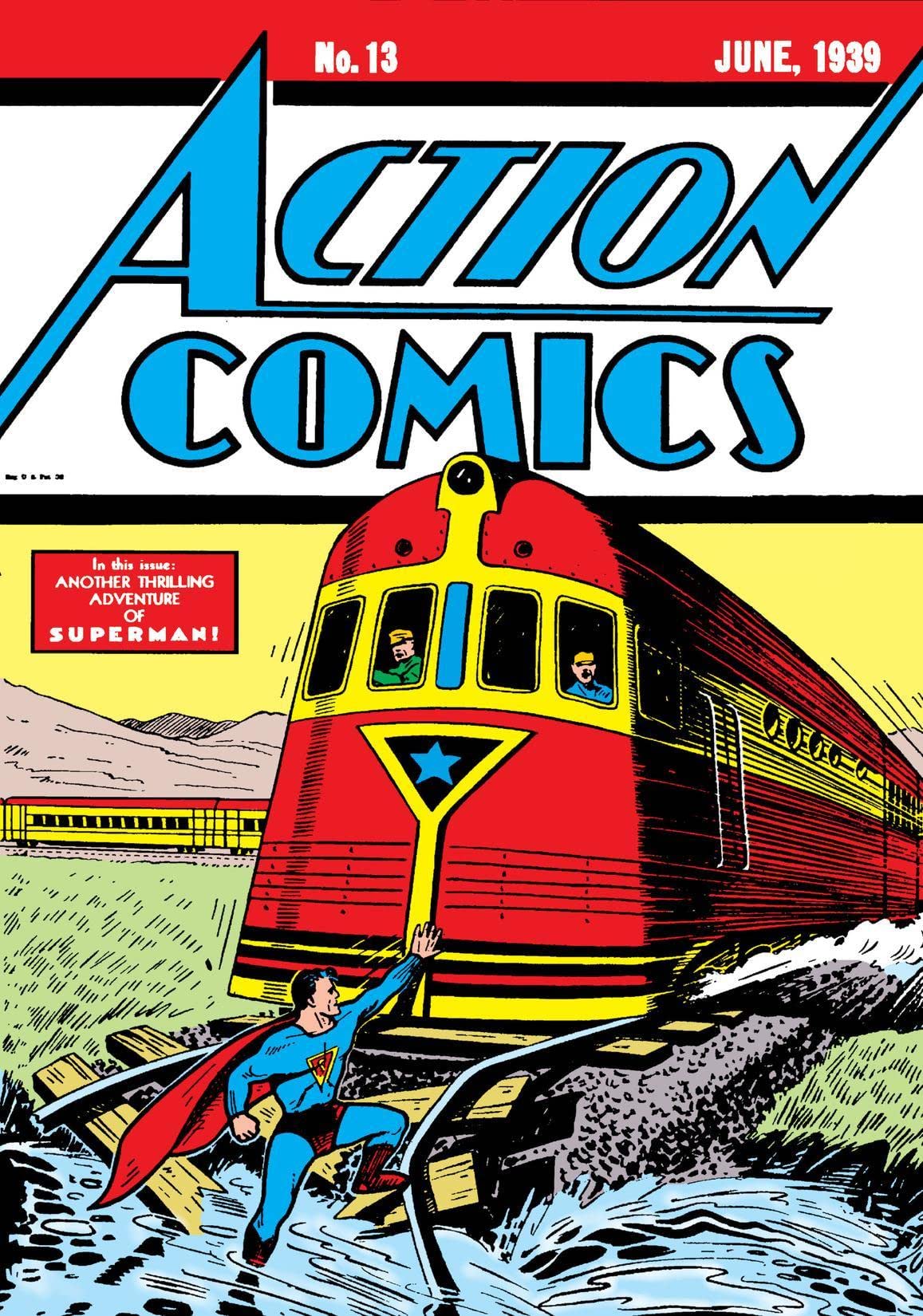
Action Comics #13
Action Comics #13 (cover date June 1939) stands as a genuine turning point in superhero storytelling because it introduced the Ultra-Humanite — Superman's first recurring supervillain and, by most accounts, the first true recurring supervillain in mainstream American comic books. Where every earlier antagonist had been a disposable gangster or one-and-done heavy, the Ultra-Humanite was deliberately constructed as Superman's intellectual opposite: a wheelchair-bound criminal genius whose paralyzed body and towering intellect made him a fundamentally different kind of threat. The character would serve as Superman's primary nemesis until Lex Luthor displaced him just ten issues later, and his body-hopping concept — transplanting his consciousness into new hosts — seeded one of comics' most durable and philosophically unsettling villain archetypes. Beyond the villain debut, the issue also marks the first appearance of the 'S' symbol on Superman's cape, a costume detail that became inseparable from the character's visual identity.
In "Superman vs. the Cab Protective League," Superman takes on the corrupt Cab Protective League to defend independent cab drivers, showcasing his early commitment to justice. But his victory is short-lived as he faces a chilling new adversary— the Ultra-Humanite, a genius whose mind was enhanced by science, now plotting to rule the world. Written by Jerry Siegel and illustrated by Joe Shuster, with a cover by Wayne Boring, this 1939 classic captures Superman’s growing role as a protector in a world full of unseen threats.
In "Superman vs. the Cab Protective League," Superman takes on the corrupt Cab Protective League to defend independent cabbies, only to find himself facing a far more dangerous adversary: the Ultra-Humanite, a genius whose mind, enhanced by science, now threatens to rule the world.
In "The Ibor Jewel Curse," Scoop and Rusty chase a lead that takes them straight into a mystery tied to a cursed treasure from India. When they discover a dead man on the steps of a secluded house, the man’s survivor, William Davis, reveals a chilling pattern of deaths among those who once shared in the jewels’ discovery—each victim meeting a grim end. The truth behind the so-called curse lies not in the supernatural, but in a cold, calculated human hand.
In "The Journey Home, Part 1," Jo embarks on a sea voyage from South America, seeking to return home. When Captain Sindra, a fugitive from jail, spots his old crewmate Dunn on the docks, he slips aboard under a false name, plotting a mutiny with Dunn. But as the ship sails, Pep’s sharp ears catch the conspiracy—and he’s determined to stop it.
ComicBooks.com Value
Show all 19 grades ▾
This exact issue on ebay
CGC 6.5 ▾ $27,000–$126,510 2 listings
Raw / ungraded ▾ $6,150–$71,500 2 listings
More listings for this title
Read it digitally
Sell my copy
Have this issue — or a whole collection? Get a fair offer from us, skip the marketplace fees and the hassle.
We Buy Collections ▸History
By the spring of 1939, Superman's overnight success had ballooned Siegel and Shuster's workload to an almost unmanageable degree: they were simultaneously producing a monthly Action Comics strip, a monthly Superman title, and a daily newspaper comic strip launched in January 1939. To manage the volume, Shuster had brought in ghost artist Paul Cassidy — a Milwaukee art instructor who had answered a help-wanted notice — to handle penciling and inking duties, with all work credited to Shuster. It was Cassidy, working with relative creative latitude according to his own later accounts, who introduced both the five-sided diamond 'S' on Superman's chest and the matching emblem on the cape in this issue, even if the cape symbol appears inconsistently from panel to panel. The Superman story was written by Jerry Siegel and the entire 68-page anthology was edited by Vin Sullivan (credited as Vincent A. Sullivan) for publisher Detective Comics, Inc.
Trivia · 8 facts
- First appearance of the Ultra-Humanite (June 1939), created by Jerry Siegel and Joe Shuster, making him Superman's first recurring supervillain and one of the earliest recurring supervillains in superhero comics.
- The Ultra-Humanite is depicted in his original form: a nearly bald, wheelchair-bound criminal mastermind whose genius intellect — the product of a self-administered scientific experiment — is his sole superpower, a deliberate contrast to Superman's physical strength.
- The Superman story 'Superman vs. the Cab Protective League' was written by Jerry Siegel and drawn by Paul Cassidy, ghosting for Joe Shuster; the issue was edited by Vin Sullivan for Detective Comics, Inc., with a cover date of June 1939 and an on-sale date of April 24, 1939.
- Paul Cassidy, the first ghost artist on Superman (active 1938–1940), introduced the 'S' shield emblem on Superman's cape in this issue — though it appears only in some panels — as well as refining the chest 'S' into a five-sided diamond shape, both of which became permanent fixtures of the character's costume.
- This is the final Action Comics appearance of the Scoop Scanlon strip (art by Will Ely); the feature moved to Holyoke Publishing after this issue, with Clip Carson by Bob Kane replacing it starting in issue #14.
- The issue is a 68-page anthology also featuring: Pep Morgan (story by Gardner F. Fox, art by Fred Guardineer under the pseudonym 'Gene Baxter'); Tex Thomson (art by Bernard Baily); Chuck Dawson (art by Homer Fleming); Adventures of Marco Polo part XIII of XVII (art by Sven Elven); and Zatara's 'Swamp of Satan' (script by Gardner F. Fox, art by Fred Guardineer).
- The Ultra-Humanite served as Superman's arch-nemesis through Action Comics #21 (1940), after which he was supplanted by Lex Luthor, who debuted in Action Comics #23. One noted fan theory — popularized by John Byrne's Superman/Batman: Generations — is that Luthor's famously bald appearance was influenced by artist Leo Nowak modeling the newly redrawn Luthor on Cassidy's depiction of the Ultra-Humanite.
- The Superman lead story from this issue has been reprinted in Superman: The Action Comics Archives Vol. 1 (DC Archive Editions, 1997), Superman Chronicles Vol. 1 (2006), Superman: The Golden Age Omnibus Vol. 1 (2013), Superman: The Golden Age Vol. 1 (2016), and DC Finest: Superman: The First Superhero (2024).
Cast · 11 characters
Full credits
Reprints
↩ Reprints Superman #[1] (1939)
Reprinted in Superman from the Thirties to the Eighties #[nn] (1983), Superman in Action Comics #1 (1993), Superman: The Action Comics Archives #1 (1998), Clásicos DC #6 (2005), The Superman Chronicles #1 (2006), Superman: Cover to Cover #[nn] (2006), Superman: The Golden Age Omnibus #1 (2013), Superman: The Golden Age #1 (2016), DC Finest: Superman: The First Superhero #[nn] (2025), Aventures #11/1941, Aventures #12/1941, Aventures #13/1941, Aventures #14/1941, Aventures #15/1941
Key issues in Action Comics
Reviews
Reader reviews
No reader reviews yet.