
A complete issue · 68 pages · 1924
Captain Billy's Whiz Bang #59
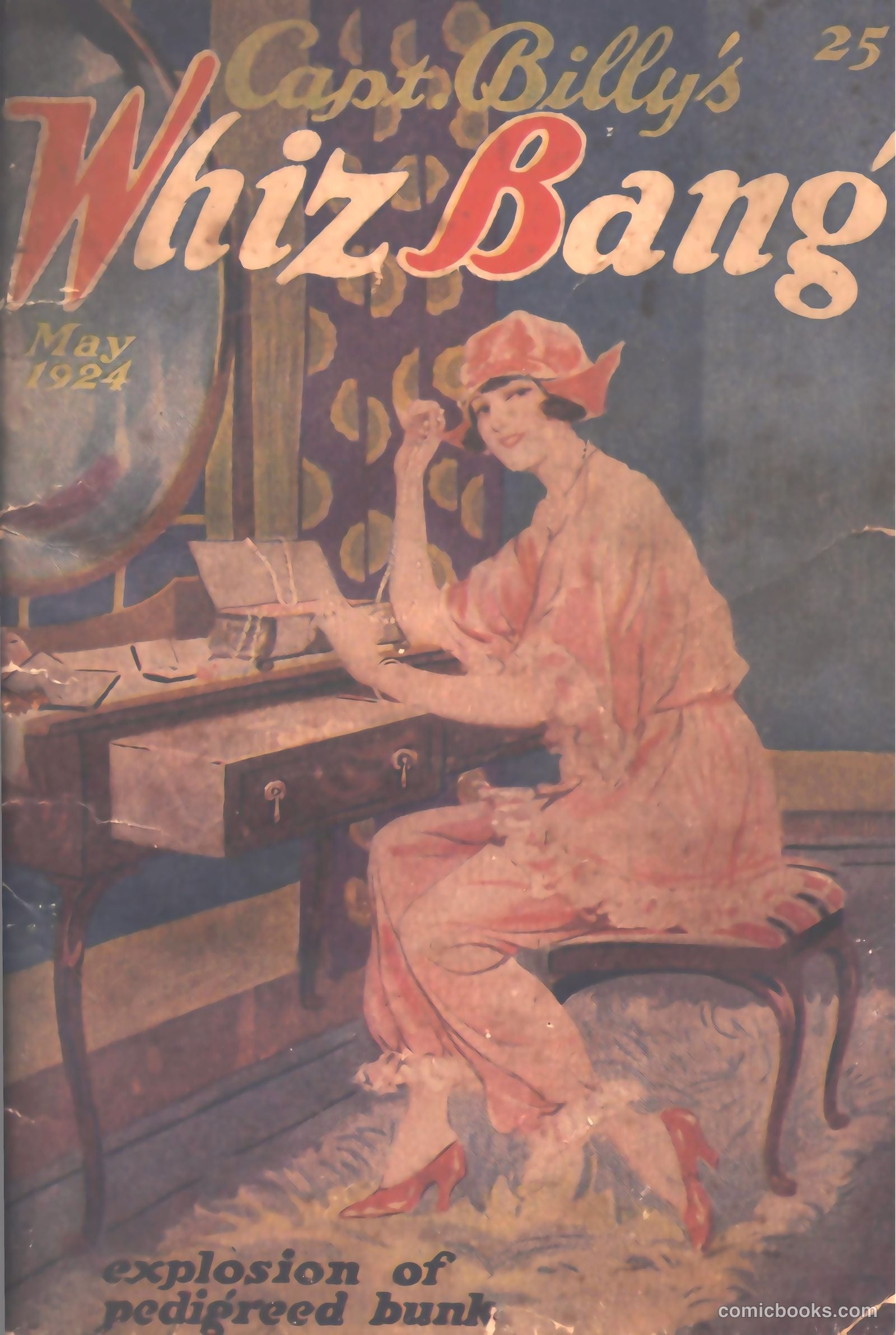
This is the cover of *Whiz Bang*, a satirical magazine edited by "Captain Billy" (Billy DeBeck). The illustration depicts a woman in pink loungewear and cap sitting at a vanity mirror, applying makeup or adjusting her appearance. The subtitle reads "explosion of pedigreed bunk," suggesting the magazine's satirical purpose—debunking pretentious claims or exposing nonsense. The 1924 date and the woman's appearance reflect post-WWI attitudes about changing female fashion and behavior. The "pedigreed" reference likely mocks upper-class or aristocratic pretensions. Without additional context about the specific issue's contents, the exact satirical target remains unclear, though it appears to lampoon vanity or false sophistication among women of the era.
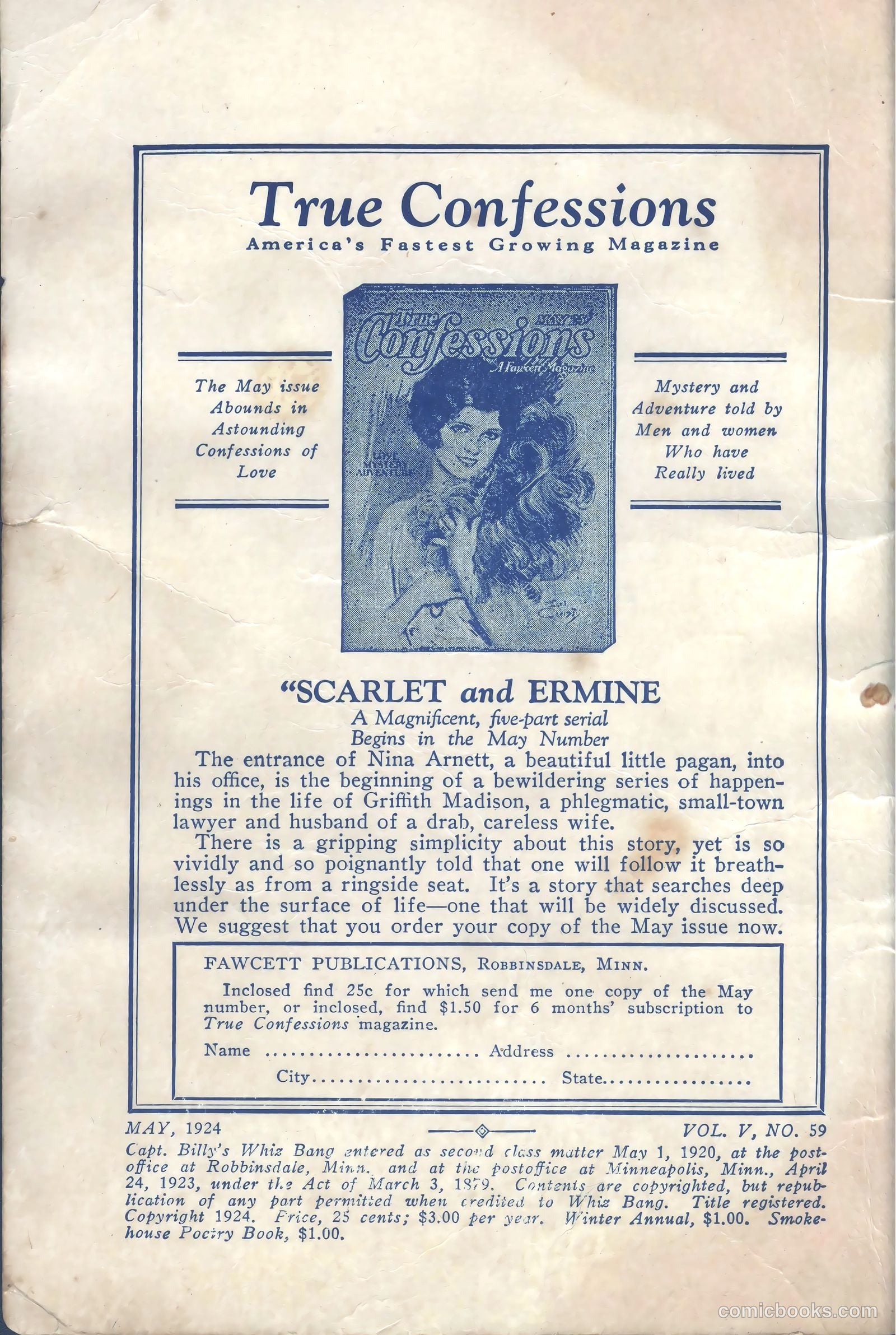
This is primarily a **magazine advertisement**, not a cartoon or satirical content. It promotes *True Confessions* magazine's May 1924 issue published by Fawcett Publications in Robbinsdale, Minnesota. The ad features an illustration of a young woman with long hair and emphasizes the magazine's appeal to readers seeking personal stories. It advertises a five-part serial titled "Scarlet and Ermine," describing a narrative about Nina Arnett entering lawyer Griffith Madison's office, leading to complications involving his neglectful wife. The subscription offer costs 25 cents for a single issue or $1.50 for six months. This represents early 20th-century pulp magazine marketing, targeting audiences interested in romance and domestic drama presented as "real" confessions—a popular genre emphasizing sensationalism and relatability.
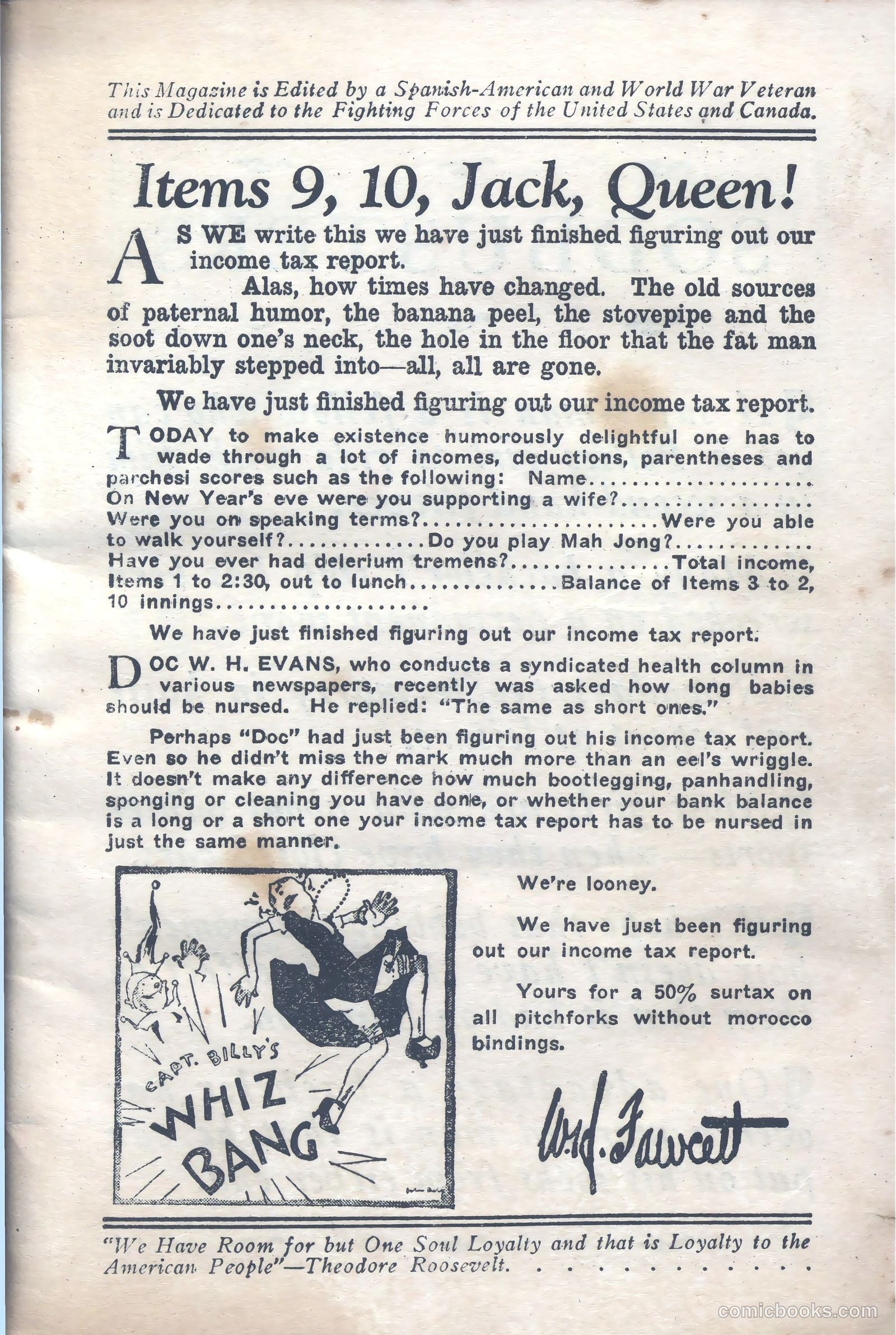
This page satirizes the tedium and complexity of filing income tax reports, a relatively new burden for Americans. The repeated refrain "We have just finished figuring out our income tax report" emphasizes how exhausting and mind-numbing the task is. The humor relies on absurdist logic: outdated slapstick comedy tropes (banana peels, soot down necks) are "gone" because people are too exhausted by taxes to enjoy simple humor. Doc W. H. Evans's joke about nursing babies "the same as short ones" illustrates how tax forms make people nonsensical. The cartoon shows "Capt. Billy's Whiz Bang"—a character taking a comedic tumble—suggesting that even humor itself gets knocked down by tax season. The closing joke about a "50% surtax on all pitchforks without morocco bindings" mocks the absurdly specific tax regulations citizens faced.
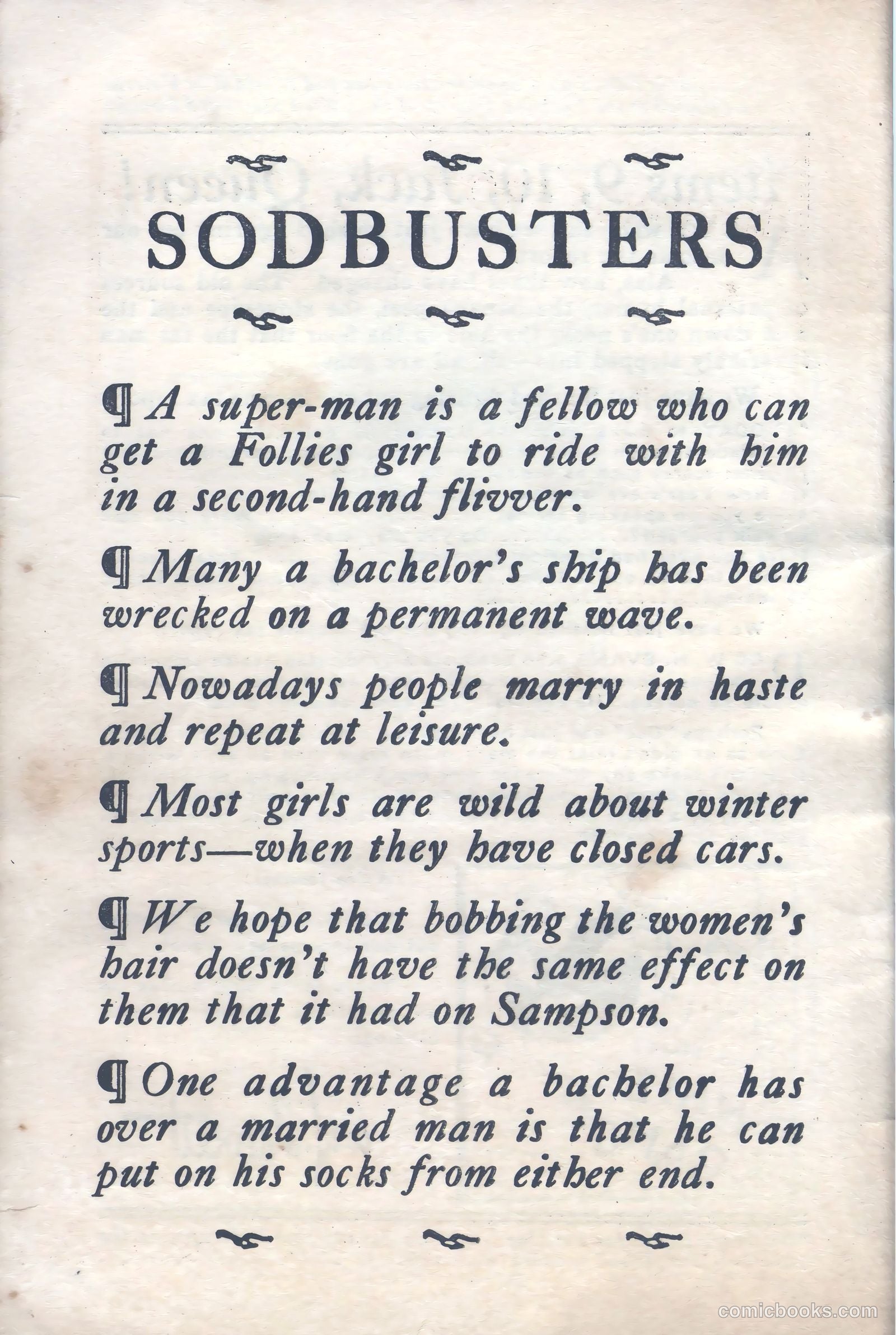
This page from *Whiz-Bang* presents "Sodbusters"—brief humorous quips about bachelor and married life, typical of 1920s men's humor magazines. The jokes target social anxieties of the era: expensive courtship (Follies girls), marriage as a trap ("permanent wave" as metaphor for being stuck), hasty weddings, and women's newfound independence (winter sports, bobbed hair). The Samson reference alludes to biblical strength loss through a woman's influence—here, concern that bobbing hair (a 1920s feminist symbol) might similarly emasculate men. The final joke mocks married men's loss of autonomy, suggesting bachelors retain basic freedoms. These represent period anxieties about women's changing roles and sexuality during the Jazz Age, presented through light misogynistic comedy typical of male-oriented humor publications of that decade.
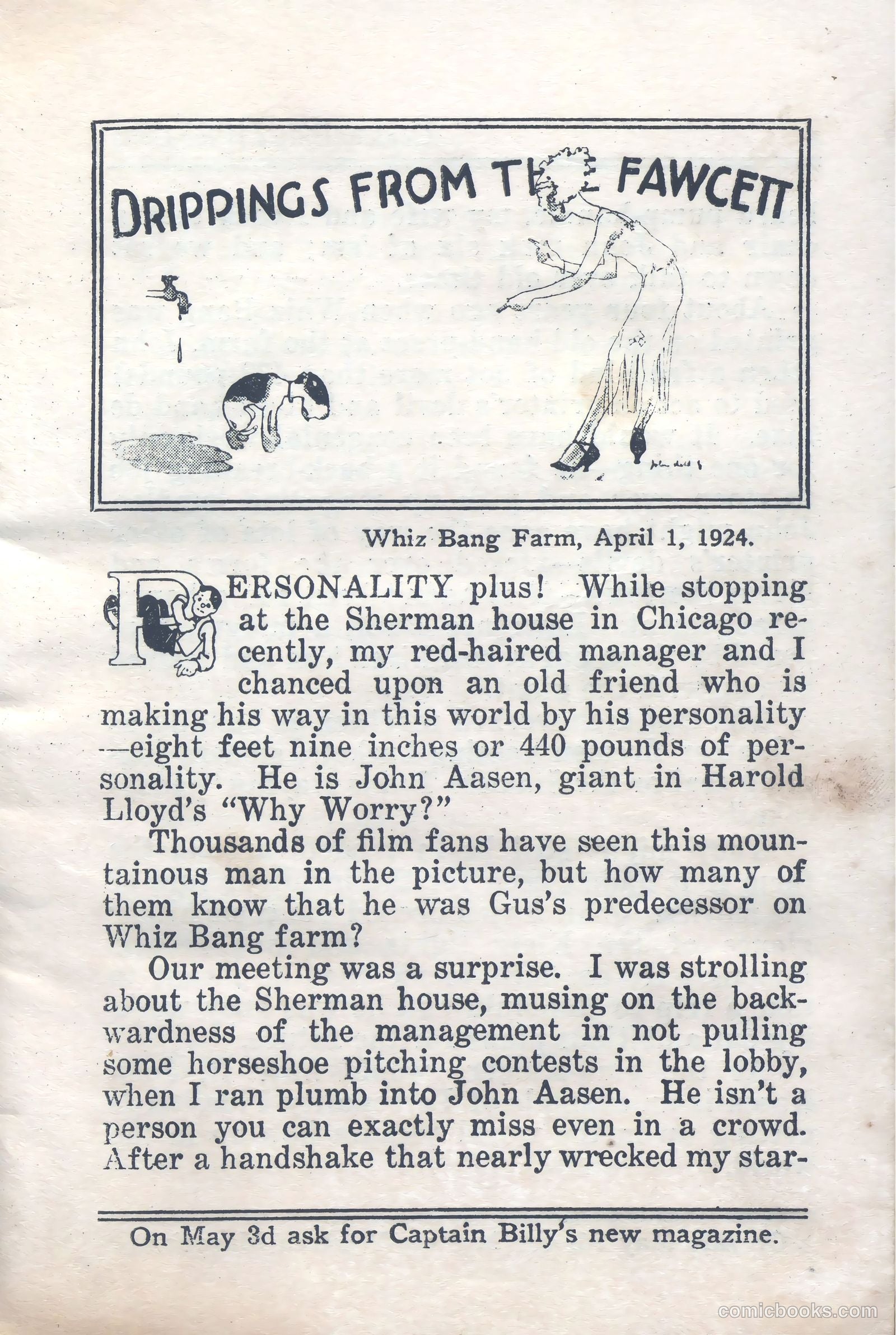
This page combines a cartoon and advertisement from *Whiz Bang* magazine (April 1, 1924). **The Cartoon**: The header illustration shows a woman dripping water onto a small dog. It's a crude visual gag—likely a pun on "faucet" sounds or bathroom humor typical of this era's satirical magazine style. **The Text**: The main article discusses meeting John Aasen, a 8'9" tall actor who appeared in Harold Lloyd's film "Why Worry?" The writer notes Aasen was "Gus's predecessor on Whiz Bang farm"—likely referring to another figure associated with the magazine's fictional farm setting. The piece humorously emphasizes Aasen's remarkable height and mentions the surprisingly firm handshake from this "mountainous man." It's primarily a celebrity anecdote promoting both Aasen and *Captain Billy's* magazine.
This is not a cartoon page but rather **prose content** — a reminiscence by the magazine's editor about the publication's history. The text describes how John Aasen, a notably tall man (contrasted with Lawrence Buck, described as a "midget"), worked together on the magazine four years prior. The piece humorously notes how Aasen was tempted away by Hollywood's "Kleig lights," becoming "famous," while reflecting on his "Personality Plus" — suggesting success comes from personal magnetism rather than printing skills. The bottom advertises an upcoming Mystery-Western Magazine. There are **no visible cartoons or caricatures** on this page to analyze.
This page contains three separate humorous anecdotes rather than political cartoons: 1. **"Armistice Encounter"**: A story about encountering an old backwoods man in Northern Minnesota while wearing a khaki uniform. The man hasn't heard news of WWI's end (Lee's surrender reference suggests confusion about which war). The satire mocks rural isolation from current events. 2. **"Game Hog Reform"**: A brief note about state game commissions banning publicity photos of dead wildlife, positioning hunting as "poor sport" rather than sportsmanship—likely responding to post-WWI conservation efforts. 3. **"Street Car Incident"**: An incomplete anecdote beginning on a Twin City trolley, cut off mid-story. The page appears designed for light comedic reading rather than serious political commentary. A footer advertises "The New Fawcett magazine" launching May 3rd.
This page contains humorous anecdotes rather than cartoons. The jokes target: 1. **A conductor's unusual excuse**: A man won't retrieve money from his pocket because he's buying shoes and fears losing the size—a absurdist deflection from accusations of paralysis or dishonesty. 2. **"Philanthropist" joke**: Olaf doesn't understand the word "philanthropist" (public benefactor). His confused response "The son-of-a-gun!" suggests rural/immigrant unfamiliarity with refined vocabulary—typical satire of the era mocking working-class ignorance. 3. **Police chief's observation**: Chief Bloberger quips that some dishonest men are merely "broadminded"—cynical commentary on crime rationalization. 4. **Mah-jongg debate**: References a contemporary 1920s fad (Chinese tile game), with Deacon Callahan attributing its origins to Confucius—likely poking fun at the game's trendy exoticism among Americans.
This page contains humorous anecdotes rather than political cartoons. The jokes rely on rural/small-town American stereotypes and wordplay typical of 1920s-30s satirical magazines: 1. A neighbor spreading false rumors about a "Yawn Shing" craze supposedly from Palestine—likely mocking how exotic fads spread through gossip. 2. A barber's self-talk leading to an unwanted haircut—absurdist humor about overthinking. 3. Commentary on regional differences, suggesting Northern/Midwestern audiences cheer loudest for "Dixie" despite the Mason-Dixon line dividing North and South—poking fun at North-South cultural tensions and hypocrisy. 4. A mention of receiving poetry from a penitentiary inmate—suggesting rehabilitation or unexpected talent from unlikely sources. The humor targets small-town pretension and regional stereotypes.
This page contains humorous anecdotes rather than political cartoons. The satire targets social absurdities: 1. **The "only poet" joke**: A writer claims to be the sole poet in his location—a self-aggrandizing boast the narrator mocks through repetition. 2. **Movie theater advertising**: Two contrasting signs (one promoting "Three Weeks" by Elinor Glyn, another offering warmth) humorously highlight desperation in entertainment marketing during what appears to be winter. 3. **Rural ignorance satire**: An elderly woman from Robbinsdale fears a "new train" because the engineer won't know the route—mocking rustic unfamiliarity with modern technology and progress. 4. **The poem challenge**: Gus offers payment for someone to complete an intentionally bad poem, satirizing low literary standards. These anecdotes exemplify *Whiz Bang*'s trademark humor: gentle ribbing of small-town life, advertising absurdity, and technological anxiety.
This page contains humorous anecdotes rather than political cartoons. The pieces mock rural and small-town American life through brief satirical observations: **Deacon Miller** offers tongue-in-cheek advice for entertainment—playing Mah-jongg, eating chocolate fudge, and socializing—presented as thrilling activities to tempt "healthy men," satirizing the mundane pleasures of rural life. **Zeph White** of Pequot is mocked for not recognizing spring because he hasn't seen beer advertisements announcing its arrival, satirizing commercial culture's influence on seasonal awareness. The final anecdote jokes about aggressive, dim-witted men who succeed through sheer nerve despite lacking intelligence—comparing their offensiveness to "limberger cheese to a dyspeptic." These are gentle, folksy satirical observations typical of 1920s humor magazines targeting urban readers amused by rural stereotypes.
This page contains brief humorous anecdotes rather than political cartoons. The jokes target: 1. **University courses**: Satire on a University of Washington correspondence course for mothers about baby care, with a joke about "Lunch Hour" being lesson one. 2. **Women's appearance**: A quip suggesting women need only possess physical attractiveness to invite "suspicion" (implying infidelity). 3. **Hog contentment**: Folksy humor about a pig's simple life ambitions—eating and mud. 4. **A farmer's misunderstanding**: Dark comedy about a hired man's poorly-worded telegram announcing the farmer's wife's death, which the farmer initially misunderstood as referring to his cow. 5. **Olaf's fake degree**: A joke about someone claiming a humorous made-up degree in "Bugs and Indisposed Radio Sets." The page exemplifies typical 1920s satirical magazine humor—lighthearted, occasionally crude, focused on domestic and rural scenarios.
This page contains three separate humorous anecdotes rather than cartoons: 1. **The Bathtub Story**: A joke about "Gus," a hired man who fell asleep in a running bathtub. The humor relies on the clerk's dry observation that Gus was "lucky he slept with his mouth open"—implying the water would have drained into his mouth rather than overflowing the tub. 2. **Social Commentary**: A brief quip about changing times, replacing "wine, women and song" with "methyl alcohol, a trained nurse and 'Lead Kindly Light.'" 3. **Hamlin Garland Quote**: Discusses the literary tendency to romanticize rural life while criticizing cities. Author Garland explains his preference for cities despite their physical ugliness—he values "intellectual companionship" over pastoral aesthetics. The page reflects 1920s attitudes toward modernization, rural versus urban life, and satirizes both literary pretension and everyday absurdity.
This page contains a collection of short humorous anecdotes rather than cartoons. The jokes target rural/small-town life and social pretension: 1. A dig at intellectual pretension in Robbinsdale 2. A joke about a poorly-maintained Ford automobile 3. An anecdote about the author's car trouble near Brainerd, followed by a gravestone inscription humorously suggesting the deceased wife was unfaithful—with a guest's sarcastic comment about the husband suing for "alienation of affections" 4. A brief joke about a Leap Year proposal to a recently-released convict The humor relies on crude wordplay, class humor, and cynicism about marriage. The page closes with an advertisement for the magazine itself, on sale May 8th.
This page contains humorous anecdotes rather than political cartoons. The content includes: 1. **Olaf's Romance**: A joke about Olaf (apparently a hayshaker or farmhand) who announces a new girlfriend in Brainerd who works as a "dairy maid in a candy kitchen" making milk chocolates—a pun playing on the unusual job description. 2. **Gospel Animal Joke**: A reference to zoologists searching for "The Consecrated Cross I'd Bear," apparently a hymn-based animal name joke. 3. **Whiz Bang's Travel Anecdote**: The author describes declining a Parisian guide while managing the American Olympic trap-shooting team, choosing conscience as his guide instead—a mild philosophical quip. 4. **Final Punchline**: "Yours till they sell corkscrews as antiques"—a closing joke about obsolescence. The page is primarily text-based satire and humor, signed by Whiz Bang Bliff.
This page contains five brief humorous anecdotes rather than cartoons: 1. **"At the Pearly Gates"**: A joke about an applicant denied heaven because they can only play saxophone poorly—St. Peter sends them to Hell instead. 2. **"Gus Says"**: A brief item about someone traveling to Hawaii to unload hay and see an "uncovered wagon" (likely a risqué reference). 3. **"Golden Rule Days"**: A classroom joke where a student defines "sympathy" as "blind man's bluff"—playing on words rather than understanding. 4. **"The Armpit Blues"**: A verse mocking a village artist's model, suggesting her blonde hair is artificially bleached. 5. **"Darn the Sun and Air"**: A flirtation interrupted by daylight—satirizing romantic inconvenience. The page exemplifies *Whiz Bang*'s irreverent, pun-heavy humor targeting everyday situations.
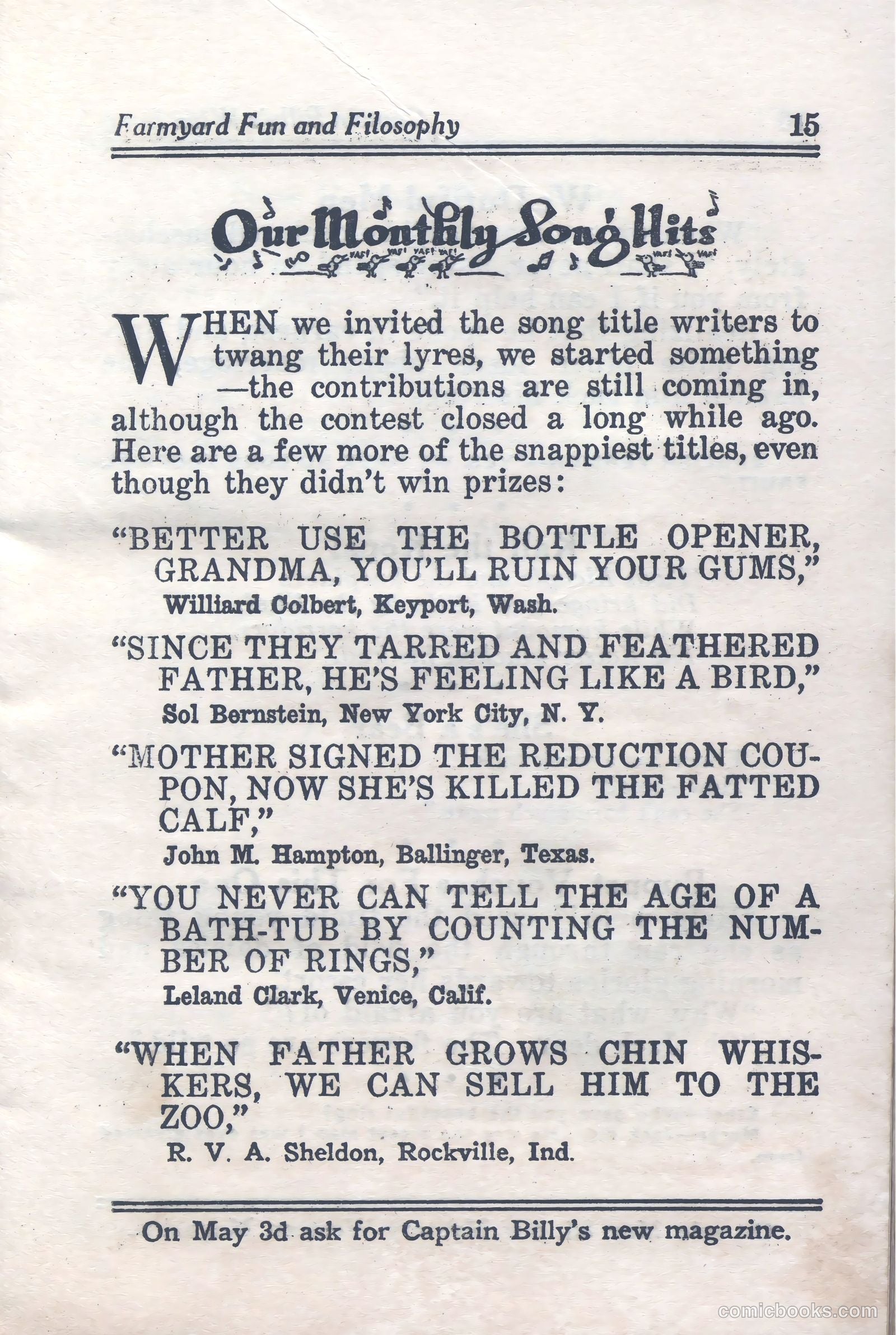
This page presents humorous fake song titles submitted to a magazine contest. The satire works by taking mundane, slightly absurd domestic situations and treating them as if they were serious song subjects—a parody of contemporary popular songwriting. The jokes target everyday family life: a grandmother ruining her gums with a bottle opener, a father feeling bird-like after getting a haircut, a mother killing a fattened calf due to a coupon mistake, difficulty aging a bathtub, and selling a bearded father to the zoo. The humor derives from the contrast between the silly, trivial premises and the formal presentation as legitimate song titles with credited contributors from various American cities. It's gentle satire of both domestic absurdity and the proliferation of sentimental popular songs of the era.
This page contains five separate humor sketches with punchlines, typical of Whiz Bang's satirical format. Rather than political cartoons, these are social comedies targeting early 20th-century domestic and gender relations: 1. **"We Dutiful Men"** mocks men who promise unwavering devotion in marriage; the woman's rejection suggests such promises are unrealistic. 2. **"Kall the Kops!"** appears to be nonsense verse humor, unclear without additional context. 3. **"She's a Bear"** jokes about a woman with a weak back—likely playing on "bear" as slang for a difficult/unattractive person. 4. **"Puppet Vouches For This One"** satirizes timid women afraid of flowers, with the punchline hinging on romantic irony. 5. **"Ethel"** concludes with dark humor about divorce and jewelry. These reflect period attitudes toward marriage, femininity, and social propriety through crude stereotypes.
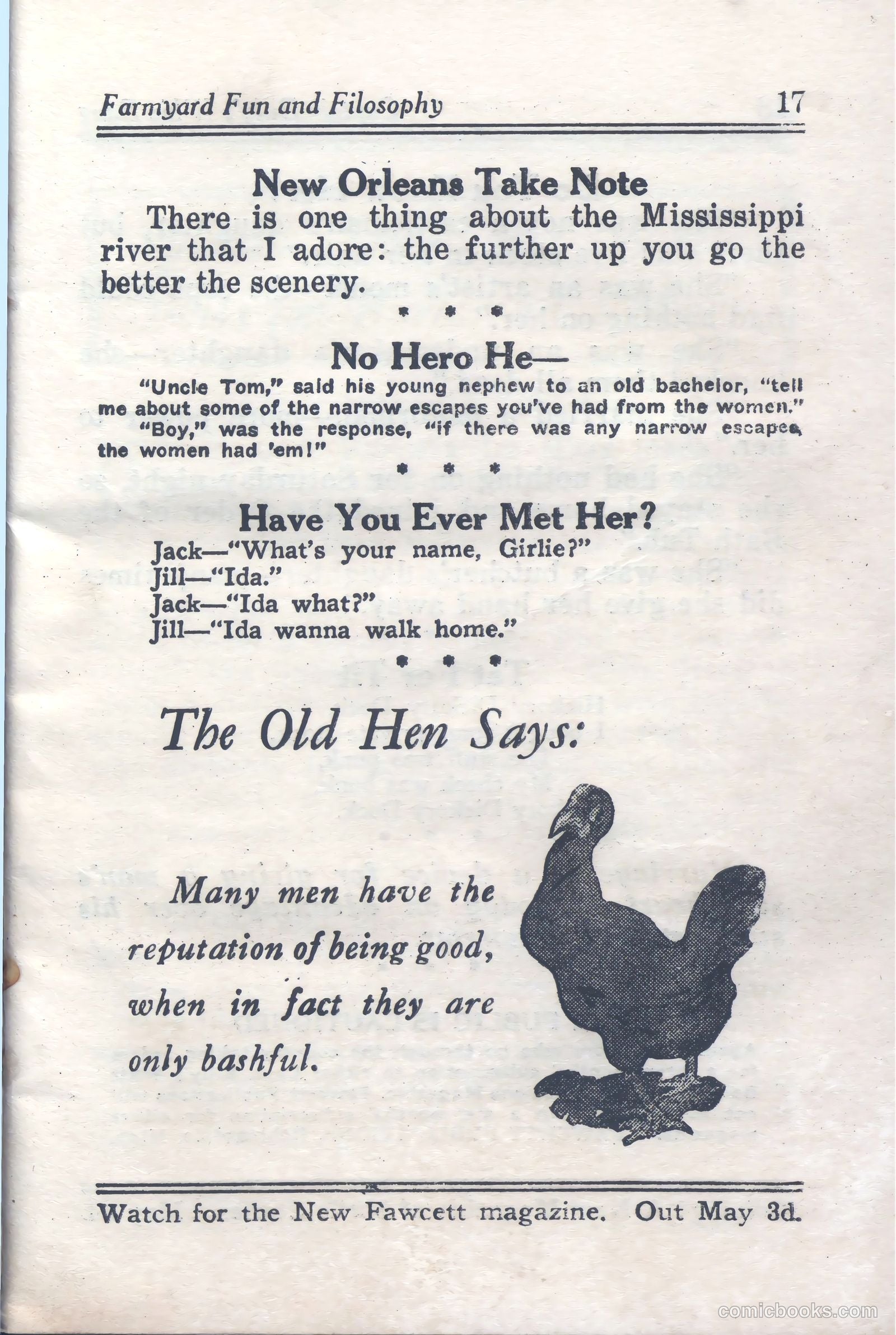
This page contains four brief humorous items typical of 1920s satirical magazines: 1. **"New Orleans Take Note"** — A mild geographical joke about the Mississippi River's scenery improving upstream. 2. **"No Hero He"** — A joke about an old bachelor claiming women caused his narrow escapes, contradicted by a boy who says women were actually responsible for them (implying the bachelor couldn't escape women's interest). 3. **"Have You Ever Met Her?"** — A pun-based dialogue where "Ida" sounds like "I'd a" (I would have), with the punchline playing on "Ida wanna walk home" (I'd want to walk home). 4. **"The Old Hen Says"** — An illustrated aphorism about men having reputations for goodness when they're merely shy/bashful. The hen serves as a folksy wisdom figure. All are lighthearted domestic humor targeting courtship and masculinity stereotypes.
This page contains humor sections rather than political cartoons. The content includes: **"Do You Know Her?"** — A series of ribald jokes playing on women's occupational backgrounds (cattleman's daughter, artist's model, undertaker's daughter, butcher's daughter) with double-entendre punchlines about their sexual availability or behavior. **"Tat For Tat"** — A nursery-rhyme parody about poor investments ("private stock"). **"Marriage" definition** — A cynical quip about marriage providing men present advantage over future romance. The page also contains a **publisher's caution** warning against unauthorized subscription solicitors. These represent typical 1920s "adult" humor—risqué jokes about women's morality and sexuality, presented without illustration. The satire targets sexual double standards and marriage rather than specific political figures.
This gossip column from *Whiz-Bang* (April 1, 1924) targets Barbara LaMarr, a silent film actress. The satire mocks her tumultuous personal life: she was evicted from her apartment for making loud bath splashes, her marriage to Jack Dougherty is legally questionable (since she may still be married to Ben Deely), and she's separated from Dougherty while he takes up with someone else. The humor is cruel Hollywood gossip—portraying LaMarr as a philanderer caught in serial marriages and affairs. Ben Deely is characterized as a "gay butterfly" (meaning frivolous man) now courting the recently-divorced Mrs. Monte Blue. The column implies LaMarr's chaotic love life follows her everywhere, even causing domestic disputes over bathroom noise. The tone is typical of *Whiz-Bang*'s irreverent celebrity mockery.
This page contains gossip column content rather than cartoons. The column, titled "Captain Billy's Whiz Bang," reports on Hollywood scandals circa the 1920s silent film era. **Key references:** - **Mary Pickford**: A major silent film star; the text notes her maid left after four years to pursue acting - **Wallace Beery**: A popular male film actor; the column jokes that a former maid (Mme. de Bodamere) wants to become "the female Wallace Beery" - **Cullen Landis**: An actor whose divorce is discussed, with age difference cited as a cause The satire targets Hollywood's instability—servants leaving to pursue acting, convenient reconciliations between separated spouses, and marital discord. The tone is gossipy and mildly mocking of industry pretensions and romantic chaos among celebrities.
This page contains celebrity gossip items rather than cartoons. The satire targets wealthy, famous figures through humorous anecdotes: **Item 1** mocks Barney Oldfield (a famous racing driver) and Texas Guinan (a New York nightclub hostess) for their extravagant spending—throwing money at orchestras and impulsively investing $200,000 in film equipment and horses while intoxicated. **Item 2** humorously praises Will Hays (a movie industry executive) for his devotion to his wife, contrasting with the stereotype of traveling businessmen who neglect their spouses. **Item 3** gossips about Ann Luther (wife of Ed Gallagher, likely an entertainer), noting her separation and $25,000 settlement. The satire targets Hollywood excess and celebrity behavior during the silent film era, using humor to critique frivolous wealth and unconventional relationships.
This page contains Hollywood gossip written in a satirical, breathless tone typical of 1920s scandal columns. The text discusses romantic entanglements among entertainment figures, including: - Ed Gallagher's marital troubles and renewed interest in Hilda Morena - Frank Auditore's disappointment when his traveling companion Irene Wales fell in love with someone else - Ann Luther's old Hollywood flame - Charles Duell's separation and young actress Lillian Gish's reluctance to marry him due to their age difference The gossip mocks the melodramatic relationship drama of Hollywood celebrities, treating their personal lives as entertainment for readers. There is no visible cartoon on this page—it's purely text-based satirical gossip journalism typical of the magazine's "scandal sheet" approach to celebrity culture.
This page contains Hollywood gossip column items with no visible cartoons. The text discusses: 1. **Lillian** (likely an actress) and her romantic interest in Pierre Troys, an Italian ship officer, with speculation she might leave her film contract. 2. **Herbert Brenon** and his wife celebrating their 20th wedding anniversary (married on St. Valentine's Day 1904). 3. **Jacqueline Logan's** romantic troubles—Jack Nolan previously denied marriage plans, and director George Melford recently testified in divorce court that he knew her but wasn't in love with her. 4. **Francelia Billington** and Lester Cuno, who reconciled after a Christmas separation, with Francelia dismissing divorce proceedings. The page is primarily a celebrity gossip column rather than satirical commentary.
This page contains Hollywood gossip columns rather than cartoons. The pieces mock early 1920s film industry scandals: 1. **Alice Lake's engagement**: The column jokes about Lake's romantic history with various actors (Arbuckle, Farnum, Lytell), suggesting her relationships were frequent and somewhat mercenary. 2. **De Wolf Hopper's divorce**: A brief jab at the comedian's fifth failed marriage. 3. **Corinne Griffith's retirement**: Satirizes her announcement to quit films and raise a family after her honeymoon, cynically suggesting financial need will force her back. 4. **William Farnum's career collapse**: The sharpest joke—that Farnum, once significant, is now so obscure he's metaphorically dead, though a competing studio (Famous Players-Lasky) has rescued him from complete obscurity. The satire targets Hollywood's instability, failed marriages, and fickle careers.
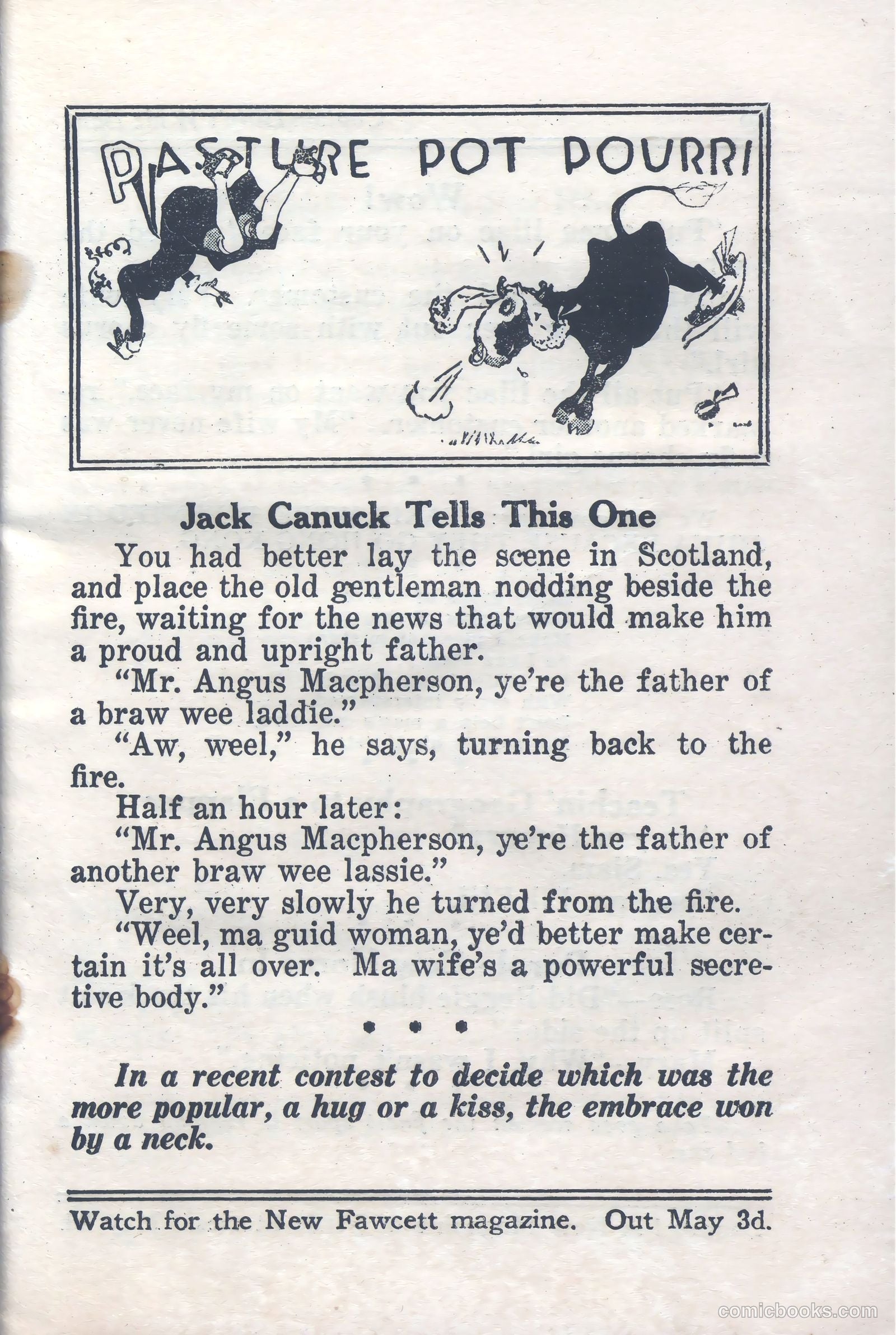
This page contains a humorous anecdote attributed to Jack Canuck (a Canadian persona popular in early 20th-century satire). The joke centers on a Scottish gentleman, Mr. Angus Macpherson, who receives news that he's fathered multiple children in quick succession—first a "braw wee laddie" (fine baby boy), then a "braw wee lassie" (fine baby girl) within half an hour. The humor relies on the rapid-fire births implying either twins or his wife's exceptional fertility. His resigned response—suggesting his wife is a "powerful secretive body"—plays on Scottish dialect and the comic stereotype of bewildered fathers overwhelmed by large families. The accompanying cartoon (top) depicts two figures in exaggerated motion, likely illustrating the chaotic domestic situation. The joke reflects early 20th-century attitudes toward large families and gender roles.
This page contains several short humorous anecdotes rather than cartoons. The jokes play on domestic and social scenarios typical of 1920s humor: 1. **The barber joke** plays on marital suspicion—a man refuses cosmetic face powder fearing his wife will think he's been with "chorus girls," suggesting anxiety about infidelity and changing social norms around male grooming. 2. **The geography/food pun** relies on stereotypical associations (Siam/hunger, Fiji/food) that were standard in period humor. 3. **The "Purple Cow Horns"** joke involves sexual innuendo about a man's athletic clothing splitting, with a woman's feigned obliviousness serving as the punchline. The final line moralizes about women and "running down a bad one"—typical of era's gender commentary.
This page contains four separate humorous anecdotes rather than cartoons: 1. **"No Irish Jubilee For Him"**: A joke about an Irishman named Clancy who, after a severe accident and ten-day hospital stay on "brandy and milk," is disappointed he was unconscious the whole time—missing the experience. 2. **Prenatal influence story**: A brief anecdote about a cow struck with a broom, producing a calf born without straw hat and wooden leg. 3. **Dropped glove dialogue**: A flirtation scene where a gentleman picks up a lady's dropped glove, claiming it's "just like this—I meant your glove." 4. **"Deep Sea Stuff"**: Shipwrecked Hebrew merchants on a life raft; when one spots a sail, the other dismissively replies they have "no samples"—implying Jewish salesmen's preoccupation with commerce even in dire circumstances. 5. A nonsensical North Carolina drinking law.
This page contains four humor pieces with no illustrations: 1. **"Greasy Spoon" English**: A joke about a cheap diner where waiters shout back exaggerated or nonsensical responses to customers' orders (beans becoming "a thousand on a plate," hash becoming "another sport"). The humor mocks both working-class diner culture and the gap between what customers say and what waiters hear or choose to hear. 2. **Gus's Feed Store Joke**: A brief gag about mistaking a chicken feed store for a restaurant selling chicken dinners. 3. **"Speaking of Endurance"**: A brief domestic joke about a couple rushing through romance before her father arrives home. 4. **"Olaf's Mother Goose Rhyme"**: A parody verse mocking Scandinavian immigrants through comedic exaggeration. 5. **"Love's Little Lapses"**: A brief joke about a woman forgetting her ex-boyfriend's name after four years.
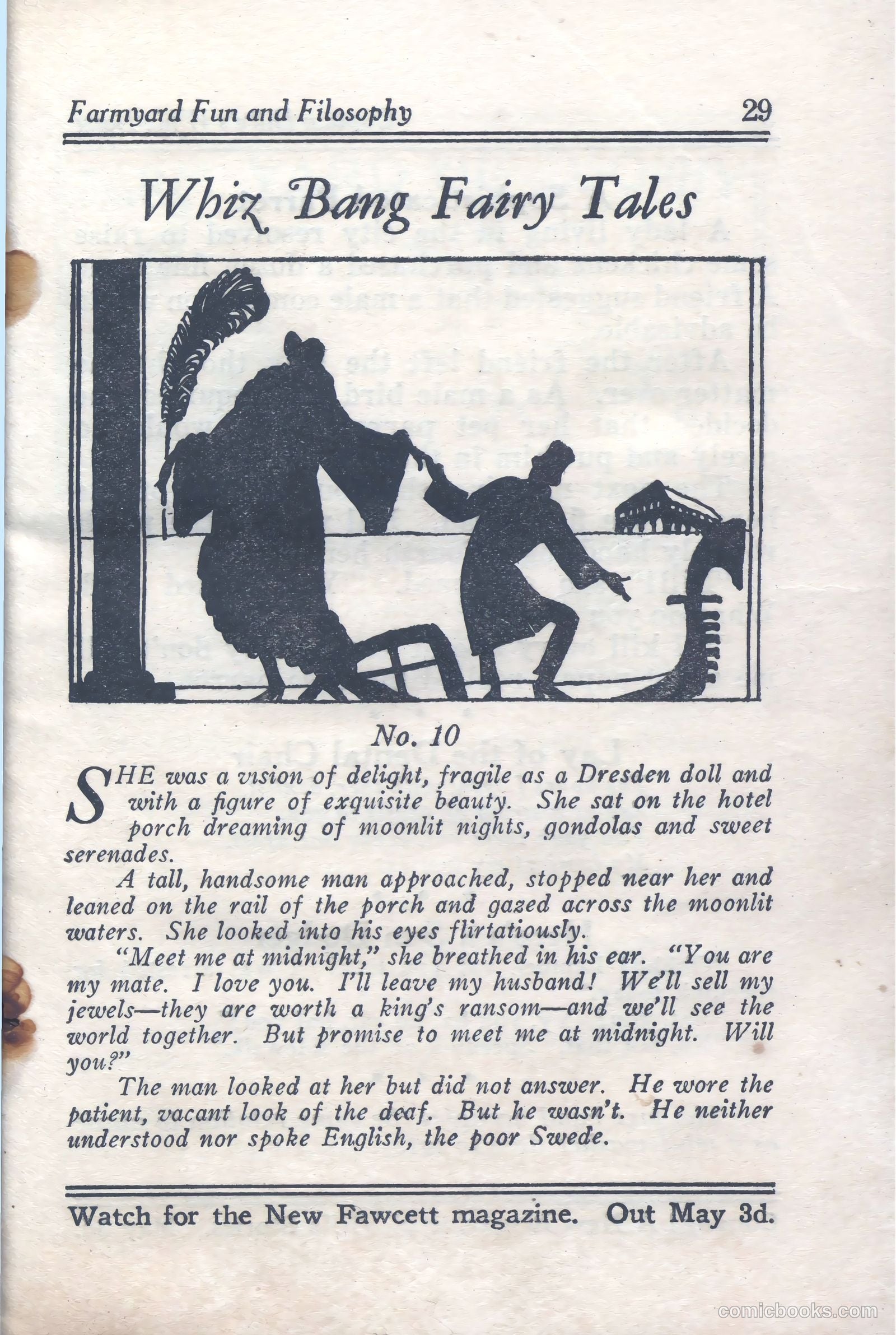
This page presents a comedic short story rather than a political cartoon. The silhouette illustration depicts a woman on a hotel porch and a tall man who approaches her. The narrative mocks romantic melodrama: a beautiful woman propositions a stranger to abandon her husband, sell her jewels, and meet her at midnight for elopement. The man—described as a deaf Swede who speaks no English—simply stares without responding or understanding her plea. The satire targets overwrought romantic fantasies and their collision with reality. The punchline hinges on language barriers and the protagonist's failure to seduce this oblivious foreigner, deflating the grandiose seduction scenario through absurdist humor.
This page contains three humorous anecdotes rather than political cartoons: 1. **"A Sophisticated Parrot"** — A comedic story about a lady who places her pet parrot in a henhouse as a "male companion." The parrot kills three hens, then demands the remaining chickens call him "sweet papa" or he'll kill them all. The joke plays on the parrot's aggressive territorial behavior and anthropomorphizes his demands for respect. 2. **"Lay of the Dental Chair"** — A brief poem lamenting dental visits, comparing lost teeth to a "string of pearls" being yanked out one by one. 3. **"Here's a Sun Dodger"** — A brief dialogue where someone claims arrest for "speedink" (speeding) on the sidewalk without a car—absurdist humor. The page exemplifies *Whiz Bang's* style of light, nonsensical comedy aimed at general audiences.
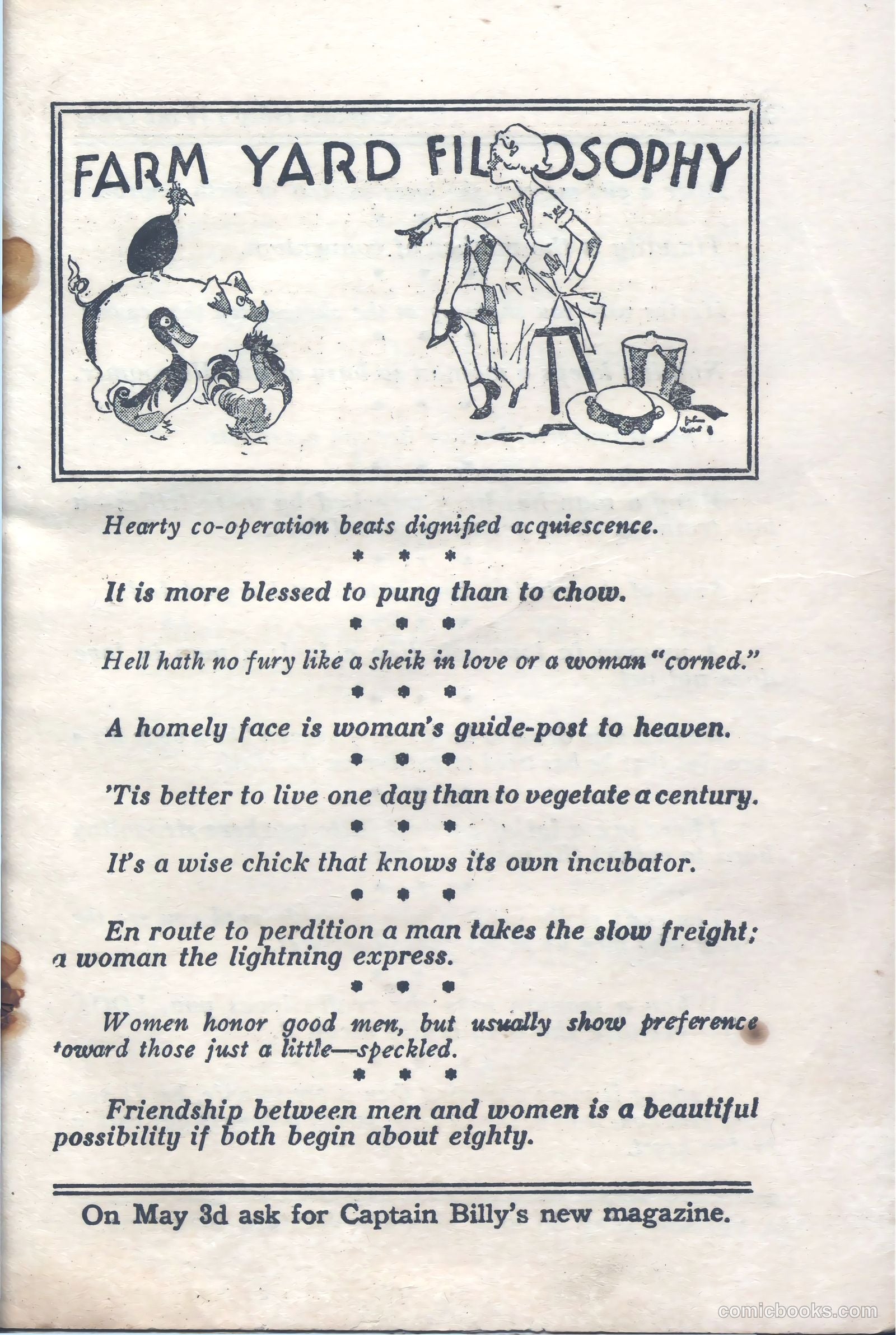
This page is primarily a collection of humorous aphorisms rather than political satire. The header illustration shows a rural woman tending farm animals (a peacock, cat, duck, and rooster), establishing a "farm yard" setting for homespun wisdom. The jokes are satirical commentary on gender relations and human nature. They mock pretension ("dignified acquiescence"), offer cynical observations about women's preferences ("usually show preference toward those just a little—speckled"), and make jibes at both sexes regarding courtship and forgiveness. The overall tone is lighthearted domestic humor typical of 1920s popular magazines—poking fun at relationships, vanity, and human folly through rural metaphors and pithy observations rather than targeting specific political figures or events.
This page contains a collection of witty, cynical one-liners and brief observations about relationships, gender, and human behavior—typical of the aphoristic humor style that filled *Whiz Bang*, a satirical magazine popular in the 1920s. The jokes target romantic relationships and gender dynamics with sardonic observations: women losing interest after marriage, the dangers of casual affairs, men's deceptive declarations, and the contrast between women's and men's behavior when in love. The final advertisement promotes an upcoming "Mystery-Western Magazine" launching May 3rd, suggesting *Whiz Bang* was part of a broader publishing enterprise. No specific political figures or events are referenced; instead, this represents general social satire mocking courtship rituals and marital realities of the era.
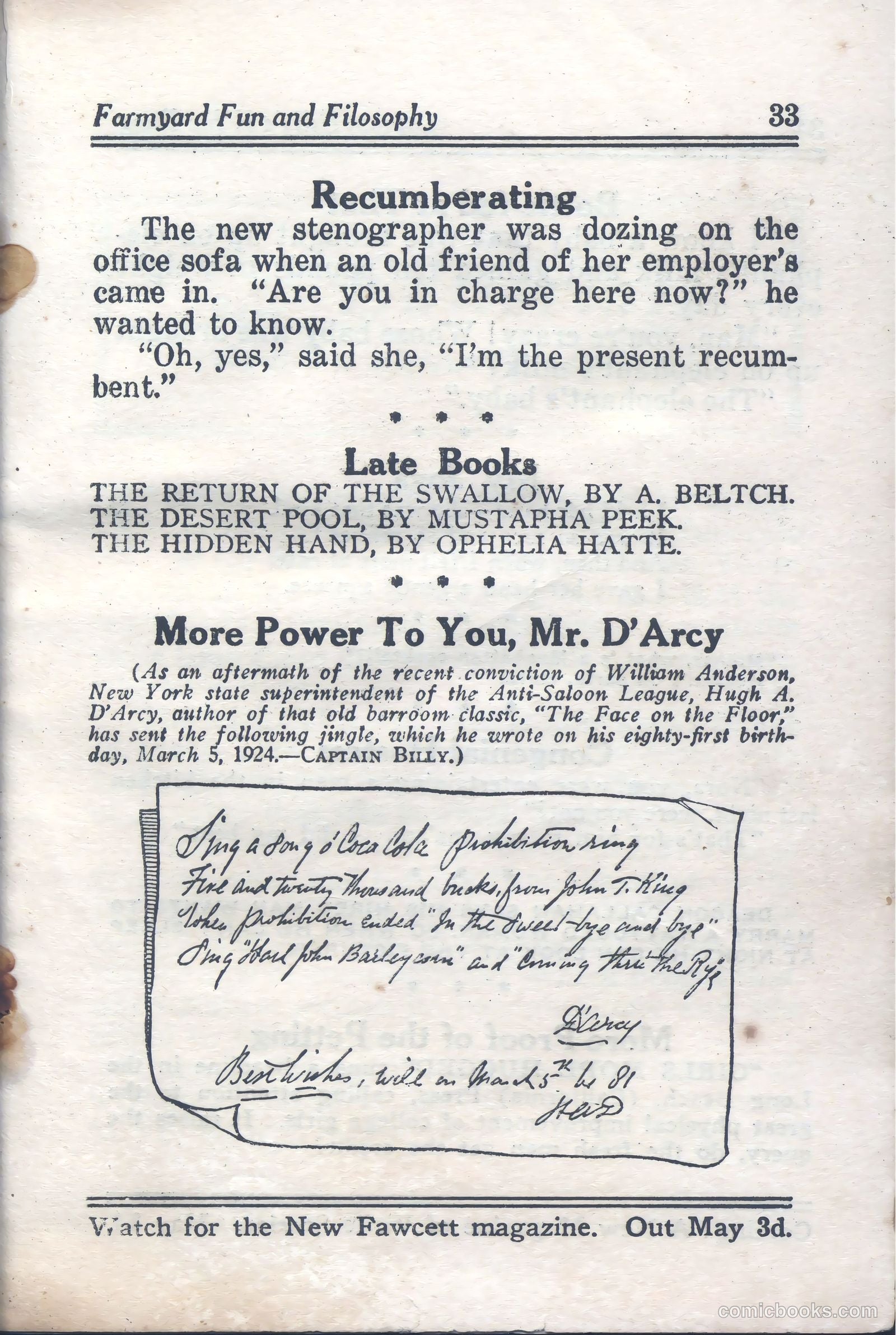
This page contains three separate humor items: 1. **"Recumbering"**: A short joke about a stenographer sleeping on the office sofa who calls herself "the present recumbent" (a pun on "incumbent"). This is mild wordplay without political content. 2. **"Late Books"**: A simple listing of three book titles—no cartoon or commentary. 3. **"More Power To You, Mr. D'Arcy"**: A handwritten jingle from Hugh D'Arcy (author of the saloon classic "The Face on the Barroom Floor"), written on his 81st birthday in 1924. The jingle mocks William Anderson, New York's Anti-Saloon League superintendent, who had recently secured a conviction. The humor derives from D'Arcy—representing old saloon culture—celebrating Anderson's prosecution while pretending to support Prohibition. The page is primarily advertisements and filler content rather than political satire.
This page contains five brief humorous anecdotes typical of 1920s men's magazines. The jokes target: 1. **"Bottle-fed at That"**: A absurdist joke about a baby raised on elephant's milk—playing on exaggeration. 2. **"My Joys"**: A sentimental piece about holding a woman's hand, mocking romantic sentimentality. 3. **Manhattan Cocktail**: A mother-child exchange about alcohol, reflecting Prohibition-era humor. 4. **"Congenial Hostess"**: A domestic joke about a woman entertaining a man in the kitchen, with innuendo about propriety. 5. **"More Proof of the Petting"**: References a newspaper headline about college girls being "more hugged," satirizing concerns about changing youth behavior and physical affection norms during the 1920s social revolution. The page emphasizes humor about alcohol, courtship, and evolving social mores.
This page contains an editorial titled "The Bull is Mightier Than the Bullet" responding to concerns about population decline in America. The author argues against pessimism about the "race thinning out," countering that 350,000 children were born while 300,000 people died—showing life's vitality persists. The piece references Ralph Waldo Emerson's "divine law of compensation," comparing human existence to an army marching across life's stage. The editorial reassures readers that Nature's balance (birth exceeding death rates) demonstrates life remains worthwhile. The page is primarily text-based editorial content with minimal visual elements. It appears designed to counter early-20th-century anxieties about declining birth rates and population concerns that were circulating in American discourse.
This page is primarily **text-based editorial content**, not a cartoon. It discusses Ralph Waldo Emerson and his famous quote about mousetraps, then pivots to praising President Woodrow Wilson's character—describing him as stern and studious yet capable of enjoying humor (detective stories and limericks) during leisure time. The piece emphasizes Wilson's ability to balance serious work with relaxation, framing this as evidence of "punch and vitality." This appears to be **laudatory content** about Wilson, likely written after his presidency or death (the text says "now departed war president"). The underlying point suggests that successful leaders combine discipline with human warmth and humor—a character-building message typical of this era's popular magazines.
This page contains humorous limericks and brief philosophical commentary rather than political cartoons. The content includes: **Two limericks** mocking specific targets: 1. A prince of Siam and Omar Khayyam (the Persian poet), playing on the name "Omar" 2. A girl from St. Louis suing over a car injury, with a jury response punning on "Missouri" **A note** about archaeologist Howard Carter's discovery of Egyptian artifacts, with a quip about fashion implications. **A longer passage on revenge**, comparing the futility of "getting even" with enemies to impossible philosophical pursuits like finding the fourth dimension. **A closing line** praising Thackeray's satirical writing. The page appears designed for light entertainment rather than serious political commentary, typical of satirical magazines' miscellaneous humor sections.
This page is primarily **text content, not a cartoon**. It's an essay defending girls' education and autonomy, quoting John Ruskin (the 19th-century social critic) on female development. The piece argues against "narrow-minded reformers" criticizing modern girls attending social events. It advocates letting girls develop freely through reading and self-discovery—comparing their growth to a flower rather than something that can be "hammered" into shape like a boy. The satire appears indirect: *Whiz Bang* uses Ruskin's conservative yet surprisingly progressive words ironically, perhaps mocking both rigid reformers *and* the contradictions in contemporary debates about women's roles. The magazine positions itself as defending female intellectual freedom while satirizing those who would restrict it. The bottom advertises an upcoming "Magazine of Virile Stories"—likely contrasting with this essay's defense of female independence.
This page contains three separate prose pieces rather than cartoons. The first is a sentimental essay about "home," emphasizing its emotional value regardless of physical appearance or location. The second is a brief, cynical aphorism about breaking a horse's spirit, comparing it to managing servants. The third discusses a theatrical "battle" between **Sarah Bernhardt** (the famous French actress) and **Ida Rubinstein**, competing for prominence in Paris and America. The text notes that Bernhardt's former dominance in French cultural life is being challenged by Rubinstein's efforts to promote an Italian poet, Gabrielle D'Annunzio. The satire mocks celebrity competition and the intense devotion audiences showed these performers. The page footer advertises "Captain Billy's new magazine" for May 3rd.
This page contains humorous short pieces rather than political cartoons. The satire targets everyday social situations: **"A George-ous Meal"**: Two Black men from St. Paul discuss ptomaine poisoning after a church dinner—a joke about food safety concerns common in that era. **"My Montana Bandana"**: A playful piece about a shy Montana woman named Anna who adopts the stylish nickname "Annabelle" in Rochelle, humorously ending with a banana shortage punchline. **The Cohen suit exchange**: A customer complains about rust spots on a suit; the tailor jokes about wanting fabric that wears like iron—humor based on Jewish merchant stereotypes. **"Chirps From a Very Blue-Jay"**: Cynical relationship advice warning men against marriage, suggesting it leads to "murder" and misery. These are lighthearted, period-typical social humor pieces with some stereotyping, appearing in *Whiz Bang*, a 1920s-era satirical magazine.
This page contains humor pieces rather than political cartoons. The jokes target social conventions of the 1920s era: **"Heard at the Irish Ball"** mocks both Irish-Americans and dating etiquette—a woman demands a man stop close dancing or she'll bite his nose; his friend notes she's "a mouthful," playing on crude stereotypes. **"Still Another Version"** parodies the nursery rhyme "Jack and Jill," suggesting sexual impropriety with a darkly humorous twist about consequences. **The remaining items** are light domestic humor: a child's wishbone joke, a gravestone epitaph about infidelity, and an ethnic dialect joke about alibis for gambling. The page reflects period humor: Irish caricatures, sexual innuendo presented as transgressive comedy, and working-class dialect portrayed as inherently comic. The magazine advertised itself as "farmyard fun"—rural, unsophisticated entertainment.
This page contains humorous short jokes and anecdotes rather than political cartoons. The content includes: **"Non-Skids?"** — A joke about car tires, where one vehicle boasts of traveling 3,000 miles without a puncture, only to be reminded it was seen with a flat tire. **"Distrust"** — A verse mocking folding beds, joking that dead lambs are hidden in the folds. **"Also, the Poor Fish!"** — A satirical commentary on male behavior, claiming men act like various animals depending on circumstances. **"Two colored soldiers"** — An anecdote depicting racial dialect humor, showing soldiers under fire discussing a song, likely referencing wartime experience. The page reflects 1920s popular humor: automotive culture, domestic life jokes, and unfortunately, period-typical racial stereotyping presented as entertainment. Whiz-Bang specialized in bawdy, irreverent humor for male readers.
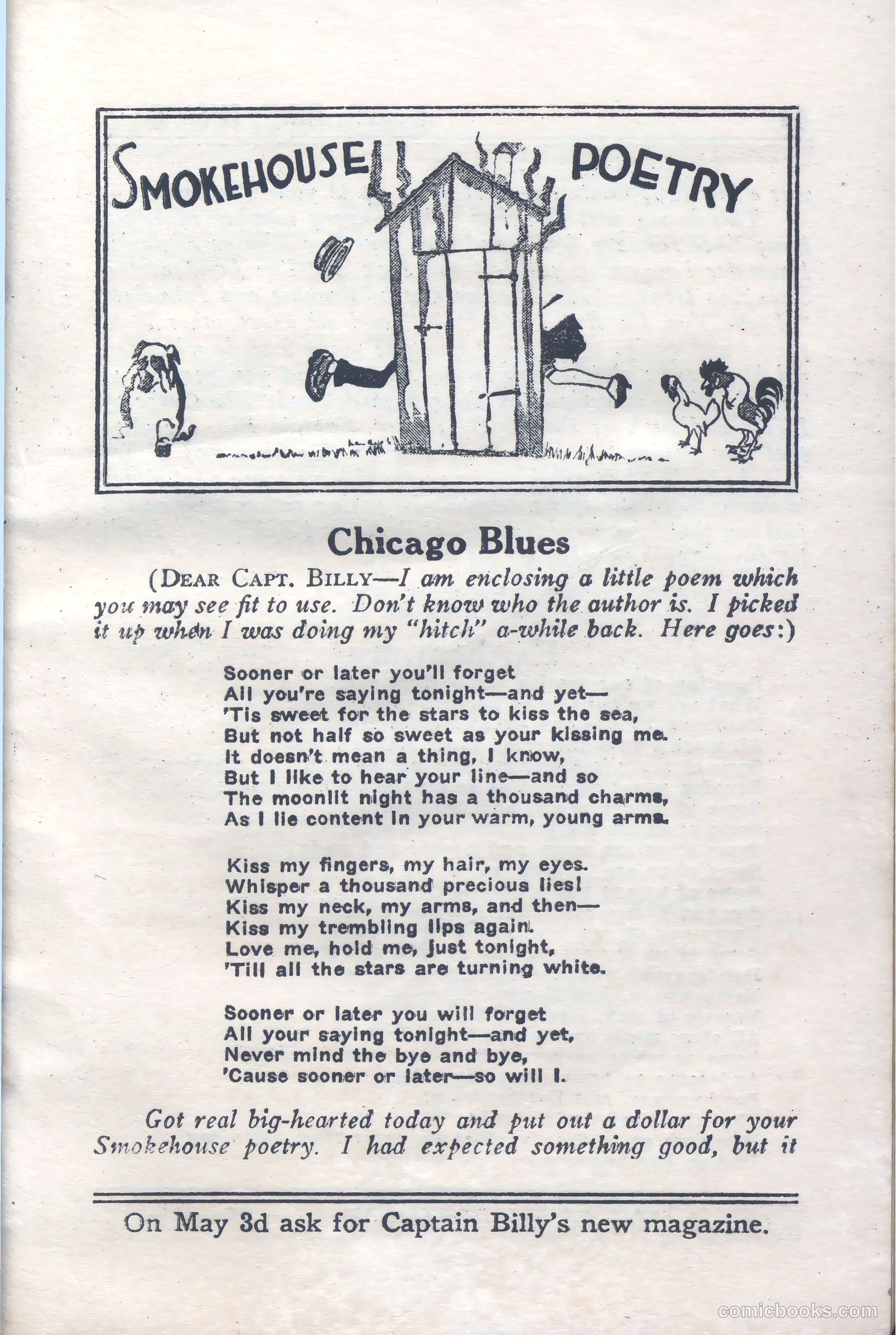
This page is primarily **advertising for "Smokehouse Poetry"** — apparently Captain Billy's magazine feature or section. The cartoon header shows a rickety smokehouse with figures engaged in comic activity. The main content is a romantic/sentimental poem titled "Chicago Blues," presented as a letter from a reader. The poem expresses romantic longing ("sooner or later you'll forget / All you're saying tonight—and yet") with passionate imagery about kissing and starlight. The framing note beneath suggests this is genuinely reader-submitted poetry that the editor found mediocre ("I had expected something good, but it"). This is **satirical commentary on amateur poetry submissions** — presenting sentimental romance verses as examples of the sometimes overwrought material magazines received from readers. The "Smokehouse Poetry" title itself appears mockingly dismissive of such submissions.
This page consists almost entirely of reader letters and advertising rather than editorial cartoons or satirical content. The top section features a letter from Earl F. Amiot of Chicago criticizing "Captain Billy" (the magazine's editor) for excluding lighter, humorous pieces—specifically naming poems like "The Land of the Swinging Door" and "Frankie and Johnnie"—in favor of heavier fare like "Grey's Elegy in a Country Church-yard." The letter praises the "Pedigreed Bull" feature. Below is a poem titled "Earthenware" using pottery as metaphor for human variety and worth—some people polished and prized, others broken or cracked, but all made by "the one Great Potter." The bottom advertises an upcoming Mystery-Western Magazine launching May 3rd. No political satire or caricature appears on this page.
This page contains two poems satirizing male hedonism and nostalgia, not political cartoons. "My Memories" humorously catalogs a dissolute bachelor's life: multiple romantic conquests, legal troubles (breach of promise suits), financial losses, and now declining health (gout, liver problems, hair loss). The refrain "lotta memories" becomes ironic—his only real wealth is regrettable experiences, not actual fortunes or successful relationships. "You Said It, Brother" is a brief drinking toast romanticizing "the old oak bar" and better days past, contrasting sharply with the first poem's admission that those memories are largely embarrassing mistakes. Together, these pieces mock masculine bravado and the tendency to sentimentalize wasted youth. The satire targets men who boast about dissolute lives while their bodies pay the price. The page advertises an upcoming Fawcett magazine issue.
This page contains two literary pieces rather than political cartoons: 1. **"Ballade of Futility"** (by "A.S.") — A satirical poem promoting fatalism and apathy. It mocks worry through repeated refrains ("Nothing matters anyway," "What's the sense of worrying?"), suggesting acceptance of life's troubles—business failure, nagging wives, death itself—through indifference and leisure (Mah Jongg, Pong Ping, mandolin). The envoi self-consciously acknowledges the poem's own hypocrisy. This likely reflects post-WWI disillusionment and Jazz Age escapism. 2. **"Our Whiz Bang Toast"** — A brief, somewhat bawdy verse about seizing pleasure ("the rose") before it fades, including a double entendre about a maid left alone. The page is primarily literary/humorous rather than visual satire, emphasizing *Whiz Bang's* irreverent, anti-establishment voice.
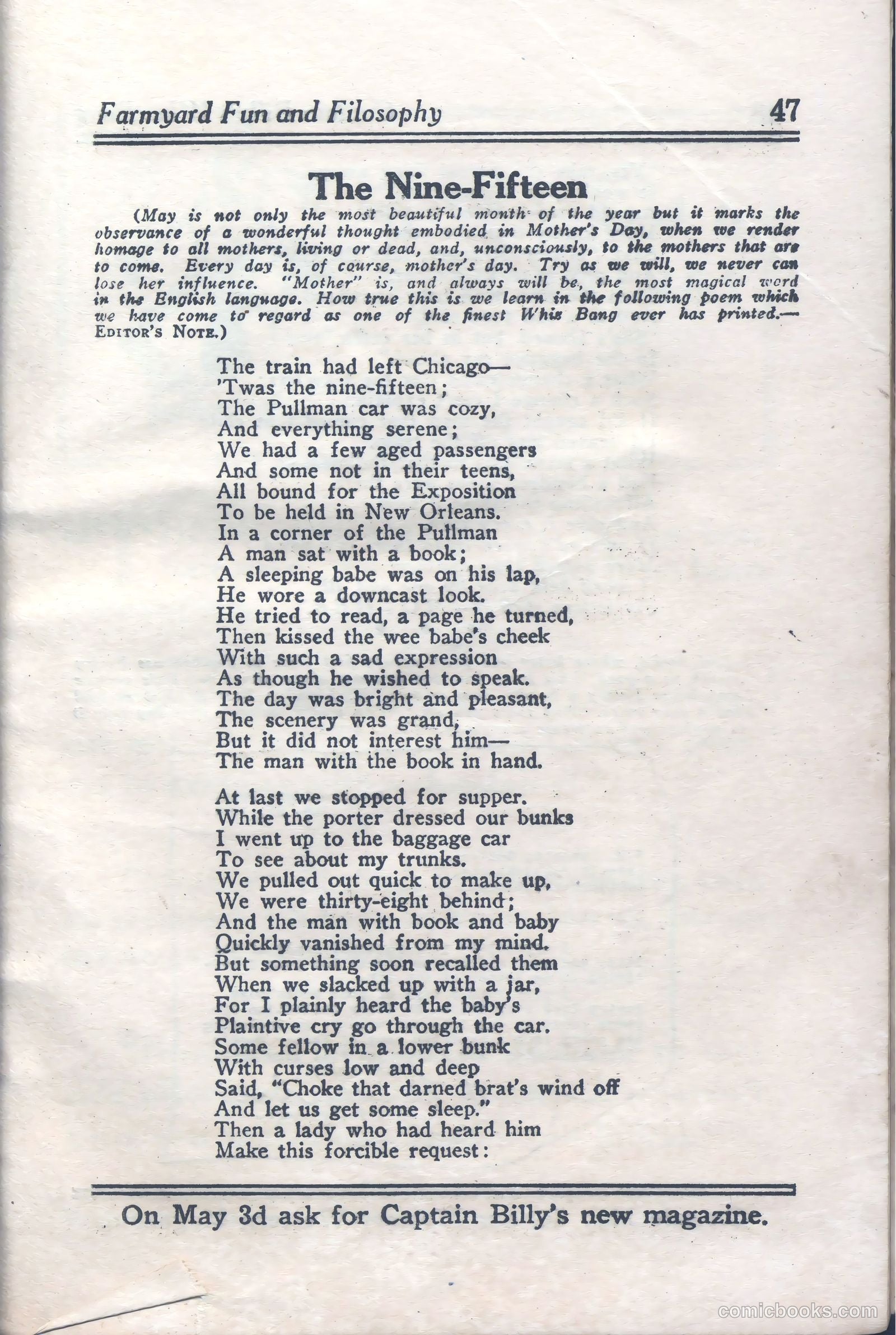
This page contains a poem titled "The Nine-Fifteen," presented as narrative verse about train travel. The poem describes a Pullman car journey from Chicago to New Orleans for an exposition, focusing on a man absorbed in reading while holding a sleeping baby. The narrative develops tension: the baby cries during the overnight journey, disturbing other passengers. A frustrated man curses the infant, prompting a lady to make "a forcible request" (implied: she tells him off). **No political cartoon or caricature appears on this page.** It's primarily literary content — a humorous poem about everyday train travel frustrations and social friction between passengers. The satire targets inconsiderate behavior and the clash between personal needs (a crying baby) and others' comfort.
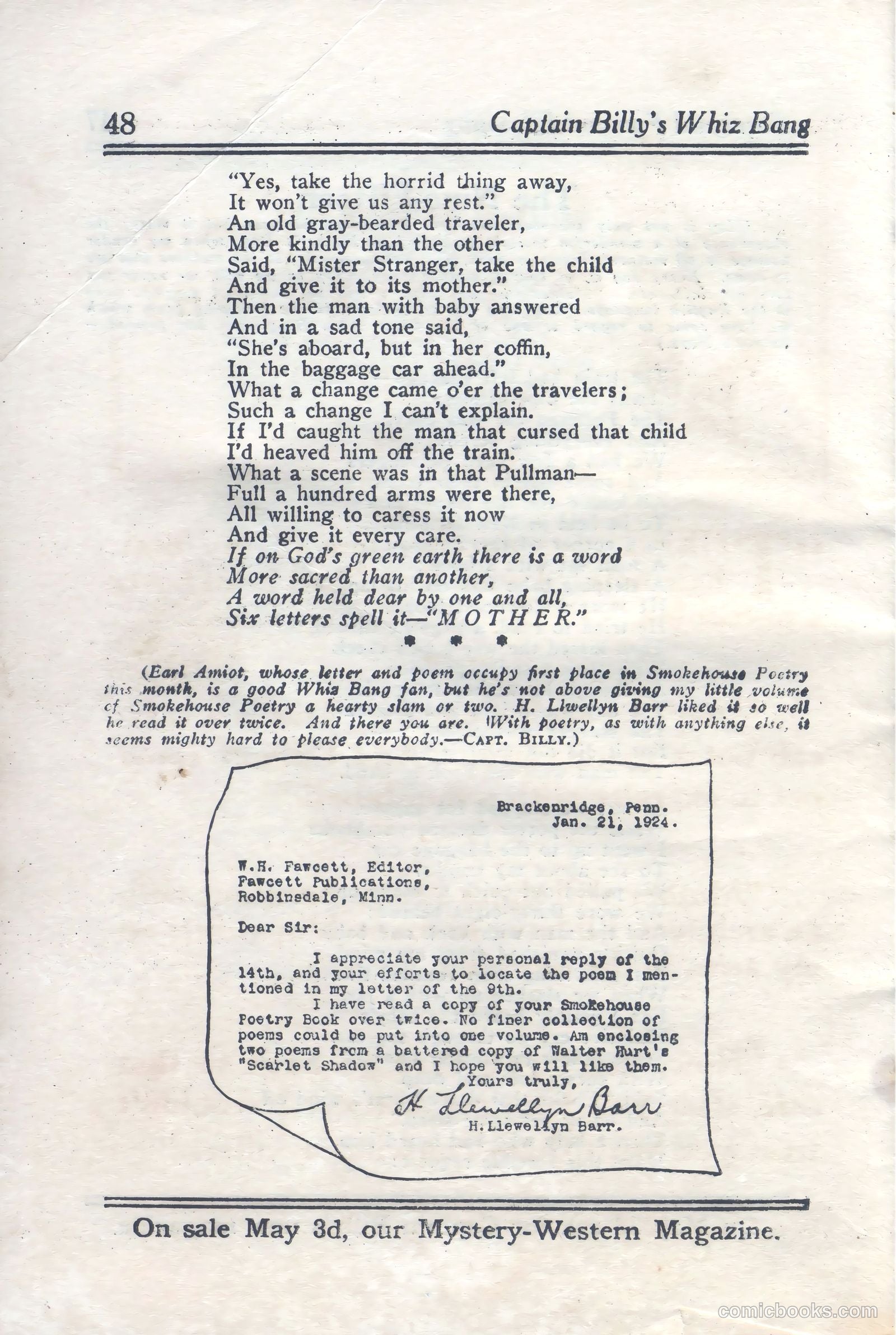
This page contains a sentimental poem about a dead mother traveling by train, followed by a letter from poet H. Llewellyn Barr to the editor. The poem tells of travelers' emotional reaction upon learning a man carries his dead mother in a coffin in the baggage car—generating sympathy and collective mourning among passengers. **No political satire or cartoon appears here.** Instead, this represents *Whiz Bang's* lighter content: sentimental Victorian-era verse emphasizing maternal sanctity ("a word...More sacred than another...MOTHER"). The editor's note praises the poem's emotional impact. The page functions primarily as poetry publication and reader correspondence, typical filler material in satirical magazines of the 1920s that balanced humor with earnest human-interest content.
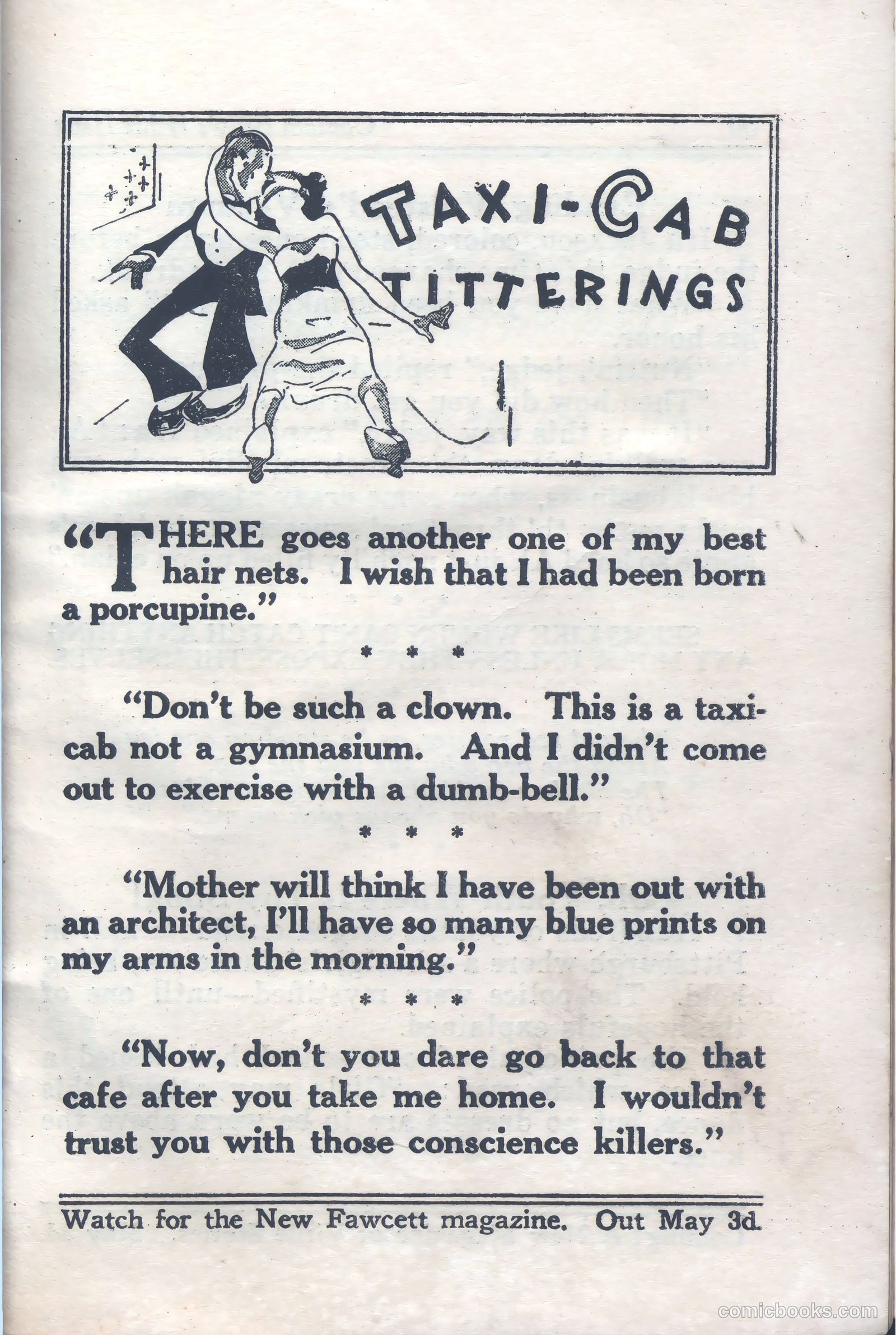
This is a humorous advertisement for *Fawcett magazine*, presented as "taxi-cab titterings"—overheard conversations between passengers and drivers. The cartoon shows a flapper-era couple in a taxi, with exaggerated physical comedy (acrobatic poses). The four jokes satirize: 1. Women's elaborate hairstyles requiring "hair nets" 2. Rowdy passenger behavior in cabs 3. Romantic encounters leaving physical evidence ("blue prints on my arms") 4. Passengers visiting disreputable cafes The satire reflects 1920s social anxieties: women's changing appearance and behavior, young couples' independence, and the moral concerns around urban nightlife and unchaperoned dating. The "conscience killers" reference likely means alcohol, still illegal during Prohibition. The humor relies on innuendo about modern youth culture.
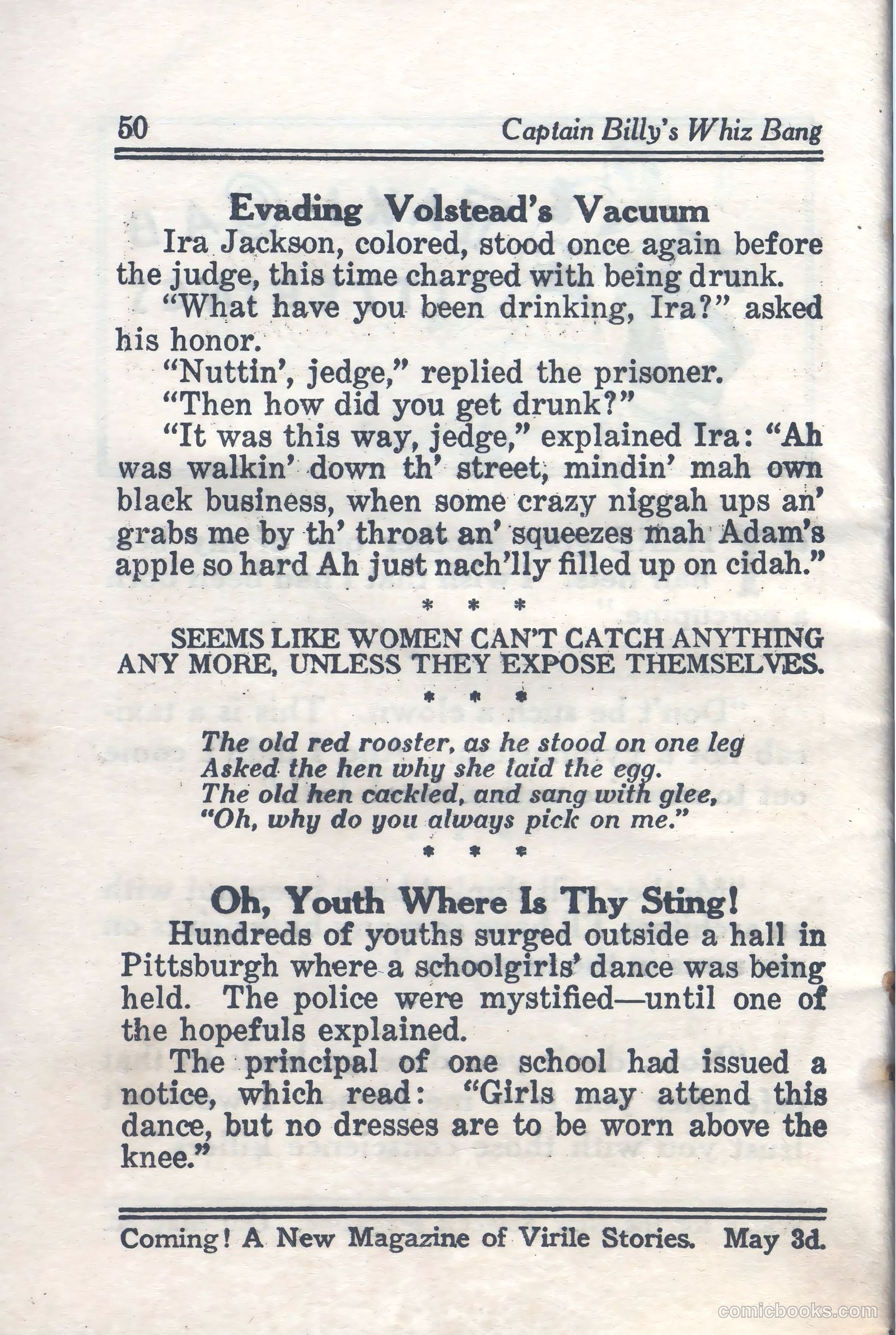
This page contains three separate humorous anecdotes rather than cartoons: 1. **"Evading Volstead's Vacuum"**: A joke about Prohibition enforcement. A drunk Black man named Ira appears in court; when asked how he got drunk drinking "nuttin'," he claims someone choked him and he accidentally swallowed cidah (cider). The humor targets both Prohibition's ineffectiveness and racial stereotypes in dialect humor. 2. **A brief animal joke** about a rooster and hen. 3. **"Oh, Youth Where Is Thy Sting!"**: Commentary on a Pittsburgh schoolgirls' dance where hundreds of youths gathered outside. A principal's dress code notice ("no dresses above the knee") apparently sparked the commotion—suggesting the restriction itself caused the scandal rather than preventing one. The page reflects 1920s-era concerns about Prohibition enforcement, youth morality, and dress codes.
This page from *Whiz-Bang* (April 1, 1924) contains theatrical gossip rather than political cartoons. The content consists of three celebrity gossip items: 1. **Richard Barthelmess and Mary Hay**: Reports suggest marital tension—Barthelmess danced with chorus girls (Kay Carlin, Louise Groody) instead of his wife at a party. 2. **Irving Berlin and Connie Talmadge**: References Berlin's romance being approved by the wealthy Schenck family, who lent him their yacht. 3. **Bernarr Macfadden**: A physical culturist (fitness promoter) receives criticism for "pestiferousness" in a Broadway magazine. The satire targets entertainment-world romantic scandals and social climbing among celebrities of the era.
This page from *Whiz Bang* magazine contains gossip and satirical commentary rather than political cartoons. The main items mock: 1. **Publishing industry drama**: A satirical piece about John Brennan leaving Bernard Macfadden's publishing outfit to join Hearst, presented with mock-serious "industry news" tone to ridicule both publishers and their competitive rivalry. 2. **Celebrity gossip**: Items about "Kitty Gordon" and romantic/marital rumors, treating Hollywood scandal as entertainment. 3. **Film stars**: References to unnamed actors ("Doug and Mary," "Strongheart and Lady Julie") whose popularity is being satirized as fleeting compared to newer stars. The satire targets publishing magnates, celebrity culture, and the industry's breathless attention to minor personnel changes and romantic gossip—treating serious business matters with exaggerated importance for comic effect.
This page contains gossip column items rather than cartoons. The satirical content mocks entertainment industry figures: 1. **Jim Cruze & Betty Compson**: The joke targets extravagant long-distance phone bills between Hollywood and New York lovers—$425 versus $419.75 in telegrams, framing the savings as modest. 2. **Irene Castle**: Satirizes her eccentric pet habits (bringing worms to canaries, shaggy dogs disturbing aristocratic neighbors). The joke emphasizes class anxiety—even tolerant "blue-blooded" families disapprove of her unconventional ways. 3. **Sessue Hayakawa**: Mocks the Japanese actor's gambling losses ($50,000 in Monte Carlo), suggesting he abandon gambling for his artistic career. The humor relies on celebrity scandal and social pretension typical of 1920s gossip columns.
This page contains a collection of brief jokes and witticisms typical of 1920s humor magazines. The content includes: **"The Little Baggage"** - A risqué joke about a chorus girl wearing her trunks (corsets/undergarments) during a fire, playing on double meaning. **"Shocking!"** - A pun about Sally McSmidge losing at bridge. **"Curtailing Production"** - Wordplay about a dog getting a replacement tail, with a pun on "retailing." **"Somebody's Lyin'"** - A brief character joke about someone named Maggie. **"A Blue Jay Special"** - A joke using animal behavior for humor. The magazine primarily functions as an advertisement for upcoming content and reflects early-20th-century comedic sensibilities emphasizing puns, double entendres, and observational humor.
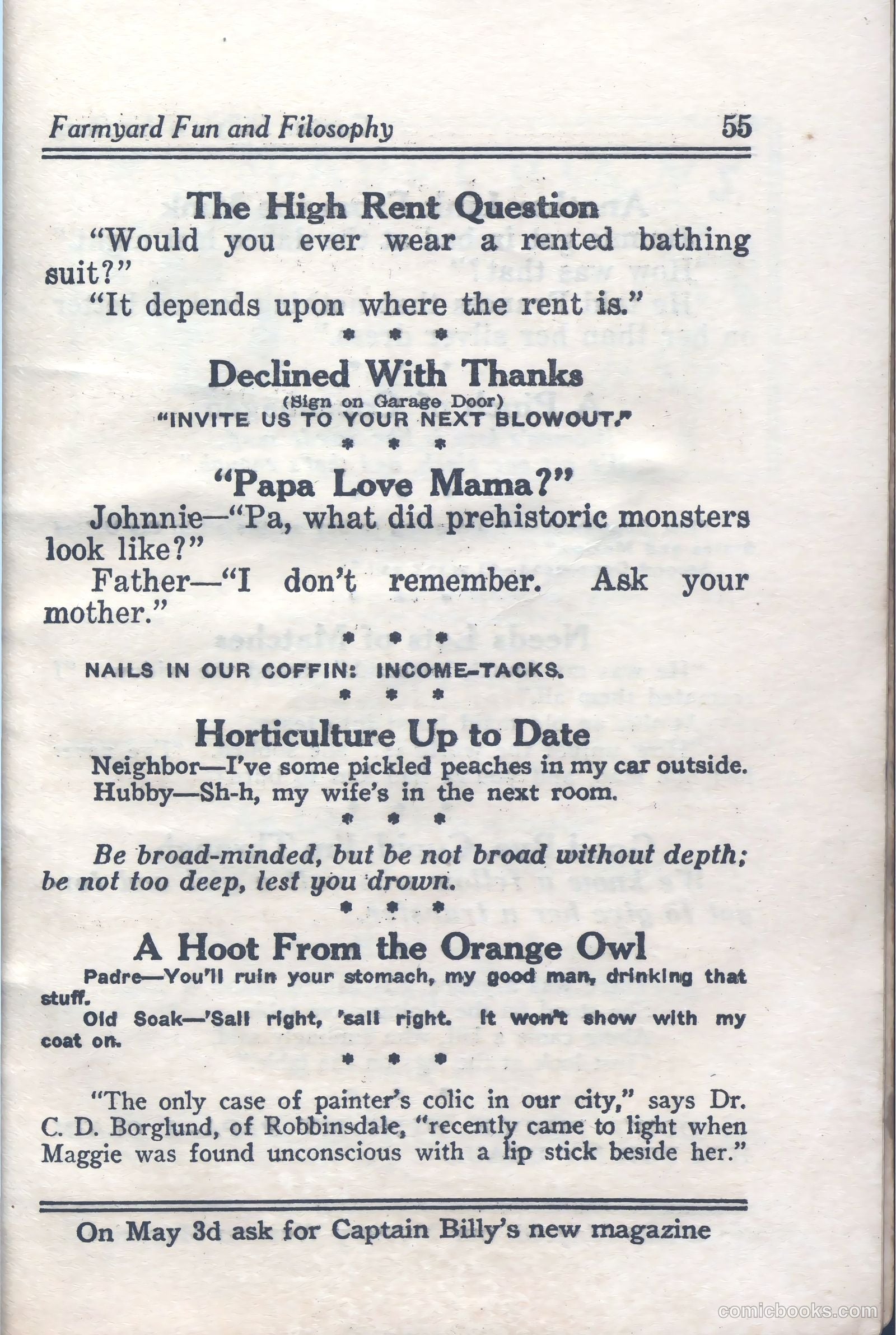
This page contains a series of brief humorous anecdotes rather than illustrated cartoons. The jokes target everyday absurdities: **"The High Rent Question"** satirizes housing costs during an era of economic strain, joking that whether you'd rent a bathing suit depends on rental prices. **"Papa Love Mama"** is a domestic joke where a father deflects his son's question about prehistoric monsters by telling him to ask his mother—implying mothers are similarly ancient or difficult to understand. **"Horticulture Up to Date"** presents a neighbor-and-husband exchange about pickled peaches, with a double entendre about the wife's presence in another room. **"A Hoot From the Orange Owl"** features drinking-related humor and a reference to "painter's colic" caused by lip stick. The humor relies on wordplay, marital dynamics, and mild innuendo typical of 1920s satirical magazines.
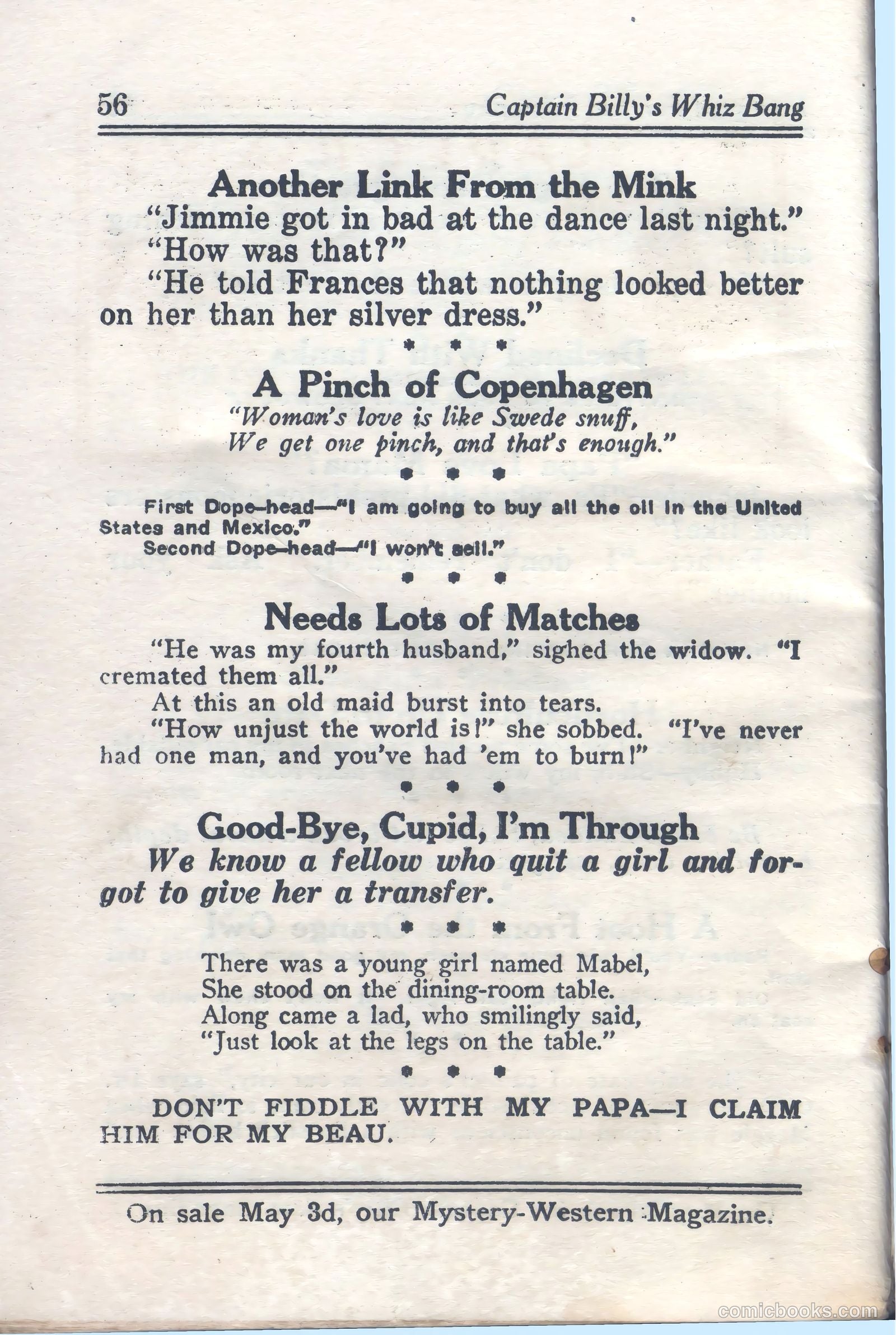
This page contains a collection of brief humorous anecdotes and jokes rather than political cartoons. The humor targets social behavior, romance, and gender relations typical of 1920s American satire. "Another Link From the Mink" mocks courtship etiquette—a man compliments a woman's dress to impress her. "A Pinch of Copenhagen" uses snuff as a metaphor for romantic satisfaction being brief and unsatisfying. The "dope-heads" joke plays on contemporary slang and economic absurdity. "Needs Lots of Matches" presents dark humor about a widow who cremated multiple husbands, contrasted with an old maid's jealous response. The final anecdotes mock courtship rituals and flirtation tactics. The page reflects period attitudes toward romance, marriage, and gender dynamics through lowbrow humor typical of Whiz Bang's irreverent style.
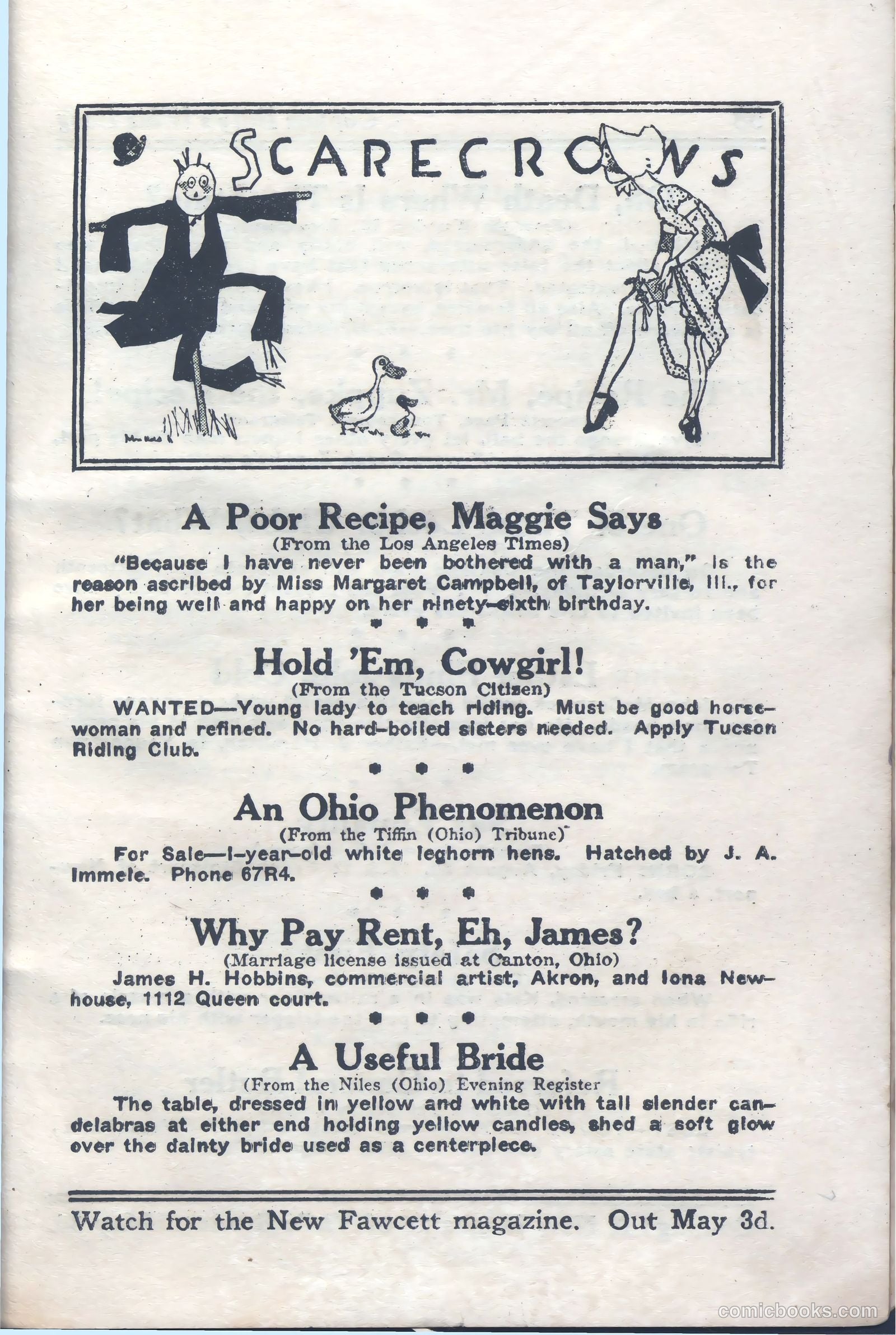
This page from *Whiz-Bang* magazine contains humorous newspaper clippings rather than original political cartoons. The illustrated header shows a scarecrow and a woman on horseback—visual puns relating to the stories below. The five brief items are comedic takes on real newspaper announcements: 1. **"A Poor Recipe, Maggie Says"** — A woman's claim that remaining unmarried keeps her healthy (96th birthday) 2. **"Hold 'Em, Cowgirl!"** — A Tucson riding club advertisement humorously requesting "refined" women, excluding "hard-boiled sisters" 3. **"An Ohio Phenomenon"** — A leghorn hen for sale 4. **"Why Pay Rent, Eh, James?"** — A jab at newlyweds, referencing a marriage license issued in Canton, Ohio 5. **"A Useful Bride"** — Satirical description of wedding table decoration using the bride as centerpiece The humor derives from the absurdity of these real-life announcements when presented together.
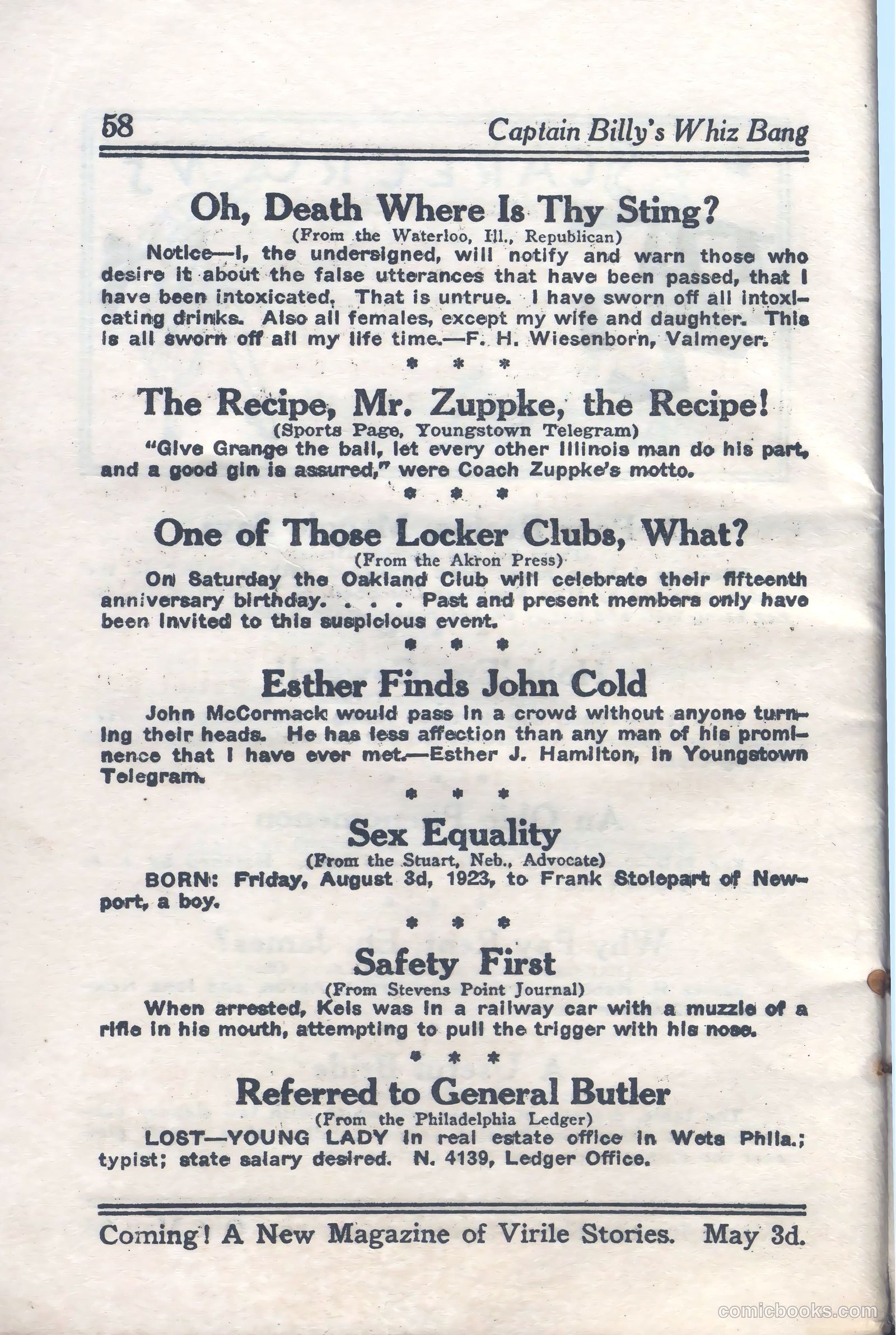
This page is primarily a **collection of humorous notices and classified ads** from various newspapers, rather than illustrated cartoons. The humor relies on absurdist situations and social commentary: - **"Oh, Death Where Is Thy Sting?"** features a man denying false claims about his drinking habits - **"Esther Finds John Cold"** mocks a man's aloofness in social situations - **"Safety First"** presents dark humor about a criminal arrested with a rifle in his mouth - The classified ads include a birth announcement and a job listing for a typist The satire is primarily **verbal rather than visual**, using irony and understatement typical of 1920s humor magazines. The page reflects period attitudes toward drinking (Prohibition era), masculinity, and workplace absurdities.
This page contains three brief humorous anecdotes rather than political cartoons. **"Preliminary Skirmish"** mocks masculine bravado at a dinner party. Tom Howard, a Minneapolis lumber dealer, is surrounded by men ordering increasingly aggressive meat preferences ("raw," "red, raw meat"). When asked his preference, Tom deflates their posturing by suggesting they drive in their "dod-rotted cow" so he can cut his own slice—implying the others' toughness is performative nonsense. The second item jokes about a storekeeper hired by a pretty clerk, whose stern wife discovers the arrangement and causes his firing—a mild commentary on workplace temptation and domestic authority. **"Competition"** briefly notes stick-up men robbing a Broadway cafe, with cafe owners driving them away out of professional jealousy—a joke about territorial crime. The content reflects early 20th-century American humor: masculine posturing, workplace dynamics, and petty criminality treated as comedy.
This page contains humorous anecdotes rather than political cartoons. The jokes target: 1. **Prohibition-era bootleggers** — The opening anecdote mocks illegal alcohol makers by exaggerating their product's potency (strong enough to transform plant life). 2. **WWI bonus payments** — The "Ode to the Bonus Bill" satirizes soldiers' delayed compensation. Tom sarcastically lists absurd conditions before receiving payment ("when Trotsky and the Spanish King decide to dance the Highland fling"), implying the bonus is perpetually promised but never delivered. 3. **General absurdist humor** — The final quips ("Ain't her niece nice?") use non-sequiturs typical of the era's comedic style. The page reflects post-WWI economic frustrations and Prohibition's cultural impact, presented through crude wordplay and exaggeration common to 1920s American humor magazines.
This page from *Whiz-Bang* magazine presents a humor column featuring short, punchy jokes submitted by rural readers. The format mimics a "letters to the editor" section, with contributors identified by nicknames (Belle, Maid, Ima Bear, Tommy Rot, Al Falfa, Ella Vate, Buddy). The jokes target farm life and rural concerns: bed bugs, butter production, oxtail soup, traveling salesmen, and marriage. They employ deliberate malapropism and wordplay (likely "Al Falfa" = alfalfa; "Ella Vate" = elevator). The humor is accessible, family-friendly comedy emphasizing rural stereotypes and domestic challenges. This reflects 1920s-era satirical magazines' heavy reliance on reader participation and everyman humor rather than topical political commentary.
This page contains four separate humorous anecdotes rather than political cartoons: 1. **"The Shades of Night Are Falling Fast"** — A suggestive joke about an artist's model undressing, playing on the poem's title. 2. **"Lumbago" anecdote** — A brief joke about a friend helping someone drink medicine for back pain. 3. **"Going the Limit"** — A flirtatious reference to sitting close to someone (Dempsey, likely boxer Jack Dempsey) on a Ferris wheel. 4. **"A Total Eclipse"** — A workplace humor piece about a fastidious proofreader who objects to ambiguous phrasing ("west end of a boy"), responding with a geographical joke about sunsets. These reflect *Whiz Bang*'s focus on risqué humor, wordplay, and workplace comedy typical of 1920s-era men's magazines.
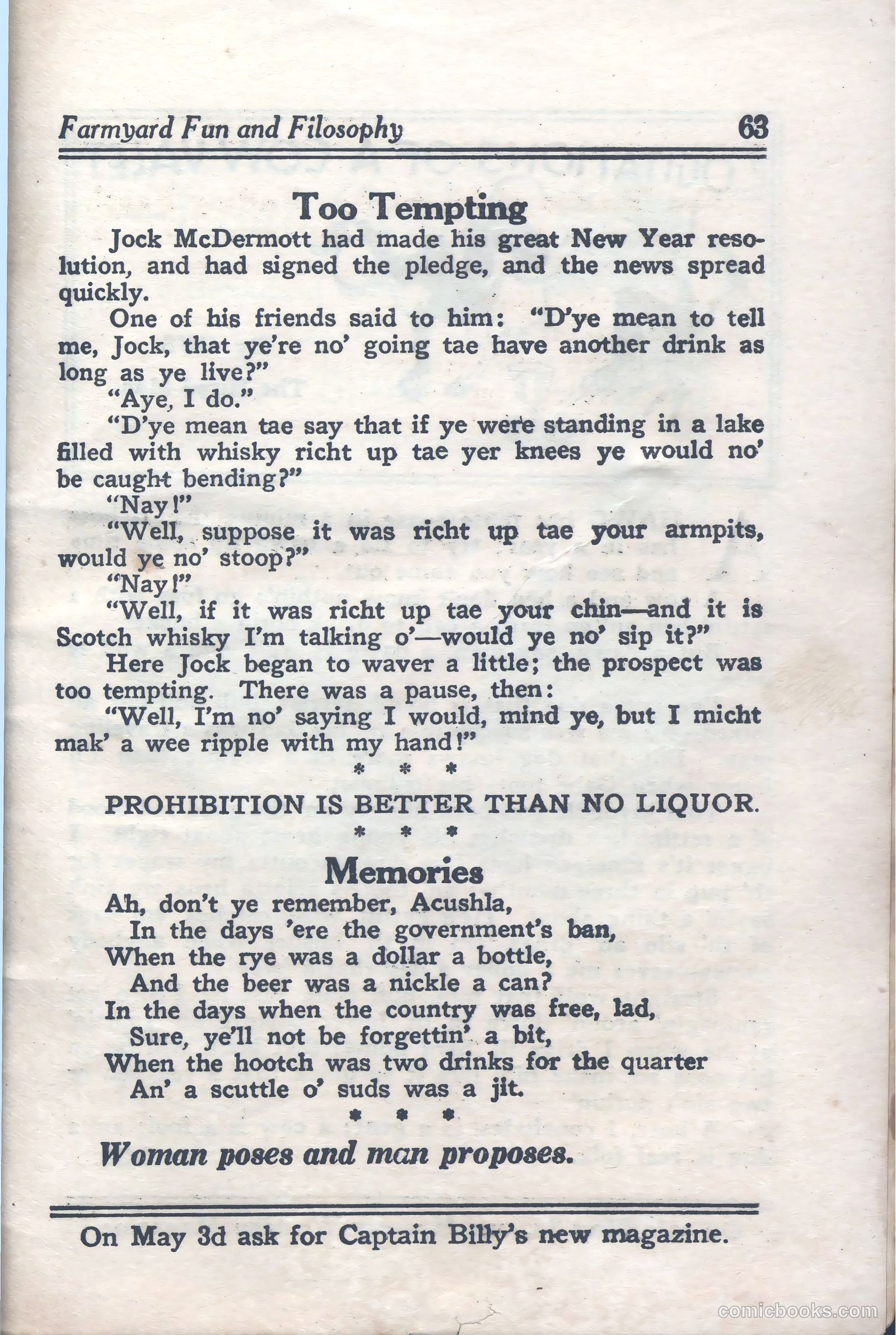
This page satirizes Prohibition through a dialogue between Jock McDermott and a friend. McDermott has pledged total abstinence from alcohol, but his friend tests his resolve with increasingly tempting hypotheticals—imagining whisky filling a lake up to his knees, armpits, and chin. The joke's punchline: even faced with absurd scenarios, Jock wavers, admitting he "might mak' a wee ripple with my hand"—suggesting that total prohibition is unrealistic and human temptation will inevitably find outlets. The subsequent poem "Memories" nostalgically references pre-Prohibition pricing, mocking the government's alcohol ban as futile. The satire targets Prohibition itself as an overly strict, unenforceable policy that ignores human nature.
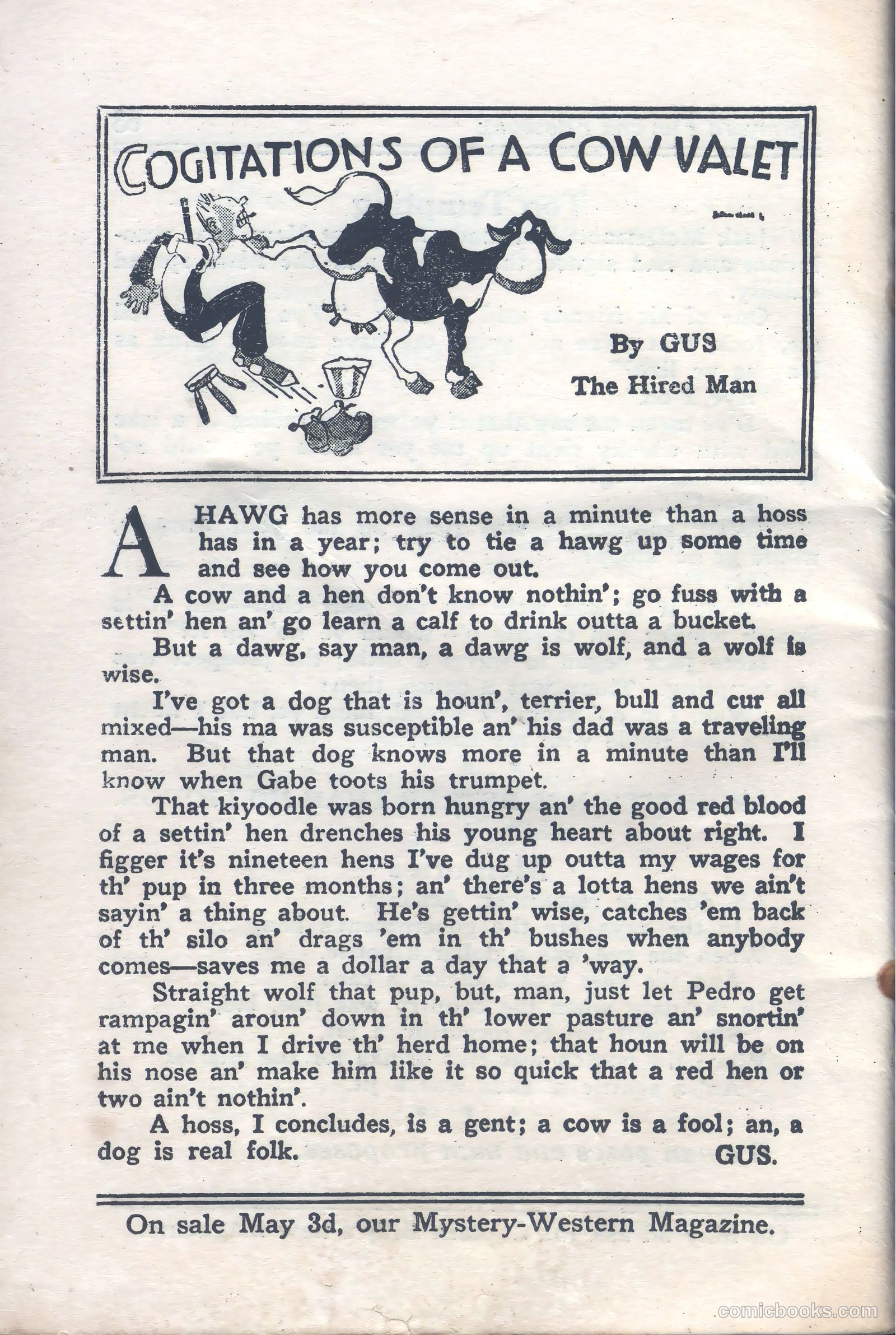
This is a humorous rural monologue by "Gus the Hired Man," comparing the intelligence of different animals. The speaker, a farm worker, argues that dogs possess superior intelligence to horses and cows. He illustrates this through folksy anecdotes: describing his mixed-breed dog's cleverness in catching runaway chickens and evading his employer ("Pedro"), contrasting this with the stupidity of cattle and hens. The satire targets rural hierarchies and class dynamics—the hired man's sardonic conclusion that "a hoss...is a gent; a cow is a fool; an', a dog is real folk" inverts social standing, positioning working animals and their caretaker as the story's only intelligent characters. The piece appears designed as light entertainment for Whiz-Bang's working-class readership, validating their practical rural knowledge.
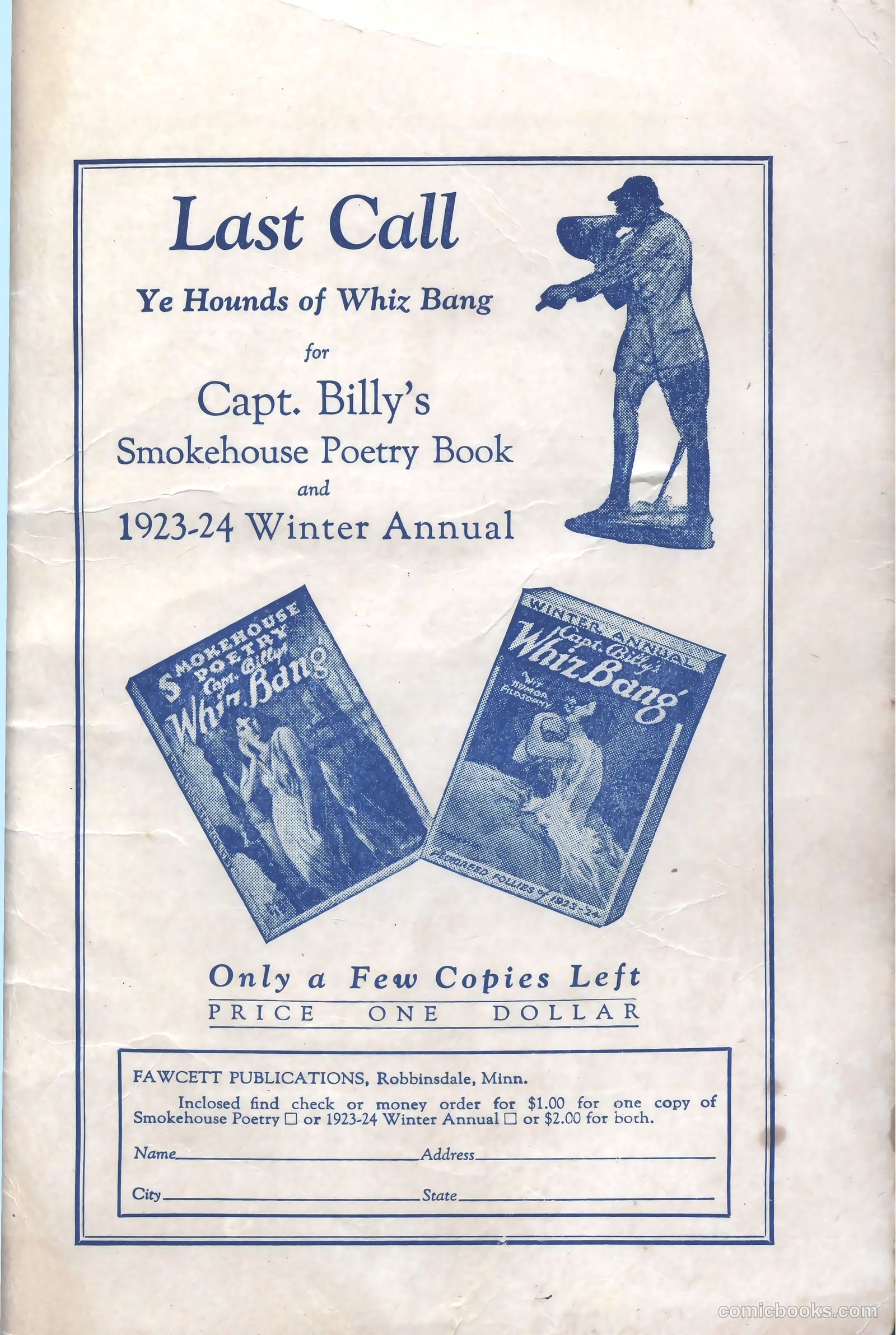
This is an **advertisement/title page**, not a satirical cartoon. It promotes "Capt. Billy's Smokehouse Poetry Book" and a "1923-24 Winter Annual" from *Whiz Bang* magazine, published by Fawcett Publications in Robbinsdale, Minnesota. The page features an illustration of a man in a coat pointing/beckoning (the "Last Call" imagery), alongside images of two book covers. The ad emphasizes scarcity ("Only a Few Copies Left") and offers both publications for $1-2, with an order form below requesting name, address, city, and state. This represents typical **early 1920s magazine marketing**—using urgency and collectibility to drive sales of related publications to existing readers.
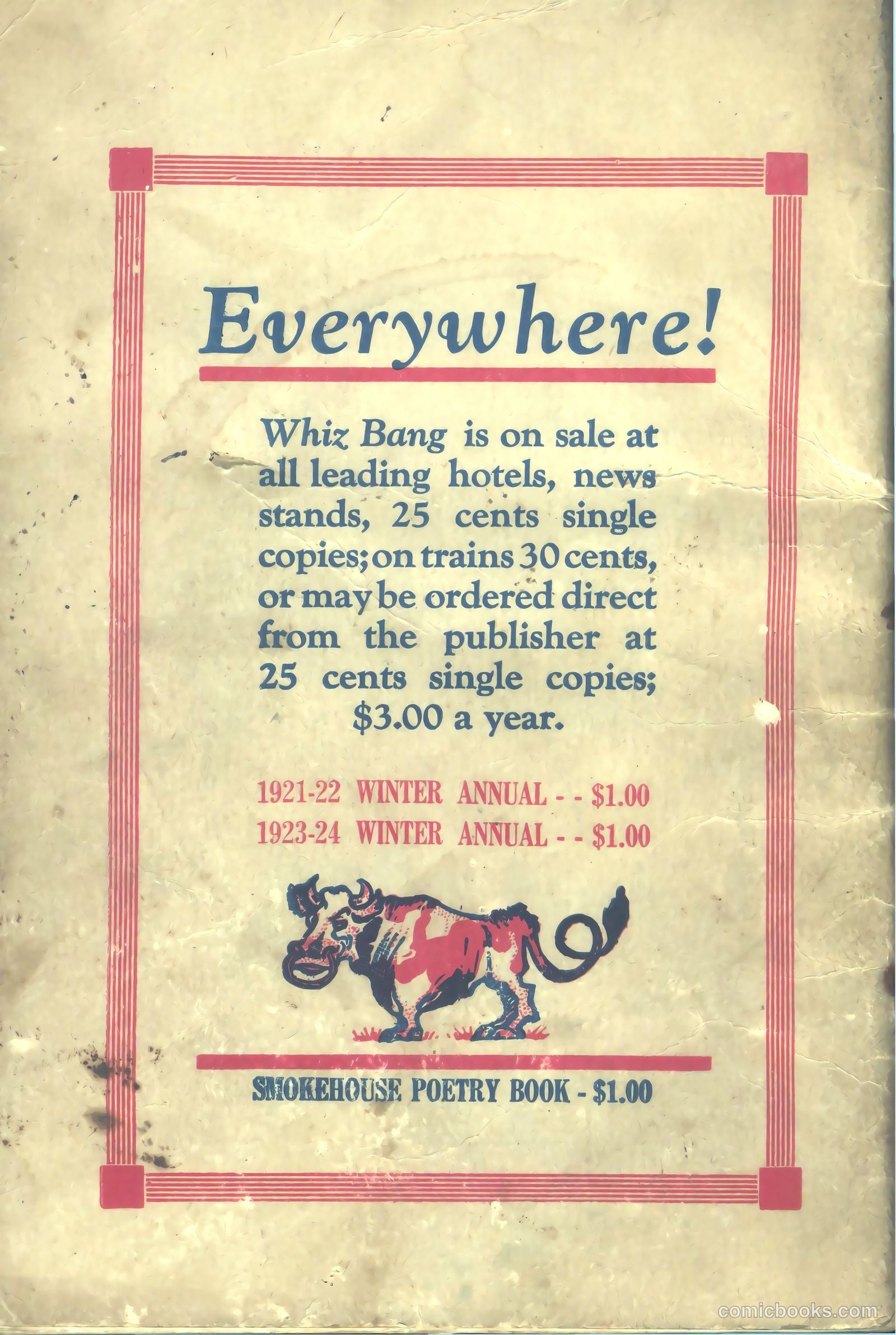
This is primarily an **advertisement page**, not satirical content. It promotes *Whiz Bang*, a satirical magazine from the early 1920s, emphasizing its widespread availability at hotels, newsstands, and via direct subscription ($3.00 yearly). The page advertises back issues: the 1921-22 and 1923-24 Winter Annuals (each $1.00), and a "Smokehouse Poetry Book" ($1.00). The decorative element is a **cartoon cow or bull mascot** in red and blue—likely the magazine's logo or brand identifier. It's stylized in the humorous, exaggerated manner typical of 1920s commercial art, but carries no apparent political meaning. This is a marketing document rather than content showcasing *Whiz Bang's* actual satirical humor.