
A complete issue · 68 pages · 1923
Captain Billy's Whiz Bang #45
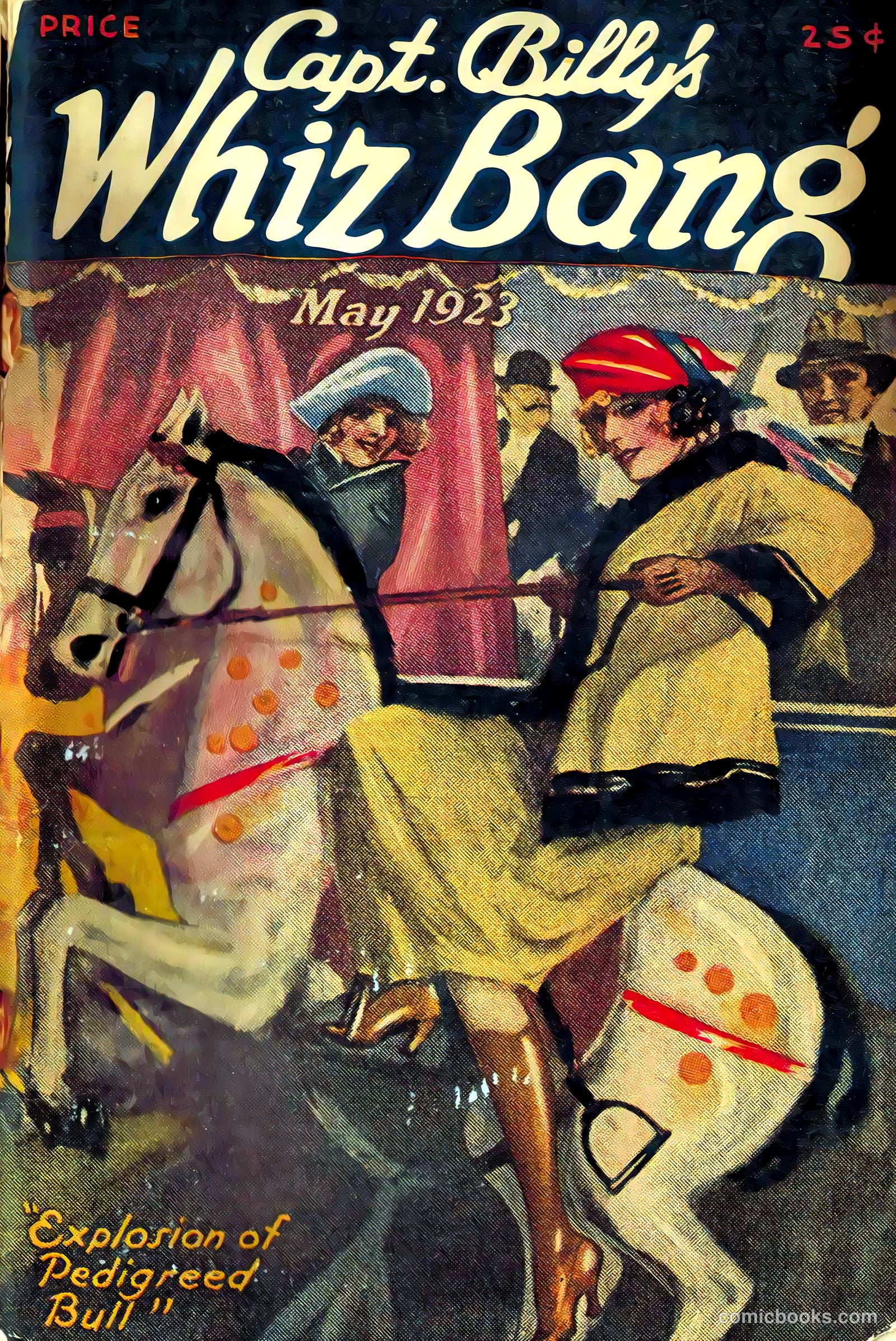
This is a **title page** for a satirical magazine priced at 25 cents. The cover illustration depicts a dramatic scene with a bucking horse and several men in period clothing and hats, with text referencing "Explosion of Pedigreed Bull." The image appears to be a humorous visual pun or slapstick scenario—likely depicting the chaotic aftermath of the titled incident. Without additional context from the magazine's interior, the specific satire or social commentary remains unclear, though the absurdist humor (an explosion involving a "pedigreed" bull) was typical of 1920s comedic magazines that relied on exaggeration and visual gags. The elaborate staging and dramatic composition suggest this was meant as entertainment rather than pointed political commentary.
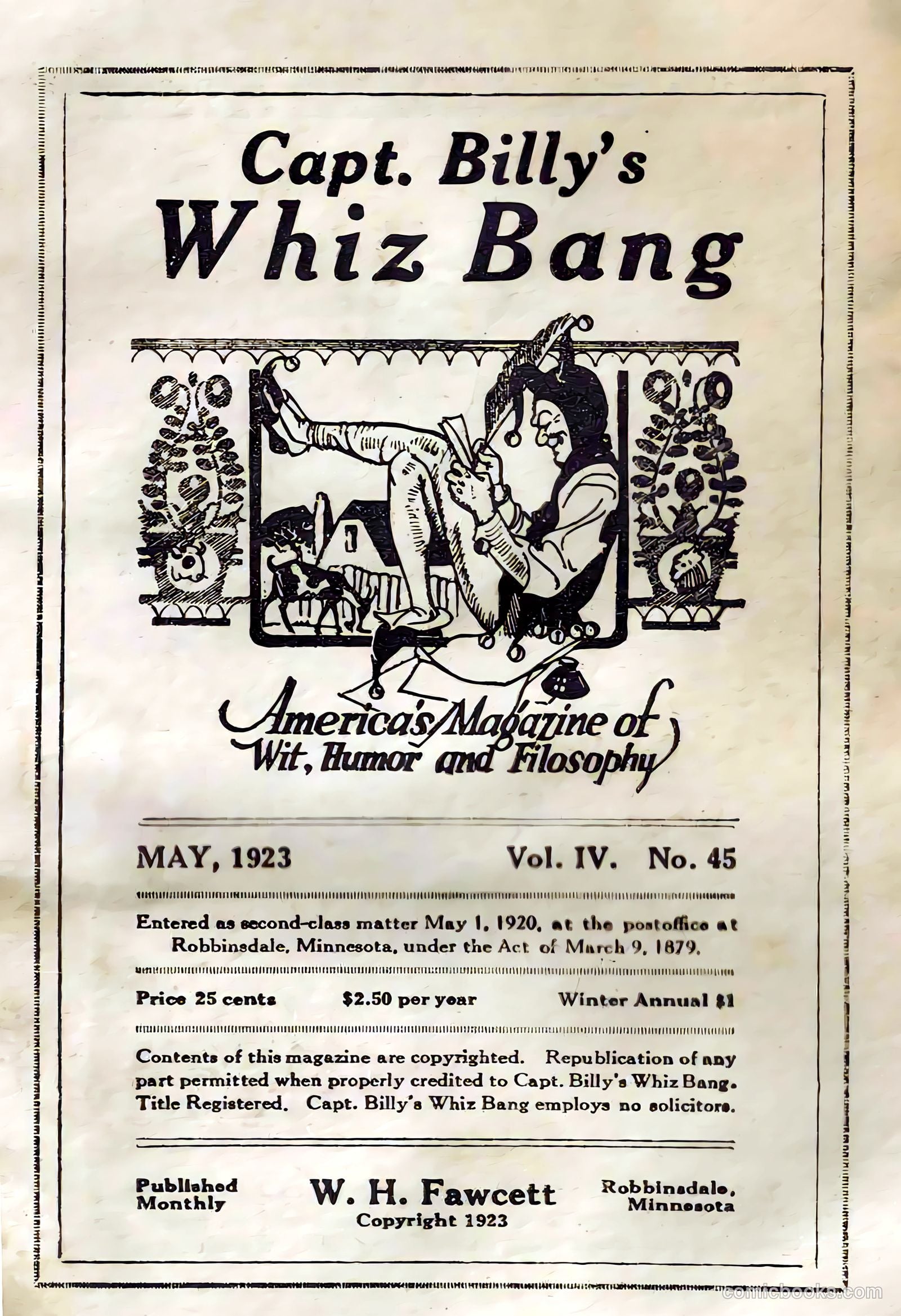
This is the cover/title page for *Capt. Billy's Whiz Bang*, a satirical magazine published in May 1923 by W.H. Fawcett in Robbinsdale, Minnesota. The subtitle describes it as "America's Magazine of Wit, Humor and Philosophy." The illustrated vignette shows a man in formal attire (top hat and tails) being physically ejected—his legs kicking upward—while a woman operates what appears to be a mechanical device or contraption to propel him out. The decorative borders suggest this is likely depicting a domestic conflict or romantic mishap, typical of 1920s slapstick humor. Without identifying the specific figures, the image appears to satirize social awkwardness or relationship drama through exaggerated physical comedy, a common theme in era magazines aimed at adult male readers.
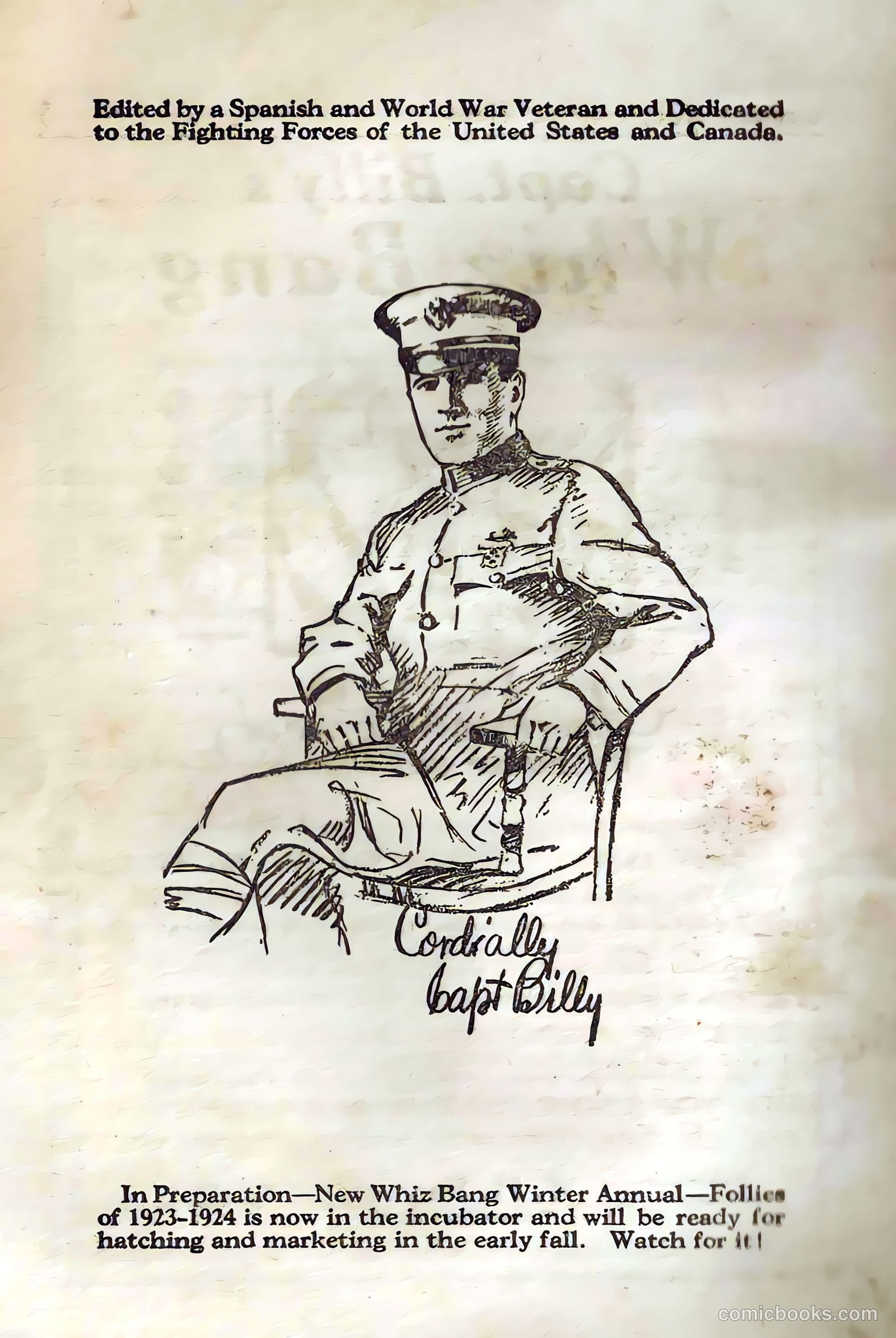
This is a title/dedication page from *Whiz Bang*, a satirical magazine. The page features: **The Image**: A sketch of a military officer in WWI-era uniform, signed "Cordially, Capt Billy." The officer wears a campaign hat, insignia, and appears to be sitting casually. **The Text**: The magazine is "Edited by a Spanish and World War Veteran and Dedicated to the Fighting Forces of the United States and Canada." A note announces an upcoming "New Whiz Bang Winter Annual—Follies of 1923-1924." **Context**: "Capt Billy" (Captain Billy Fawcett) founded *Whiz Bang* as a humor magazine for WWI veterans. This dedication page establishes the magazine's patriotic military credentials while promoting the upcoming annual issue. The casual sketch style reflects the magazine's irreverent, soldier-friendly humor aimed at post-war audiences.
This is a humorous column by "Captain Billy" comparing dogs and cats. The author argues that dogs are superior to cats because of their loyalty and willingness to endure hardship ("sticks around waiting for bones until he's all bones himself"), while cats are selfish—they abandon you the moment food rations run out. The piece appears to reference wartime rationing conditions, likely from WWI era, when the magazine operated. The comparison uses contemporary hardship as its joke: during scarcity, dogs remain faithful dependents while cats are purely transactional. The satire works by applying human economic and social concepts (loyalty, fair-weather friendship) to pet behavior, making it commentary on both animal nature and perhaps human reliability during difficult times.
This is a prose article titled "Captain Billy's Whiz Bang," not a cartoon page. The narrator ("Captain Billy") describes a rambling trip visiting various American and Mexican towns with his wife. The piece satirizes border towns—particularly Tijuana and Mexicali—as centers of drug use and vice. The author describes witnessing drug transactions at "Chink's Dope House" and observes crowds of people, including young women from California, openly using narcotics ("getting their 'shot' of 'dope'") in broad daylight. The tone is moralistic outrage at what he views as uncontrolled depravity and criminality, presented as social commentary on drug abuse and border-town corruption in early-20th-century America.
This page contains personal memoir/travel writing rather than political satire or cartoons. The author describes a visit to Los Angeles, romanticizing it as a glamorous destination filled with "Princes and Sheiks" and exotic luxury. The satire is subtle: the author mocks this romanticization while simultaneously indulging in it, noting that Los Angeles offers "nothing undone" in terms of romance and adventure—suggesting it's a place of excess and artificiality rather than genuine experience. The final anecdote about visiting Harold Lloyd's film studio and encountering actor John Aasin (a real "giant" performer of that era) adds humor through the casual mention that one giant actor had already died during production, reflecting on the physical demands and risks of early Hollywood filmmaking.
This page from *Whiz Bang* contains a humorous anecdote about Prohibition-era bootlegging in Portland. The narrator describes visiting a speakeasy operator on lower Washington Street who sells illegally distilled whiskey. The bootlegger boasts about his product's quality—twice-distilled, charcoal-filtered, aged six weeks—and notes how prices have fallen from $35 per gallon during early Prohibition to $10 now, expecting further drops. The satire mocks both the bootlegger's proud commercialism during Prohibition and the economic reality of black-market liquor: despite illegality, competition drives prices down and quality suffers. The bootlegger's dismissal of inferior Canadian imports adds regional humor. The piece implicitly critiques Prohibition's failure to eliminate drinking—it merely created a criminal enterprise—a common theme in 1920s satire.
This page contains satirical commentary on Prohibition-era smuggling and public morality. The opening paragraph jokes about finding "Canadian King George on tap"—referencing illegal alcohol smuggling across the Canadian border during Prohibition. The main anecdote mocks religious hypocrisy: a minister on a train claims moral authority, but a passenger challenges him with a $5 bet about Biblical interpretation regarding Lot's wife and Joseph. The joke implies the "man of the Gospel" may not actually know scripture, exposing the gap between religious pretension and genuine knowledge. The satire targets both Prohibition enforcement failures and the sanctimonious moralizing that accompanied the era, suggesting traveling Americans encountered both interesting characters and dubious piety.
This page contains two humorous anecdotes rather than political cartoons. The first story mocks Prohibition-era hypocrisy: the author attended a temperance play in Nassau that was so preachy it nearly converted him—until an advertisement for "Gilby's dry gin and whiskey" appeared between acts, undermining the message's seriousness. The second anecdote features Ring Lardner (a well-known American humorist), who encounters two drunk men in Miami. Believing each lives in the building where he finds them, Lardner helpfully deposits them in successive apartments upstairs—a joke about mistaken identity and good intentions gone absurdly wrong. Both stories satirize 1920s American excess and social contradictions during Prohibition.
This page contains two distinct pieces: 1. **The drunk anecdote** (top): A humorous vignette where a drunk man, descending stairs, stumbles over another drunk who appeals to a policeman for "protection" from being repeatedly thrown down an elevator shaft. It's a slapstick joke playing on urban drunkenness and police complaints. 2. **The New Orleans essay** (bottom): An informational piece explaining that New Orleans exists due to the fur trade, and discussing the term "Creole" in Louisiana—comparing it to "Knickerbocker" in New York. It describes Creoles as descendants of French and Spanish families claiming status as "old families" distinct from later emigrants. No specific political figures are caricatured. The content reflects 1920s attitudes toward immigration, class distinction, and regional history.
This page contains two separate gossip items. The first is a mild anecdote about a drayman (delivery driver) hired to move a trunk, only to discover a young man emerges from it—implying an affair or secret relationship. The second item is a racist "joke" that uses a slur to demean Black people, claiming a distinction based on work ethic and procrastination. This represents the casual, normalized racism common in 1920s American popular media. "Whiz Bang" was known for crude humor and social commentary. While the first anecdote relies on surprise and innuendo typical of the era's "morsel of gossip" format, the second item reflects deeply prejudiced attitudes that were mainstream entertainment at the time, though shocking today.
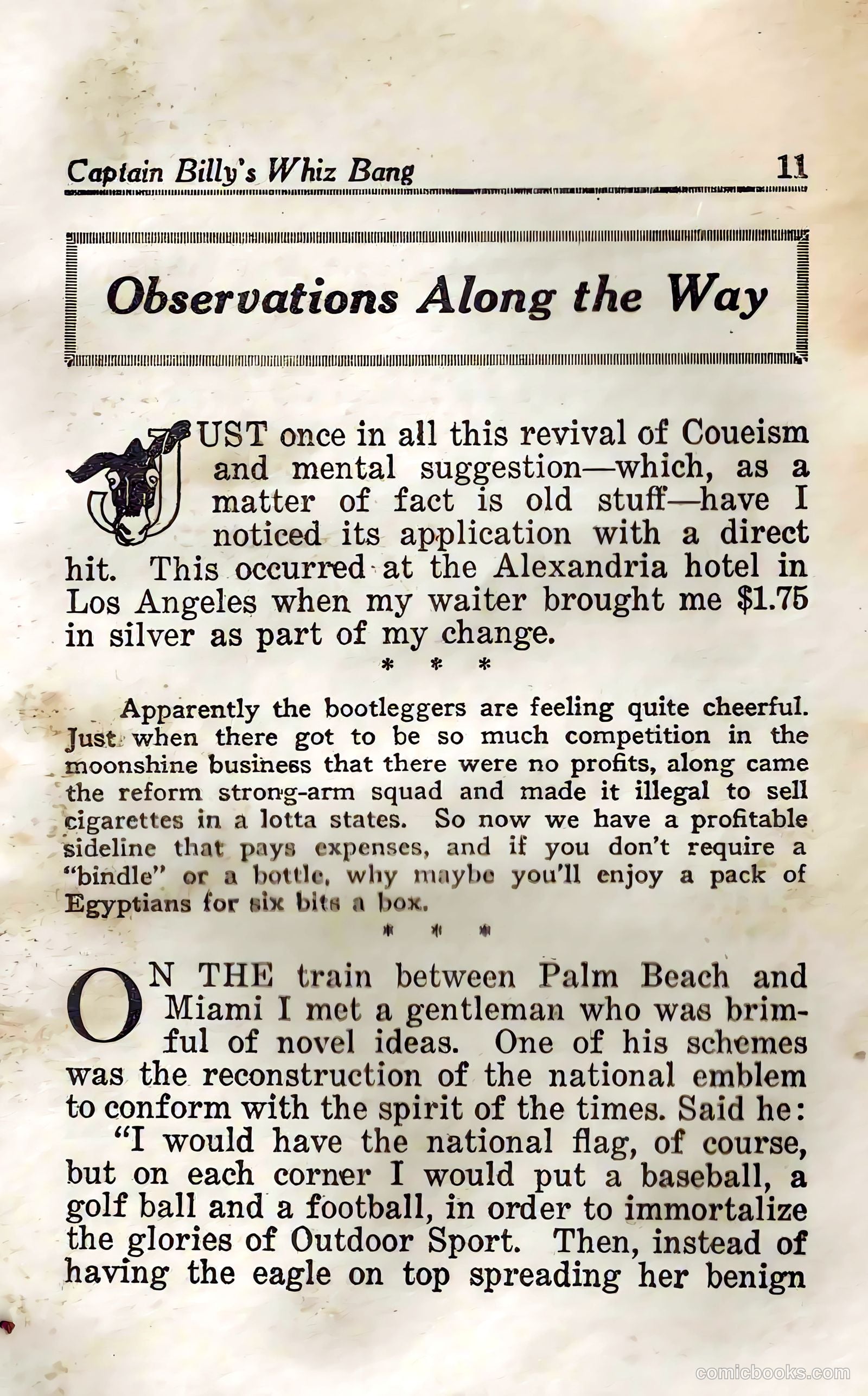
This satirical column contains three brief anecdotes mocking contemporary issues: 1. **Mental suggestion/Coueism**: The author received $1.75 in silver change, apparently as a "mental suggestion" experiment—satirizing the popular Coué method of self-improvement through positive affirmation. 2. **Prohibition-era bootlegging**: The piece jokes that bootleggers profited after cigarette sales became illegal in some states, creating a new black-market revenue stream. Cigarettes now cost "six bits a box"—expensive by the era's standards. 3. **National emblem redesign**: An anecdote about reconstructing the American flag to include baseballs, golf balls, and footballs to celebrate outdoor sports—mocking nationalistic jingoism and American sports obsession. The humor targets 1920s fads, unintended consequences of Prohibition, and American culture.
This page contains three satirical commentary pieces by the magazine's author addressing contemporary American issues: 1. **Stork imagery**: A humorous reflection on the stork as symbolic of procreation and natural reproduction. 2. **Comstock Law critique**: Satire of Congressional hypocrisy—mocking how government alternates between tax incentives for large families and "pruning hooks" (birth control restrictions). The author sarcastically suggests Congress needs "root grafting" to fix America's "family trees." 3. **Traffic safety satire**: Western states' new laws requiring herds (people) to wear reflective gear are mocked. The author proposes color-coding pedestrians by category (red for males under 30, violet for widows, green for "old maids") so drivers know "who to pick up"—crude satire suggesting sexual predation is inevitable. The humor is dark, cynical, and misogynistic by modern standards.
This page contains a humor column by "Whiz Bang Billy" (signed at bottom) consisting of several brief satirical observations rather than cartoons: 1. **Hotel pricing**: Mocks American leisure culture—hotels charge premium rates for weekend stays ("transients"), yet guests still must pay extra for basic amenities like baths. 2. **Chaperones vs. Prohibition**: References the shift from traditional dance chaperones to modern Prohibition enforcement officers, suggesting society's values have changed regarding supervision. 3. **Waiter pretension**: Satirizes servers who ceremoniously present covered dishes ("sous cloche") with exaggerated reverence. 4. **Perfect husbands**: Reports a newspaper query, with Billy's character "Gus" cynically observing women wouldn't want a perfect husband anyway. The humor targets middle-class American social conventions and consumerism of the 1920s Prohibition era.
This page contains humorous anecdotes and short jokes rather than political cartoons. The content includes: **"One Way of Telling the Story"**: A doctor's misdiagnosis joke where a soda-jerker woman sarcastically suggests if he can diagnose intestinal indigestion from her throat, perhaps he should check if her hat is on straight—mocking incompetent medical examination. **"What Is So Rare as a Day in June?"**: Absurdist riddles listing impossible/contradictory items (an ermine horse blanket, bald-headed caterpillar), playing on the famous poem opening. **Other jokes**: Brief humorous pieces about a cat's injury, a sleepwalking maiden, and young men in Nebraska lingering at gates late at night—mild social humor typical of 1920s-era satirical magazines aimed at general audiences. The page represents lighthearted, non-political entertainment journalism.
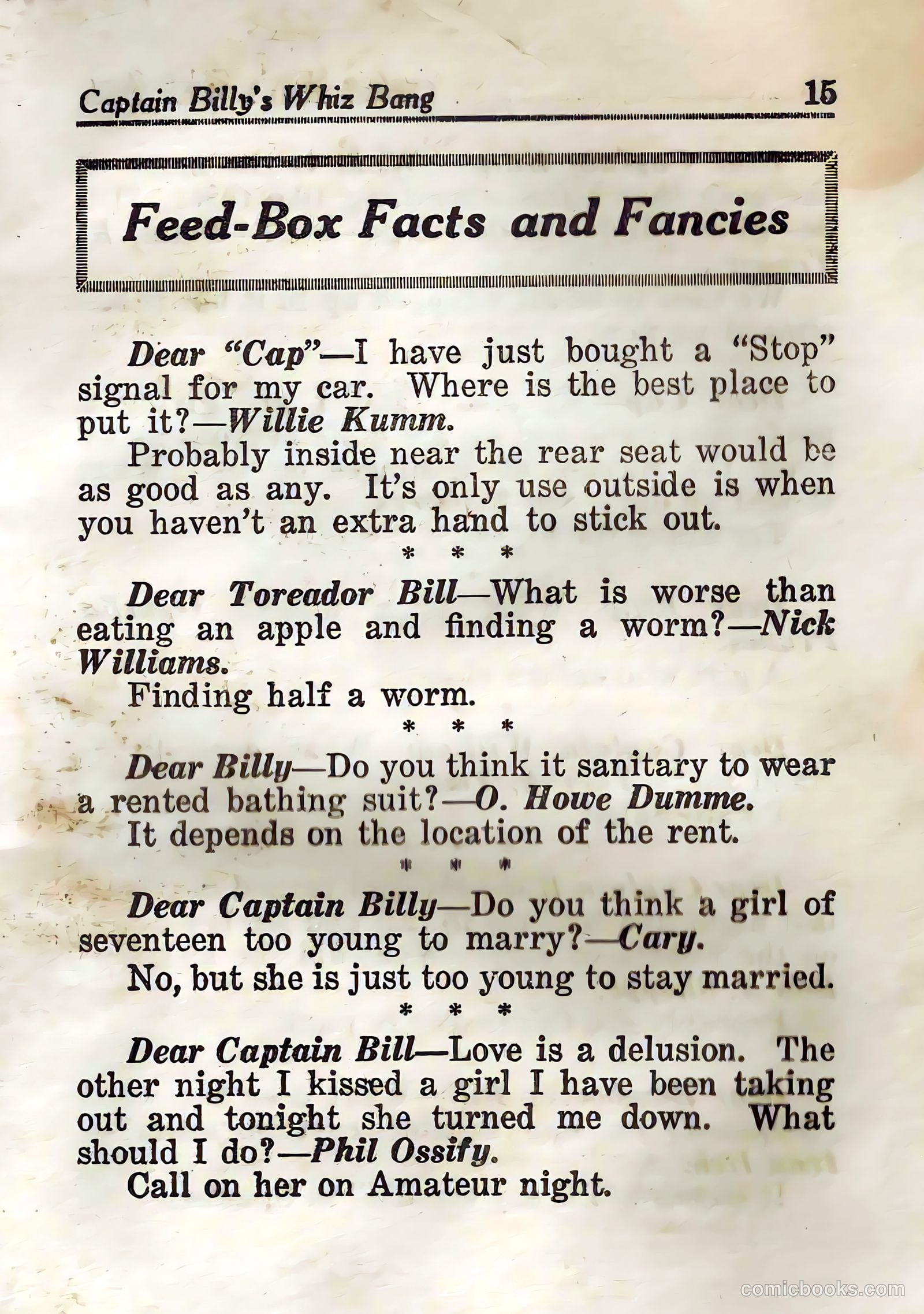
This is a humor advice column featuring jokes disguised as reader questions and responses. The satire targets courtship customs and social conventions of the 1920s era. Notable jokes include: - A practical joke about car "Stop" signals (the humor relies on implying manual hand signals for stopping) - A riddle about finding half a worm in an apple (dark humor typical of the era) - A jest about rented bathing suits being unsanitary, with Captain Billy's quip hinging on rental location - A joke about girls marrying too young but not staying married - A final gag about romantic rejection, suggesting the rejected boy visit on "Amateur night" (implying public humiliation) The column exemplifies working-class humor from this period, relying on wordplay and deflating romantic sentiment.
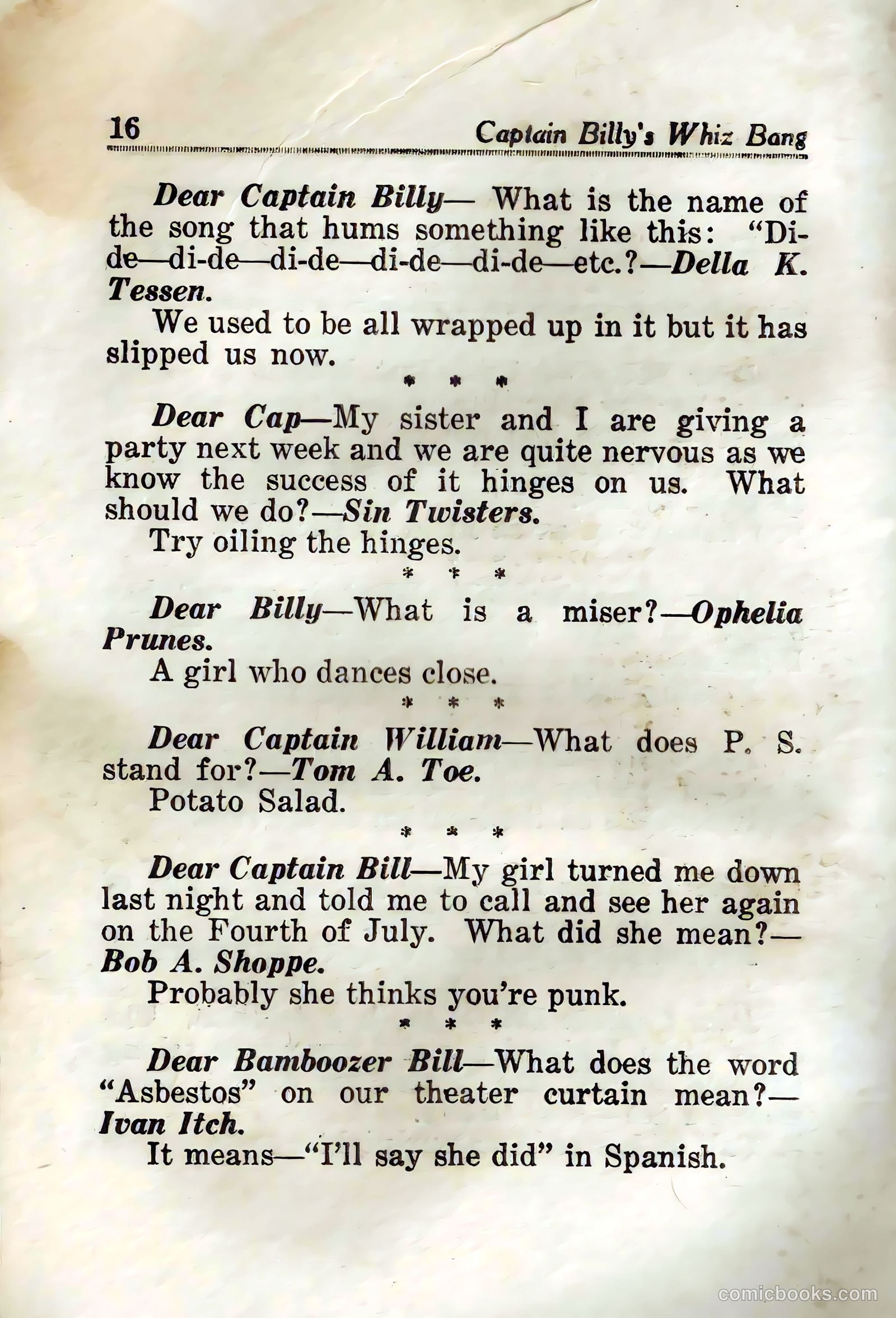
This is a humor advice column ("Dear Captain Billy") from *Whiz Bang*, a 1920s satirical magazine. The humor relies on punny or absurdist answers to readers' questions: - A song described as "Di-de-di-de..." (likely referencing a popular tune with repetitive lyrics) - Party hosting anxiety → "Oil the hinges" (physical humor) - "Miser" definition → "Girl who dances close" (dating/romance humor) - "P.S." stands for "Potato Salad" (wordplay) - A girl's rejection → she thinks you're "punk" (dismissive slang) - "Asbestos" on theater curtain → absurdist Spanish pun about saying "she did" The column's appeal lies in its rapid-fire, deliberately silly non-sequiturs and double meanings typical of 1920s vaudeville humor. Names like "Ivan Itch" and "Della K. Tessen" appear to be puns themselves.
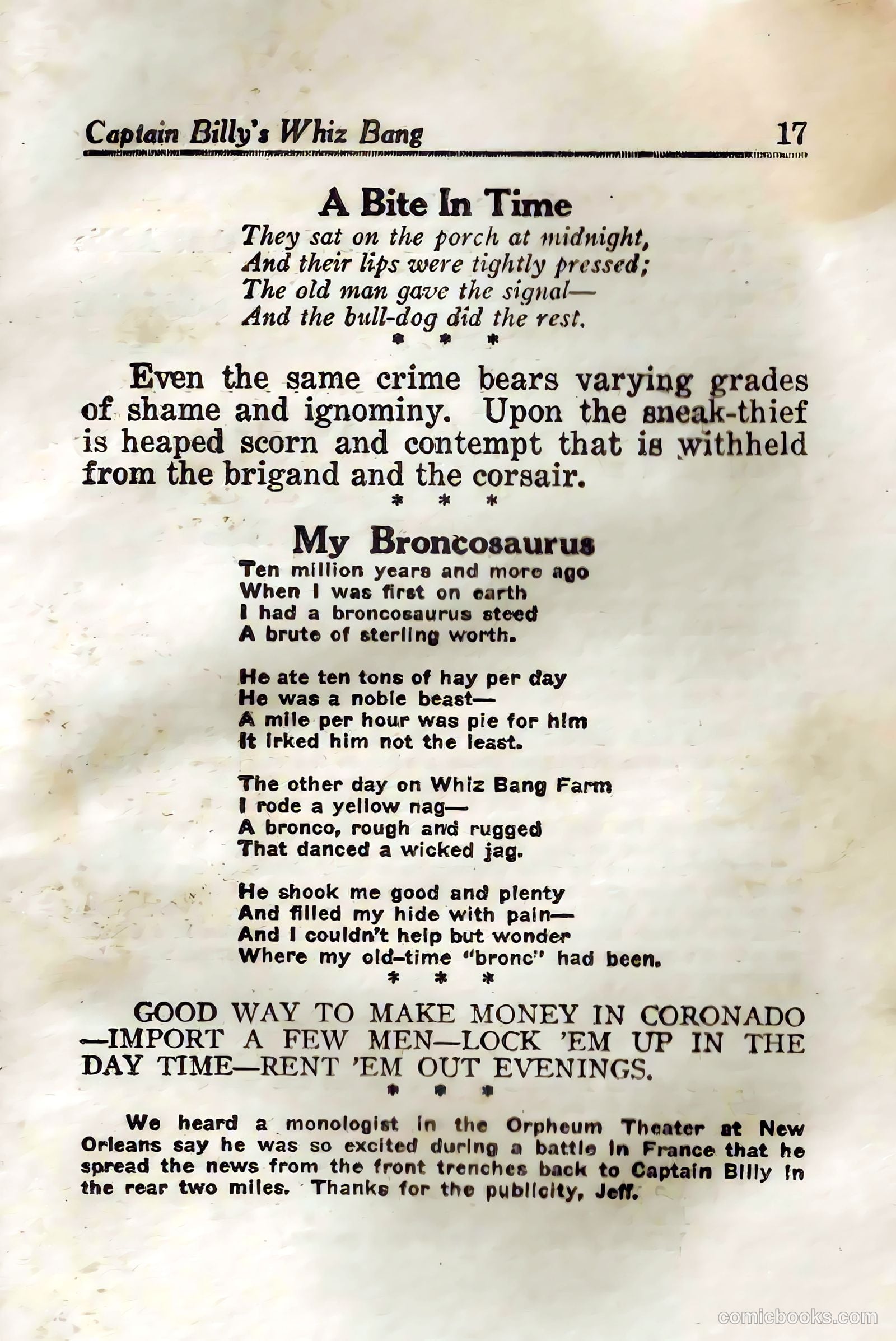
This page contains three separate pieces of humorous content rather than a unified cartoon: 1. **"A Bite In Time"** — A brief poem about a midnight porch robbery thwarted by an old man and a bull-dog, followed by philosophical commentary on how even criminals have hierarchies of shame. 2. **"My Broncosaurus"** — A nostalgic poem claiming the author once owned a dinosaur on "Whiz Bang Farm" ten million years ago, contrasted humorously with a modern bronco horse that bucked him painfully. 3. **A brief joke** about profiteering in Coronado by locking up men during the day and renting them out evenings. 4. **A theater anecdote** about a monologist so excited by WWI battle news that he spread rumors back to Captain Billy. The page emphasizes rustic humor and wartime references typical of 1910s-1920s American satire magazines.
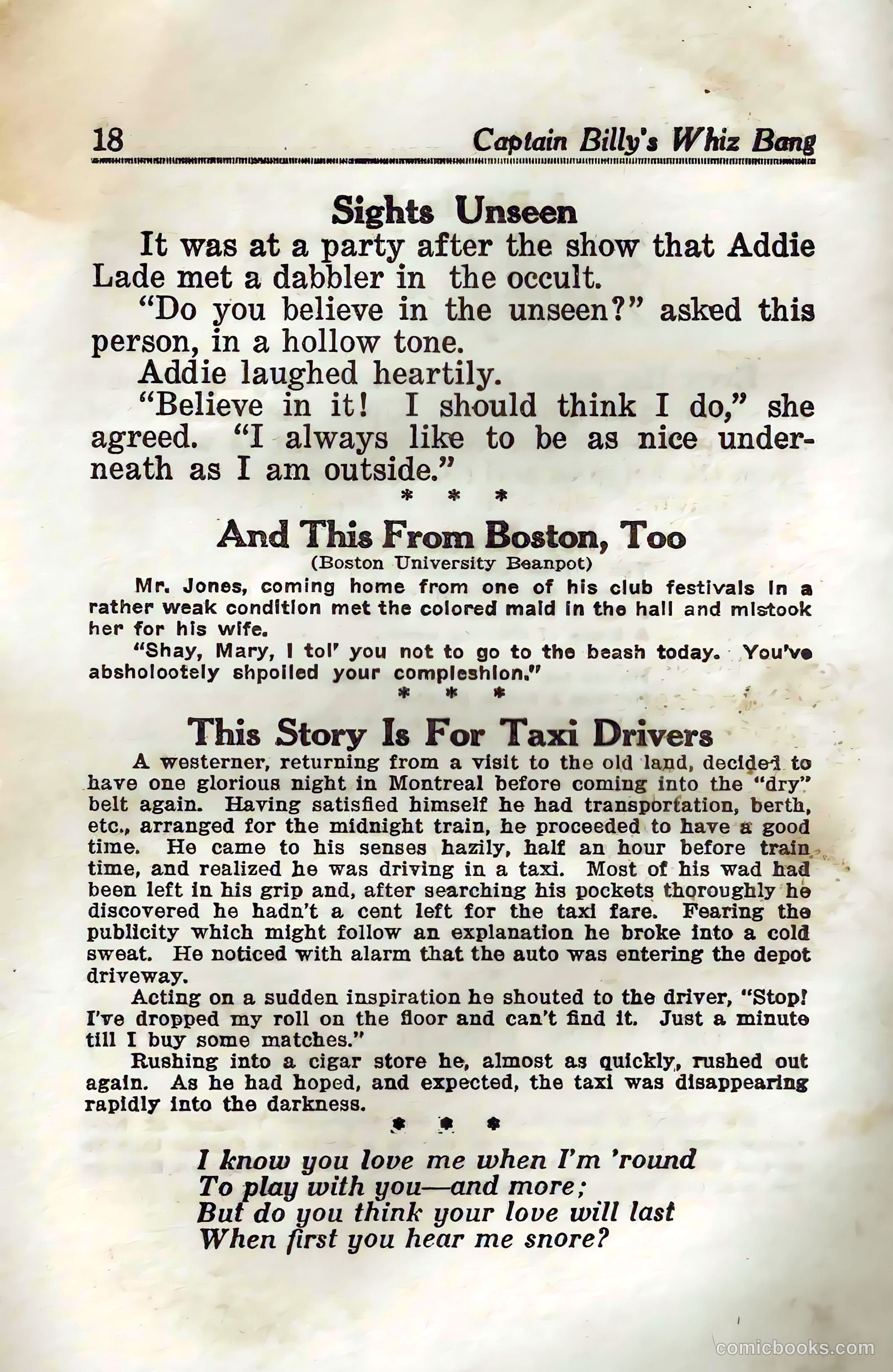
This page contains three brief humorous anecdotes rather than political cartoons: 1. **"Sights Unseen"**: Addie Lade meets an occult dabbler at a party and makes a witty comeback about being "nice underneath" as well as outside—deflating the occultist's pretentious mysticism. 2. **"And This From Boston, Too"**: A husband mistakes a maid for his wife and compliments her on ruining her complexion at the beach—a simple case of mistaken identity humor. 3. **"This Story Is For Taxi Drivers"**: A drunk man escapes a taxi ride by claiming he lost his money roll, then flees into darkness. The joke targets both drunken behavior and taxi driver frustrations. The final verse humorously questions whether romantic love survives hearing one's partner snore.
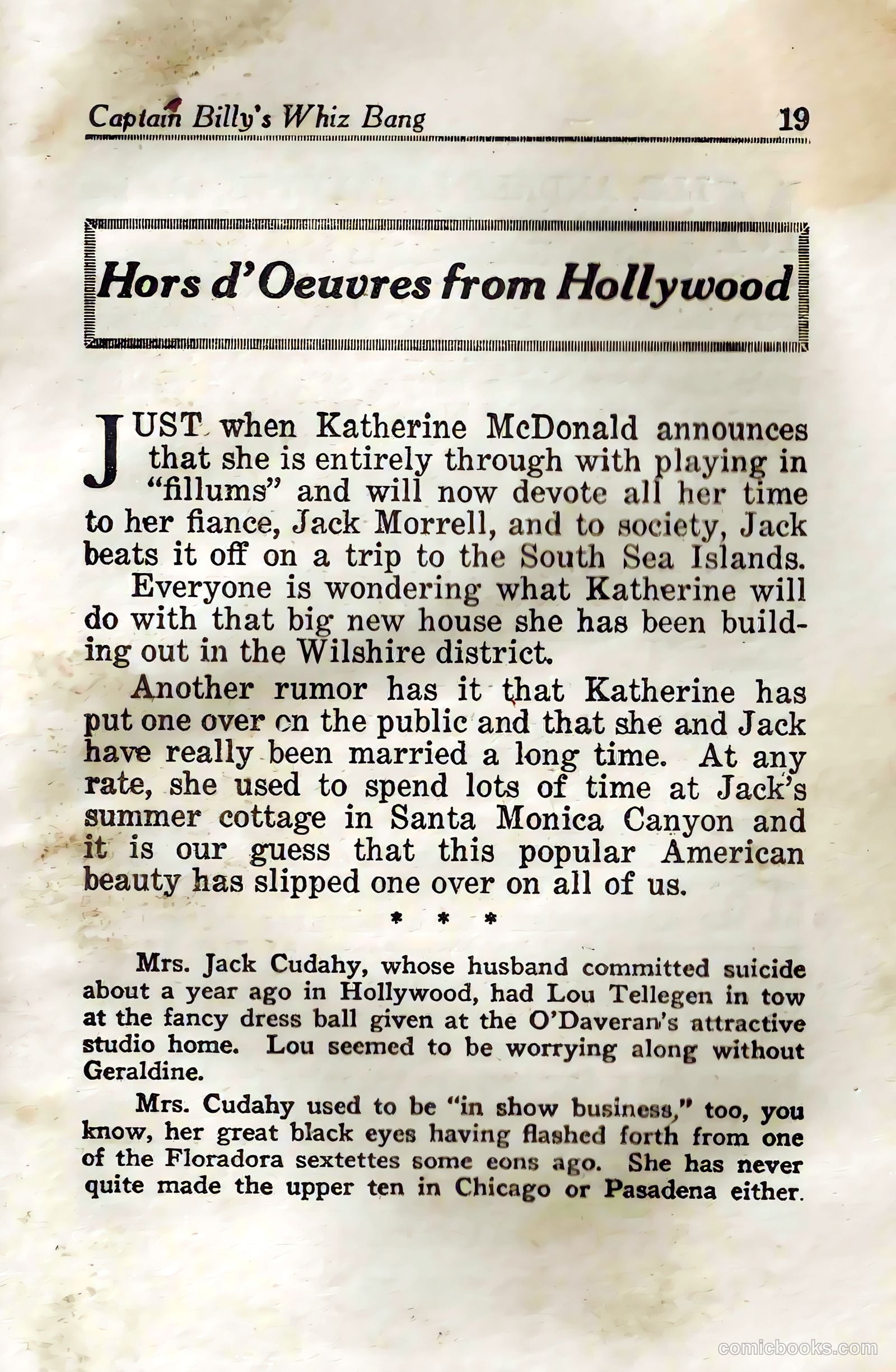
This gossip column satirizes Hollywood celebrity culture of the 1920s. The main item concerns actress **Katherine McDonald**, who announces retirement from "fillums" (films) to focus on her fiancé **Jack Morrell** and society life. The satire mocks the contradiction: she's building an expensive house while claiming to leave show business, and there's speculation she and Morrell may already be secretly married. A secondary item discusses **Mrs. Jack Cudahy**, whose husband died by suicide a year prior. She apparently appeared at a social event without her friend **Geraldine**, prompting gossip. The column notes Cudahy was formerly in "show business" but never achieved top-tier success in Chicago or Pasadena society. The tone is cattily mocking, exposing Hollywood pretension and social-climbing ambitions.
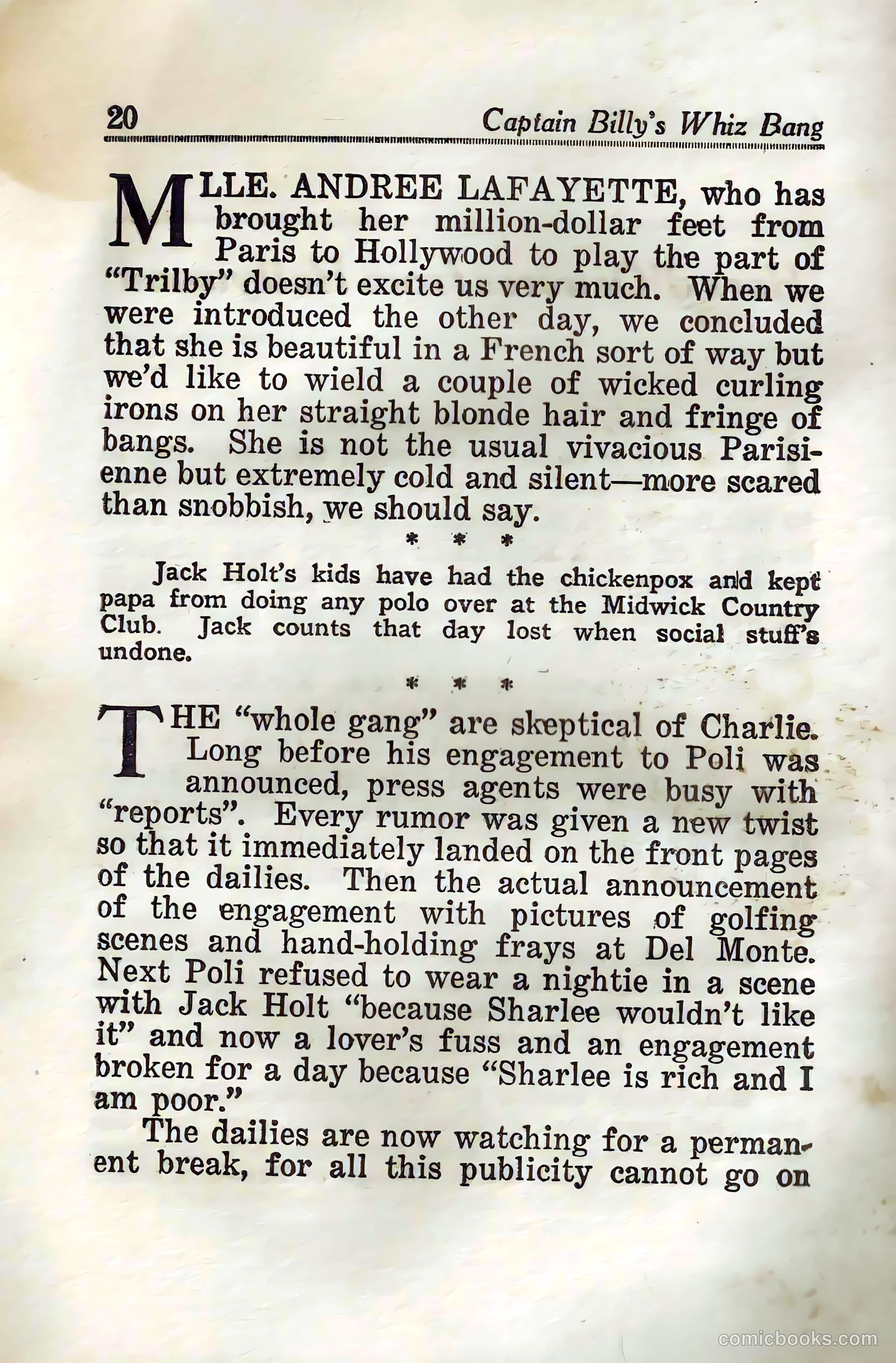
This page contains celebrity gossip rather than political cartoons. It discusses three Hollywood scandals: 1. **Mille Andree Lafayette** — A French actress hired to play "Trilby" in a film. The columnist critiques her appearance (straight blonde hair, needing curls) and personality (cold and silent rather than vivacious). 2. **Jack Holt** — His children caught chickenpox, preventing him from playing polo at an exclusive country club, disrupting his social life. 3. **Charlie** and **Poli** — An engagement announcement became tabloid fodder. The scandal involved jealousy (someone named "Sharlee"), a refused nightie scene, and a one-day broken engagement blamed on wealth disparity ("Sharlee is rich and I am poor"). The satire mocks Hollywood's manufactured publicity and dramatic personal conflicts.
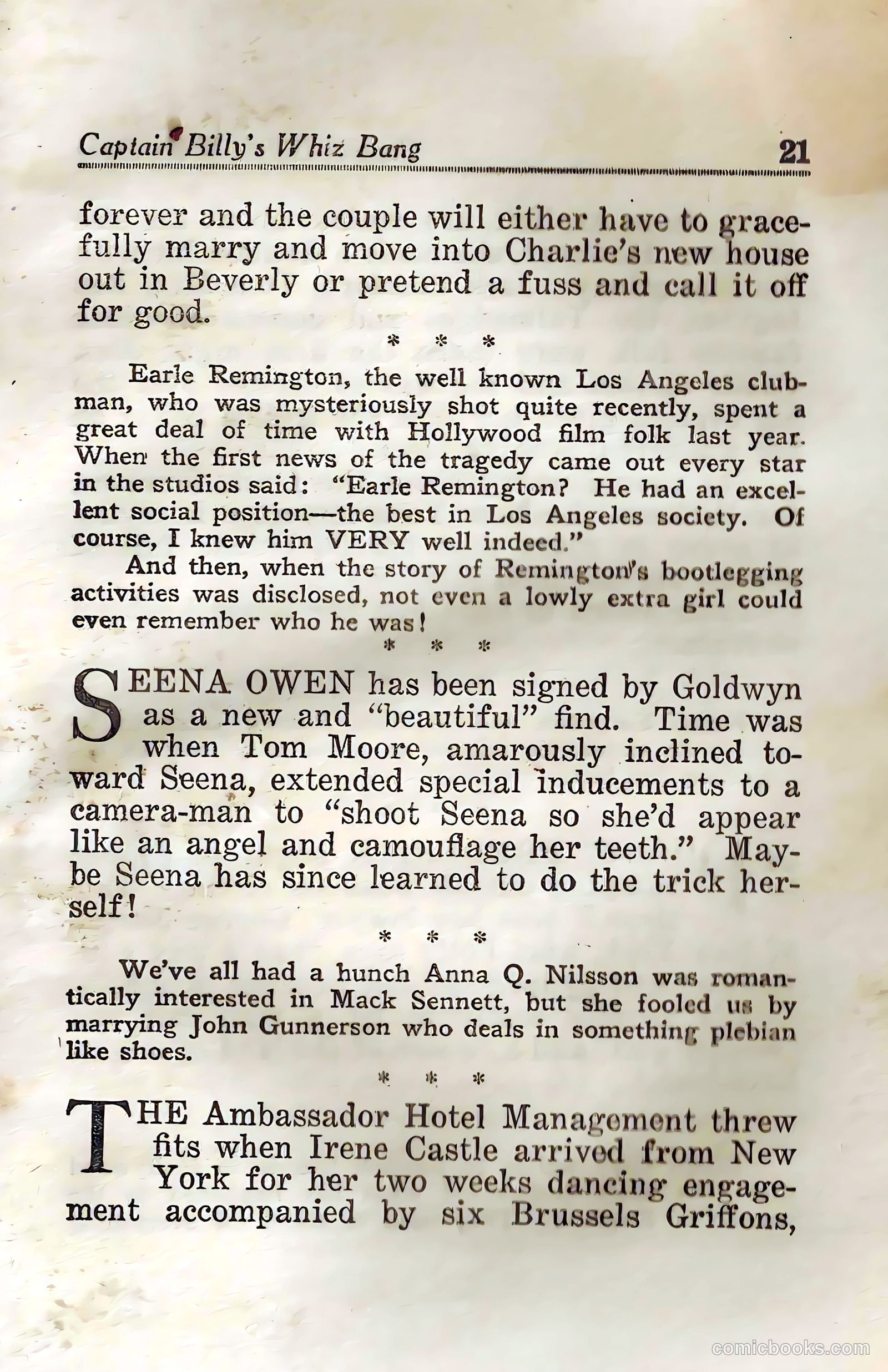
This page contains four gossip items about Hollywood celebrities, presented without illustrations. The satire targets entertainment industry hypocrisy and shallow celebrity culture: 1. **Earle Remington**: Mocks how Hollywood stars claimed close friendship with a murdered clubman while his reputation was respectable, then abandoned those claims when his bootlegging activities were revealed—exposing their opportunistic social climbing. 2. **Seena Owen**: Ridicules the studio system's manipulation, describing how Tom Moore allegedly paid a cameraman to flatter her appearance, implying Owen needed artificial help to look presentable. 3. **Anna Q. Nilsson**: Brief jab at her romantic choices. 4. **Irene Castle**: Notes her arrival from New York with six dogs, likely mocking celebrity affectation. The humor relies on insider knowledge of these minor Hollywood figures and contemporary gossip.
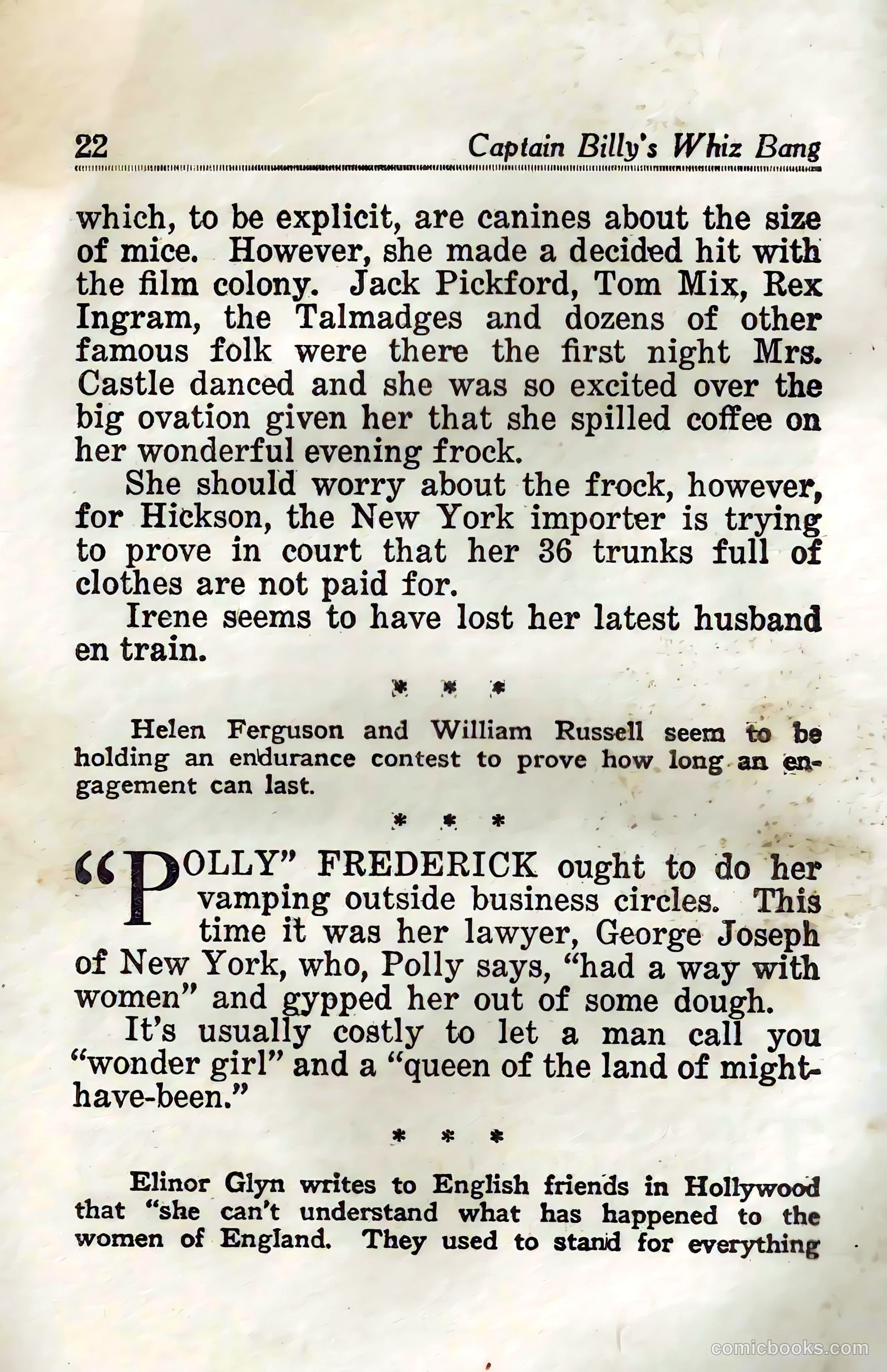
This page consists entirely of celebrity gossip items, not political cartoons or comics. The satire targets Hollywood and high-society figures through scandal and innuendo: - **Mrs. Castle** receives mockery for her expensive wardrobe and a coffee-stained evening gown incident at a film colony party attended by Jack Pickford and other celebrities. - **Polly Frederick** is satirized for allegedly being "vamped" by her lawyer, George Joseph, who supposedly manipulated her financially. - **Elinor Glyn** (a noted screenwriter/socialite) is criticized in a fragment discussing changing standards for "women of England." The humor relies on readers' familiarity with these entertainment-world personalities and enjoys their misfortunes and romantic entanglements. No images accompany the text on this particular page.
This page is a gossip column satirizing Hollywood and literary figures of the silent film era. The main targets include: **Nina Wilcox Putnam** — a writer whose success allegedly inspired a western studio writer, who brags he can sell stories because "if a wholesome looking person like Nina...can sell stories, I can." The satire mocks his cynical reasoning and implies Putnam's respectable appearance contradicts her actual behavior (smoking, slang-using). **Gloria Swanson and Marie Prevost** — mocked for bobbing their hair, with "Prevo" presented as a rhyming nickname. **Lady Sackville West** — mentioned as an extra on a film set alongside various aristocratic and socialite figures. The column's tone is cattily gossipy, using innuendo and mockery typical of 1920s scandal journalism about Hollywood's perceived moral decline.
This page contains brief satirical gossip items and jokes rather than cartoons. The content targets Hollywood celebrities and social conventions of the era: 1. **Barbara La Marr adoption**: Mocking her multiple marriages to different men (La Marr, Watson, Ainsworth, Lytell, Converse, Deeley), suggesting adoption was unnecessary given her marital history. 2. **Marjorie Prevost's quick divorce**: Satirizes the speed of a film bride's marriage ending, joking that film actresses' names should remain in type longer before publication due to rapid divorces. 3. **Jack Miller anecdote**: Notes he lacks his father's robust health, alternating between acting and sanitarium stays. The humor relies on readers' familiarity with Hollywood gossip and mocking the era's marital instability among entertainers.
This page contains several brief humorous anecdotes rather than traditional cartoons. The jokes target: 1. **"Pasture Pot Pourri"**: Mocks a city girl's pretentiousness after being chased by a bull—she boasts about her "agility" climbing a fence while exposing her undergarments, ironically unaware of her undignified appearance. 2. **"We Wonder Why"**: A domestic satire about two wives praising their husbands as "good and sweet" for staying home, then admitting neither enjoys pleasure-seeking—implying the husbands are dull or sexually disinterested. 3. **"Latest Song Hit"**: A cheeky reference suggesting impropriety ("Sister Susie's night to use the Parlor"). 4. **Etiquette Lesson**: Absurdist advice about not pointing at drowning people. The humor targets vanity, marital dissatisfaction, and social pretension typical of 1920s satirical magazines.
This page contains three separate humor pieces: 1. **"Am They a Hell?"** — A satirical sermon by a Black pastor using dialect humor (common in this era's comedy). The joke presents a theological explanation for Hell using an extended metaphor: God greased the world's axles, but sinners stole the lubricant by drilling oil wells across America and globally. When the axles overheat from friction, that friction becomes Hell itself. The satire appears to target both religious hypocrisy and the oil industry's environmental exploitation. 2. **A brief romantic poem** about past romantic conquests. 3. **"Say It With Corn Flowers"** — A darkly comedic obituary from the Pikeburg Gazette reporting a man's death by laughing so hard at a cockroach tickling his neck that he burst a blood vessel. The Mayor saved the spilled corn liquor bottle.
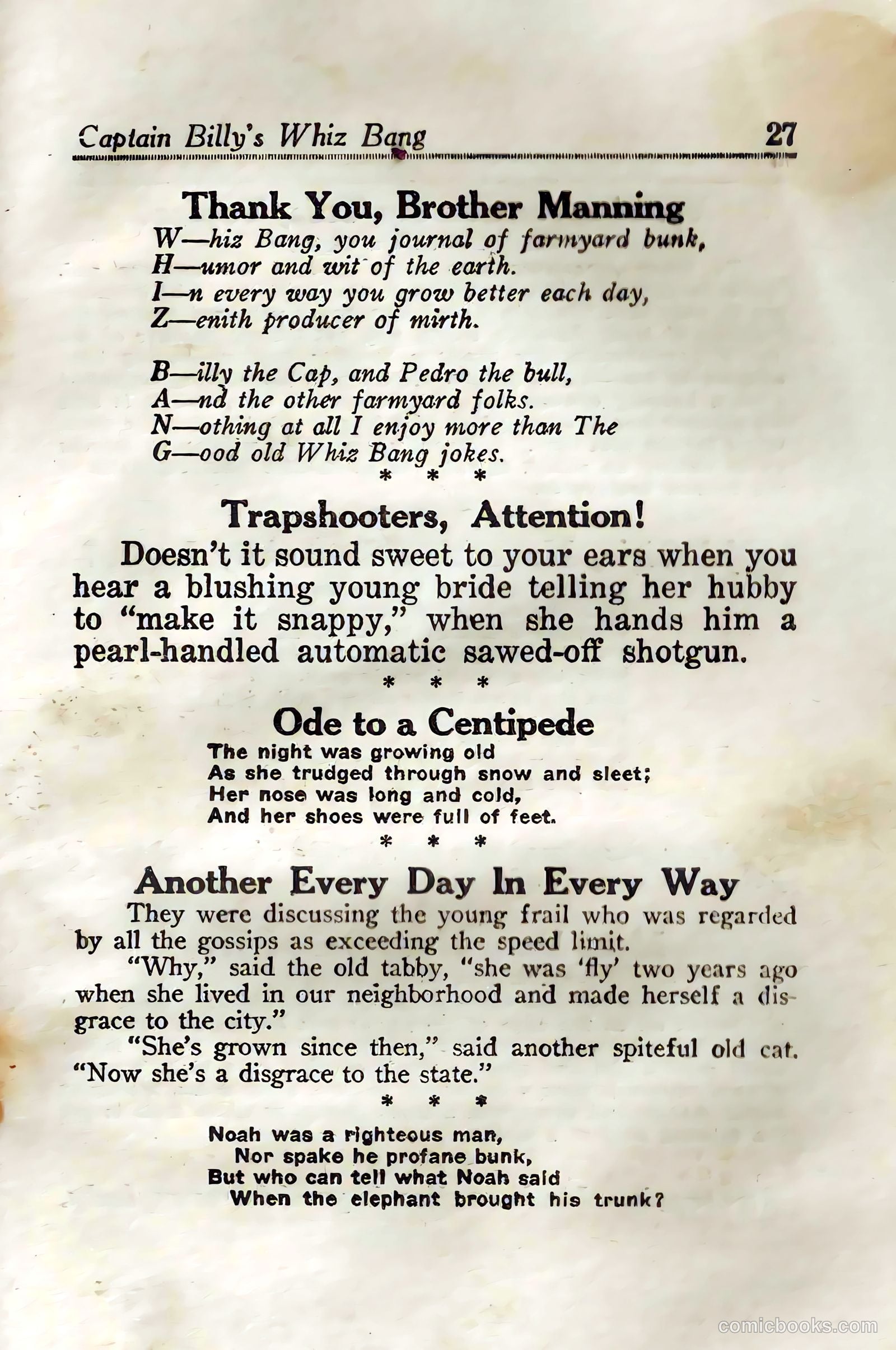
This page contains **humorous verse and jokes rather than political cartoons**. The content includes: 1. **"Thank You, Brother Manning"** — An acrostic poem praising the publication itself, suggesting reader appreciation. 2. **"Trashshooters, Attention!"** — A joke about newlyweds, where a bride humorously tells her husband to "make it snappy" while handing him a sawed-off shotgun—playing on double meanings. 3. **"Ode to a Centipede"** — Light verse about a centipede trudging through snow. 4. **"Another Every Day In Every Way"** — A gossip joke where old women discuss a young woman's escalating reputation for impropriety, progressing from local to state-level scandal. 5. **Noah joke** — A punchline about Noah's propriety when the elephant boarded the ark. The magazine targets rural/working-class humor with sexual innuendo and small-town gossip themes typical of 1920s satirical publications.
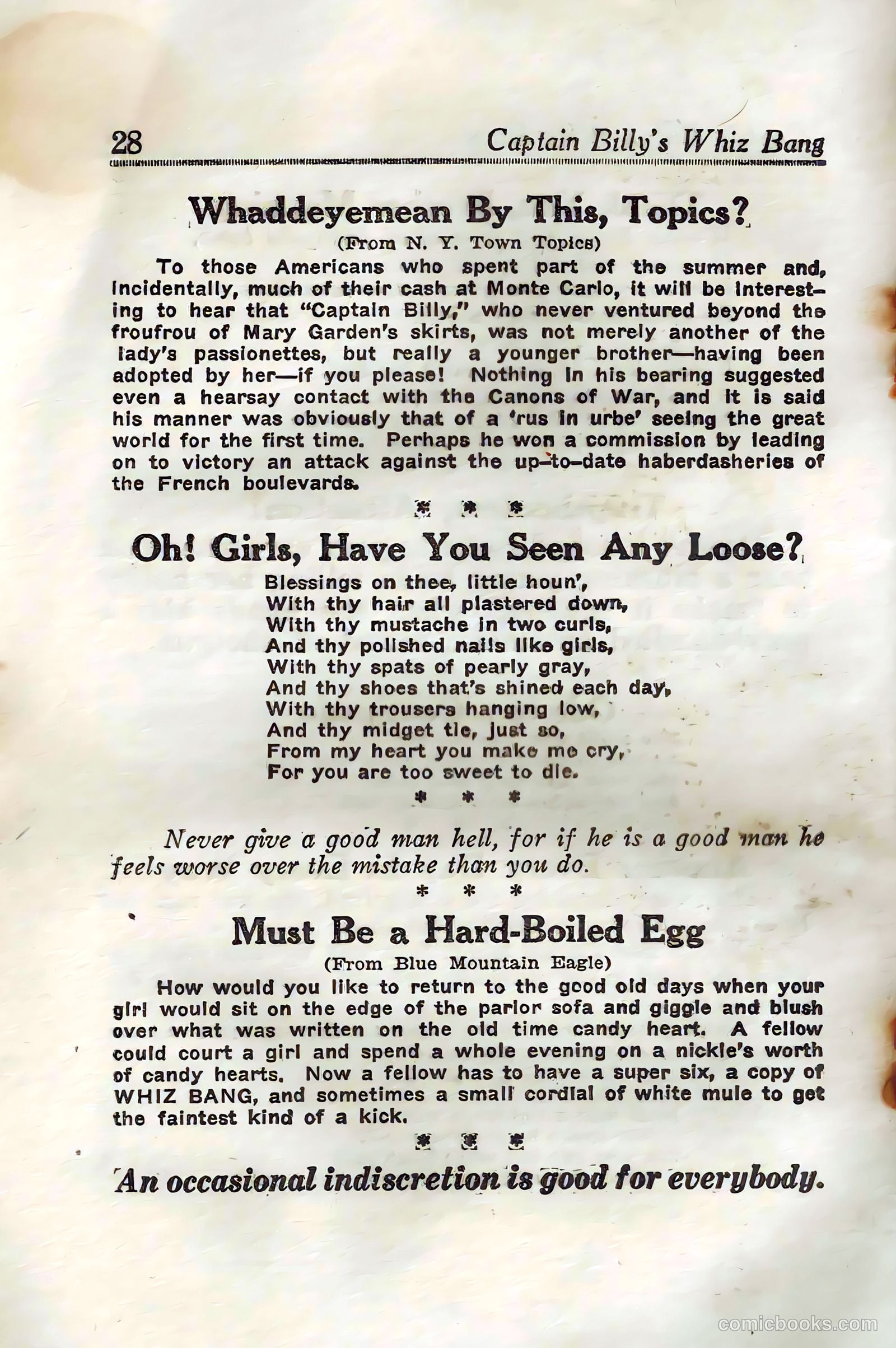
This page contains three separate satirical pieces rather than cartoons: 1. **"Whaddyemean By This, Topics?"** mocks an American tourist named "Captain Billy" who frequented Monte Carlo but had no actual military experience—satirizing wealthy Americans' pretensions and their obsession with European sophistication. 2. **"Oh! Girls, Have You Seen Any Loose?"** is a humorous poem describing an exaggeratedly fashionable man with meticulous grooming, poking fun at dandyish male fashion and vanity of the era. 3. **"Must Be a Hard-Boiled Egg"** contrasts old-fashioned courtship (candy hearts, modest gestures) with contemporary dating requiring expensive entertainment, satirizing how modern romance had become costly and commercialized. The page represents Whiz Bang's characteristic blend of social commentary and irreverent humor about American culture and gender relations.
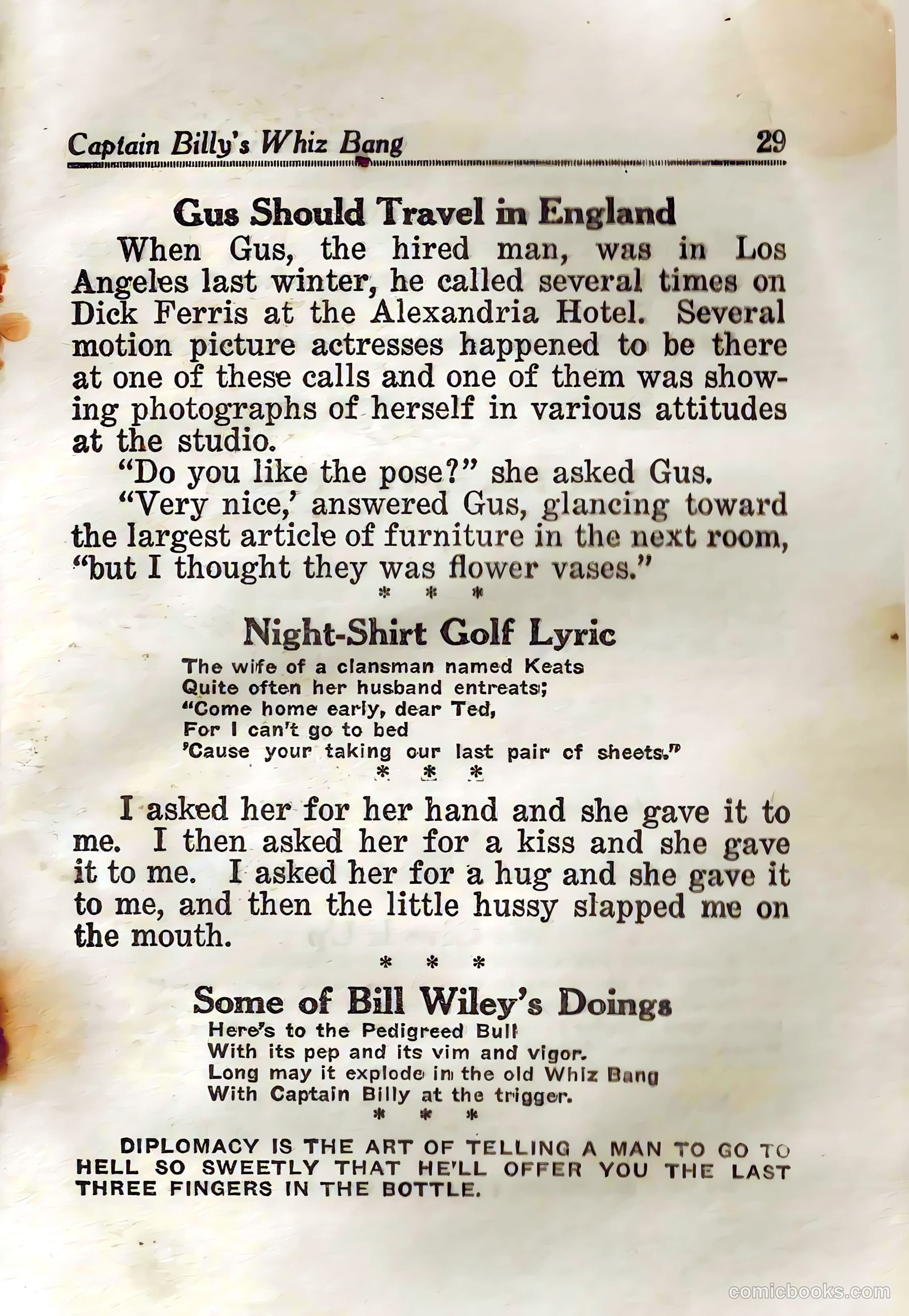
This page contains three humorous anecdotes rather than political cartoons: 1. **"Gus Should Travel in England"** — A joke about a hired man named Gus who mistakes large furniture for flower vases, poking fun at working-class ignorance of refined décor. 2. **"Night-Shirt Golf Lyric"** — A comedic poem about a wife (named Keats) complaining her husband Ted takes their bedsheets to play golf, followed by a crude anecdote about physical intimacy ending in a slap. 3. **"Some of Bill Wiley's Doings"** — A brief verse celebrating a pedigreed bull, plus a definition of diplomacy as deceptive persuasion. The humor is typical of 1920s-era satirical magazines: crude, class-conscious, and focused on domestic situations and working-class mishaps.
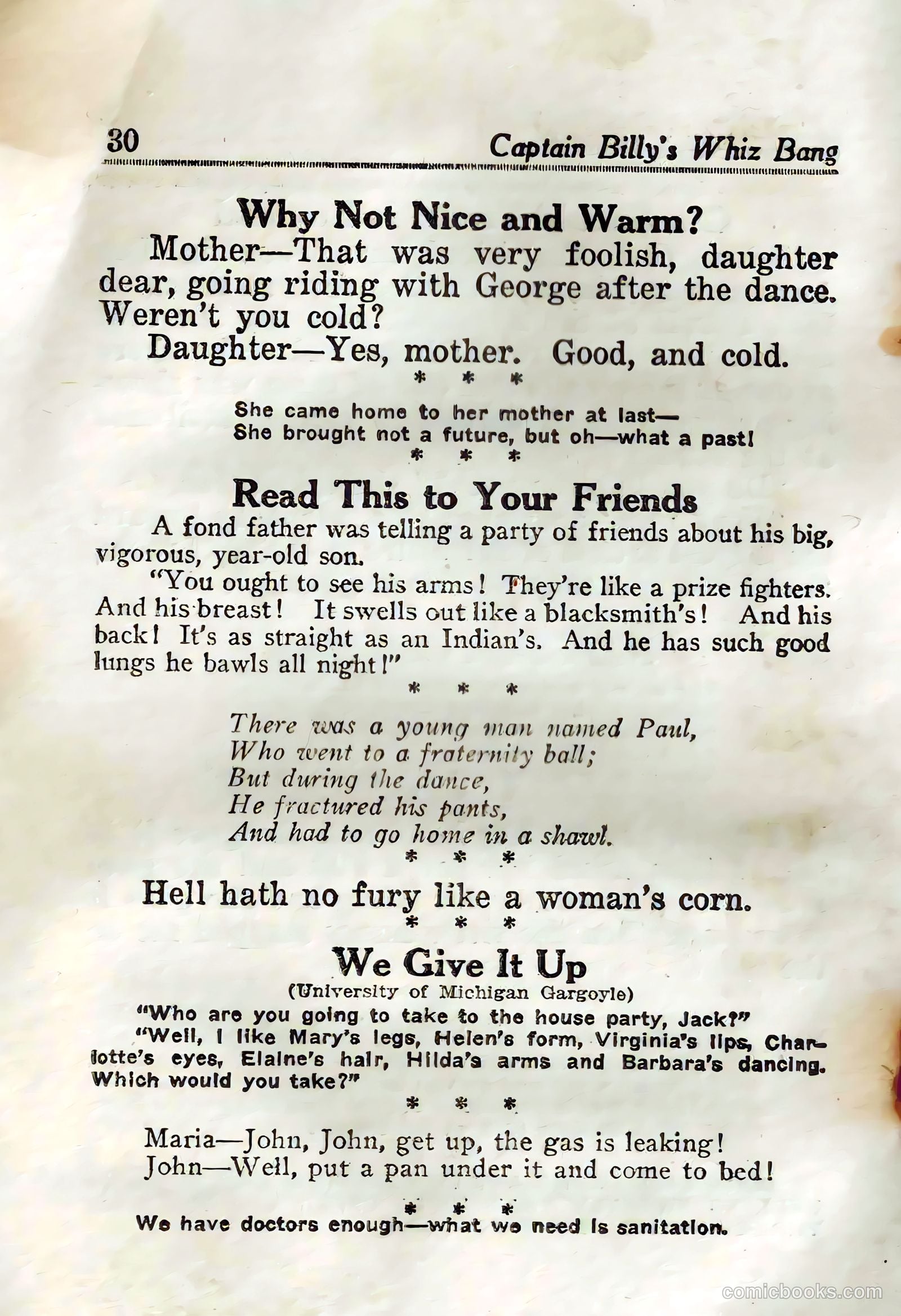
This page contains several short humorous anecdotes rather than political cartoons. The jokes target social conventions and bodily humor common to 1920s comedy: 1. **"Why Not Nice and Warm?"** — A mother scolds her daughter for going riding with "George" after a dance; the daughter's reply about being "cold" suggests improper behavior. 2. **"Read This to Your Friends"** — Jokes about a son's physical strength and a collegiate mishap where "Paul" tears his pants at a fraternity ball. 3. **"We Give It Up"** — A University of Michigan gargoyle where a man composes an impossible "ideal woman" from multiple girls' body parts. 4. **Final joke** — A domestic scene where "John" ignores a gas leak, typical of absent-minded husband humor. The satire mocks dating etiquette, college life, and marriage dynamics of the era.
This page from *Whiz Bang* presents two brief satirical anecdotes about social embarrassment and indiscretion. **First story:** A man at a fashionable ball casually identifies an embroidered garter on the floor as belonging to "Mrs. Dare"—implying he knows intimate details about a married woman. The joke hinges on how he could possess such knowledge, suggesting an affair. Everyone wonders how he knew. **Second story:** A woman boasts she never snores, then her fiancé warns her not to tell such stories—implying she actually does snore, and he already knows this unflattering fact about her. Both anecdotes satirize social pretension and the gap between public personas and private realities, with humor derived from unwitting self-exposure and uncomfortable truths revealed in polite company.
This page contains two separate pieces of verse satire: **"Captain Billy's Whiz Bang" (Section III)**: A gossipy narrative poem about a baby's christening where a visiting cousin from Oxford makes an inappropriate comment about the infant's physical resemblance to her older sister Jane—specifically mentioning a dimple. The poem satirizes how everyone puzzles over how the cousin knew this private detail, eventually revealing he simply saw it while the baby was being bathed. The humor lies in the insinuation and innuendo surrounding his knowledge. **"Gus' Latest Masterpiece"**: A brief, suggestive poem about visiting a girl in dimmed lighting, with the closing line implying sexual knowledge gained without full visibility. Both pieces employ the magazine's typical formula: ribald humor with mild sexual innuendo presented through ostensibly innocent narratives. The aphorisms below add moralistic commentary on feminine duplicity and moral danger.
This page contains humor pieces rather than political cartoons. The main content includes: **"And Why Not Papa?"** - A father-son dialogue about a "wild" girl, followed by a ribald poem from a woman's perspective celebrating men who are rough, don't care, and treat her roughly. The humor plays on the contrast between the father's moral concerns and the daughter's enjoyment of aggressive male behavior. **"He Found Out"** - A brief anecdote about an old man ("Hood") testing whether alcohol relieves ailments. The piece includes references to Texas longhorns and "stall-fed heifers," likely sexual innuendo about different types of women. **General tone:** Whiz Bang was known for bawdy, sexually suggestive humor targeting working-class audiences. These pieces reflect 1920s-era attitudes about gender relations and courtship, using crude double entendres typical of the magazine's style.
This page contains five brief humorous stories typical of 1920s-era satirical magazines: 1. **"And the Parson Sold the Parrot"** — A minister throws water on a cursing parrot, which then asks where he was during a cyclone. The joke mocks the minister's ineffectual attempts at moral correction. 2. **"Skating in the Shipyards"** — Poetic fragment about a woman skating, likely celebrating industrial-era activity or female independence. 3. **"Incorrigible"** — A mother questions her daughter Mary about playing with boys; Mary jokes that being bigger makes her enjoy it more. This plays on contemporary anxieties about changing gender roles and young women's behavior. 4. **"Babbitt Has Nothing on Us"** and **"I sure despise Susannah Wise"** — Brief folk-style jokes about dryness, wetness, and romantic frustration. The content reflects post-WWI American humor emphasizing modern social change and mild irreverence.
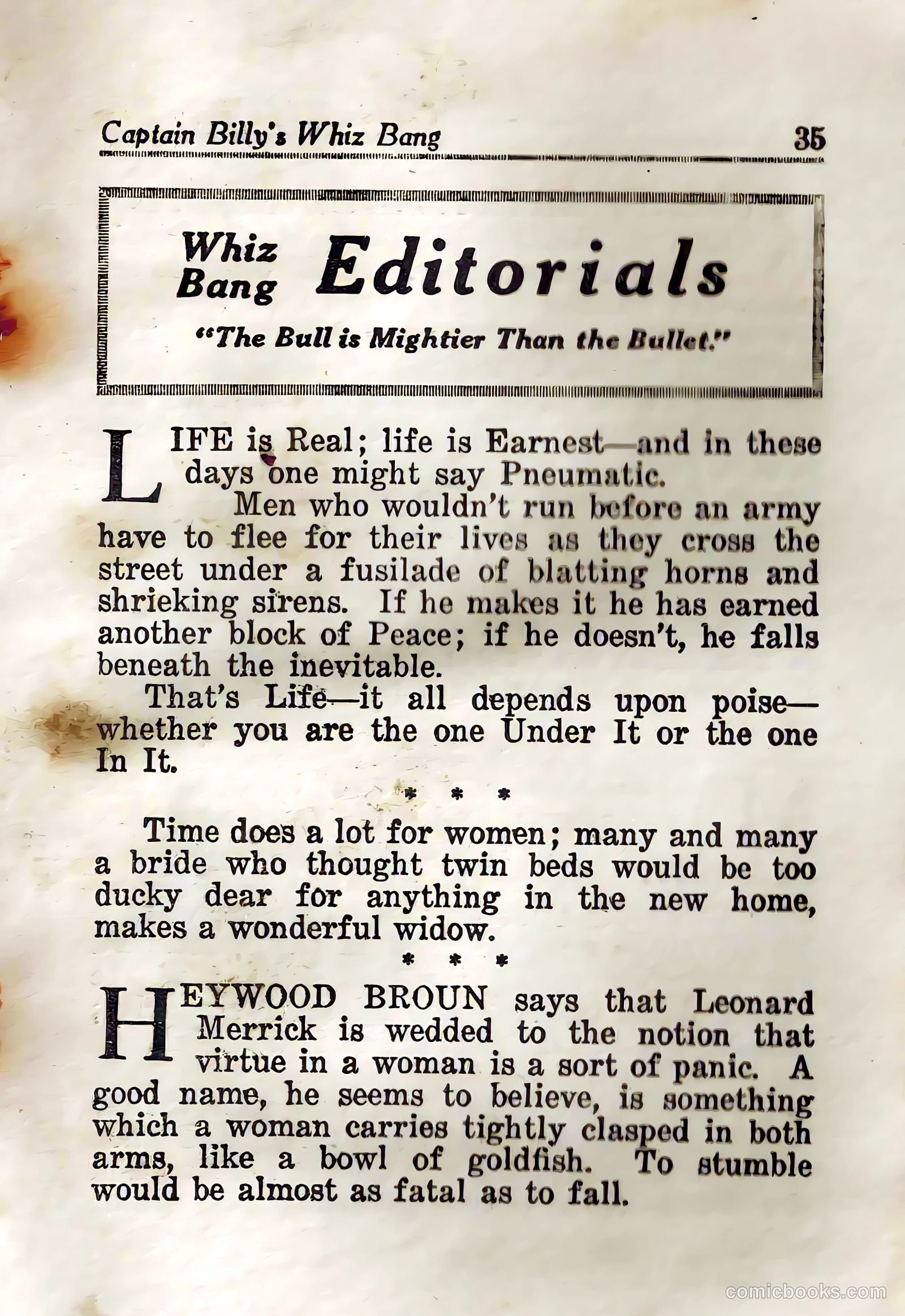
This page contains three brief satirical editorials rather than cartoons. The first mocks modern urban life's dangers—men dodging traffic like a military assault, where survival depends on "poise" and positioning. The second is a dark joke about widowhood: women who initially rejected twin beds in their new homes became widows, implying wartime deaths. The third editorial, attributed to Heywood Broun, satirizes Leonard Merrick's view that female virtue must be guarded like a fragile "bowl of goldfish"—so carefully protected that any stumble risks catastrophe. The satire critiques this exaggerated, restrictive view of women's morality and respectability as outdated panic. The magazine's tagline, "The Bull is Mightier Than the Bullet," suggests satirical commentary on power and persuasion.
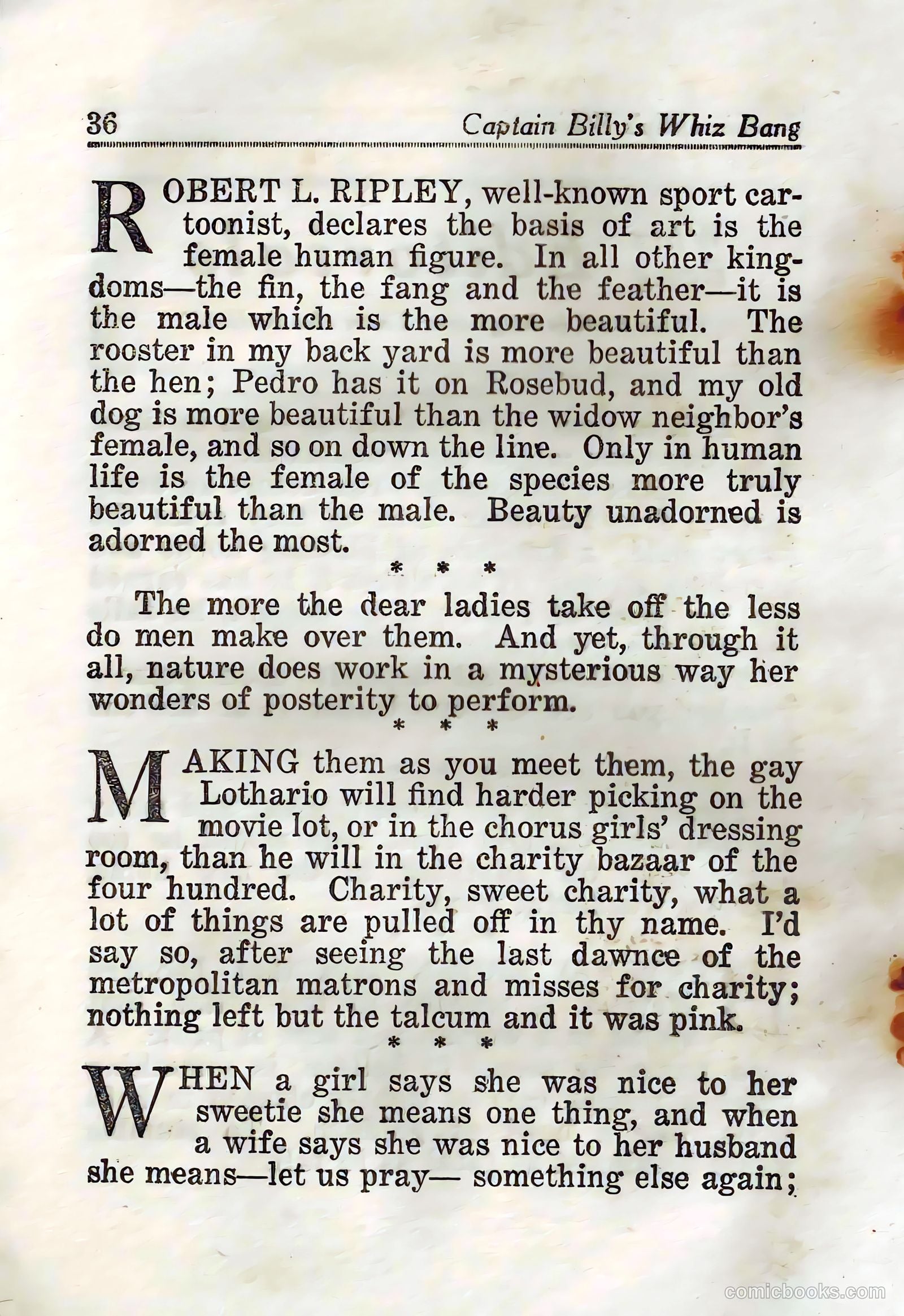
This page contains humor columns attributed to "Captain Billy," the magazine's editor. The content consists of three brief satirical observations: 1. **Robert L. Ripley quote** on beauty: Claims the female human form is uniquely beautiful in nature, unlike other species where males are more decorative. The joke appears to be vanity-focused commentary on human exceptionalism. 2. **Women and adornment**: A quip suggesting women who wear less makeup are more successful with men, implying contradiction in female behavior. 3. **Charity bazaar commentary**: Mocks wealthy society women attending charity events, suggesting their efforts are superficial (ending with "nothing left but the talcum and it was pink"). 4. **Final observation on female "niceness"**: Implies women's politeness toward romantic interests versus spouses carries different—perhaps insincere—meanings. The humor targets upper-class feminine behavior and vanity.
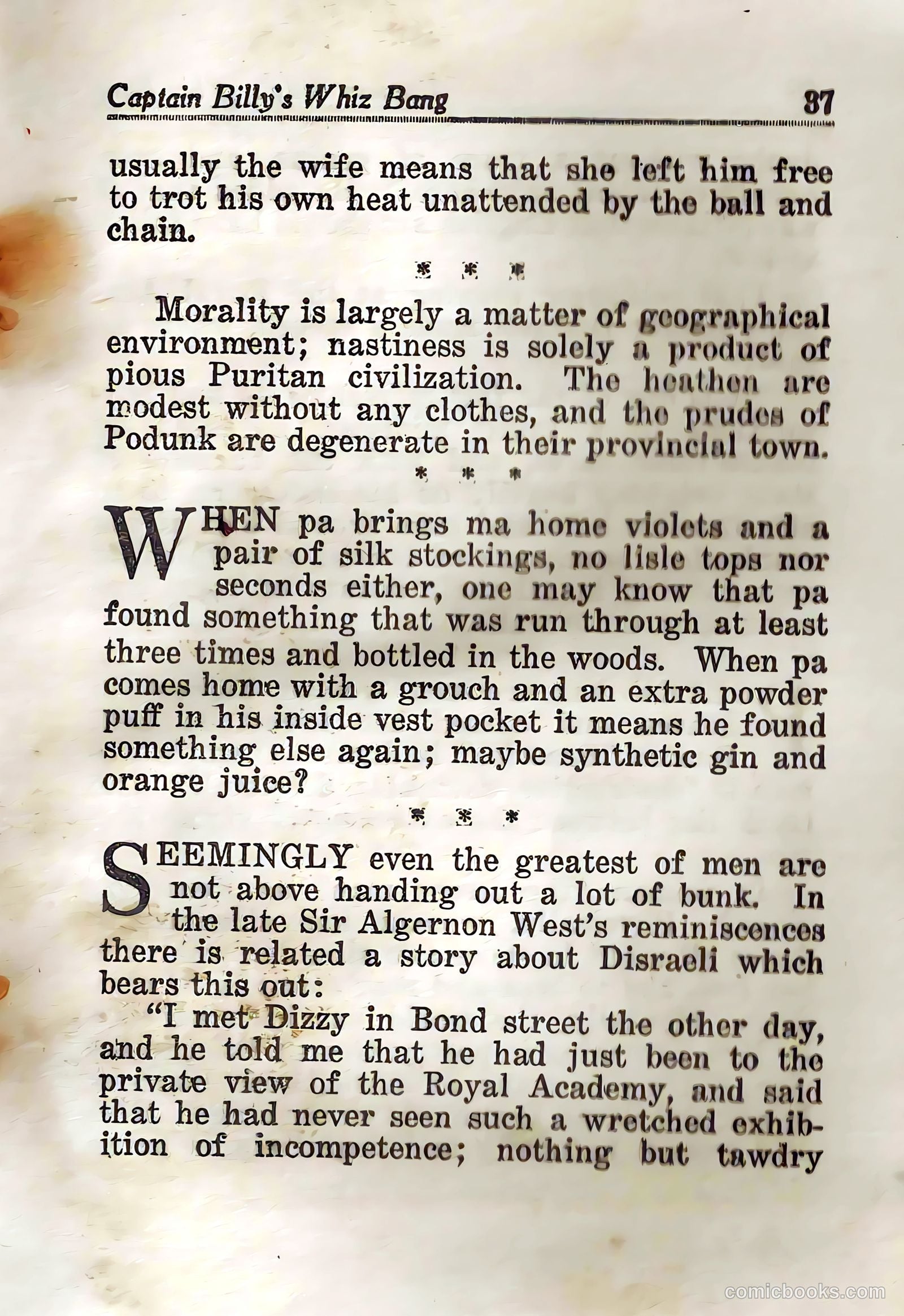
This page contains satirical social commentary rather than cartoons. The text mocks Victorian morality and propriety through three vignettes: 1. A joke about marital infidelity—a husband's extramarital activities are signaled by gifts and behavior. 2. A philosophical observation that morality is culturally relative, not absolute—contrasting "heathen" modesty with Puritan prudishness. 3. A quoted anecdote (attributed to late Sir Algernon West's reminiscences) mocking the artist Disraeli's dismissive critique of a Royal Academy exhibition as "tawdry" and incompetent. The satire targets hypocrisy, cultural pretension, and the arbitrary nature of social conventions. *Whiz Bang* was known for irreverent humor aimed at middle-class respectability.
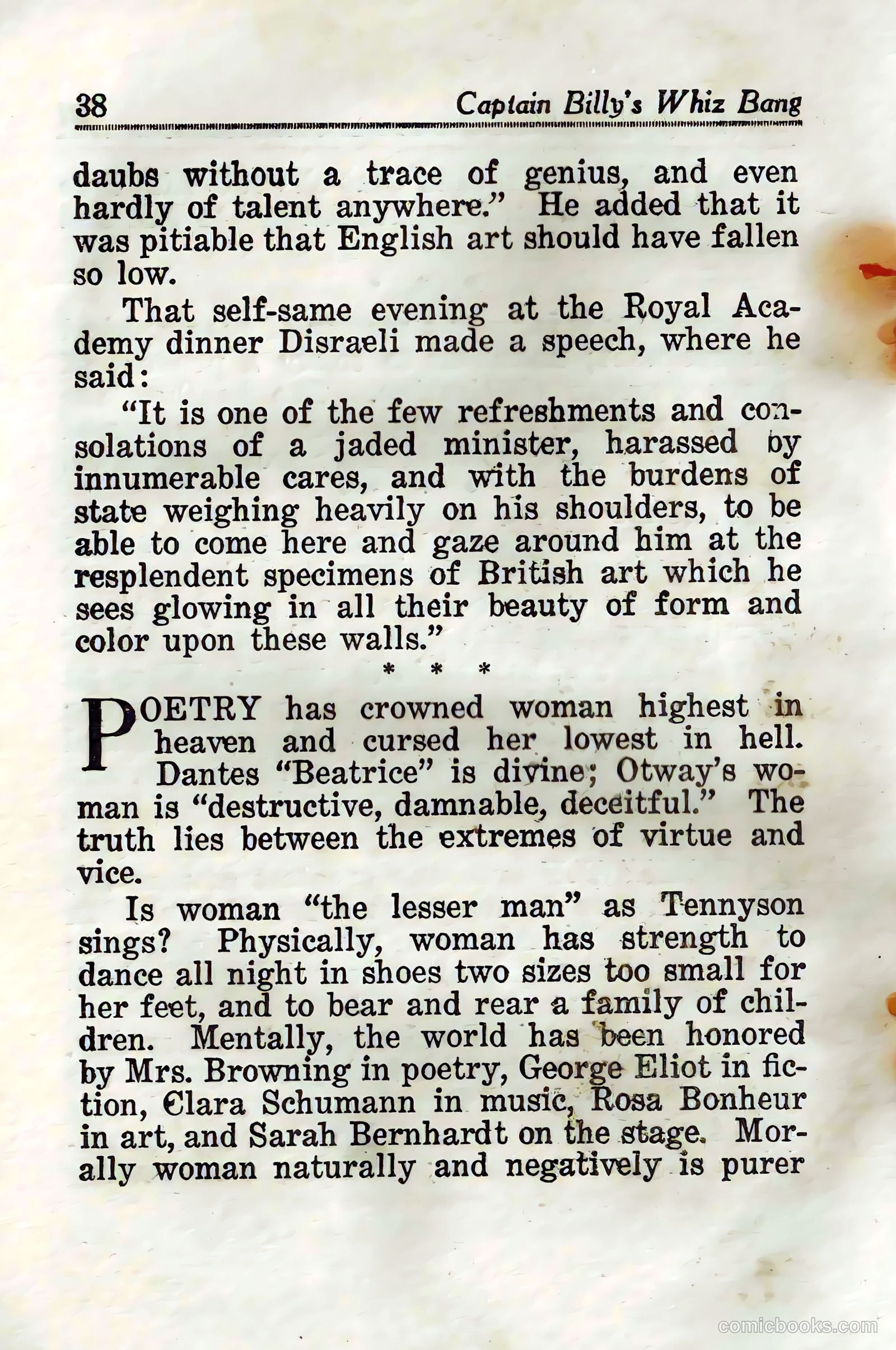
This page contains two distinct pieces of satirical commentary: **Upper section:** Criticism of English academic art institutions. The text quotes harsh attacks on Royal Academy painters as "daubs†without talent," contrasted with Disraeli's flattering speech praising British art's "resplendent specimens." The satire mocks the gap between official praise and actual artistic mediocrity in establishment institutions. **Lower section (titled "Poetry"):** Social commentary on women's roles. The text argues against Tennyson's phrase "the lesser man" applied to women, citing female achievements in poetry, fiction, music, and theater (Mrs. Browning, George Eliot, Clara Schumann, Rosa Bonheur, Sarah Bernhardt). It defends women's physical and moral capabilities, suggesting contemporary gender hierarchies are unjustified.
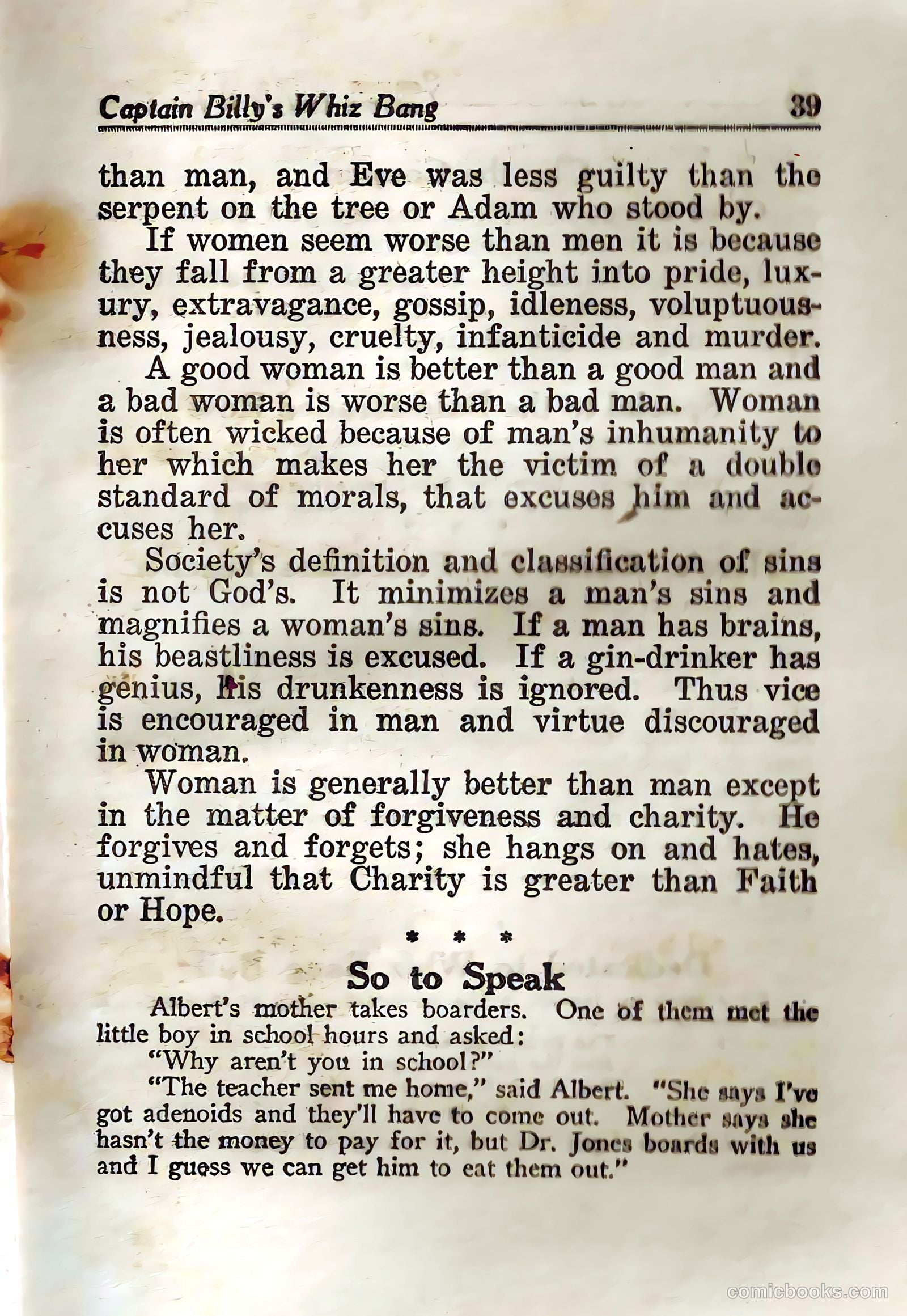
This page contains two distinct sections: **Top section:** A lengthy editorial essay arguing that women and men are held to different moral standards by society. The author contends that women are unfairly judged more harshly than men for similar behaviors, and that this double standard corrupts both genders—encouraging vice in men while discouraging virtue in women. The piece concludes that women are generally superior to men except in forgiveness and charity. **Bottom section ("So to Speak"):** A brief humorous anecdote about a boy named Albert who's been sent home from school. He explains the teacher says he has adenoids requiring surgery, and proposes that a boarding doctor could eat the adenoids, solving the problem without his mother needing to pay for the operation. The humor relies on childish logic and misunderstanding of medical procedures.
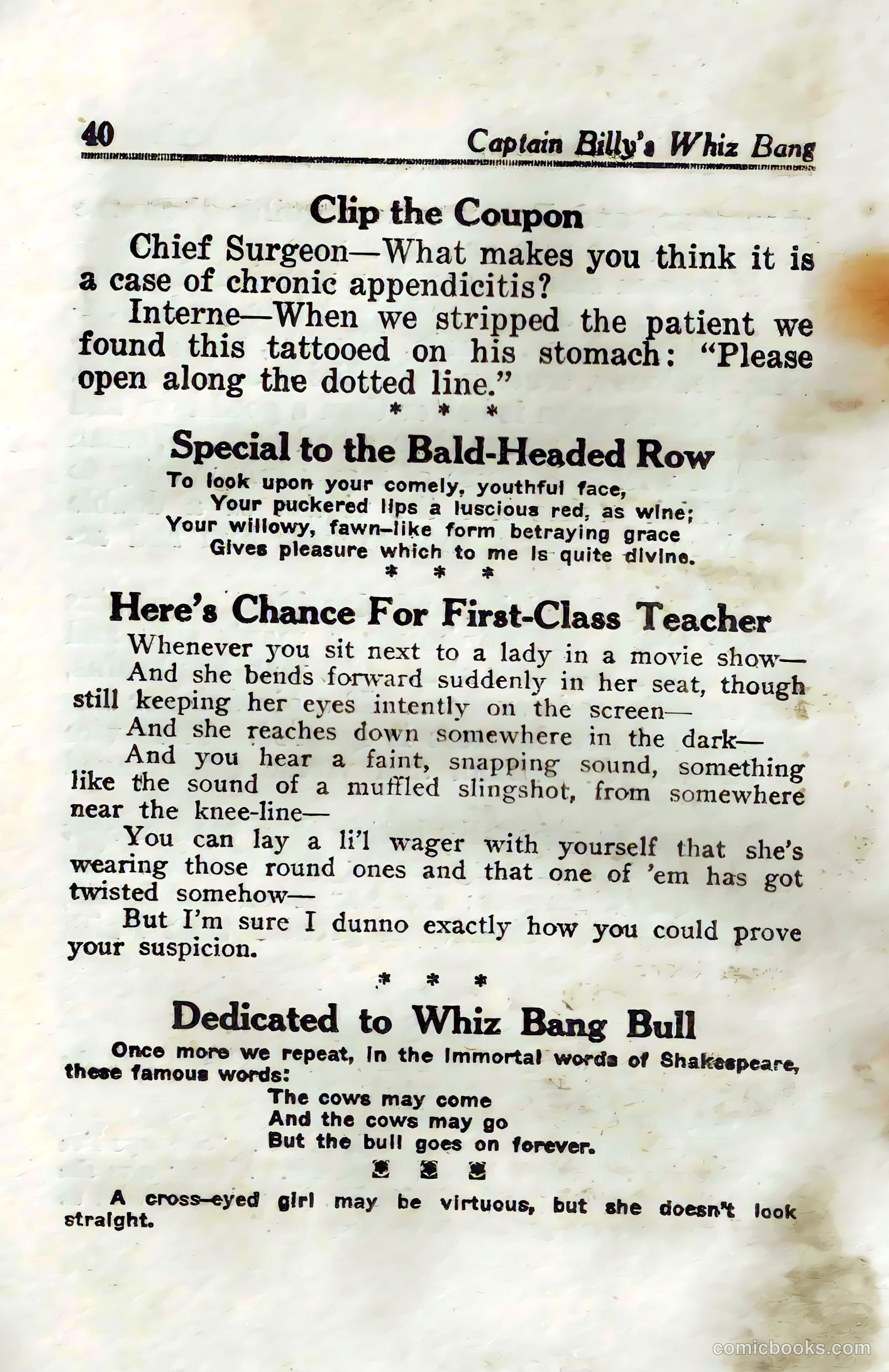
This page contains four separate humor pieces rather than cartoons: 1. **"Clip the Coupon"**: A joke about appendicitis, where a surgeon finds a patient with a tattoo reading "Please open along the dotted line." 2. **"Special to the Bald-Headed Row"**: Flirtatious verse addressing bald men, complimenting a woman's appearance. 3. **"Here's Chance For First-Class Teacher"**: A joke about detecting when women wear garters in movie theaters—describing a snapping sound and suggesting it's impossible to prove suspicions. 4. **"Dedicated to Whiz Bang Bull"**: A parody of Shakespeare about bulls, followed by a quip about cross-eyed girls. The humor is crude, focused on bodily functions, sexuality, and physical appearance—typical of 1920s-era "spicy" magazine content aimed at male readers.
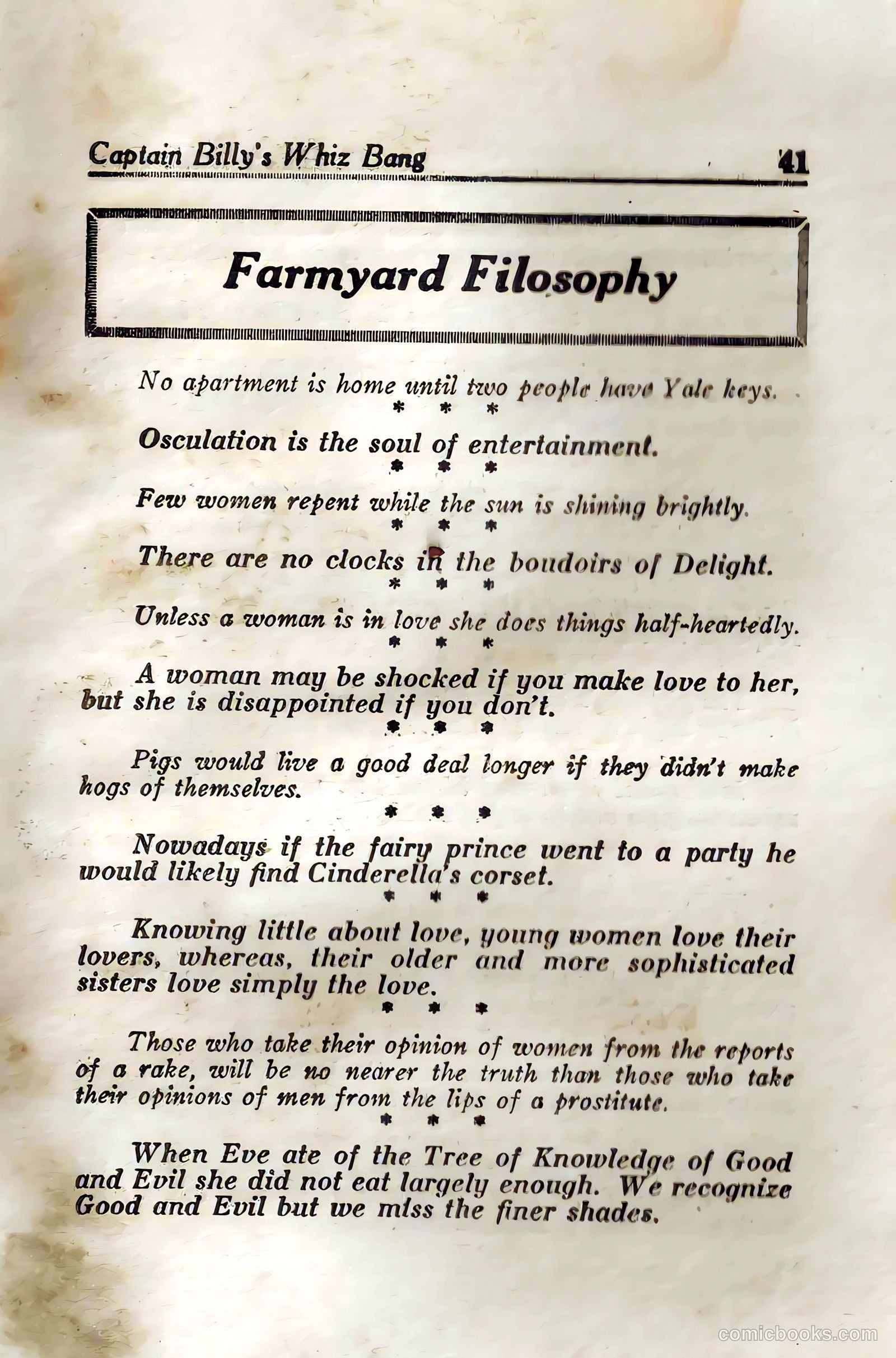
This is a satirical humor column titled "Farmyard Philosophy" from *Whiz Bang*, a 1920s-era American comedy magazine. Rather than featuring a cartoon, the page presents a series of witty one-liners and aphorisms mocking social conventions, particularly around romance, gender relations, and human nature. The jokes target women's romantic behavior ("A woman may be shocked if you make love to her, but she is disappointed if you don't"), class pretension, and hypocrisy. References include fairy tales (Cinderella) and Biblical allusion (Eve's knowledge of good and evil). The humor relies on cynical observations about love, materialism, and the gap between appearance and reality—typical of the irreverent, somewhat risqué tone *Whiz Bang* was known for during the Jazz Age.
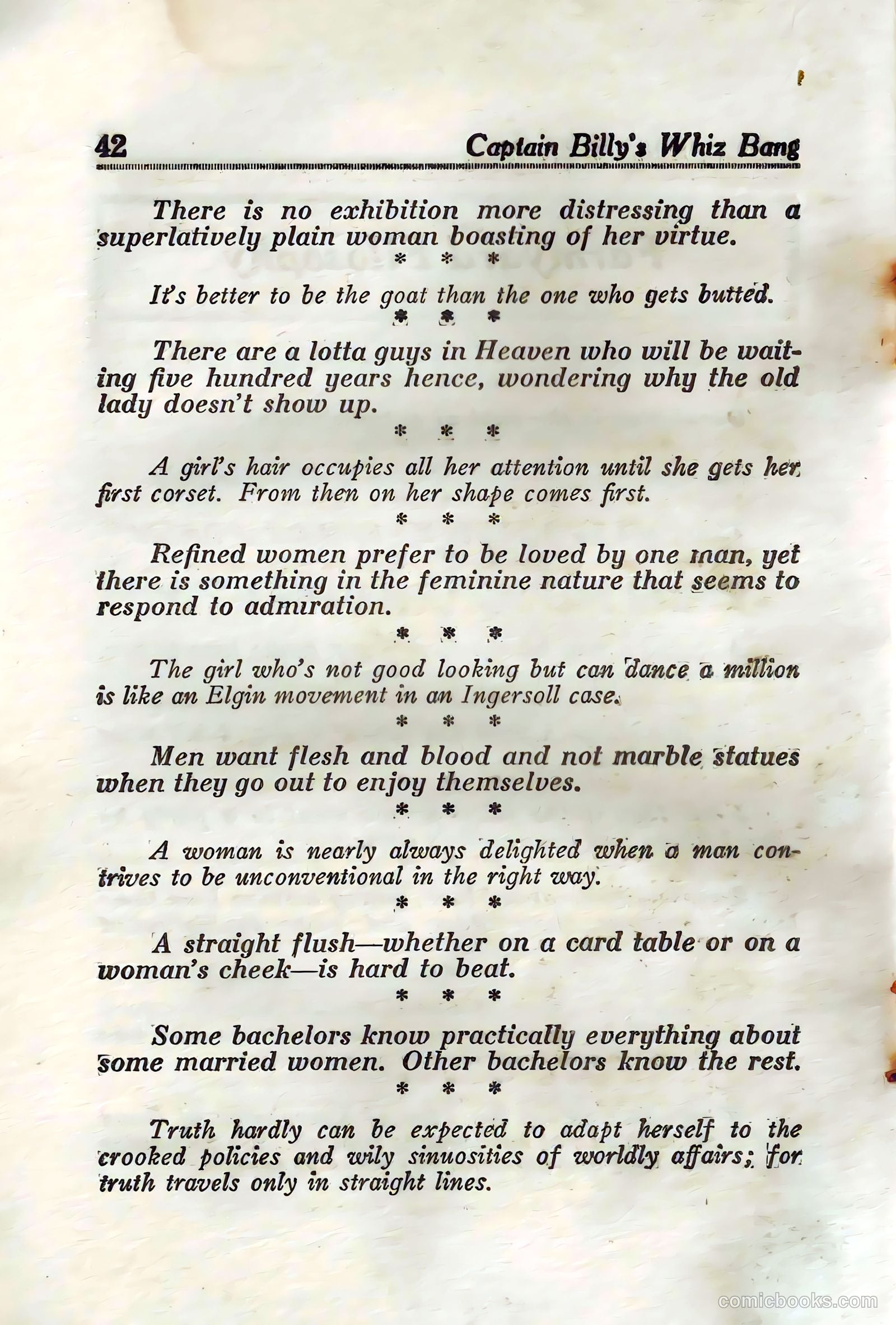
This page contains a series of short satirical observations about gender relations and social behavior—not political cartoons. The content is presented as witty aphorisms mocking both men and women. The jokes target: women's vanity (boasting of virtue, obsession with hair and corsets), feminine nature's inconsistency regarding romantic attention, men's preferences for natural beauty over refinement, bachelors' knowledge of married women's infidelities, and the difficulty of truth in worldly affairs. The satire reflects 1920s attitudes about gender, appearance, and marital dynamics. References like "corset" and "Elgin movement" (a watch brand used as a metaphor for mechanical precision) are period-specific. The humor is cynical about human nature generally, with particular skepticism toward women's behavior and motivations—typical of this era's satirical publications targeting a male audience.
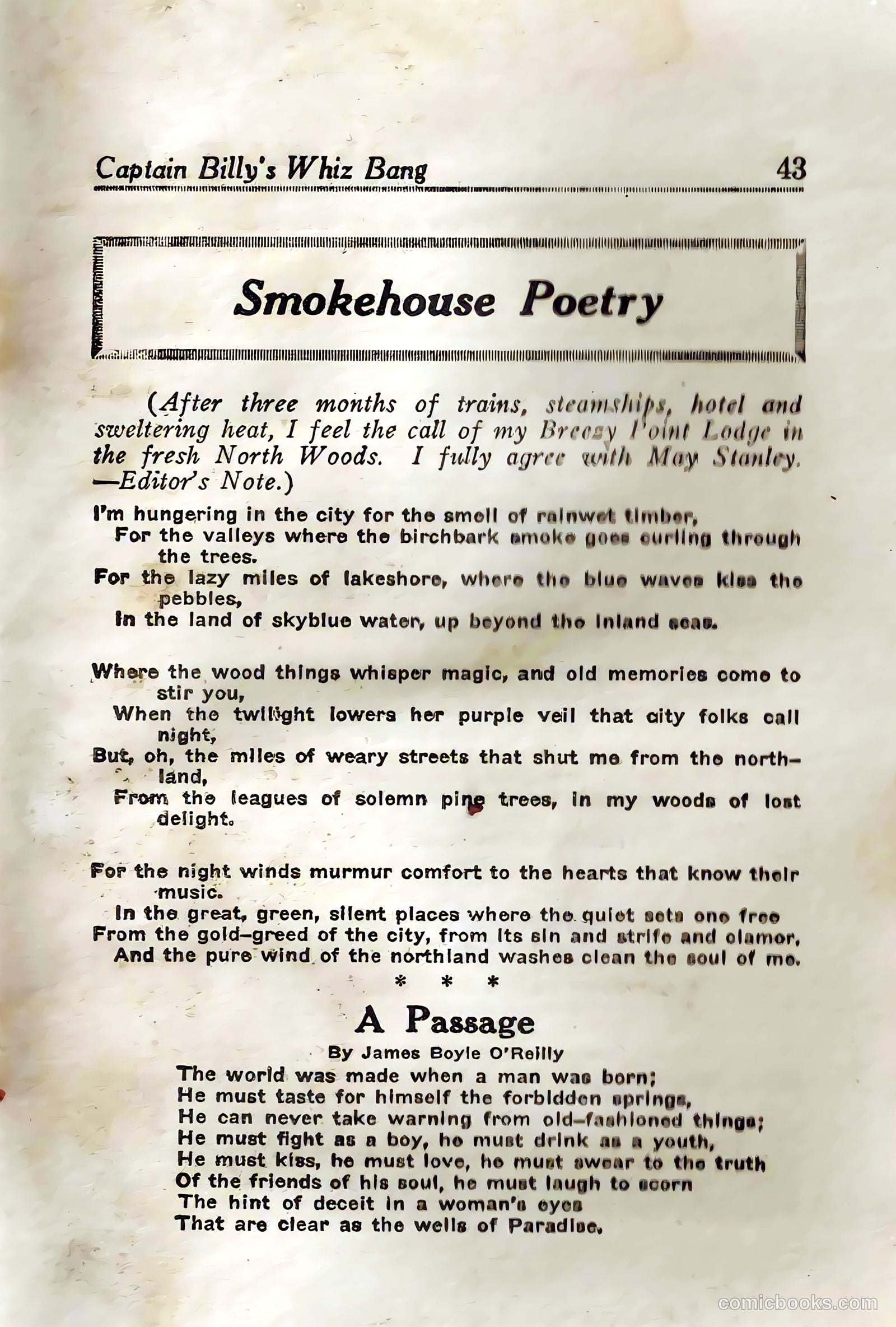
This page contains two poems rather than cartoons. "Smokehouse Poetry" is a nostalgic piece expressing urban exhaustion—the speaker yearns to escape city life for the natural world of northern woods, lakes, and pine forests. The poem contrasts urban "sin and strife and clamor" with the restorative power of nature's "pure wind." The second poem, "A Passage" by James Boyle O'Reilly, offers philosophical advice about youthful experience—a man must taste life's forbidden fruits, love, kiss, and navigate deception rather than heed warnings from the old-fashioned. These reflect common Whiz Bang content: humorous or sentimental verse appealing to readers seeking escape from post-WWI urban American life.
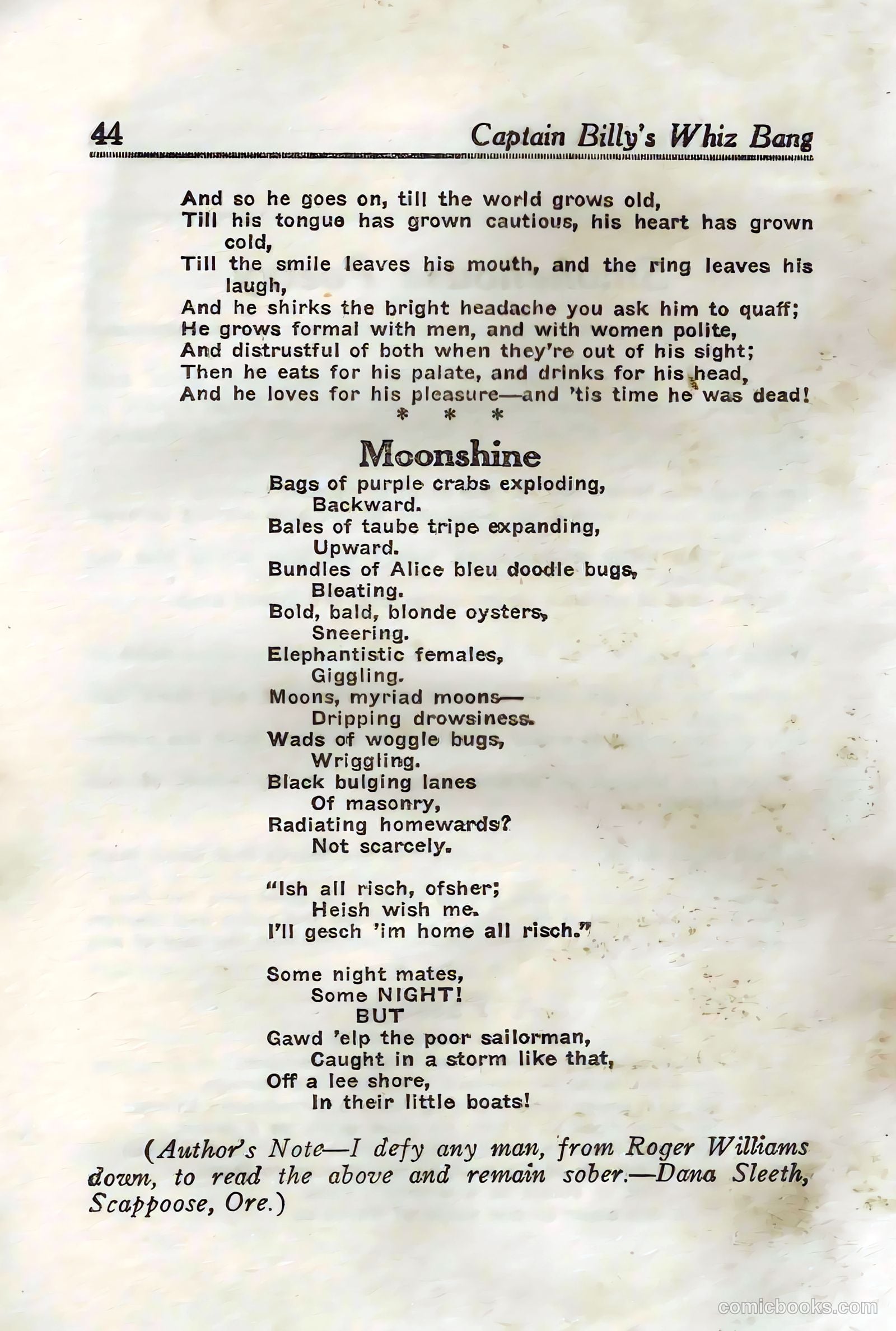
This page contains two literary pieces rather than visual cartoons. "Moonshine" is a nonsensical, surreal poem using absurdist imagery (purple crabs exploding, blonde oysters sneering, elephantistic females giggling). The dialect passage about a sailor caught in a storm uses phonetic Irish-American speech ("Ish all risch, ofsher"; "I'll gesch 'im home all risch"). The author's note challenges readers to recite the "Moonshine" poem while remaining sober—the joke being its difficulty suggests intoxication. This reflects Whiz Bang's typical humor: absurdist wordplay and ethnic dialect comedy mixed with irreverent challenges to readers. The content satirizes nothing specific but rather celebrates nonsense and linguistic play as entertainment, common in 1920s humor magazines.
This page contains three poems with no visible cartoon illustrations. The editor's note prefaces "The Soldier of the Legion," acknowledging that grave-robbing was "lawful and even popular in northern Africa," explaining why this dark humor poem appears in the magazine. The poems satirize post-WWI social attitudes: "The Soldier of the Legion" mocks indifference to disabled veterans' fates; "Here's the Dope" warns of female sexual freedom's social consequences; "Retrospect" critiques shallow high-society courtship rituals and gender dynamics, with the speaker rejecting "society daughters" for nature. The satire targets 1920s social hypocrisy, particularly attitudes toward war veterans and changing gender relations during the Jazz Age.
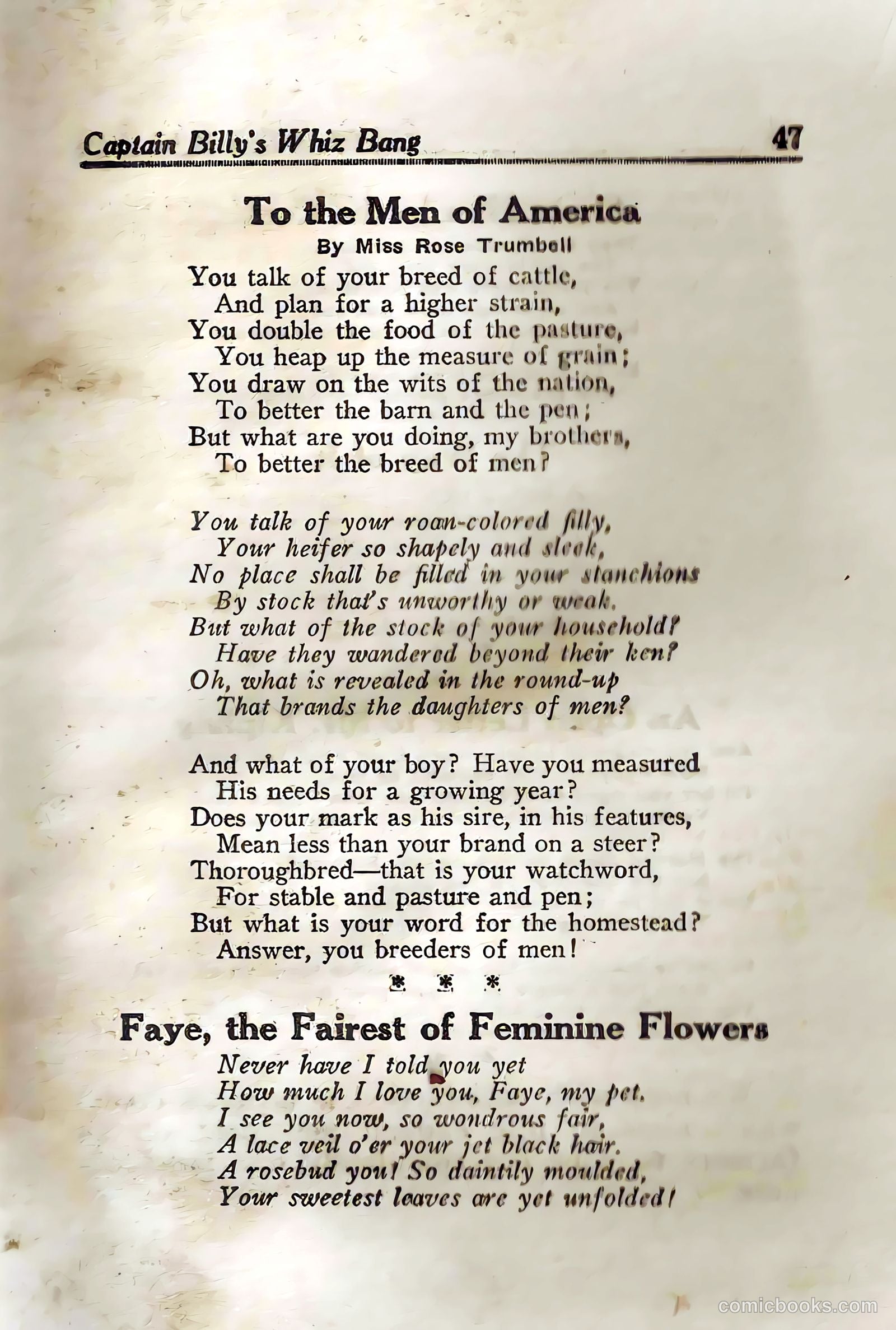
This page contains two poems from *Whiz Bang*, a satirical magazine. The first poem, "To the Men of America" by Miss Rose Trumbell, uses agricultural metaphors to critique American men's selective breeding practices. It argues that while men obsess over improving livestock—cattle bloodlines, horses, pasture quality—they neglect the "breeding" of their own families: daughters who "wander beyond their ken," and sons lacking proper development. The satire suggests hypocrisy: men apply rigorous standards to animal husbandry but not to human character development within their households. The poem advocates for applying the same careful attention to raising children as to raising cattle—a progressive feminist argument for parental responsibility and education wrapped in the language of agricultural improvement. The second poem, "Faye, the Fairest of Feminine Flowers," appears to shift to romantic verse.
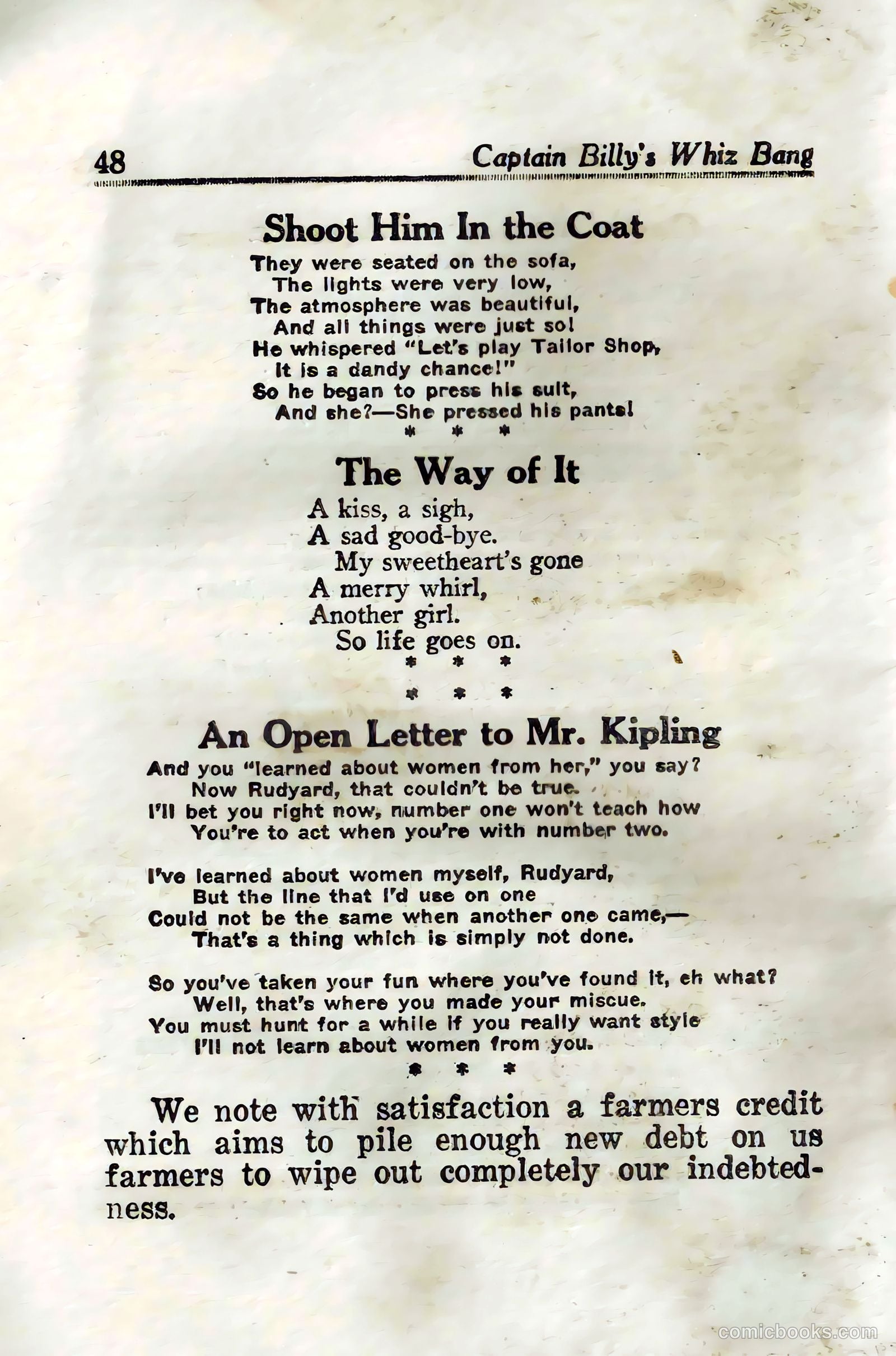
This page contains three separate satirical pieces from an early 20th-century humor magazine: 1. **"Shoot Him in the Coat"** - A suggestive joke about a couple on a sofa playing "Tailor Shop," a euphemistic game involving removing clothes. 2. **"The Way of It"** - A brief poem about romantic transience—a kiss, goodbye, then moving on to "another girl." 3. **"An Open Letter to Mr. Kipling"** - Social commentary critiquing Rudyard Kipling's claims about understanding women. The author argues Kipling couldn't possibly have learned about women from a single source, and that using the same romantic approach on multiple women is unethical—"that's a thing which is simply not done." 4. A final paragraph satirizes farmers' credit policies designed to increase debt rather than relieve it. The humor targets sexual double standards, masculine presumption, and economic exploitation of rural Americans.
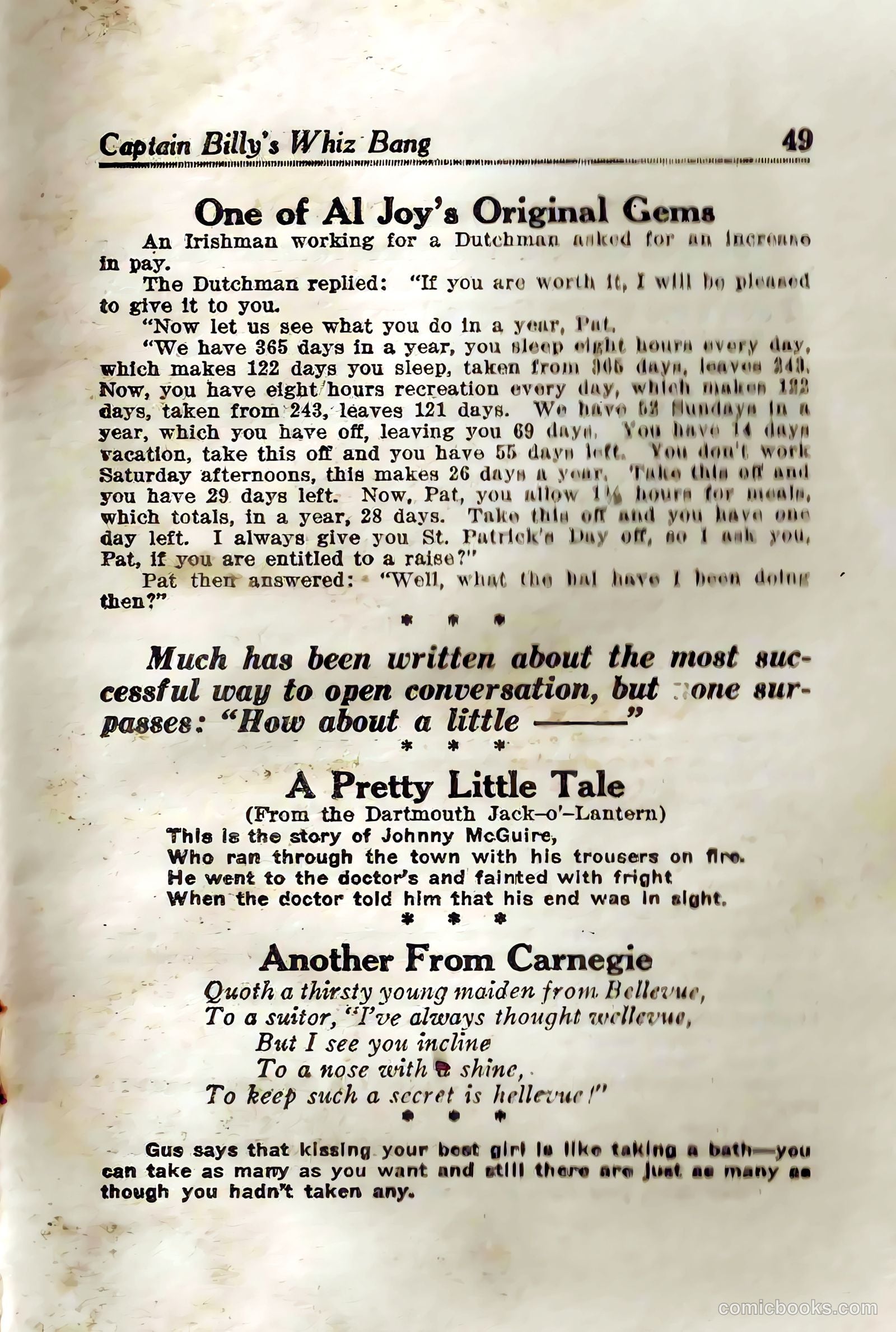
This page contains four separate humor pieces rather than political cartoons: 1. **"One of Al Joy's Original Gems"**: A joke about an Irishman (Pat) asking a Dutchman for a raise. The Dutchman responds by calculating that Pat already receives enough time off (accounting for sleep, recreation, holidays, Saturdays, and St. Patrick's Day) to owe the employer money. The humor relies on ethnic stereotyping common to 1920s comedy. 2. **"A Pretty Little Tale"**: A brief joke about Johnny McGuire running through town with his trousers on fire, fainting at the doctor, who then tells him his "end was in sight"—a pun on his burning rear end. 3. **"Another From Carnegie"**: A poem mocking a "thirsty young maiden from Bellevue" who claims virtue while flirting with a suitor displaying a shiny nose (suggesting alcoholism). 4. A final joke about kissing and bathing, presented as credited to "Gus." These are joke collections, not political satire.
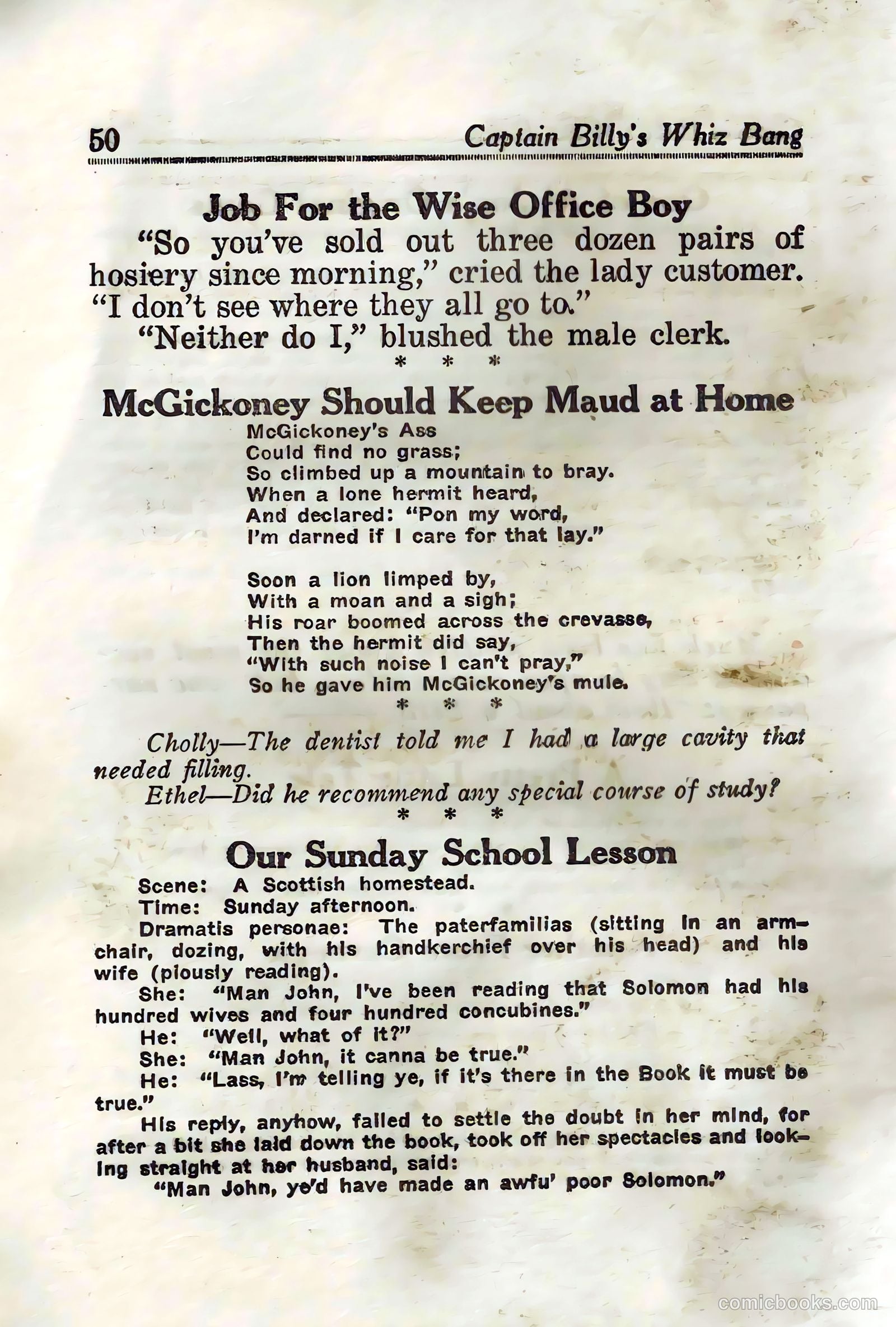
This page contains four separate humorous pieces rather than unified cartoons: 1. **"Job For the Wise Office Boy"**: A brief joke about a male clerk caught unable to account for missing hosiery inventory to a female customer—the humor relies on embarrassment about women's intimate apparel. 2. **"McGickoney Should Keep Maud at Home"**: A verse about a stubborn mule that refuses to graze, climbs a mountain, insults a hermit, and gets given away to a lion. The joke appears to be a play on stubbornness and consequences. 3. **Dentist/cavity joke**: A brief exchange about dental work. 4. **"Our Sunday School Lesson"**: A Scottish domestic scene where a wife lectures her husband about Solomon's biblical wives, concluding he'd have made Solomon "an awfu' poor" man—satirizing pedantic Bible literalism and marital dynamics.
This column from *Whiz Bang* (page 51) is entertainment gossip rather than political satire. The text discusses Hollywood production troubles: **Mary Pickford** and director **Ernest Lubitsch** (recently arrived from Berlin) attempted two films—"Dorothy Vernon of Hadden Hall" and "Faust"—but abandoned them partway through. The column reports that Lubitsch's vision clashed with Pickford's capabilities; she couldn't convincingly play the morally complex character Marguerite, so they halted production. The piece also mocks **Famous Players-Lasky's** casting choice of **Pola Negri** in "Bella Donna," noting the original character was villainous but the film sanitizes her into "a pure gell" controlled by hypnosis—a significant softening of the source material. This reflects 1920s-era Hollywood's commercial caution about depicting morally ambiguous female characters.
This is a gossip column rather than a cartoon page. The content consists of three celebrity scandal items typical of 1920s entertainment journalism: 1. **Pola Negri**: Questions whether Hollywood will "remove the lure" from actress Pola Negri, suggesting her appeal derives from romantic/sexual scandals. 2. **Tony Moreno**: Mocks that an actor married a wealthy woman ($3 million), noting comedians cried at the Lambs' Club upon hearing this news—satirizing how actors' fortunes were measured by marrying rich women. 3. **Rex Ingram**: Recounts a conversation about casting a German film adaptation, joking about needing "the right type" for a German story. The humor targets Hollywood's superficiality, romantic scandals, and type-casting practices of the era. This reflects 1920s entertainment culture's obsession with actors' personal lives and wealth.
This page contains **gossip columns** about Hollywood, not political cartoons. The content mocks entertainment industry figures and practices: 1. **Beauty/Actress Scandal**: Reports an unnamed actress's engagement to an "unknown" figure, suggesting it's a publicity stunt to counter bad press. 2. **Valentino Reference**: Cites Sheik Rudolph Valentino's dating advice about "stalling" in romance—creating suspense rather than immediate intimacy. 3. **Carl Laemmle/Universal Pictures**: Satirizes a scholarship fund announcement as a transparent publicity move rather than genuine philanthropy. 4. **Thomas Meighan**: Notes the actor's declining popularity and decision to shift toward directing work while his star power remains viable. The satire targets **Hollywood's manufactured image-making**, exposing how studios manipulate publicity and how actors' careers are strategically managed commodities.
This page contains three separate humor items rather than cartoons: **"The Caddie's Suggestion"**: A clergyman at St. Andrews golf course gets stuck in a bunker called "Hell," makes a successful shot, then asks his caddie for praise. The caddie's response—"tak yer niblick wi' yer"—is a Scottish dialect punchline suggesting the clergyman should use better equipment or technique next time. The joke mocks pompous self-congratulation. **Untitled Poetry Section**: A brief exchange about a woman's "figure" valued at "one hundred thousand," likely satirizing either celebrity endorsements or wealthy marriages. **"Too Late"**: A reporter arriving at a murder scene finds the "murder's been done"—a simple wordplay joke about arriving after events have concluded. These are lighthearted, mild satirical humor pieces typical of 1920s-era American magazines, with no apparent political commentary.
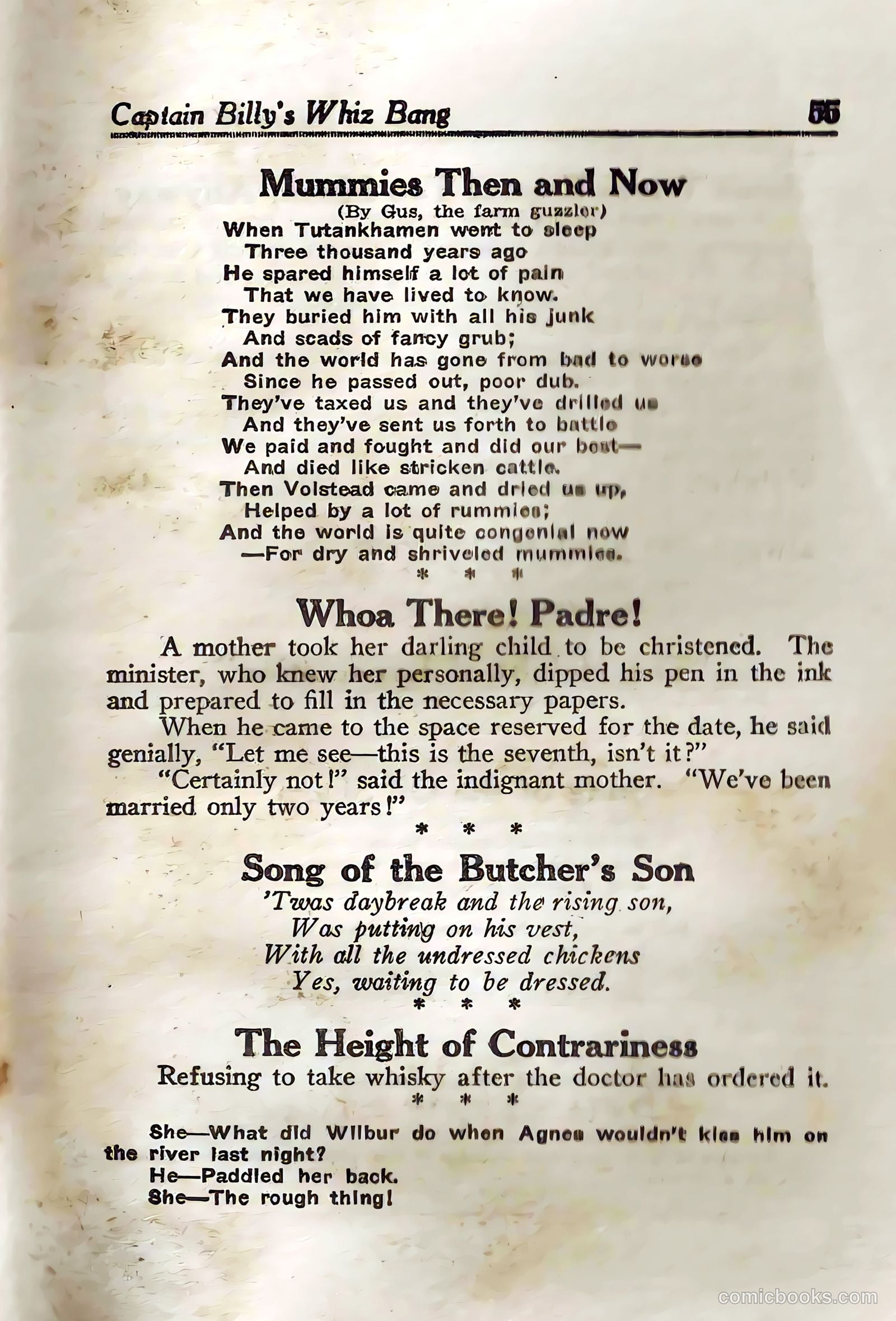
This page contains humorous short pieces rather than political cartoons. The content includes: **"Mummies Then and Now"** — A poem satirizing post-WWI conditions. It contrasts Tutankhamen's burial 3,000 years ago with modern hardships: taxation, military drafts, combat deaths, and economic decline under Volstead (Prohibition). The joke: ancient mummies had it better than contemporary "dried up" people suffering prohibition and war's aftermath. **"Whoa There! Padre!"** — A joke about a christening where a minister assumes a seventh child, but the mother reveals they've only been married two years—implying rapid/frequent pregnancies. The remaining items are brief comic anecdotes about everyday situations. The overall tone reflects post-WWI American cynicism about government, Prohibition, and social disruption.
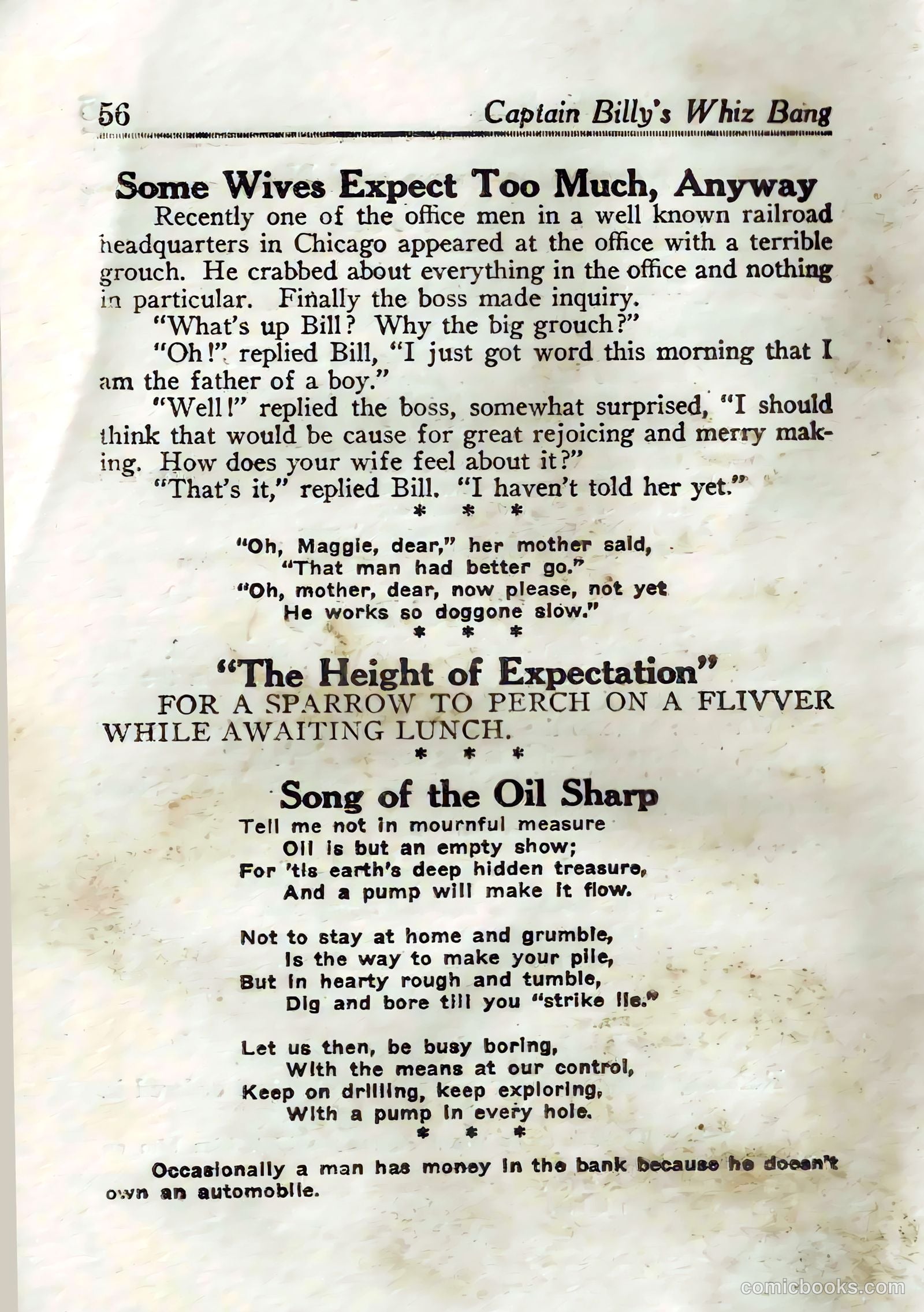
This page contains three separate humor pieces: 1. **"Some Wives Expect Too Much, Anyway"** — A joke about a railroad office worker who received news of becoming a father but delayed telling his wife, fearing her reaction. The satire targets wives' supposedly unrealistic expectations of their husbands' professional obligations. 2. **"The Height of Expectation"** — A one-liner about a sparrow waiting for lunch on a window ledge, poking fun at futile hope. 3. **"Song of the Oil Sharp"** — A satirical poem encouraging oil prospecting as a path to wealth, mocking get-rich-quick schemes and the oil industry boom mentality. It contrasts staying home and grumbling with aggressive business venture-seeking. The final joke mocks automobile culture, suggesting car ownership prevents savings.
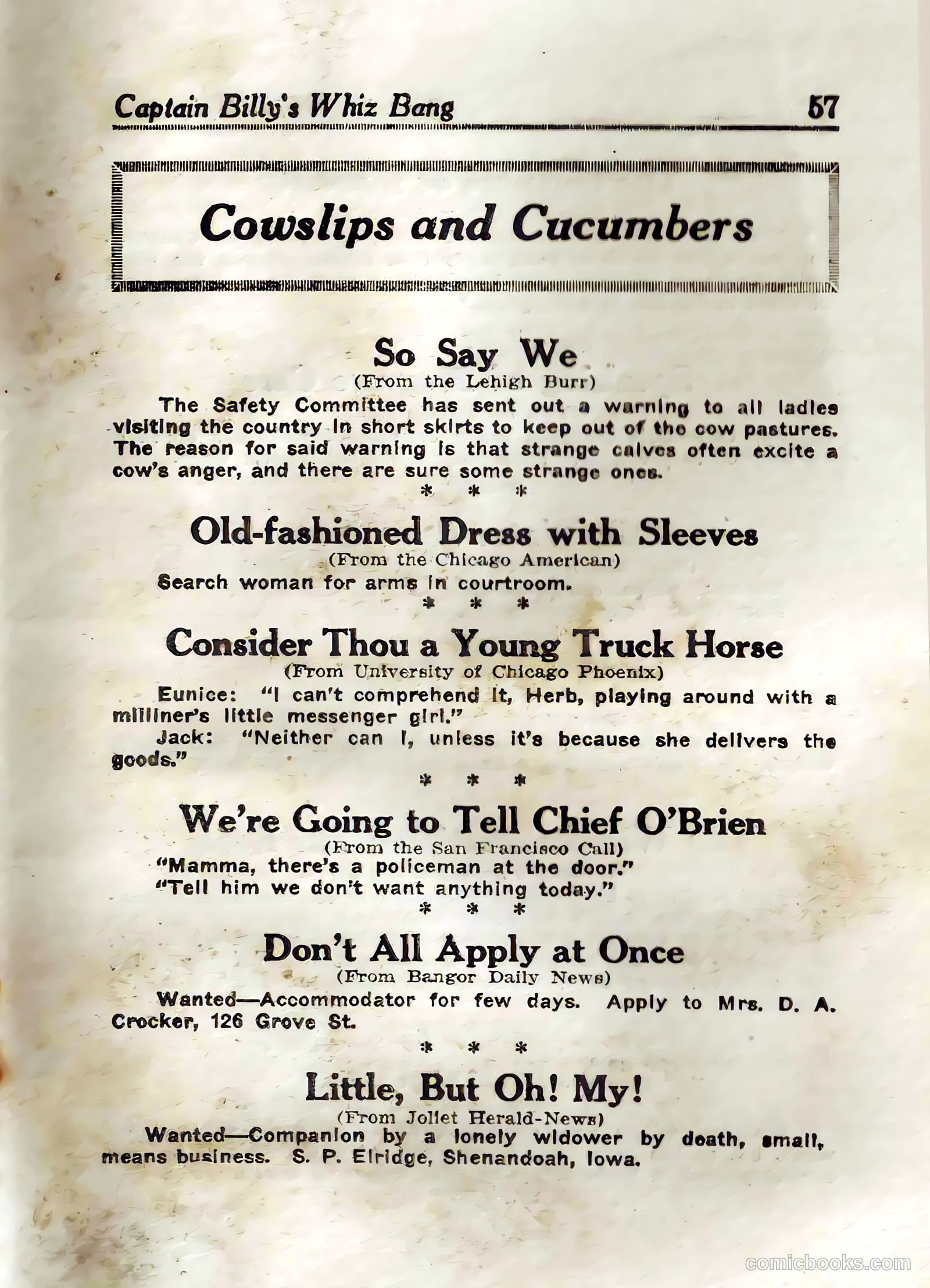
This page contains a collection of brief humorous anecdotes and want-ads rather than cartoons. The jokes target several social themes: **"Cowslips and Cucumbers"** warns women against wearing short skirts near cow pastures, joking that strange calves might become aggressive—a risqué innuendo about male attention. **"Old-fashioned Dress with Sleeves"** sarcastically references a courtroom search for a woman's arms, likely commenting on the era's changing fashion standards. **"Consider Thou a Young Truck Horse"** plays on confusion about a milliner's messenger girl, with a delivery joke. **"We're Going to Tell Chief O'Brien"** depicts a child threatening to report police presence to avoid parental discipline. The remaining items are classified advertisements. Overall, the page reflects 1920s-era humor about changing social norms, particularly regarding women's fashion and behavior.
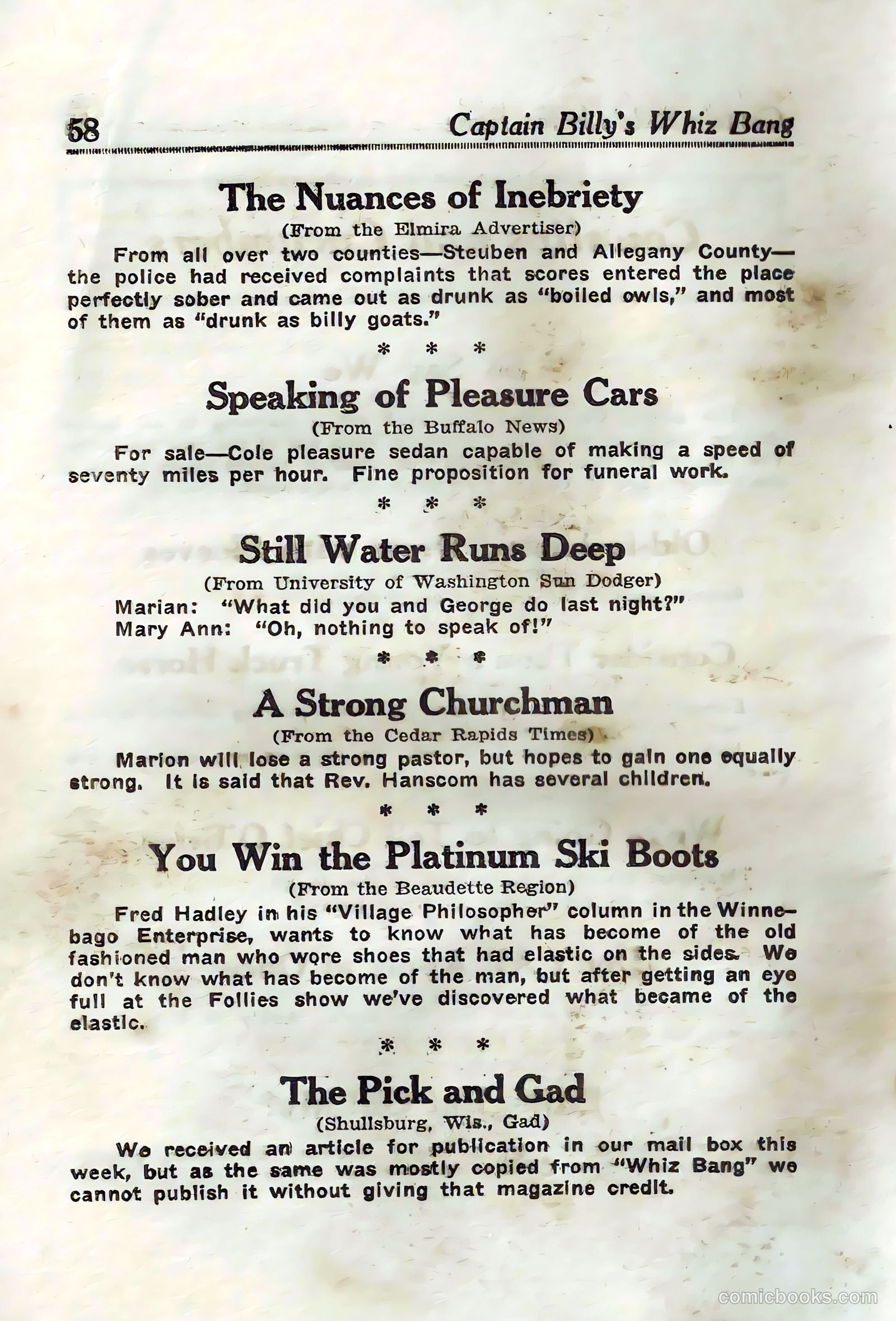
This page contains a humor column of short satirical items reprinted from various newspapers and publications. The jokes target early 20th-century social behaviors: - **"The Nuances of Inebriety"** mocks drunk men from two counties, describing their varying degrees of intoxication using colorful comparisons ("boiled owls," "billy goats"). - **"Speaking of Pleasure Cars"** satirizes a car advertisement listing a sedan's speed (70 mph) as suitable for "funeral work"—dark humor about vehicle safety. - **"Still Water Runs Deep"** presents a flirtatious double-entendre between two women about their evening activities. - Other items mock clergy transfers, old-fashioned footwear, and magazine copyright disputes. The column relies on period-specific references—Prohibition-era drinking culture, early automobiles, and rural Americana—aimed at readers familiar with these regional newspapers.
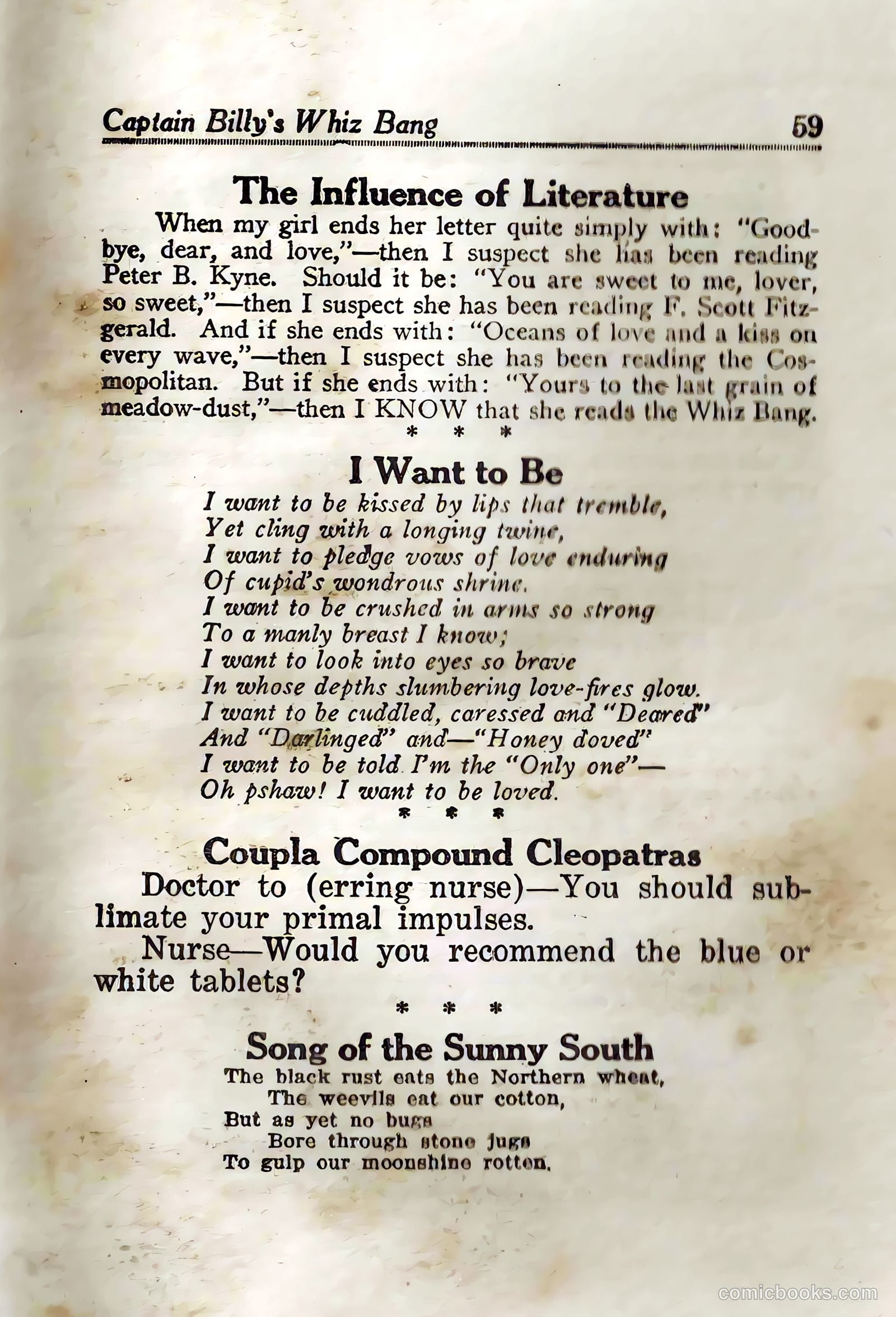
This page contains four separate humorous pieces rather than a political cartoon: 1. **"The Influence of Literature"**: A joke about a girlfriend's letter-writing style revealing which romantic authors she's been reading (Peter B. Kyne, F. Scott Fitzgerald, Cosmopolitan magazine, and the magazine *Whiz Bang* itself). 2. **"I Want to Be"**: A sentimental romantic poem in italics mocking overwrought love poetry conventions of the era. 3. **"Coupla Compound Cleopatras"**: A brief doctor-nurse dialogue joke about "sublimating primal impulses," using medical language to create innuendo. 4. **"Song of the Sunny South"**: Rural agricultural humor about crop pests (rust, weevils) and bootleg whiskey ("moonshine"), likely reflecting post-Prohibition concerns. The page is primarily satirical entertainment rather than political commentary.
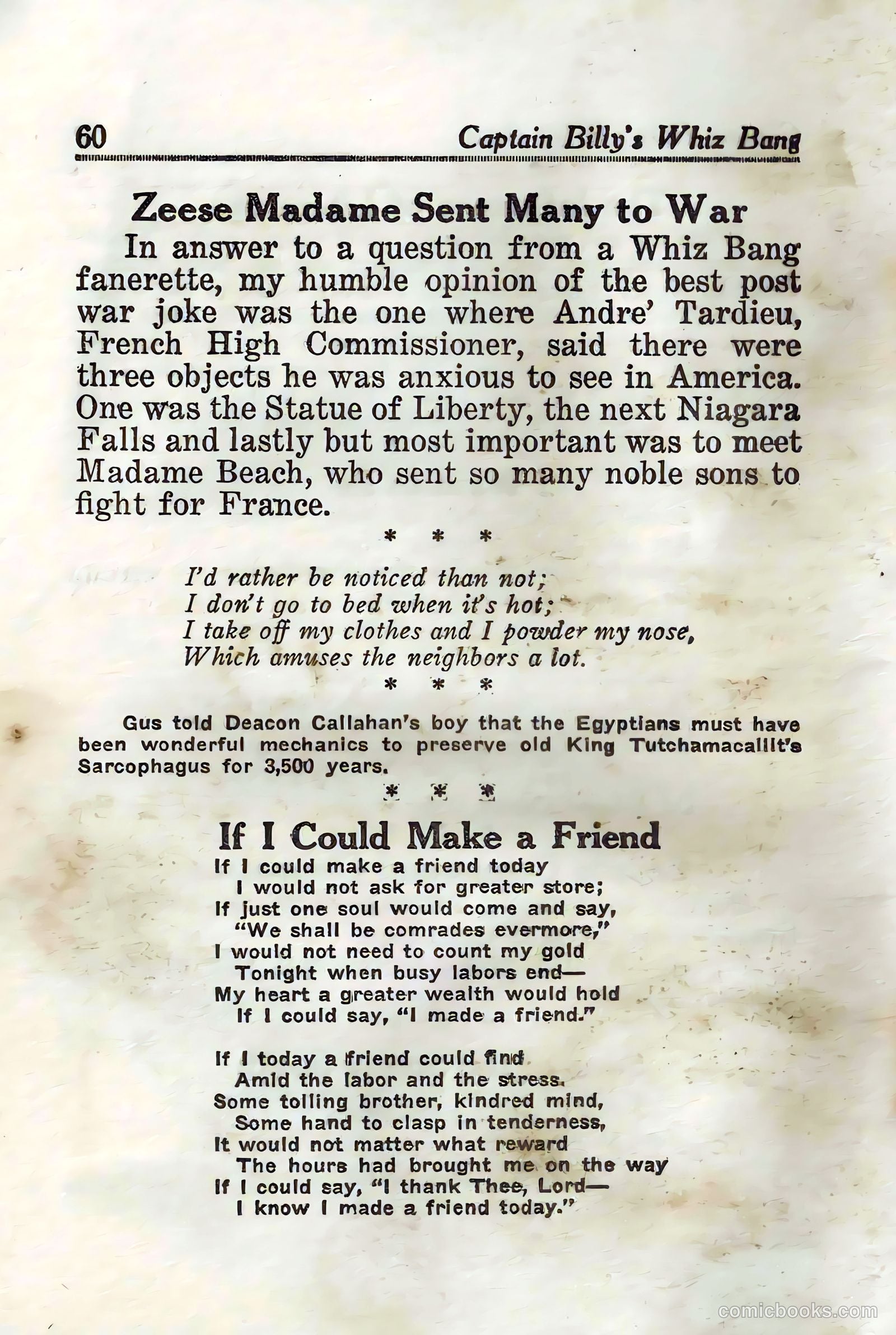
This page contains three separate pieces: a humorous anecdote, a brief comic verse, and a sentimental poem titled "If I Could Make a Friend." The first section jokes about André Tardieu (French High Commissioner) listing three things he wanted to see in America: the Statue of Liberty, Niagara Falls, and "Madame Beach"—a pun on the American actress/performer who apparently "sent many noble sons to war for France" (likely referring to women who encouraged men to enlist during WWI). The humor relies on mocking Franco-American relations and suggesting European fascination with American women. The second item is a brief, risqué joke about a woman's summertime behavior. The final poem is sentimental verse about friendship's value—disconnected from the satirical content above.
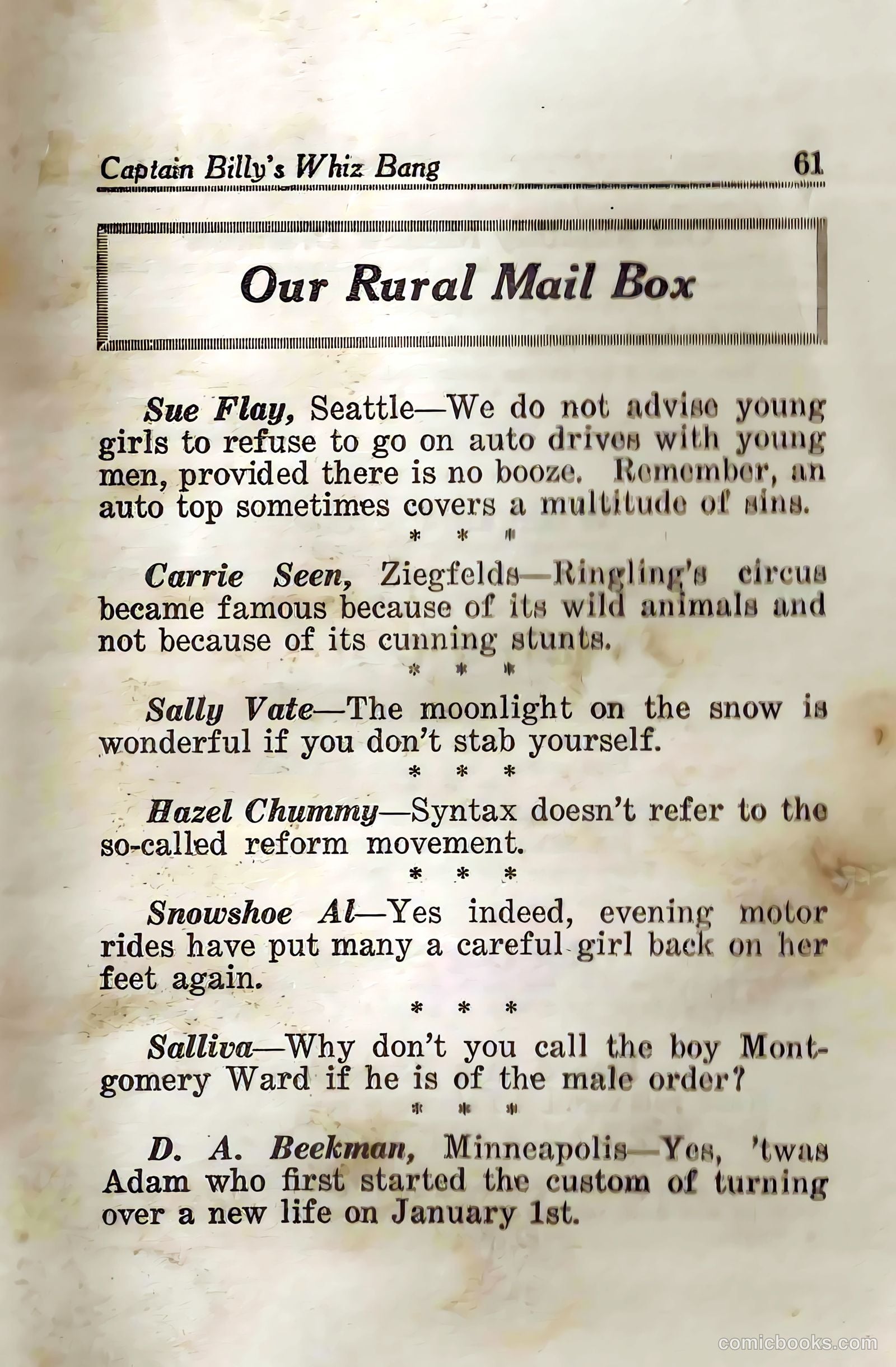
This page from *Whiz-Bang* presents "Our Rural Mail Box"—a humor column of satirical letters and responses addressing social conventions of the era. The jokes target dating customs and propriety: Sue Flay's advice warns against unchaperoned auto rides (cars as private spaces enabling moral danger); Snowshoe Al suggests evening drives reform "careful girls"; and Salliva jokes about naming conventions for men. Other entries mock intellectual pretension (Hazel Chummy's quip about "syntax" and "reform movement") and reference circuses (Ringling's fame derives from animals, not "cunning stunts"). Sally Vate's cryptic moonlight joke and D.A. Beekman's note about January 1st resolutions round out the social commentary typical of *Whiz-Bang*'s irreverent, working-class humor targeting middle-class anxieties about morality, courtship, and changing American culture.
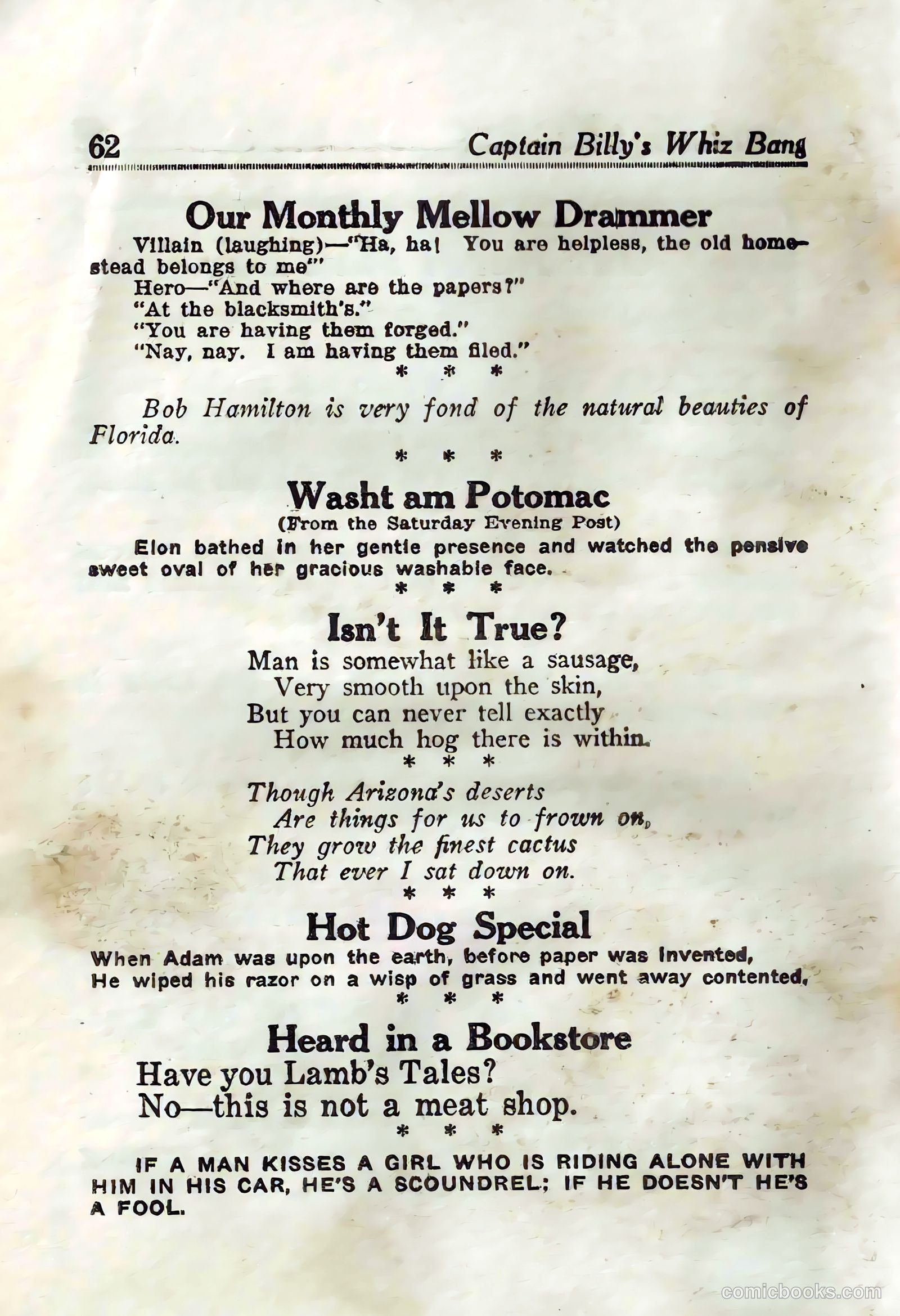
This page contains brief humorous vignettes and jokes typical of 1920s satirical magazines. The content includes: - **"Our Monthly Mellow Drammer"**: A dialogue joke about forged homestead papers - **"Washt am Potomac"**: A flowery romantic piece from the *Saturday Evening Post* mocking sentimental prose - **"Isn't It True?"**: A crude joke comparing men to sausages - **"Hot Dog Special"**: A joke about pre-industrial hygiene - **"Heard in a Bookstore"**: A pun on *Lamb's Tales* mistaken for a butcher shop - A final crude joke about kissing in cars The humor is broadly working-class, relying on puns, sexual innuendo, and crude analogies. There are no identifiable political figures or specific historical references. This represents typical *Whiz Bang* content: irreverent, lowbrow humor aimed at soldiers and working-class readers.
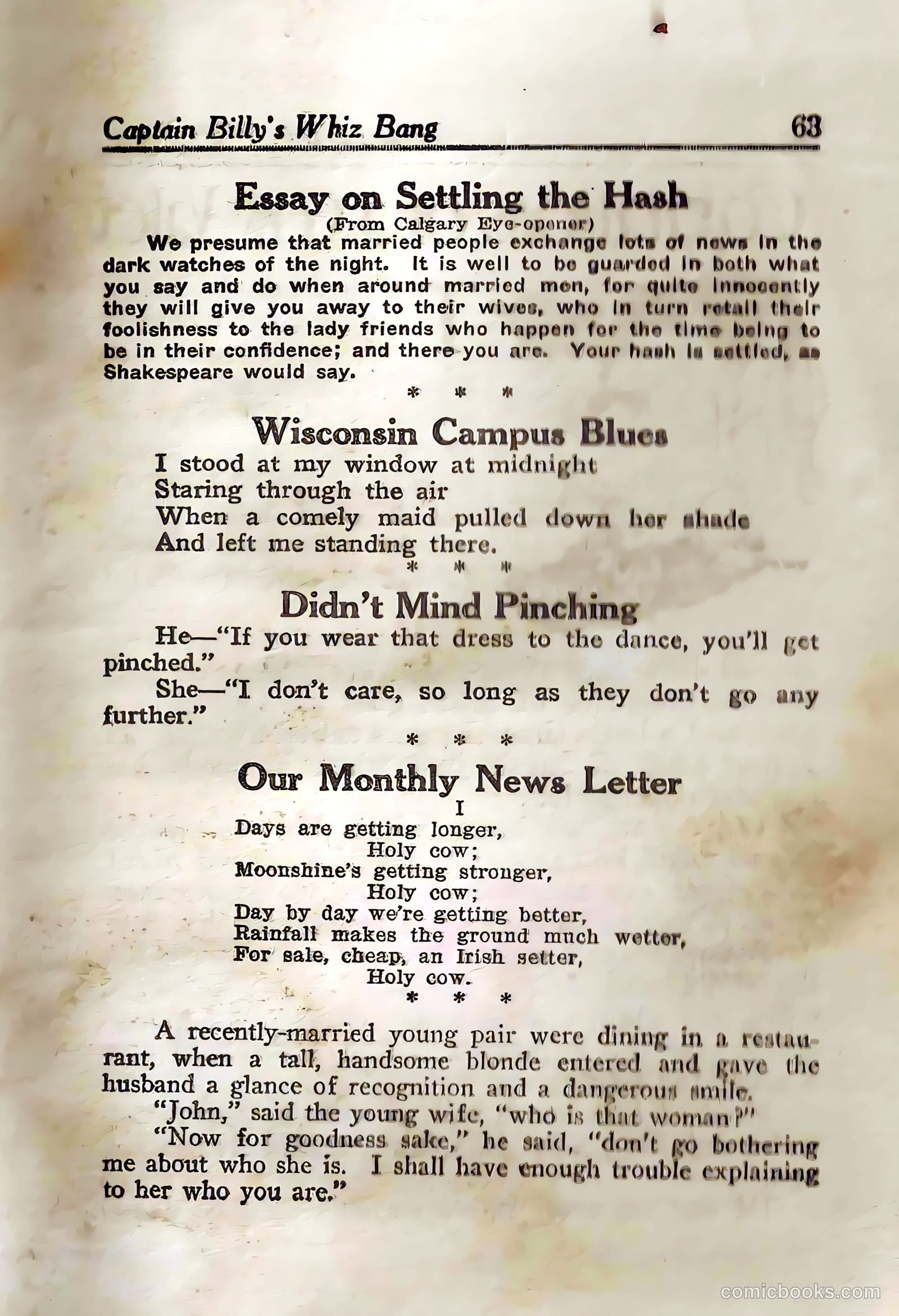
This page contains humorous essays and poems rather than political cartoons. The content reflects 1920s social satire: **"Essay on Settling the Hash"** warns married women to guard conversations around married men, who innocently gossip to their wives—a commentary on marital indiscretion and how secrets spread through social networks. **"Wisconsin Campus Blues"** depicts a young man frustrated when a woman closes her window shade at midnight, suggesting romantic disappointment. **"Didn't Mind Pinching"** satirizes dating etiquette: a man warns a woman her dress will get pinched at a dance; she replies she doesn't care as long as pinching doesn't go further—a risqué joke about physical boundaries and flirtation norms. **"Our Monthly News Letter"** uses doggerel verse to comment on weather and includes an anecdote about a jealous husband confronting his wife about a beautiful blonde—reflecting anxieties about infidelity.
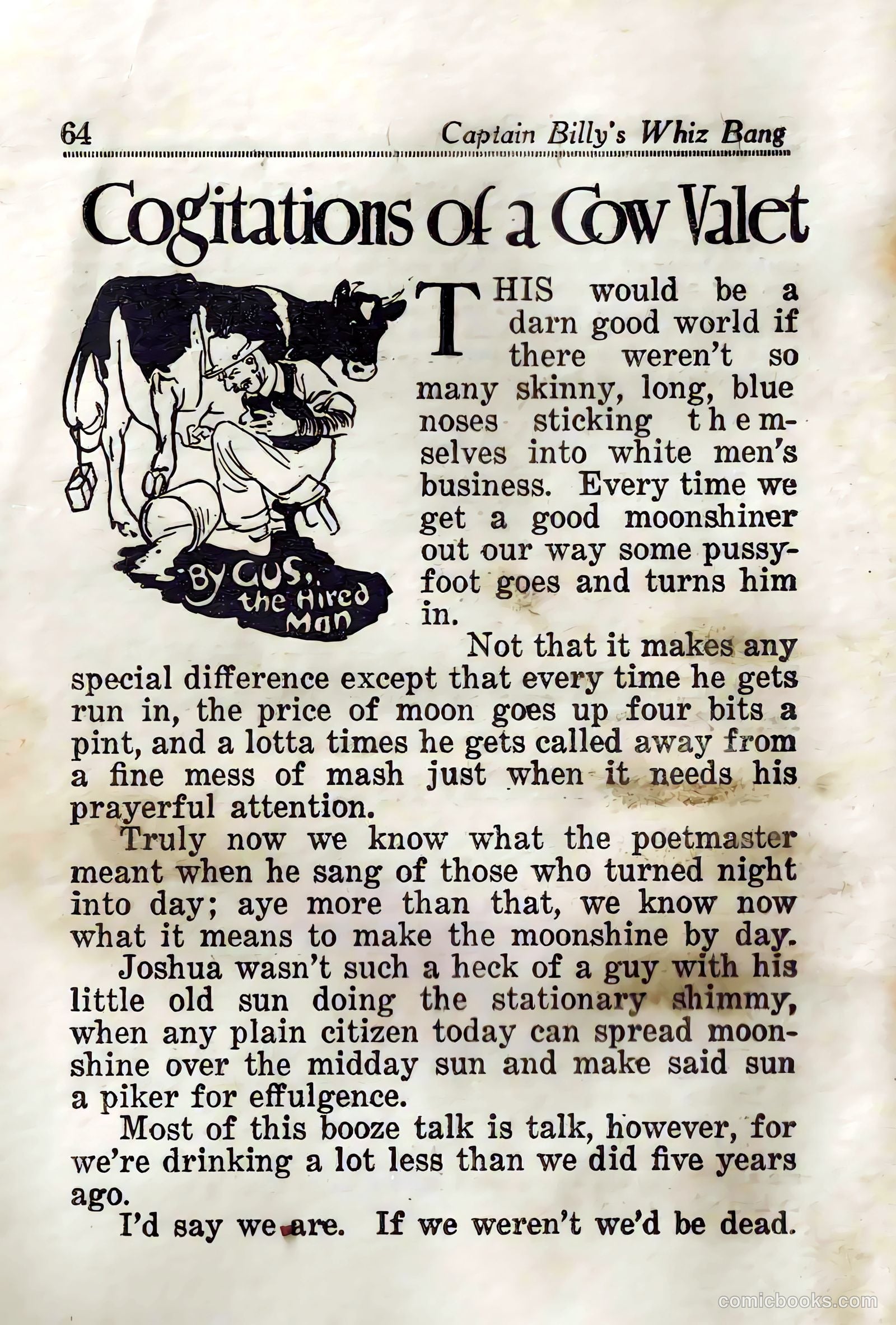
This satirical piece by "Cus, the Hired Man" critiques Prohibition-era bootlegging and its economic effects. The cartoon depicts a rural worker complaining about illegal moonshiners ("skinny, long, blue noses") infiltrating his community. The satire targets how bootlegging operations: - Drive up moonshine prices ("four bits a pint") - Disrupt farm labor when workers get arrested - Have paradoxically *reduced* overall alcohol consumption compared to five years prior The text ironically compares bootleggers to Joshua making the sun stand still—suggesting they've accomplished the remarkable feat of manufacturing daylight alcohol ("make the moonshine by day"). The underlying joke: Prohibition's black market has become so dysfunctional that it's actually decreased drinking rather than increased it—an unintended consequence.
This page contains **no cartoon or satirical content**. It is a legal document—specifically, a "Statement of Ownership, Management, Circulation, etc." required by the Act of Congress of August 24, 1912. The document certifies that Harvey Fawcett is the business manager of *Captain Billy's Whiz Bang*, a monthly publication from Robbinsdale, Minnesota. It lists ownership details, bondholder information, and circulation figures, sworn before notary J. W. Roche on March 31, 1923. This is a **title page or legal filing**, not editorial content. To understand *Whiz Bang*'s actual satire and humor, one would need to examine the magazine's interior pages.
This is primarily an **advertisement page**, not a political cartoon. It announces the availability of *Whiz Bang* magazine through various retail channels and direct subscription. The page features the magazine's **mascot: a cartoon devil or imp figure** (rendered in red and black), which appears to be the publication's recurring brand symbol. The text emphasizes widespread distribution ("Everywhere!") and pricing: 25 cents for single copies at hotels and newsstands, 30 cents on trains, or $2.50 yearly by direct subscription. This pricing structure reflects early 20th-century magazine economics. The decorative Art Deco-style border with geometric patterns was typical of the era's design aesthetics. Without additional context, the specific satirical content of *Whiz Bang* itself isn't evident from this page alone—it functions purely as a sales announcement.