
A complete issue · 68 pages · 1919
Captain Billy's Whiz Bang #3
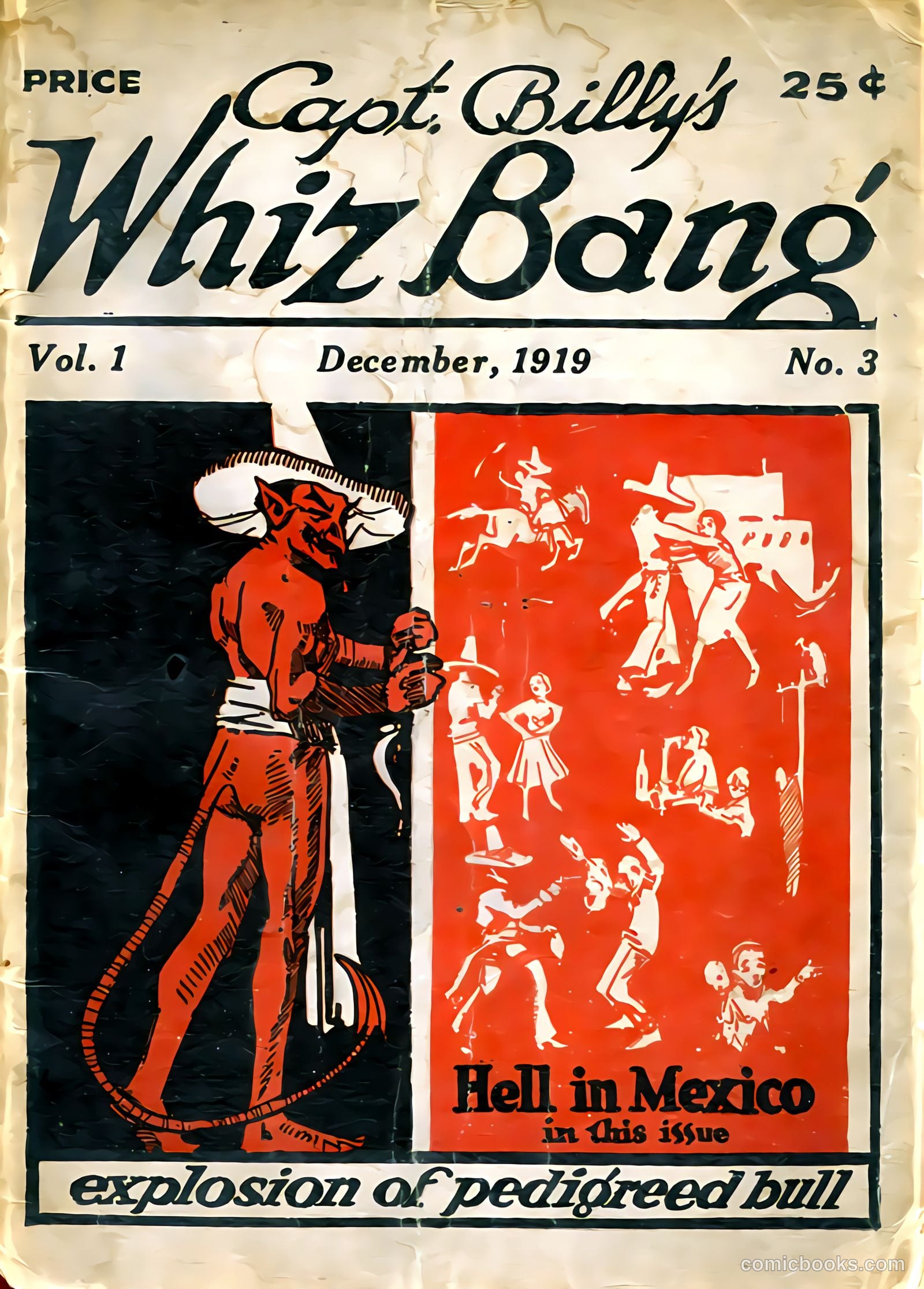
This is a title page for a satirical magazine. The left illustration shows a devil figure in red holding a whip—likely representing a demonic or malevolent force. The right panel advertises content titled "Hell in Mexico" featuring chaotic scenes of violence and mayhem in red and white. The bottom text references "explosion of pedigreed bull," suggesting crude humor about livestock destruction or absurdity. Without additional context, the specific political references remain unclear. However, the 1919 date places this during post-WWI America, when anti-Mexican sentiment and sensationalized depictions of Mexico were common in American media. The magazine appears designed around provocative, vulgar humor—typical of satirical publications of the era—rather than sophisticated political commentary.
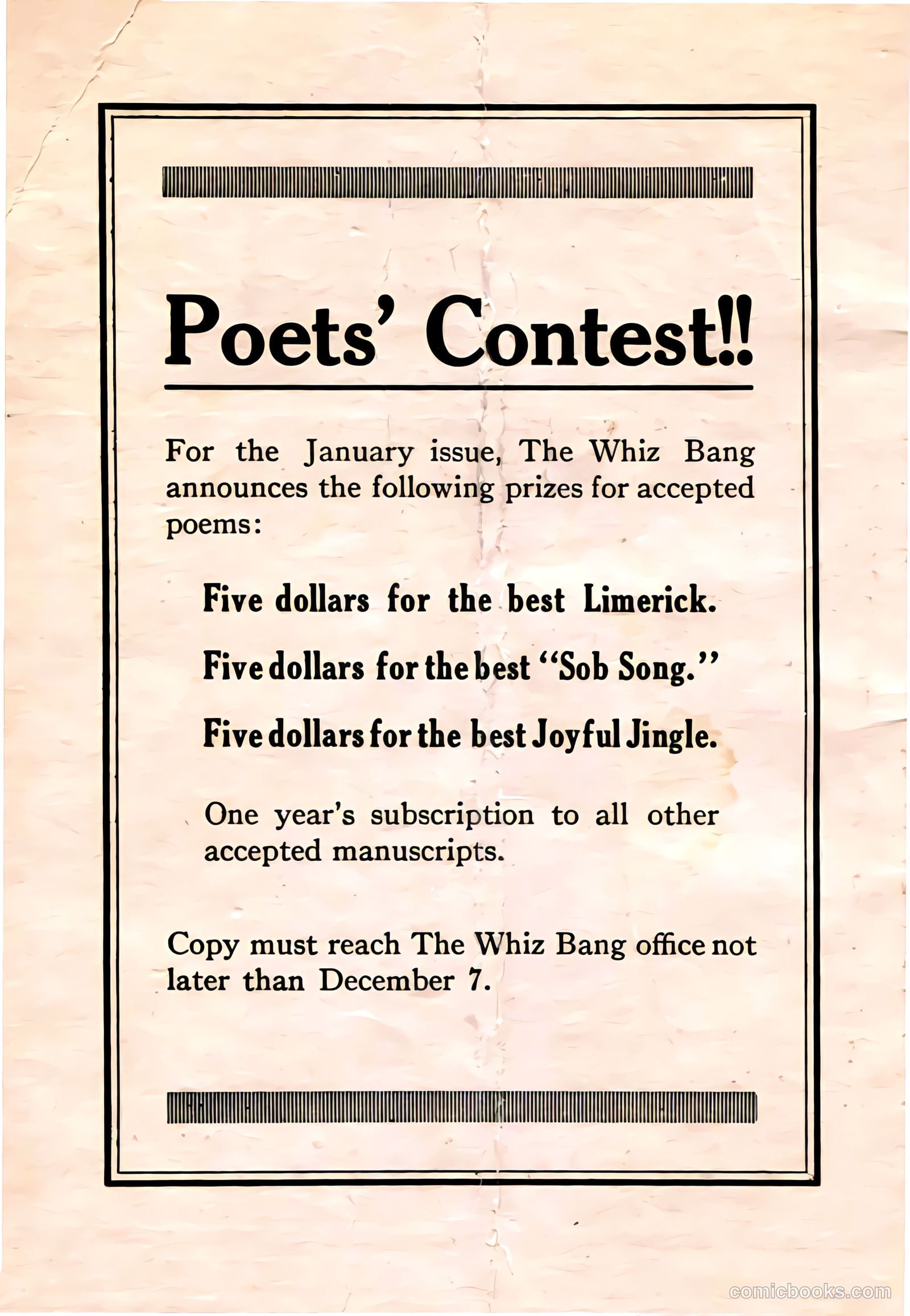
This is a **title page or advertisement**, not a cartoon. It announces a poetry contest for the January issue of *The Whiz Bang*, a satirical magazine known for humor and irreverent content. The contest offers monetary prizes ($5 each) for three categories of humorous poetry: - Best Limerick - Best "Sob Song" (likely sentimental or maudlin verse) - Best "Joyful Jingle" Winners also receive a year's subscription. The deadline was December 7. This reflects early-20th-century magazine culture, where reader participation contests were common entertainment. The categories—particularly "Sob Song"—suggest *Whiz Bang* aimed to parody overwrought sentimental poetry alongside lighter verse, fitting its satirical brand.
This is a title page for *Captain Billy's Whiz Bang*, a satirical American magazine. The decorative ornament beneath the title appears to be purely decorative rather than satirical imagery. The page lists the price as 25 cents per issue or $2.00 annually, typical pricing for early-to-mid 20th century magazines. Without additional content visible on this page, I cannot identify specific political figures, social references, or satirical points. The title itself suggests the magazine focused on humor and satire (suggested by "Whiz Bang"), but this cover page contains only the masthead and pricing information, functioning as a cover rather than presenting substantive cartoon or editorial content.
This is a title page rather than a cartoon page. It identifies the publication's editor and publisher as W. H. Fawcett, based in Robbinsdale, Minnesota (Rural Route No. 2). The page displays a decorative publisher's mark or emblem in the center. There is no satirical content, political commentary, or humor visible on this page—it serves solely as a credits/masthead page indicating the magazine's editorial leadership and location. To understand the actual satirical content of Whiz-Bang, one would need to examine other pages from the publication containing the magazine's cartoons and articles.
This is a title page and introduction to an article, not a cartoon. It presents "Hell in Mexico" by Rev. "Golightly" Morrill, who is identified as pastor of the People's Church in Minneapolis. The article critiques conditions in Vera Cruz, Mexico, focusing on what Morrill views as moral decay—specifically the prevalence of disease advertisements in newspapers and public spaces. He describes billboards and shop windows displaying photographs of patients allegedly "cured" of venereal diseases and other ailments, with names and addresses meant to attract future customers. The satire targets Latin America's medical practices and advertising ethics, portraying Mexico as morally corrupt through its commercialization of disease treatment. The inflammatory title "Hell in Mexico" reflects early-20th-century American moral reformism and xenophobia toward Latin American nations.
This page contains no cartoons or illustrations—it's purely text content from the magazine's editorial section. The author describes social conditions in Vera Cruz, Mexico, critiquing local male culture. He observes men gathering in plazas from afternoon into early morning, primarily discussing women rather than serious topics. The piece satirizes this preoccupation as "guilty love." The author further criticizes Vera Cruz's literature market, which stocks imported "smut" alongside "questionable classics" and "filthy novels." He notes the prevalence of sexually suggestive bread and pastry designs from local bakeries, which he views as reflecting the town's moral corruption. The overall tone is disapproving moralism mixed with satirical observation of what the author sees as a sexually obsessed culture.
This page contains no cartoon—it's text only, appearing to be satirical social commentary about Vera Cruz, Mexico. The author mocks Roman decadence, then compares it to modern Mexican society in Vera Cruz. The piece critiques: 1. **Sexual/moral laxity**: A girl smoking and flirting openly in a café, shocking to American sensibilities 2. **Social reputation**: Gossip culture where being seen with an attractive woman causes scandal 3. **Coming-of-age corruption**: The "Don Juan" phenomenon—Mexican boys allegedly turn to womanizing at age 15, making it their life's primary pursuit The tone is judgmental toward both Roman excess and contemporary Mexican behavior, typical of early 20th-century American attitudes toward Latin America—portraying it as morally corrupt and sexually permissive compared to American standards.
This appears to be a text-heavy editorial or opinion piece rather than a cartoon page. The author criticizes moral conditions in Mexico, particularly in Vera Cruz, describing poverty, prostitution, disease, and sexual exploitation. The piece claims Mexican society lacks moral restraint, citing examples like young girls begging at wharves, widespread venereal disease, and casual cohabitation without marriage. The satire targets Mexican social conditions and, implicitly, critiques the contrast between public morality standards and actual behavior among all social classes, including military officers. The author suggests youth are corrupted by witnessing such widespread vice. This reflects early 20th-century American attitudes toward Mexico—likely post-Mexican Revolution—mixing moral judgment with travel reporting.
This page contains no cartoon or illustration—it's purely text presenting satirical social commentary on Mexican culture and morality, addressed to an American readership. The author critiques Mexican attitudes toward marriage, cohabitation, and sexual behavior, contrasting them unfavorably with American standards. The satire employs exaggeration and dehumanizing comparisons (likening family life to "pigs and dogs"), suggesting moral superiority of American society. The piece also contains problematic references to India and stereotypes about gender roles across cultures. The concluding passage discusses courtship customs, suggesting disapproval of Mexican social practices around dating and parental involvement. The tone reflects early 20th-century American attitudes: ethnocentric, moralistic, and comparative in nature.
This page contains several brief satirical anecdotes rather than visual cartoons. The humor relies on wordplay and social commentary: 1. **Opening section** mocks sexual morality in rural/poor communities, referencing high illegitimacy rates and transactional relationships. 2. **Military drill anecdote** uses a racist slur (period-typical for this publication) to joke about a soldier's posture—the sergeant's retort plays on the soldier's bent knees. 3. **Church basket anecdote** involves a pun: "long handles" for collection baskets, which Brother Spiffins (identified as a former palmist/entertainer) interprets as a double entendre. 4. **Final anecdotes** make simple puns about medicine almanacs and stovepipes. The satire targets lower-class morality, military discipline, and church culture through crude humor typical of 1920s-era men's magazines.
This page contains two distinct pieces. "Plump Polly Puckers" is an alliterative tongue-twister story by Edgar M. Schoenberg about a character named Polly and her romantic interest Paul. It appears to be humorous light verse exploiting the "P" sound throughout—a popular literary game in early 20th-century magazines. "The Naked Truth" below is a brief social commentary from the Los Angeles Times, sardonically suggesting that if Los Angeles women adopt bare-legged fashion in public, the term "legs" would be more accurate than the euphemistic "limbs"—a joke about Victorian-era prudishness versus emerging flapper-era fashion trends of the 1920s.
This page is the opening of an essay, not a cartoon. Schneider adopts a mock-pompous tone to discuss jazz dancing as a social phenomenon. He addresses "Ma'am" and promises to explain jazz dance with proper "exposition of the proposition"—humorously treating this popular entertainment with academic formality. The satire targets pretentious essay-writing and contemporary anxiety about jazz culture. Schneider pokes fun at both overly serious literary analysis and the "jazz age" phenomenon itself. His joke about dances formerly being called "balls" because dancers "grabbed she and then they rolled around a little" is crude innuendo mocking both dance and formal language. The piece reflects 1920s cultural debates about jazz as modern, improper entertainment.
This is a satirical narrative mocking post-WWI social changes and jazz culture. The unnamed narrator describes attending a "jazz festival" with "Kid Herpercide," where he encounters a doorman distributing blue ribbons that grant men the right to hug women without consequence—a jab at perceived moral loosening of the 1920s. The satire targets: - Jazz as frivolous "novelty noise" - Post-war social permissiveness and sexual license - The "Roaring Twenties" culture clash The narrator, disguised by three weeks' stubble, nearly fools the doorman into thinking he's a "bulshevik or anti-saloon leaguer"—mocking both radical politics and Prohibition-era temperance advocates as equally suspicious outsiders. The humor relies on exaggeration of contemporary anxieties about modernization.
This page contains humorous prose rather than a cartoon. The narrator describes attending a jazz parlor performance featuring an exceptional dancer he calls a "fufu" — likely slang for an attractive or stylish person. The text celebrates the dancer's technical skill, describing the jazz performance in vivid, exaggerated language ("shimme-ing," "wabbling maneuvers"). The satire targets jazz culture itself, which was controversial in 1920s America. The passage mocks both the music's intensity and the sensual dancing through colorful descriptions ("cow bell," "slippery slide"). The reference to Noah's ark suggests the performer's talent is ancient and legendary. The humor lies in treating jazz performance with mock-serious anthropological detail, satirizing both jazz enthusiasts and their critics' moral anxieties about the music.
This page contains prose satire rather than cartoons. The narrator describes attending a dance where he observes social pretense and foolishness. He mocks "Kid Herpeicide" (a crude pun on the dandruff product Herpiside) for lying to impress a woman in a red necktie, calling him "plumb loco." Disgusted, the narrator demands his money back from the "Watch Dog of the Treasury" (likely a satirical reference to government fiscal oversight). The second section ridicules Christian Science medicine, mocking hypochondriacs who imagine ailments after reading patent medicine advertisements. The satire suggests people are healthier if they simply think positively rather than obsessing over imaginary symptoms—a skeptical jab at both Christian Science practitioners and the pharmaceutical industry's marketing tactics.
This page from *Captain Billy's Whiz Bang* presents a misogynistic satirical piece titled "The Man Hater," featuring a woman's bitter monologue against men. The narrator expresses extreme hostility toward men, comparing them to predatory animals ("blind dog in a meat house") and stating she'd prefer all men except her father be "driven out or killed." The piece appears designed for crude humor targeting feminist sentiment—mocking women who express anti-male views by presenting an exaggerated, hostile female voice. The accompanying aphorisms about old friends and boys' camping skills offer lighter humor but maintain the magazine's generally misogynistic tone. This reflects early 20th-century satirical magazine conventions that normalized hostility toward women's independence and changing social roles.
This page contains a "Personal" gossip column about ex-servicemen adjusting to civilian life after WWI. The humor relies on satirizing their various post-war situations: **Percival Filbert** - A former captain now slings sodas at a pharmacy, a comedown from military authority. **Pete Greasyneck** - A former mule handler bought a Jowll Soyce car with gambling winnings, heading to Arizona construction work. **George Thisseldown Chomwoley De Pussey** - The longest name gets the sharpest satirical jab: a former aide to a general now takes orders from a floor-walker (retail supervisor) of lower rank, humiliatingly reversing their military hierarchy. The final joke ("two heads better than one") likely references De Pussey's absurdly long name. The satire mocks post-war social disruption and rank reversals.
This page is primarily text-based commentary rather than cartoon content. It discusses whether theater is becoming immoral, arguing that motion pictures—not stage plays—have actually *reduced* scandalous theatrical productions. The article critiques Olga Nethersole, an English actress prominent in the 1880s-90s who famously starred in provocative plays including "Sappho" (which caused particular controversy). Nethersole claimed she played such roles to expose social suffering, not for sensationalism. The Whiz Bang's point appears to be that cinema has displaced theater as the primary source of morally questionable entertainment, making the earlier theatrical scandals seem quaint by comparison. The piece uses Nethersole as a historical example of past theatrical controversy now largely forgotten.
This page contains three brief satirical pieces rather than visual cartoons: 1. **Olga Nethersole discussion**: References the actress and her moral crusade against illicit passion in drama. The satire notes her prediction that theatrical reform would matter has proven false—her name and principles are now forgotten, despite her earnest efforts. 2. **"Quick Recipe for H.C.L."**: A joke about the high cost of living (H.C.L.), suggesting eating dried apples and drinking water causes stomach swelling—a dark humor commentary on poverty-level diets. 3. **"Oh, Pluto!"**: A pun on Pluto water (a commercial laxative). The joke: selling it at discount proved beneficial to "bargain chasers" after a previous day's events—implying digestive distress requiring the product's use. All three pieces use caustic humor addressing class, morality, and consumer culture.
This page from *Captain Billy's Whiz Bang* is primarily a section of classified want ads titled "Our Want Ads," presented as humor. The joke relies on double meanings and suggestive language common to 1920s satirical magazines. The satire mocks how innocuous classified advertisements can be misread as having sexual or scandalous meanings. For example, "Combination Sex" advertises farm work, while "The Owl Car, Perhaps" offers roommate situations. The humor comes from readers' potentially dirty interpretations of straightforward job postings. The ads are sourced from real newspapers (Winona, Petersburg, Shreveport, Rockford), suggesting the magazine reprinted actual classifieds and highlighted their unintentional innuendo for comedic effect—a common editorial practice in risqué humor magazines of this era.
This page satirizes the Detroit Golf Club's ban on "cheek dancing," a then-current dance craze where partners placed their cheeks together while dancing. The club's entertainment committee issued a formal notice threatening suspension for repeat offenders, calling the practice too intimate and improper for respectable society. The satire mocks the prudishness of Detroit's elite ("dignified sons and daughters of Terpsichore") who found this close contact scandalous. The humor lies in the overwrought formal response to a minor dancing style—the club treating it as serious misconduct warranting board intervention. The page concludes with witty observations about courtship customs contrasting "old-time lovers" with modern behavior.
This is a humorous essay rather than a cartoon, appearing in *Captain Billy's Whiz Bang*, a satirical magazine. The piece comments on Japanese women in Hawaii, describing how their traditional kimono garments—held together with a wide sash—behave when caught by wind, creating an unintended revealing effect. The humor relies on the cultural contrast between Japanese formal dress and Western expectations, along with double-entendre about glimpsing legs and ankles. The essay concludes with speculation that the term "Madame Butterfly" (likely referencing the opera) may originate from this wind-induced silhouette resemblance to a butterfly. The tone reflects early 20th-century American attitudes toward Asian immigrants and their cultural practices, mixing admiration with voyeuristic observation.
This page contains three separate humorous anecdotes rather than cartoons. The first mocks American tourists in Japan, contrasting their prudish reaction to a woman's exposed kimono with Japanese men's indifference. The second section, "Noonan's Sunshine," is a collection of brief jokes and observations: about Indian summer, San Francisco's dryness, Bolshevism, and a shooting accident. The humor relies on wordplay and absurdist connections—for example, the "Robbinsdale man" anecdote appears to joke darkly about accidental violence. The final item references a dispute between French dancer Mlle. Bourgeoisdite Mistinquett and American performer Ann Pennington over who has the most beautiful legs, claiming the French dancer insures hers for $100,000. This reflects 1920s celebrity culture and competitive vanity.
This page from *Captain Billy's Whiz Bang* contains a humorous narrative (no visible cartoon) about a dance at "Bowlby's" where the narrator describes learning a new dance called the "Hi Diddle Diddle Jazz" from a "Professor." The story is written in vernacular dialect featuring characters named Gert, Jake, and Grace. The humor derives from physical comedy—Jake fails to support the narrator during the backwards-bending move, causing them to fall. The narrative concludes with Jake awkwardly asking the narrator on what appears to be a date ("regular supper"). The piece satirizes 1920s jazz culture, dance crazes, and romantic social conventions through slapstick situations and period slang, reflecting the magazine's focus on irreverent, youth-oriented humor.
This page contains two humorous anecdotes typical of the magazine's satirical style. The first section depicts a hangover scenario involving someone named "Gertie"—likely a common colloquial name of the era. The humor centers on morning-after recovery clichés: asking the time, seeking aspirin, and casual farewells. The second section, titled "Proof," presents a more elaborate joke about a college student caught with contraband ale. When confronted by the college president, the student claims medical necessity and ingeniously argues the barrel provides health benefits—he's become strong enough to carry it easily. The satire mocks both the student's creative excuse-making and Prohibition-era hypocrisy, where alcohol was officially forbidden yet commonly rationalized as medicinal.
This page contains two separate humorous pieces from *Captain Billy's Whiz Bang*, a satirical magazine popular in the 1920s-30s. The first story mocks Mrs. Brown's anxiety about attending her first cinema showing in small-town Slowville. She dresses formally in her "Sunday bonnet and cloak" for this novelty entertainment, then panics during a dusty cowboy film, frantically worried the action scenes will ruin her clothes. The second piece is a satirical news item about Charles Hugh Wilson arrested for bigamy. His jail-composed poem uses Biblical kings (Solomon and David) as justification for multiple marriages, humorously suggesting that matrimony improved his character—a pointed joke about his obvious hypocrisy and the absurdity of his defense.
This page is a humor advice column featuring four Q&A exchanges. The jokes rely on wordplay and social commentary: 1. **Worried Winnifred** asks how to contact a soldier; the answer jokes about military bureaucracy. 2. **Ima Boob** observes a crying baby and receives a joke implying the father is poorly dressed ("sympathized with its father"). 3. **Puzzled Pussy** compares military recruits ("cooties"), "gray-backs" (lice), and conscientious objectors—the joke being that soldiers have military training while other "vermin" lack discipline. 4. **Mikelovitch**, a foreigner, asks what "sport" means. The answer satirizes American crime: in England a sport is gambling; in America it's someone police pursue. The humor targets military life, fashion, and American crime culture of the era.
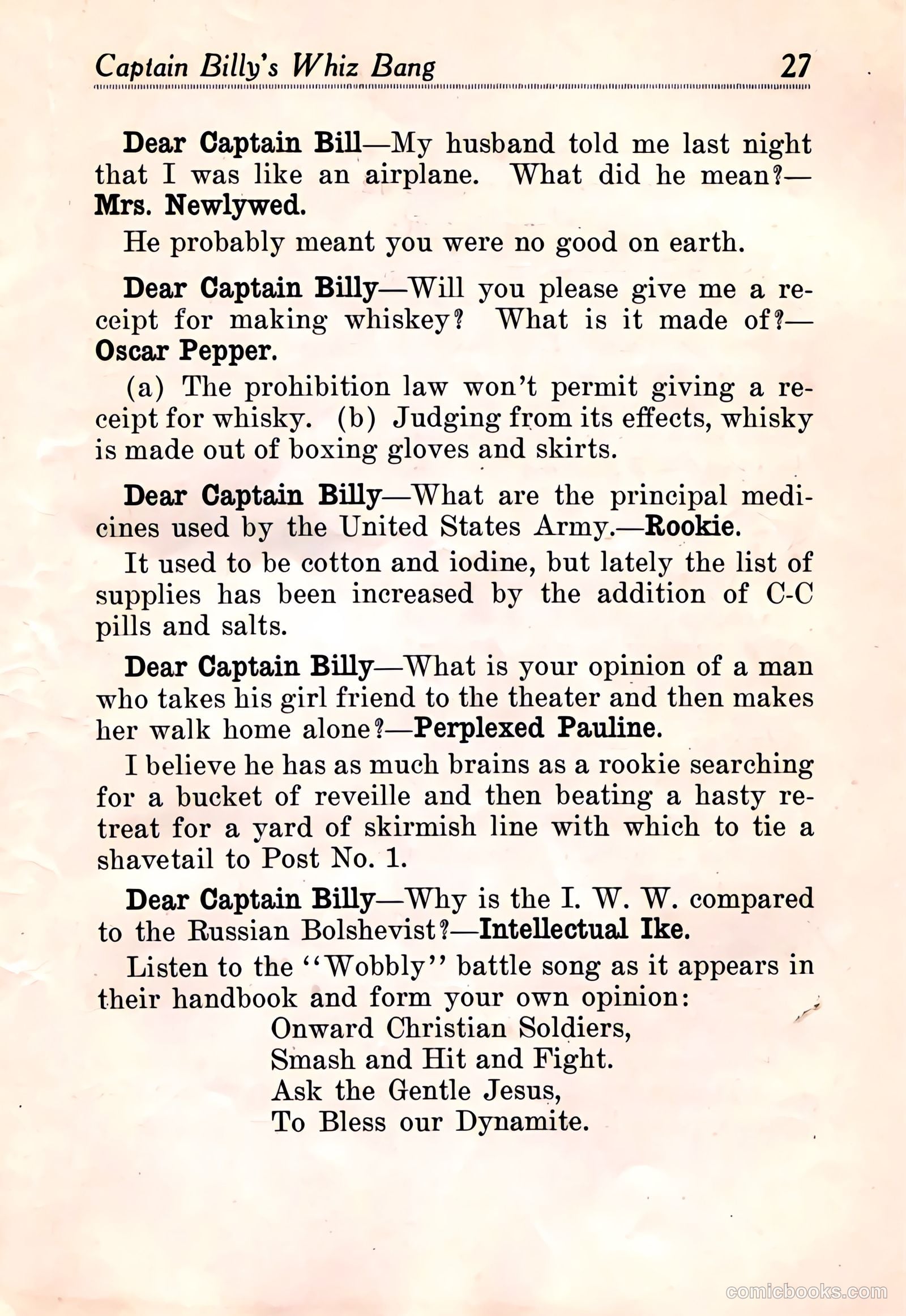
This is a humor advice column where "Captain Billy" responds to reader questions with jokes. The satire targets various 1920s social issues: **Key references:** - **Prohibition era**: Oscar Pepper's whiskey question mocks the alcohol ban; the answer jokes that whiskey's effects (boxing gloves, skirts) suggest its violent intoxication - **Military medicine**: The C-C pills reference appears to be satirizing Army medical supplies - **Gender relations**: "Perplexed Pauline" criticizes men who don't properly escort women home—the response compares such a man's intelligence unfavorably to a rookie soldier - **I.W.W. (Industrial Workers of the World)**: "Intellectual Ike" asks why this radical labor union is compared to Russian Bolsheviks. Captain Billy's response quotes a militant "Wobbly" battle song mocking Christian pacifism, implying the I.W.W. advocates violence—thus resembling Bolshevism The humor relies on readers recognizing these contemporary concerns.
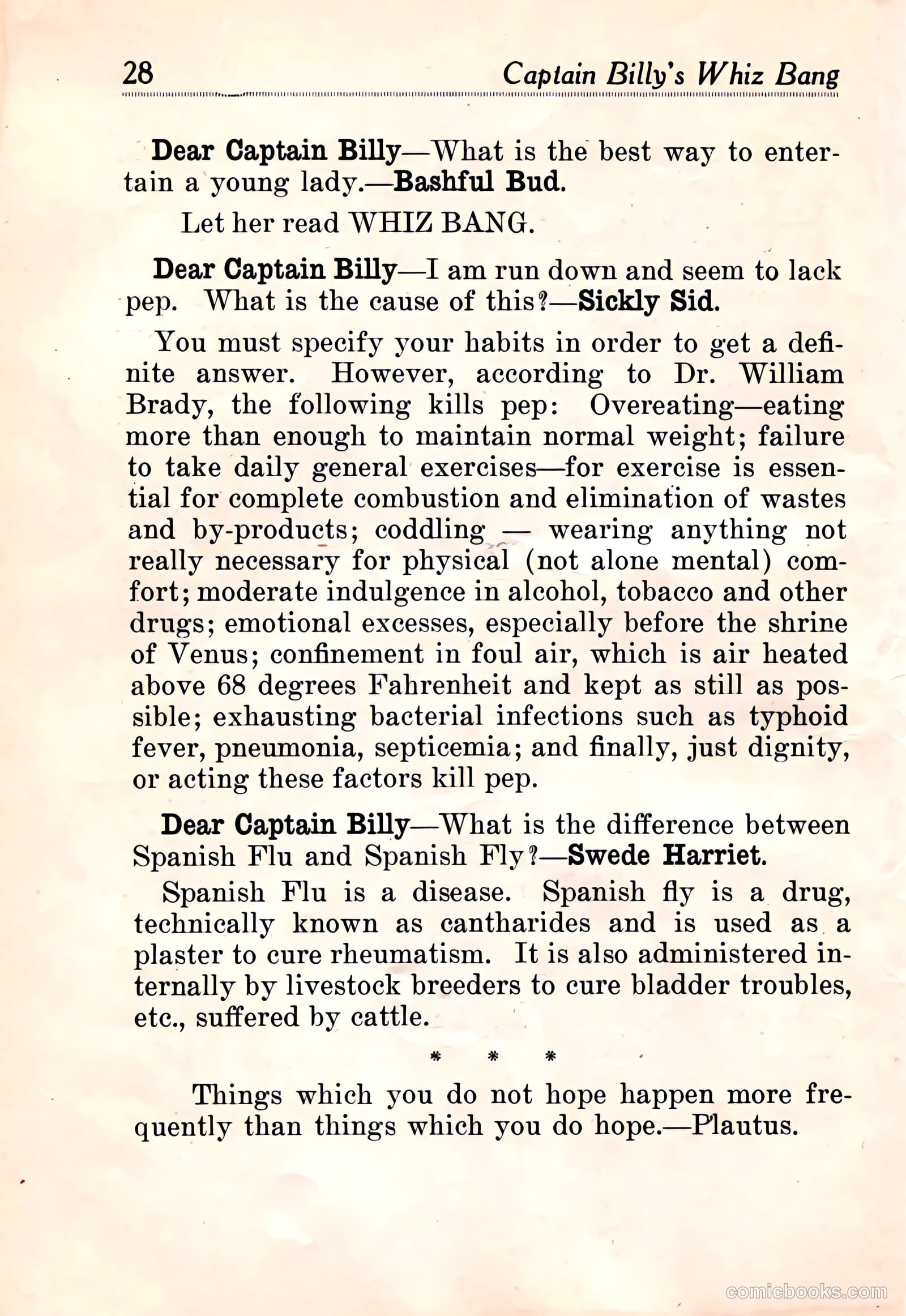
This page contains a humorous advice column titled "Captain Billy's Whiz Bang" with three reader questions and answers. There are no political cartoons visible. The content includes: 1. A joke answer about entertaining young ladies (suggesting they read the magazine) 2. Health advice from "Dr. William Brady" about lacking energy, listing factors that reduce vitality: overeating, lack of exercise, excessive clothing, alcohol/tobacco use, sexual excess, poor air quality, and bacterial infections 3. A distinction between "Spanish Flu" (the 1918 pandemic disease) and "Spanish fly" (a drug/plaster used for rheumatism and livestock ailments) The page reflects early 20th-century health concerns and the lingering impact of the Spanish Flu pandemic. The advice column format was typical entertainment for this era's satirical magazines.
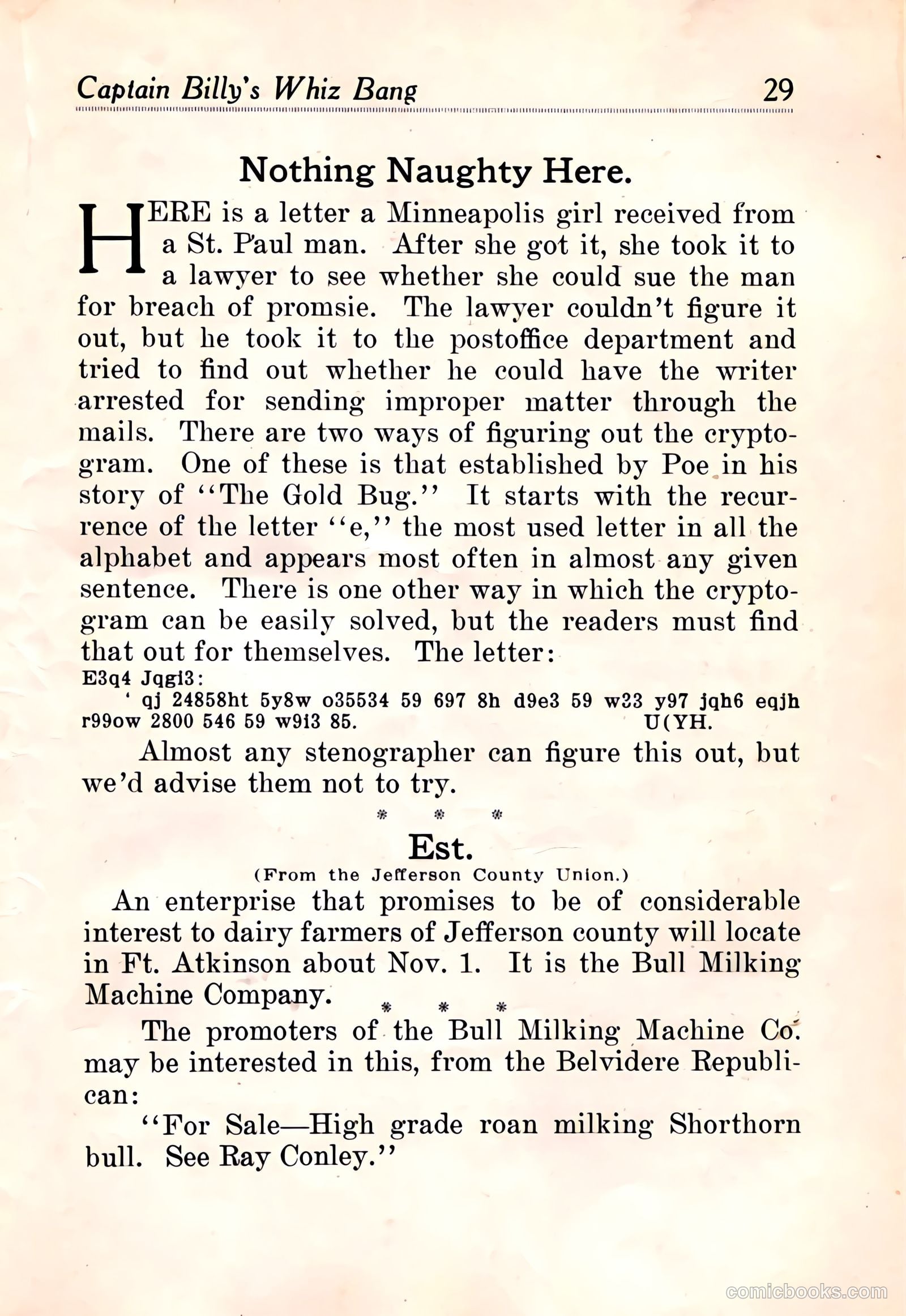
This page contains three unrelated short pieces rather than a cartoon: 1. **"Nothing Naughty Here"**: A humorous anecdote about a Minneapolis woman who received a suggestive letter from a St. Paul man. She attempts legal action, then the postmaster tries to determine if it violates mail regulations. The piece presents an unsolvable cryptogram (cipher text) as the actual letter, joking that readers shouldn't attempt to decode it. 2. **"Est."**: A brief notice about the Bull Milking Machine Company establishing operations in Ft. Atkinson, presented as a business announcement. 3. A classified advertisement from the Belvidere Republican offering a "high grade roan milking Shorthorn bull" for sale. The humor relies on wordplay and the absurdity of the cryptogram premise rather than visual satire.
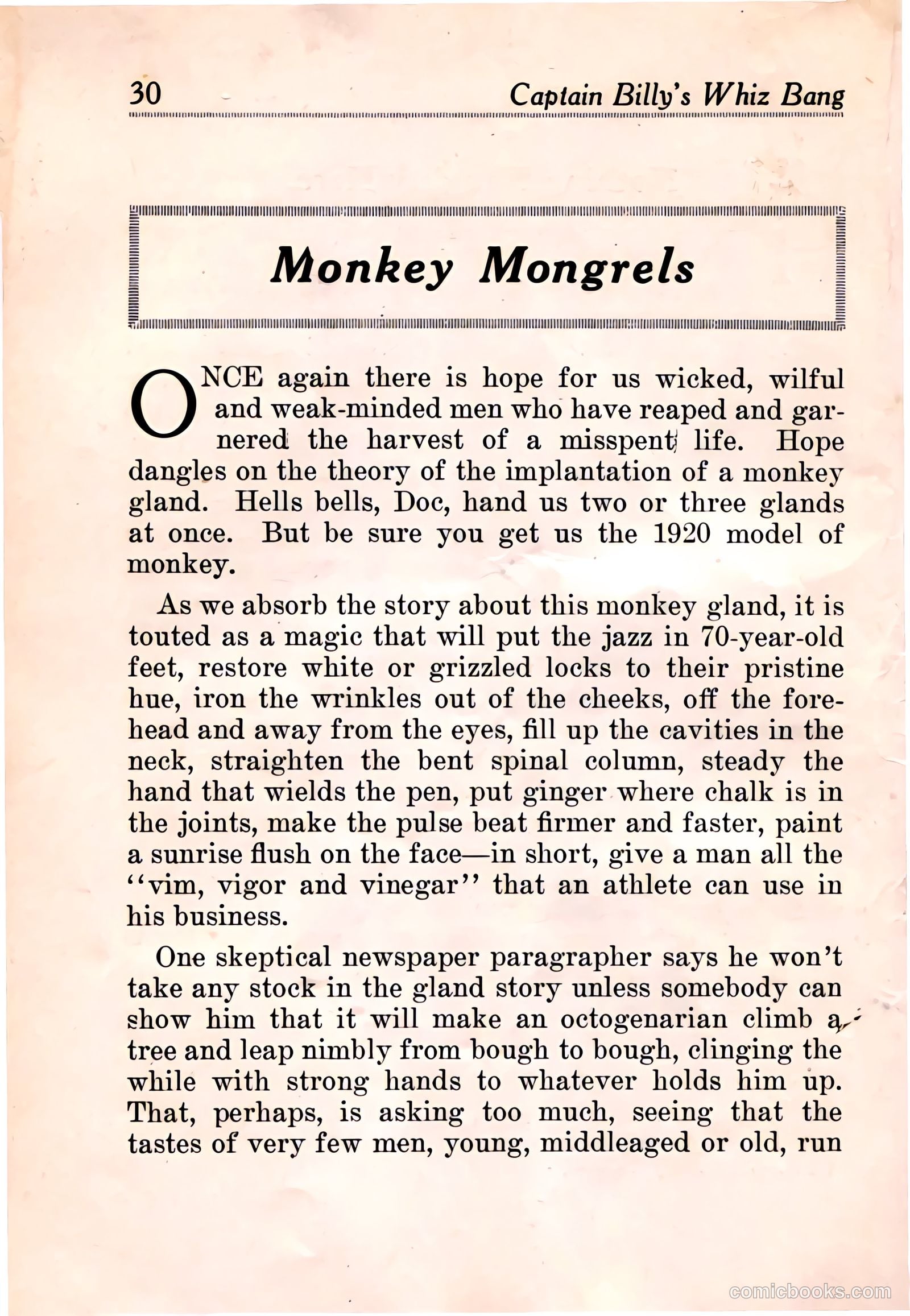
This article satirizes the "monkey gland" craze of the 1920s—a pseudo-scientific fad where men underwent surgery to implant monkey testicular tissue, supposedly to restore youth and virility. The piece mocks aging men desperately seeking rejuvenation through this dubious procedure. The satire targets: - Gullible older men ("wicked, wilful and weak-minded") seeking magical cures - Exaggerated promises: restoring vigor, straightening spines, darkening gray hair - A skeptical newspaper columnist who demands proof the procedure actually works The humor lies in the absurd claims and the author's sarcastic tone mocking both the procedure's believers and the desperation of aging men. This reflects 1920s skepticism toward early medical quackery marketed as rejuvenation.
This page contains three brief satirical observations rather than illustrated cartoons. The main content mocks a dubious medical fad: a "monkey gland" rejuvenation procedure supposedly developed by a Paris scientist. The text sarcastically suggests attaching monkey gland tissue to aging men to restore youth and vitality—a real (fraudulent) treatment that circulated in the 1920s. The satire targets gullible "old-timers" desperate to recapture youth, warning them to "place your gland orders early." The final quip criticizes business competitors as motivation for success. The page exemplifies *Whiz Bang*'s cynical humor about contemporary medical quackery and age-anxiety, reflecting 1920s skepticism toward dubious rejuvenation therapies promoted to the wealthy and desperate.
This page announces a monthly poetry contest for amateur "Kiplings" (aspiring poets), with the winning "sob song" titled "Chicken Fever" by Field Ashworth. The poem is a humorous drunk narrative: the speaker has consumed cheap alcohol ("the stuff they sold to me"), experiences hallucinations (pink elephants), loses his girlfriend to someone named Jack, and ends with an interrupting phone call. The repeated "Broke, broke, broke" refrain emphasizes financial and moral dissolution. The satire targets two things: the pretensions of amateur poetry contests, and the comedic portrayal of working-class drunkenness—a common Whiz Bang theme. The "sob song" format mimics sentimental popular music while celebrating crude, bawdy humor instead. It's gentle mockery of both poetry aspiration and modern urban dissipation.
This page contains three humorous limericks and verses, not political cartoons. The humor relies on absurdist situations and wordplay typical of early 20th-century satirical magazines: 1. **"Feeling the Wheeling Ceiling"** (Earl Girard) — A woman from Wheeling, West Virginia experiences dizziness, which a nurse treats by aggressively rubbing her back, supposedly throwing her toward the ceiling. 2. **"Twin Troubles"** (Henry George Foss) — Dark humor about twins in Golden Town; one dies of whooping cough, then the other contracts influenza ("the 'flu'"). 3. Additional verses mock a confused Swedish immigrant and offer philosophical observations about mortality and social class. The satire targets immigrant confusion and treats illness casually, reflecting period attitudes.
This page contains two literary pieces rather than visual cartoons: 1. **"Hell"** — A poem by M.B. Summer reimagining hell not as traditional fire and brimstone, but as a psychological torment of emptiness, silence, and regret—a modernist reinterpretation popular in early 20th-century literature. 2. **"Miss Quick-Change"** — Satirical verse about a frivolous young woman from questionable social circles who accepts gifts and money from admirers, periodically disappearing then returning "tired and jaded." The satire mocks both her shallow lifestyle and her morally dubious mother who encourages such behavior. This reflects contemporary concerns about women's changing social roles and loose morality in the Jazz Age. Both are text-based social commentary typical of *Whiz Bang*'s satirical approach.
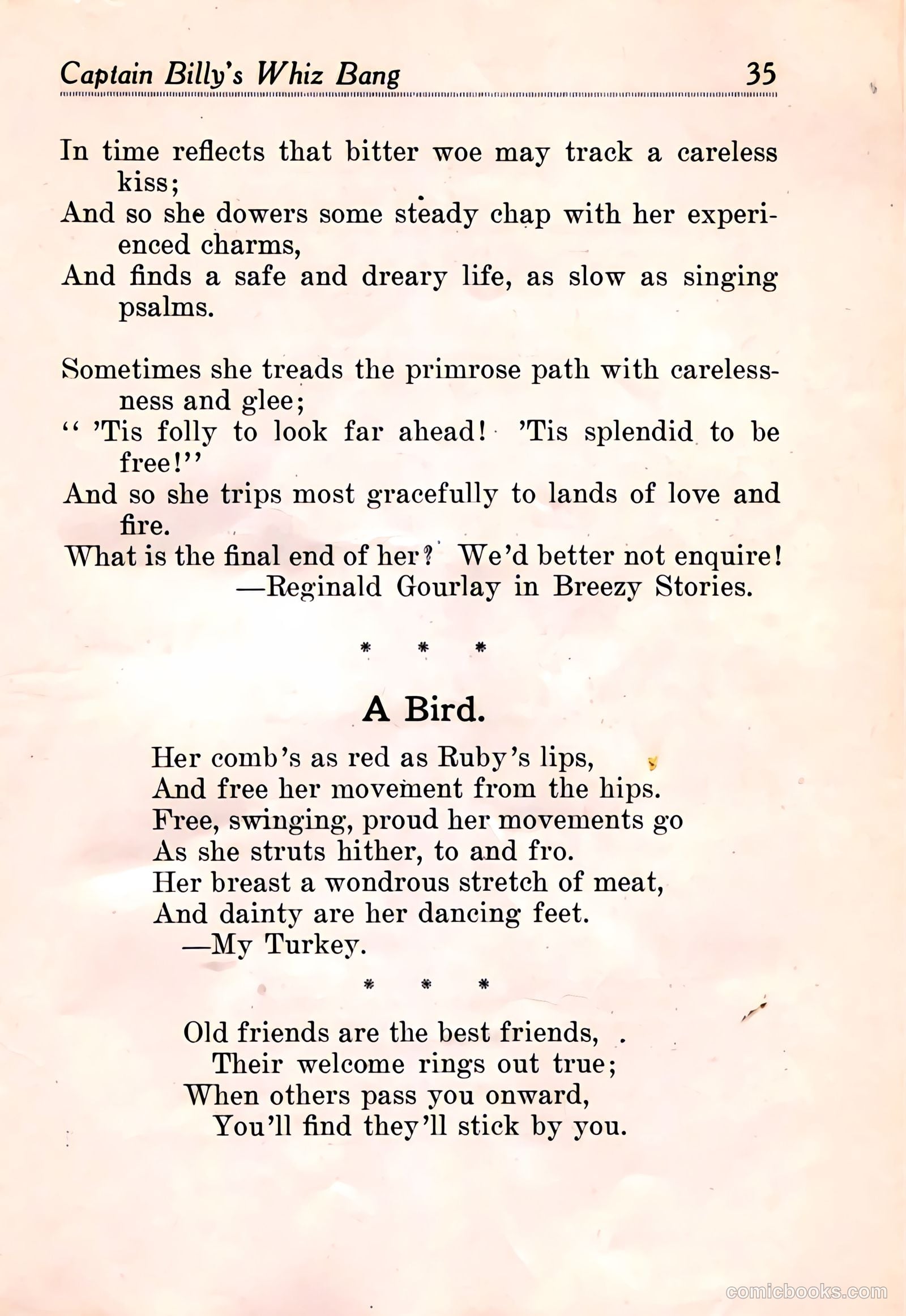
This page contains literary excerpts rather than cartoons. It presents three pieces of verse: 1. **A passage by Reginald Gourlay** from "Breezy Stories" describing a woman's romantic and carefree life choices, ending with a knowing rhetorical question about her fate. 2. **"A Bird"** — a short poem attributed to "My Turkey" describing a bird's physical attributes and movements in sensual terms (red comb, "wondrous stretch," "dainty dancing feet"). 3. **A brief verse about old friendship** emphasizing loyalty and constancy. The content reflects *Whiz Bang's* satirical humor through suggestive innuendo and double entendre typical of 1920s-era "adult" humor magazines. The bird poem particularly uses animal description as thinly-veiled sensual commentary, characteristic of the publication's comedic style.
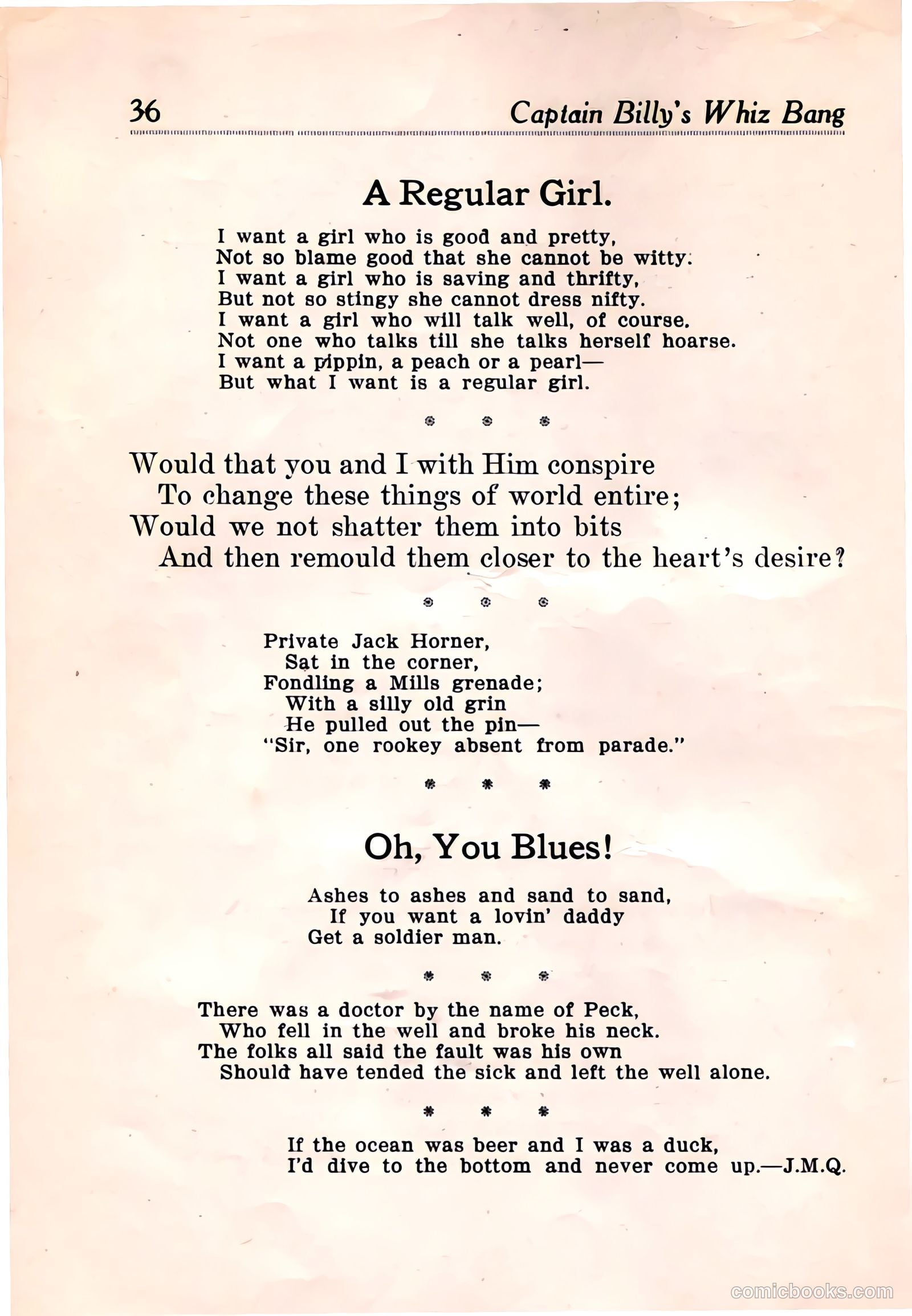
This page contains five separate humorous poems and verses rather than cartoons. The content includes: **"A Regular Girl"** — A poem about wanting a woman who is attractive, witty, thrifty but fashionable, and well-spoken (but not talkative to the point of hoarseness). **"Private Jack Horner"** — A brief anecdote about a soldier pulling the pin on a Mills grenade (a WWI-era weapon) while sitting in a corner, apparently absenting himself from a parade. **"Oh, You Blues!"** — A short verse about wanting a "lovin' daddy" and suggesting one get a soldier man; includes the nursery-rhyme-style doctor anecdote about Dr. Peck falling in a well. **Final line** — A humorous conditional statement comparing getting drunk to being a diving duck. These are typical of *Whiz Bang*'s mix of mild humor, military references, and everyday observations aimed at soldiers and post-WWI audiences.
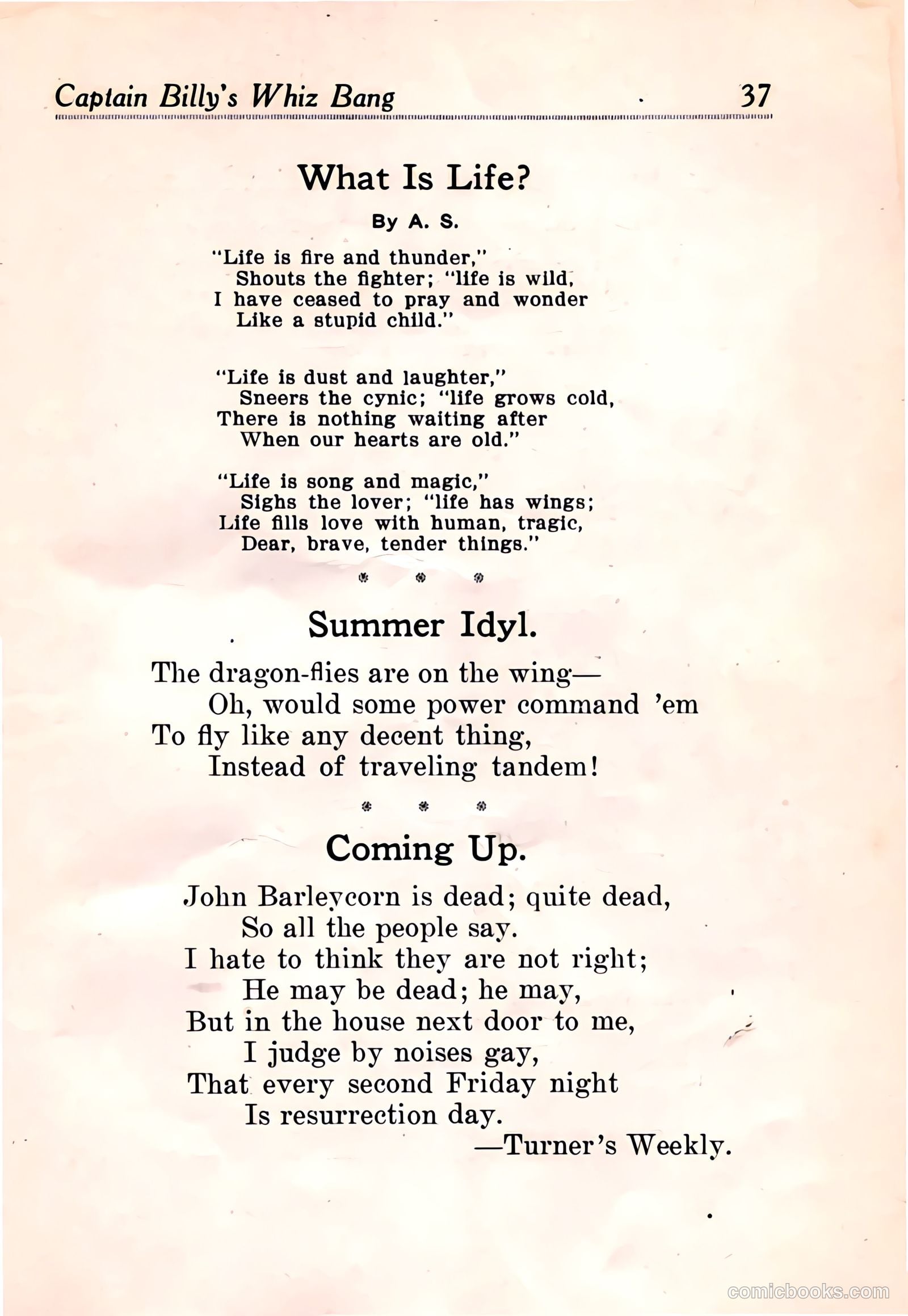
This page contains three separate poems rather than political cartoons: 1. **"What Is Life?"** by A.S. presents contrasting philosophical views through different voices: a fighter calling life "fire and thunder," a cynic claiming it's "dust and laughter," and a lover seeing it as "song and magic." 2. **"Summer Idyl"** humorously complains about dragonflies flying in tandem formation rather than individually—a lighthearted observation about nature. 3. **"Coming Up"** from Turner's Weekly is a comedic poem about a supposedly dead neighbor, John Barleycorn, whose noises every Friday night suggest resurrection. "John Barleycorn" likely references alcohol/drinking—the poem jokes that weekly parties prove the neighbor isn't truly dead. The page emphasizes humor and social satire through verse rather than visual cartoons.
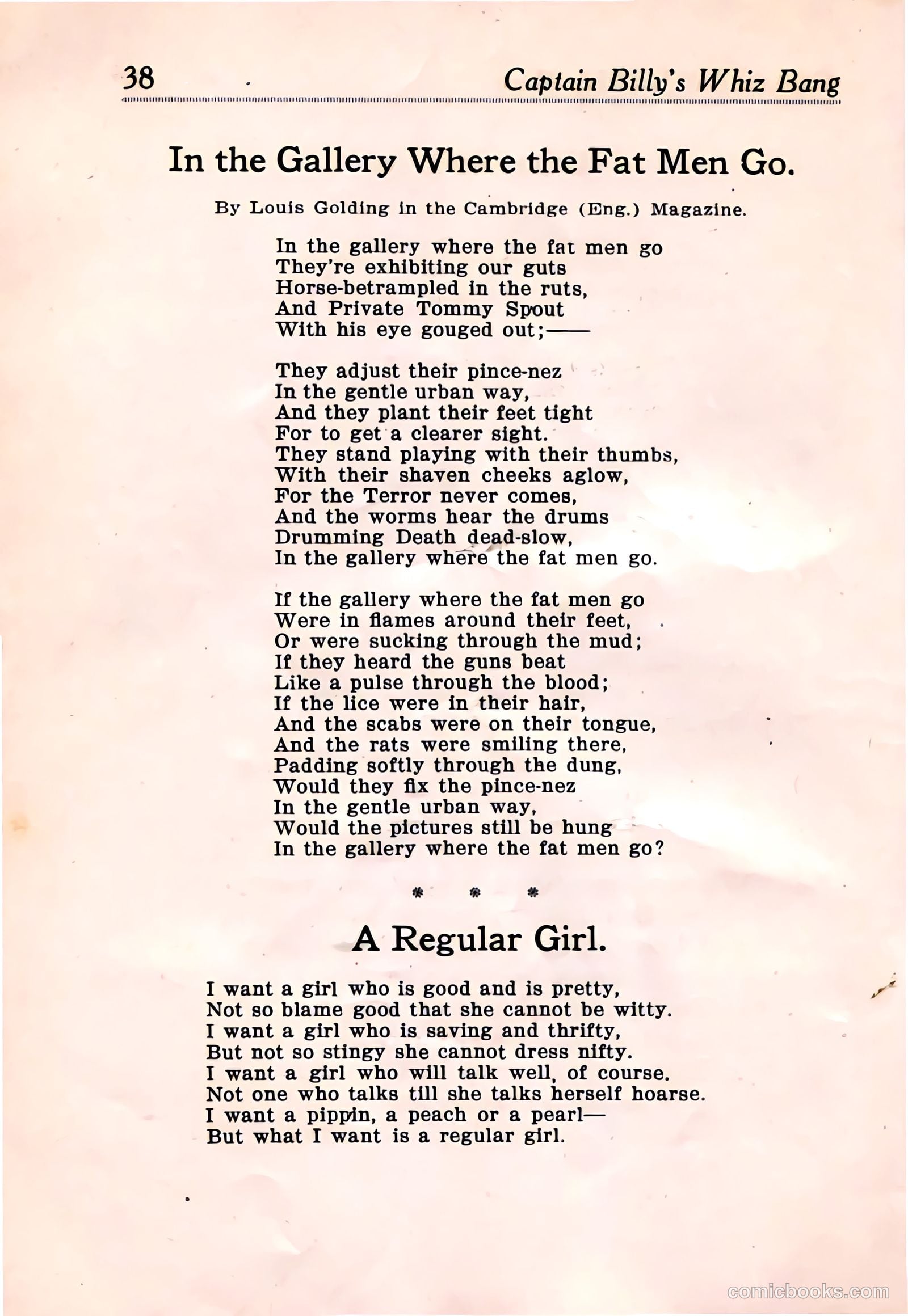
This page contains two poems with no accompanying cartoons or illustrations. "In the Gallery Where the Fat Men Go" by Louis Golding is a World War I satire. It depicts soldiers in a gallery viewing war casualties displayed like artwork—the "guts" of horse-trampled soldiers and a blinded soldier ("Private Tommy Spout"). The poem's repeated rhetorical question sardonically asks whether fat civilians would maintain their detached aesthetic appreciation if forced to experience actual combat conditions (flames, mud, gunfire, lice, disease). It's a scathing critique of wartime civilian complacency and the disconnect between those fighting and those safely observing at home. "A Regular Girl" below is a lighter poem about conventional feminine ideals—requesting a woman who is attractive yet practical, witty yet modest, articulate but not verbose. It reflects period gender expectations.
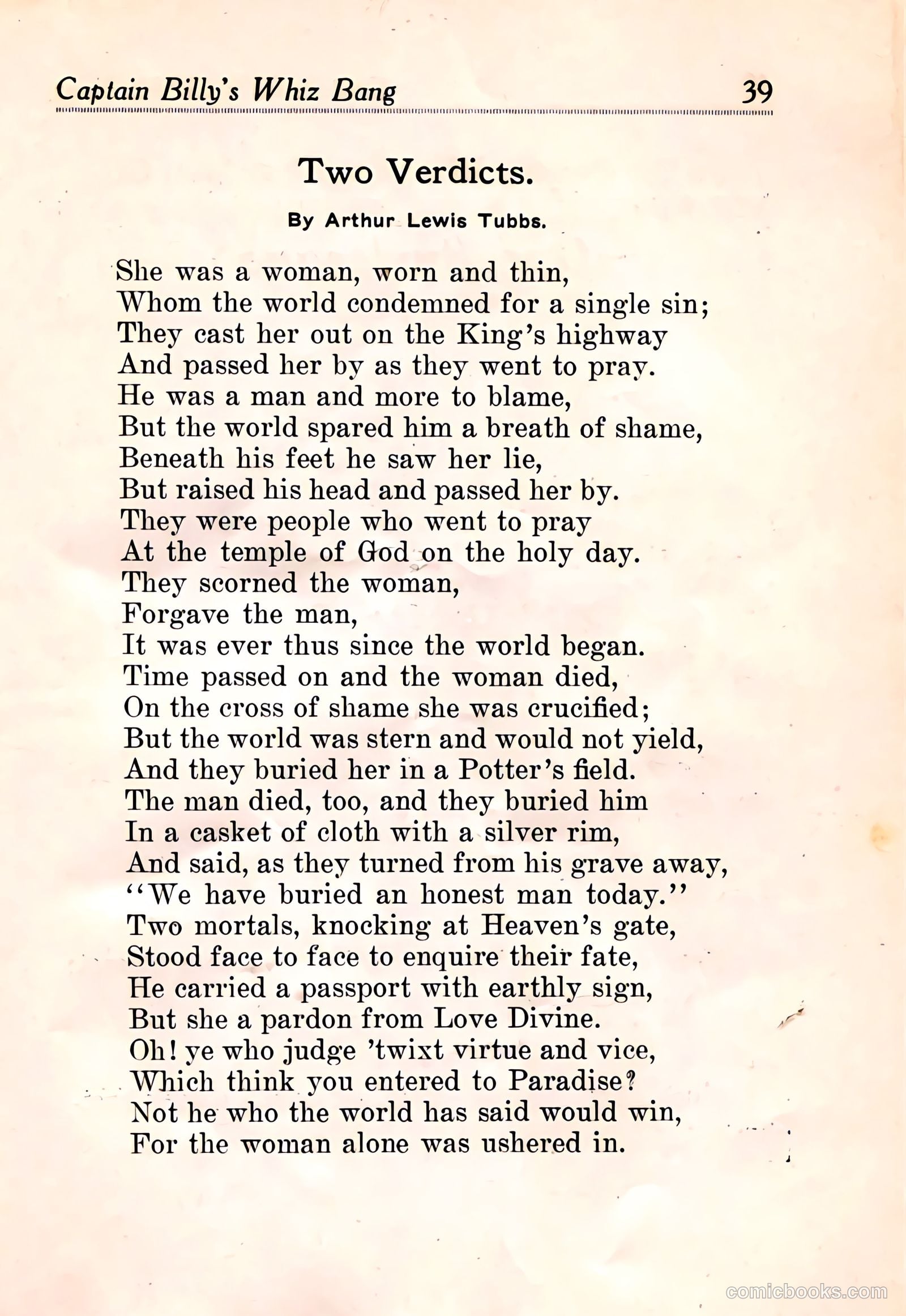
This is a poem, not a cartoon. It presents a moral critique of religious hypocrisy and gender double standards. The narrative contrasts two people guilty of the same sin: a woman who is publicly condemned, cast out, and dies in shame ("cross of shame"), and a man who receives social forgiveness and is buried with dignity ("honest man"). The poem's conclusion—that only the woman enters Paradise while the man is excluded—inverts worldly judgment. It critiques how society applies morality unevenly: harshly punishing women's transgressions while excusing men's identical sins. The final lines challenge readers' assumptions about "virtue and vice," suggesting God's judgment differs radically from society's hypocritical verdicts.
This page from *Whiz Bang* contains a section of short satirical pieces rather than a cartoon. The humor targets various subjects: 1. **The opening poem** parodies Shakespeare, joking about someone from Kentucky/Tennessee who wants to "shimmie" (dance the shimmy, a 1920s dance considered risqué). 2. **The economic joke** mocks rising shoe prices and their impact on bootleggers—a reference to Prohibition-era illegal alcohol traders who needed sturdy footwear. 3. **The final pieces** are absurdist observations: that virtuous behavior causes hangovers, a woman requiring lemon extract (containing alcohol) for intoxication, and a found-watch ad's accusation that the editor deals in junk. The overall tone is irreverent 1920s humor, blending Prohibition commentary with crude jokes and mockery of contemporary affairs.
This page from *Whiz Bang* contains brief humorous observations rather than cartoons. The jokes mock contemporary social conventions and public figures: 1. A parody of Omar Khayyam's famous "Rubaiyat" poetry, substituting beer for romantic sentiment 2. A jab at General Pershing (likely WWI commander), suggesting he didn't actually "go over the top" as reported—a military phrase meaning leading a charge 3. Commentary on tobacco chewing as wasteful 4. Observations on age, dancing, and women's morality The content reflects 1920s attitudes: irreverent toward authority, focused on alcohol and social propriety, and containing somewhat misogynistic humor. The magazine's satirical voice mocks military leadership, literary pretension, and Victorian moral standards that were increasingly questioned during the Jazz Age.
This is a satirical article (not a cartoon) critiquing young women's use of cosmetics, specifically rouge and lip paint. Schneider mocks the trend sarcastically: he acknowledges that poets romanticize natural "rose-tinted cheeks," but notes that since nature doesn't always cooperate, girls are now buying cosmetics from drugstores to artificially create this look. The satire targets the contradiction between idealized feminine beauty (natural rosy cheeks) and the commercial reality (store-bought makeup). He frames makeup application as girls' "conscientious duty to charm the men," suggesting they've internalized pressure to beautify themselves. The tone is gently disapproving of this commercialized approach to beauty standards, even while acknowledging the girls' understandable motivations.
This page contains no visible cartoon or illustration—it's purely text commentary on women's makeup and cosmetics. The piece satirizes young women who wear heavy makeup, comparing their painted faces unfavorably to natural complexions. The author mocks excessive rouge as gaudy (likening it to "emblazoned scarlet on a brilliant sign-board") and contrasts it with Indians who painted themselves for battle purposes. The satire targets both the women applying makeup and the young men seeking wives, arguing men want authenticity over deception. The advice given: accept your natural appearance as "the Maker's" work, or risk deceiving a future husband into regretting marriage. This reflects early-20th-century anxieties about cosmetics, femininity, and courtship rituals during makeup's increasing commercialization.
This page contains three separate, unrelated jokes rather than a political cartoon: 1. **Fairy Soap joke**: A pun mocking a feminine young man. The joke implies he resembles "Fairy soap," a real Cincinnati-based cleaning product brand. The humor relies on stereotyping effeminate male appearance. 2. **Patent leather "draws" joke**: A pun on "draws" (underwear) versus "drawers." Emily's feet hurt from patent leather pumps and patent leather drawers (undergarments), but George misinterprets "draws" as the furniture. 3. **Lady bug joke**: A visual pun. A young woman finds a bug on her lap; her escort calls it a "lady bug," and she humorously notes he has "good eyesight"—implying she's the real "lady bug." These are period humor jokes without political content, typical of 1920s satirical magazine filler.
This page contains several short jokes and anecdotes rather than political cartoons. The content includes: 1. **Bishop Hendrix's marriage commentary**: A satirical contrast between "old-fashioned" marriages (with multiple children) and "new-fashioned" ones (with frequent divorces), using children's observations as humor. 2. **Pat and Mike dialogue**: An Irish-stereotyped joke about Ireland's independence from England, suggesting the Irish got freedom without fighting—framed as unusual for the English. 3. **Schultz's job interview joke**: A pun about being a "pilot on a dump," where Schultz clarifies he piloted while "Casey did the digging." The humor relies on contemporary references to divorce rates, Irish independence (likely post-1920), and working-class stereotypes typical of 1920s American satire.
This page contains four separate joke items typical of the magazine's humor style: 1. **Breakfast scene**: A young woman deflects her mother's question about being kissed by suggesting the man traveled from the Great Lakes just to hear her sing—a joking claim of her vocal talent. 2. **Drug store exchange**: Uses dialect humor with a Black woman attempting to return a product to a drug clerk, trading it for baby food ("Mellen's food"). The humor relies on stereotypical speech patterns common to 1920s-era publications. 3. **Rebecca and Abe**: An anecdote about a robbery where a fat woman hides her rings in her stocking instead of mentioning it beforehand, leading to lost livestock. 4. **Ikey and Rebecca**: A brief setup about an engagement, with a friend's cryptic warning not to marry "already yet." These represent typical period humor: domestic comedy, ethnic caricature, and wordplay.
This page contains five unrelated short jokes typical of 1920s humor magazines: 1. **Abe and Ikey dialogue** - A Jewish-dialect joke about a girl's reputation in East Chicago, relying on ethnic stereotypes common to the era. 2. **Farmer's burlesque anecdote** - A joke about a "Dance of the Seven Veils" performance where the dancer refuses an encore, playing on expectations of indecency. 3. **Bench romance** - A flirtation joke where a girl uses her dog to make romantic advances, sourced from the Detroit Free Press. 4. **Church collection baskets** - A pun joke where "Brother Spiffins," a former palmist, recommends long-handled baskets for church collections—the joke being that long handles would prevent palmists from stealing donations. These represent typical period humor: ethnic stereotypes, sexual innuendo, and religious/moral satire.
This page contains a collection of brief humorous anecdotes rather than political cartoons. The jokes target: **Military/Camp Life:** A camp cook is criticized for making soup that tastes like "dishwater"—a common complaint about army food. **Military Hierarchy:** A sergeant named Cherie asks to trade names with "Fifi," who declines, suggesting he should "leave [him] somesing." **Music/Band Behavior:** A joke about bandsmen being uniquely permitted to "blow and get away with it." **Marriage/Romance:** Several observations satirize gender dynamics—particularly the contrast between men's idealized daytime perceptions of women versus their evening pursuits, and the idea that attractive young women possess "perpetual motion." These are lighthearted, domestic jabs at military culture and romantic relationships, typical of Whiz Bang's irreverent humor.
This page contains three humorous short pieces typical of 1920s satirical magazines: 1. **"Soft Bosoms Only"**: A joke about a woman shopping for a shirt for her ill husband who must avoid starch—the clerk's misunderstanding of "soft bosom" (shirt front) plays on double entendre. 2. **"That Shiftless Shavetail"**: A military joke about a young, inexperienced officer (shavetail = junior officer slang). Soldiers mock him with a Biblical reference ("a little child shall lead them"), and the officer retaliates by ordering a grueling 25-mile march—a classic power-play punchline. 3. **"Sayings of the Famous"**: A list of catchphrases attributed to frontier/outlaw figures (Blackjack Pete, Poker John, etc.), presenting colorful period-appropriate slang. The humor relies on wordplay, military hierarchy satire, and period vernacular.
This satirical story mocks young women of the 1920s who aspired to sophistication and fashionability. Six girls from "Shy old Chi" (Chicago) attempt to appear elegant by rolling down their stockings below the knee and painting decorative designs on their exposed shins, mimicking Parisian fashion trends. The satire targets their pretension—they fancy themselves aristocratic simply for attending a lakeside high school. Their fashion stunt backfires spectacularly when they parade through the school auditorium, causing such scandal that teachers need smelling salts and the girls face public humiliation and punishment. The moral: youthful vanity and blind imitation of foreign fashion trends lead to embarrassment and disciplinary consequences. It's gentle mockery of 1920s youth culture and women's fashion consciousness.
This page contains three short satirical items typical of 1920s humor magazines: 1. **Art school debate**: Students mock a supposedly serious artistic endeavor, with the moral that you cannot replicate the Moulin Rouge (the famous Parisian cabaret) in "Saintly Chi[cago]"—mocking both art pretension and Chicago's reputation for vice. 2. **"They're More Than Willing"**: A moralistic piece from a religious publication criticizing Chicago authorities' warnings to women about wearing revealing bathing suits at public beaches. The satire targets the contradiction between enforcement and actual public behavior. 3. **"Berkeley Girls Curious"**: Female students at UC Berkeley are frustrated that a gym director announced 25 "physically perfect" male freshmen but refused to publish their names—satirizing both youthful curiosity and paternalistic gatekeeping.
This page contains two literary pieces rather than political cartoons. "Old Age" is a humorous poem from *Life* magazine depicting an elderly narrator lamenting lost youth—roaming dunes, playing pranks on crawfish, and carefree days now gone. The speaker is physically deteriorating (dim eyes, weak knees, loose teeth) and resigned to decline. "River Bank Philosophy" offers brief social commentary, likely post-WWI. It satirizes modern culture: craftsmanship replaced by "graft," wartime silenced orators now proliferating, and men attending Western movies merely to see what bars look like. The final line criticizes loss of the "old-fashioned man" who took pride in honest work—suggesting post-war moral and cultural decline among contemporary society.
This page contains two satirical pieces without accompanying cartoons or illustrations. **"Who Wants Beer?"** mocks Prohibition-era debates in Ontario. It attacks the temperance movement's argument that 2½% beer represents a meaningful compromise—suggesting the difference between "virtue and vice" is absurdly minor (only ½ percent alcohol). The satire implies that if alcohol prohibition is the goal, allowing any beer is hypocritical; if not, the restrictions are pointless. **"Larry Ho's Pearls"** is a collection of aphorisms on diverse topics (bees making honey, love, manners, baseball umpires, and politics). The final quip—that politicians immediately compromise their convictions—offers cynical social commentary on political integrity. Both pieces represent typical Whiz Bang content: irreverent commentary on contemporary social issues and human nature.
This piece satirizes small-town religious prudishness clashing with emerging modern youth culture. In Rock Island, Illinois, conservative church leaders disapprove of dancing, yet young women become obsessed with "classic terpsichore" (artistic dancing). The satire's target: the women justify their scandalously undressed outdoor dancing as "true art" requiring "full expression of self," while respectable townspeople must hide such behavior indoors. A church deacon becomes shocked witnessing women "Dancing to the Pipes of Pan" (pagan mythology reference suggesting licentiousness), and calls a constable to arrest them. The joke mocks both the young women's pretentious rationalization of immodest behavior and the town's rigid moral enforcement. It captures 1920s-era tension between traditional values and youth rebellion.
This page contains three separate humor pieces satirizing American military conduct during World War II: 1. **"Forty days in jail"** - A judge's unsympathetic sentence regarding disorderly conduct in Rock Island (likely a military town). 2. **"Naughty American Soldiers"** - Reports testimony from a British official alleging immoral behavior by American troops stationed in Lincolnshire, England. The anecdote describes drunken soldiers harassing Women's Royal Air Force personnel in their quarters. 3. **"Take Your Turn, Boys"** - A dialect joke about African American soldiers, depicting one contemplating violence against an officer, while another counsels patience and proper procedure. The page reflects contemporary American anxieties about soldier conduct abroad and racial tensions within the military.
This page is the opening of an article in *Whiz Bang*, a satirical magazine. The text criticizes a Minneapolis apartment building raid where police caught a man involved in illegal activities (the "hydrant head of teetotalism" appears to be sarcasm—possibly referring to prohibition-era violations). Captain Bill uses this as a springboard to satirize urban apartment living, claiming such buildings commonly harbor prostitutes and "kept women." He mocks the anonymity of city life, suggesting pilots and other professionals enable immoral conditions by enabling vice to flourish unchecked in apartment buildings. The article launches into commentary about the flu epidemic, though that section is cut off here. The satire targets both urban vice and those who enable it through indifference.
This is a text-only page from *Whiz Bang* magazine (page 57) containing a humorous anecdote titled "Captain Billy's Whiz Bang." The passage describes a sailor who contracted the "Kill-em-Quick Flu" (likely referencing the 1918 Spanish Flu pandemic) and was treated with moonshine whiskey as folk medicine. The humor centers on the narrator's hangover and subsequent disciplinary troubles when a Chicago Major named Constantine B. Howard ("Con") reports him for refusing to wake during duty. The piece satirizes both quack medical remedies popular during the flu epidemic and military discipline. There are no visible cartoons on this page—it's purely comedic narrative text typical of *Whiz Bang's* irreverent, working-class humor style.
This page contains two brief humor pieces rather than cartoons. The main article is a personal anecdote by the narrator about being charged with drunkenness during military service. A colonel gives him a choice between court martial or three months confined to camp. The narrator cheerfully accepts confinement, viewing the camp as pleasant with its YMCA, barber shop, and other amenities. He jokes that he "beat the game" when the war ended after only six weeks of service. The second item, titled "Same Old Thing," is a Harvard Lampoon joke comparing the ancient Greek lyre to the modern mouth organ—suggesting human behavior remains unchanged across centuries. Both pieces employ self-deprecating humor typical of *Whiz Bang*, a magazine known for irreverent jokes about military life and social conventions.
This page contains two humorous anecdotes rather than cartoons: **"A Pussytail Cocktail"** mocks Prohibition-era bootleg liquor. John Mehanskey of Perth Amboy, N.J. drinks homemade "Liberty Cocktail" (wood alcohol, red pepper, vinegar, syrup) and becomes so intoxicated he genuinely believes he's a cat—meowing, climbing trees, and hissing. Police retrieve him using a dead mouse. The judge fines him $100, sarcastically suggesting more of that poison might make him think he's a tiger instead. **"Some Sensation"** briefly describes Old Bede Carter kissing a baby unexpectedly, comparing the experience to "kissing a poached egg." Both pieces use crude, physical humor typical of 1920s men's magazines. They satirize Prohibition's dangerous homemade alcohol and offer irreverent observations about everyday life.
This page contains two humorous pieces from *Captain Billy's Whiz Bang*, an American satirical magazine. **"A Private Still"** is a joke playing on the term "private." An Irish man named Pat tricks an excise officer (tax collector) hunting illegal whiskey distilleries by pointing to his brother Mike, a soldier, and claiming he's "a private still"—a pun on "private" (the military rank) versus "still" (an illegal distillery). The joke satirizes Irish resistance to alcohol taxation and law enforcement during Prohibition-era America. **"A Bird"** is a brief poem describing a turkey, using sexually suggestive language about its physical appearance and movements—typical of the magazine's cheeky, adult-oriented humor.
This page contains three humor pieces about marital infidelity: **"Tipping It Gently"** satirizes Editor Mills of a Minnesota newspaper who publicly exposes unfaithful spouses. The anecdotes mock both straying husbands and wives—including a married woman meeting a "friend" at 4 a.m. and a wife chasing her husband at high speed after discovering his late-night visit to another woman's home. The humor targets the hypocrisy of infidelity in supposedly respectable society. **The Henry Ford joke** makes a risqué pun about Ford's removable car seats, implying this design facilitates seduction. **The dog joke** plays on "Pekingese" sounding like an innuendo. **"We Got This Straight"** makes a dark joke predicting another war in 1966 based on a soldier's comment, reflecting World War I-era anxieties about future conflict.
This page from *Captain Billy's Whiz Bang* presents two brief humorous pieces: **"Direct from Denver"** mocks prudish social conventions around public displays of affection. A shy young woman asks a Denver Tourist Bureau clerk whether it's "proper" for her fiancé to kiss her goodbye publicly before his departure. Mrs. Hobbs (the clerk) gives a noncommittal answer. The joke is that the couple proceeds to kiss anyway "just as the train was about to pull out"—and the crowd "wasn't so badly shocked," suggesting that public kissing, while socially questionable to some, was becoming more acceptable. The brief fable that follows satirizes parents who boast about their children's intelligence, using crude humor ("deaf and dumb") typical of the era's satire magazine style.
This page contains several short satirical pieces rather than a cartoon. The content includes: 1. **"And Watch It Fade"**: A quote attributed to Dr. Sidney E. Mezes (identified as director of the American peace delegation's experts) mocking French cynicism about love's durability, followed by a joke about two French men discussing love's cure. 2. **"Somebody Been Measuring?"**: A brief note satirizing reports that English girls grew larger during World War I, with waists now averaging 26-28 inches. 3. **"Old Father Hubbard"**: A humorous domestic quip about finding an empty cupboard. 4. **Peace Terms Joke**: A satirical jab at Allied reparations from Germany after WWI, suggesting they're taking everything except German trousers. The humor targets post-WWI politics, French stereotypes, and wartime social changes.
This page contains satirical short pieces and jokes rather than political cartoons. The humor targets: 1. **"The Reward of Virtue"** — Mocks classified ads advertising a low-paid Protestant clerk position, sarcastically suggesting virtue leads to poverty wages ($17). 2. **"Something Wrong!"** — Jokes about a hen-laying advertisement claiming "18 hens, 16 eggs a day," questioning the productivity of the other two hens. 3. **"Oh, Jazz!"** — Satirizes jazz culture and a salesman's dismissive attitude toward modern music records. 4. **Camp cook dialogue** — Mocks military food quality through a joke about soup tasting like dishwater. 5. **Police prayer anecdote** — Ironically suggests that Minneapolis police chief J. Francis Walker's request for prayer helped, since his force immediately arrested "drunks" — implying either divine intervention worked or prayer is ineffective for crime prevention.
This is a **title page or advertisement**, not a political cartoon or satirical content. It announces the next issue of *Whiz-Bang* magazine, promising 64 pages featuring content described as "Unadulterated Bull"—a self-aware, humorous way the publication refers to its own satirical, irreverent material. The phrase "Unadulterated Bull" suggests the magazine embraced its reputation for publishing unfiltered, exaggerated humor and social commentary without pretense. The call to "LOOK for the January Number" is a standard promotional announcement urging readers to purchase the upcoming issue. Without seeing the actual cartoons or articles within that January issue, we cannot identify specific political figures or current events being satirized.
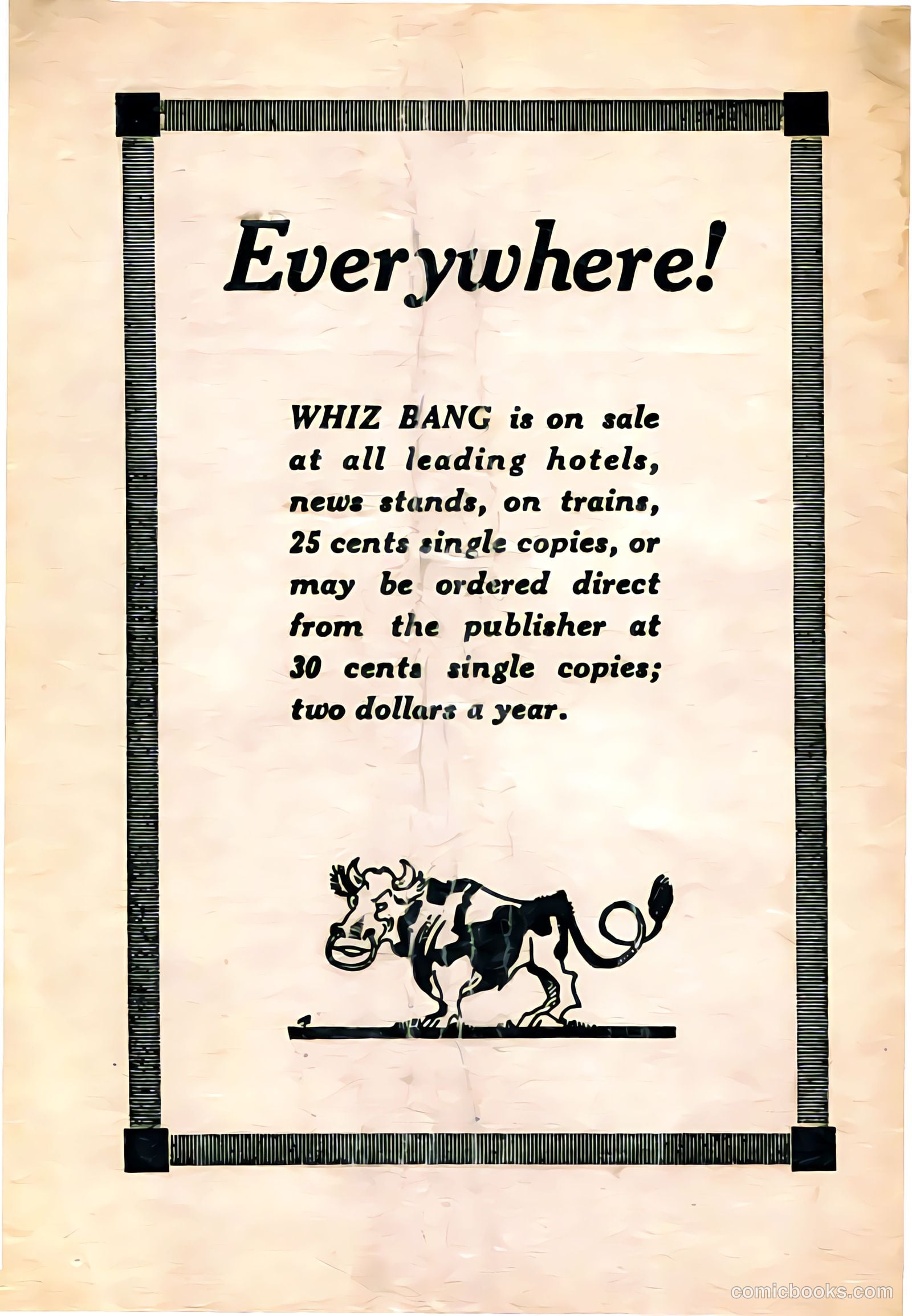
This is a **title/advertisement page** for *Whiz Bang*, a satirical magazine. The page announces the publication's widespread availability ("Everywhere!") and pricing: 25 cents at newsstands/hotels/trains, or 30 cents ordered directly from the publisher; annual subscription two dollars. The only visual element is a **cartoon cow mascot** — likely the magazine's logo or recurring character — depicted in a simple, bold black-and-white style typical of early 20th-century advertising. The page serves primarily as promotional material rather than containing satire or political commentary. It's designed to reach potential subscribers by emphasizing the magazine's accessibility through multiple distribution channels, a common marketing strategy of that era.