
A complete issue · 68 pages · 1921
Captain Billy's Whiz Bang #24
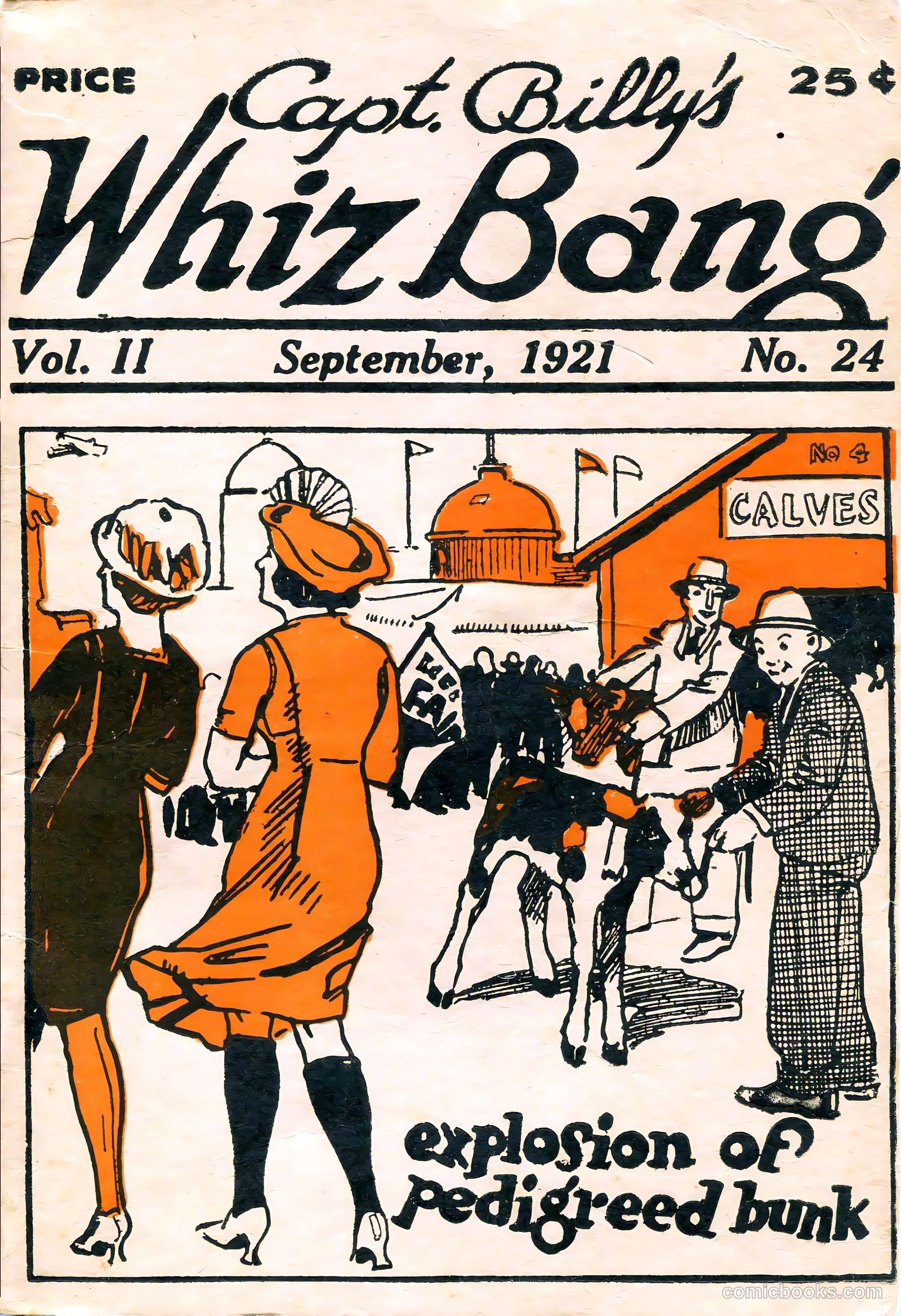
This satirical cartoon depicts what appears to be a social gathering or fair where well-dressed men and women are examining calves. The title "explosion of pedigreed bunk" suggests mockery of pretentious claims about livestock breeding or agricultural superiority. The figures—stylishly dressed in 1920s fashion—seem to represent wealthy or elite society members who take themselves too seriously. The "pedigreed" reference likely mocks their inflated claims about animal breeding credentials, while "bunk" (slang for nonsense) indicates the satire targets fraudulent or exaggerated marketing of livestock quality. The cartoon appears to ridicule post-WWI American society's vanity and gullibility toward commercial hype, a recurring theme in *Whiz Bang*, known for satirizing contemporary social pretensions.
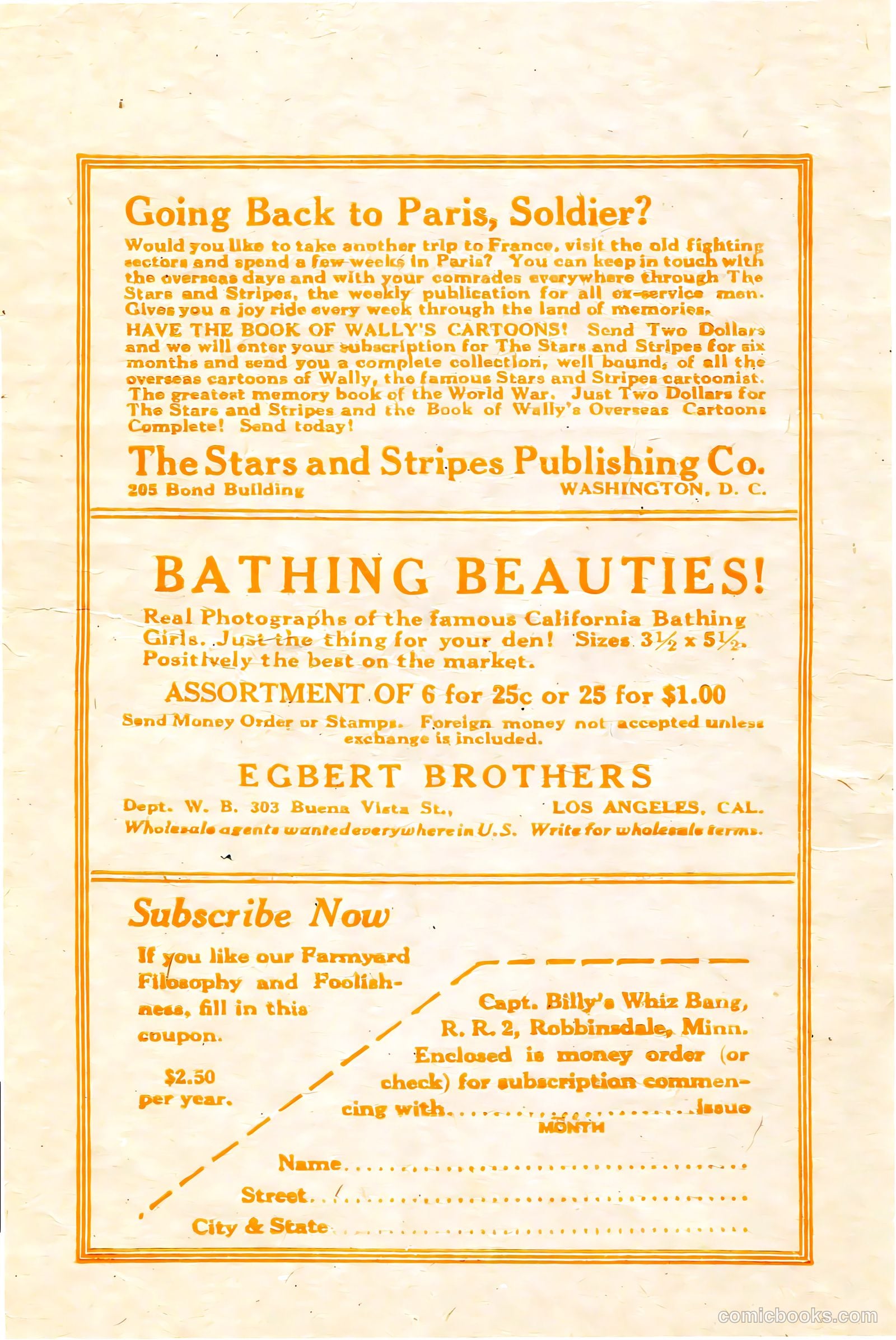
This page is **primarily advertising**, not satirical content. It contains four separate advertisements: 1. **Stars and Stripes Publishing Co.** - promoting subscription to the military newspaper *The Stars and Stripes* for soldiers returning from WWI, offering cartoon collections and overseas connection. 2. **Bathing Beauties** - selling photographs of California bathing girls (3½ x 5½ inches) for 25¢ or $1.00 per assortment of six. 3. **Egbert Brothers** - distributing the bathing beauty photographs from Los Angeles. 4. **Captain Billy's Whiz Bang subscription** - a $2.50/year subscription coupon for what appears to be a humor/satirical magazine marketed to WWI veterans. The page targets post-WWI soldiers with nostalgia for France and comradeship, while simultaneously selling pin-up photographs and a satirical publication. No specific political satire or caricatures appear on this page.
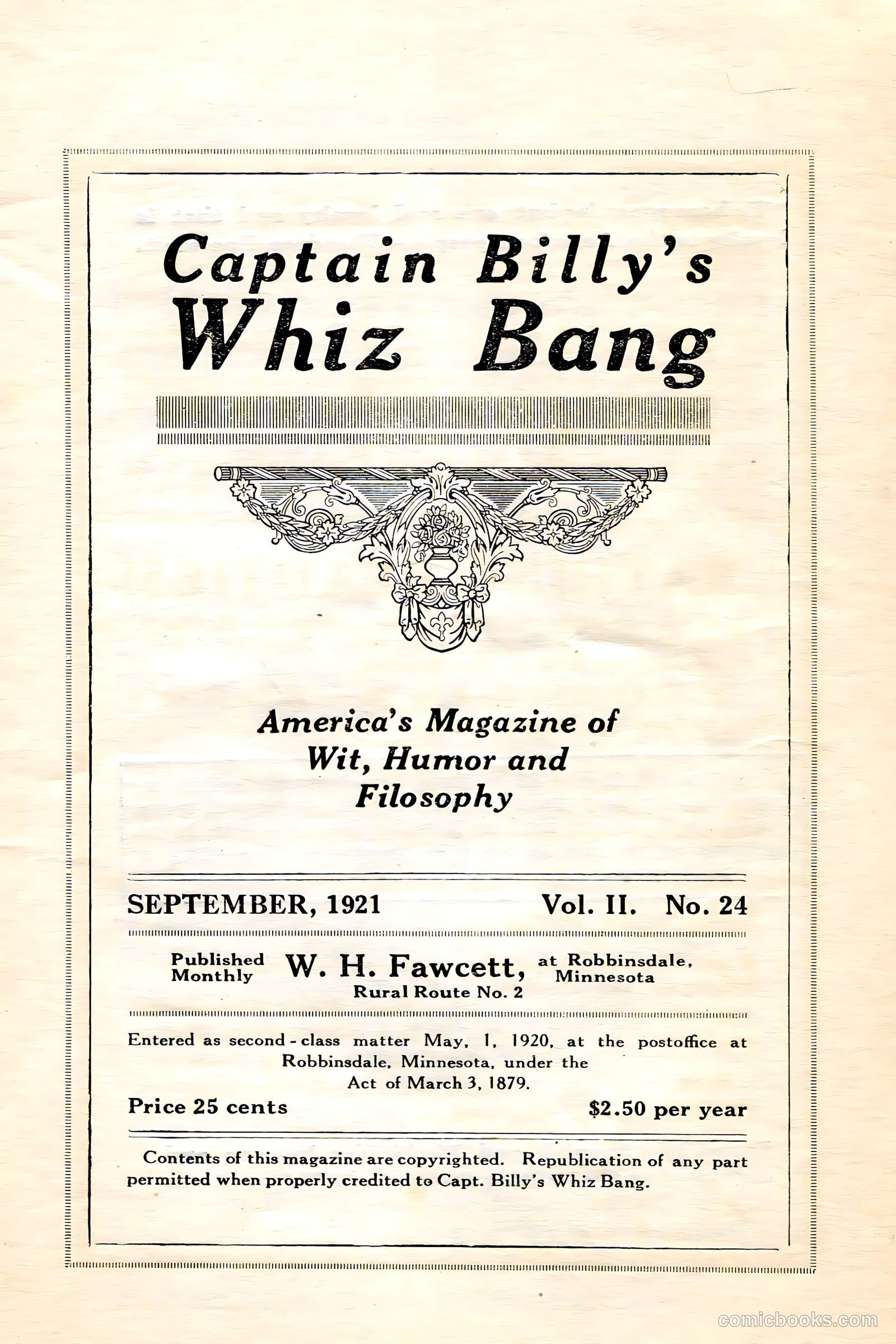
This is the cover/title page of *Captain Billy's Whiz Bang*, a monthly humor magazine published in Robbinsdale, Minnesota. The page identifies it as "America's Magazine of Wit, Humor and Philosophy," priced at 25 cents per issue ($2.50 yearly). The ornate decorative header and border are typical of 1920s magazine design. The publication was entered as second-class mail in May 1920 and published by W.H. Fawcett. No specific cartoons or political satire appear on this particular page—it's the title/masthead page containing publishing information and legal notices about copyright. The actual satirical content would appear on subsequent pages.
This page from *Whiz Bang* contains no visible cartoon. It's the opening of an editorial essay titled "Drippings From the Faucet" that contrasts urban and rural girls. The piece uses florid, moralizing language typical of early 20th-century social criticism. It compares the modern city to a "grim monster" consuming innocent women, arguing that city girls face constant sexual temptation and unwanted male attention ("Men eye her with glances of suggestion and invitation"), while country girls enjoy wholesome simplicity. The satire's target appears to be urban vice and moral corruption—concerns common in 1920s-era commentary about modernization. The piece reflects period anxieties about changing gender roles and sexuality in cities.
This page contains three humorous anecdotes rather than political cartoons: 1. **The Church Collection Story**: A Black preacher uses social pressure—threatening public shaming—to extract a $5 donation from an unfaithful congregant. The joke relies on mid-1920s stereotypes about Black churches and emotional manipulation. The parishioner's anonymous note requesting privacy suggests shame about his infidelity being exposed. 2. **The Prohibition Banner**: References the Anti-Dry (anti-Prohibition) parade in New York City, with a satirical banner mocking prohibitionists' appearance—topical since Prohibition was active 1920-1933. 3. **The Robbinsdale Farmers**: A practical joke where one farmer tries to catch his neighbor in bed at 2 AM to prove he gets up earlier. The joke's punchline is cut off but implies rural competitiveness or foolishness. The content reflects 1920s satirical humor focused on contemporary social issues and stereotypes.
This page contains three humorous anecdotes rather than a political cartoon: 1. **Opening joke**: A missing person anecdote (context unclear). 2. **Deacon Kingdom story**: A humor piece about a marksman who hit a bull's-eye on his first shot but had to pay for the bull—satirizing the unintended consequences of skill. 3. **"Pinkham's Home Broo"**: A mock recipe for illegal alcohol disguised as domestic "home brew," listing absurd ingredients (pickle brine, shellac, soap, nitric spirits) and process. This satirizes Prohibition-era bootlegging. 4. **"This Is For Railroaders"**: An anecdote mocking railroad bureaucracy—a section boss uses profanity in reports; the superintendent forces him to write his own after hiring female stenographers, then Casey reports a train accident using stilted language. The satire targets Prohibition, workplace absurdity, and early 20th-century social conventions.
This page discusses a recent boxing match between **Georges Carpentier** (French boxer) and an American opponent, likely **Jack Dempsey**, at Boyle's Thirty Acres in Jersey City. The text praises Carpentier's graceful defeat—he lost the championship bout but maintained dignity and composure, displaying what the author calls the "stoical smile of defeat." The satire compares Carpentier's dignified bearing to Napoleon's composure during military defeats, suggesting French cultural sophistication. The piece mocks the American winner's lack of comparable grace, implying Americans are more primitive in their triumphalism. The page concludes with two brief, unrelated joke items about alimony and reconciliation—typical filler content for this satirical magazine.
This is a satirical article by Richmond about director Allan Dwan's personal quirks and insecurities. The piece claims Dwan, a successful electrical engineer turned film director, is sensitive about his short stature—a "tender spot" that "hinges upon this item of feet up and down." Richmond notes that studio insiders have nicknamed him "Napoleon," apparently a reference to the historical figure's reputed short height, though Richmond dismisses this as unfair. The satire targets Hollywood's culture of personal mockery toward industry figures. The "peacock walk" title suggests Dwan adopts an ostentatiously proud demeanor to compensate for his height—a common stereotype about shorter men. The article exemplifies *Whiz-Bang*'s gossipy, irreverent coverage of entertainment industry personalities.
This page is **text-only** — a satirical article about Hollywood personalities from the silent film era, likely 1920s. The writer discusses: - **Mr. Dwan** ("The Big Little Man"): A director described as clever but short - **Douglas Fairbanks**: A major star married to Mary Pickford, critiqued for adopting English sporting affectations and surrounding himself with sycophantic hangers-on - **Bull Montana**: A character actor discovered by Fairbanks who doubled for monkeys and performed stunts (notably getting hit by fire hoses). The text notes Bull "takes it away from" Fairbanks in scenes despite being less distinguished-looking The satire mocks Hollywood's pretensions, star hierarchies, and the physical comedy/stunt work of silent cinema. The humor targets celebrity egos and the industry's obsession with appearance and status.
This page from *Whiz Bang* magazine contains two separate gossip columns about early Hollywood celebrities, not political cartoons. The first section discusses **Douglas Fairbanks**, a major silent film star known for swashbuckling adventure movies. The writer humorously describes how Fairbanks orchestrates public appearances—arriving with an entourage in "platoon formation" while he walks ahead alone, strategically allowing his gang to fade away so crowds focus entirely on him. The satire mocks his calculated self-promotion and theatrical star persona. The second section discusses **Lottie Pickford**, sister of famous actress Mary Pickford. The writer contrasts Lottie's preference for "jazz," bright lights, and socializing against Mary's demure image, suggesting Lottie deliberately defines herself through rebellious behavior opposite to her sister's wholesome public brand. Both sections satirize Hollywood's manufactured celebrity images and deliberate public relations strategies.
This page is satirical commentary on celebrity personalities and their self-promotion strategies. The text discusses: 1. **Colonel Roosevelt's family** — likely Theodore Roosevelt's relatives claiming fame through family association rather than individual accomplishment 2. **Roscoe "Fatty" Arbuckle** — the silent film comedian, criticized for trying to rebrand himself as "Roscoe" to gain dignity while profiting from his "Fatty" persona and reputation 3. **D.W. Griffith** — the famous film director, mocked for cultivating a "poet" image through deliberate public seclusion to seem more artistic and intellectual The satire targets how celebrities manufacture personas and credibility through contradiction: Arbuckle wants respect while trading on his nickname; Griffith seeks attention through withdrawal. The piece ridicules pretentious self-mythologizing among the entertainment elite.
This page contains two separate pieces: 1. **The opening section** discusses David Wark Griffith, the famous film director, whom the writer jokingly calls a "poet" (Griffith was known for artistic pretensions). The satire suggests Hollywood people are affectedly cultured and self-promotional—they "strut and fluff and show our fine feathers." 2. **"We'll Say So!"** is an anecdote about Al Jolson, the blackface comedian, visiting an insane asylum in California. A newly admitted patient wishes that "Volstead was born with a thirst"—referencing the Volstead Act (Prohibition legislation). Jolson's punchline suggests the patient's anti-Prohibition sentiment proves he's actually sane, creating dark humor about Prohibition-era politics.
This is a humorous short story about Irish-American urban life, not a political cartoon. It depicts Thomas Patrick Gallagher, an Irish traffic cop in Chicago, stopping a driver named Clancy (also Irish, from County Mayo) after Clancy's car hits a parked limousine while waiting for a drawbridge to close. The humor relies on ethnic stereotypes common to 1920s American satire: Gallagher's aggressive, bellicose manner and thick accent ("Phwat in hal does yez mane"), and Clancy's meek demeanor. The joke pivots on Gallagher's mock-threatening behavior—threatening to take Clancy to headquarters—before asking why the car was hit, suggesting Irish-American working-class comic types and police culture.
This page contains two satirical anecdotes: **"Ikey's Recklessness"** mocks a young Jewish boy who, after being put to work at age eleven, consistently short-changes his mother by a nickel each week—money he claims to need for himself. The humor relies on period stereotypes about Jewish figures and youthful dishonesty, culminating in Rachel's suspicious questioning about whether he's seeing a woman. **"Overwhelmingly"** satirizes congressional vanity. When a congressman learns he's fathered triplets, he demands a "recount," implying the number must be an error in his favor—mocking politicians' self-importance and tendency to question unfavorable outcomes. Both jokes exemplify the crude ethnic and political humor typical of 1920s American satirical magazines, reflecting attitudes toward immigrants, children's labor, and elected officials that modern readers would find offensive.
This is a humorous anecdote about workplace insubordination and clever revenge. Cassidy, a switchman at Minneapolis's Great Northern Railway yards, rudely approaches his superintendent without removing his cap or pipe—a serious breach of workplace etiquette for the era. The superintendent responds with a clever trap: he instructs Cassidy to leave, change his comportment, and return to request a pass properly. When Cassidy returns, now respectfully dressed, the superintendent responds sarcastically by saying the employee should "go to hell" and get a pass from the competing Northern Pacific Railway instead. The joke satirizes both workplace hierarchy and competitive railroad rivalry. The page's closing aphorism—"It is always good to be nice, but not always nice to be good"—suggests the superintendent's calculated rudeness achieved its goal more effectively than direct reprimand.
This page contains three humorous verses under "Limber Kicks" rather than political cartoons. The content consists of bawdy, satirical poems targeting contemporary social attitudes: **"Bow Wow"** mocks the difference between women's behavior before and after marriage—moving from primping and vanity to domestic anger. **"Ask Bob He Knows"** contains risqué double entendres about "painted kings" (likely cosmetics or makeup), references ballet as outdated entertainment, and includes a crude joke about Scottish balls and a woman named Jenny. **"Poor Lot's wife"** alludes to the biblical story, making a crude pun about her skirt position. These are typical of *Whiz Bang's* bawdy humor style—working-class, heterosexual, and focused on mocking marriage, women's vanity, and sexual innuendo rather than political satire.
This page contains three brief humorous anecdotes typical of the magazine's satirical style: 1. **"The Power of the Press"**: Satirizes small-town gossip and reputation-making. A Sunday School teacher warns girls about a new barber based on hearsay, but the barber claims all the girls smiled at him—illustrating how rumor and counter-rumor shape public perception. 2. **"Wall, I Calc'late!"**: A joke playing on educational ignorance. A justice of the peace misidentifies bigamy (having three wives) as "trigonometry," mocking rural officials' lack of learning. 3. **"We'd Say So"**: A brief quip about romantic physical intimacy as a signal for either proposing marriage or leaving. The content reflects 1920s small-town American life, rural dialects, and period attitudes toward courtship and authority figures.
This satirical column by Captain Billy ridicules a fashion dispute among New York's elite women. Mrs. Lydig Hoyt reportedly claimed that skirt hemlines should drop to the ankles (following Paris fashion), while Betty Compson, a movie actress, disagreed, insisting hemlines should stay higher. The satire targets New York society women's obsession with fashion trends and their status anxieties. Captain Billy mocks Mrs. Hoyt by suggesting that movie actresses—not society matrons—actually dictate American fashion. He further notes that society women have become "dippy" trying to break into movies, deflating their pretensions to cultural authority. The piece ridicules both high society vanity and the emerging celebrity culture replacing traditional social hierarchies.
This page from the satirical magazine contains gossip-style commentary about wealthy New York socialites and their involvement in silent film acting. The text mocks the wealthy's pretensions, noting that a rich woman with yachts and imported cars dabbled in movies simply because she had "the itch to act." The passage reveals that Evelyn Walsh (identified as "the richest unmarried woman in the world") and Mrs. Morgan Belmont appeared as extras in the film "Way Down East." The satire suggests that old-money New York society has lost prestige compared to Texas oil millionaires, and mocks Mrs. Belmont's frivolous discussion of boxers Jack Dempsey and Jack Johnson while on a film set. The humor targets wealth, social climbing, and celebrity culture.
This page contains gossip-style commentary rather than cartoons. The text discusses society figures and celebrities of the 1920s era: **Key references:** - **Mrs. Morgan Belmont** and **Mary Pickford**: Wealthy/famous women who appear in pictures mainly due to their names rather than talent - **Mrs. Lydig Hoyt**: Described as genuinely beautiful with cinema potential - **F. Scott Fitzgerald**: The young author is mocked for his novel *"This Side of Paradise,"* which Princeton University reportedly found offensive for revealing unflattering truths about college life. The writer expresses surprise at Princeton's touchiness, calling Fitzgerald charming and defending his work The satire targets both the shallow celebrity culture of wealthy socialites and institutional oversensitivity to honest literary critique. The piece exemplifies Whiz Bang's irreverent commentary on 1920s American high society.
This page is primarily text commentary on contemporary literary celebrities, not a cartoon. The author discusses: **F. Scott Fitzgerald** — described as a young author with "he-vamp blue eyes" whose novel "This Side of Paradise" paralleled his own life. The satire mocks how he married a woman who "turned him down" in the book. **Harold Bell Wright** — a bestselling author (9+ million copies sold) who started as a naive country preacher from Arkansas. The satire emphasizes his transformation from idealistic writer to wealthy businessman with a Rolls-Royce and divorce, while literary critics dismiss his work. The underlying joke: Wright's enormous commercial success despite critical disdain reveals the gap between popular taste and literary establishment approval. A brief final paragraph mentions a Hearst-Marion Davies studio dispute.
This page contains a humorous article about **William Randolph Hearst**, the famous newspaper magnate. The satire mocks Hearst's personal eccentricities rather than his media empire: The main joke concerns Hearst's inability to locate his own automobiles—despite owning approximately twenty cars, he constantly forgets where he parks them and resorts to taxis instead. His employees apparently accept this as routine behavior. The piece contrasts Hearst's **absent-minded personality** with his **sharp intellect and commanding authority**. Though he appears meek and apologetic in person ("I hope I am not in the way"), subordinates fear defying his orders. The satire suggests that brilliant minds often possess impractical quirks, using Hearst as a prominent example of wealth and power coexisting with everyday incompetence.
This page contains satirical commentary on Reverend Wilbur, a moral crusader concerned with various social issues. The text ridicules his selective outrage: he's alarmed by girls wearing one-piece bathing suits at Atlantic City, families wanting to walk to the beach in street clothes over swimwear, and Tex Rickard's swimming exhibitions in Madison Square Garden. The satire mocks Wilbur's censorship bill proposal, then pivots to note his "Christian" acceptance of a congressional amendment—raising his salary from $4,000 to $8,000 yearly. The joke: Wilbur abandoned his moral principles when offered money. The page concludes introducing the "Annette Kellermanns" controversy at Somer's Point near Atlantic City, presumably related to bathing suit scandals that generated public outrage about women's beachwear standards.
This page contains humor pieces rather than political cartoons. The text satirizes: 1. **Somer's Point, New Jersey**: A mayor allegedly blocked beach access, becoming locally famous for this petty decision and later a one-piece swimsuit endorsement. 2. **Prohibition-era gin palaces**: The piece mocks a famous New York gin establishment formerly run by "Tom Sharkey, the old sailor heavy weight fighter," suggesting the underworld speakeasy culture flourishing despite Prohibition laws. 3. **Tom Sharkey's saloon**: A humorous anecdote about Tom's lackluster response to a suggestion for a chandelier—he lacks the education or sophistication to appreciate such refinements. The final paragraph references a scandalous "Garden-of-Eden" party with nude dancers near Boston involving film figures Adolph Zukor and Hi Abrams, indicating ongoing social controversy.
This page contains no cartoon but rather satirical gossip-style text commentary. The writing mocks wealthy New York socialites and scandals of the era, specifically targeting: **"The Spanish Jade"** (Elizabeth Darrow), a Greenwich Village socialite who married naval officer Frederick Linde Ryan. The piece ridicules her as representative of New York's frivolous spending class. The satire focuses on a poker scam involving marked cards that victimized movie industry figures for $500,000. It credits Norma Talmadge's quick thinking with exposing the con artist. The piece uses gossipy, irreverent tone typical of Whiz Bang's brand of humor—mocking both high society pretension and criminal schemes operating within it. The overall target is wealthy Manhattan society and their susceptibility to fraud.
This page contains three brief humorous anecdotes rather than political cartoons: 1. **The Debt Story**: A young sailor accumulates $20,000 in debt (cigarettes at $1/pack, chocolates at $5/pound) on naval pay. A court case brought by his friend results in the court ruling he needn't pay further—satirizing both the absurdity of military wages versus temptation spending and frivolous legal action. 2. **Isle of View**: A romantic anecdote where a man names his island property "Isle of View" (a pun on "I'll sue you"), causing a woman to lose romantic interest—satirizing both poor naming choices and how material expectations affect relationships. 3. **The Cross-Eyed Judge**: A wordplay joke about a cross-eyed judge mishearing responses from three prisoners, confusing who said what—simple slapstick humor.
This page contains two satirical pieces about marriage and infidelity, typical of Whiz Bang's irreverent humor. **"Wife—Mistress—Lady"** is a German satire (translated 1856) that cynically categorizes women by marital status and the man's motivation for marriage. It suggests men maintain three simultaneous relationships with different expectations from each. **"Wifey's Lament"** is a brief comic dialogue between Clarence and Doris. The joke hinges on Doris saying "yes" to something (likely a marriage proposal or commitment), only to regret it "the other day"—implying she immediately experienced buyer's remorse about her decision. Both pieces mock the institution of marriage through humor about male infidelity and female regret—standard Whiz Bang fare that scandalized conservative readers of the 1920s.
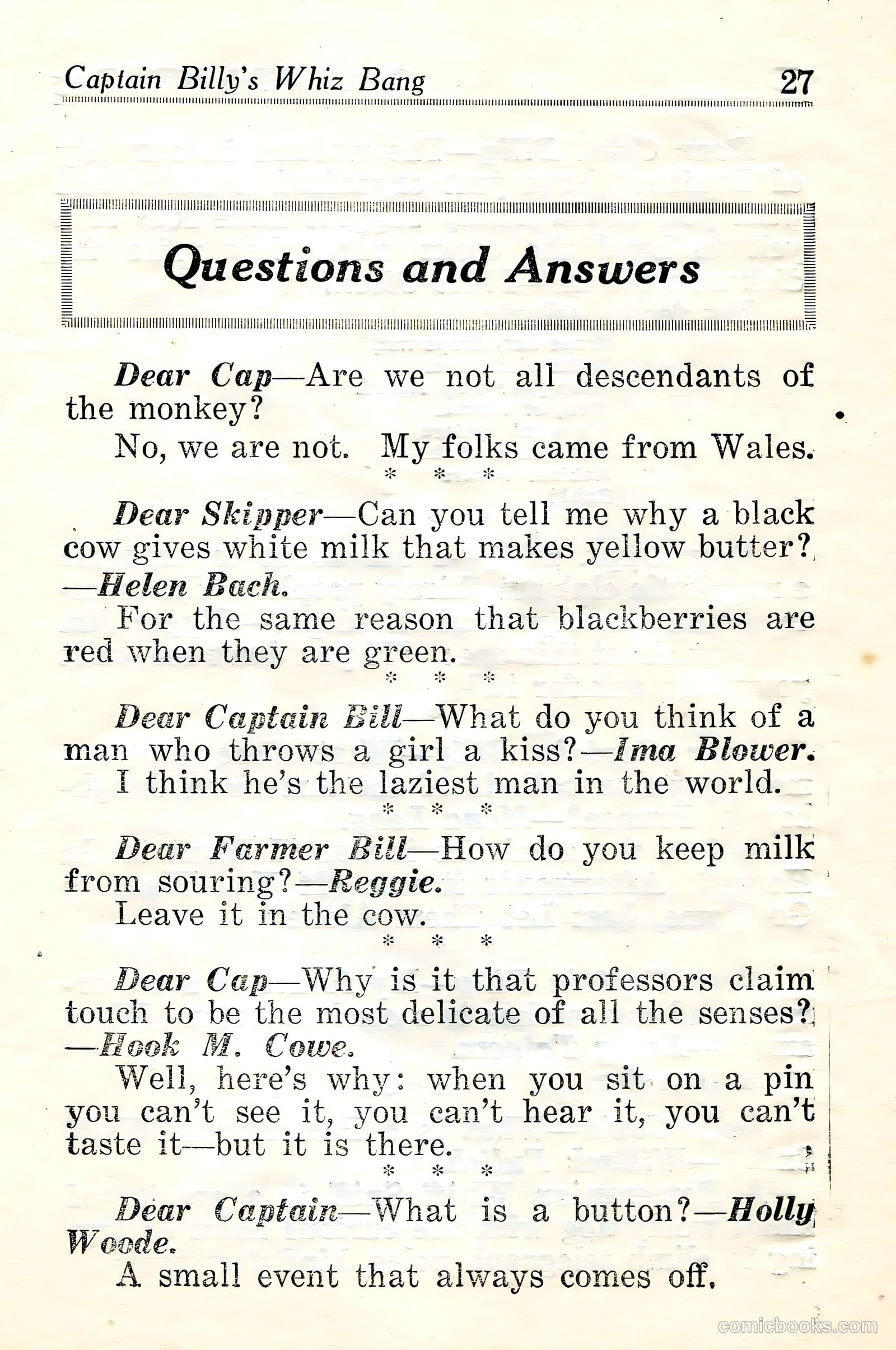
This page from *Whiz Bang* presents a humor column of reader Q&As addressed to "Captain Billy" (the magazine's editor). The jokes rely on deliberate logical absurdities and wordplay typical of 1920s comedy magazines: - **The monkey question** plays on evolutionary theory debates of the era - **The cow/butter joke** uses circular logic humor - **The kiss/laziness quip** makes a crude pun - **The milk-sourcing answer** offers practical (but silly) advice - **The touch/pin joke** builds humor from physical sensation logic - **The button definition** uses a double meaning (clothing fastener vs. social event) These are simple joke-telling devices without political commentary or caricatures. The humor targets no specific figures—it's generic, reader-submitted comedy meant for mass entertainment in a satirical magazine aimed at general audiences.
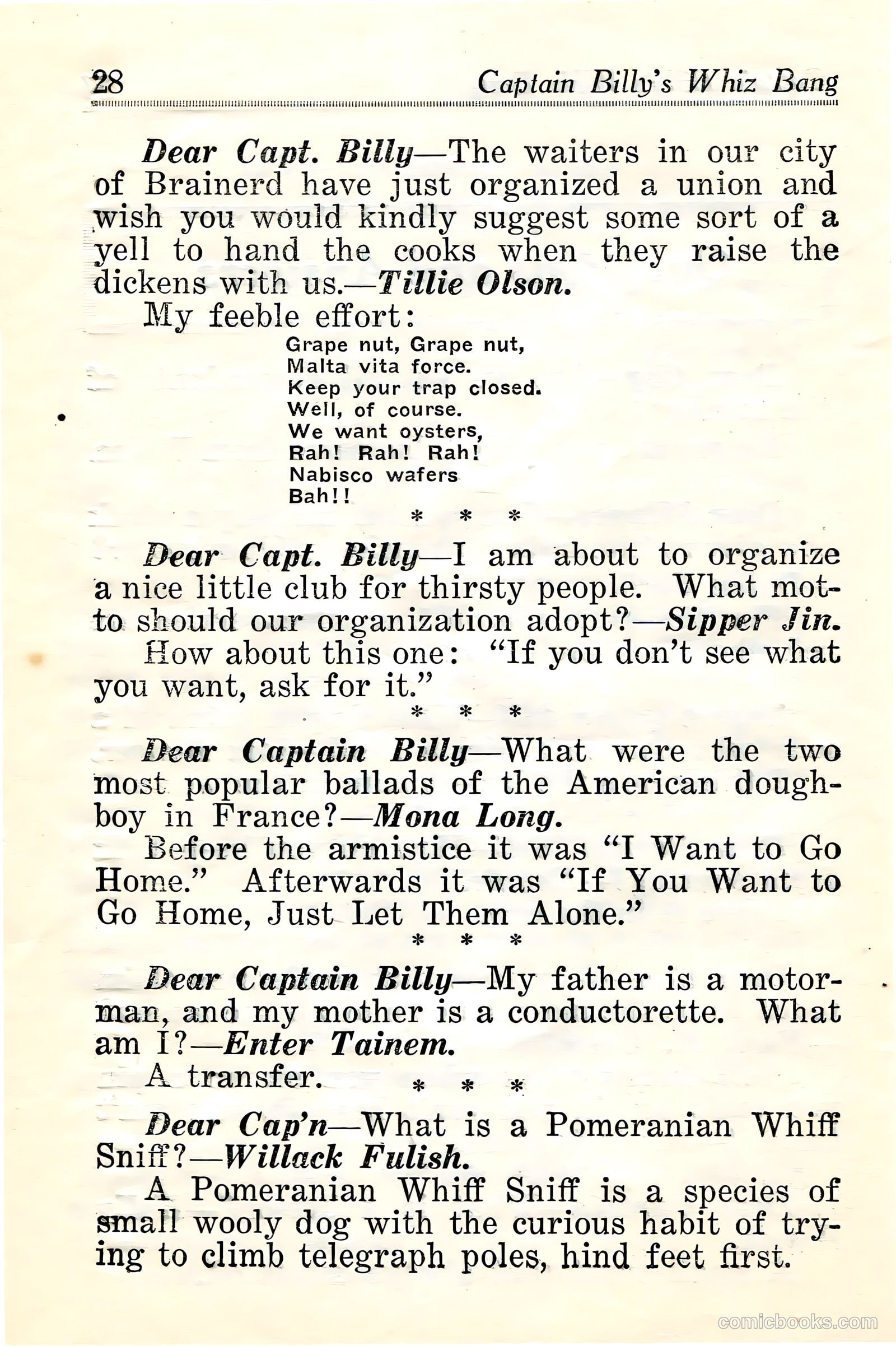
This page is a humor advice column where "Captain Billy" answers reader questions with jokes and puns. The content includes: 1. **A waiters' union yell** - A joke response to a request for a union chant, using food-related puns ("Grape nut," "Malta vita force," "Nabisco wafers"). 2. **A club motto** - A simple joke about asking for what you want. 3. **WWI ballads** - Reference to American soldiers' songs in France, noting how soldier sentiment shifted from wanting to go home pre-armistice to wanting to be left alone afterward. 4. **A riddle** - A parent occupation joke (motorman father + conductorette mother = a transfer). 5. **Dog breed joke** - A humorous definition of a Pomeranian Whiff Sniff as a dog that climbs telegraph poles. The humor relies on wordplay, puns, and topical WWI references typical of 1920s American satire magazines.
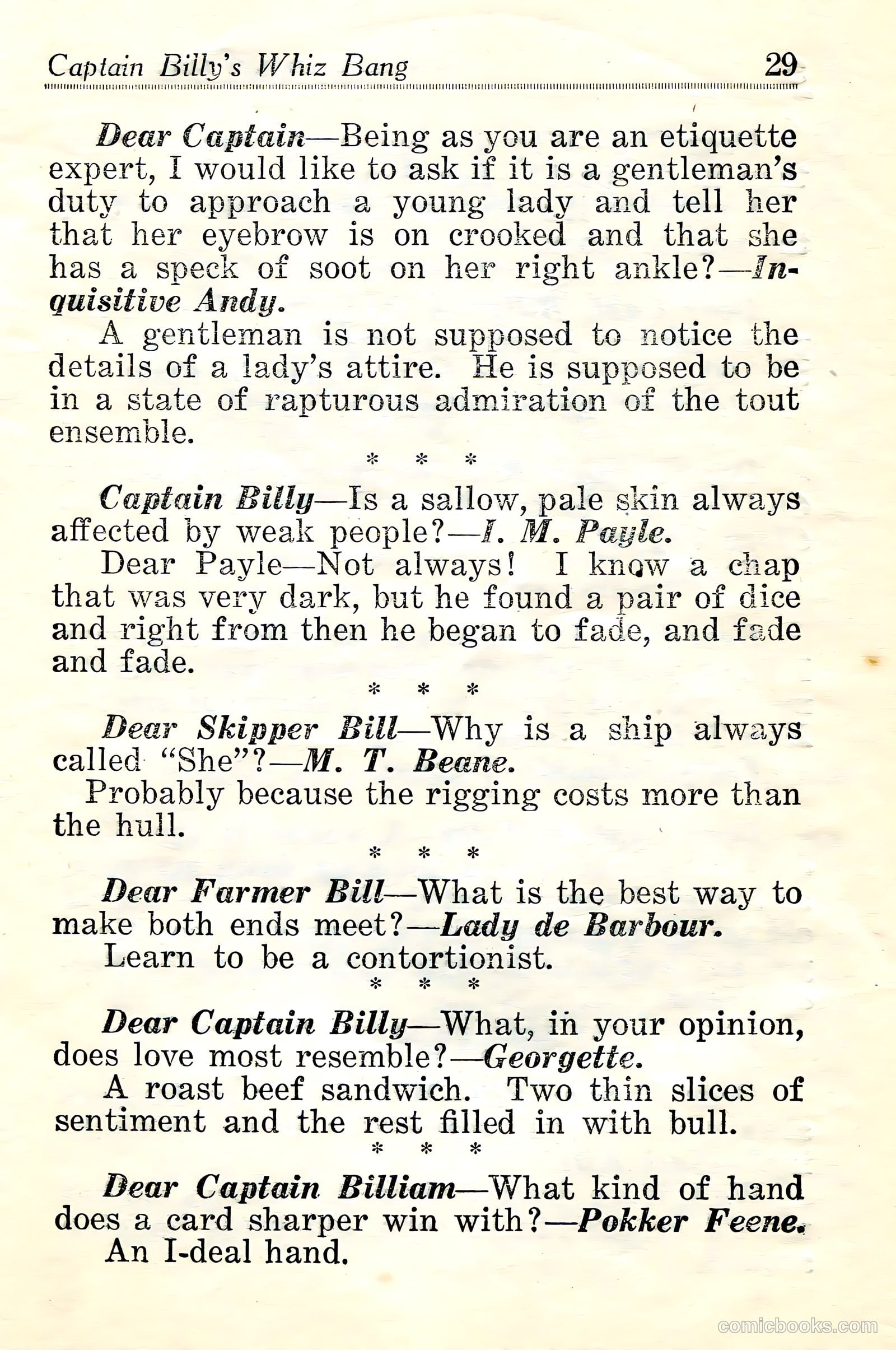
This page features a humor advice column titled "Captain Billy's Whiz Bang" containing short Q&A jokes. The humor is aimed at working-class readers and employs crude, often cynical wordplay: - A question about etiquette advice regarding noticing a woman's appearance is answered with a jab at superficial courtship - A joke about pallid skin connects gambling losses to physical deterioration - A ship nomenclature joke plays on rigging costs - A contortionist joke responds to a farming question - Love is compared to a roast beef sandwich with minimal sentiment - Card sharping is answered with an "I-deal hand" pun The column represents early 20th-century working-class humor: crude, irreverent, and skeptical of romance and polite society.
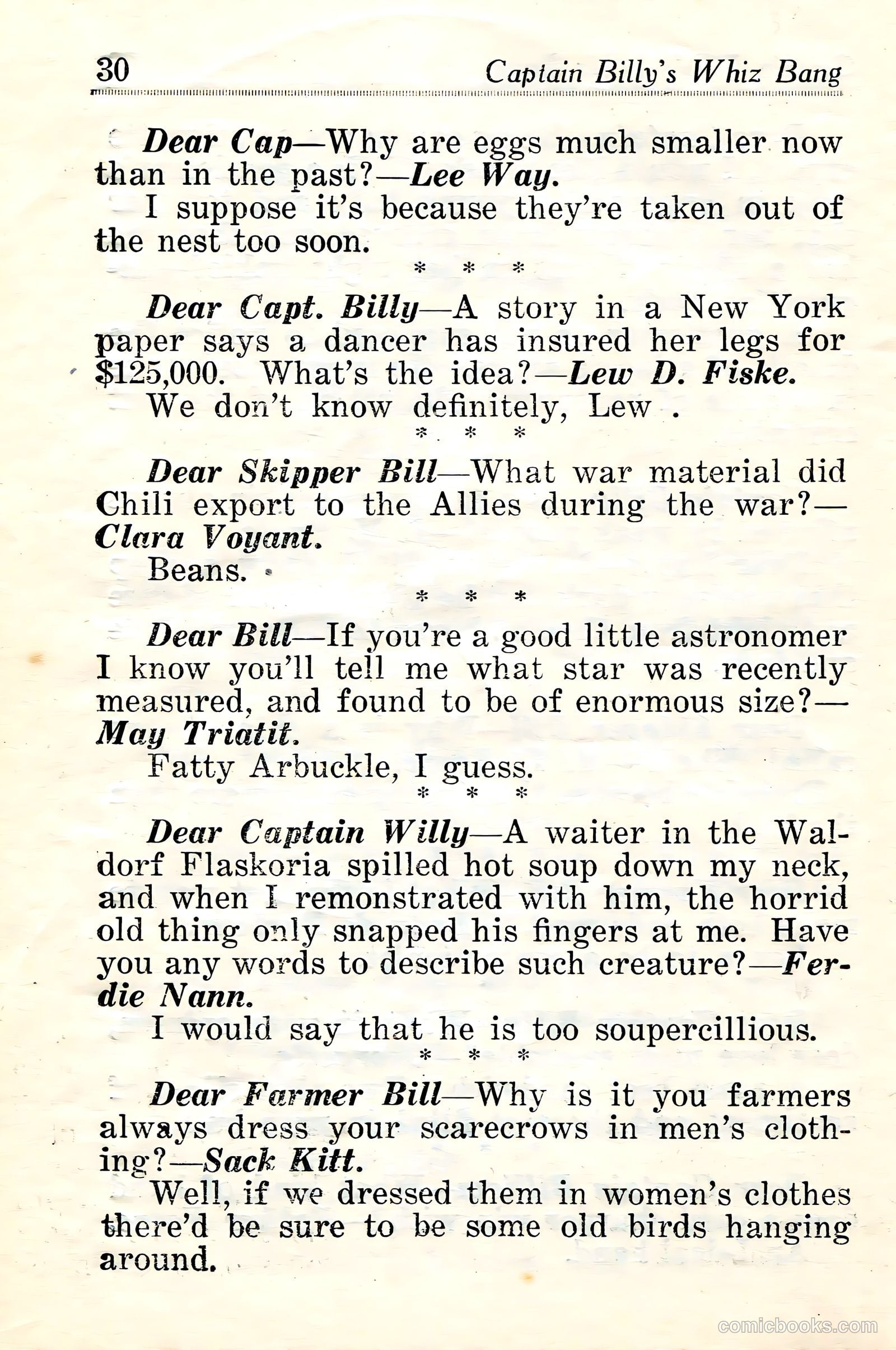
This page from *Whiz Bang* (a 1920s humor magazine) features a "Dear Captain Billy" advice column with humorous reader questions and responses. The jokes rely on wordplay and social commentary: - **Eggs smaller than before**: A joke about timing egg collection (implying chickens now lay prematurely) - **Dancer's leg insurance**: Captain Billy admits ignorance about why anyone would insure legs for $125,000 - **Chile's war exports**: The answer "Beans" is a pun (Chile → chili → beans) - **Star size**: "Fatty Arbuckle" references the silent film comedian/scandal figure - **Rude waiter**: "Soupercillious" is a pun (soup + supercilious) - **Scarecrow clothing**: The joke suggests dressing scarecrows in women's clothes would attract "old birds" (women) These represent typical early 20th-century magazine humor: puns, contemporary celebrity references, and mild social satire.
This page contains humorous verses and satirical commentary rather than cartoons. The content includes: **Military satire**: A WWI-era song from British soldiers ("Limies") expressing their desire to stop military duties—no drilling, marching, or polishing brass—once the war ends. The humor lies in soldiers' frustration with military discipline. **Social humor**: A verse about a woman named "Kitty" who appears attractive at dances but looks tired the next morning—likely mocking women's makeup or the toll of nightlife. **Commercial satire**: A washing machine advertisement ("Don't kill your wife. Get one of our machines") satirizes crude marketing that treats housework as deadly drudgery. **Record store humor**: A poorly-worded record advertisement is mocked for its awkward phrasing suggesting the seller has low standards. The page uses wit to critique military life, gender stereotypes, and commercial culture.
This editorial page addresses gender dynamics in the Jazz Age (1920s). The piece contrasts "old colonial days" when women set social standards for courtship and behavior with the modern era, when men control social norms. The author argues that modern girls compromise their own preferences—disliking close dancing and "wiggly" movements—to accommodate men's desires and maintain social acceptance. The satire criticizes both "good-hearted fool" men who exploit women's accommodation, and women who suppress their authentic preferences. The headline "The Bull is Mightier Than the Bullet" suggests that masculine social dominance (the "bull") has replaced other forms of power. This reflects 1920s anxieties about changing gender relations during the era of increased female independence and jazz culture.
This page contains editorial commentary on women's suffrage and changing social morality in the 1920s. The main text advocates that women, now having voting rights ("equal suffrage"), will naturally establish new behavioral standards—rejecting excessive "good fellowship" (a euphemism for sexual permissiveness) without requiring laws. The author predicts women will set boundaries through "sweet common sense" rather than prudery. The secondary anecdote mocks men who married multiple women without proper divorce, framing this as foolish behavior. The humor derives from regional variation in attitudes: different editors cite examples from their areas, suggesting this was a widespread (and scandalous) practice. The overall tone is satirical commentary on post-Prohibition era morality and the anticipated impact of female suffrage on social conduct.
This page contains advice text rather than cartoon content. The piece argues that happily married couples should ignore each other's pasts entirely—not inquire about previous relationships or confess past indiscretions unless they threaten the marriage's future. The advice reflects early-20th-century attitudes: women are portrayed as "naturally and generally better than men," yet advised to stay silent about their histories. The text warns against double standards in morality while simultaneously recommending strategic ignorance ("Where ignorance is bliss, 'tis folly to be wise"). This represents typical *Whiz Bang* content—satirical advice columns offering sardonic commentary on courtship, marriage, and gender relations through mock-earnest rhetoric that invites readers to recognize the absurdity or hypocrisy being described.
This page contains a lengthy moral essay rather than a cartoon. The text argues for gender equality and against judging women by their sexual past. It defends women's capacity for redemption, criticizing men who value material wealth over moral character in wives, and condemning society's harsh judgment of "fallen women." The piece references literary works—Hood's "Bridge of Sighs" and Goldsmith's "Folly"—both 19th-century poems about seduced or ruined women. It critiques the double standard where men escape consequences while women face permanent social condemnation, and warns against men who seduce women then abandon them (the "Faust to Margaret" reference from Goethe). The essay advocates compassion and equality in an era of rigid Victorian sexual morality.
This page contains several brief satirical items rather than a cartoon. The content includes: 1. **Moralizing passage** about women's redemption through marriage and motherhood—suggesting women with questionable pasts could be reformed through domestic life. 2. **"Hello! or Ohell!"**—A linguistic joke observing that "ohell" is essentially "hello" reversed, and that American greetings work better than reverse-English cusswords. 3. **"How About This?"**—A newspaper classified ad joke: "Two sisters want washing. Will go anywhere"—likely a double-entendre implying prostitution. 4. **Final quip** about a girl shaking the "shimmy" (a 1920s dance) so vigorously she's "shaken herself out of shape." The page reflects 1920s attitudes toward women, morality, dancing, and working-class humor typical of Whiz Bang's irreverent style.
This page is primarily **literary content, not a political cartoon**. It features: 1. **"Smokehouse Poetry" introduction** - announcing three poems for October, including "The Prisoner's Prayer" written on a prison wall at McNeil Island Penitentiary in 1909, later memorized and released by another inmate. 2. **"Betrayed" by Angela Morgan** - a melancholic poem about a woman who sacrificed everything for love, only to be betrayed. The poem addresses themes of romantic loss and maternal heartbreak. The page represents *Whiz Bang's* literary/poetry section rather than satirical commentary. It reflects early 20th-century sentimental verse conventions and the magazine's apparent interest in presenting both prison-authored works and established poets like Morgan.
This page contains a lengthy poem rather than a cartoon. The poem presents a woman's defense of her moral character and maternal love despite being socially condemned as "base" and having "gone astray"—Victorian-era terminology for unmarried motherhood. The speaker contrasts herself with "good" women who wear wedding rings, claiming she answered the same "call" of love but without marriage's legitimacy. She defends her child as equally worthy and describes her maternal devotion (warm milk, soft words, kind hands). The poem appeals to a future "judgment day" when social prejudices will be abandoned and society will recognize that loving mothers—regardless of marital status—deserve dignity and explanation rather than condemnation. This reflects early 20th-century social satire criticizing rigid moral double standards regarding unwed mothers.
This page contains a narrative poem about a man's moral and social decline. The speaker confesses to a doctor that he was once respectable but gradually descended into alcoholism and infidelity. The poem's title references the "unwritten law"—a colloquial term for extrajudicial justice, particularly crimes of passion committed to defend family honor. The poem catalogs the speaker's failures: drinking, his best friend's seduction of his wife, and his discovery of their affair. The implied "unwritten law" suggests he may have committed violence in response, though this remains unstated. The work appears to be social commentary on masculine honor, betrayal, and the destructive consequences of moral compromise in early 20th-century American society.
This page contains a narrative poem titled "Captain Billy's Whiz Bang," presented as a first-person confession. The speaker describes finding his wife with another man, shooting at the intruder (missing), then spiraling into years of wandering, poverty, and obsessive thoughts of revenge. The story culminates when the speaker encounters the man again, kills him with multiple gunshots, and is himself shot by police while fleeing. The poem ends with the narrator apparently dying, resigned to damnation. This appears to be crime fiction in verse form—a popular genre in early 20th-century American periodicals. The content exploits themes of betrayal, murder, and moral decay for entertainment, likely appealing to readers interested in sensational stories. No specific political satire is evident; this is straightforward dramatic narrative rather than social commentary.
This page contains three humorous poems with no visible cartoons or caricatures: **"Going Down"** uses extended metaphor about life's decline, with vivid nautical/nature imagery about the sea and gulls—likely reflecting post-WWI disillusionment about mortality and fate. **"Hail to the Devil Dog"** celebrates a tough, fighting man ("Devil Dog" was a WWI Marine nickname). The poem praises his toughness while noting his vices and short work ethic, concluding he's "Uncle Sammy's nephew / And all American"—apparently honoring aggressive American masculinity and military service. **"A Tip For Wifey"** offers marital advice: when husbands claim late nights out, wives should respond by going out themselves. The joke assumes mutual infidelity threat keeps marriages "honest." All three reflect 1920s attitudes about masculinity, mortality, and marriage dynamics.
This page contains several humorous sketches and witty observations rather than political cartoons. The content includes: **"Have a Drink, Boys?"** — A joke about a woman on a train with a bottle labeled "consumption" (tuberculosis), playing on the double meaning of the word. **"Always"** and **"You need your money"** — Generic relationship and financial humor about couples and domestic economics. **"In the Game of Love"** — A cynical observation about women's romantic behavior, suggesting women claim to love differently at various life stages, with the punchline that promiscuous women "keep twenty lovers guessing." The final line about "dramatic triangle" being caused by people "not being on the square" uses mathematical/geometric metaphors for dishonesty. These are lighthearted satirical quips typical of 1920s magazine humor, with no identifiable specific political figures or events.
This gossip column reports on actress Agnes Ayres's divorce proceedings. The satire lies in the contrast between her Hollywood stardom and her anonymity in the Los Angeles courtroom—few recognized "the Lasky leading lady" under her real name, Schucker. The piece mocks both Hollywood's artificial celebrity and the legal system's indifference to it. Agnes's mother's tearful testimony about inadequate support from her estranged husband (Captain Frank R. Schucker) initially gained court sympathy, until a Hollywood insider recognized Ayres in the room, apparently threatening to expose her celebrity status and undermine her sympathetic plaintiff narrative. The humor targets Hollywood's superficiality and the gap between screen fame and real-world identity.
This page contains gossip-column humor about Hollywood scandals. The main story mocks actress Agnes (last name unclear from visible text) and her mother's involvement in a court case involving desertion. The satire centers on Agnes's theatrical courtroom behavior—arriving in an elaborate champagne-colored gown with ostrich plumes—and her mother's absurd explanation that she "misunderstood" support obligations, claiming they simply lived together. The column jokes about Agnes's rapid rise in filmdom, attributing it to Wallie Reid, a prominent silent-film actor known for lavish entertaining. The final section begins gossiping about Samuel Merwin, a screenwriter, attending an exclusive Riverside party. The humor targets Hollywood excess, maternal interference, and legal absurdity typical of 1920s celebrity scandal coverage.
This page contains gossip-style commentary about Hollywood personalities and social dynamics of the 1920s. The text discusses: - **Merwin**: An unnamed romantic figure who allegedly fell asleep while escorting a beautiful English girl, missing romantic opportunity - **J. Parker Reid** (director) and **Louise Glaum** (actress): They visited Coronado, California where Reid socialized with wealthy locals - **Coronada Hotel society crowd**: Satirized as idle rich with "plenty of money, little to do" who gain status by networking with Hollywood figures The satire targets the pretentious behavior of San Diego's wealthy elite who seek glamour through association with movie people. Louise Glaum is praised for artistic dedication, contrasting with the shallow social-climbing depicted elsewhere. The humor relies on insider Hollywood gossip typical of 1920s fan magazines.
This page contains Hollywood gossip presented as satirical commentary. The text discusses actress Louise Glaum's career struggles and romantic entanglements with director J. Parker Reid, who abandoned her to marry a wealthy "Mrs. Piper." The author mocks the fickleness of show business romance, concluding "Life's a funny little game after all." The second section addresses rumors about actor Jack Mulhall following his wife Laura Mulhall's suicide in Hollywood. The author defends Mulhall's character, calling him a "square shooter" with a good disposition and claiming he was a devoted husband—attempting to counter "derogatory rumors" circulating in scandal circles. The page serves as celebrity gossip framed as moral commentary on early 1920s Hollywood.
This page contains a humor column titled "Our Local Color" with short anecdotes rather than a political cartoon. The jokes target: 1. **Railroad officials**: Mocking someone (possibly named Gemmell) for allegedly confusing a gondola (a boat) with a bird, leading to an absurd attempt to stock a Minnesota city park with gondolas. 2. **A poet named Liebst**: Humorously noting he's received requests from railroad managers to name boxcars after him—satirizing sudden minor fame. 3. **Ham Tomlin**: A joke about aging, where he's lost the vigor to kiss his wife frequently. The remaining items are crude one-liners about drinking and appearance. This is typical early 20th-century magazine humor: lightweight, pun-based comedy aimed at general audiences with no serious political commentary.
This is a humor column from *Whiz Bang*, a satirical magazine. The page contains several unrelated jokes and quips rather than a cohesive cartoon: **"Velvet Joe Says"** offers domestic humor: a tip about tobacco ashes deterring moths, followed by wisecracks about Sousa's Band and Napoleon's height limiting him from becoming a modern policeman. **"And Very Nice, Too!"** presents a joke about distinguishing identical twins by their shared niceness. **"Our friend Deegan"** makes a joke about Irish people and death/heaven—likely ethnic humor typical of early 20th-century American magazines. The final items include a riddle about headaches and brains, and a marital dialogue where a husband claims he won't come home, prompting his wife's sarcastic reply. The humor is lightweight, domestic, and relies on wordplay and stereotype rather than political commentary.
This page contains a collection of short jokes and humorous one-liners typical of 1920s satirical magazines, rather than political cartoons. The content includes: **"Let's Call It the Cockeyed Blues"** — a joke about cross-eyed girls, playing on the popular blues music genre. **"Honest, This Is True"** — a folk-style anecdote about someone named Fawcett visiting a cellar and finding it empty. **"Pathetic, Ye Gods, Too Pathetic"** — an ethnic joke featuring an Irishman and Scotchman at a bar, playing on stereotypes about drinking and money. **"Glorious Daze"** — humor about drunks on a train, with slurred speech representing intoxication. The jokes rely on period stereotypes, ethnic humor, and wordplay common to early 20th-century American comedy magazines.
This page contains a collection of short humorous anecdotes rather than political cartoons. The jokes target various social situations and character types: 1. **"Something to Worry About"** - Mocks religious hypocrisy (a priest embarrassed by girls at a beach) 2. **"We Dodged Two Yesterday"** - A pun about a poor cat and financial dodging 3. **"How is the milk maid?"** - A servant/class humor joke with wordplay about cows versus maids 4. **"Very Versatile"** - Satirizes a sailor substituting indecent chest tattoos for scheduled entertainment The humor is crude, relying on puns, sexual innuendo, and social embarrassment. The magazine targets working-class readers with jokes about clergy, servants, and sailors—reflecting 1920s satirical attitudes toward authority figures and lower-class behavior.
This page contains brief humorous vignettes rather than political cartoons. The jokes target: **"Paris Made"** — A WWI veteran's request for "tacks" for garters, playing on the double meaning (tacks/attacks). **"A New Fad"** — References a St. Paul street sign promoting shining shoes inside, likely satirizing a trendy service or absurd advertisement. **"X-Y-Z Tragedy"** — A billiards joke about a "combination shot." **"A Brief History"** — Satirizes soldiers' simplified understanding of WWI through disconnected complaints: wanting to go home, eating times, and confusion about who won (crediting the YMCA). **"An Autumn Song Success"** — Jokes about tenants' financial desperation during rent season. **"Our Sentimental Melody"** — Requests reader copies of a previous popular song. The humor relies on post-war disillusionment and working-class concerns.
This page contains three humor pieces with no illustrations: 1. **"What a Pity"**: A joke about an atheist's funeral—the irony being that despite looking presentable in death, he has "no place to go" (implying Hell). 2. **"Zoology"**: A poem playing on animal metaphors in romantic relationships, with puns (the final "nothing gnu" puns on "nothing new"). 3. **"Our London Report"**: A satirical anecdote mocking both a busybody reformer and a young smoker's financial hypocrisy. The reformer lectures about cigar savings, claiming to own a building through thrift; the youth deflates him by revealing he already owns his building—implying inherited wealth rather than earned restraint. The satire targets moral busybodies, religious hypocrisy, and class assumptions about financial virtue.
This page is an article (not a cartoon) by Rev. Golightly Morrill titled "Japanese Bathing Beauties." The piece describes the author's visit to a Japanese tea-house to observe Geisha performers. The "satire" is mild—Morrill presents himself as a somewhat prudish Western observer, expressing embarrassment at the entertainers' performance while also critiquing their musical abilities (unfavorably comparing them to Wagner). He divides Japanese women into two categories: Geisha (entertainers educated in arts/music) and Yoshiwara (implied to be in sex work). The article reflects early 20th-century American attitudes: exoticizing Japan, moral disapproval mixed with voyeuristic interest, and Western cultural superiority. The humor derives from Morrill's discomfort with unfamiliar customs rather than sharp political satire.
This appears to be a travel narrative rather than a cartoon or satirical content. The page describes Captain Billy's visit to Tokyo's Yoshiwara district (the red-light district), providing a first-person account of a stage party's excursion there. The text is notable for its era-specific perspective: it describes the district's theatrical buildings, elaborately dressed women, and notes that the Japanese government regulates this as a "necessary evil." The author makes a somewhat cynical comparison to similar practices in "Europe and America for wealth and social position, but differently estimated and under another name." The passage contains no visible illustrations or political caricatures on this page—it's prose commentary that reflects early 20th-century American attitudes toward Japanese culture and social practices.
This page contains satirical travel commentary about Japan, likely from the 1920s-30s based on the magazine's era. The author mocks Japanese customs through an American tourist's perspective: **Key targets of satire:** - Japanese women's restrictive confinement in "matrimonial bureaus" - Invasive hotel practices (peeping through wallpaper) - Public bathing culture, describing the water's progressive filthiness throughout the day - Japanese family bathing practices **The humor relies on:** Cultural superiority and voyeurism jokes typical of early 20th-century American humor. The extended metaphor comparing bathwater degradation to natural phenomena (creek, Missouri River, Yellowstone geysers) is the piece's comedic centerpiece. The final paragraph reveals the author's genuine curiosity about public baths despite the mockery, suggesting the satire is travel-guide exaggeration rather than serious critique.
This page contains satirical commentary on Japanese public bathhouses ("sento"). The author describes visiting a bath at Venus in what appears to be a red-light district, where numerous nude women bathed without apparent modesty. The satire mocks both: 1. **Japanese bathing customs** - contrasting "Japanese beauty" (angular) with American (curved), comparing Japanese women unfavorably to wax figures 2. **Western prudishness** - criticizing foreign insistence on gender separation via bamboo partitions The passage then shifts to describing Mogi, a fishing village near Nagasaki, known for its overwhelming stench. The author humorously invokes the Romantic poet Coleridge, suggesting even his imaginative powers would be "overpowered" by Mogi's smell—a joke equating poetic exaggeration with actual sensory assault. The humor relies on early-20th-century Western stereotypes and xenophobic observations.
This page contains two distinct sections: **Top section**: A travel narrative describing a journey through Japan, detailing peasants carrying bamboo buckets of human waste ("assiduously collected in accordance with the Scripture"). The author humorously notes using peanuts instead of "pansies" (euphemistic thoughts) to entertain children, and concludes with observations about reaching a coastal village. **"The Last Chortle"**: A brief anecdote about a struggling magician's final act. He promises his "very best trick" and asks audience members wanting to see the devil to raise their hands. When they do, he tells them to "go to hell, leaving the stage in much haste." The humor relies on a bait-and-switch joke and crude language that wouldn't have been considered shocking for 1920s American satirical magazines. There are no visible political cartoons on this page.
This page contains three brief humorous anecdotes rather than cartoons: 1. **"Back to Childhood Days"**: A comic story about visiting an insane asylum where an escape occurs. The narrator outruns a violent patient through the hospital grounds and into a field, where the patient catches him and slaps his back saying "Tag, you're it"—transforming the chase into a childhood game. 2. **"How's This One?"**: A short joke about someone named Jiggs falling into turpentine at a paint factory. The humor lies in the punchline that he hasn't been caught yet (unclear reference). 3. A closing aphorism about happiness being like perfume—you can't share it without getting some on yourself. The tone is lighthearted and absurdist, typical of early 20th-century satirical magazines.
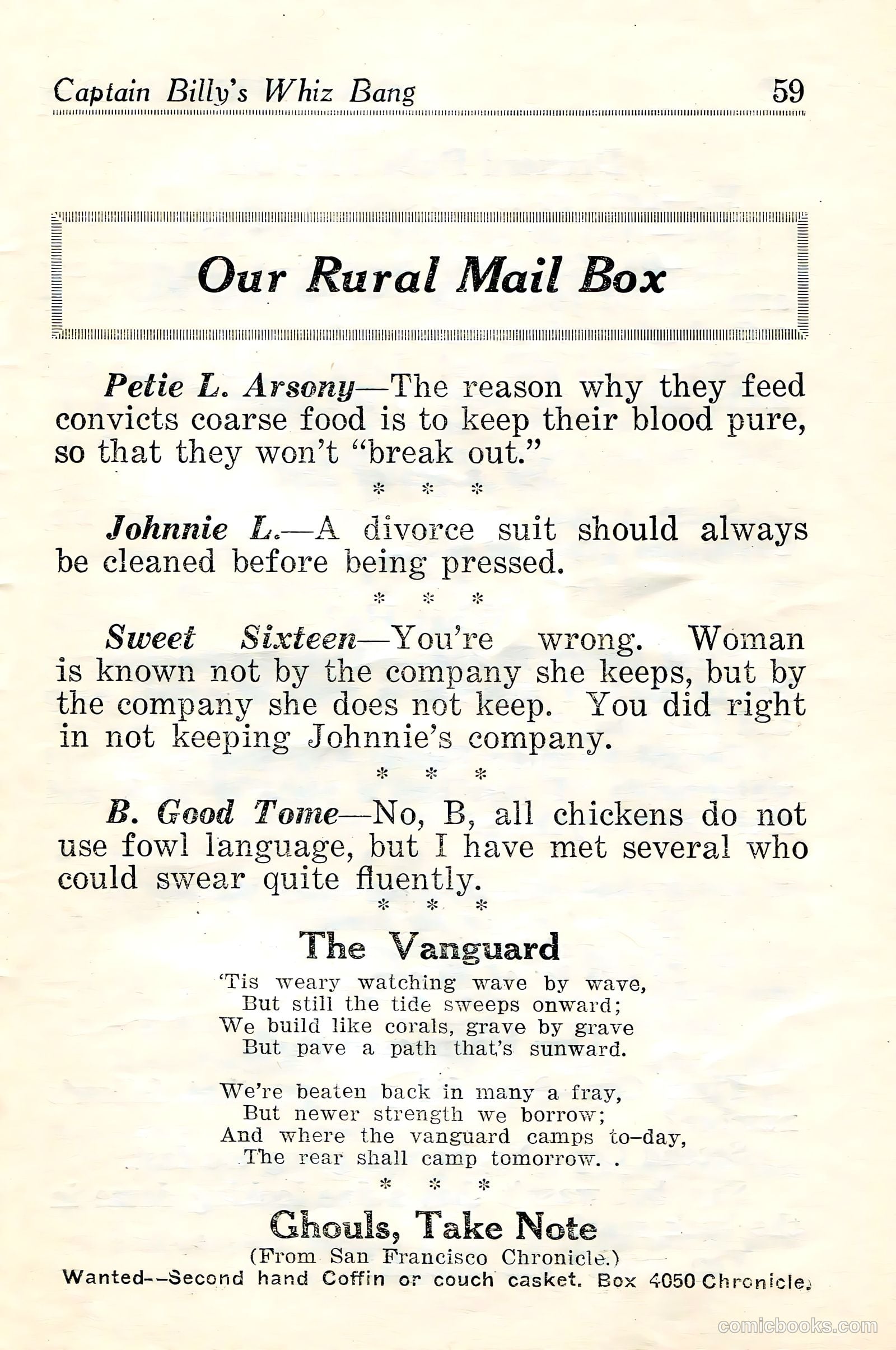
This page contains a humor column titled "Our Rural Mail Box," featuring brief comic submissions from readers with rustic or folksy pen names. The jokes employ period-typical humor: one plays on the euphemism "break out" regarding convict diet; another makes a crude joke about divorce suits needing cleaning; a third contains sexist commentary about women's reputations. "The Vanguard" is a short poem about military retreat, using metaphors of tide and camping—likely referencing WWI or post-war military concerns. The final item, "Ghouls, Take Note," reprints a San Francisco Chronicle classified ad seeking a second-hand coffin or basket, presented as darkly humorous. The content reflects 1920s-era satirical magazine style: lowbrow humor, gender stereotypes, and absurdist juxtapositions typical of Whiz Bang's irreverent tone.
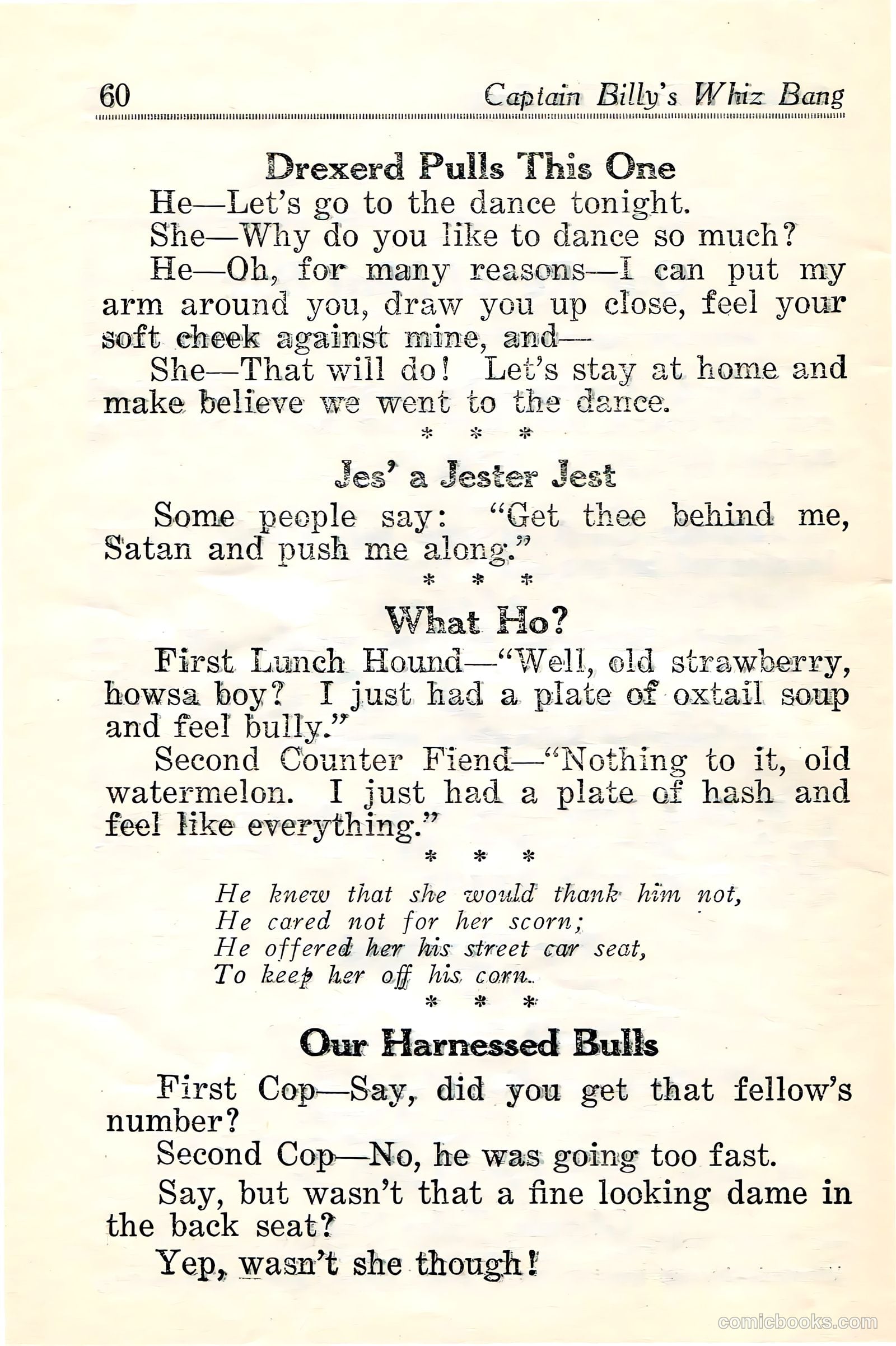
This page contains four brief humorous anecdotes typical of the magazine's satirical style: 1. **"Drexerd Pulls This One"**: A joke about a man inviting a woman to a dance; she pragmatically suggests they skip the dance and simulate it at home instead. 2. **"Jes' a Jester Jest"**: A religious reference, playing on the phrase "Get thee behind me, Satan." 3. **"What Ho?"**: Two working-class men ("Lunch Hound" and "Counter Fiend") compare digestive complaints after eating cheap food—oxtail soup and hash—using slang ("old strawberry," "old watermelon"). 4. **"Our Harnessed Bulls"**: A joke about two police officers discussing a speeding driver and an attractive woman in the backseat, suggesting the officer was distracted. The humor relies on wordplay, class-based comedy, and period slang typical of 1920s American magazines.
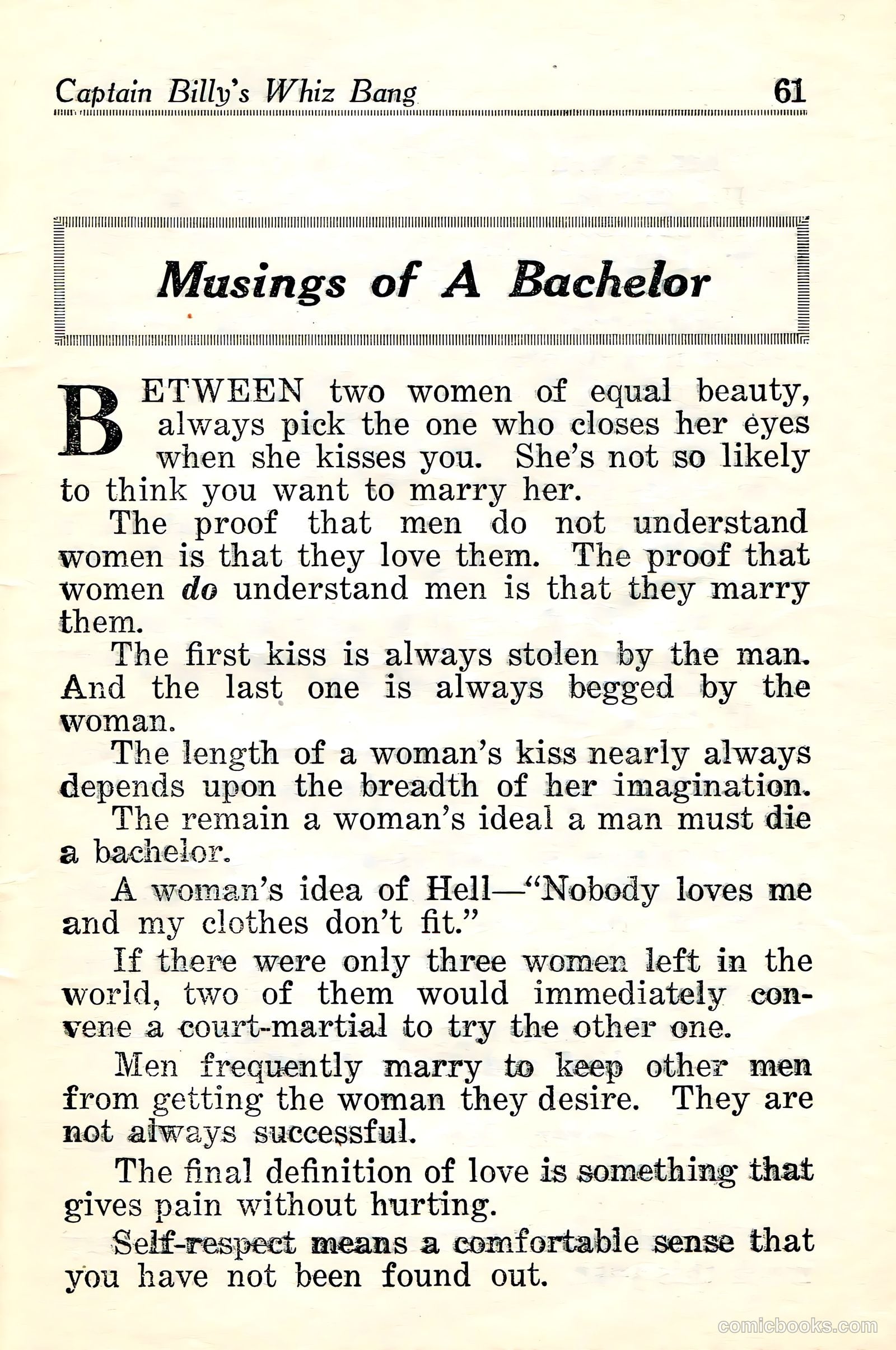
This page contains a humorous column of aphorisms about relationships and gender dynamics, presented as cynical observations from a bachelor's perspective. Rather than a political cartoon, it's satirical commentary on courtship and marriage customs of the era. The jokes target both men and women: men are portrayed as strategically marrying to prevent rivals from winning desired women, while women are depicted as competitive and materialistic (one quip about Hell being "Nobody loves me and my clothes don't fit"). The humor relies on early 20th-century gender stereotypes—women as manipulative, men as foolish or deceptive. The column mocks romantic love itself, defining it as "something that gives pain without hurting." Overall, it's cynical bachelor-humor typical of *Whiz Bang's* irreverent satirical style.
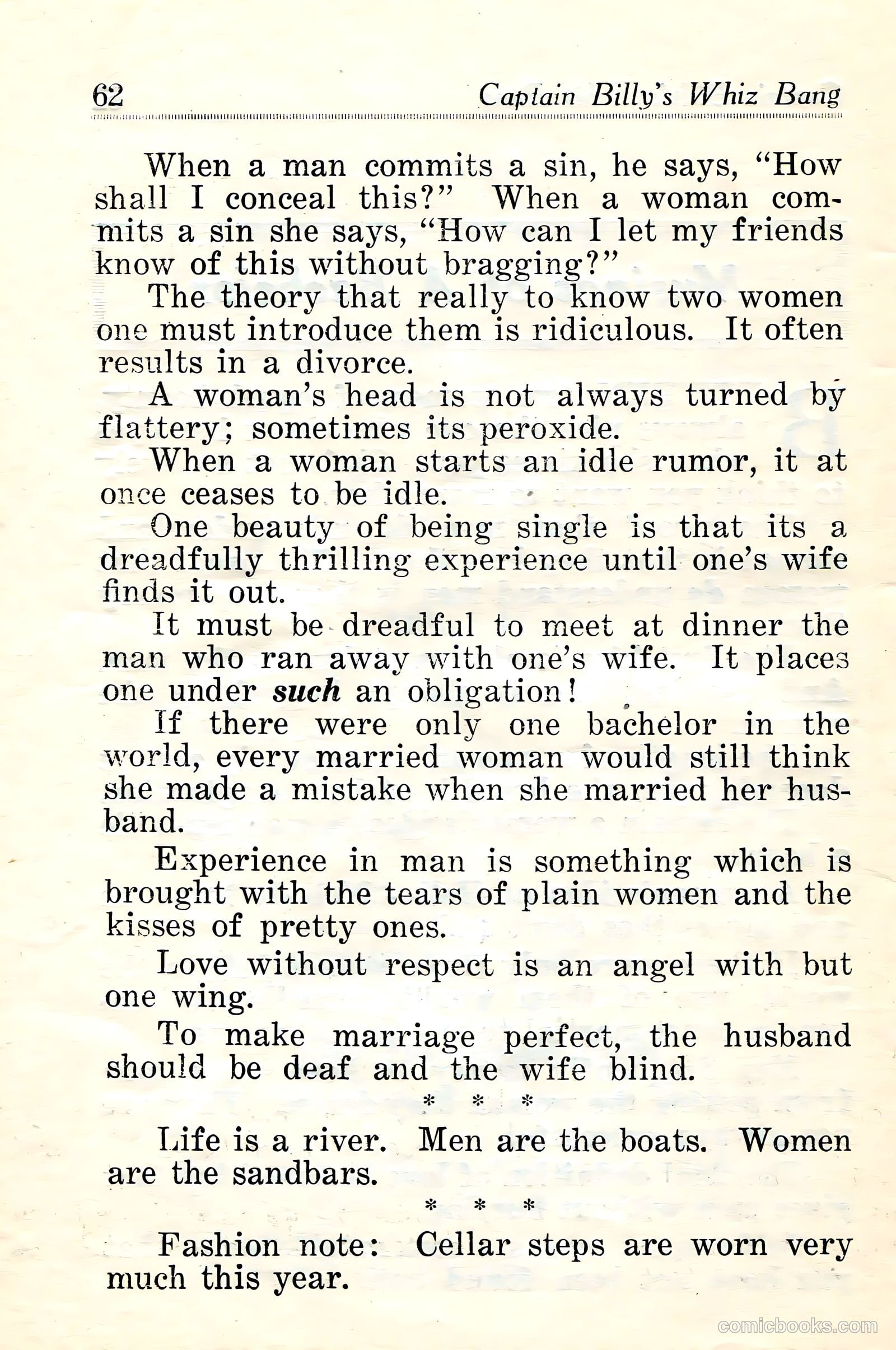
This page contains satirical aphorisms about gender relations and marriage, presented without illustrations. The humor targets both sexes with observations meant to critique marital dynamics and social conventions of the era. The satire includes misogynistic jokes (women can't keep secrets, introducing two women causes divorce) alongside critiques of male infidelity and hypocrisy. Notable quips include "Love without respect is an angel with but one wing" and the famous metaphor "Life is a river. Men are the boats. Women are the sandbars"—suggesting women obstruct male progress. The final "Fashion note" about cellar steps being worn suggests society women's clothing shows wear from descending to basements, likely referencing Prohibition-era speakeasy access. These aphorisms reflect 1920s gender anxieties and the magazine's bawdy, misanthropic humor style.
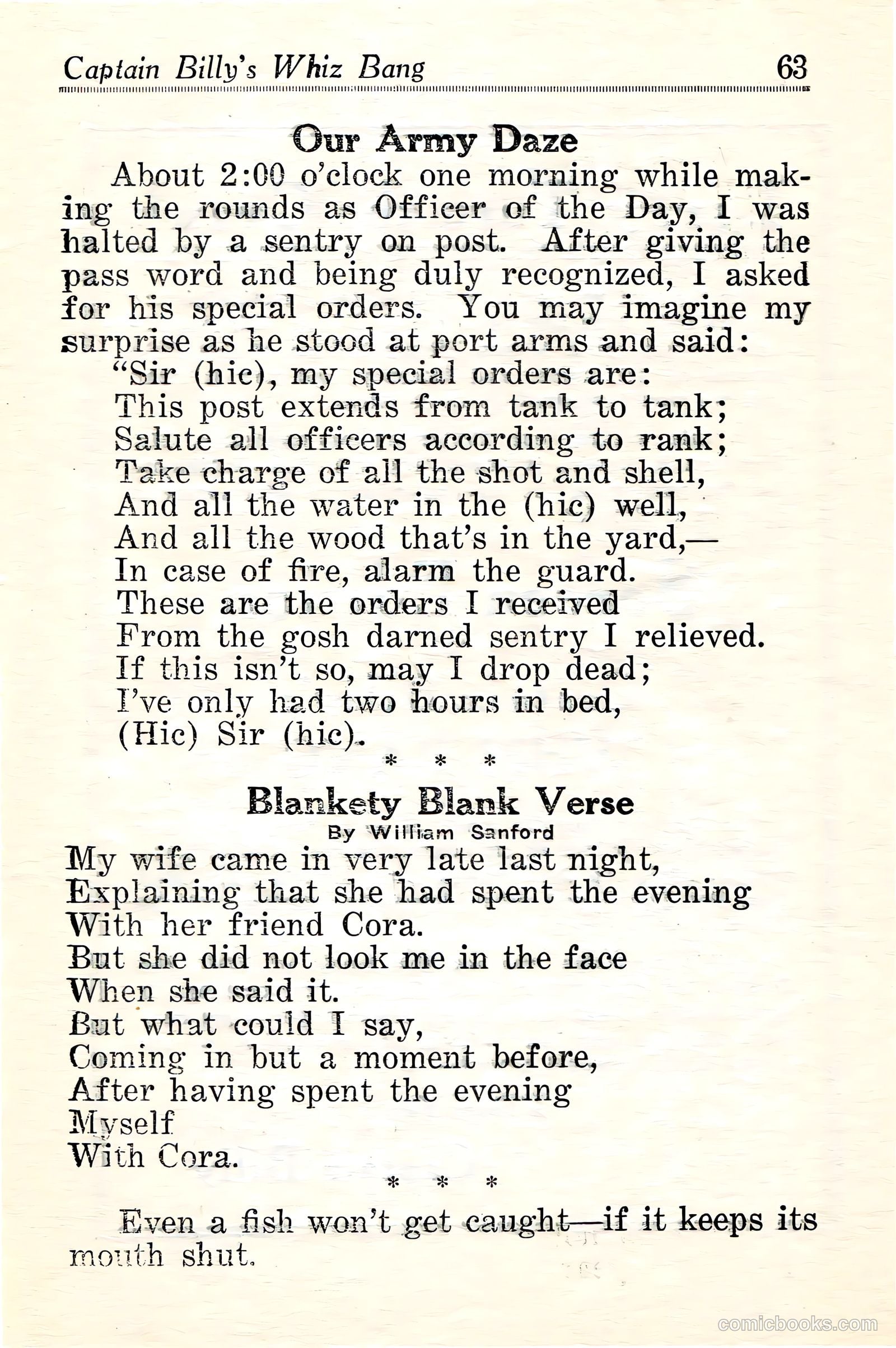
This page contains three humorous pieces from an American satirical magazine: **"Our Army Daze"** mocks military bureaucracy through a sentry's absurdly verbose special orders—a parody of military formality and unclear chain-of-command communication. **"Blankety Blank Verse"** by William Sanford presents domestic comedy: a husband caught in marital hypocrisy when his wife returns late claiming to have visited friend Cora, when he'd just spent the evening with Cora himself. The satire targets infidelity and mutual duplicity in marriage. **The closing adage** ("Even a fish won't get caught—if it keeps its mouth shut") reinforces the moral: silence protects secrets. These pieces exemplify Whiz Bang's focus on military life and domestic humor, using crude wit to appeal to working-class male readers of the 1920s-30s era.
This is a title page/advertisement rather than a cartoon. It announces that *Whiz Bang*, a satirical magazine of "wit, humor and philosophy," is being adapted into a weekly motion picture—a "Screen Edition" featuring content from the magazine. The page promotes that Morrison B. Egbert is negotiating with film distributors to show this content in up to 8,000 theaters weekly. The film will feature "gems" from past issues plus new material: jokes, advice columns (from "Captain Billy"), and humorous segments like "Mail Bag" and "Pot Pourri." The title "Larry Turn the Crank" is a period colloquialism for operating a film projector, humorously encouraging theater managers to book the picture.
This is primarily an **advertisement/order form** for a magazine special edition, not a cartoon page. "Captain Billy's Whiz Bang" was promoting its "Winter Annual" of 1921-22—a compilation issue containing reprinted jokes and new content like stories and poetry. The ad promises four times more reading material than regular issues, selling for one dollar. The listed content titles ("Johnnie and Frankie," "The Shooting of Dan McGrew," "The Harpy," "Lasca") suggest reprints of popular period fiction and verse, likely humorous or sentimental pieces typical of early-1920s mass entertainment. The form invites readers to order by mail using check, money order, or stamps—standard pre-digital subscription practice. This reflects how magazines distributed special editions through direct consumer orders rather than newsstand sales alone.
This is a **title/advertisement page**, not satirical content. It announces where readers can purchase *Whiz Bang* magazine and subscription rates. The only visual element is a cartoon cow at the bottom—likely the magazine's mascot or recurring character, given its prominent placement. The cow appears humorous and mischievous in style, fitting a satirical publication's branding. The pricing information reflects early-to-mid 20th century print economics: 25 cents per copy at newsstands, slightly more on trains (30 cents), with annual subscriptions at $2.50. This was typical distribution strategy for popular magazines of the era, making them widely accessible through multiple retail channels.