
A complete issue · 18 pages · 1880
The Wasp — July 31, 1880

I can see this is a measurement/calibration page from what appears to be archival documentation, showing an Oregon Rule Co. ruler and a grayscale color checker chart (the grid of gray and white squares). This is a technical reference image used in photographing or scanning documents, not a political cartoon or satirical content from *The Wasp* magazine itself. The ruler and color chart serve as scale and color calibration references for digitizing or microfilming historical materials. This type of page typically appears at the beginning or end of archival collections to ensure accurate reproduction quality. Without actual cartoon imagery or satirical text visible, I cannot analyze political or social commentary. This appears to be archival/technical documentation rather than the magazine's editorial content.
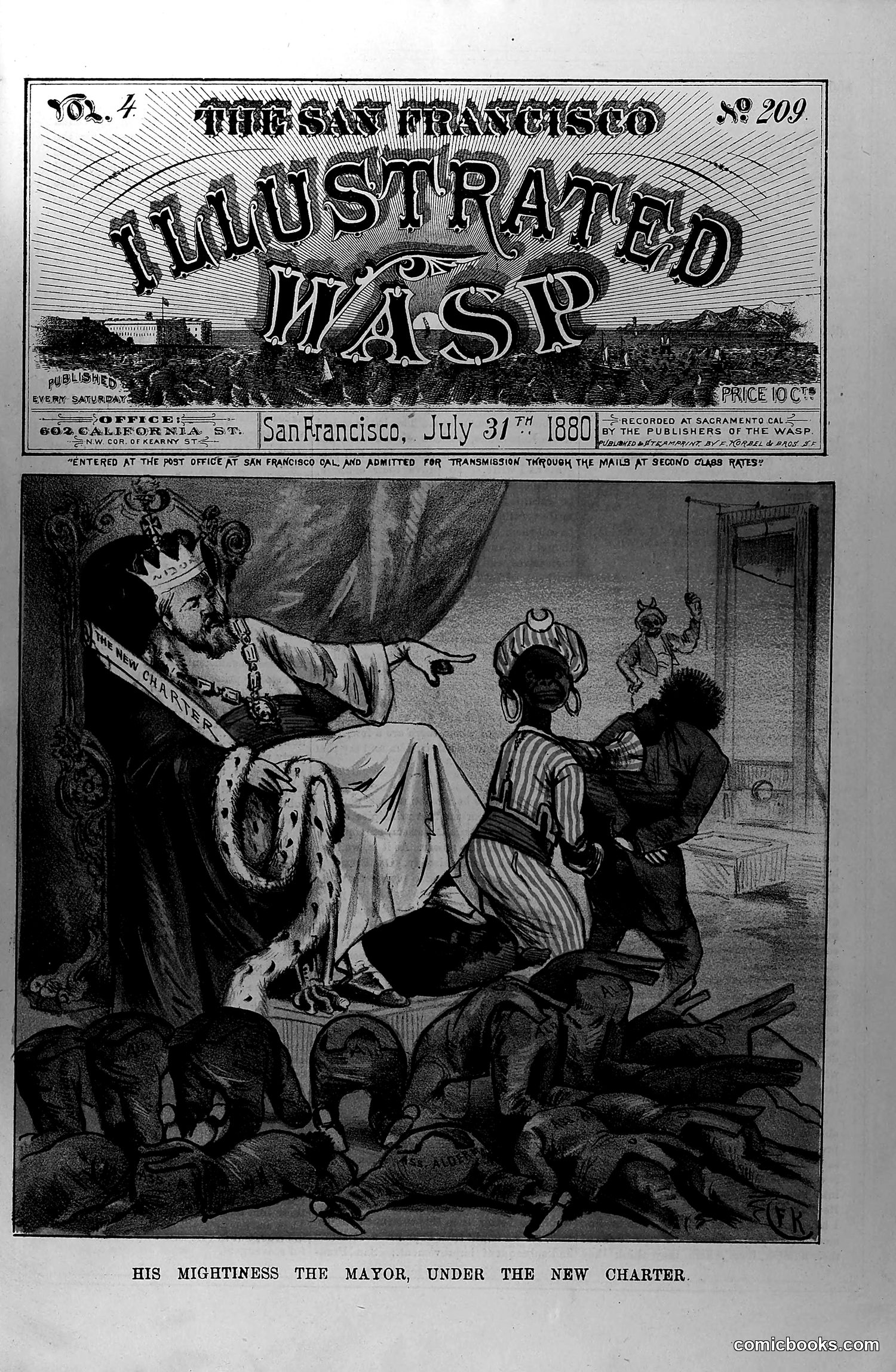
This San Francisco *Wasp* cartoon from July 31, 1880, satirizes a mayor operating under newly granted municipal powers (the "new charter"). The illustration depicts the mayor as an imperious monarch seated on a throne, pointing commands while smaller figures—appearing to represent citizens or officials—kneel or bow before him in supplication or submission. The satire critiques what the cartoonist views as excessive or autocratic mayoral authority granted under the revised city charter. The title's sarcastic tone ("His Mightiness") emphasizes the perceived transformation of the mayor into a despotic ruler rather than a democratic servant. The cartoon mocks the concentration of power in municipal government during this period of San Francisco's development.
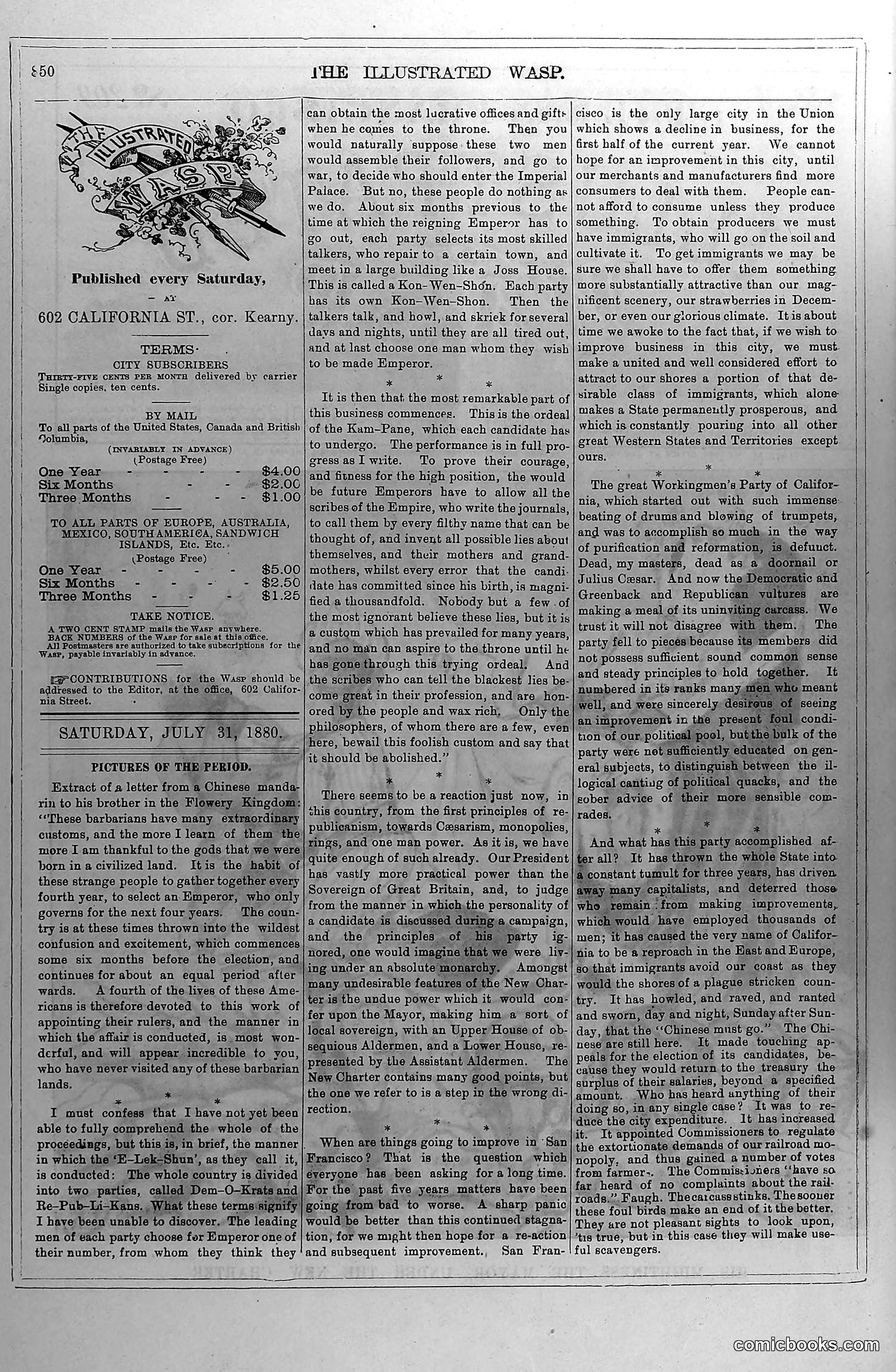
The page's main illustrated content appears to be a decorative header featuring ornate flourishes—likely the magazine's masthead rather than a political cartoon. The text content focuses on Chinese immigration and California politics. An article titled "Pictures of the Period" quotes a Chinese mandarin criticizing American electoral practices, specifically the process of selecting emperors (governors). The satire mocks the elaborate, prolonged campaign system and suggests Chinese observers find Western democracy absurd compared to their own governance. A secondary article discusses San Francisco's economic stagnation and the need for business-minded leadership and immigration reform to improve the city's prospects. The satire targets American political theater and perceived dysfunction rather than caricaturing specific individuals.
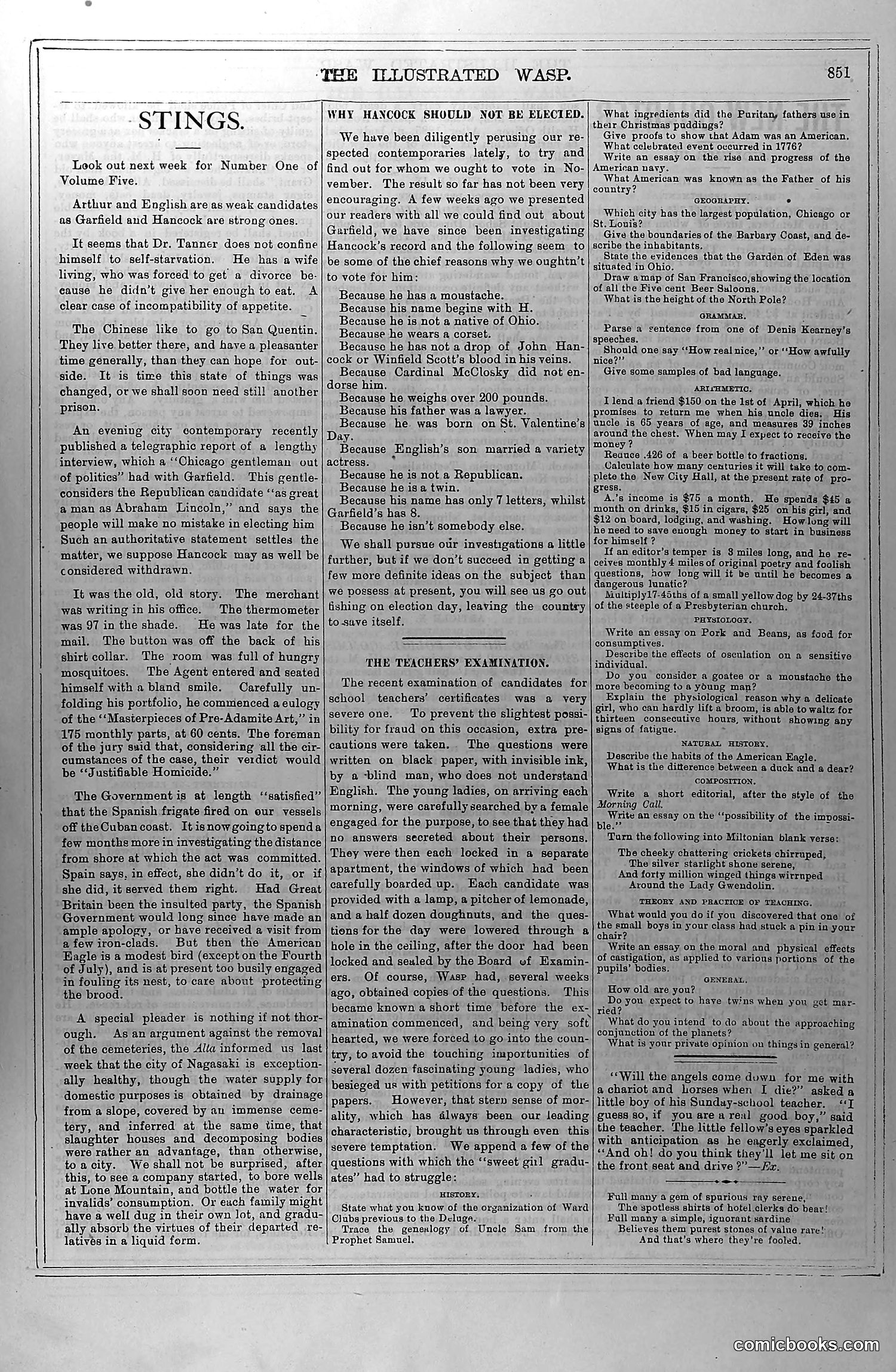
This page contains **no visible cartoon**—it consists entirely of text columns discussing political and social topics typical of satirical magazines from this era. The content includes: - **"STINGS"** section critiquing political candidates Arthur and English as weak, and Dr. Tanner for self-starvation - Discussion of **Hancock's election viability**, listing reasons against voting for him (his mustache, native Ohio heritage, Cardinal McClosky's opposition, etc.)—clearly satirical reasoning meant to mock certain voters' prejudices - **"THE TEACHERS' EXAMINATION"** section mocking school teacher certification procedures - Various reader advice columns and humor pieces The satire targets political hypocrisy, voter irrationality, and institutional incompetence rather than featuring visual caricature.
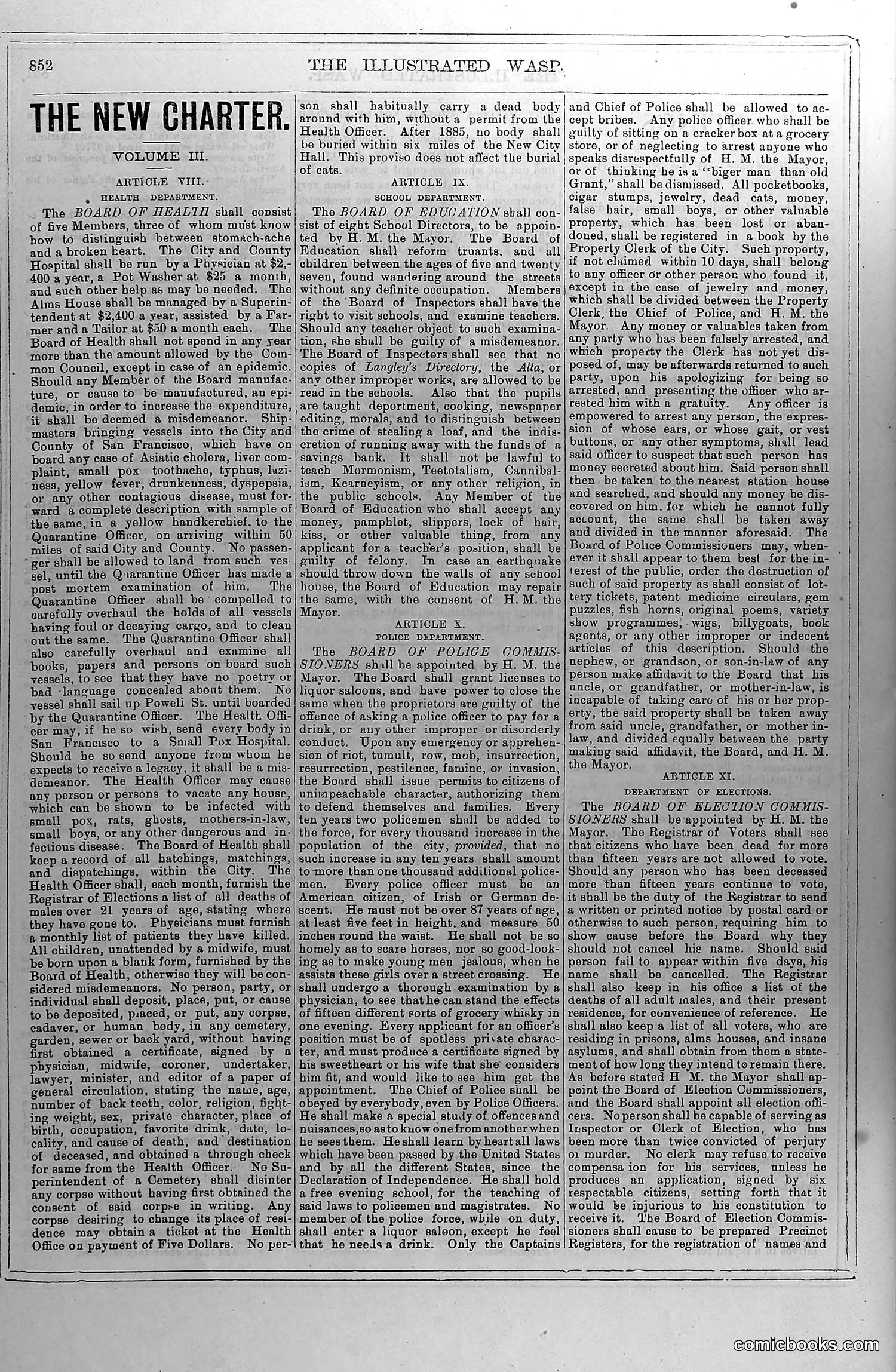
This page consists primarily of dense legal text describing San Francisco's new municipal charter (Volume III), organized into articles covering the Health Department, School Department, Police Department, and Elections Board. The content appears to be a straightforward publication of charter provisions rather than satirical commentary. Articles detail departmental structures, responsibilities, and regulations—covering everything from quarantine procedures and school inspections to police licensing and voting requirements. No cartoon or caricature is visible on this image. The page functions as informational documentation of civic governance rather than political satire, which was unusual for *The Wasp*, typically known for satirical commentary.
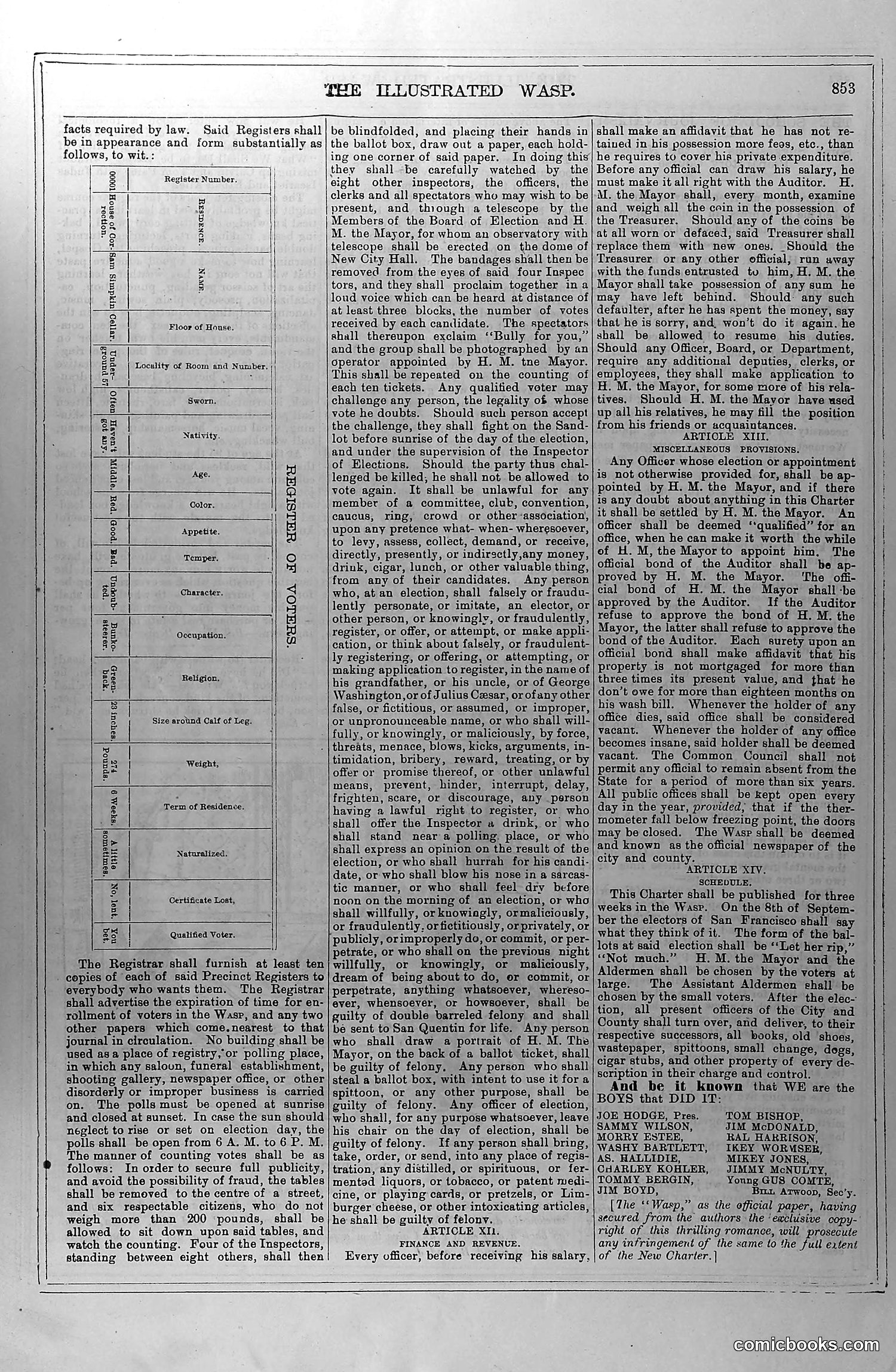
This page consists primarily of legal text describing election procedures and regulations for San Francisco, rather than satirical content. The left side contains a detailed "Register of Voters" form with fields for information like name, nationality, occupation, and other voter details. The bottom of the page lists names of boys, likely The Wasp's staff or contributors ("The Boys That Did It"): Tom Bishop, Sammy Wilson, Jim McDonald, and others. The actual satirical cartoon or commentary appears minimal or absent from this particular page. The content is largely administrative and regulatory in nature, focusing on voting procedures and election law rather than political satire or social commentary typical of The Wasp's editorial content.
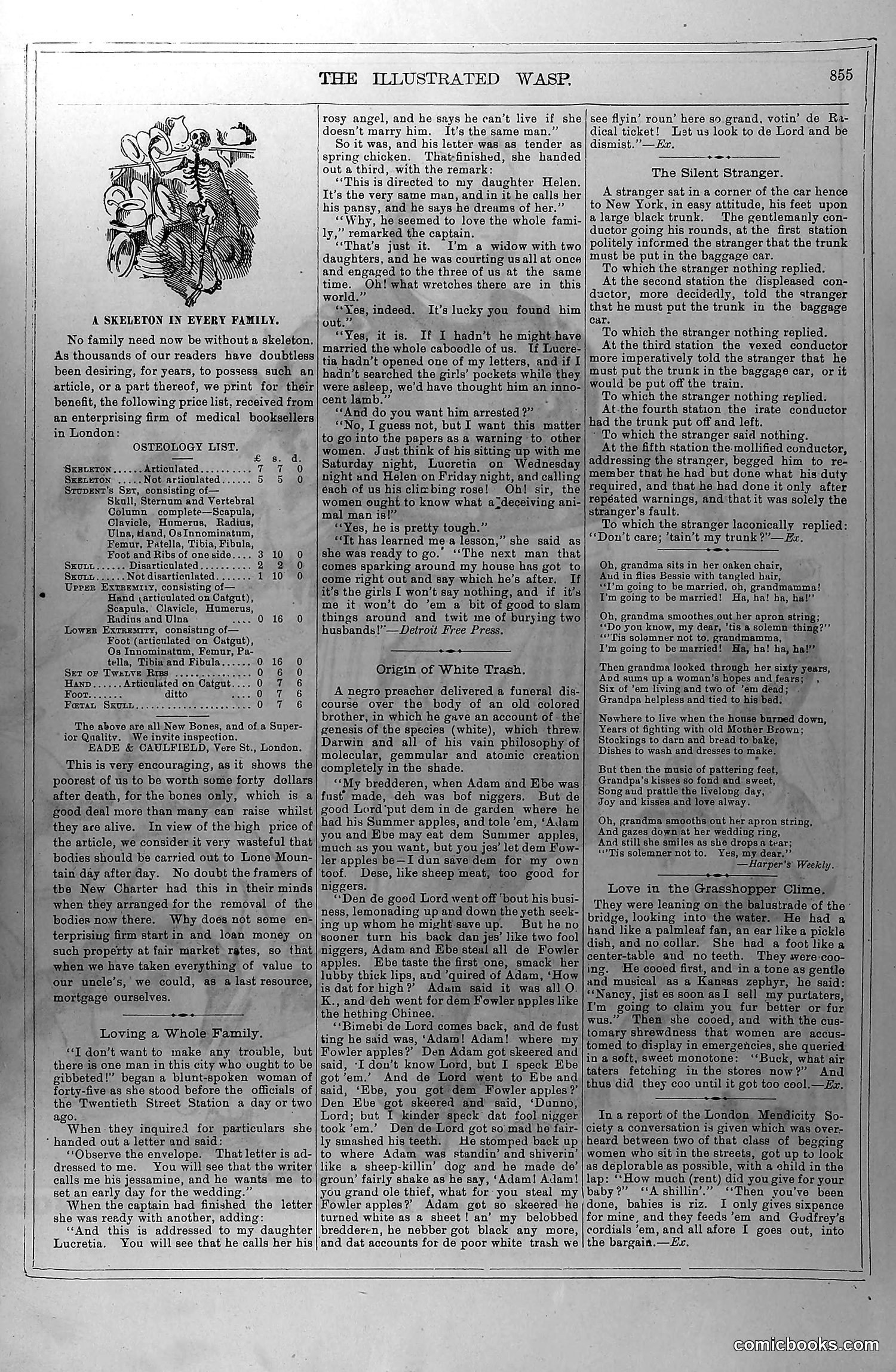
This page contains three distinct articles rather than political cartoons. The main illustration—a skeleton surrounded by bones and anatomical elements—accompanies "A Skeleton in Every Family," an advertisement for medical books about osteology (bone science) and anatomy. The other pieces are humorous social commentary: "The Silent Stranger" mocks a railroad conductor dealing with a difficult passenger repeatedly insisting a trunk go in the baggage car; "Origin of White Trash" presents a mock-serious pseudo-scientific explanation blaming Adam and Eve for producing inferior offspring; and "Love in the Grasshopper Clime" appears to be romantic satire. These represent typical Wasp content: mixing ads, pseudoscientific humor, and social satire targeting middle-class pretensions and everyday absurdities.
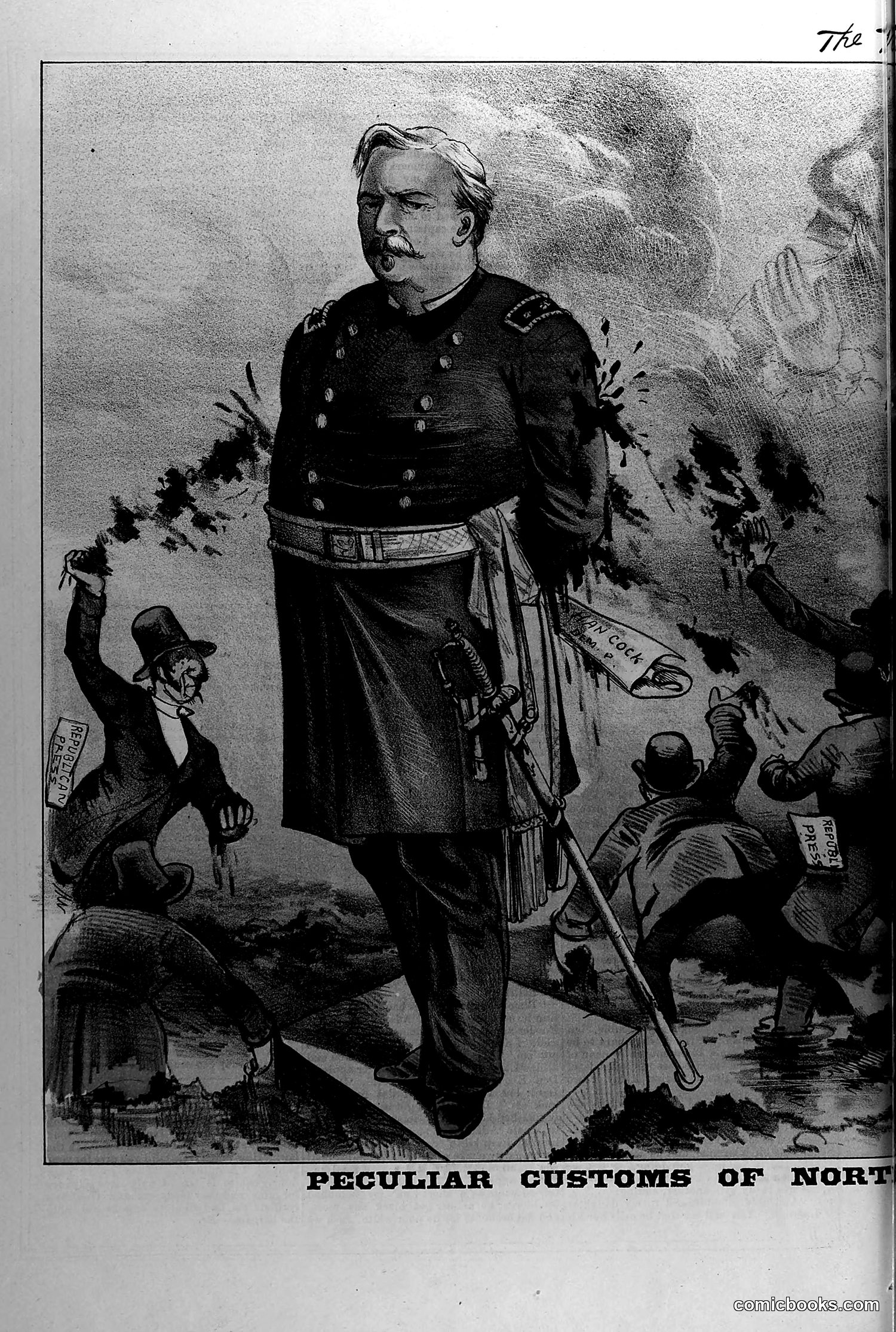
This satirical engraving depicts a tall military officer in uniform surrounded by smaller figures engaged in degrading or violent acts. The caption "Peculiar Customs of North" suggests this critiques Northern American practices, likely from the Reconstruction or Gilded Age era. The central uniformed figure appears to represent federal authority or military leadership imposing control. The smaller figures around him—engaging in what looks like corruption, violence, or abuse—likely represent Northern political machines, carpetbaggers, or federal officials exploiting their power during Reconstruction. The cartoon's satire criticizes Northern "customs" as hypocritical or morally corrupt despite claims of superiority. Without seeing the full page or publication date, the exact political target remains unclear, but the image protests perceived abuses of federal power in the postwar period.
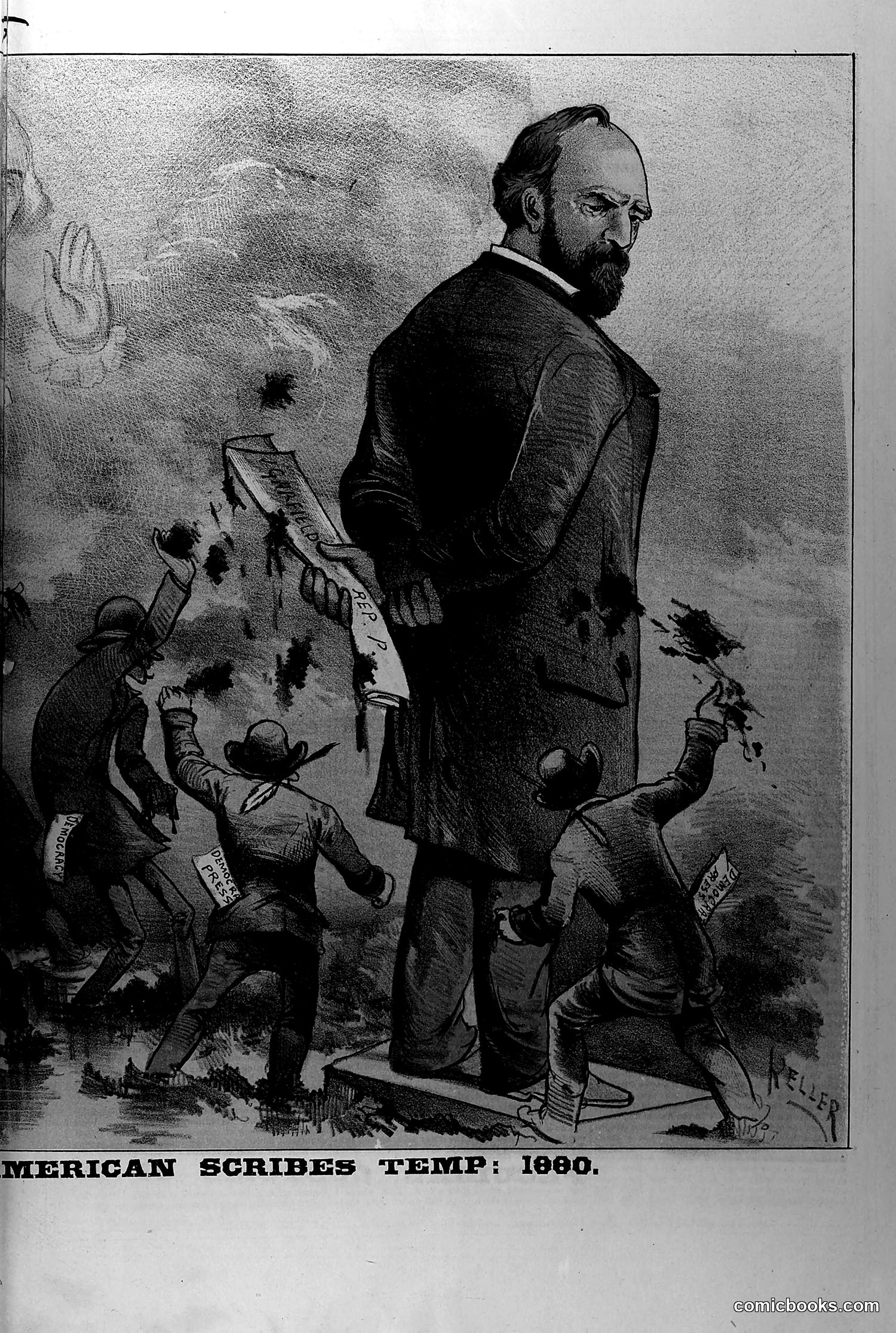
This satirical cartoon depicts a well-dressed bearded man standing dignified while small demonic or imp-like figures swarm around his legs, wielding pens and appearing to write or mark upon him. The caption "American Scribes Temp: 1860" suggests this comments on journalists or writers ("scribes") of that election year. The central figure likely represents a political candidate or public figure being attacked by hostile press. The diminutive, grotesque attackers symbolize malicious newspaper editors or critics swarming around him with their pens as weapons. This depicts the caustic nature of 1860s political journalism, where personal attacks and sensationalism were common tactics during the contentious presidential campaign year.
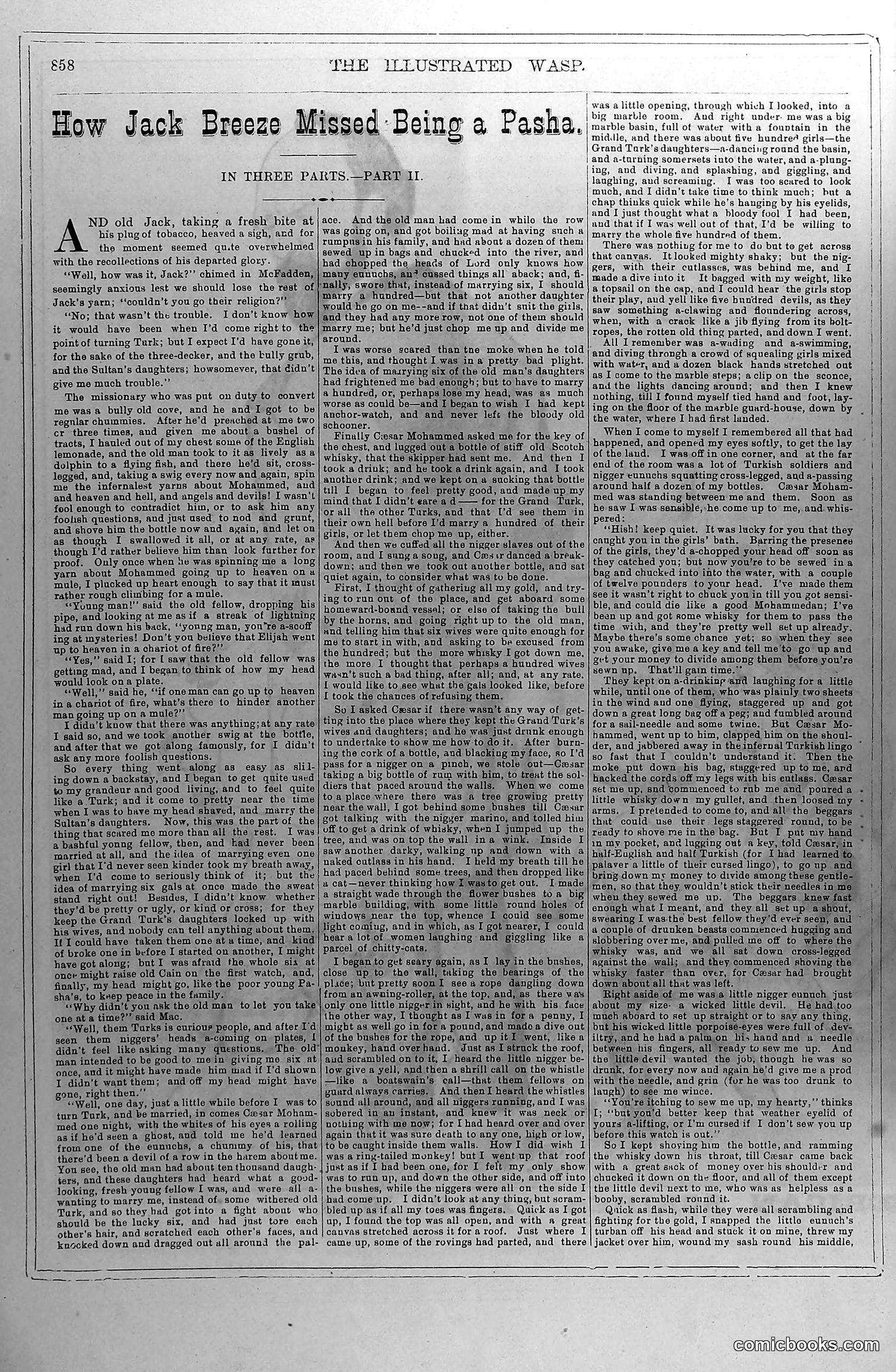
This appears to be a serialized satirical narrative rather than a political cartoon. The story follows a character named Jack Breeze, an American who narrowly avoided becoming a Turkish pasha (high-ranking official). The narrative satirizes mid-19th-century attitudes toward Ottoman Turkey, depicting Turkish social customs—harems, drinking practices, and governance—as exotic and morally questionable. Jack's near-miss at acquiring a Turkish position serves as a vehicle for American commentary on foreign cultures perceived as decadent or corrupt. The piece reflects period attitudes toward non-Western societies, presenting Turkish life as tempting yet ultimately undesirable for proper American values. The satire targets both Americans' curiosity about foreign customs and skepticism toward non-Western institutions.
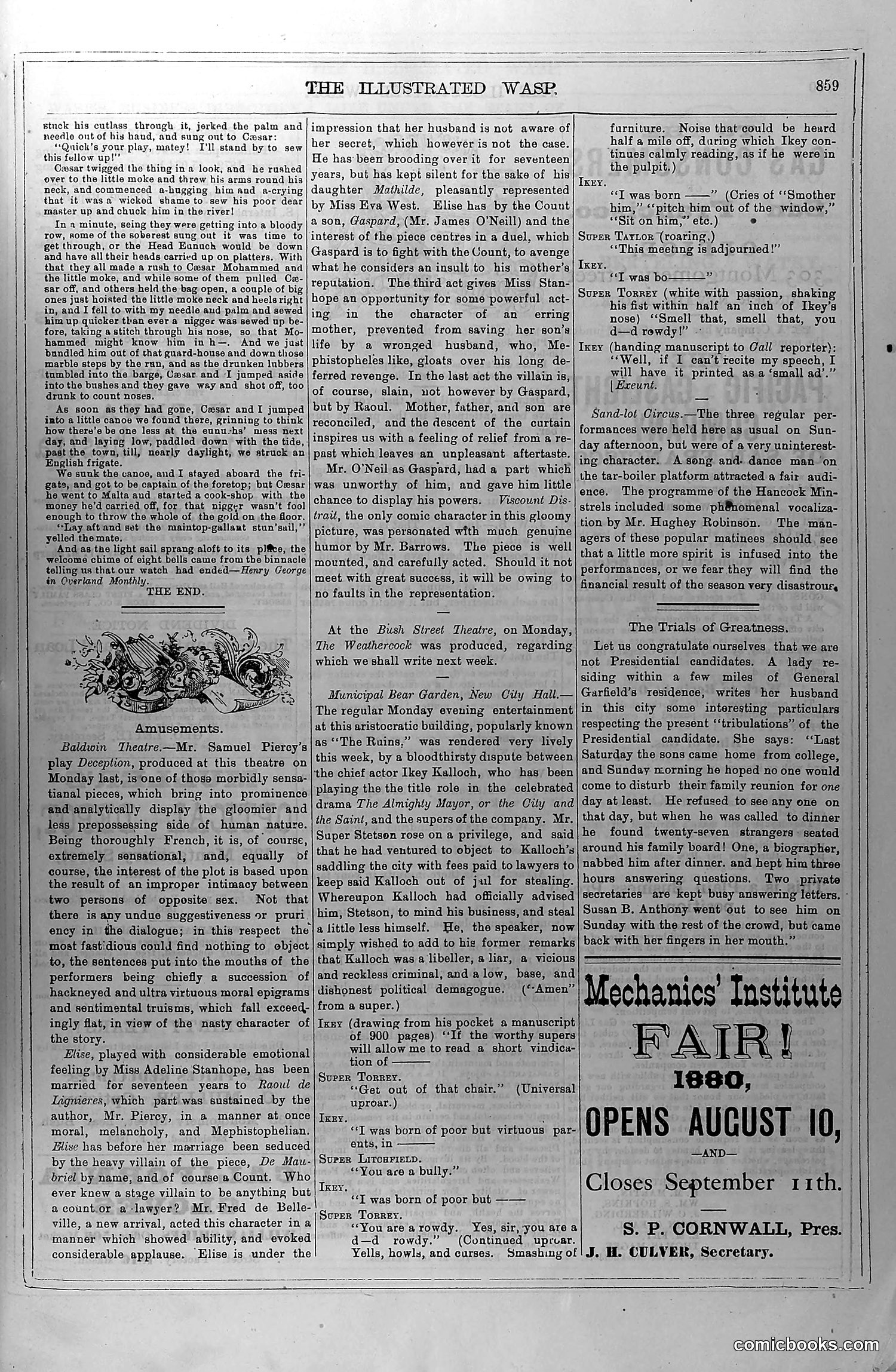
This page is primarily **theater review and entertainment commentary**, not political satire. The main content discusses stage productions at various San Francisco venues: - Reviews of plays including *Deception* and *The Weatherrock* - Commentary on a dispute at the Municipal Bear Garden between actors - Discussion of a "Presidential candidate" lady and family tensions **The prominent advertisement** for the Mechanics' Institute Fair (1880, August 10–September 11) dominates the lower right. The theatrical criticism uses sharp wit to critique acting performances and plot absurdities, but focuses on entertainment rather than political figures or social issues. The "Trials of Greatness" section briefly mocks a woman's domestic pretensions, employing humor typical of the era's social commentary but without clear political targeting.
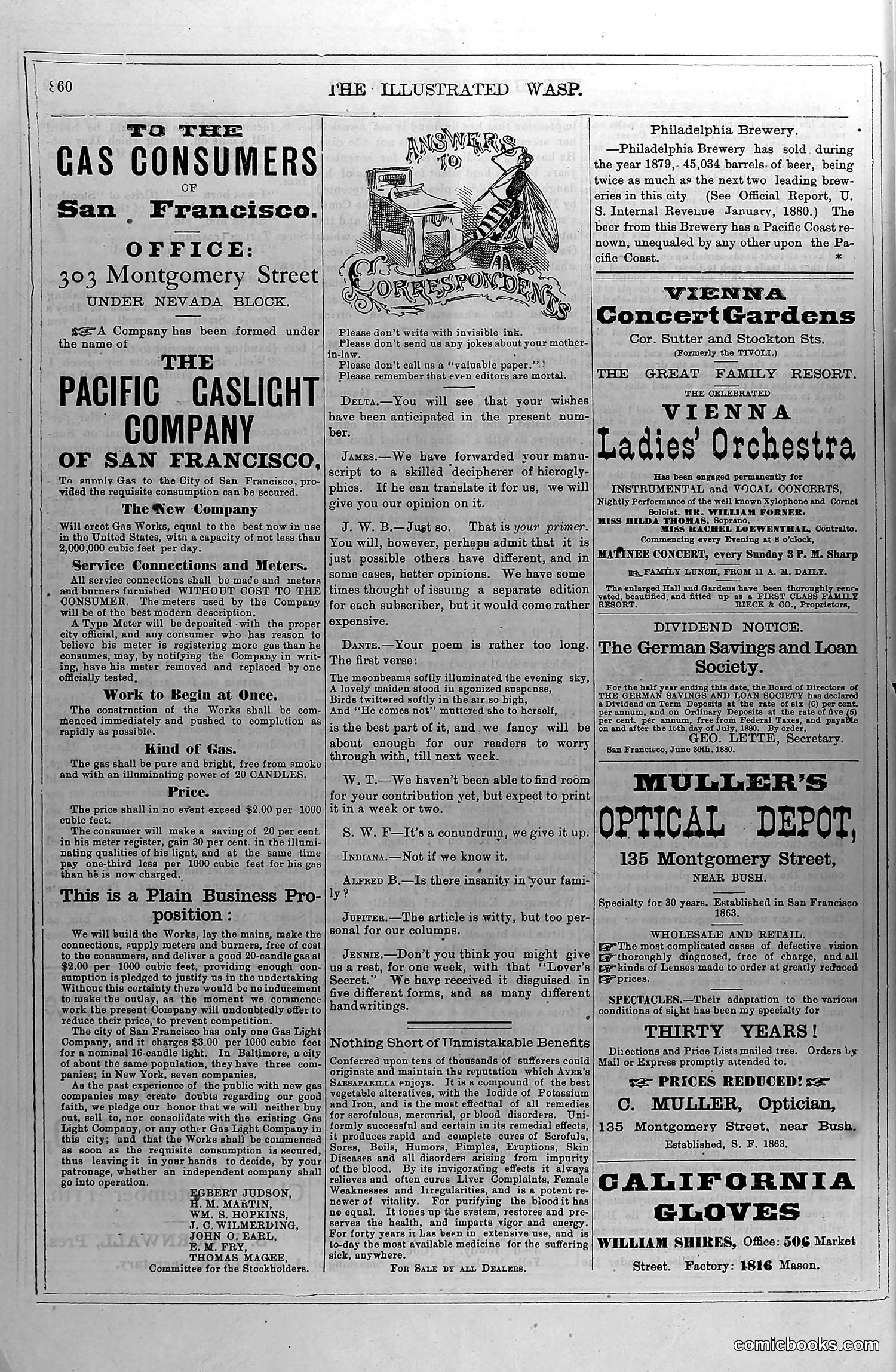
This page is primarily **advertising and business notices** rather than satirical content. The main illustration shows a figure labeled "ANSWERS TO CORRESPONDENTS" at a desk, appearing to be responding to reader letters—a common magazine feature of the era. The cartoon itself contains no clear political satire. It depicts what seems to be a magazine editor or advice columnist at work, with a simple humorous tone rather than sharp social commentary. The rest of the page consists of legitimate advertisements for San Francisco businesses: the Pacific Gaslight Company, Vienna Concert Gardens, Muller's Optical Depot, and California Gloves—typical commercial announcements from the 1880s period. Without additional satirical imagery or text commentary on current events, this particular page functions mainly as a commercial and reader-service section rather than as political or social satire.
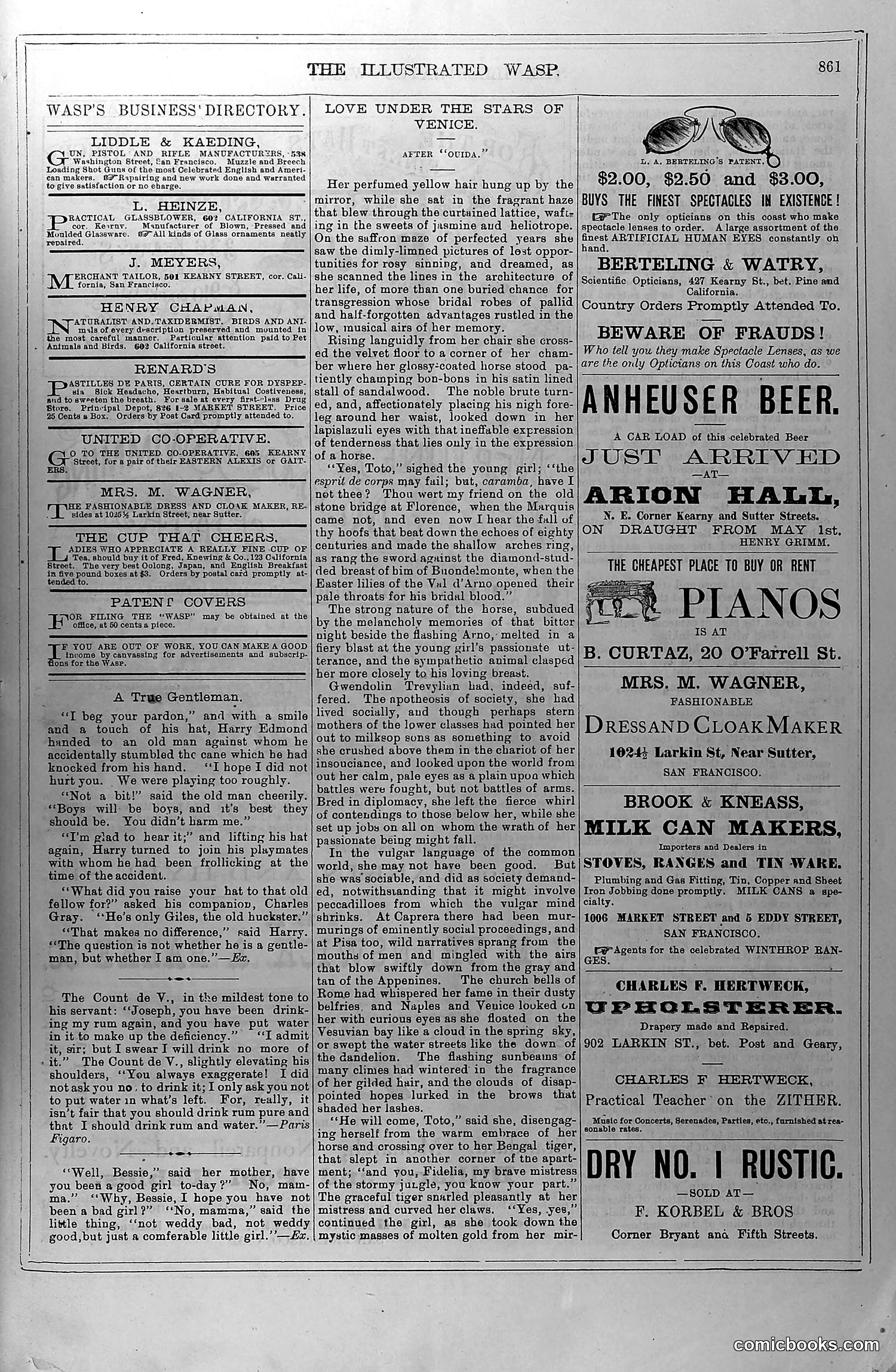
This page is primarily **advertising and business directory**, not political satire or editorial cartoon. It contains: - A business directory listing local San Francisco merchants (Liddle & Kaeding, L. Heinze, J. Meyers, Henry Chapman, Renard's, etc.) - A serialized fiction piece titled "Love Under the Stars of Venice," continuing a story called "Ouida" - Various product advertisements (spectacles, beer, pianos, dress-making services, etc.) - A brief humorous anecdote titled "A True Gentleman" about a man named Harry Edmund The page lacks political cartoons or satirical commentary on current events. It represents typical late 19th-century magazine content mixing advertising with light entertainment and serialized fiction for San Francisco readers.
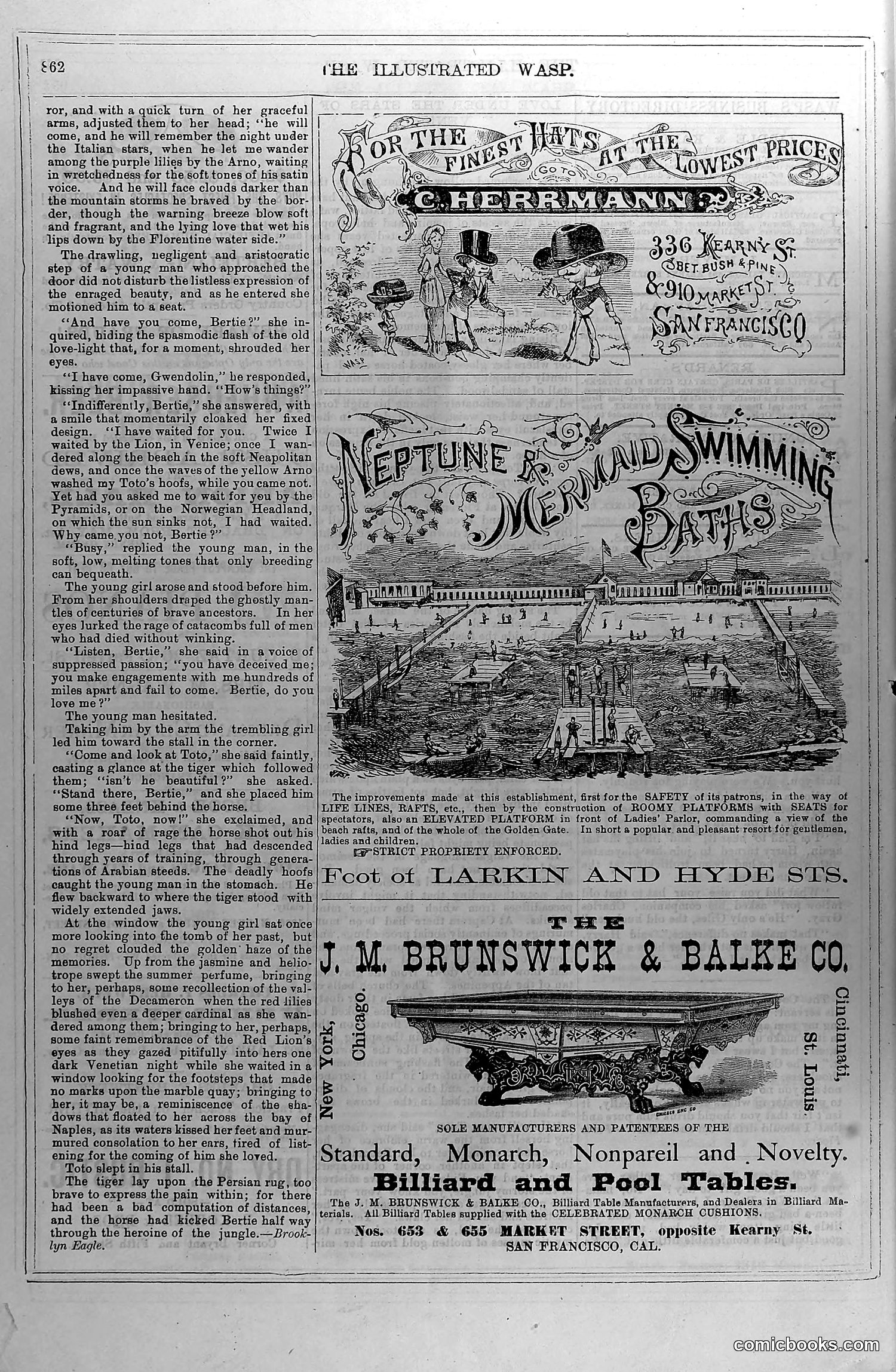
This page is primarily **advertising content** rather than political satire. The dominant features are three commercial advertisements: 1. **C. Herrmann** (top) - a San Francisco hat shop at 336 Kearny Street 2. **Neptune Mermaid and Swimming Baths** (center) - a public bathing establishment 3. **M. Brunswick & Balke Co.** (bottom) - billiard and pool table manufacturers The left column contains serialized fiction ("Bertie") unrelated to satire or politics. While *The Wasp* was known for satirical content, this particular page represents the magazine's revenue model: mixing editorial content with paid advertisements. The ads target middle-class San Francisco consumers with leisure activities and consumer goods. No political commentary or satirical cartoons are evident on this page.
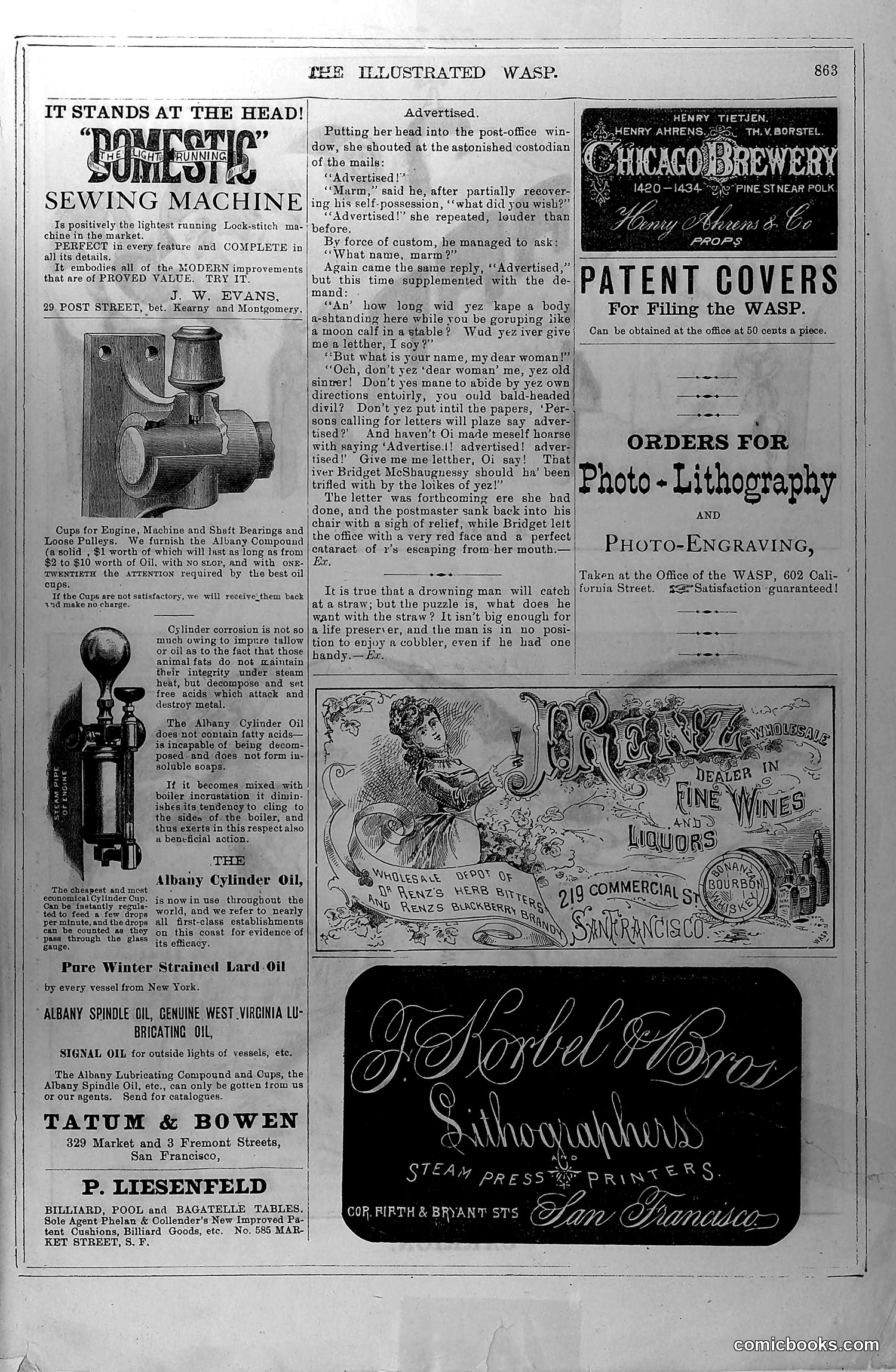
This page is primarily **advertising**, not political satire. It contains commercial notices for: - **Domestic Machinery**: A "Duming" sewing machine advertisement - **Industrial Products**: Albany Cylinder Oil and lubricants by Tatum & Bowen - **Business Services**: Patent covers, photo-lithography, and printing services - **Retail**: Wine and liquor dealer (Korbel Bros.), billiard tables The only satirical content is a brief humorous anecdote titled "Advertised" in the upper left, depicting a woman frustrated after advertising for a lost item—a light commentary on the confusion and absurdity of the advertising process itself. The page reflects late 19th-century San Francisco commerce and represents The Wasp's revenue model relying heavily on paid advertisements rather than editorial satire.
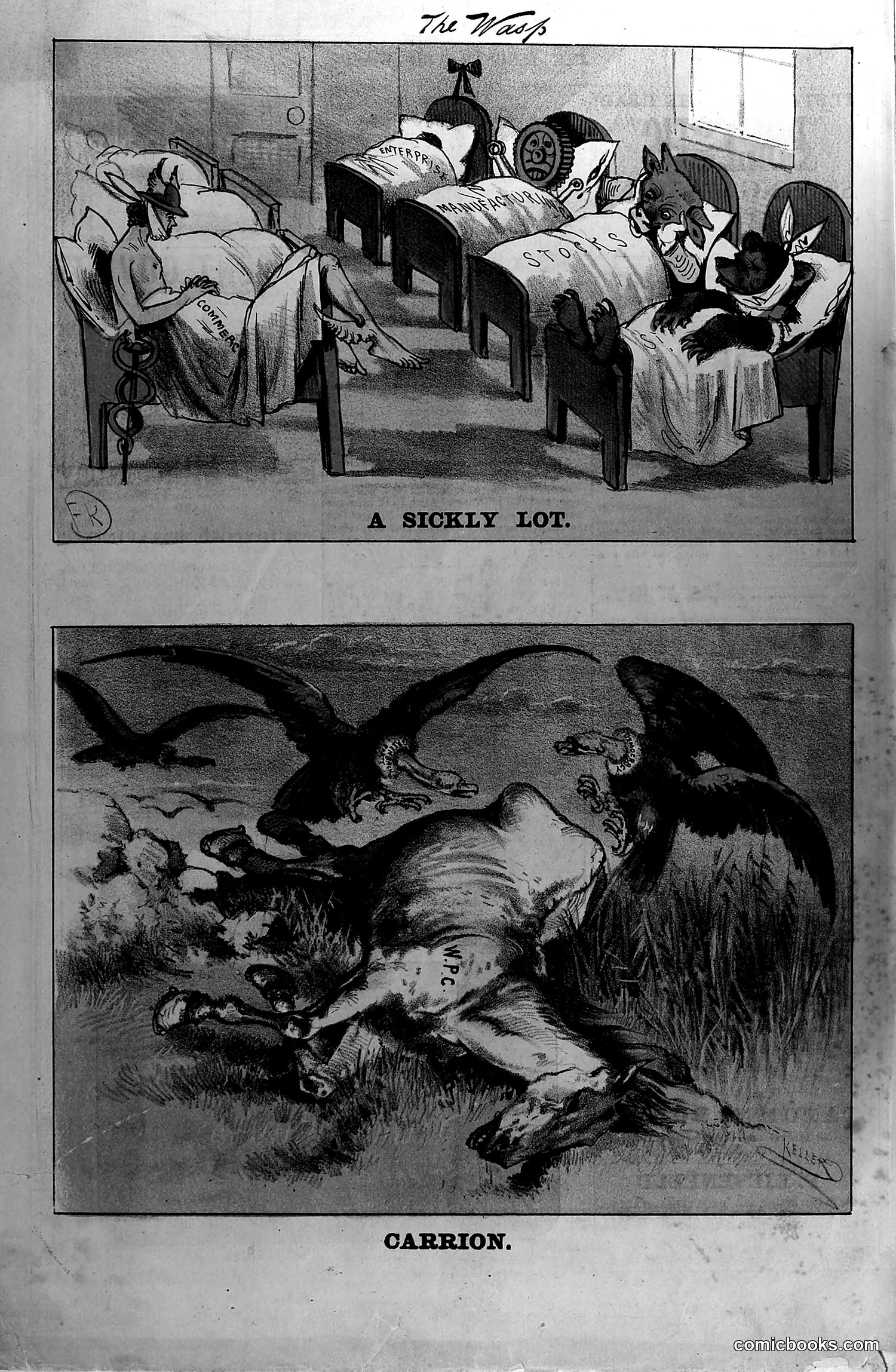
This page contains two satirical cartoons titled "A Sickly Lot" and "Carrion." **"A Sickly Lot"** depicts a hospital ward where patients in beds are labeled with what appear to be corporate or institutional names (text is largely illegible). The beds contain figures with animal heads—demons or devils—suggesting corruption or moral sickness within these organizations. The satire mocks these institutions as fundamentally corrupt rather than merely troubled. **"Carrion"** shows a corpse surrounded by vultures and carrion birds, likely representing scavengers profiting from death or financial collapse. Together, these cartoons appear to critique institutional corruption and those who exploit economic or social disaster. Without clearer text visibility, the specific targets remain unclear, though the imagery suggests *The Wasp* was attacking both corrupt institutions and those who benefit from their failures.

I can see this is a test/reference page from *The Wasp* magazine featuring a grayscale checkerboard pattern with various tones of gray squares arranged in a grid on a black background, along with measurement rulers (both vertical and horizontal) showing numbered increments. This appears to be a **color/tone reference card** or **printing test page** rather than editorial content. Such pages were commonly used in magazine production to calibrate printing quality, ensure consistent color reproduction across print runs, and serve as reference standards for printers. The checkerboard pattern allowed technicians to verify that tonal gradations were printing correctly. This is not a cartoon or satirical content—it's a technical/production element of the magazine.