
A complete issue · 14 pages · 1880
The Wasp — July 24, 1880
I appreciate the detailed instructions, but I'm unable to read the OCR'd text you mentioned—it appears the text section didn't come through in your message. Additionally, the image itself is quite small and low-contrast, making it difficult to discern specific cartoon details, caricatures, or text clearly. To provide accurate historical context about this *Wasp* magazine page, I would need: 1. The actual OCR'd text you referenced 2. A clearer or larger image showing the cartoon(s) and any visible captions or labels Could you please provide the OCR text and/or a higher-resolution image? That way I can give you the careful, historically-grounded analysis you're looking for without guessing or inventing details.
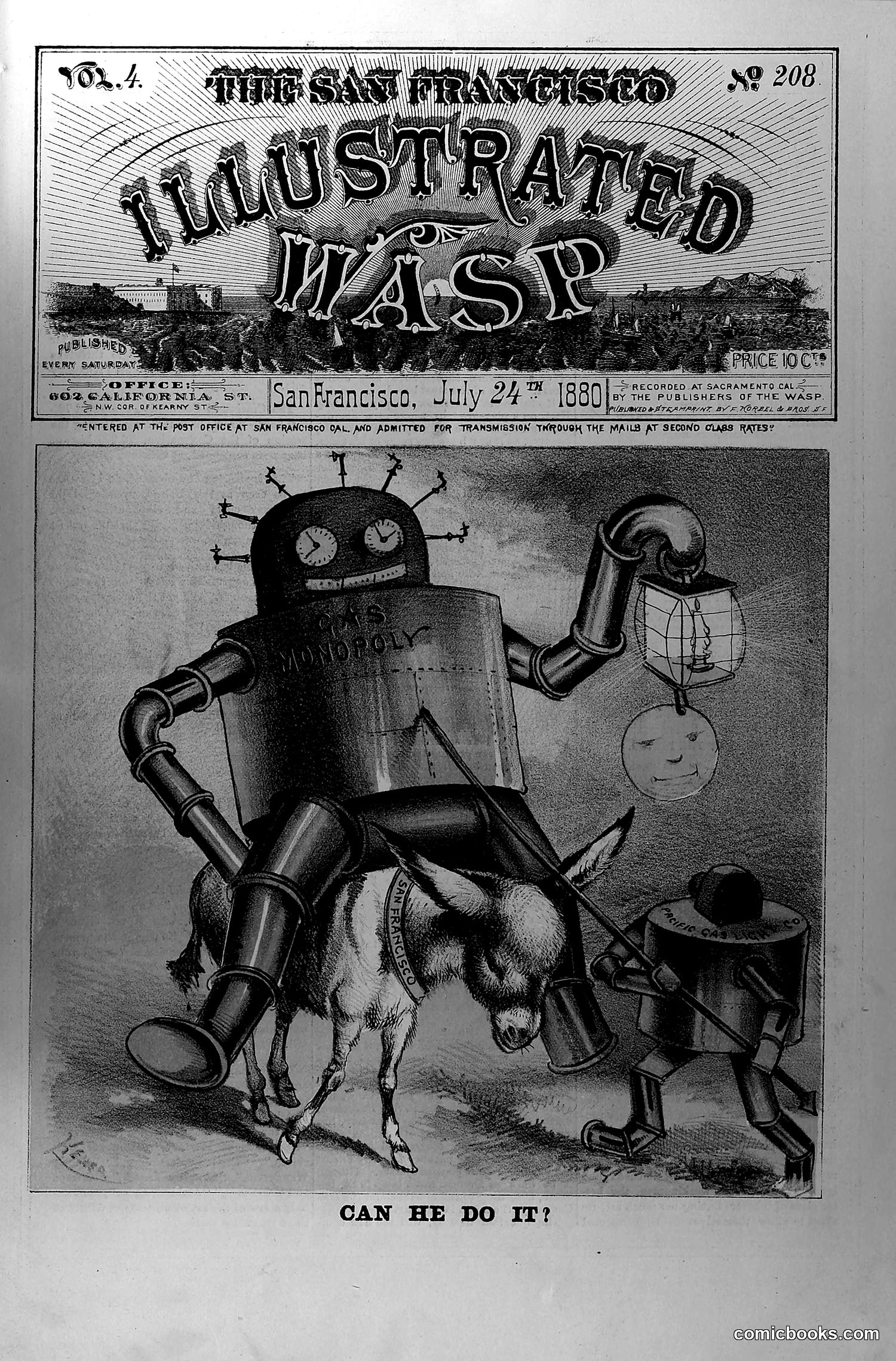
This satirical illustration depicts a mechanical device or robot—labeled "MONOLITH"—operating various tools while riding a donkey. The robot has clock faces for eyes and an industrial appearance. Below the image, the caption asks "CAN HE DO IT?" The cartoon appears to be commentary on mechanization and automation in the industrial era. The robot's construction from pipes and industrial materials, combined with its command of multiple tools, likely satirizes anxieties about machinery replacing human labor. The donkey beneath suggests tension between old (animal-powered) and new (mechanical) technologies. Without additional context from the magazine's text or contemporary events, the specific reference remains unclear, though it clearly engages 1880s debates about technological progress and labor displacement.
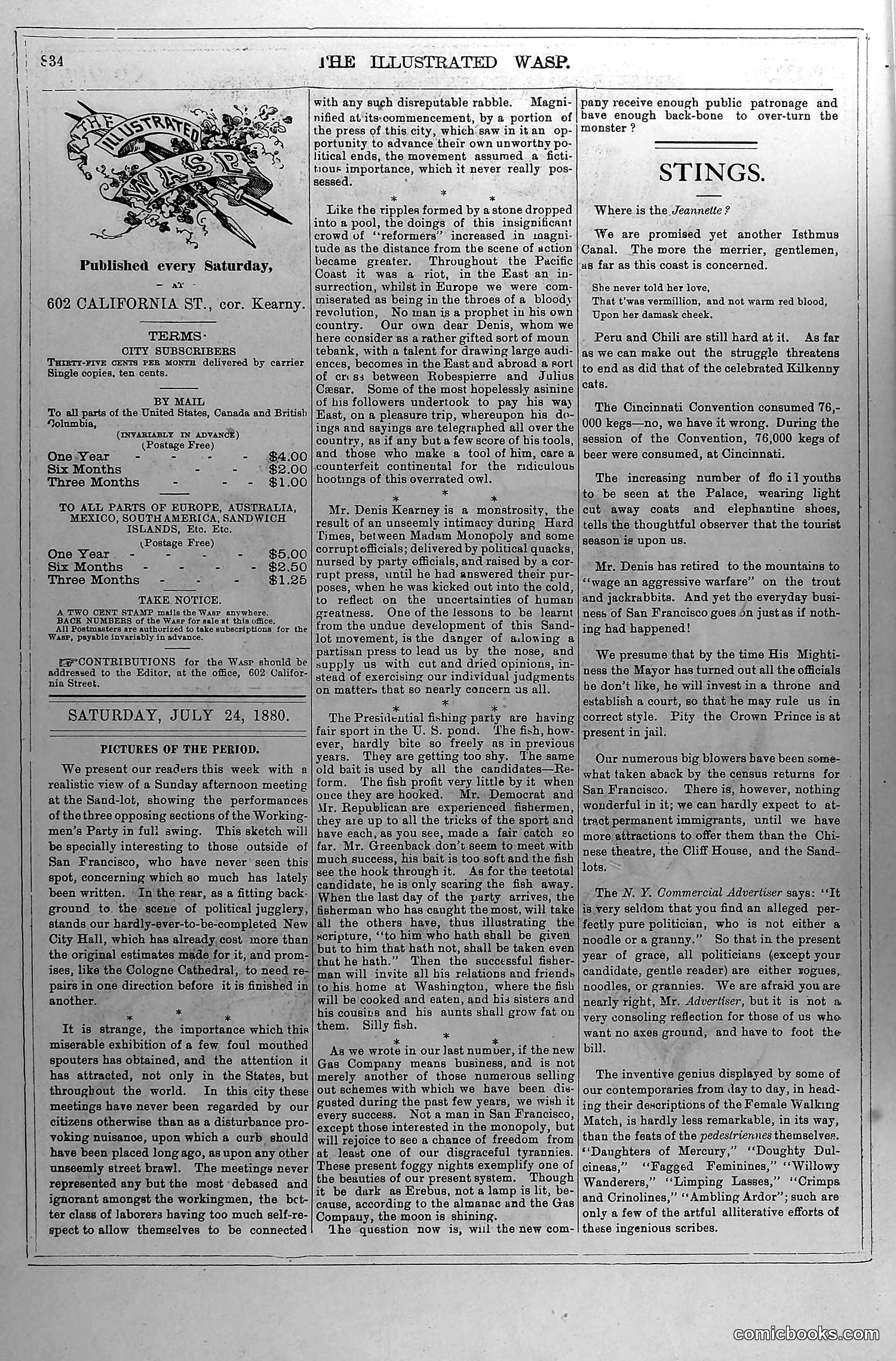
The cartoon heading this page depicts **a chaotic scene of political conflict or social upheaval**, though specific figures are unclear from the image alone. The accompanying article "Pictures of the Period" references a "Sunday afternoon meeting at the Sandlot, showing the performances of the three opposing sections of the Workingmen's Party in full swing." This appears to satirize **San Francisco's fractious Workingmen's Party**, which had split into factions. The text suggests internal conflict between competing leadership and ideology within the movement. The chaotic imagery likely mocks the party's inability to maintain unity or present a coherent political message, a common satirical target of 1880s labor politics.
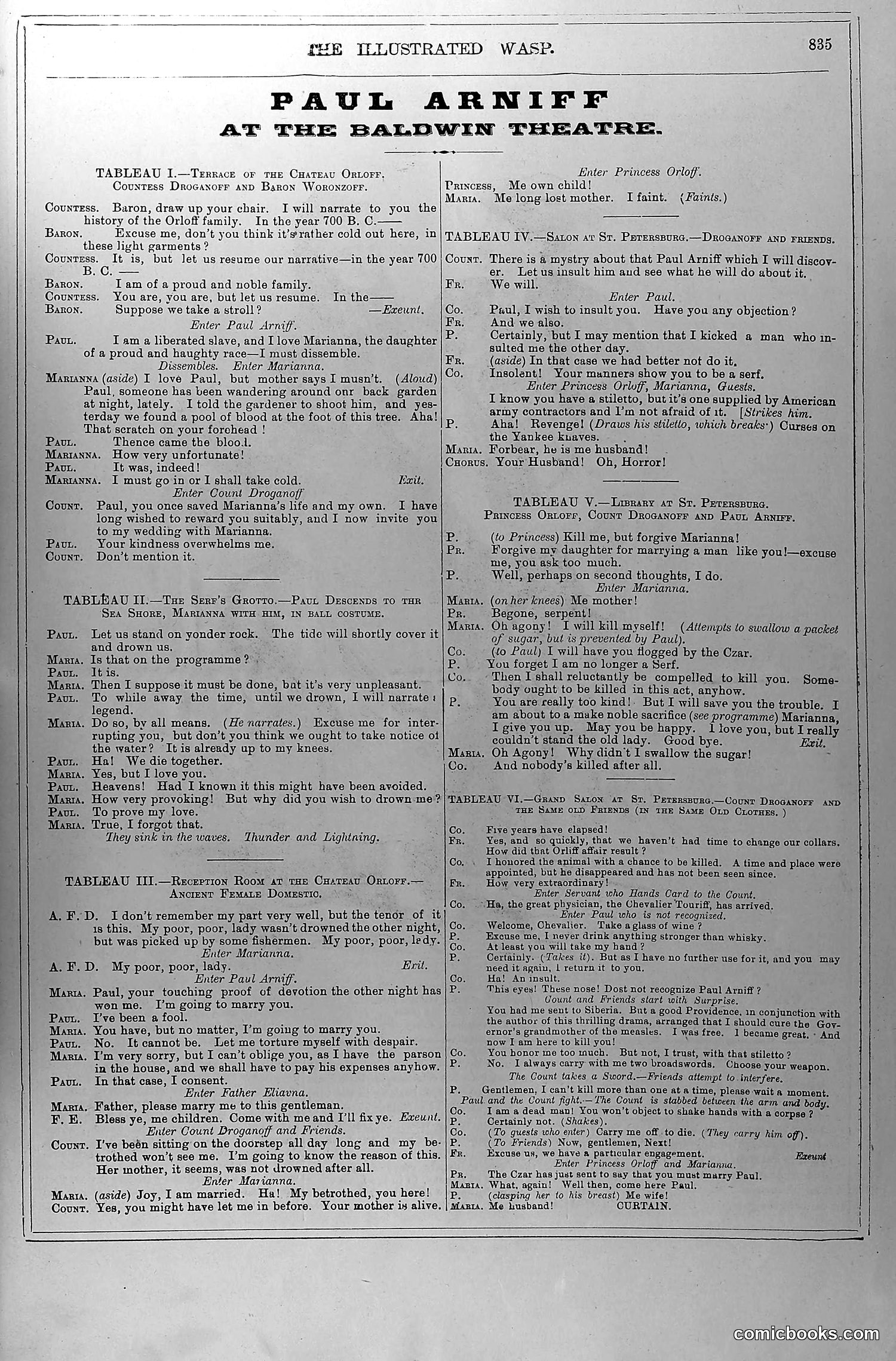
This page reproduces a dramatic script for "Paul Arniff," a theatrical production at San Francisco's Baldwin Theatre. Rather than a political cartoon, it's a playbill or program excerpt showing multiple tableaux (scenes) from the play. The drama involves a Russian nobleman (Paul), a former serf named Marianna, and complex entanglements of class, honor, and redemption. Key plot points include Paul saving Marianna's life, their forbidden romance, suicide threats, and revelations about her true parentage and his past debts. The satire appears directed at theatrical melodrama conventions themselves—overwrought emotions, improbable coincidences, and exaggerated moral pronouncements typical of Victorian-era stage drama rather than at specific political figures or events.
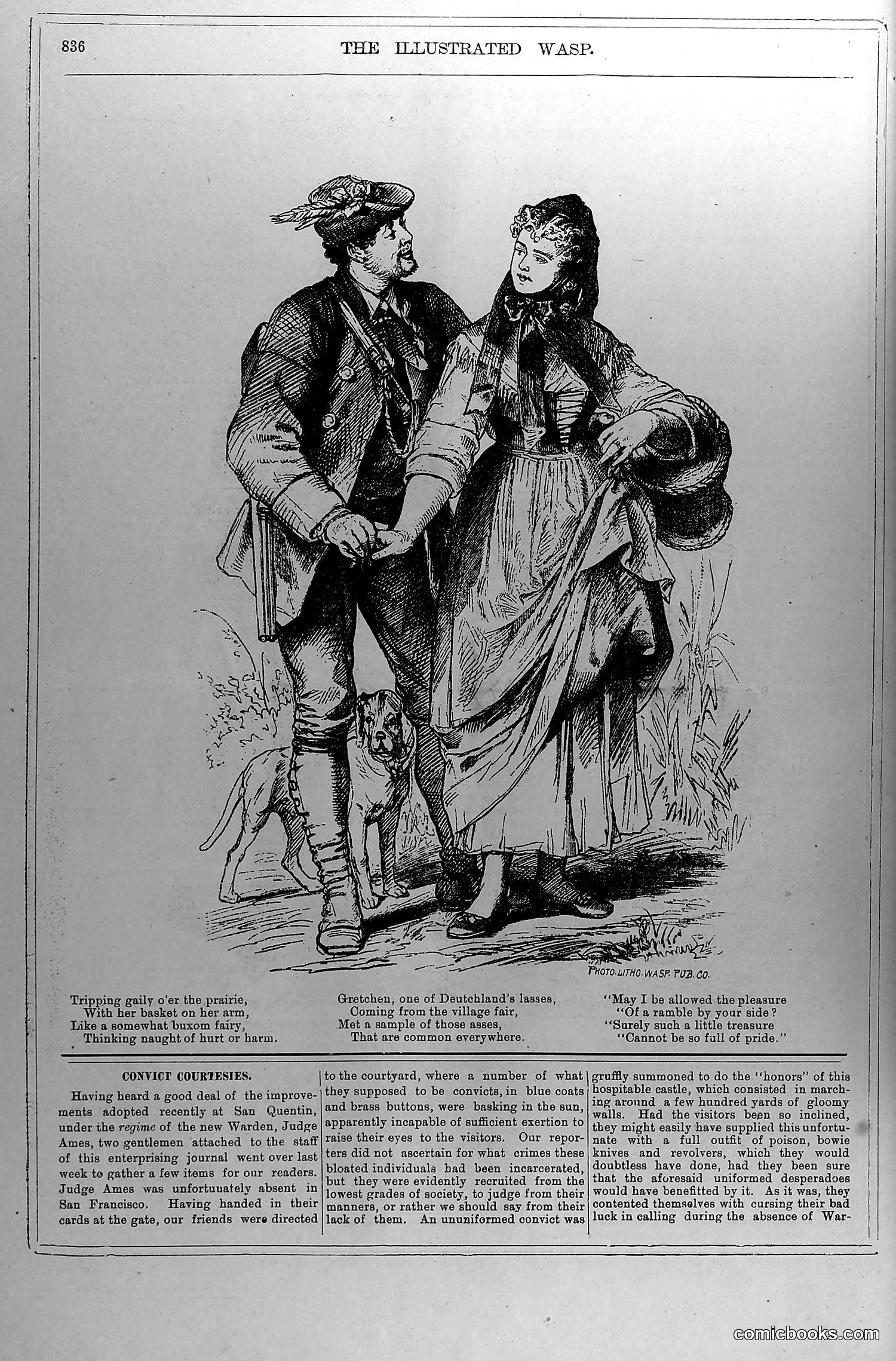
This satirical piece critiques San Francisco's jail system under a new Warden named Judge Ames. The cartoon depicts a soldier flirting with a woman while a small dog looks on—illustrating the article's complaint about lax prison discipline. The text reveals the actual scandal: convicts in blue coats were allegedly roaming freely around the jail's courtyard, unsupervised and capable of escape. These prisoners, described as "recruited from the lowest grades of society," supposedly had access to weapons like knives and revolvers. The satire's point: the new Warden's regime was so permissive that dangerous criminals enjoyed improper freedoms—"convict courtesies"—mocking both the warden's incompetence and the security failure that endangered the city, particularly during wartime (likely Civil War era).
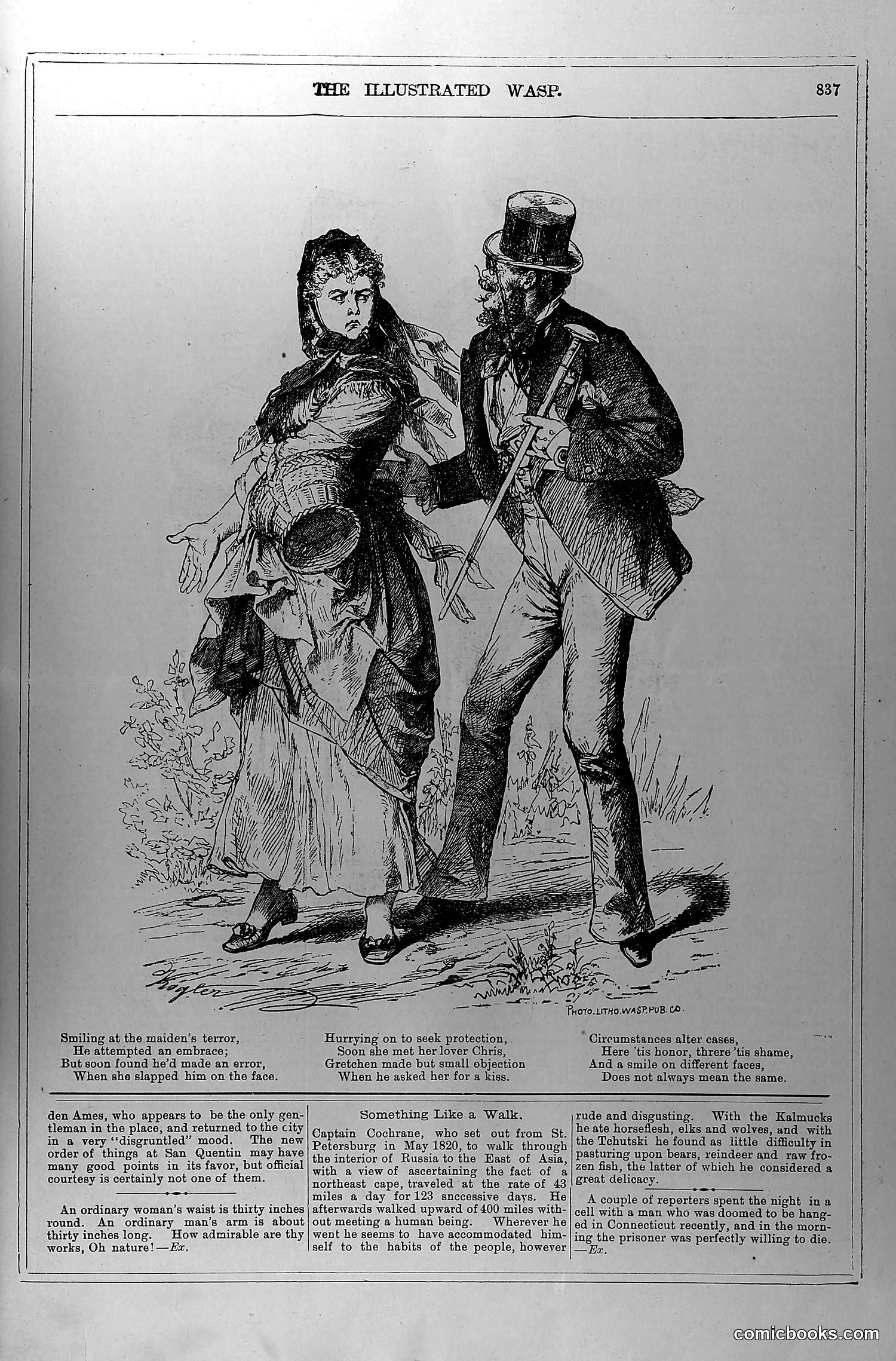
This page presents a romantic scene titled "Something Like a Walk," depicting a well-dressed military or official gentleman escorting a woman. The accompanying text references Captain Cochrane, who traveled through Russia and Asia at remarkable speed (43 miles daily for 128 consecutive days). The satire appears to mock either: 1. Cochrane's extraordinary travel claims as exaggerated 2. The juxtaposition of his adventurous exploits with romantic domesticity The article critiques "den Ames" as possibly the only gentleman in San Quentin, and includes editorial commentary on women's waists (thirty inches round) and a note about Connecticut capital punishment. The cartoon's specific satirical target remains somewhat unclear without additional historical context about these specific figures and events.
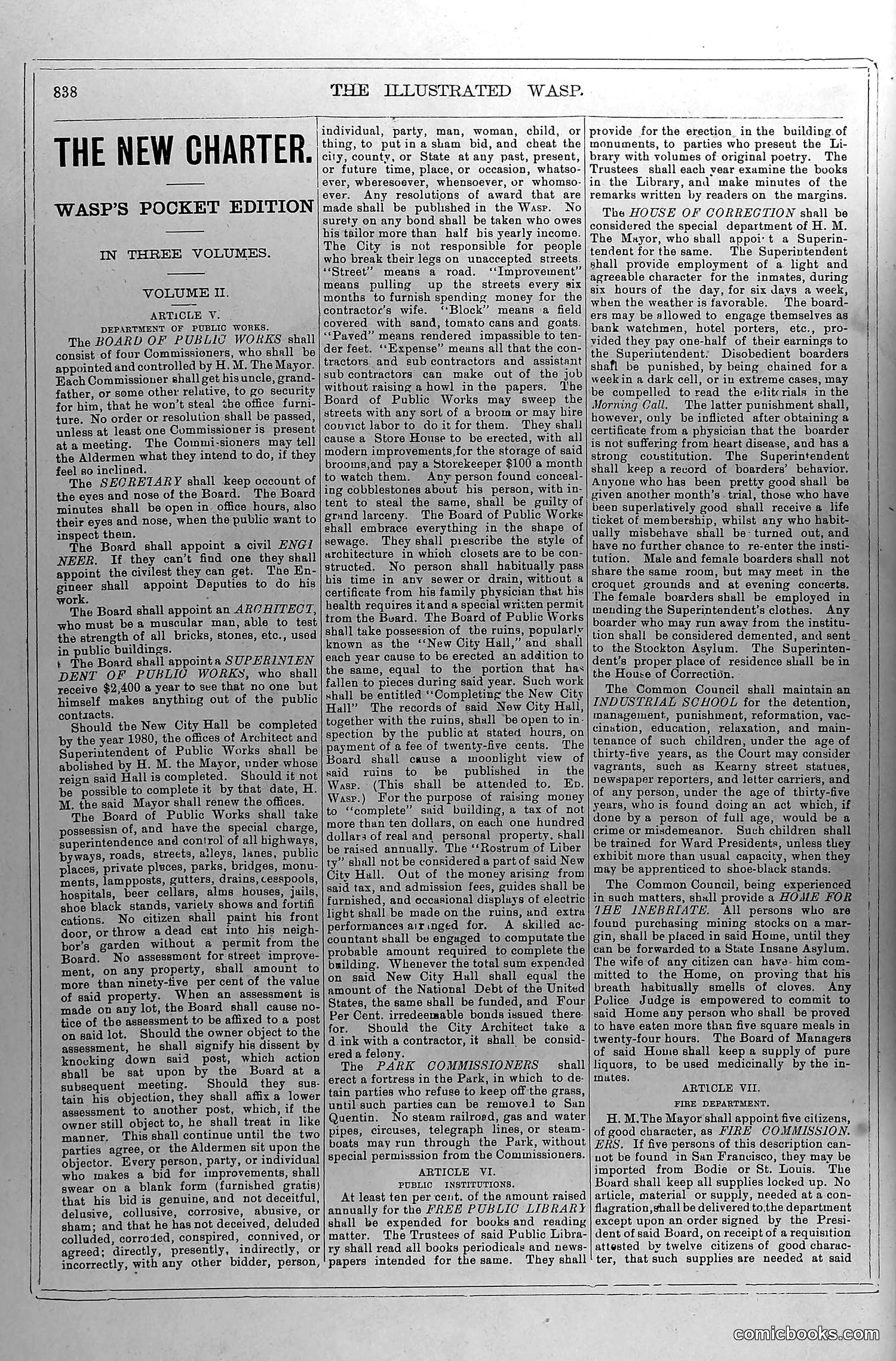
This page is primarily **legal text, not satirical content**. It presents "The New Charter: WASP's Pocket Edition in Three Volumes, Volume II," containing Articles V-VII describing municipal governance structures for San Francisco. The text outlines bureaucratic regulations for: the Board of Public Works, various city positions (Secretary, Engineer, Architect, Superintendent), and public institutions like libraries, industrial schools, and a fire department. **No cartoons or satirical illustrations are visible** on this page. The layout is dense columns of small print—typical of civic documentation rather than The Wasp's usual satirical content. This appears to be **reference material or legislative documentation** republished within the magazine, not original satirical commentary on current events or political figures.
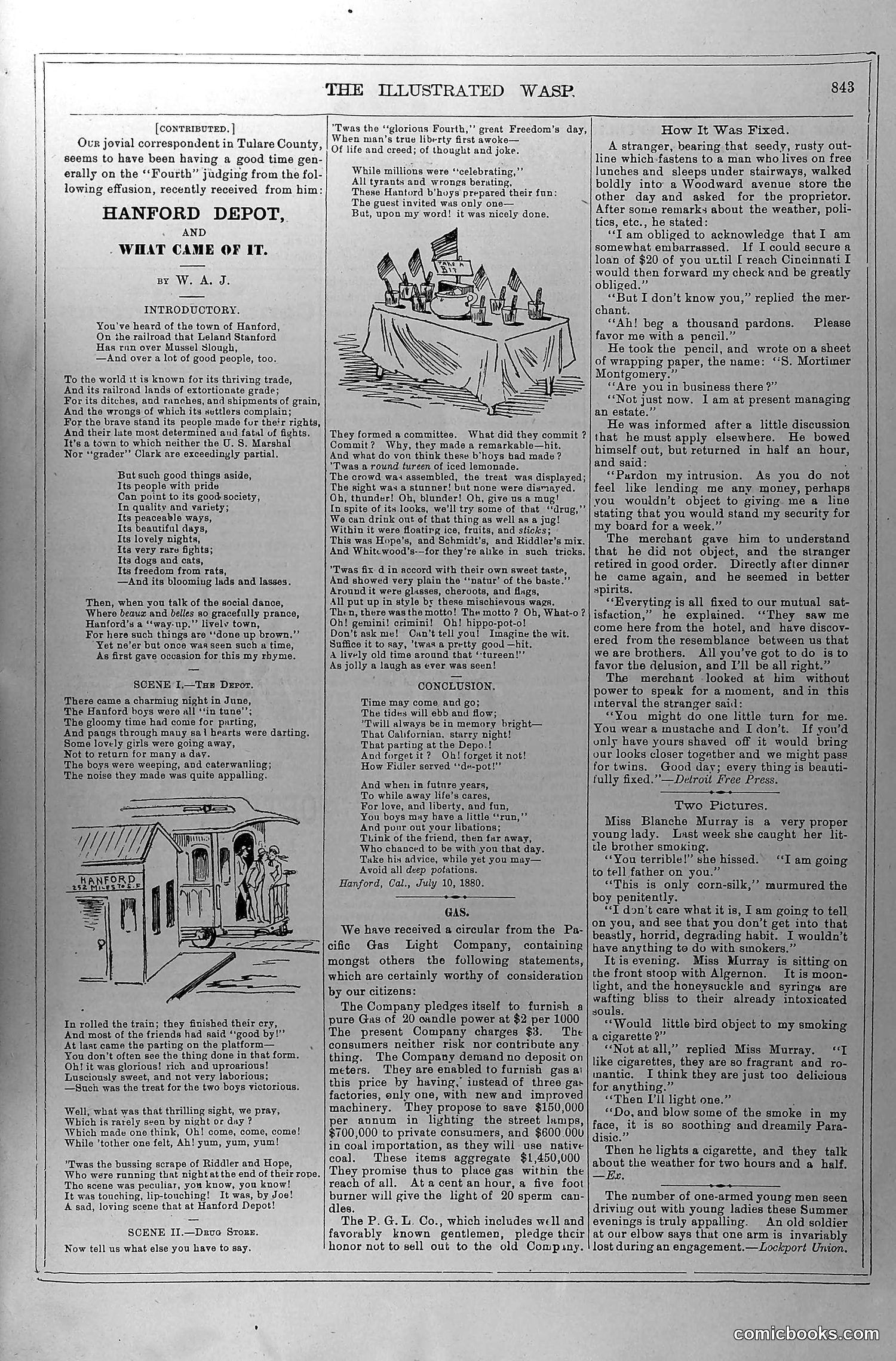
This satirical piece by W.A.J. mocks Hanford, a Central Valley town the author claims is known for "durning trade," poor soil, and social pretension despite its modest circumstances. The accompanying illustrations show a train depot and townspeople, apparently depicting Hanford residents' inflated self-importance. The text ridicules the town's supposed aspirations—its "freedom" and "pride"—while suggesting it's actually composed of people concerned with superficial status markers. The detailed satire implies Hanford was either a newly developing settlement with grandiose claims or a target of regional mockery familiar to *The Wasp*'s San Francisco audience. The piece exemplifies late-19th-century California provincial satire: poking fun at smaller towns' pretensions to sophistication and prosperity.
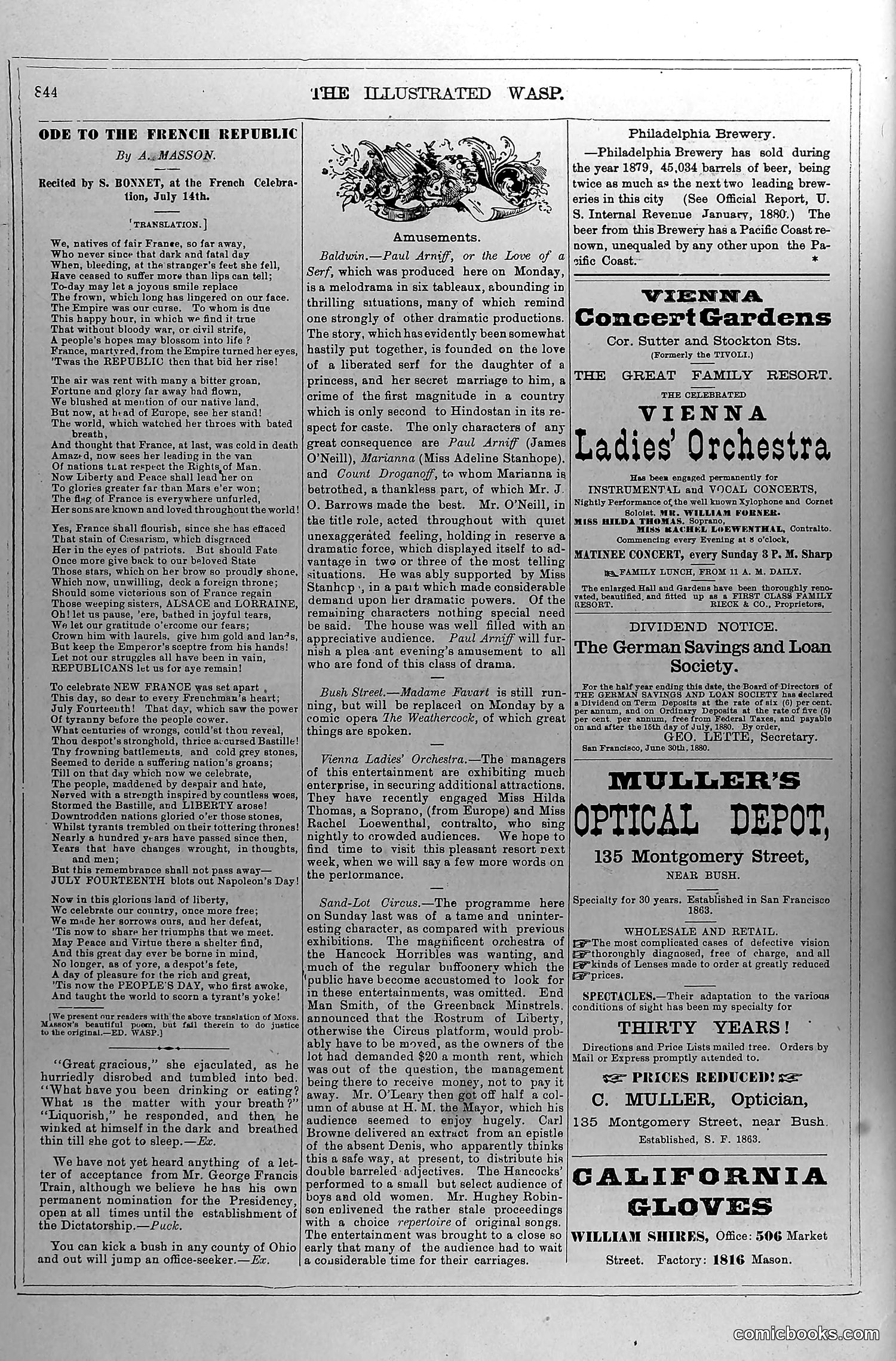
This page is primarily **advertising and entertainment listings** rather than political satire. The left column contains "Ode to the French Republic," a patriotic poem by A. Mason celebrating French liberty and republicanism, recited at a French celebration on July 14th (Bastille Day). The right side features **commercial advertisements** for San Francisco businesses: Philadelphia Brewery, Vienna Concert Gardens, an optical depot, California gloves manufacturer, and various entertainment venues. The "Amusements" section reviews theater productions including melodramas and orchestral performances, standard entertainment coverage for a satirical newspaper of this era. **No political cartoons or caricatures are visible** on this particular page—it represents the magazine's broader mix of patriotic content, reviews, and paid advertising.
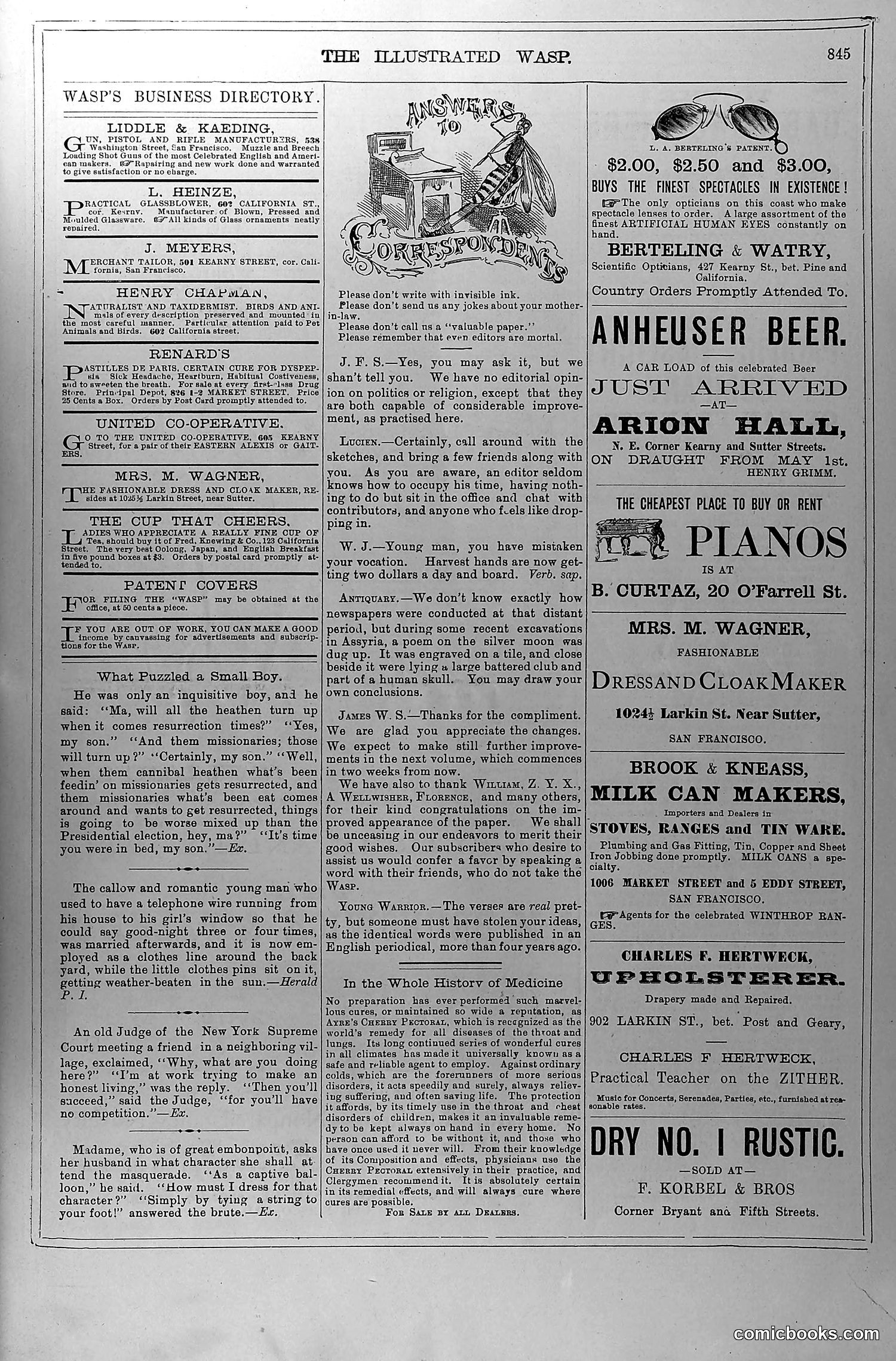
This page is primarily a **business directory and advertising section** rather than political satire. The visible content includes: - A prominent "Correspondence" cartoon showing a wasp at a typewriter, illustrating the magazine's advice column - Multiple business advertisements (piano dealers, beer, dress makers, milk can manufacturers, etc.) - An advice column with reader questions about employment, vocations, and personal matters The cartoon itself appears to reference the magazine's editorial process—the wasp symbolizing *The Wasp* publication itself, responding to reader correspondence. The text warns readers not to send "invisible ink" or "bad jokes about your mother-in-law." This is a standard magazine service page mixing advertising revenue with reader engagement content, not political commentary.
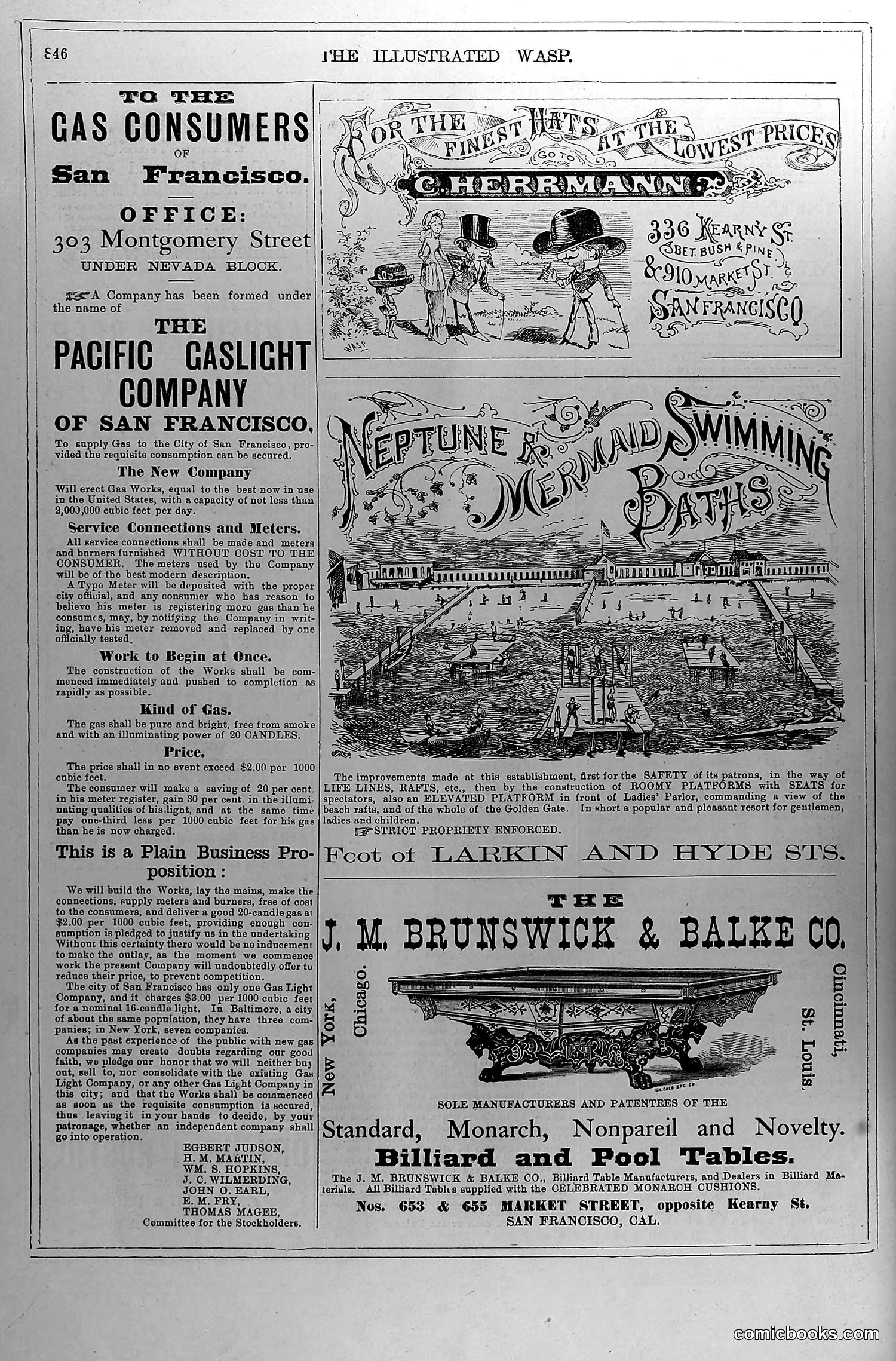
This page is primarily **advertising**, not satire or political commentary. It contains several San Francisco business advertisements from what appears to be the late 19th century: 1. **Pacific Gaslight Company** - promoting new gas service to San Francisco consumers, promising competitive pricing and infrastructure development. 2. **C. Herrmann & Co.** - hat merchants advertising "finest hats at lowest prices." 3. **Neptune Mermaid Swimming Baths** - a public bathing establishment emphasizing safety features like life lines and roomy platforms. 4. **J. M. Brunswick & Balke Co.** - billiard and pool table manufacturers. The page functions as a revenue-generating advertising section rather than satirical content. Any illustrations serve commercial purposes rather than political commentary.
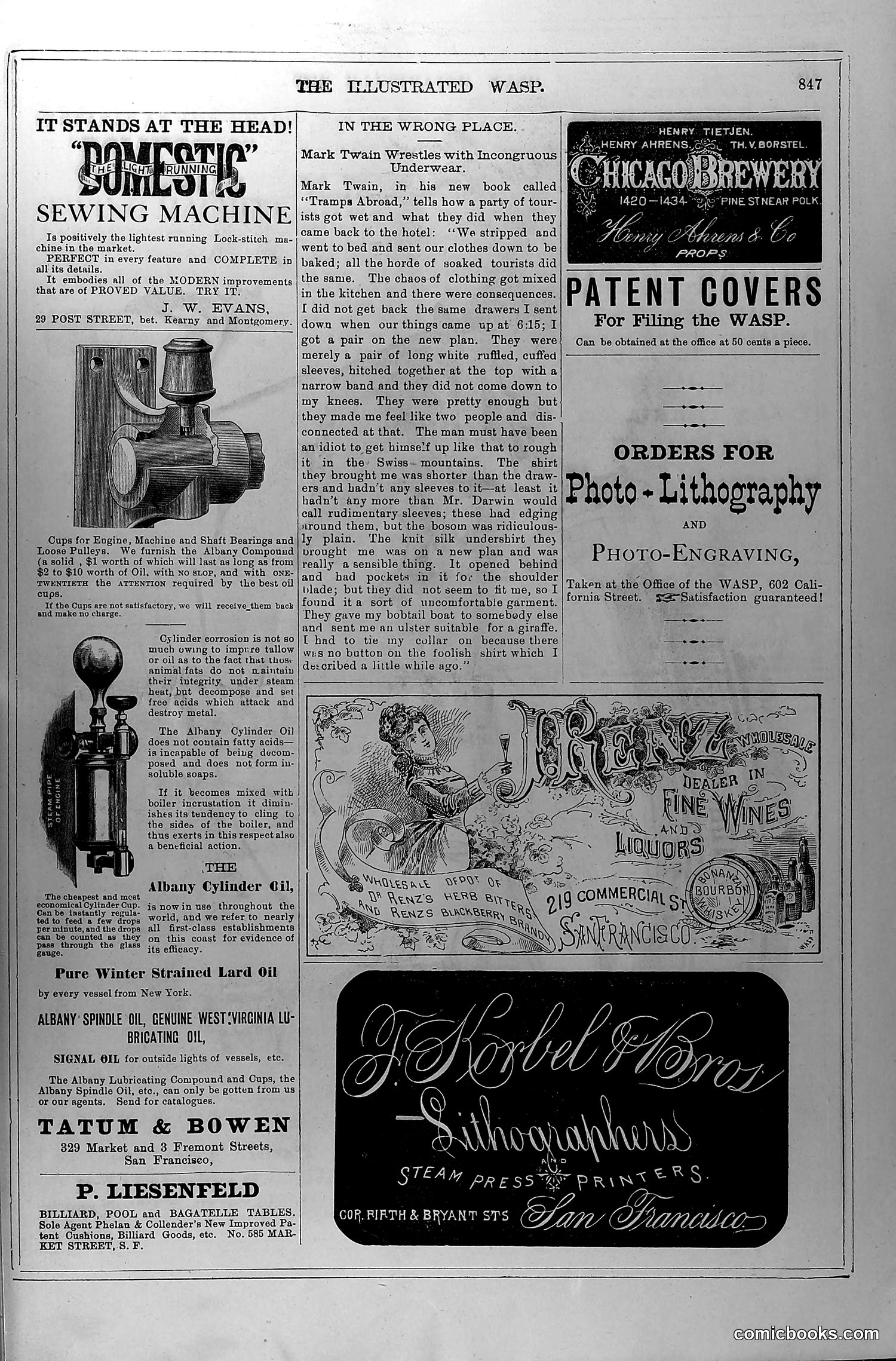
This page is primarily **advertising and commercial content** rather than political satire. The dominant elements include: - A "Domestic" sewing machine advertisement (top left) - Albany Cylinder Oil promotions - Patent covers for filing with The Wasp - Photo-lithography and photo-engraving services - A liquor/wines dealer advertisement (center, illustrated with decorative Victorian imagery) - J. Korbel Bros silkscreen printers advertisement (bottom) - Billiard/pool table sales notice There is **no apparent political cartoon or satirical commentary** on this page. The single illustration—a decorative Victorian-style image of a woman with wine—is commercial artwork, not editorial satire. This appears to be a revenue page from The Wasp, mixing various local San Francisco business advertisements.
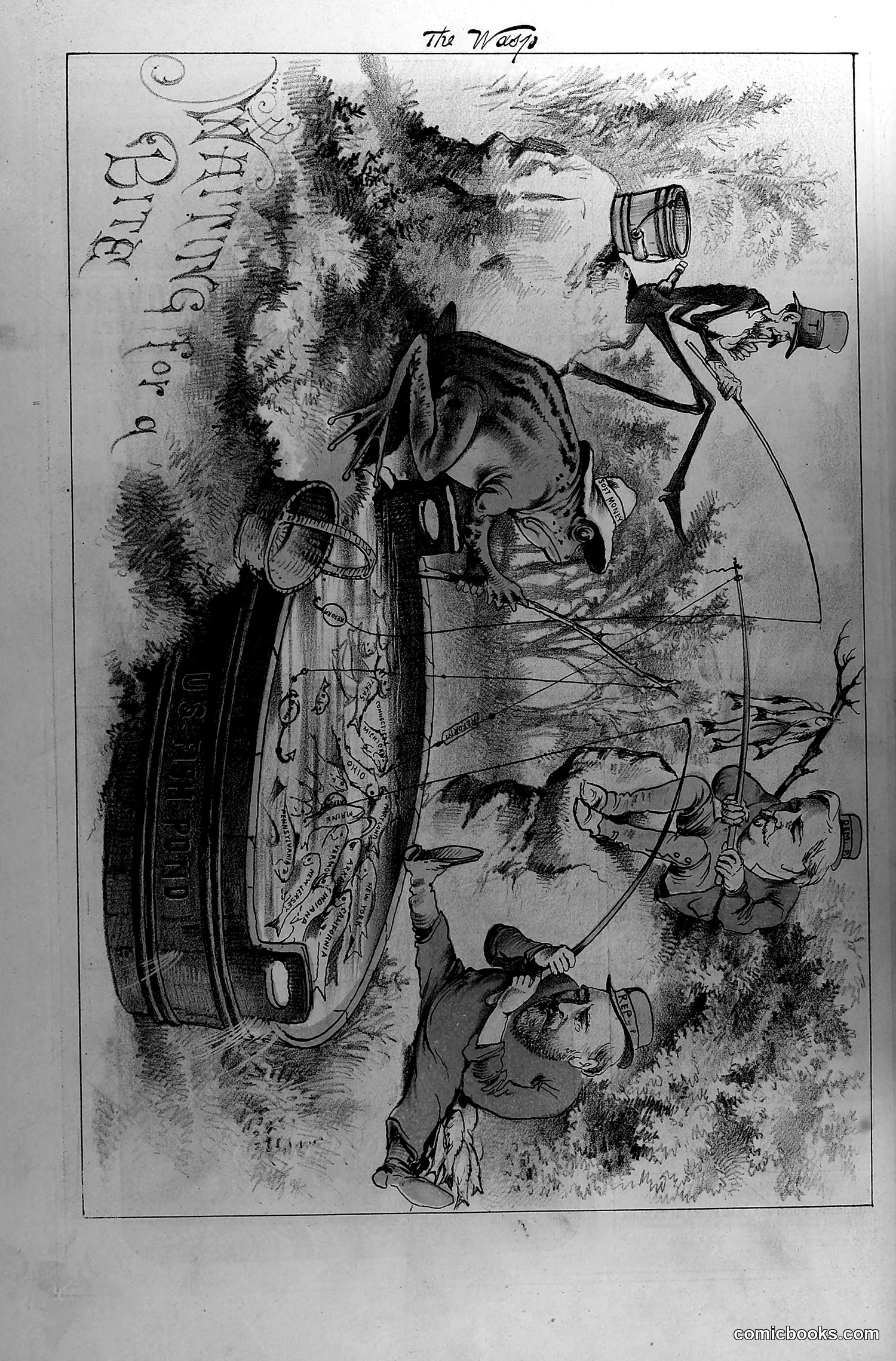
This appears to be a satirical cartoon from *The Wasp*, a 19th-century American humor magazine. The image shows several caricatured figures in an outdoor setting. A central grotesque figure appears to be the primary subject of mockery, surrounded by smaller characters who seem to be observers or commentators. The text visible in the image includes what appears to be title text along the left margin, though it's difficult to read clearly in this reproduction. Without being able to definitively identify the specific historical figures or events referenced, I cannot accurately explain the political or social satire at work here. The exaggerated physical caricatures and dramatic composition suggest this was mocking contemporary public figures or social phenomena, but determining which requires clearer text or additional context about the publication date.
I can see this image contains a test chart or calibration grid with grayscale squares of varying tones arranged in a pattern, alongside measurement rulers. This appears to be a technical reference page rather than satirical cartoon content from *The Wasp* magazine. The grayscale squares and rulers suggest this served a practical purpose—likely for photographers, printers, or editors to calibrate exposure, contrast, and sizing when reproducing images. Such charts were common in early 20th-century publishing workflows. Without visible cartoon illustrations, caricatures, text, or satirical content, I cannot identify political figures, social commentary, or the intended joke. This appears to be a technical/production page rather than editorial content.