
A complete issue · 20 pages · 1880
The Wasp — July 17, 1880

I can see this is a measurement/calibration page from what appears to be a historical document or publication, showing an Oregon Rule Co. ruler scale and a grayscale color checker chart on a black background. However, I cannot discern any actual cartoon imagery, political figures, or satirical content from this image. This appears to be a technical reference page—possibly used for document reproduction, archival purposes, or photographic standardization—rather than a page containing political satire or comics content from *The Wasp* magazine. Without visible cartoon illustrations or legible satirical imagery to analyze, I cannot identify specific figures, references, or the intended meaning of any satire. If this is meant to show cartoon content, the image quality or reproduction may be preventing visibility of the actual artwork.
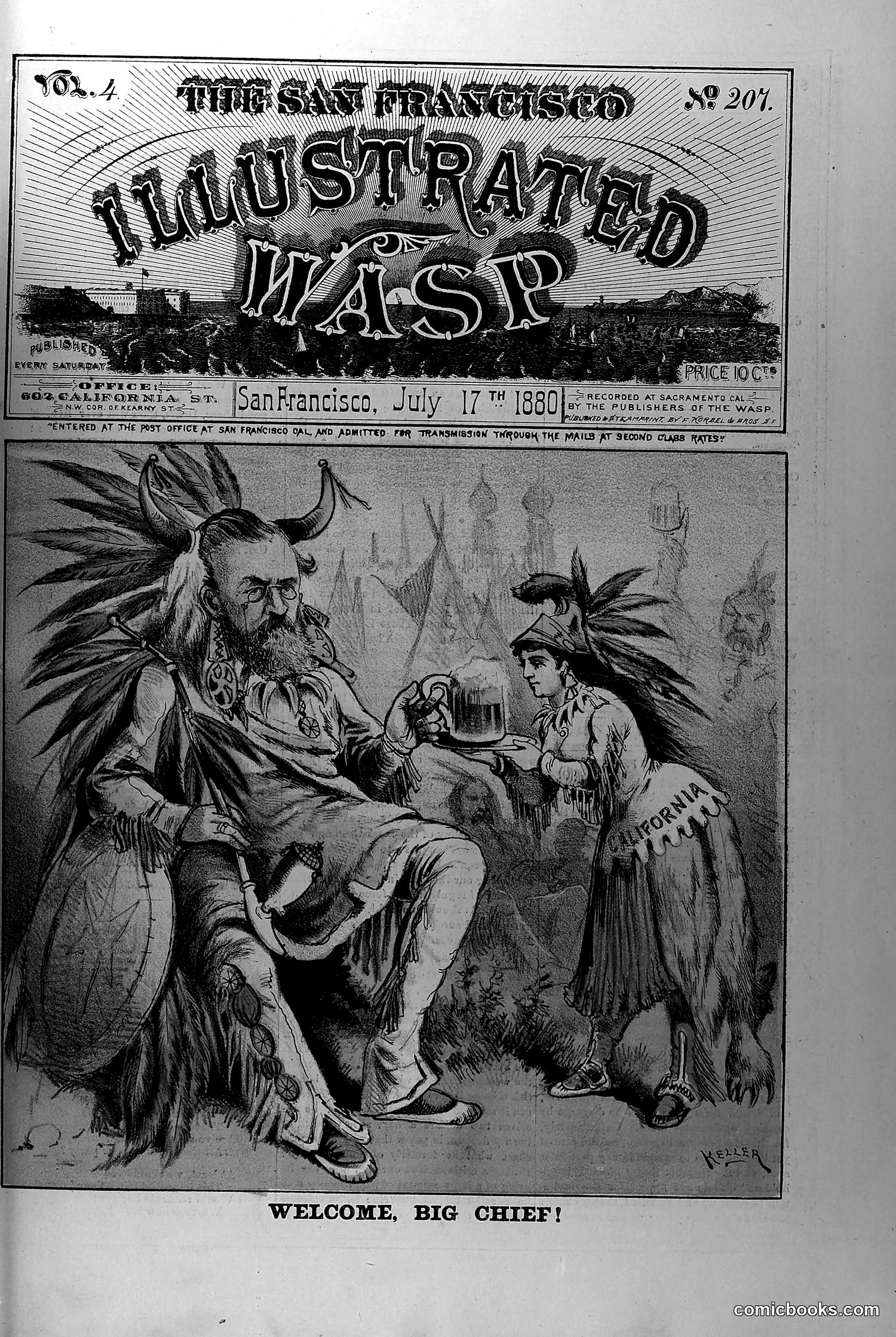
This cartoon depicts a grotesquely caricatured Native American figure (labeled with horns and wild hair) being offered a beer stein by a figure labeled "California." The satire appears to address the arrival or reception of a notable person in San Francisco, using dehumanizing Native American imagery common to 1880s American political humor. The "Big Chief" title suggests mockery of either a political leader or visiting dignitary being received in California. The exaggerated, bestial depiction reflects the deeply racist visual conventions of period satirical publications. Without additional context, the specific target remains unclear, though the cartoon demonstrates how Native American caricature served as shorthand for ridicule in contemporary political discourse.
This page is primarily **publication information and advertising** for *The Wasp* magazine itself, along with editorial commentary about financial and economic policy. The visible editorial discusses **greenback currency and inflation**, criticizing what appears to be monetary policies affecting the South and advocating for hard currency backed by gold. The text argues against inflated paper money, suggesting it burdens working people and the poor. There is **no identifiable political cartoon** on this page—the masthead illustration is merely decorative branding. The page contains subscription rates, mailing information, and a poem titled "To a Respected Contemporary" that appears to critique another publication's editorial stance. This is a typical 19th-century magazine layout mixing business operations with opinion pieces.
This page contains political commentary rather than cartoons. The main article, "A Plague on Both Your Houses," presents dueling editorials from Democratic and Republican perspectives on James A. Garfield's presidential candidacy. The Democratic piece criticizes Garfield as morally compromised, while the Republican defense praises his character and achievements. Both sides invoke Civil War-era divisions and questions of national leadership. The "Stings" column contains brief satirical jabs at contemporary figures and issues: Ohio's new Voter Registrar, European-Turkish conflicts, American rifle teams, and Clara Voss (identity unclear). The page satirizes partisan gridlock through competing narratives about the same candidate, suggesting both parties weaponize character attacks while claiming moral authority. This reflects Gilded Age political polarization.
This page presents "The New Charter," a satirical proposed city government structure for San Francisco. Rather than depicting specific political figures through caricature, The Wasp uses detailed written satire to mock the proposed municipal reforms. The text outlines absurd bureaucratic positions and requirements—such as requiring the Tax Collector to have $4,000 yearly income, demanding Aldermen be able to read and write, and specifying that the County Clerk keep office hours "four in the afternoon whenever he feels like it." The satire targets municipal incompetence and corruption by suggesting laughably basic competency standards should be legally mandated, implying San Francisco's actual government officials lack even these fundamental qualifications. The humor relies on recognizing how pathetically low these proposed standards are.
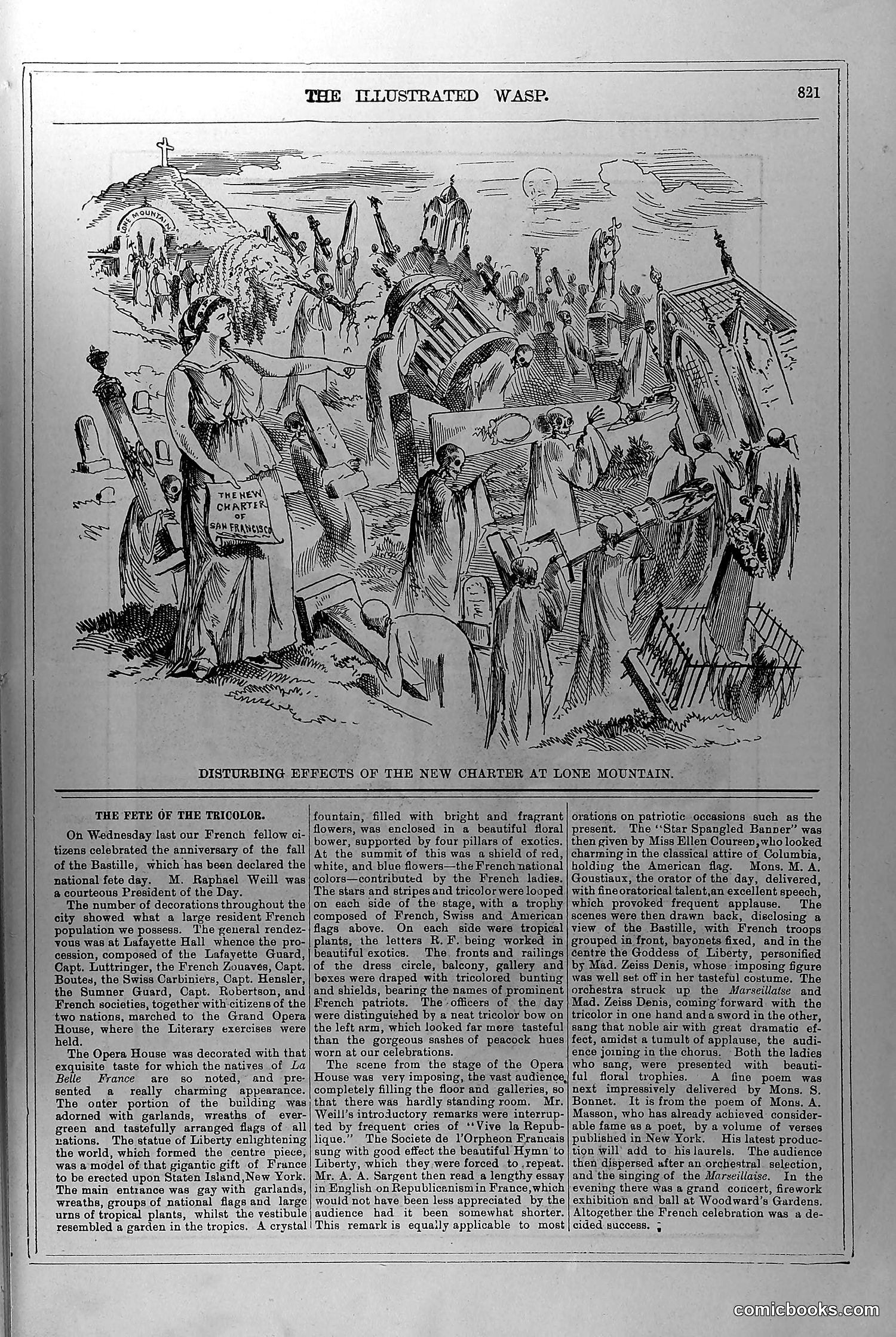
This page contains two distinct pieces: **"The Fete of the Tricolor"** (main article) describes a French celebration commemorating the fall of the Bastille, held at Lafayette Hall in San Francisco. The event featured elaborate decorations, patriotic speeches, and performances including a Marseillaise rendition. The text notes the audience response was enthusiastic but shorter than expected. **"Disturbing Effects of the New Charter at Lone Mountain"** (illustration below) appears to be a satirical cartoon, though the specific reference remains unclear from the visible text. The scene depicts a crowded, chaotic gathering with religious imagery (crosses visible), suggesting satire about civic or religious controversy. The exact political target is uncertain without additional context about San Francisco events of this period.
This page from *The Wasp* satirical magazine presents a dark allegorical illustration titled "The Illustrated Wasp" (visible in header). The image depicts a demonic or grotesque figure wielding what appears to be a scythe or sickle, surrounded by winged creatures (possibly representing wasps or demons). The figure appears menacing and authoritarian in nature. Without additional context or caption text visible on this page, the specific political or social target remains unclear. The imagery suggests commentary on death, destruction, or malevolent authority—common *Wasp* themes—but the particular historical event, politician, or social issue being satirized cannot be definitively identified from the visual alone. The artistic style employs gothic, grotesque elements typical of period political satire.
This page contains no visible cartoons or illustrations—it's entirely text-based political commentary. The *Wasp* presents several satirical articles attacking American political figures and policies: 1. **"A Terrible Danger Averted"**: Mocks a supposed British plot to annex the United States, ridiculing Republicans and traitors. 2. **"British Gold and Republican Traitors"**: Alleges British involvement in American politics, referencing Lord Beaconsfield and General Grant's European travels. 3. **"Chinese Laborers"**: Criticizes labor importation schemes and political machinations around Chinese workers. 4. **"Strike Terror Into the Hearts"**: Warns of Workingmen's Party threats to wealthy individuals. The articles use hyperbolic, conspiratorial language typical of 1870s-80s American satirical journalism, attacking both Republican politicians and various perceived threats to American interests.
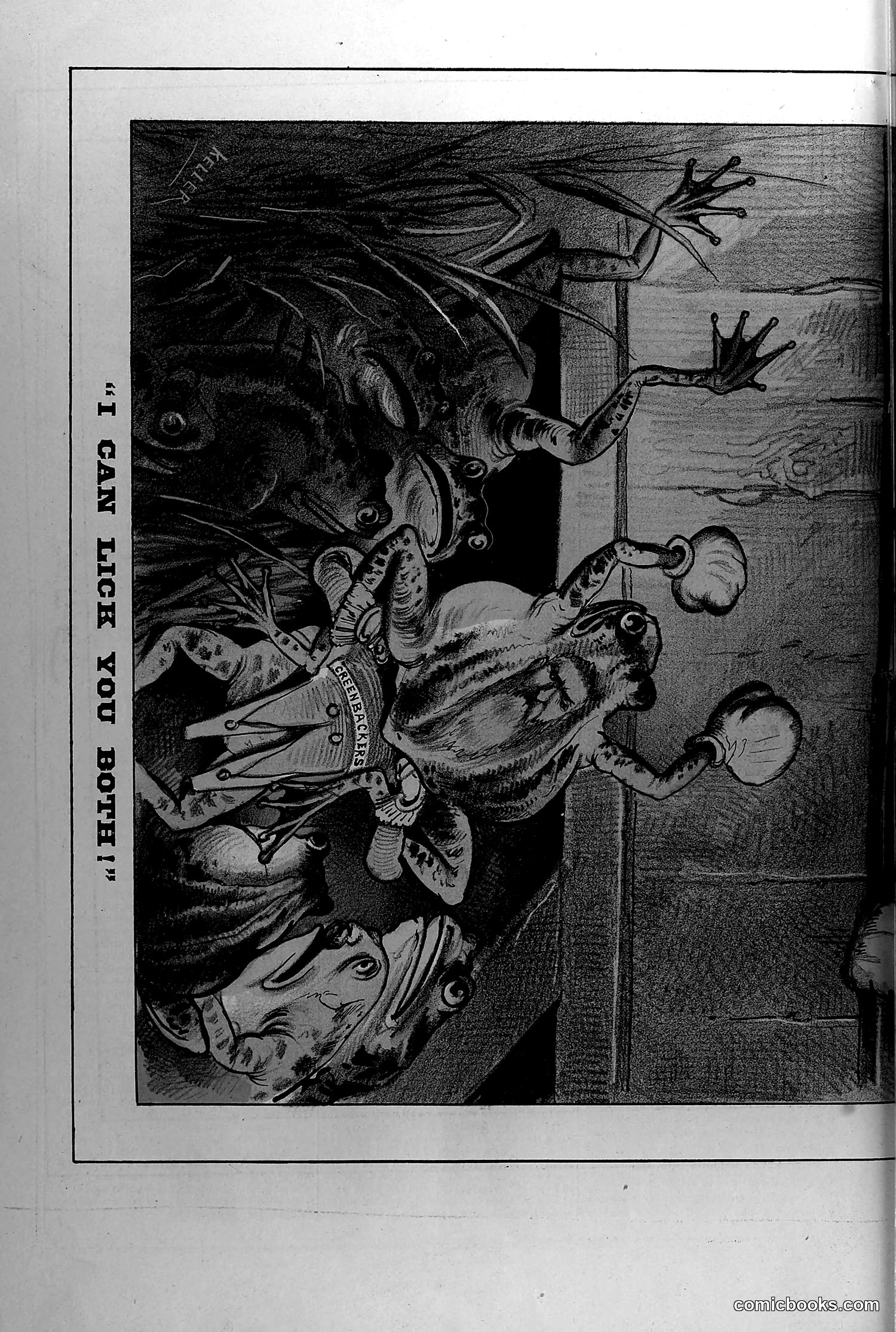
This appears to be a satirical cartoon depicting several grotesque, demonic or monstrous figures in a chaotic scene. The text on the left reads "LIEHOB YOU RCHOB NOVI" (likely OCR errors obscuring the actual caption). The style suggests late 19th or early 20th-century political satire, with exaggerated caricatures typical of *The Wasp*'s approach. The creatures display ornate decorative elements and elaborate features characteristic of period satirical art. Without legible caption text, the specific political figures or events being mocked remain unclear from the image alone. The grotesque rendering suggests criticism of unpopular public figures or movements, but identifying them precisely requires clearer text or additional historical context about *The Wasp*'s publication date.
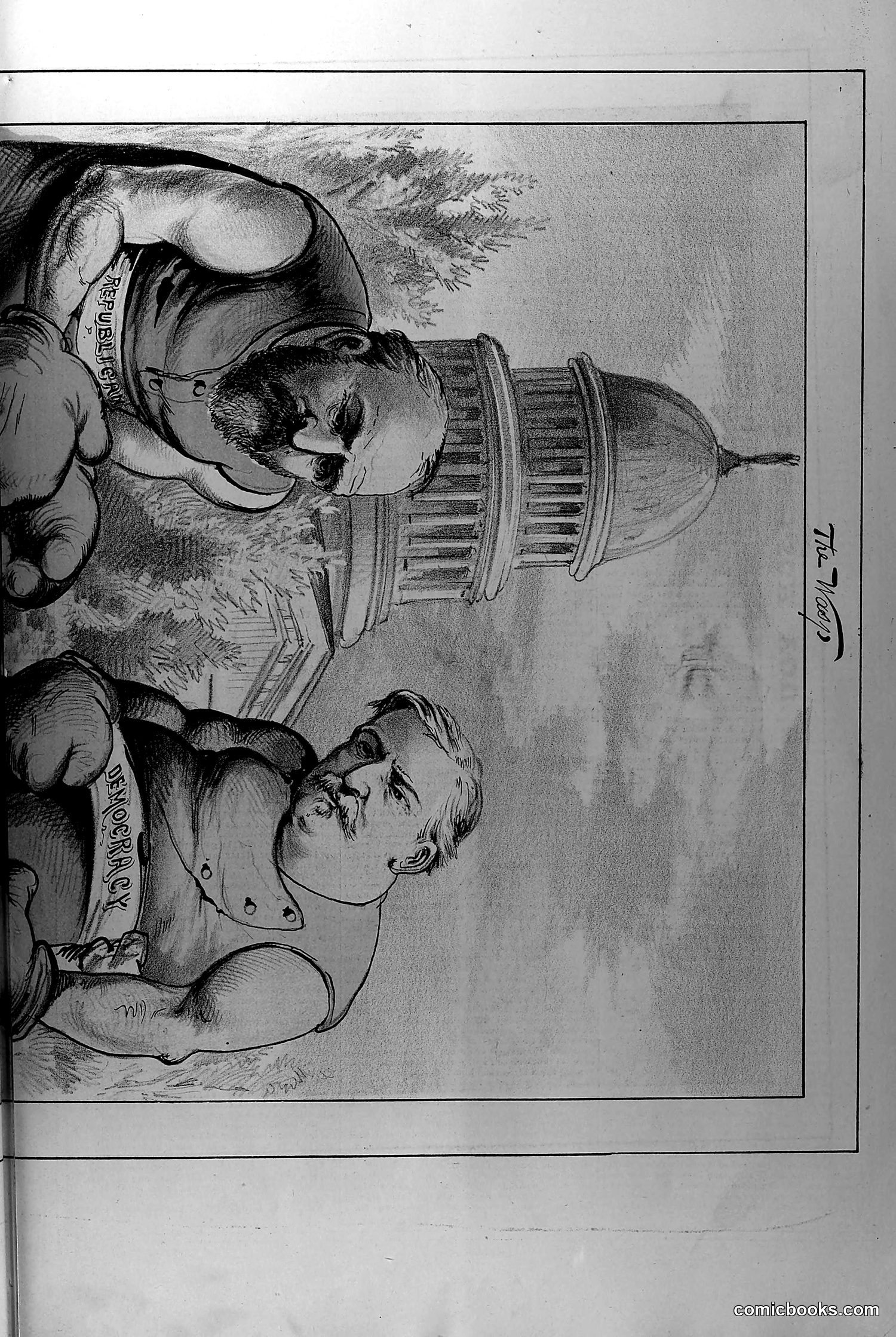
This appears to be a political cartoon from *The Wasp*, a 19th-century American satirical magazine. The image shows two figures: one wearing glasses labeled "DEMOCRACY" and another labeled "DEMAGOGERY" [sic]. The figure on the left appears to be holding or controlling a large mechanical device or puppet. The satire criticizes how demagogues manipulate democratic institutions and public opinion. The mechanical nature of the device suggests democracy is being treated as a machine to be operated rather than a genuine system of governance. The caricatured features and labeling indicate this is commentary on political corruption or the abuse of democratic processes by opportunistic politicians. Without additional context about *The Wasp's* publication date or specific historical events referenced, I cannot identify the particular figures or incidents depicted with certainty.
This is a serialized adventure story rather than a political cartoon. The narrative follows "Liverpool Jack," a sailor character who recounts his experiences at sea, including encounters with Turkish vessels and various maritime adventures. The text references historical maritime conflicts and stereotypical portrayals of Turkish and Chinese adversaries common to 19th-century adventure literature. While the story includes exotic locales (Turkey, the Grand Turk) and period naval details, it appears to be entertainment fiction rather than political satire. The page itself contains no visible cartoon illustrations—it is primarily text-based serialized storytelling typical of *The Wasp's* mixed content format.
This page contains no political cartoons. Instead, it features several short articles about San Francisco entertainment and cultural events, including: - **Amusements**: Brief notices about theatrical performances (the Irish Strollers, Vienna Ladies, Sand-lot Circus) - **Competition in Gas**: Commentary on a new gas company's business proposal - **Venetian art and exploration**: An article about a sea voyage to Central America - **"The Dark Horse"**: An anecdote about the origin of a horse-racing term in Tennessee The page appears to be a typical issue of The Wasp's entertainment and news section, with no visible satirical illustrations or political commentary. It's primarily text-based content covering local San Francisco cultural happenings and miscellaneous historical interest pieces.
This page is primarily **advertising and editorial content** rather than political satire. The masthead cartoon shows a figure labeled "ANSWERS TO CORRESPONDENCE" at a desk, suggesting this is a letters-to-the-editor section. The visible advertisements include: - **Vienna Concert Gardens** (music venue) - **Vienna Ladies' Orchestra** (instrumental and vocal concerts) - **California Gloves** (William Shires, manufacturer) - Several **dividend notices** for financial institutions The editorial content addresses **immigration to California**, discussing labor concerns and economic opportunity—a significant late-1880s political issue. The tone suggests debate about whether immigrants should be encouraged or discouraged. This appears to be a regular magazine issue mixing satire, ads, and civic discussion rather than a single coherent political cartoon.
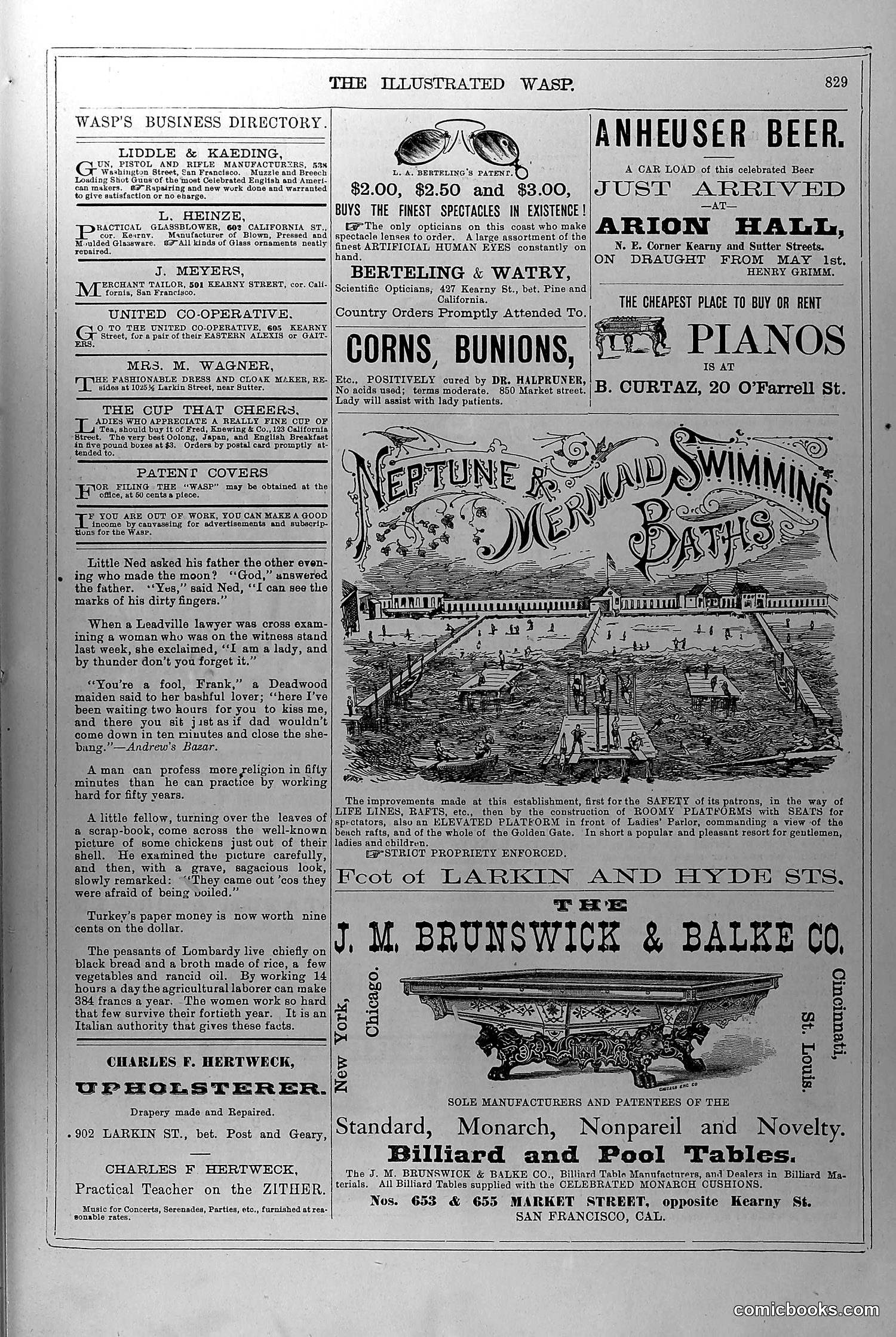
This page is primarily **advertising and business directory** for San Francisco establishments, with minimal satirical content. The advertisements include spectacles, tailoring services, piano rentals, and billiard tables. The few non-commercial items are brief **humorous anecdotes** rather than political cartoons: - A joke about a child asking his father who made the moon - A story about a Leadville lawyer being cross-examined by a woman - A quip about a man professing religion quickly while working - A brief observation about paper money's value The illustrations are **commercial graphics** (spectacles, swimming baths, billiard tables)—not political cartoons. This appears to be a typical late-19th-century magazine page mixing modest humor with paid business notices, rather than focused satirical commentary.
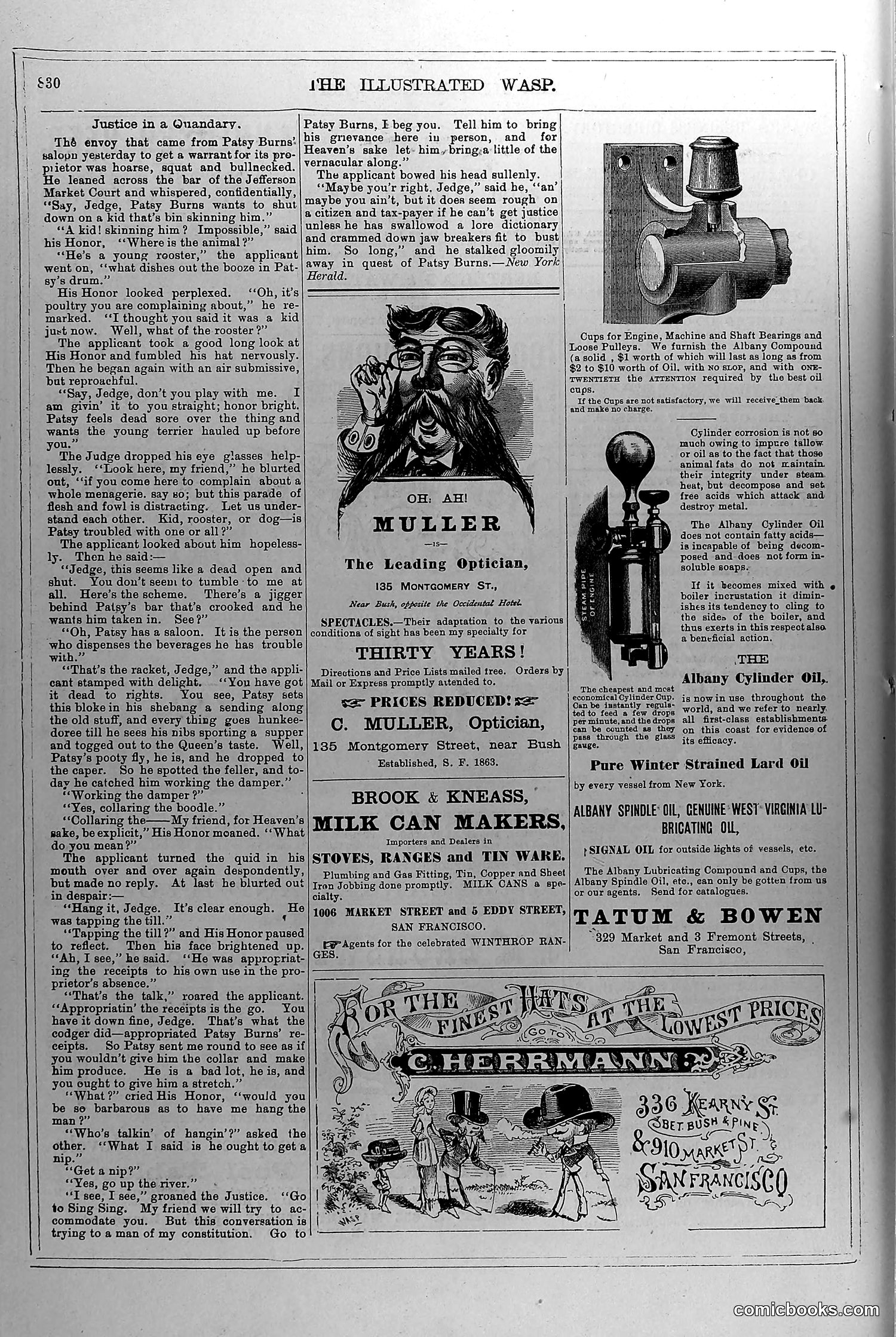
This is primarily a humorous legal anecdote about a judge and a complainant named Patsy Burns. A man comes to court claiming Patsy Burns is a "kid skinning" (swindler) who ruined him. The judge skeptically questions whether this young "rooster" actually committed fraud. The complainant insists Burns is guilty, but the judge suggests the man himself may be at fault for poor judgment—implying the complainant is the actual fool rather than the victim. The joke satirizes the absurdity of some small claims: a man complaining about being outsmarted, with the judge essentially ruling that he deserves what he got. The remainder of the page contains advertisements for optical services, oils, and other goods typical of 1880s San Francisco publications.
This page is primarily **advertising**, containing commercial notices for 1890s San Francisco businesses: - Chicago Brewery - Dry No. 1 Rustic wine - Patent covers for filing documents - Domestic sewing machine - Photo-lithography services - Fine wines and liquors dealer - Steam press printers The only editorial content is a brief story titled "An Elopement—The Result," describing a domestic dispute where a husband forgives his wife for eloping, and a paragraph about Peru's modernization. At bottom is an anecdote about American artist Mr. Whistler, whose tight coat prompted a shop clerk's sarcastic comment about returning it—illustrating Whistler's wit rather than political satire. **No significant political cartoons or social commentary appear on this page.** It represents typical late-19th-century magazine advertising space.
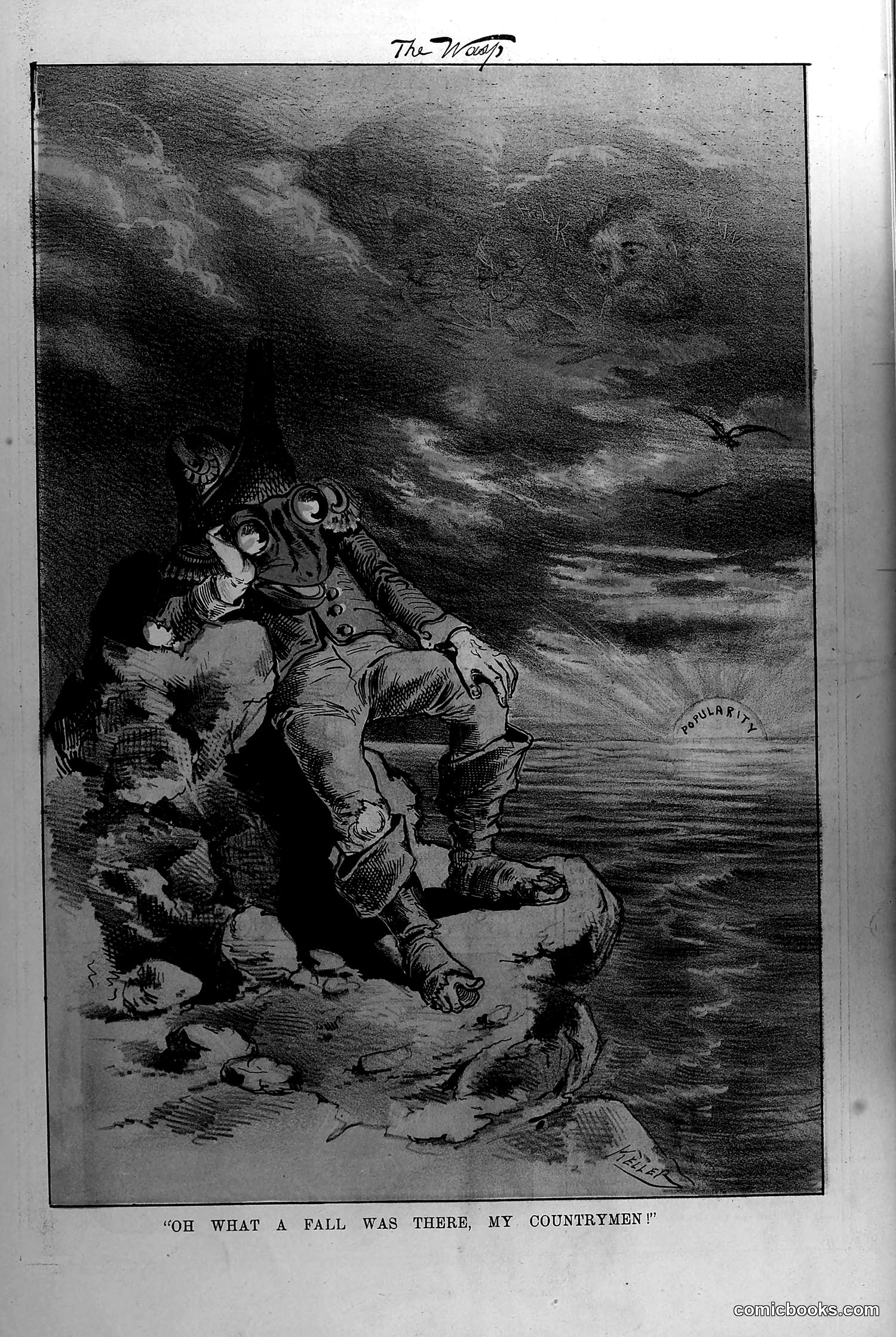
This political cartoon depicts a dramatic nighttime scene with the caption "OH WHAT A FALL WAS THERE, MY COUNTRYMEN!" The image shows what appears to be a rotund, well-dressed figure who has fallen or been thrown into water or rocky terrain, while other figures observe from above. The style and composition suggest this references a significant political downfall or scandal—the theatrical quote evokes Shakespeare's *Julius Caesar*, implying betrayal or dramatic loss of power. Without additional context about *The Wasp*'s publication date or accompanying articles, I cannot definitively identify the specific politician or event depicted. However, the elaborate caricature and melodramatic presentation suggest this mocks a prominent figure's humiliating political defeat or public disgrace that contemporary readers would have recognized immediately.
I can see this image contains a color test chart on the left side (a grid of grayscale squares of varying tones) and a ruler/measurement scale on the right side. This appears to be a **calibration or reference page** rather than actual satirical content from *The Wasp* magazine. Such pages were commonly included in publications for photographic or printing quality control purposes—the gray squares allowed printers to verify color reproduction accuracy, while the ruler ensured proper scaling during reproduction. Without visible cartoon imagery, political figures, or satirical text on this particular page, I cannot identify specific historical references or explain the satire a modern reader would encounter. This is likely a technical insert rather than editorial content.
I can see this is a photograph of a calibration/reference page rather than a cartoon or editorial content from *The Wasp*. The image shows two Oregon Rule Co. rulers (one vertical, one horizontal) and a grayscale color checker chart against a black background. This appears to be a documentation or archival photograph, possibly used for establishing accurate reproduction standards when photographing or scanning the original magazine pages. This is not satirical content or a cartoon that would require historical context explanation. It's a technical reference tool used in the digitization or preservation process of the publication itself.
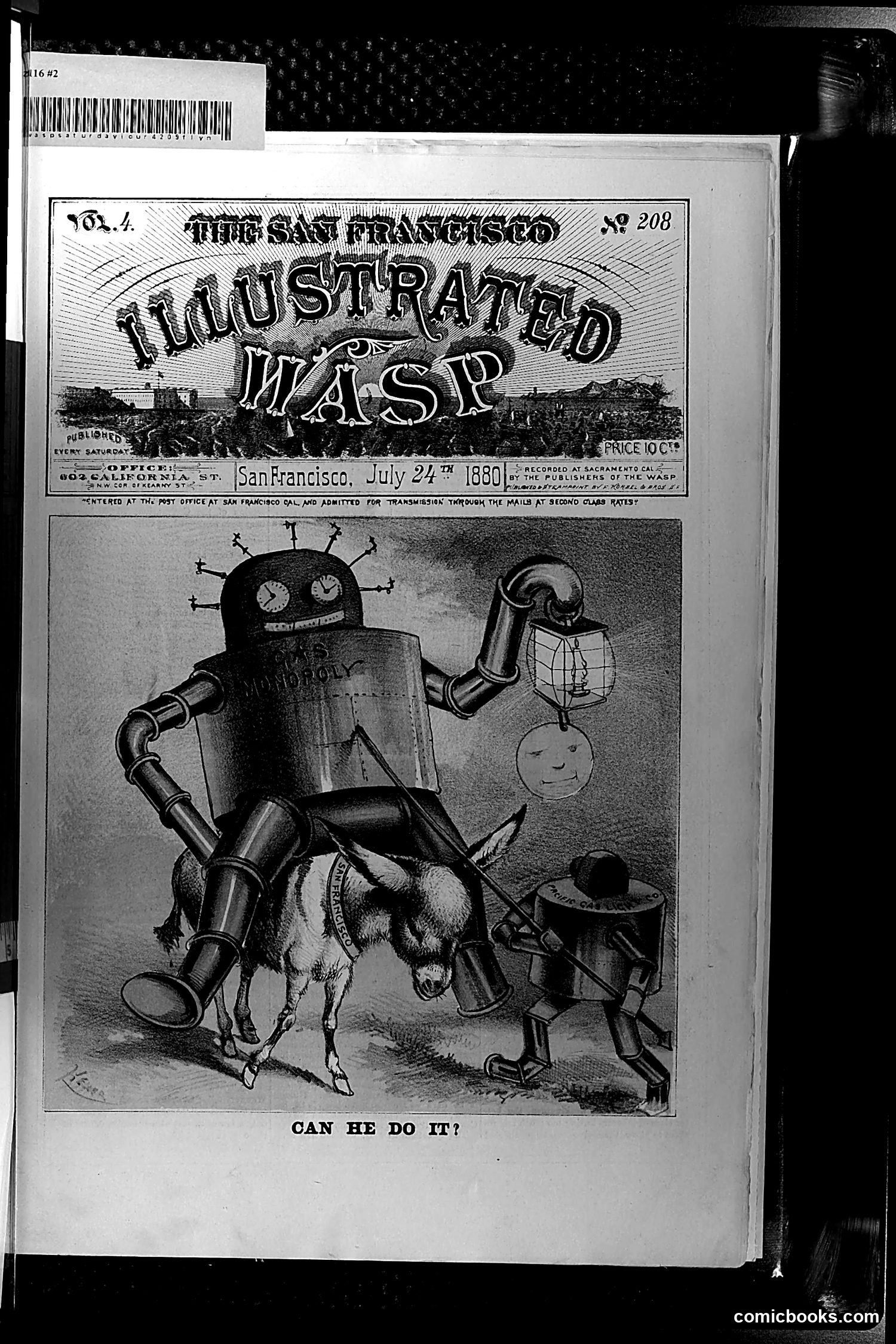
This satirical illustration depicts a mechanical robot or automaton with a donkey's head, controlled by what appears to be a small human figure (possibly representing a political operator or handler). The robot holds various implements and objects in its mechanical arms. The caption "CAN HE DO IT?" poses a skeptical question about the figure's capabilities. The cartoon likely critiques a political candidate or public figure during the 1880 election period, suggesting they are merely a puppet—a mechanical construct without independent thought, controlled by unseen political interests. The donkey imagery traditionally symbolizes stubbornness or foolishness in American political satire. The Wasp's satirical point questions whether this manipulated figure can actually accomplish anything of substance.