
A complete issue · 18 pages · 1880
The Wasp — July 10, 1880
I can see this is a measurement reference page rather than a satirical cartoon page. The image shows two Oregon Rule Co. rulers (one vertical, one horizontal) positioned on a black background with a grayscale color checker chart to the right. This appears to be a photographic documentation or test page, possibly from an archive, rather than editorial content from *The Wasp* magazine. The rulers and color checker suggest this may be a reference photograph used for cataloging, quality control, or documenting historical materials—standard archival practice. Without visible satirical imagery, caricatures, or political commentary, I cannot identify the cartoon content or explain its historical context as requested.
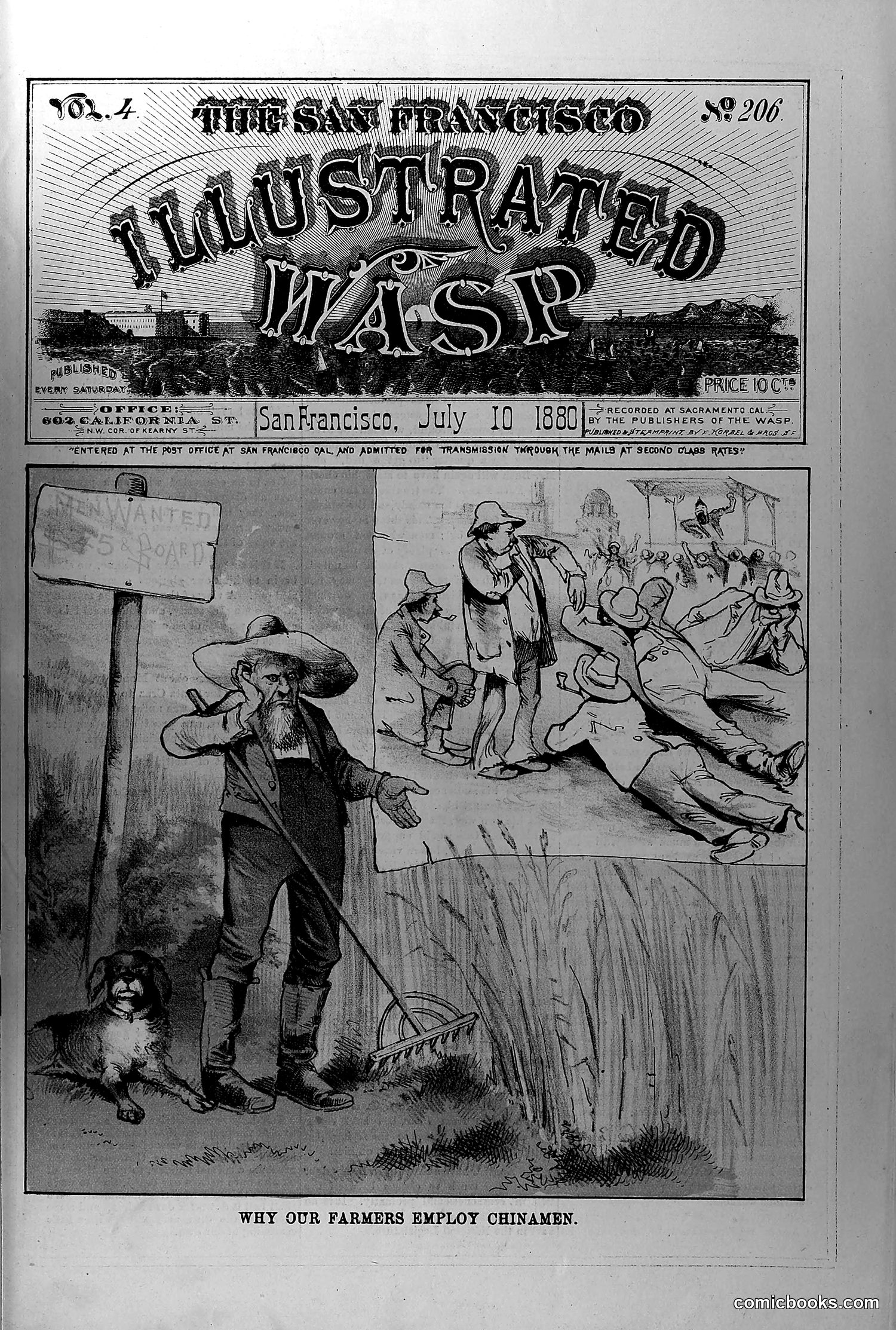
This anti-Chinese labor cartoon satirizes California farmers' economic practices during the exclusion era. The left panel depicts a desperate white farmer with a "Wanted" sign, unable to find work—likely representing depressed wages due to Chinese labor competition. The right panel shows Chinese workers being hired for agricultural tasks, suggesting they accepted lower pay. The caption's irony criticizes farmers for choosing cheaper Chinese laborers over white workers, though the cartoon's actual target appears ambiguous: it may blame either the farmers for this choice or the Chinese workers for undercutting wages. The imagery reflects 1880s anti-Chinese sentiment prevalent in California, though the satire's direction—whether attacking employers or immigrant workers—remains somewhat unclear.
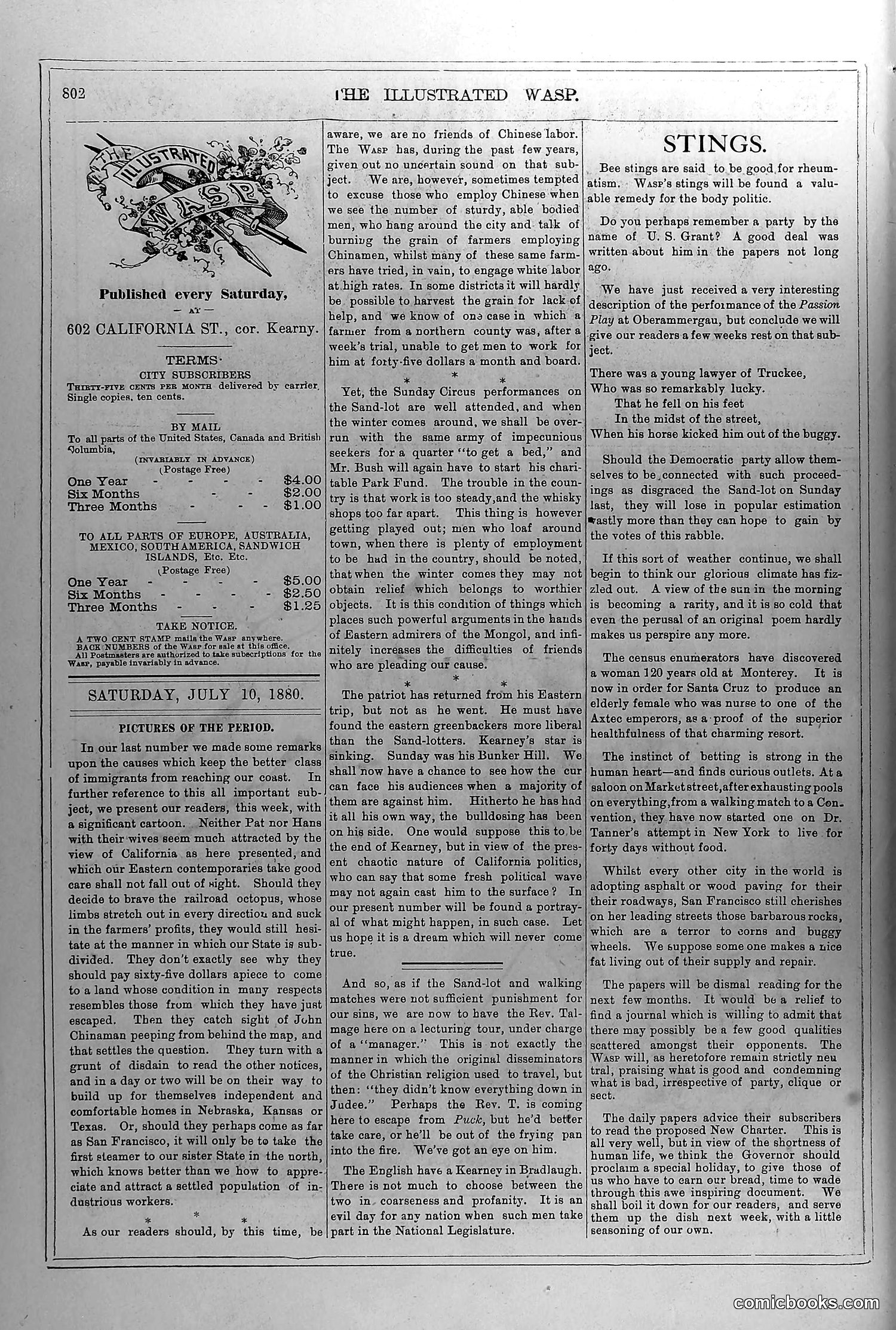
The page is primarily editorial commentary rather than cartoon satire. The main content discusses Chinese labor—a contentious political issue of 1880s California. The editors argue against employing Chinese workers, claiming they depress wages and working conditions for white laborers. Notably, the text reveals internal contradiction: while opposing Chinese immigration, *The Wasp* criticizes Democratic attempts to gain political advantage from the issue, suggesting the party uses anti-Chinese sentiment opportunistically rather than from genuine concern. The page also covers local San Francisco affairs, including vagrants, a saloon on Market Street, and debates over a proposed new charter. The "Pictures of the Period" section uses sardonic commentary on contemporary events rather than visual caricature to convey political critique.
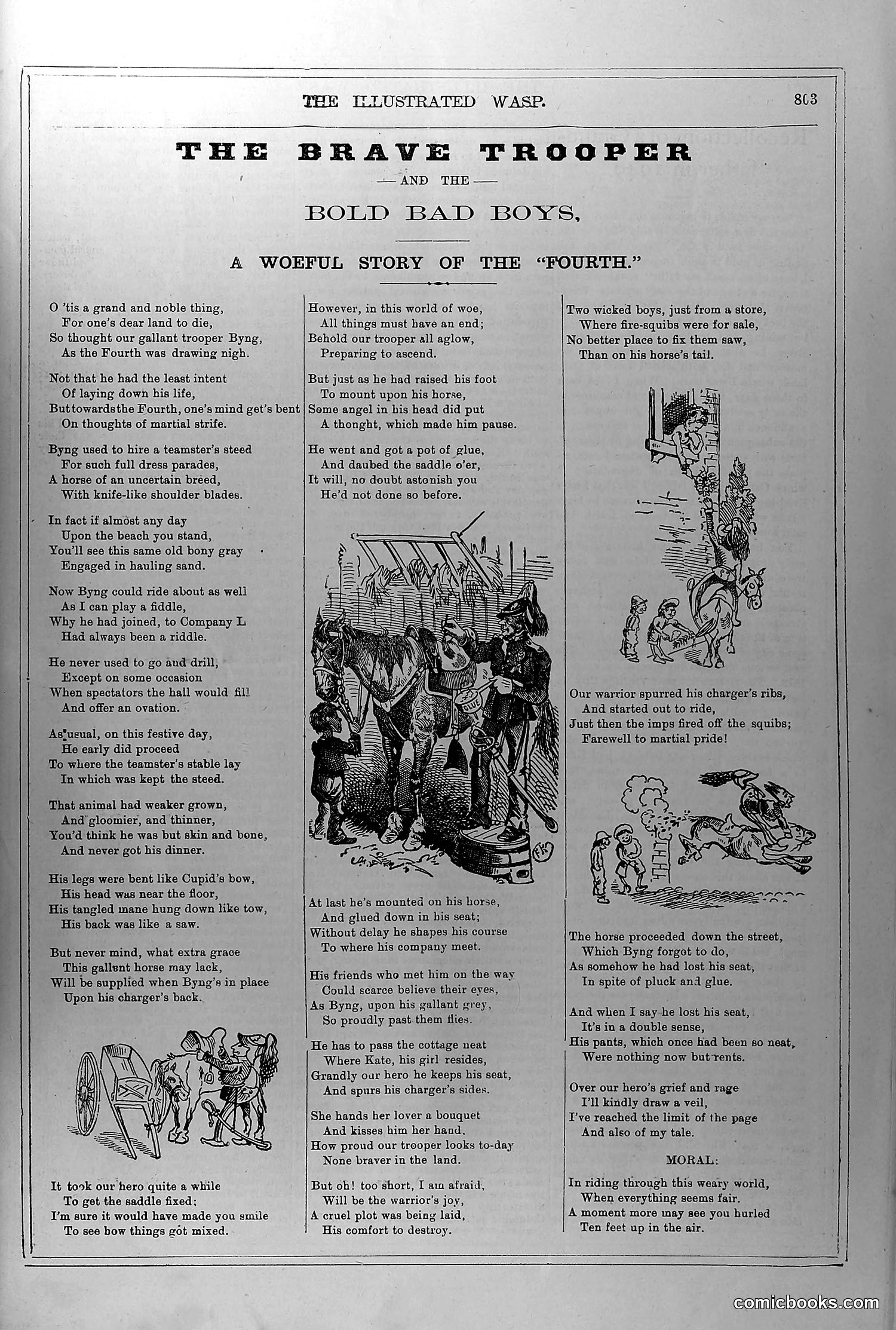
This is a humorous narrative poem with illustrations, not a political cartoon. It tells the story of "Byng," a cavalry trooper in the Fourth Regiment, who attempts to impress his girlfriend by riding a horse after gluing the saddle on with a pot of glue (a prank by two boys from a local store). The satire mocks military pretension and romantic posturing—a soldier trying to show off ends up losing his seat due to a crude prank. The moral at the end emphasizes that pride leads to humbling falls. The illustrations show the saddle-gluing scheme and Byng's subsequent embarrassment as he loses control of his horse. This appears to be lighthearted social satire rather than political commentary.
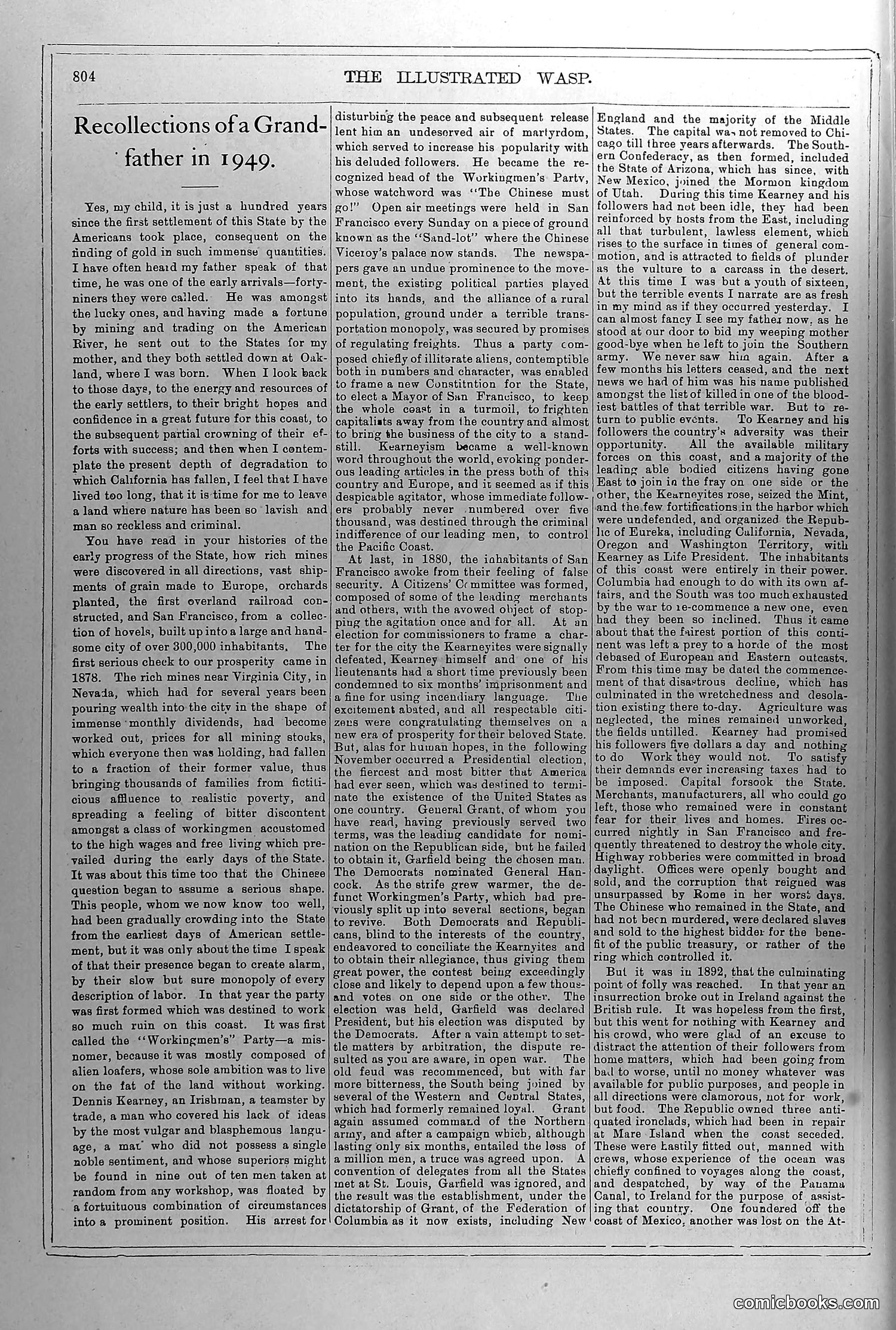
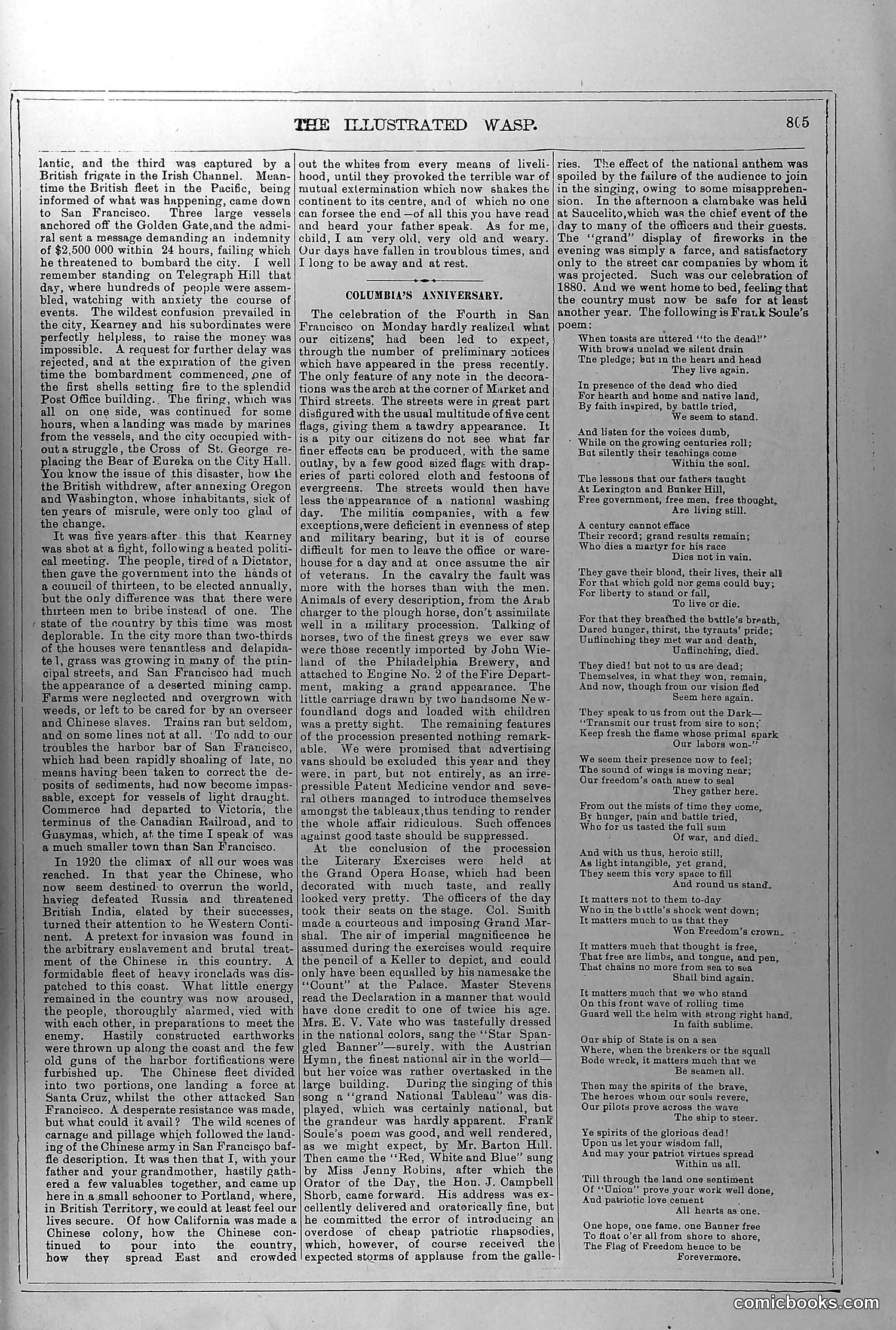
This page is primarily **text-based editorial content** rather than cartoons. The main article discusses the **Fourth of July celebration in San Francisco**, describing the city's patriotic display with decorations, militia companies, and a literary exercise at the Grand Opera House. The piece is **satirical commentary** on the event's organization and execution. It critiques the somewhat disorganized militia participation, notes the underwhelming appearance of decorated streets, and mocks the literary performances—particularly Frank Soule's poem and other patriotic contributions that apparently fell flat with audiences. The text also includes **scattered patriotic verse** (likely reprinted poetry) along the margins, adding to the satirical tone by juxtaposing grand patriotic language against the article's more sardonic observations about the actual celebration's mediocre reality.
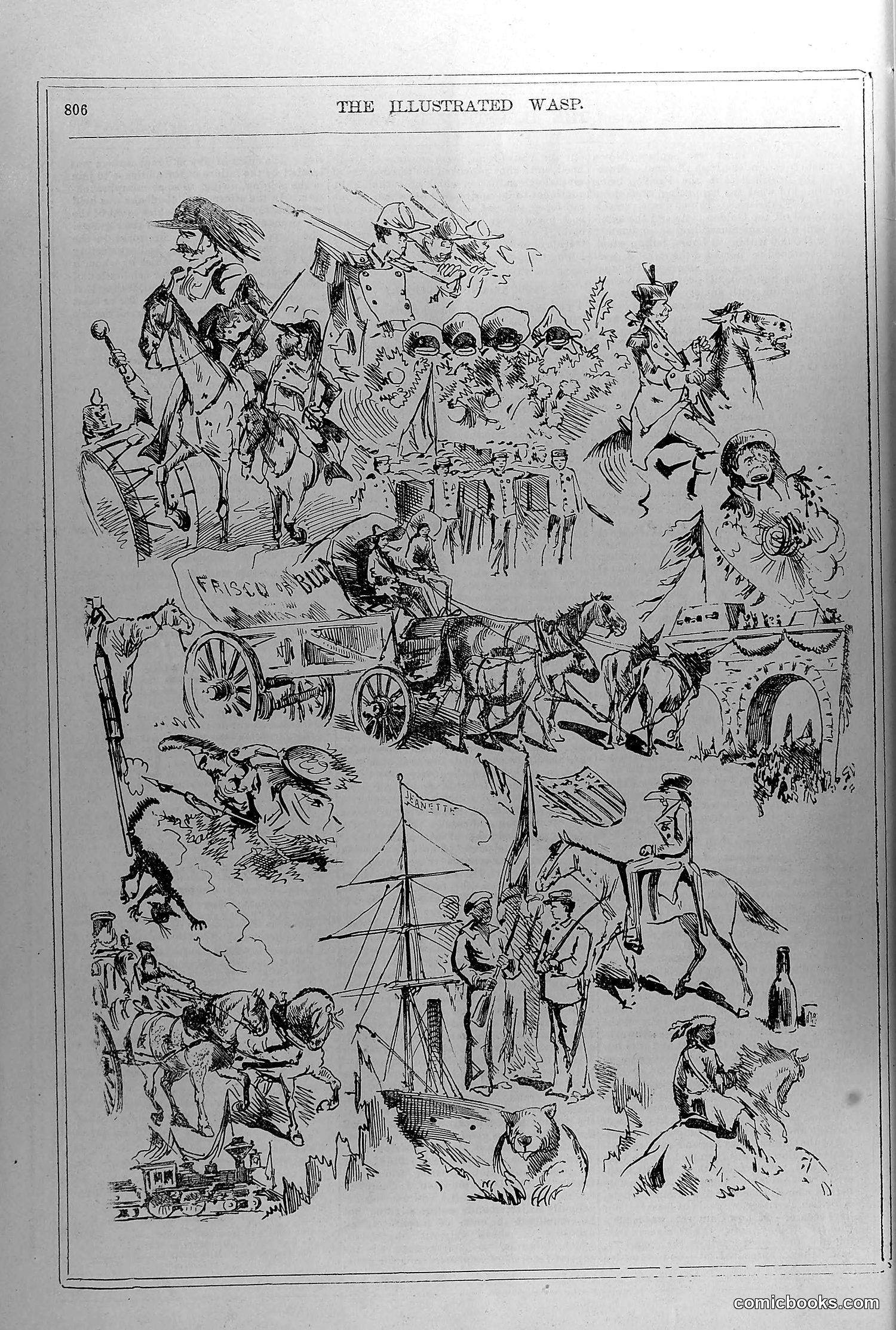
This satirical illustration compiles multiple vignettes depicting various forms of folly and excess. The compositions include: - **Upper section**: Military or political figures in ornate dress, some appearing intoxicated or disorderly - **Middle**: Transportation scenes—a cart labeled "Frisco & [unclear]" and decorated carriages, suggesting commercial or social pretension - **Lower sections**: Nautical scenes with sailing vessels and sailors, plus figures on horseback and various characters in comedic poses The overall effect mocks different social classes and professions through caricature—military pomposity, commercial greed, nautical adventures, and rural or working-class behavior all presented as worthy of ridicule. Without specific OCR text identifying particular targets, the satire appears broadly aimed at American society's various absurdities, typical of *The Wasp*'s irreverent approach to contemporary social commentary.
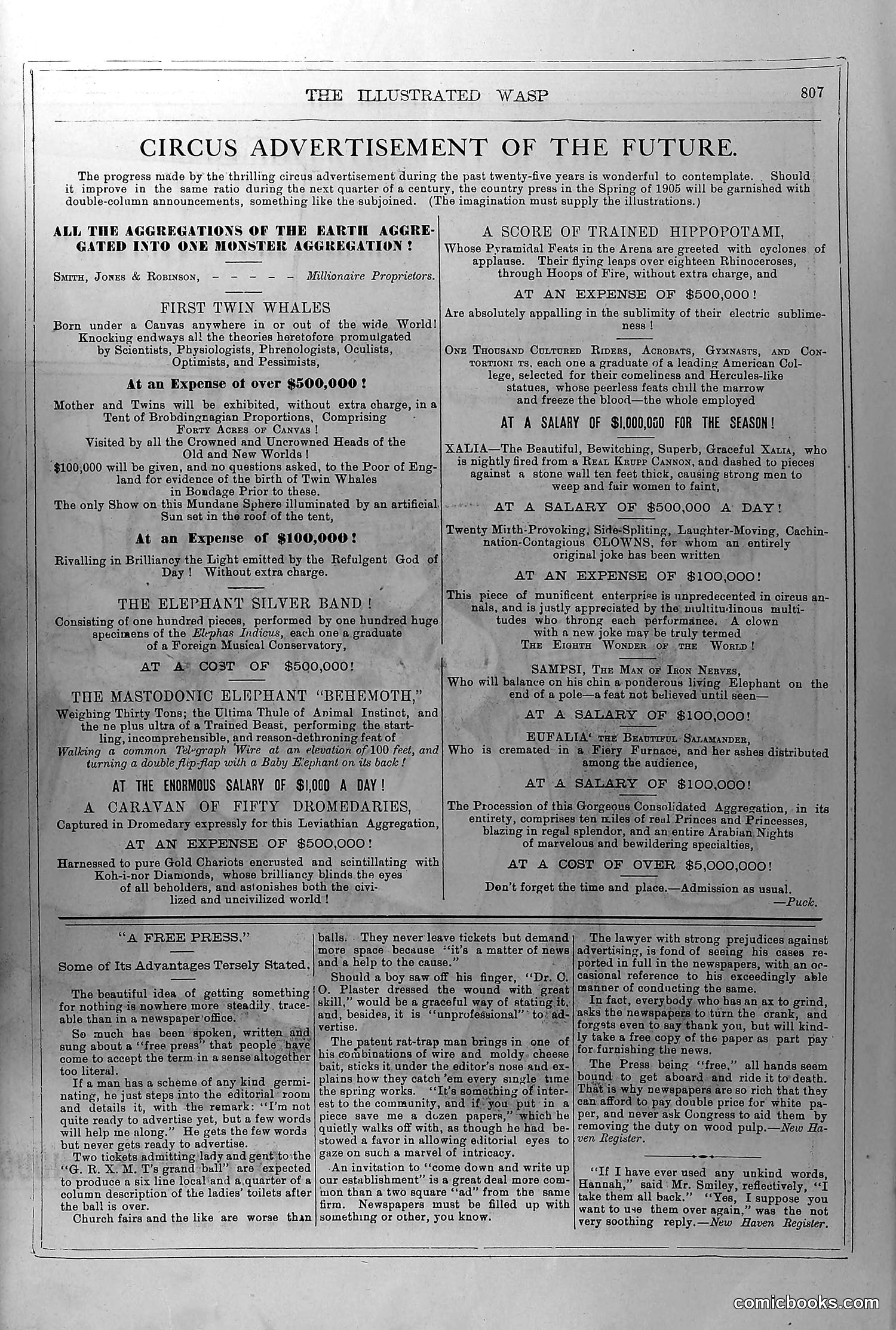
This page is primarily **satirical circus advertisements** imagining impossibly extravagant future shows (circa 1906). The humor targets late-nineteenth-century circus culture's tendency toward increasingly outrageous spectacles and exorbitant costs. The fake ads mock real circus conventions: "First Twin Whales" ($100,000 expense), "Mastodonic Elephant 'Behemoth'" ($1,000/day salary), and trained hippos ($500,000). Each entry inflates typical circus attractions to absurd scales—rhinoceroses performing, elephants balancing on poles, clowns costing fortunes. The final section includes editorial commentary ("A Free Press") defending newspapers against accusations of bias and sensationalism, suggesting *The Wasp* used this page to critique both circus excess and press credibility simultaneously. This is **satirical commentary on commercialism and spectacle**, not identification of specific individuals.
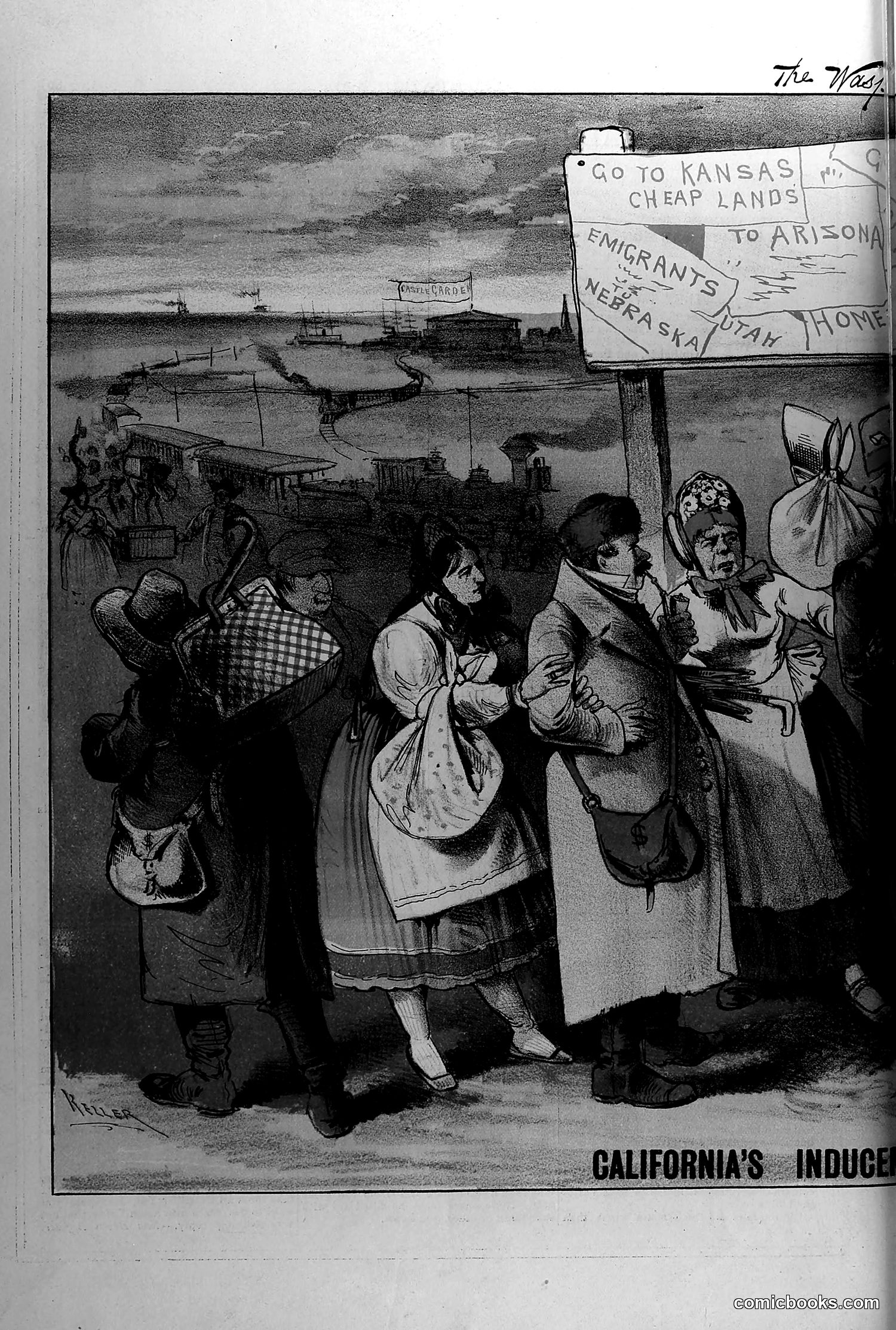
This cartoon satirizes California's recruitment of immigrants during the late 19th/early 20th century. A group of poor European emigrants—identifiable by their modest clothing and bundles—gather at a dock, reading a sign advertising "Go to Kansas, Cheap Lands" and "To Arizona," "Nebraska," "Utah," "Home," and "Emigrants." The satire critiques California's apparent role in luring desperate immigrants with false promises of opportunity, only to redirect them elsewhere or exploit them. The harbor scene with ships suggests maritime immigration points of entry. The cartoon likely exposes the gap between California's recruitment rhetoric and the actual conditions or intentions facing newcomers—a commentary on how states competed for labor while potentially deceiving vulnerable populations.
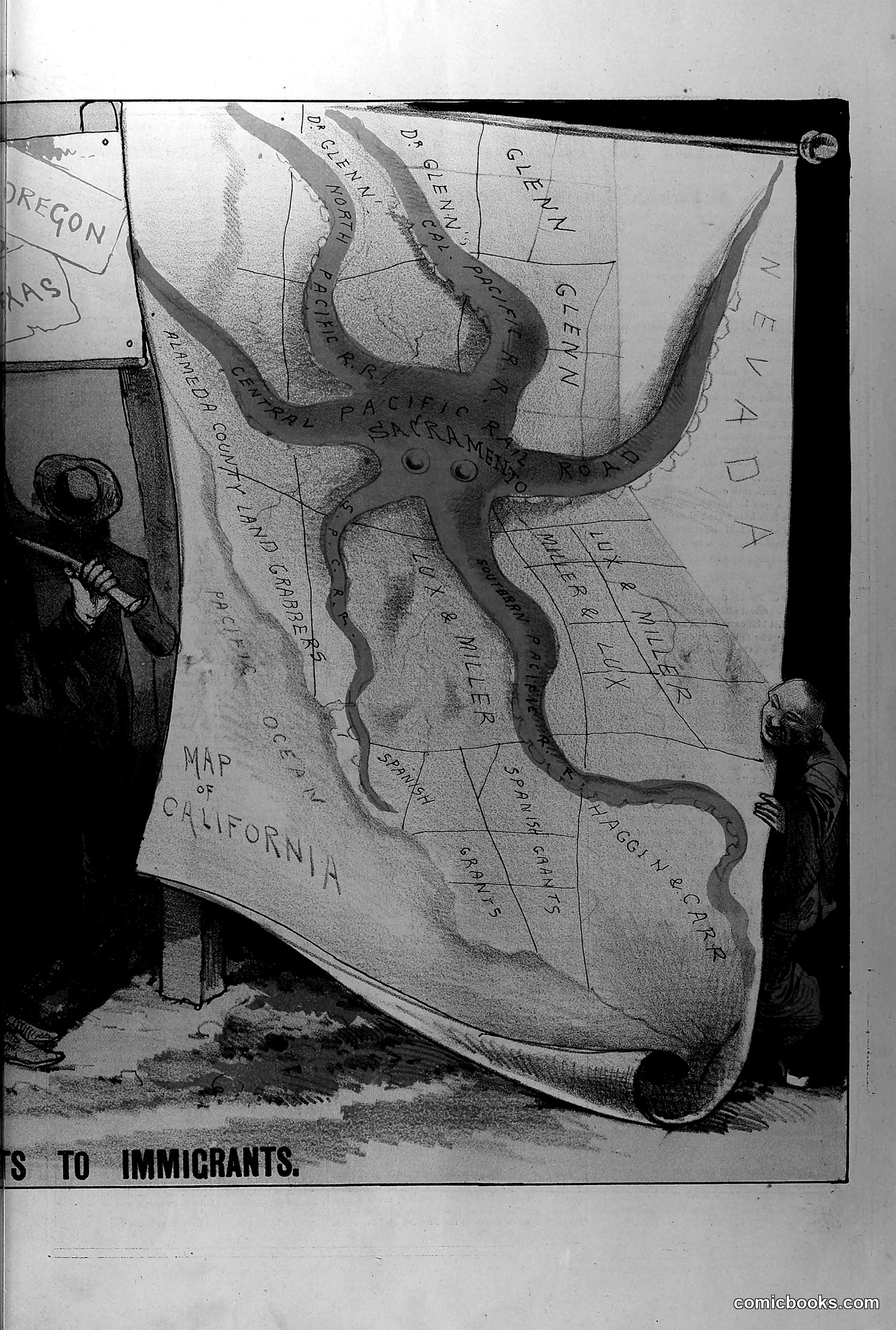
This is an anti-immigration political cartoon from *The Wasp*, a San Francisco satirical magazine. The central image depicts California as an octopus with tentacles reaching across the state's geography. The octopus appears to represent an invasive threat—likely representing either Chinese immigrants or immigration generally, a major political flashpoint in late-19th-century California. Two figures on either side of the map appear to be examining or confronting this octopus threat. The caption references "immigrants," and the overall message warns against the perceived danger immigration posed to California. This reflects the xenophobic sentiment common in American political satire of this era, particularly the anti-Chinese sentiment prevalent on the West Coast.
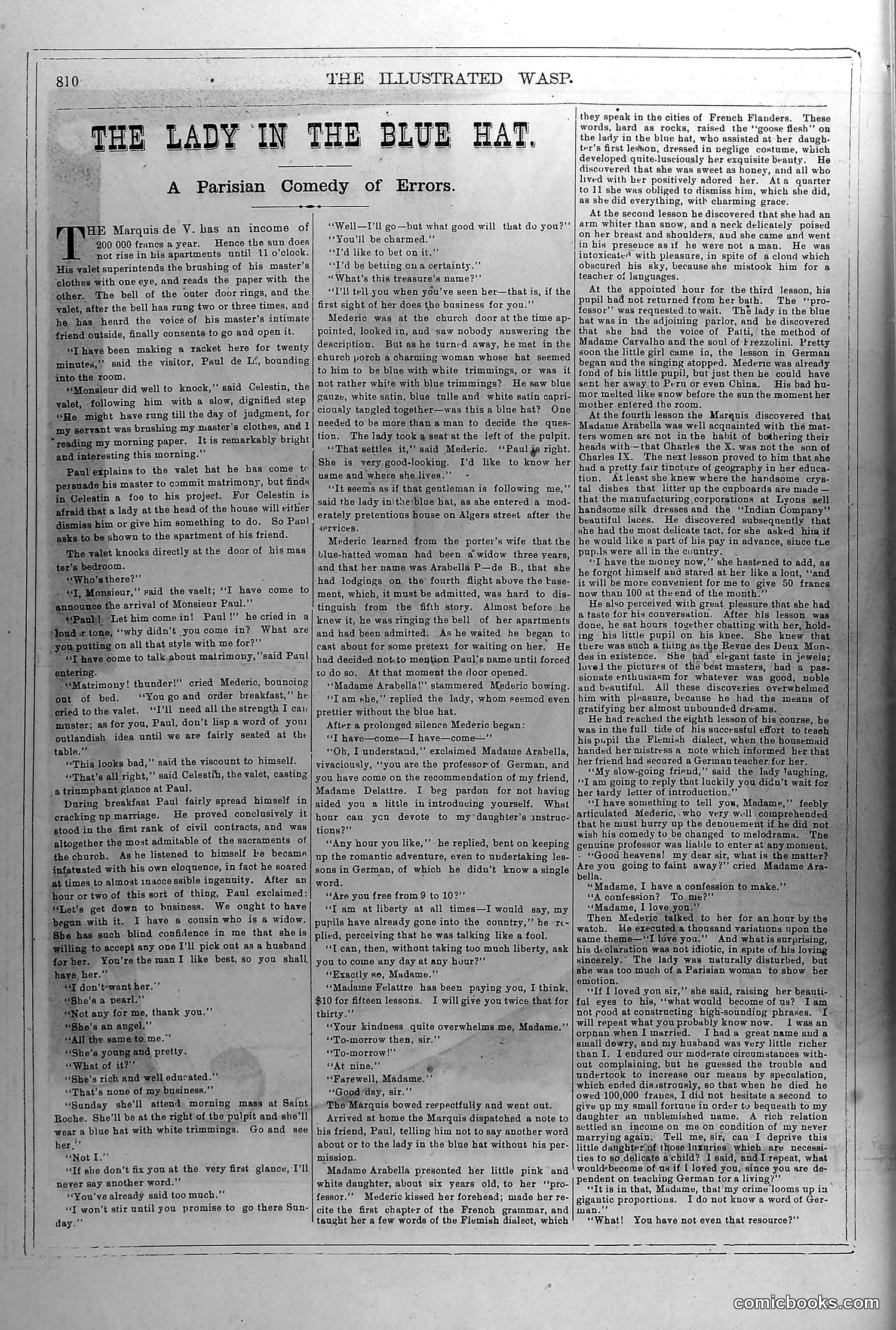
This page contains a serialized short story rather than political satire or cartoons. The narrative follows a Parisian valet's romantic misadventures involving a mysterious woman in a blue hat and various society figures. The story satirizes romantic farce conventions popular in late 19th-century literature—mistaken identities, class complications, and elaborate deceptions. References to Paris, French nobility (the Marquis), and fashionable society suggest this targets educated readers familiar with European social conventions. The humor relies on physical comedy, linguistic confusion, and the valet's social aspirations clashing with his station—typical themes of period comedy sketches rather than direct political commentary. No identifiable contemporary political figures appear.
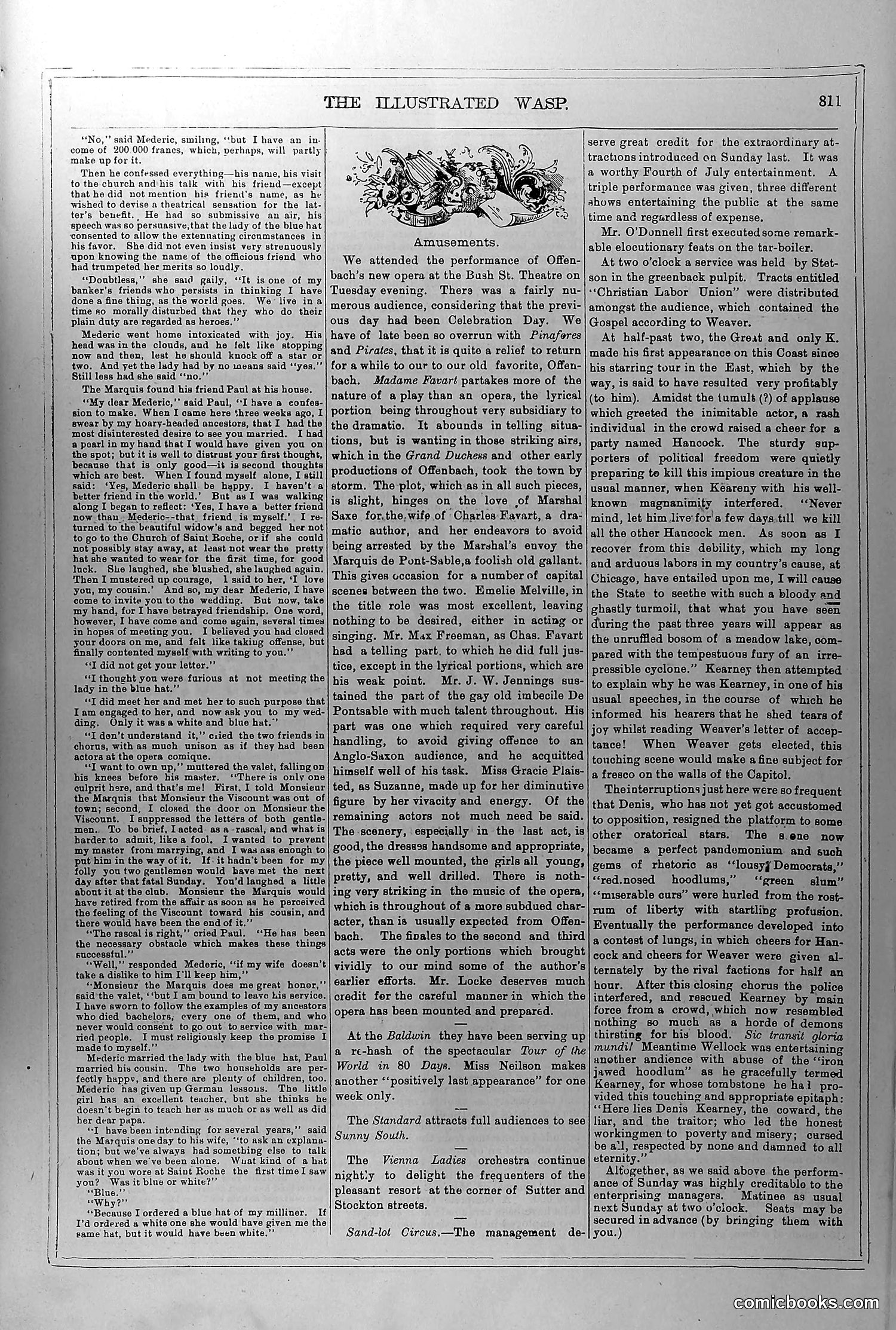
This page consists primarily of **theatrical reviews and social commentary** rather than political cartoons. The header illustration shows cherubs or putti in an ornamental design labeled "Amusements." The text reviews performances at the Bush Street Theatre, including Offenbach's opera "La Grande Duchesse," and discusses productions at the Baldwin Theatre and other venues. The reviews critique acting quality, plot construction, and audience reception. The content appears **satirical in tone** regarding theatrical productions and performers of the era, but focuses on entertainment criticism rather than political commentary. There are no clear political figures or caricatures visible in the image itself—the satire operates through witty written commentary about San Francisco's theatrical scene rather than visual political cartoons.
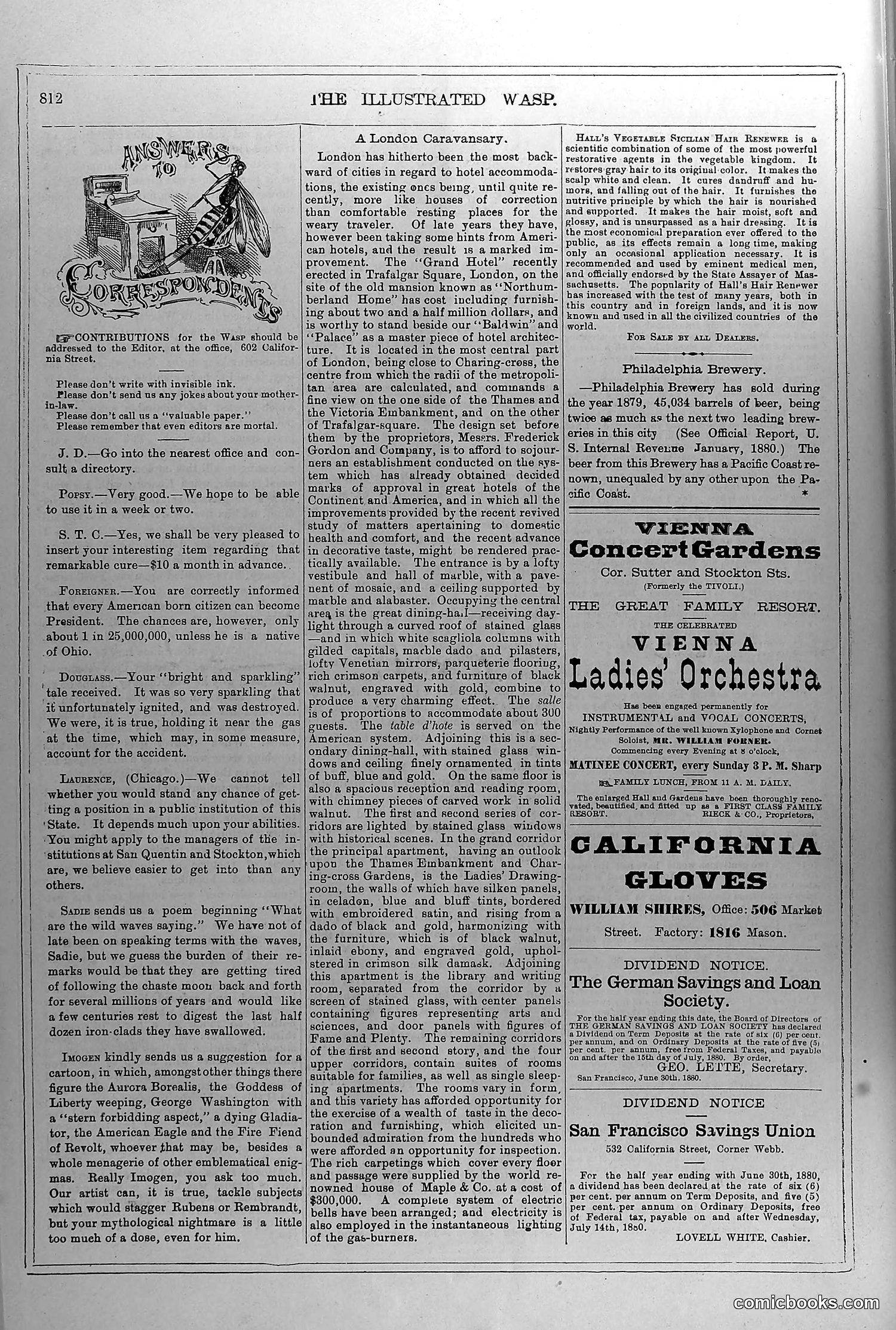
This page is primarily **advertising and notices**, not political satire. The main visual element is a masthead for "ANSWERS TO CORRESPONDENTS" featuring what appears to be a decorative illustration of a wasp. The bulk of the content comprises: - Reader correspondence responses (J.D., Poppy, S.T.C., Foreigner, Dodglass, Harmonia, Sadie, Thomes) - Commercial advertisements (Philadelphia Brewery, Vienna Concert Gardens Ladies' Orchestra, California Gloves by William Shires) - Financial notices (dividend announcements from German Savings and Loan Society and San Francisco Savings Union) - A hotel review ("A London Caravansary") describing the Grand Hotel in London **There is no discernible political cartoon or satirical commentary on this particular page.** It functions as a typical magazine page mixing reader advice, notices, and paid advertisements.
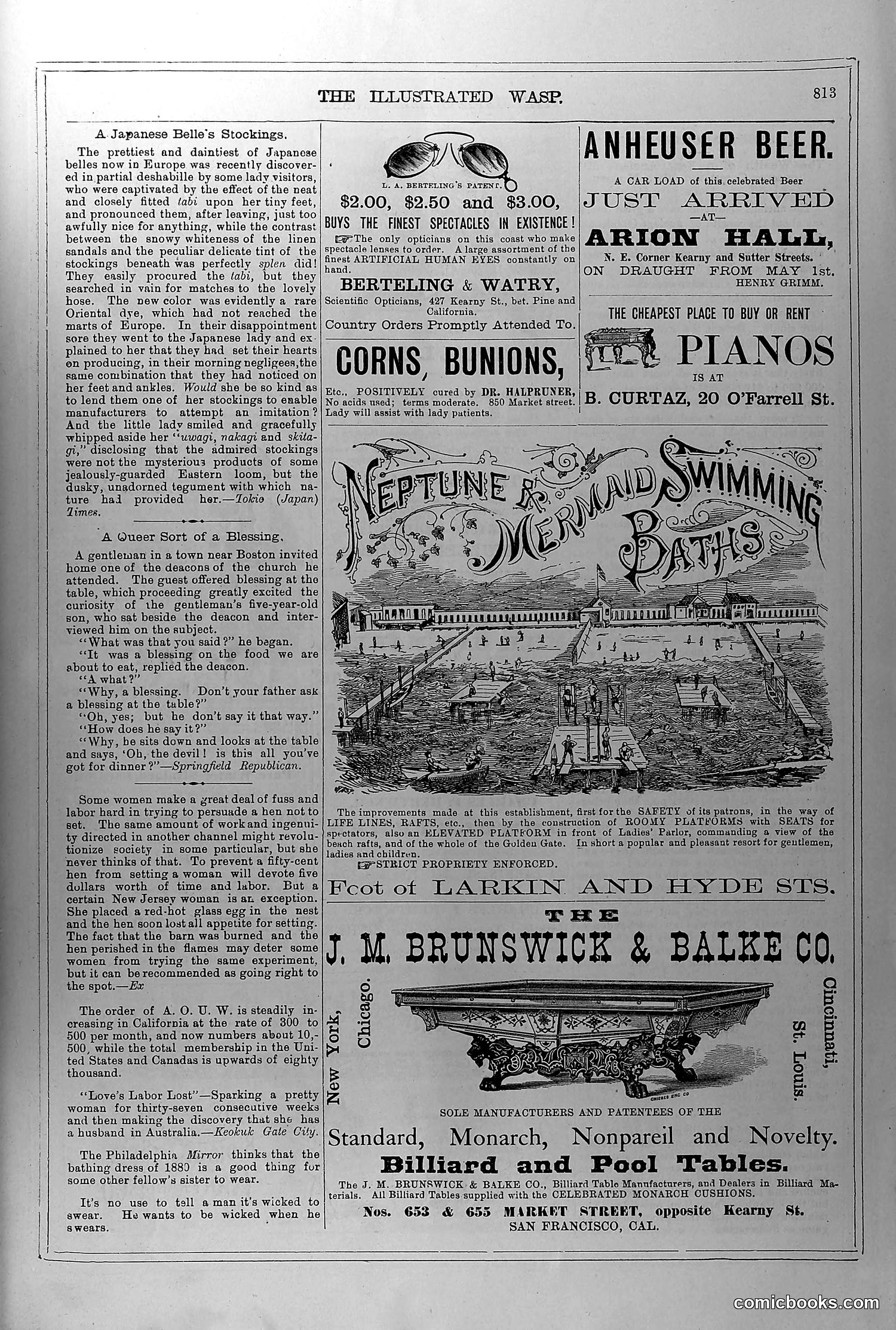
This page is primarily **advertising content** with some short humorous articles on the left side. The main illustrated ads include: - **Neptune and Mermaid Swimming Baths**: A seaside resort advertisement featuring an elaborate Victorian-era bathing establishment with platforms and facilities - **J.M. Brunswick & Balke Co.**: Billiard and pool table manufacturers The left-side articles appear to be satirical pieces about social customs—including commentary on Japanese women's stockings, church blessings at dinner tables, and women's labor organizing (A.O.U.W. membership growth). These mock contemporary manners and social movements through anecdotes rather than visual caricature. There are **no identifiable political cartoon figures** on this page. It represents a typical late-19th-century magazine layout mixing advertisements with brief satirical social commentary.
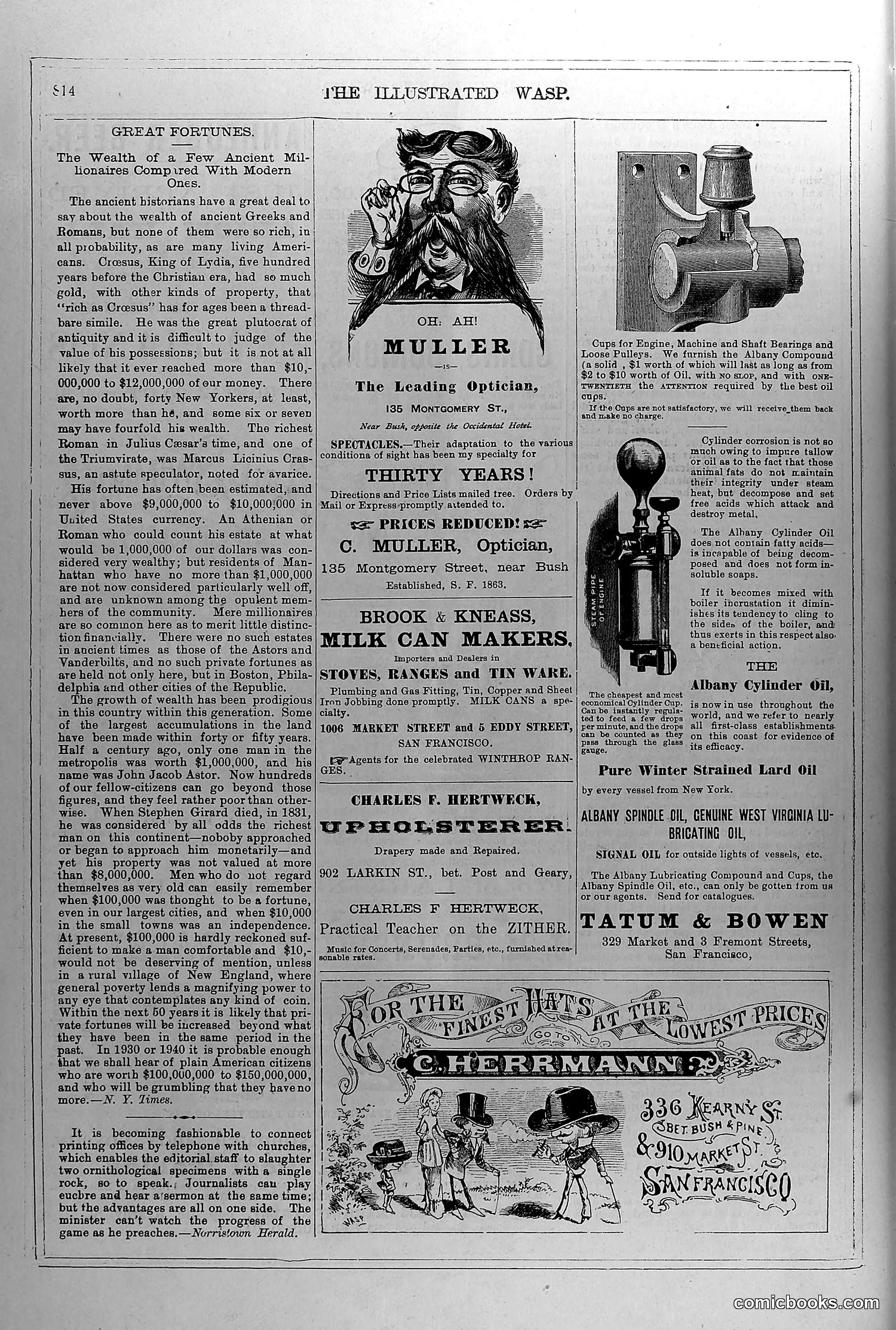
This page is primarily **advertising and editorial content** rather than political satire. The dominant feature is a large caricatured head labeled "OH! AH! MULLER - The Leading Optician" at 135 Montgomery Street, promoting his optical services with a thirty-year establishment claim. The page contains numerous San Francisco business advertisements (engine bearings, cylinder oils, hat makers, zithers instruction) typical of late 19th-century publication filler. The left column includes an essay titled "Great Fortunes," discussing ancient Roman and Greek wealth compared to modern American fortunes—editorial commentary rather than satire. At bottom, a small illustration for C. Herrmann's hat shop appears, showing two figures in period dress, likely generic advertising imagery. The page demonstrates how satirical magazines supplemented editorial content with extensive paid advertising.
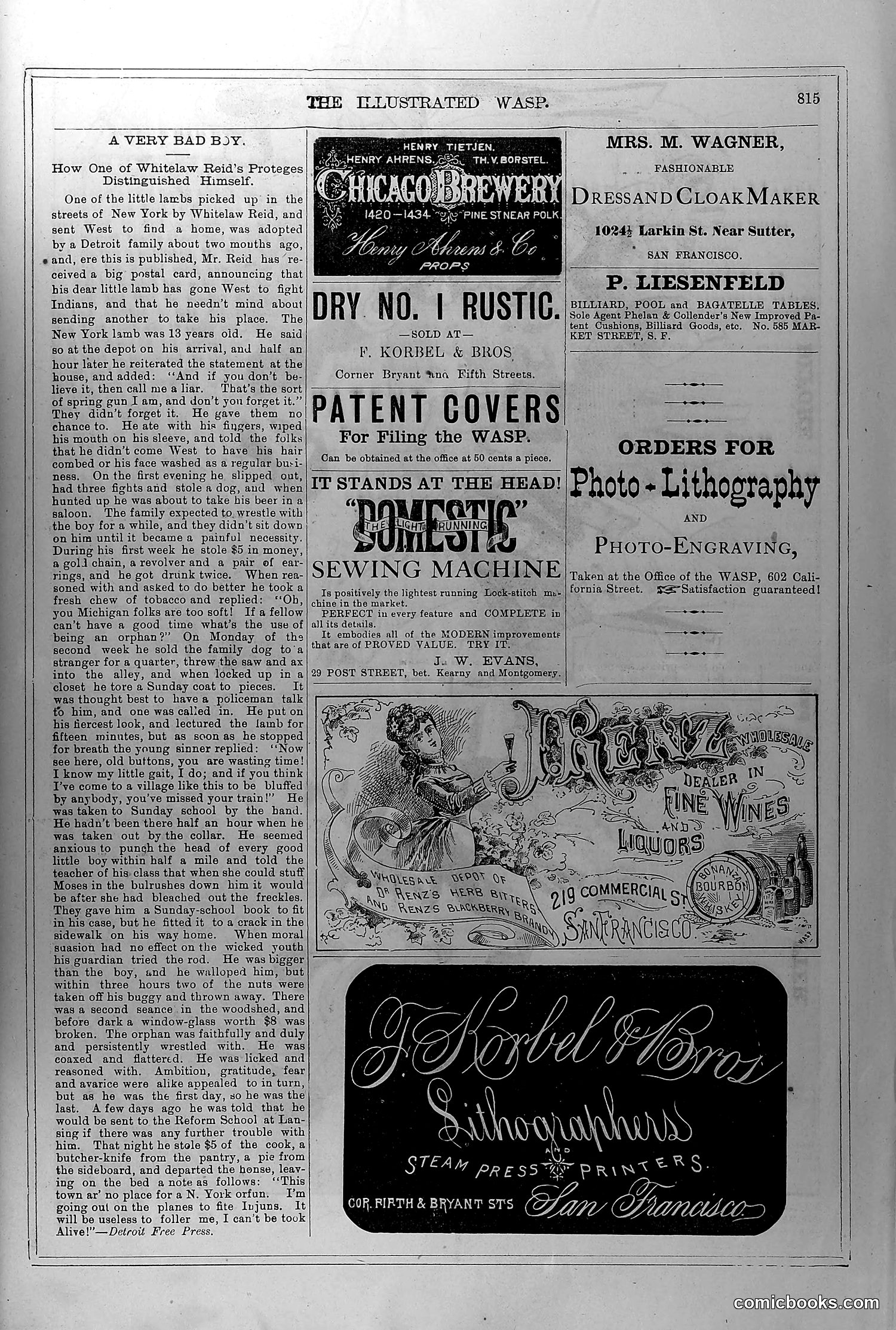
This page is primarily **advertising and editorial content** rather than political satire. The dominant features are: 1. **Main article**: "A Very Bad Boy" — a moralistic story about a child from New York adopted by a San Francisco family, emphasizing moral lessons about discipline and obedience. The narrative describes corporal punishment as character-building. 2. **Advertisements**: Patent covers for The Wasp, a Domestic sewing machine, Chicago Brewery products, and photo-lithography services dominate the layout. 3. **No significant political cartoon**: Unlike typical Wasp issues, this page lacks satirical imagery targeting specific political figures or contemporary events. The content reflects **turn-of-century American values emphasizing child discipline and moral instruction**, presented through standard magazine advertising rather than political commentary.
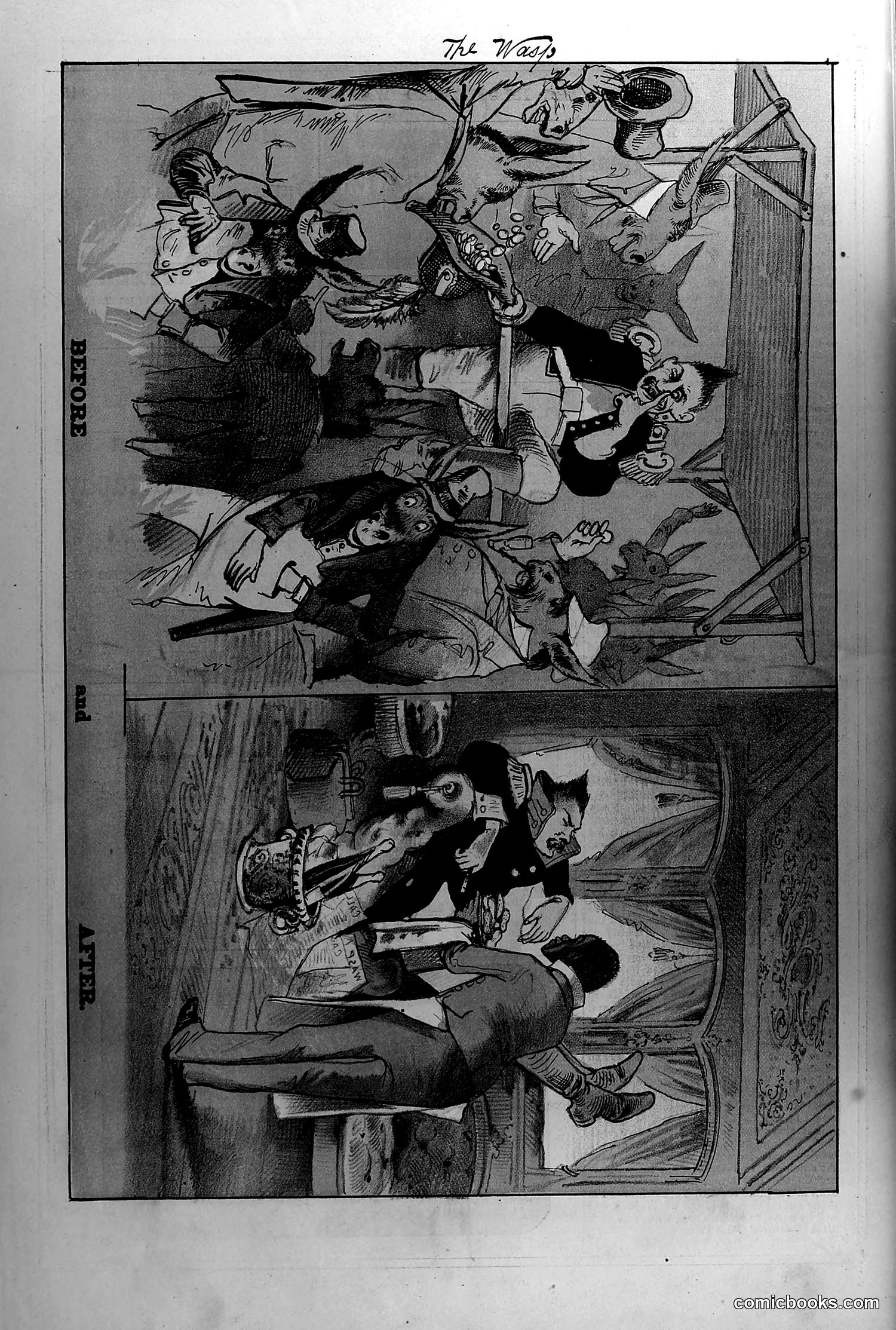
This page from *The Wasp* contains two satirical panels labeled "BEFORE" and "AFTER," depicting a political or social transformation scenario. The **upper panel** shows a chaotic scene with multiple figures in formal dress engaged in what appears to be a confrontation or dispute—the composition is deliberately crowded and tumultuous. The **lower panel** presents a calmer domestic scene with fewer figures, suggesting resolution or change. Without clearer identification of the specific figures depicted or dated context, I cannot definitively identify which political figures or events this satirizes. The overall structure suggests commentary on societal disorder versus order, or perhaps political conflict and its resolution, but the specific targets and historical references remain unclear from the image alone.

I can see this page contains a color reference chart or test pattern with graduated gray squares arranged in a grid pattern, along with measurement rulers on the sides. This appears to be a technical page used for photography or printing calibration rather than editorial cartoon content. The presence of standardized gray patches and measuring scales suggests this is documentation material—possibly a test chart inserted into The Wasp magazine for photographic reproduction purposes. Without visible cartoon imagery, political figures, or satirical commentary, I cannot identify specific historical references or explain social satire. This seems to be a technical/production page rather than satirical content meant for reader consumption.