
A complete issue · 18 pages · 1880
The Wasp — June 26, 1880

I can see this is a measurement/scale reference page from what appears to be an archival document, showing Oregon Rule Co. rulers for photographic calibration purposes. The page contains two rulers and a grayscale color chart - standard tools used in documentary photography to establish accurate scale and color reference in archival images. This is **not a satirical cartoon page** from The Wasp magazine. Rather, it appears to be a technical reference sheet used when photographing documents or artifacts for archival records. The rulers and color chart helped ensure accurate reproduction of materials being documented. Without the actual satirical content visible, I cannot identify any political figures, social references, or jokes that would be present on a typical Wasp page.
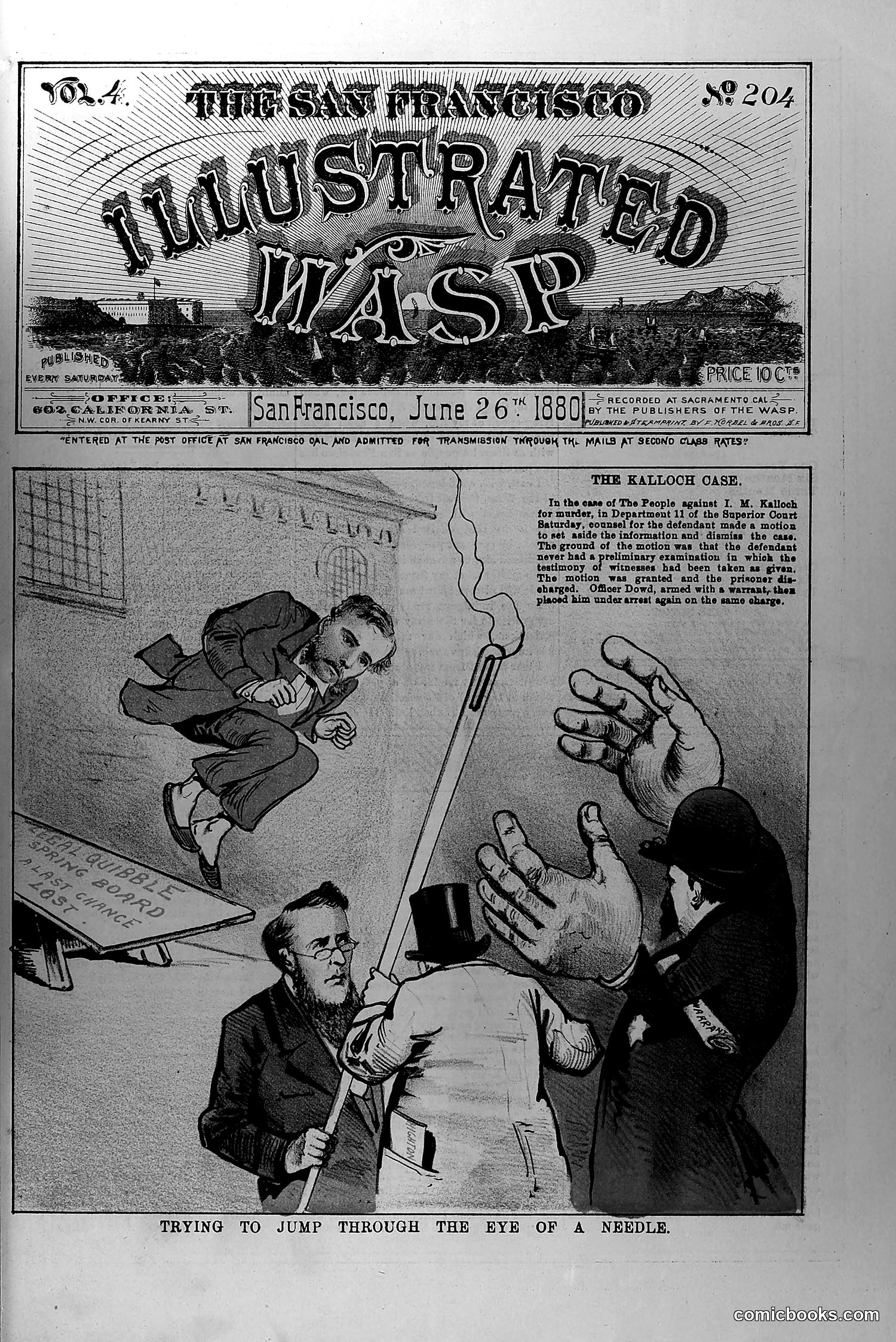
This satirical cartoon from *The Wasp* (June 26, 1880) illustrates "The Kallooh Case," a legal matter mentioned in the accompanying text. The cartoon depicts two figures attempting an impossible feat: making a man "jump through the eye of a needle." The imagery is metaphorical satire about the legal proceedings. According to the text, a defendant's motion to dismiss charges was granted after witness testimony was taken, then the prisoner was re-arrested on the same charge. The "needle's eye" represents the absurd legal gymnastics—the case appearing to go nowhere while authorities repeatedly manipulate the legal process. The cartoon mocks the illogical nature of the justice system's handling of this particular case.
This page contains the magazine's editorial farewell and a serialized short story titled "Feuilleton: Milk in Paris," with no visible political cartoons. The editorial, signed by "Salmi Morse" (the managing editor), announces the magazine's closure. Morse expresses satisfaction with his tenure, noting The Wasp's role in San Francisco journalism and its efforts to elevate public discourse. He acknowledges the paper's "independence" and "praise" while promising to continue civic engagement elsewhere. The accompanying story appears to be a romantic narrative set in Paris, unrelated to political satire. The page primarily serves as a transition document marking the publication's end, rather than presenting satirical commentary on contemporary political figures or events.
This page is primarily **text-based content** rather than political cartoons. It contains several short articles and humorous pieces, including: 1. **"Santa Cruz Caved"** - A satirical piece praising Santa Cruz's discovery of underground caverns, mocking the town's efforts to attract tourists with this "natural wonder." 2. **"Over The Wires"** - Poetry pieces, likely contemporary verse. 3. **"Her Harçlos Barbarized"** - A humorous lexicon defining bar-related terms (bar-bet, bar-gain, bar-ring, etc.), satirizing saloon culture. 4. **"Sea Saws"** - A brief piece about ship design. The page demonstrates *The Wasp's* satirical approach through wordplay and social commentary rather than visual caricature. The humor targets frontier boosterism, drinking culture, and contemporary absurdities.
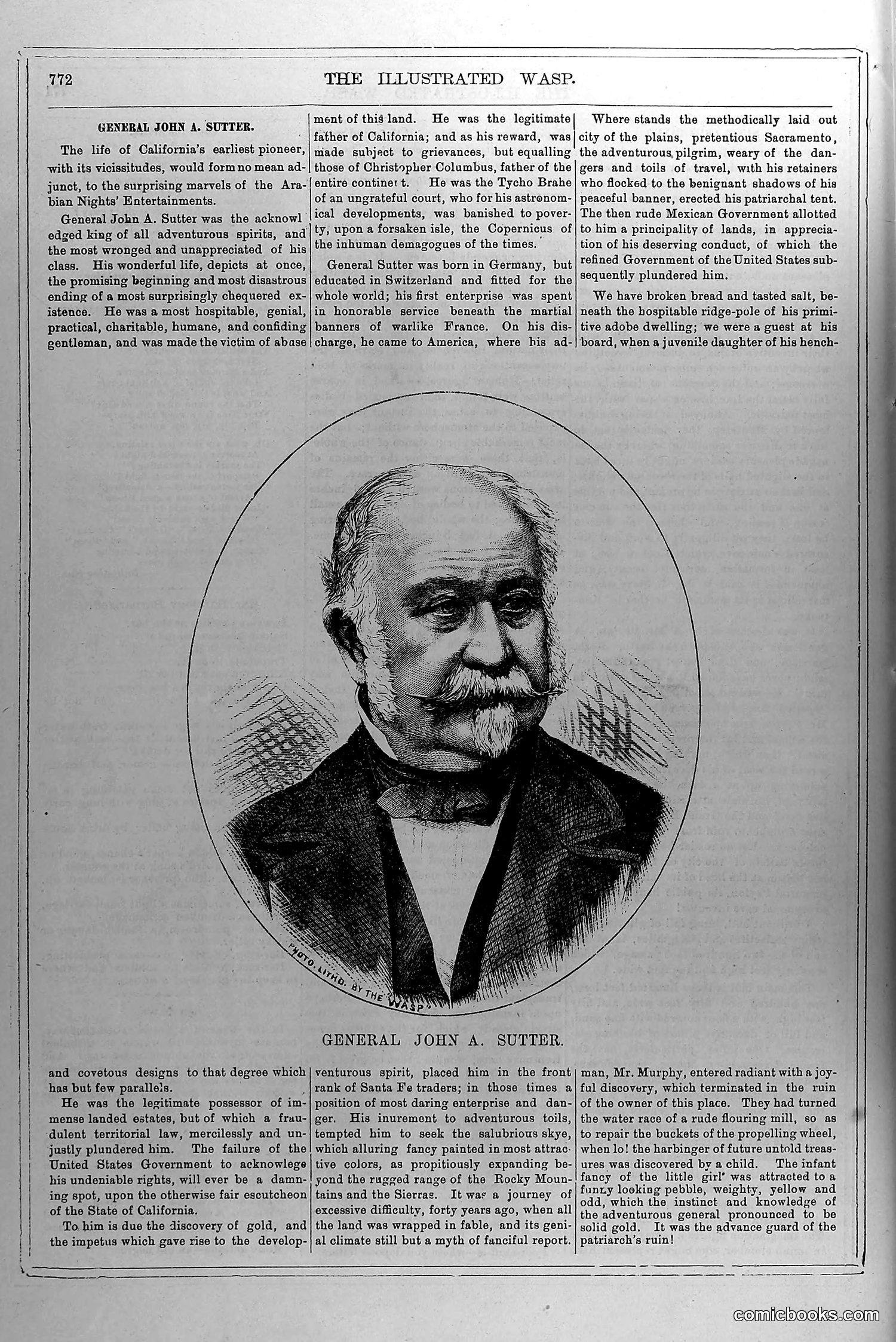
This page from *The Wasp* features a biographical article and portrait of General John A. Sutter, California's early pioneer. The text describes Sutter as an adventurous but ultimately tragic figure—a German-born entrepreneur who came to California and built substantial landholdings and enterprises. However, the article's tone suggests criticism beneath the admiration. It notes Sutter was "the victim of abuse" and that his "failure" resulted in loss of his estates, despite his "undeniable rights." This appears to reference Sutter's actual historical downfall: he lost his massive land grants and wealth following the Gold Rush, largely due to legal disputes and inability to defend his claims against squatters and the U.S. Government's failure to acknowledge his legitimate land rights. The piece seems a sympathetic but cautionary portrait of a pioneer whose ambitions outpaced his legal protections.
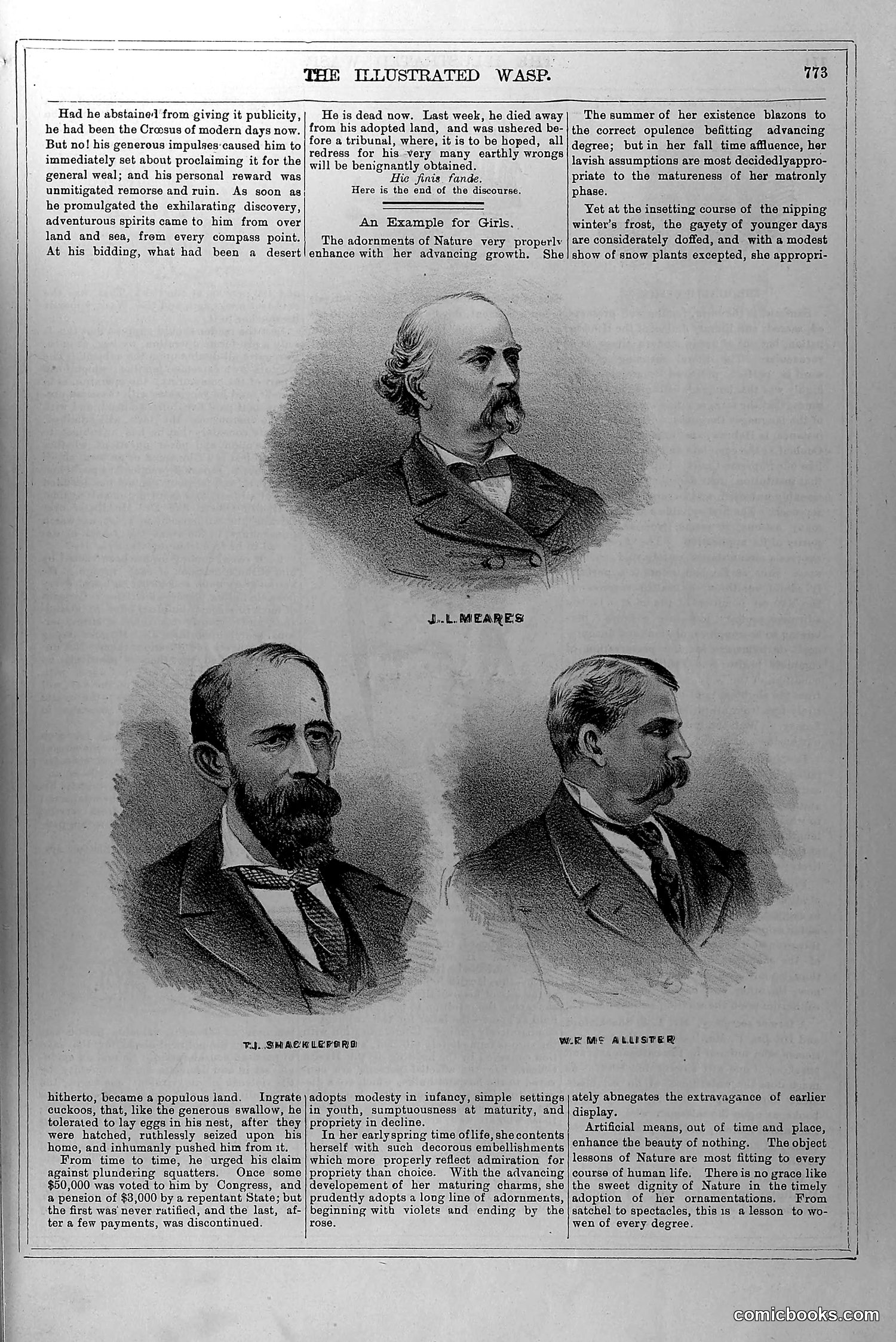
This page features three portrait engravings labeled J.L. Meares (top), T.J. Shackelford (bottom left), and W.F. McAllister (bottom right). The text discusses these individuals in a biographical context, mentioning their roles in land development and public service. The accompanying article titled "An Example for Girls" appears to praise their advancement through growth and development. However, without additional contextual information about specific events or controversies involving these three men, the satirical intent remains unclear. The page may be commending or critiquing their public achievements, but the precise point of the satire cannot be determined from the visible text and portraits alone.
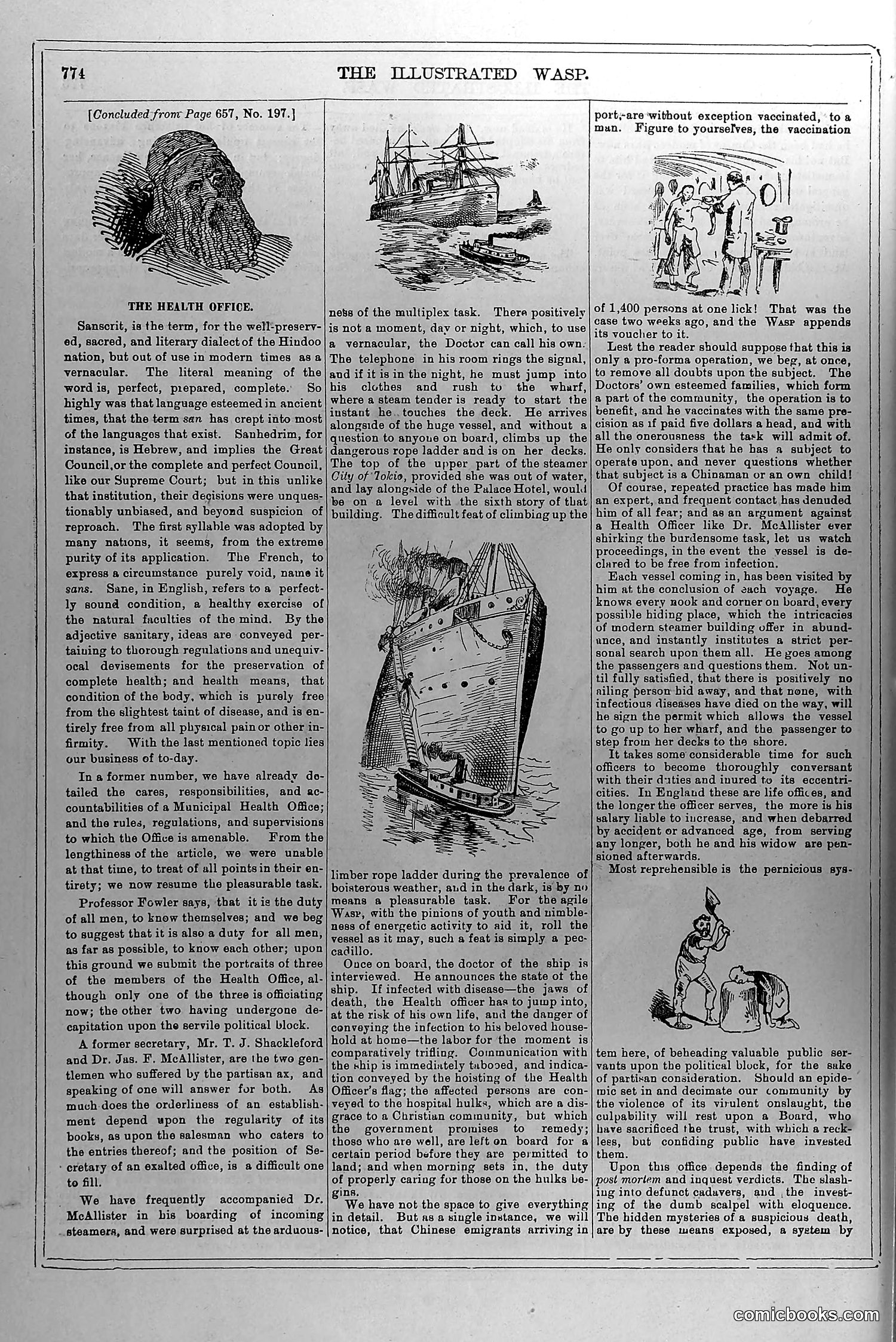
This page contains an article titled "The Health Office" discussing sanitation and disease prevention on ships arriving at port. The text criticizes the Health Office's practices regarding vaccination and disease screening of incoming passengers and crew. The accompanying illustrations show: 1. **A fish** (top left) - unclear symbolic purpose 2. **A steamship with a small boat** (top center) - depicts a vessel being inspected 3. **Medical personnel examining passengers** (top right) - shows the health inspection process 4. **A ship's interior/cabin** (center) - illustrates conditions aboard vessels 5. **Figures at bottom** - appears to show medical examination or treatment The article advocates for improved public health procedures, arguing that proper vaccination and disease inspection protect both arriving immigrants and resident populations from infectious disease spread.
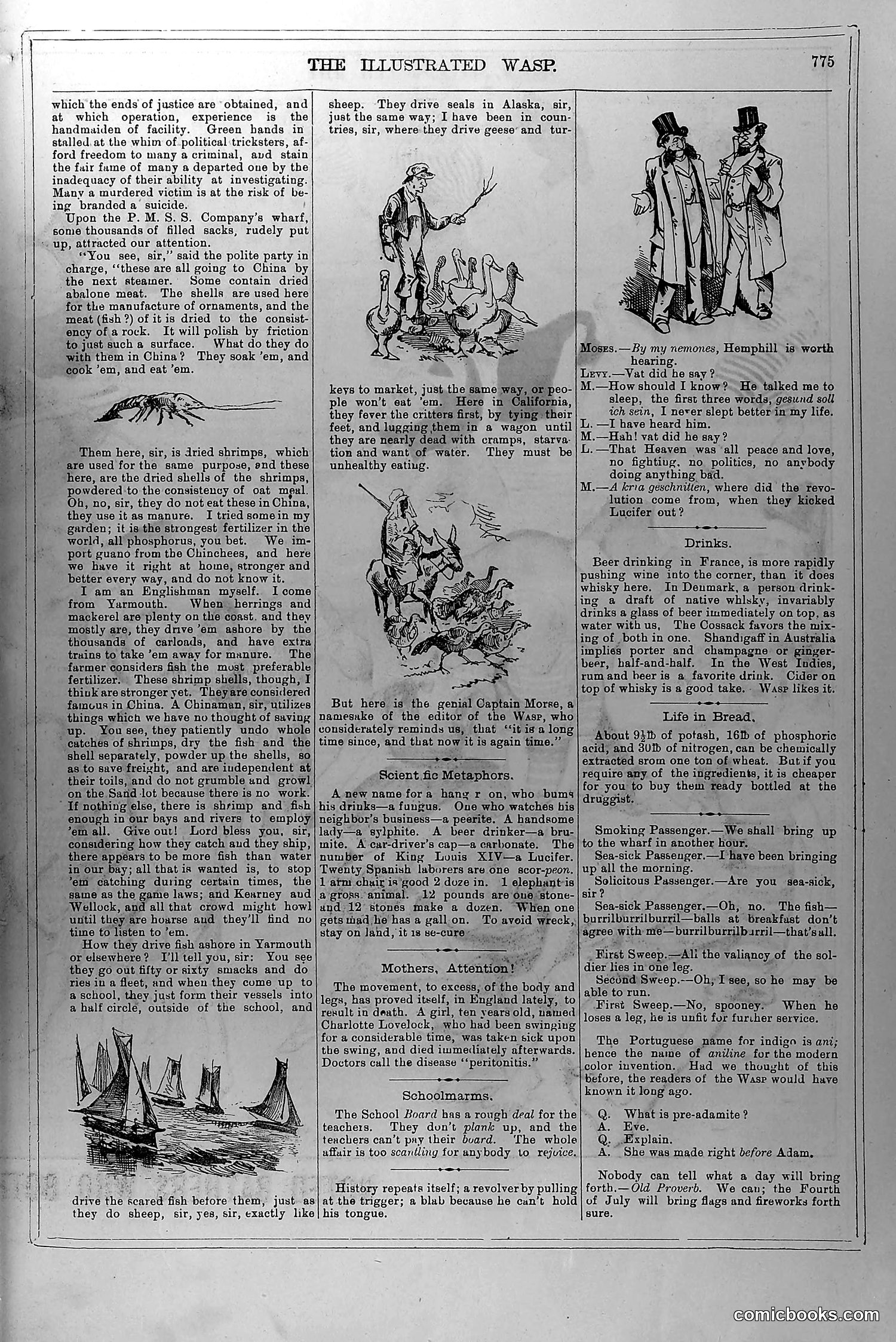
This page combines satirical dialogue with humorous sketches. The main cartoon depicts **Moses** (identified by text) conversing with figures labeled **Levy** and **Hemphill**, discussing religious and moral matters. The dialogue references "psalmody" and divine justice, suggesting social commentary on religious hypocrisy or competing moral claims. Below are separate illustrated vignettes covering unrelated topics: **"Drinks"** discusses beer consumption in France versus Denmark; **"Life in Bread"** references phosphoric acid in wheat; **"Smoking-Passenger"** and **"Sea-sick Passenger"** present brief humorous scenarios; **"Mothers, Attention!"** warns about a childhood disease called "pemphigus." The page functions as a miscellaneous satirical and informational column rather than a unified political cartoon, typical of 19th-century satirical magazines mixing humor with practical social commentary.
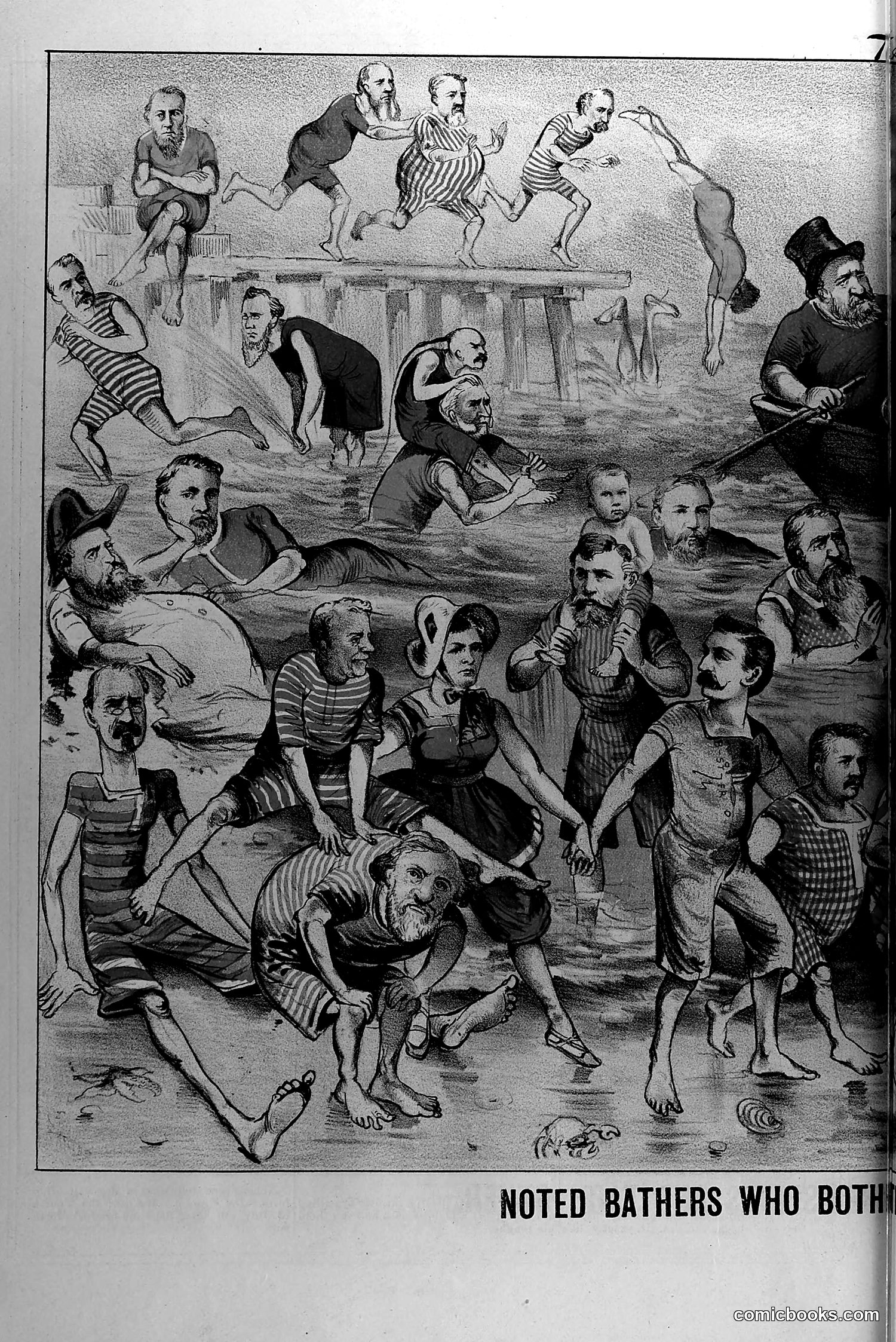
This satirical cartoon depicts various men of different ages and body types bathing together in water. The title "Noted Bathers Who Both[...]" is cut off, preventing full context identification. The cartoon appears to be 19th-century political satire, likely from *The Wasp* magazine. The exaggerated physical caricatures—emphasized bellies, facial features, and body proportions—suggest these represent specific public figures or politicians being mocked. The bathing scene may lampoon these figures' hypocrisy, vulnerability, or some shared scandal. Without the complete caption, the specific identities and satirical point remain unclear. The striped swimwear and casual poses suggest either leisure critique or a commentary on public behavior. The drawing style and composition are typical of period editorial cartooning meant for immediate political commentary.
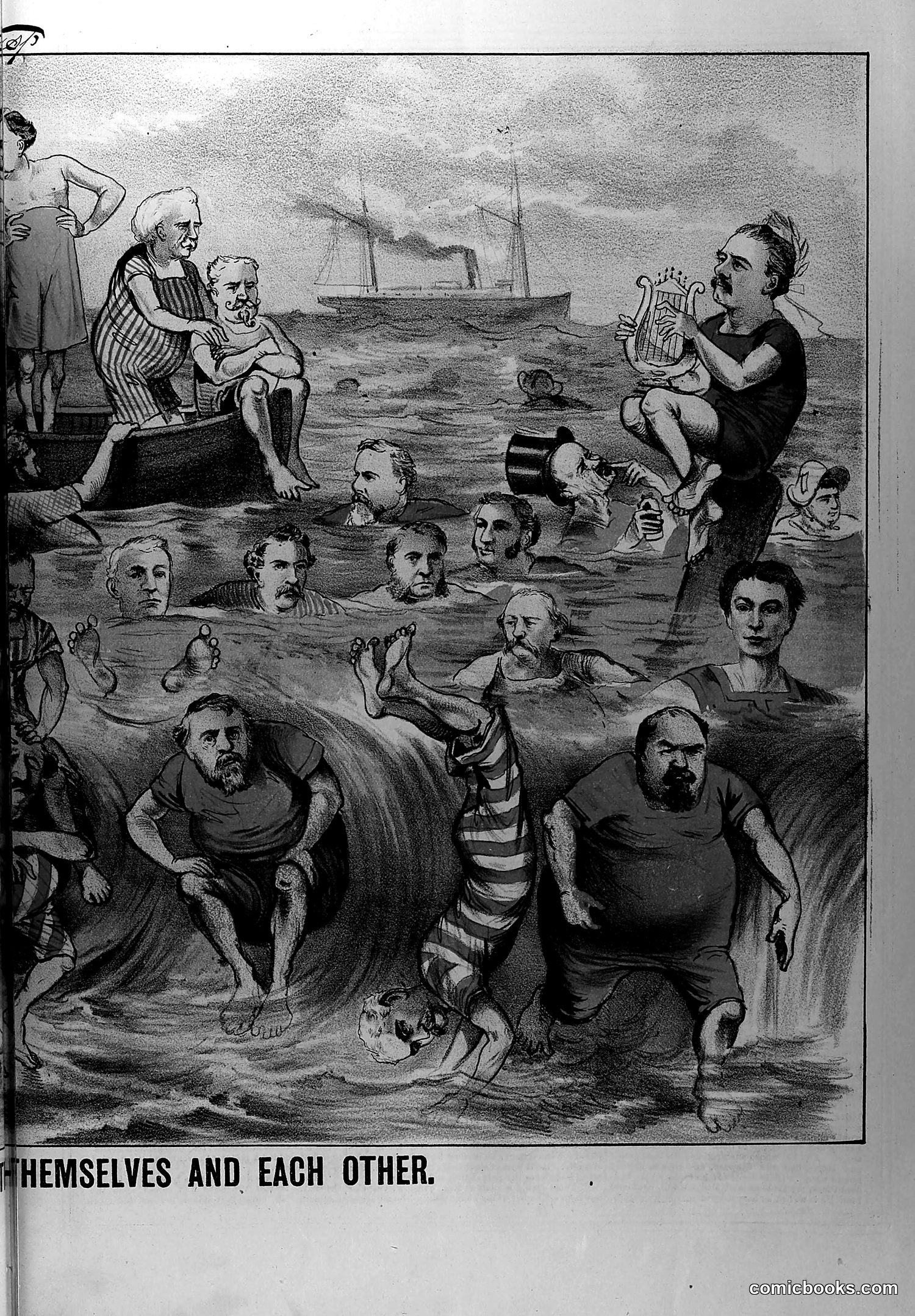
This satirical cartoon depicts multiple male figures in water, appearing to struggle or swim together. The caption reads "THEMSELVES AND EACH OTHER," suggesting internal conflict or mutual antagonism. Based on *The Wasp's* San Francisco origin and satirical focus, this likely depicts political or business rivals engaged in destructive competition—possibly California politicians or business leaders of the era. The water setting and drowning imagery emphasize mutual ruin: the figures are harming each other while potentially sinking together. The man on the shore playing a lyre (upper right) may represent a detached observer, suggesting someone benefits from or manipulates the conflict. The ship in the background adds ambiguity—possibly representing commerce, state interests, or opportunity lost to infighting. Without specific historical context or clearer identifying details, the exact figures remain unclear, but the satire condemns wasteful internal conflict.
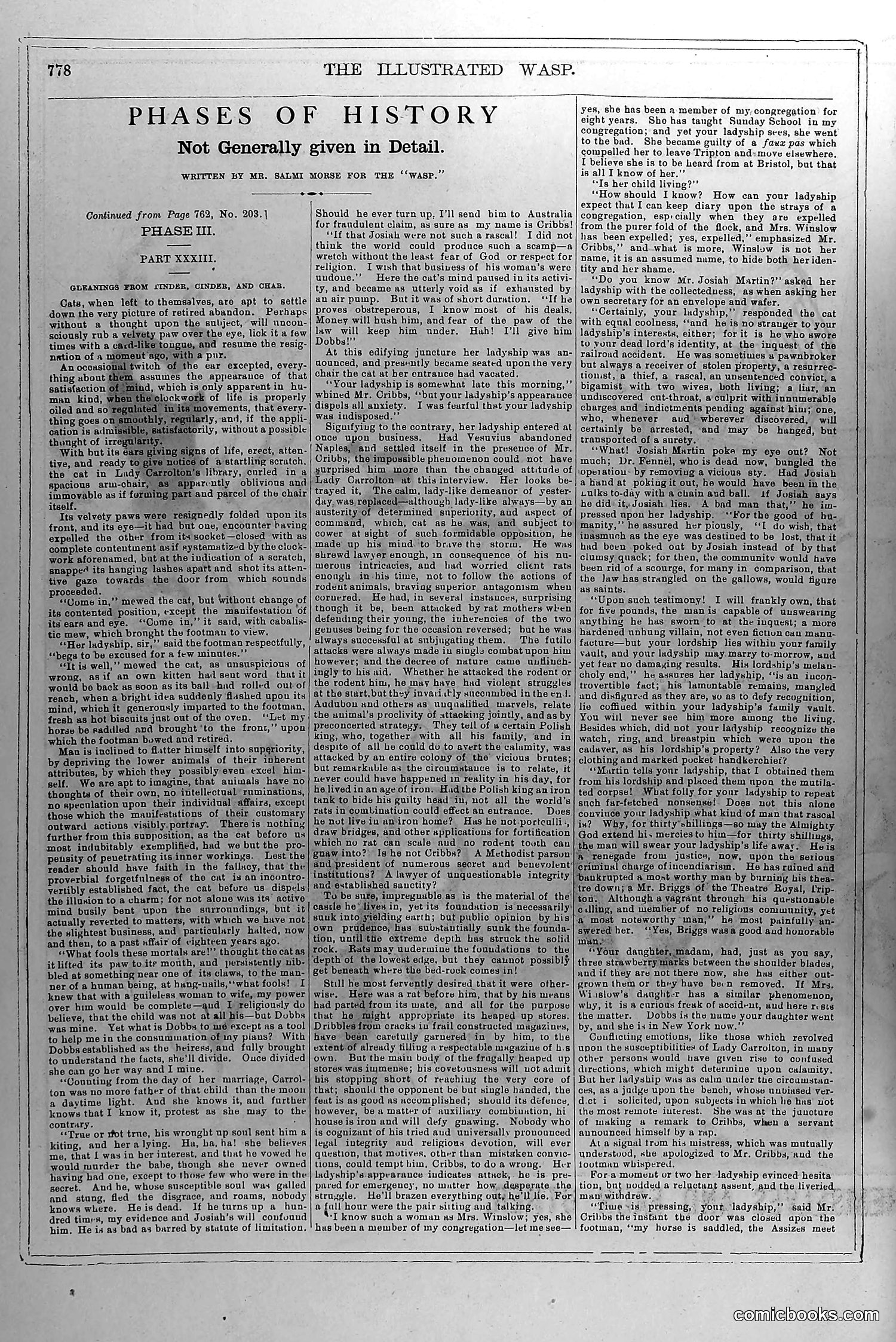
This page is primarily **text content, not a cartoon**. It's the continuation of an article titled "Phases of History: Not Generally given in Detail," written by Mr. Salmi Morse for *The Wasp* magazine. The piece appears to be a satirical social commentary addressing **class dynamics and labor relations**. It discusses retirement, abandonment, and the treatment of working-class individuals—specifically referencing a character's experience with "cinder, cinders, and char." The narrative critiques how society discards people once they're no longer economically useful, using vivid language about cats and lower animals to satirize human indifference to suffering. The text suggests this is **social satire about economic inequality and workers' exploitation** during the period *The Wasp* was published (late 19th century America). No specific political figures are identifiable on this page.
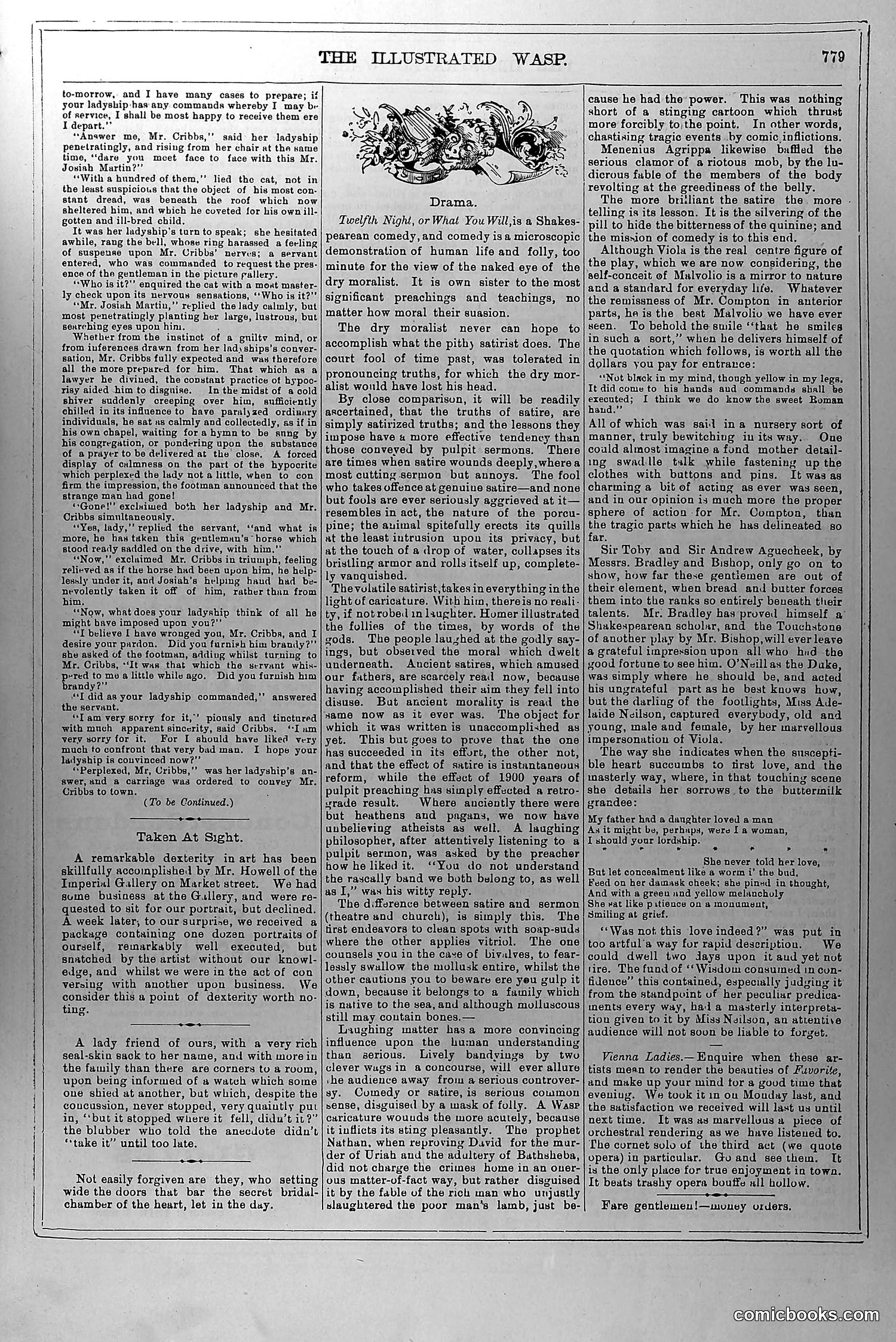
This page is primarily **text content** rather than political cartoon. The visible material includes: 1. **"Drama" section** - A theatrical review discussing a Shakespearean comedy and its moral lessons, contrasting satire with earnest preaching about human folly. 2. **"Taken at Sight"** - An anecdote about a Gallery owner named Howell who sold portraits to patrons, described as a "point of dentistry worth noting." 3. **"Vienna Ladies"** - A brief social commentary about women's beauty treatments and singers. The page lacks the political cartoons typical of *The Wasp*'s satirical format. Instead, it features literary criticism, social gossip, and humorous anecdotes targeting Victorian theatrical and social pretensions. The tone is witty but the specific targets are **not clearly identifiable** without additional historical context about 1880s theatrical personalities or social figures.
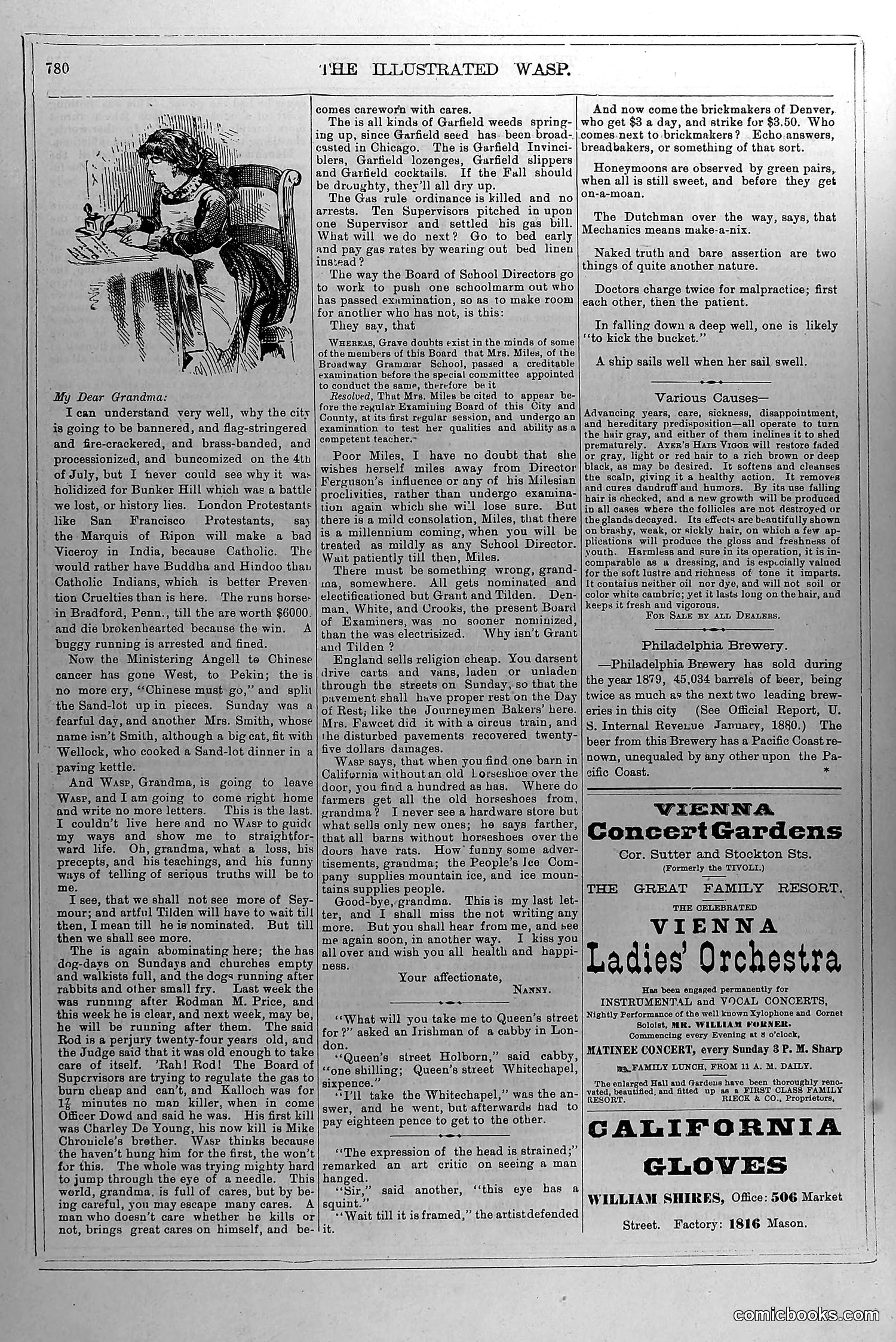
This page contains a satirical letter to "Grandma" discussing San Francisco politics and social issues. The accompanying illustration shows a woman in Victorian dress reading correspondence. The letter criticizes various local figures and institutions: it attacks the "Gas rule ordinance," complains about School Board Supervisors, and mocks Mrs. Miles (apparently an education examiner) through sarcastic praise. There's commentary on working-class grievances—brickmakers, breadmakers earning meager wages. The satire employs heavy irony, particularly regarding Mrs. Miles, whom the writer claims to "have no doubt" excels while implying the opposite. The tone suggests frustration with municipal corruption and incompetence affecting ordinary workers. The rest of the page contains advertisements and unrelated content, making this primarily a social/political commentary piece rather than a visual cartoon.
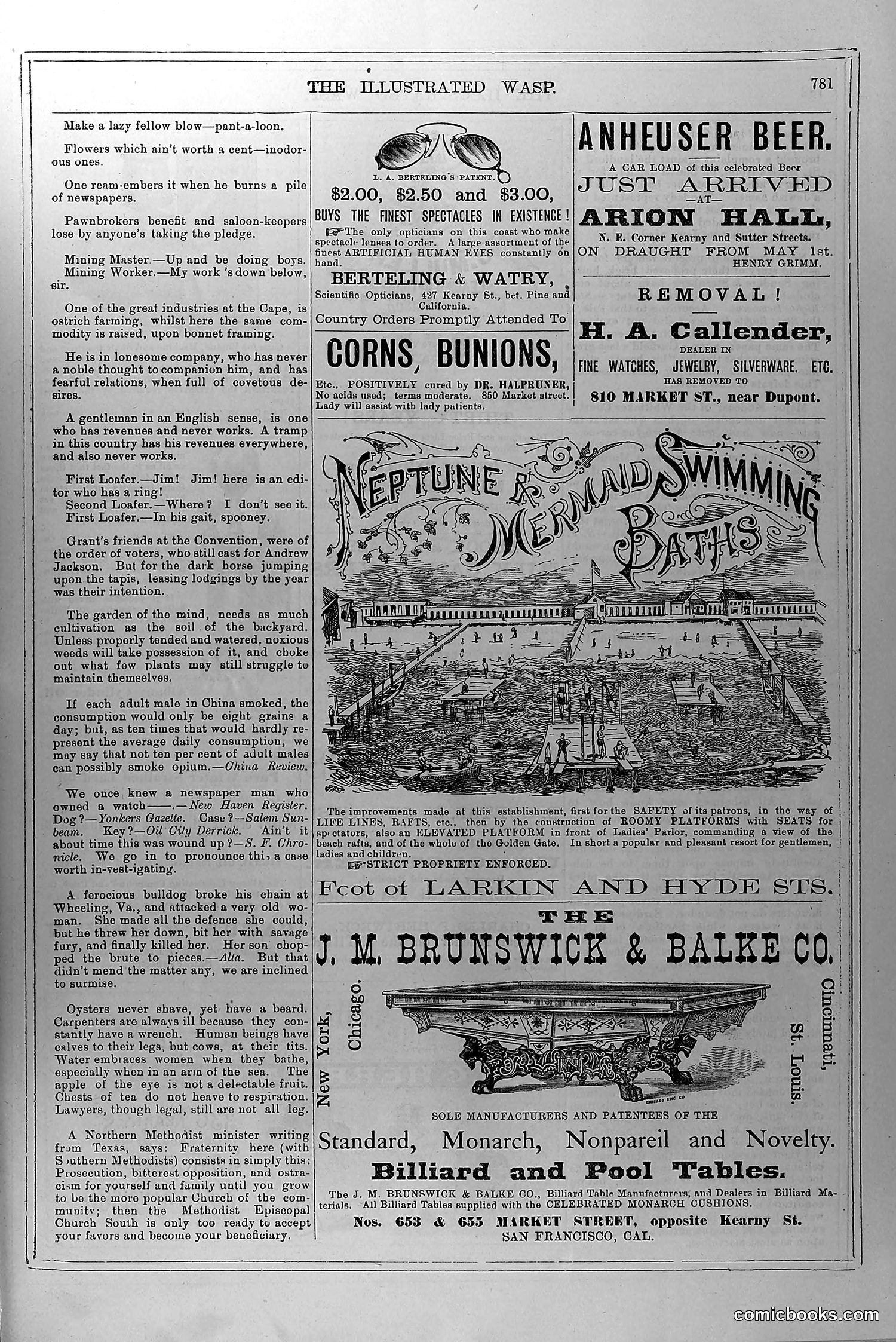
This page is primarily **advertising with satirical columns**, not political cartoons. The left side contains humorous short pieces mocking various subjects: lazy workers ("Make a lazy fellow blow—pant-a-loon"), useless flowers, mining workers, and South African farming. There's a joke about a newspaper man in China and a story about a ferocious woman attacking a wheelbarrow. The right side features advertisements for Anheuser Beer, H.A. Callender's jewelry shop, Neptune Mermaid Swimming Baths (with an illustrated pavilion), and J.M. Brunswick & Balke Co.'s billiard tables. The satirical content appears to be **general social humor rather than political commentary**—poking fun at everyday absurdities and occupational stereotypes typical of 1880s-90s American comic magazines. No specific political figures or events are identifiable from this page.
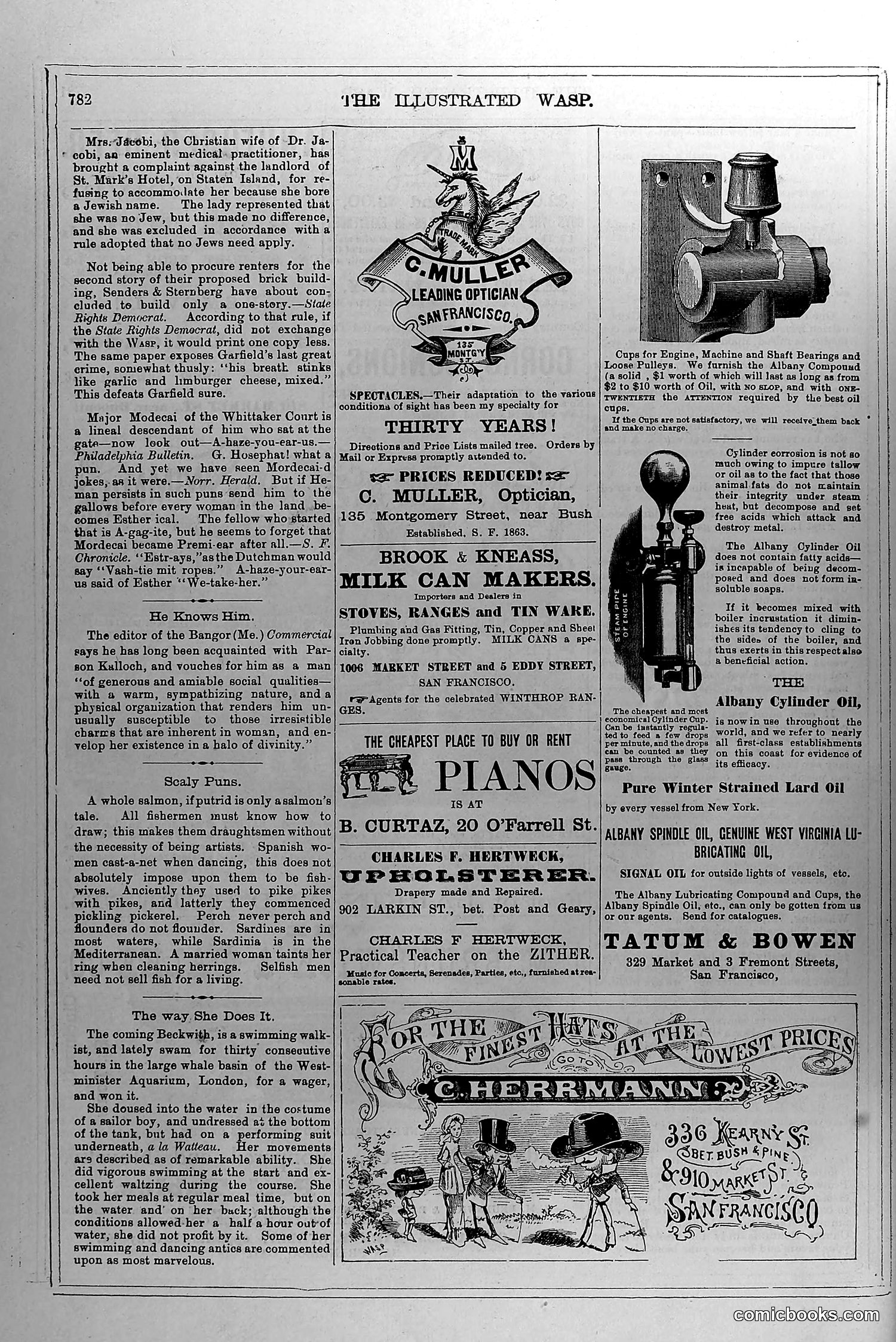
This page is **primarily advertising**, not political satire. It contains commercial notices for San Francisco businesses from what appears to be the 1860s, including: - G. Miller's optician shop - Engine and machinery caps - Albany Cylinder Oil - Piano rentals - An upholsterer's services - Hat merchant C. Herrmann There are a few brief editorial pieces mixed in—anecdotes about "Scaly Puns," "He Knows Him," and "The Way She Does It"—but these appear to be light humor columns rather than political commentary. The page lacks the political cartoons or satirical illustrations typical of *The Wasp's* content. It's essentially a classified advertising section with filler material.
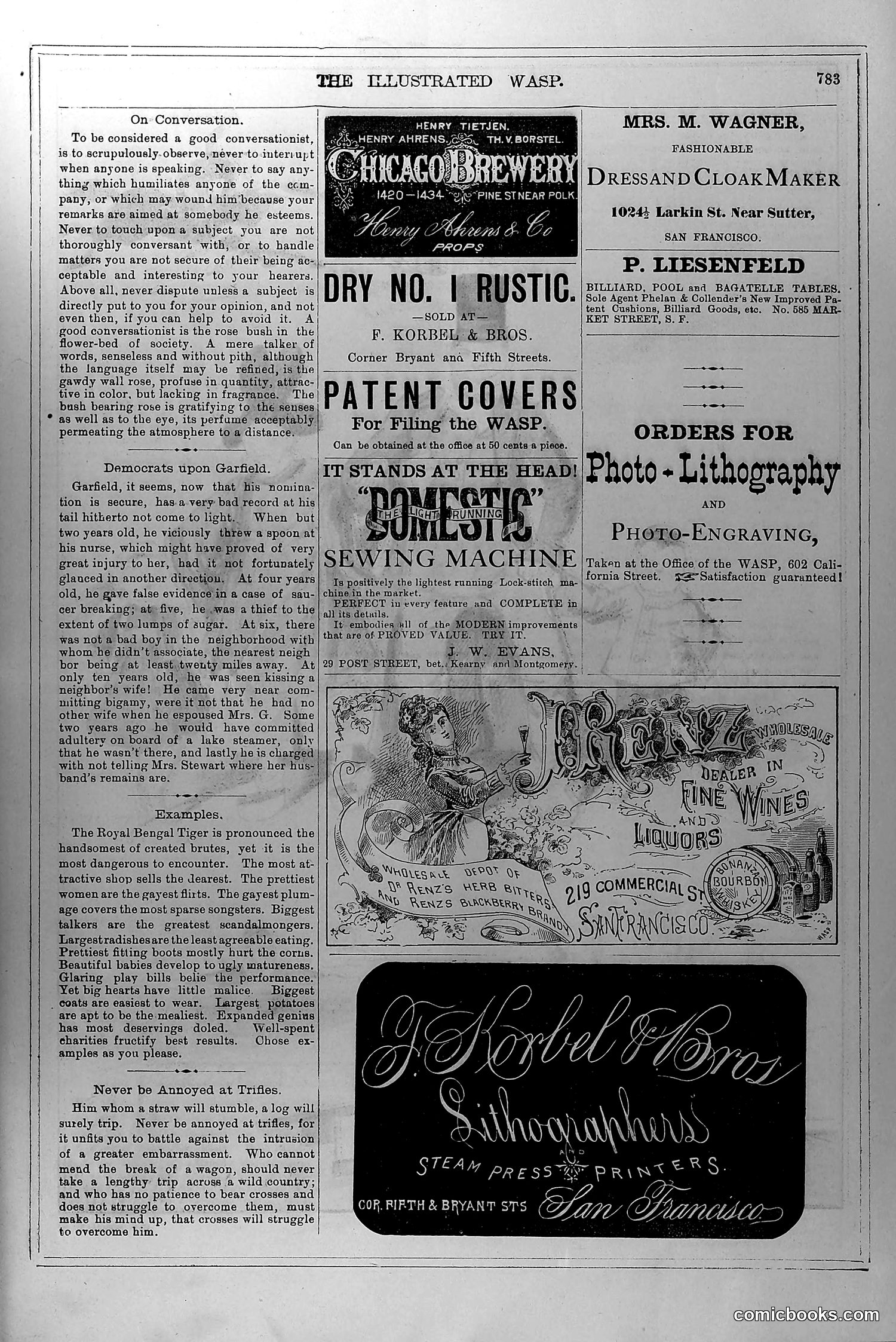
This page is predominantly **advertisements and commercial notices** rather than satirical content. The main visible elements include: - **Henry Ahrens & Co. Chicago Brewery** advertisement (top) - **"Dry No. 1 Rustic"** liquor advertisement - **Patent covers for filing the WASP** notice - **Shufeldt's Sewing Machine** advertisement - **Photo-Lithography services** announcement - **Wine and liquor dealer advertisement** (bottom right, featuring an illustrated woman) - **F. Korbel & Bros.** and other merchant advertisements The left column contains brief editorial pieces on conversation etiquette and anecdotes ("Democrats upon Garfield," "Examples," "Never be Annoyed at Trifles"), but these are generic advice columns rather than political satire. **Overall assessment:** This is a typical late-19th-century magazine page where advertising revenue dominates the layout, with minimal political cartoon content visible.
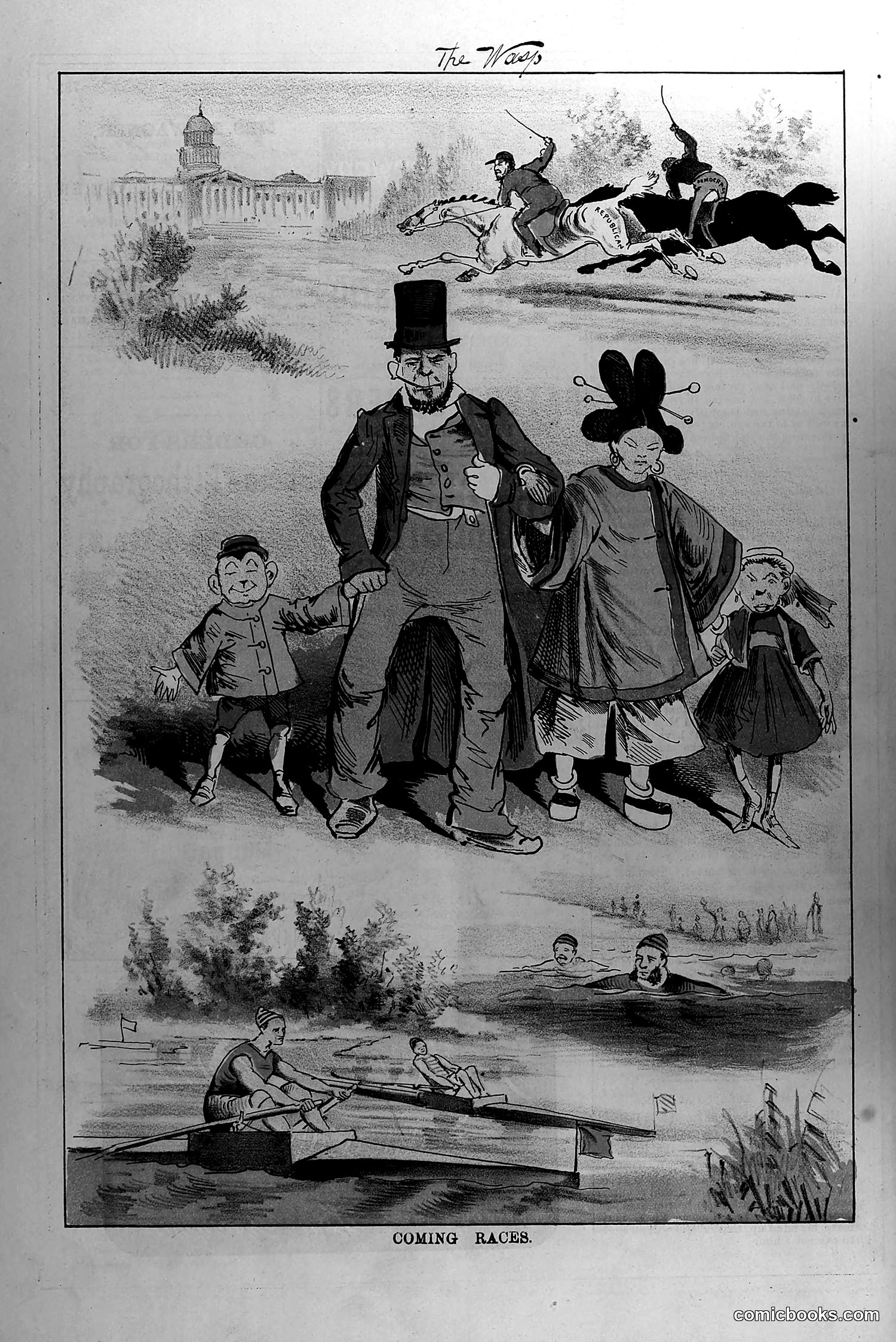
This satirical cartoon depicts various competitive "races" in American society. The upper panel shows a man in a top hat (likely a politician or wealthy figure) herding three caricatured children with exaggerated features toward what appears to be the Capitol building. The grotesque depictions suggest this is commentary on racial or ethnic stereotypes of the era. The middle panel shows horse racing—literal racing—in the background. The lower panel depicts rowing/boat racing on water. The title "Coming Races" appears to be a pun: simultaneously referencing actual sporting competitions (horse racing, boat racing) and making a darker satirical point about social hierarchies and immigration or class divisions in America. The specific identities of the figures remain unclear without additional historical context.

I can see this is a test or calibration page for *The Wasp* magazine, rather than an actual cartoon or editorial content. The page displays: - A color checker/reference chart on the left (a grid of grayscale squares used to test printing quality) - Two measurement rulers—one vertical and one horizontal—for gauging reproduction accuracy - Standard printing calibration marks This type of page was used by printers and publishers to ensure consistent image quality and proper scaling during the reproduction process. It's not satirical content but rather a technical tool page, likely included in archival materials or bound collections of the magazine for documentation purposes. Without actual cartoon imagery or text content visible, no political or social satire can be identified.