
A complete issue · 18 pages · 1880
The Wasp — June 19, 1880

I can see this is a scale reference page from what appears to be a archival or microfiche document, showing two Oregon Rule Co. rulers against a black background with a grayscale color chart. However, this is **not a page from The Wasp satirical magazine** — it's a technical documentation photograph used for archival purposes, likely for digitization or microfilm standards. There are no cartoons, political figures, caricatures, or satirical content visible. The image serves only as a calibration and scale reference tool for archivists or researchers working with historical documents. Without the actual magazine page content, I cannot provide the historical or political analysis you're requesting.
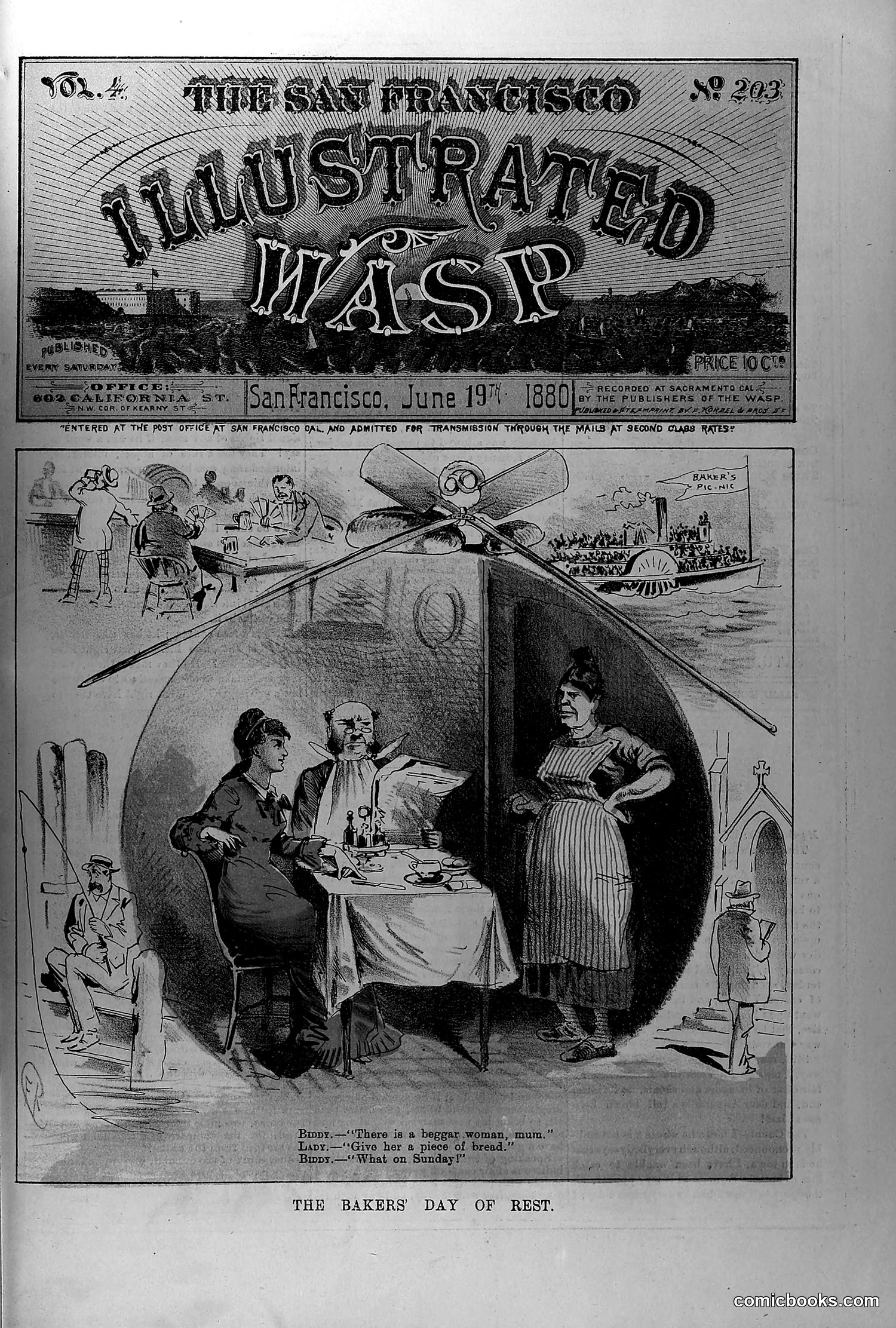
This satirical cartoon critiques bakers' working conditions in 1880 San Francisco. The main illustration shows a baker (left) and what appears to be a baker's wife or family member dining with a well-dressed clergyman in a cramped, circular space—likely representing a baker's modest home or workspace. The dialogue suggests irony: the clergyman asks about "a beggar woman," the baker requests "a piece of bread," and the clergyman responds "What on Sunday?" The humor appears to target how religious authorities preached rest and charity while bakers—among the most exploited workers—labored continuously, even on Sundays, with little food or leisure time. The title "The Bakers' Day of Rest" reinforces this bitter irony.
The visible cartoon at the top depicts a wasp attacking what appears to be a man's head. This likely relates to the magazine's masthead—*The Wasp* used aggressive insect imagery to represent its satirical "sting." The primary content is an article titled "DENIS KEARNEY ON FEMALE SUFFRAGE," which satirizes labor leader Denis Kearney's arguments against women voting. The piece ridicules his reasoning that women shouldn't vote because they lack certain professional qualifications men possess. The accompanying letter "MICE IN PARIS" discusses social gossip from France, unrelated to the suffrage debate. The satire's target is clear: Kearney's hypocrisy in denying women rights while championing working-class male enfranchisement.
This page contains **no political cartoon**—it's primarily text columns discussing various topics: men's rights and the House of Correction, Mark Twain's travel humor, bamboo paper manufacturing, and natural hot springs. One brief illustrated item titled "THE GEYSER SPRINGS" appears to reference California's geothermal attractions, likely promoting tourism or discussing their scientific properties. The longest piece critiques atheist arguments about women's rights and Christian doctrine regarding marriage, defending traditional religious positions on women's property and marital rights—a 19th-century social debate. The page is essentially **editorial/opinion content** rather than satirical cartooning, typical of Wasp's mix of humor, social commentary, and practical information for readers.
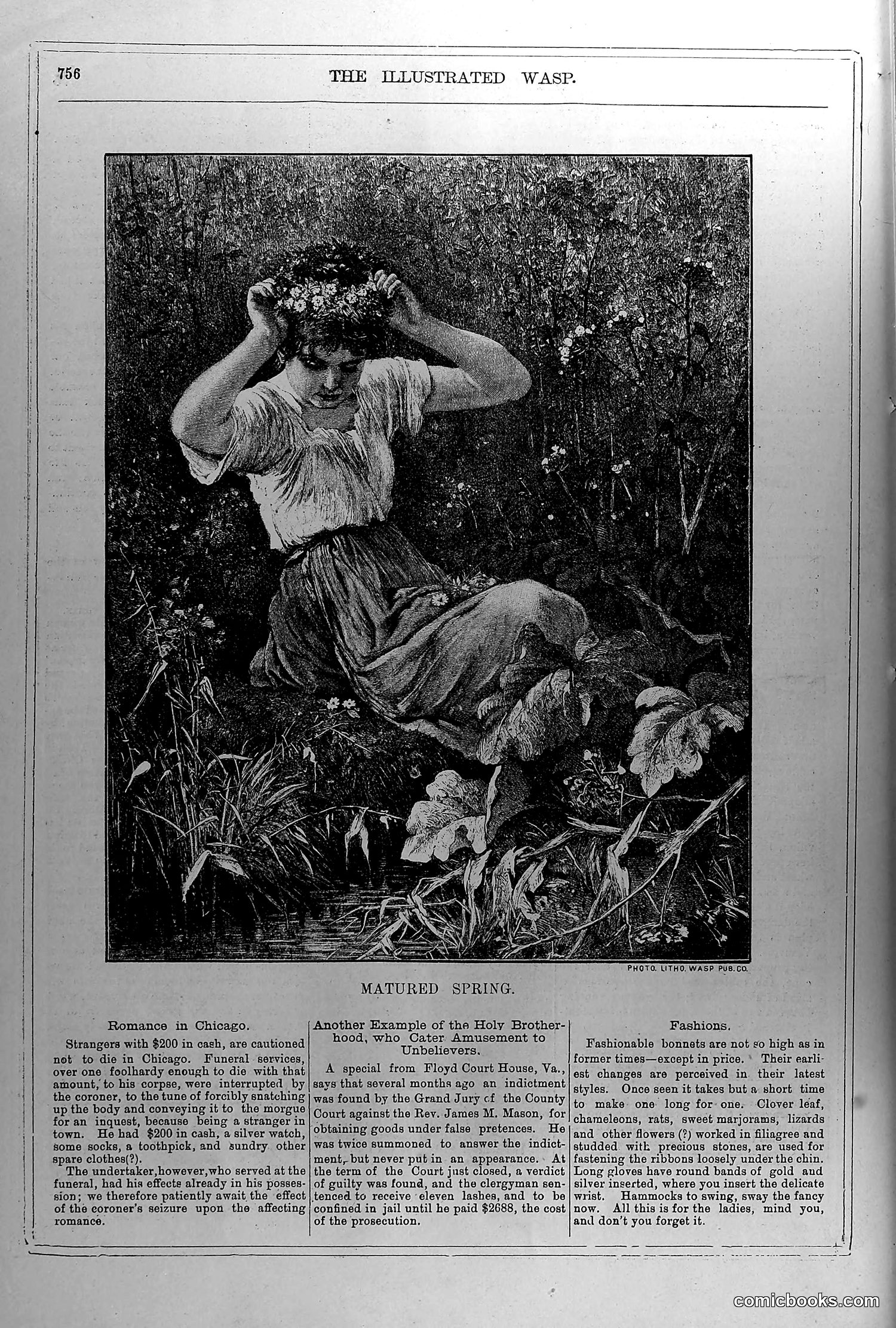
This page contains three distinct text sections rather than traditional political cartoons. The central illustration shows a classical female figure in a garden setting, accompanying the title "Matured Spring." The three columns present satirical commentary on contemporary social issues: 1. **"Romance in Chicago"** mocks a stranger's murder in Chicago, cynically noting the coroner's patience awaiting the victim's romantic effects. 2. **"Another Example of the Holy Brotherhood"** criticizes clergy corruption, detailing a reverend's conviction for fraud involving illegally confined individuals forced to work. 3. **"Fashions"** satirizes women's fashion trends, humorously describing elaborate accessories like ribbons, gold silver, and hammocks worn under clothing. The magazine uses social satire to critique urban crime, religious hypocrisy, and fashion excess in late 19th/early 20th-century America.
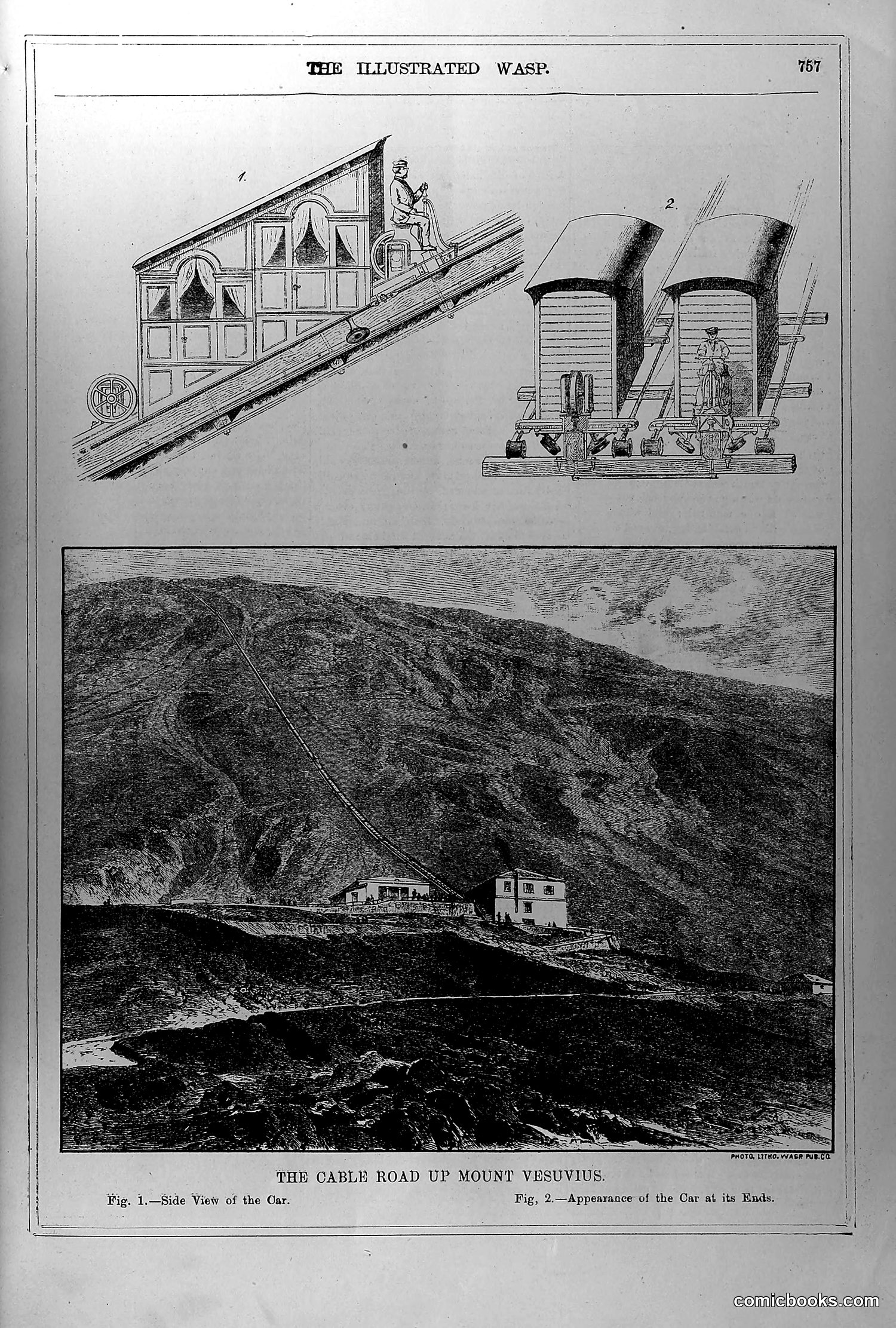
This page illustrates the mechanical system of an inclined cable railway on Mount Vesuvius in Italy. The diagrams show the car's construction and operation: Figure 1 depicts the side view of the passenger car on the steep track, while Figure 2 shows the appearance of the car's ends with their mechanical features. The bottom photograph shows the actual installation on Vesuvius's slope, with the station buildings visible against the dramatic volcanic landscape and the cable line extending up the mountain. This appears to be a **technical/informational feature** rather than satire—documenting an engineering achievement in transportation technology. The Wasp likely presented this as an interesting example of Victorian-era mechanical innovation and tourism infrastructure.
This page contains **dramatic criticism and theater review** rather than political satire or comics. The main content discusses Miss Neilson's performance as Juliet in *Romeo and Juliet*, staged in Verona, Italy. The reviewer praises Neilson's portrayal, particularly her emotional authenticity and natural performance style—contrasting her favorably with overly theatrical interpretations. The text emphasizes how her "glowing Italian" setting and genuine passion created a powerful effect. The ornamental header illustration depicts classical theatrical figures, appropriate to the drama-focused content. This appears to be **arts criticism** rather than political satire, typical of *The Wasp's* broader cultural coverage beyond humor and political commentary.
This page contains mixed content: satirical text pieces and advertisements rather than a political cartoon. The main sections include: **"The Faded Attractiveness of Past Celebrities"** — a gossip column mocking aging female performers (Jenny Lind, Mademoiselle Georges, Mademoiselle Patti), describing their physical decline with cruel detail. This reflects 19th-century entertainment scandal sheets targeting women's appearance. **Humorous dialogue sketches** about domestic life (bakers' wages, Sunday work) and a piece titled "**$50,000**" regarding railroad litigation against the Central Pacific Railroad. **"**Edison over Again**"** mocks a reversible hat invention. The page reflects The Wasp's formula: mixing celebrity gossip, social satire, and advertisements. The tone is typical of period satirical magazines—caustic, focused on personal appearance and social pretension rather than systemic critique.
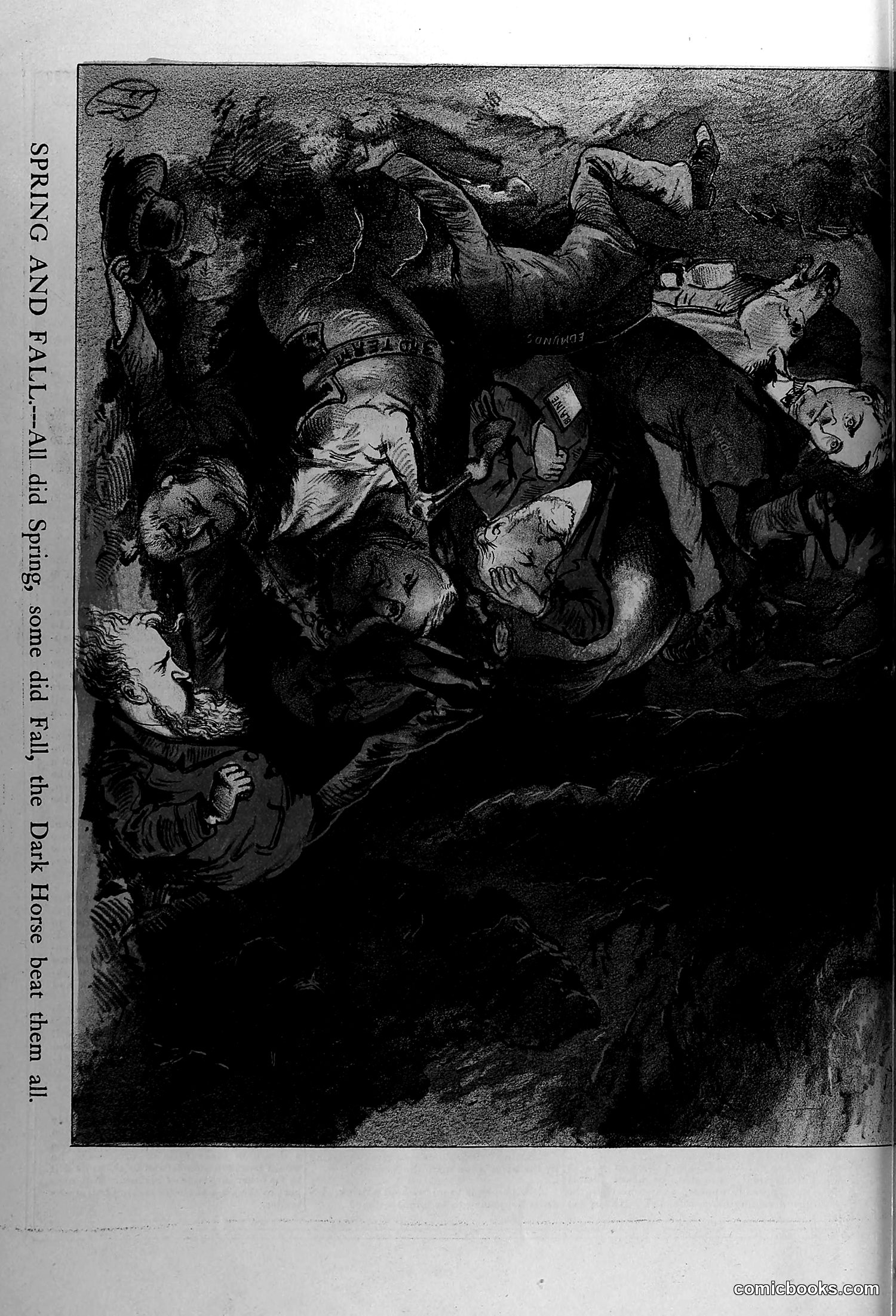
This appears to be a dramatic engraving titled "Spring and Fall—All dds Spring; some ddo Fall, the Dark Lords boat them all" (text somewhat unclear due to OCR limitations). The image depicts a chaotic, nightmarish scene of multiple figures—apparently wealthy or elite gentlemen—tumbling or falling together in darkness. The style suggests social satire, likely criticizing the wealthy or powerful classes experiencing some form of collective downfall or misfortune. Without clearer context about *The Wasp* magazine's publication date or specific historical references, I cannot definitively identify the individual caricatures or the precise political event being satirized. The theatrical, grotesque engraving style is consistent with 19th-century American satirical art targeting economic inequality or class conflict, but the specific targets remain unclear from this image alone.
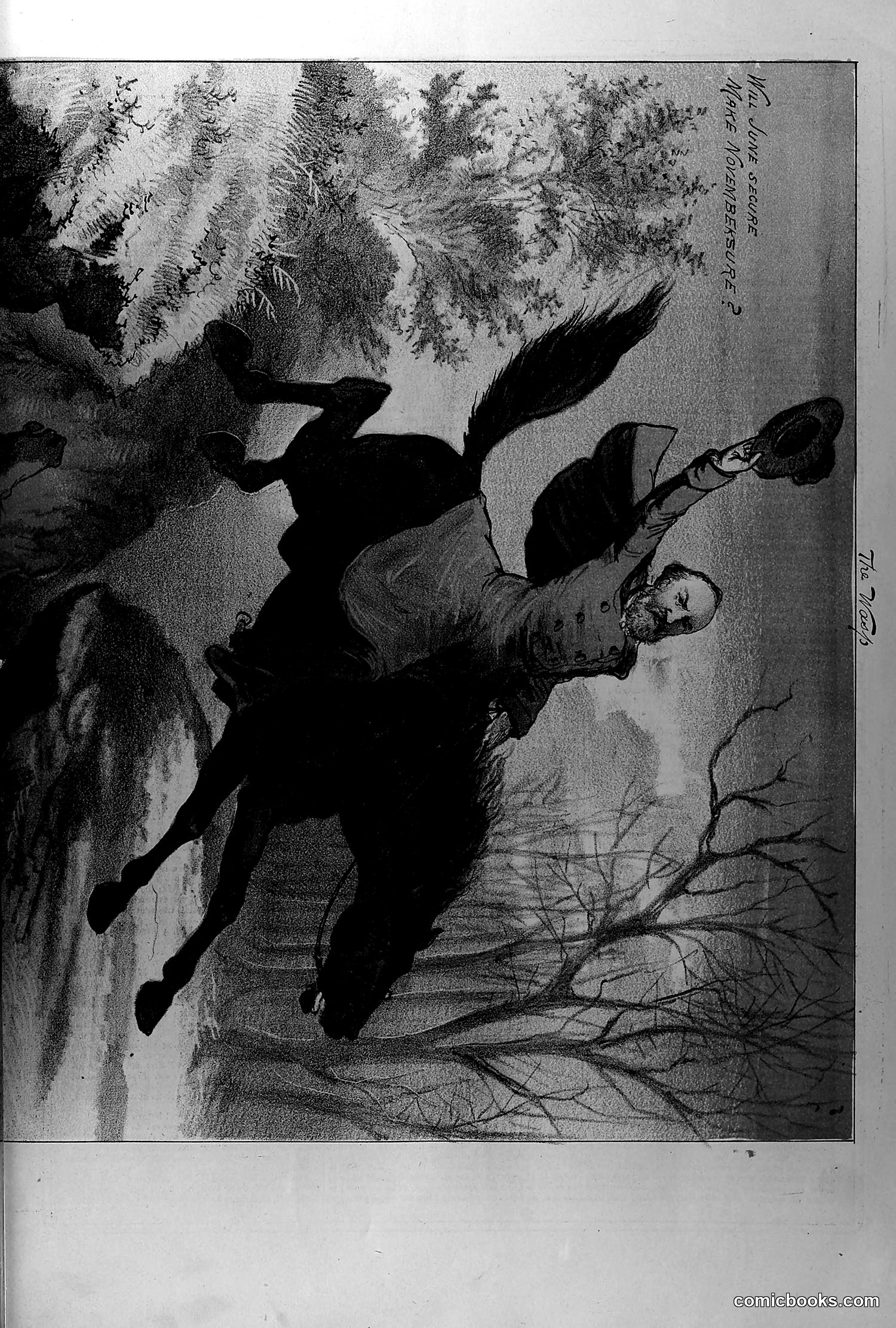
I can see this is a black and white illustration showing a man in formal dress appearing to fall or stumble in a landscape with bare branches and foliage. The image is rotated 90 degrees, making it difficult to read any accompanying text clearly. The OCR text provided appears incomplete or corrupted, containing only fragmented words that don't form coherent sentences. Without legible text identifying the specific figures, political figures, or events referenced, I cannot reliably explain what this satirical cartoon means to a modern reader. The artistic style and formal dress suggest it's likely 19th-century political satire, but I cannot accurately identify who is depicted or what event is being mocked without clearer textual support.
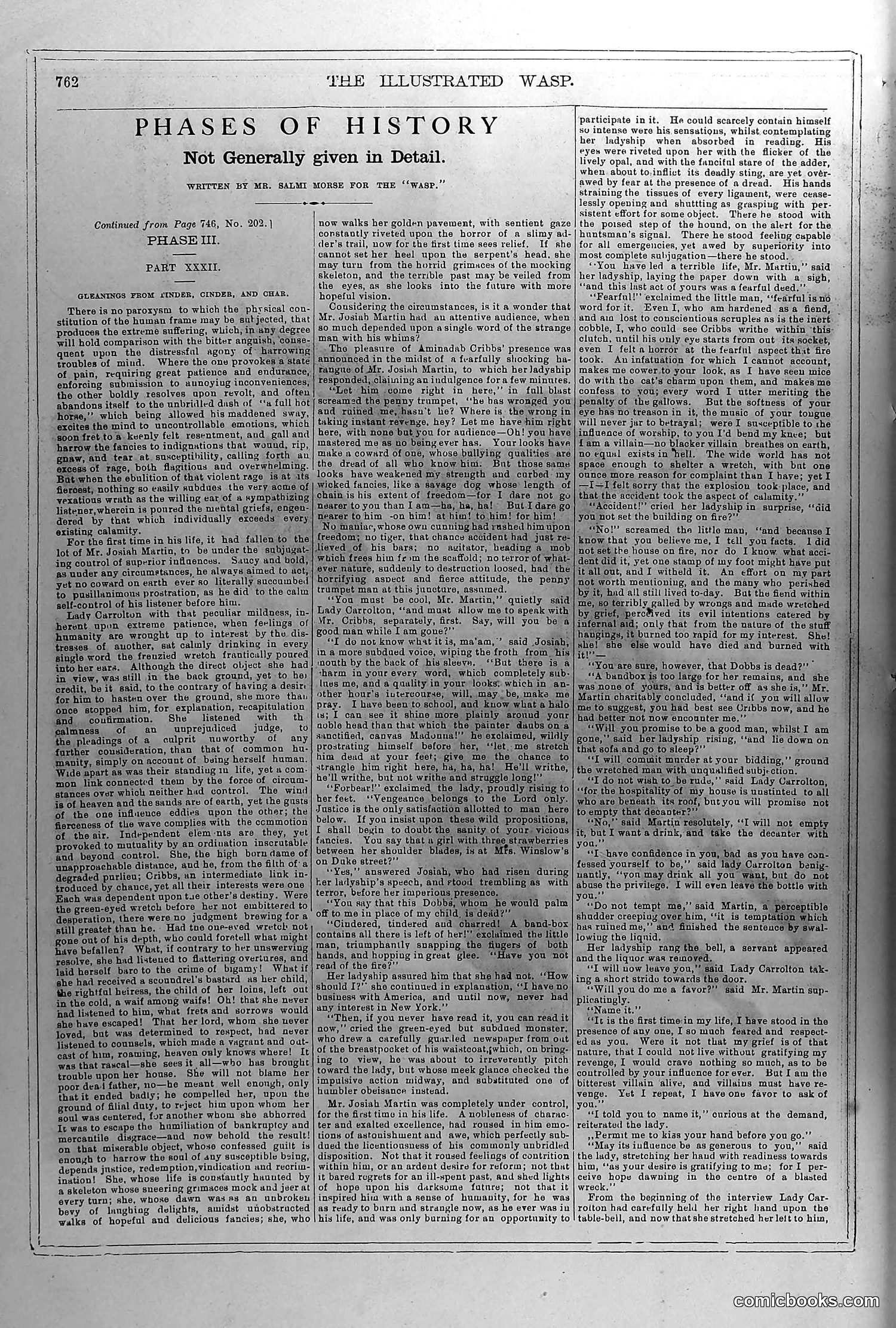
This page contains text only—no visible cartoon or illustration. It presents "Phases of History Not Generally Given in Detail," Part XXXIII, subtitled "Gleanings from Cinder, Cinder, and Char." The narrative is written by Mr. Salmi Mobbe for The Wasp and continues a serialized story (from page 746). The content depicts a dramatic domestic dispute between a husband and wife, involving accusations of infidelity and emotional abuse. The text emphasizes the woman's suffering and the man's controlling behavior. This appears to be Victorian-era satirical fiction rather than a political cartoon. Without the accompanying illustration, we cannot identify specific contemporary figures being lampooned. The piece likely satirizes marriage dynamics and gender relations of the period.
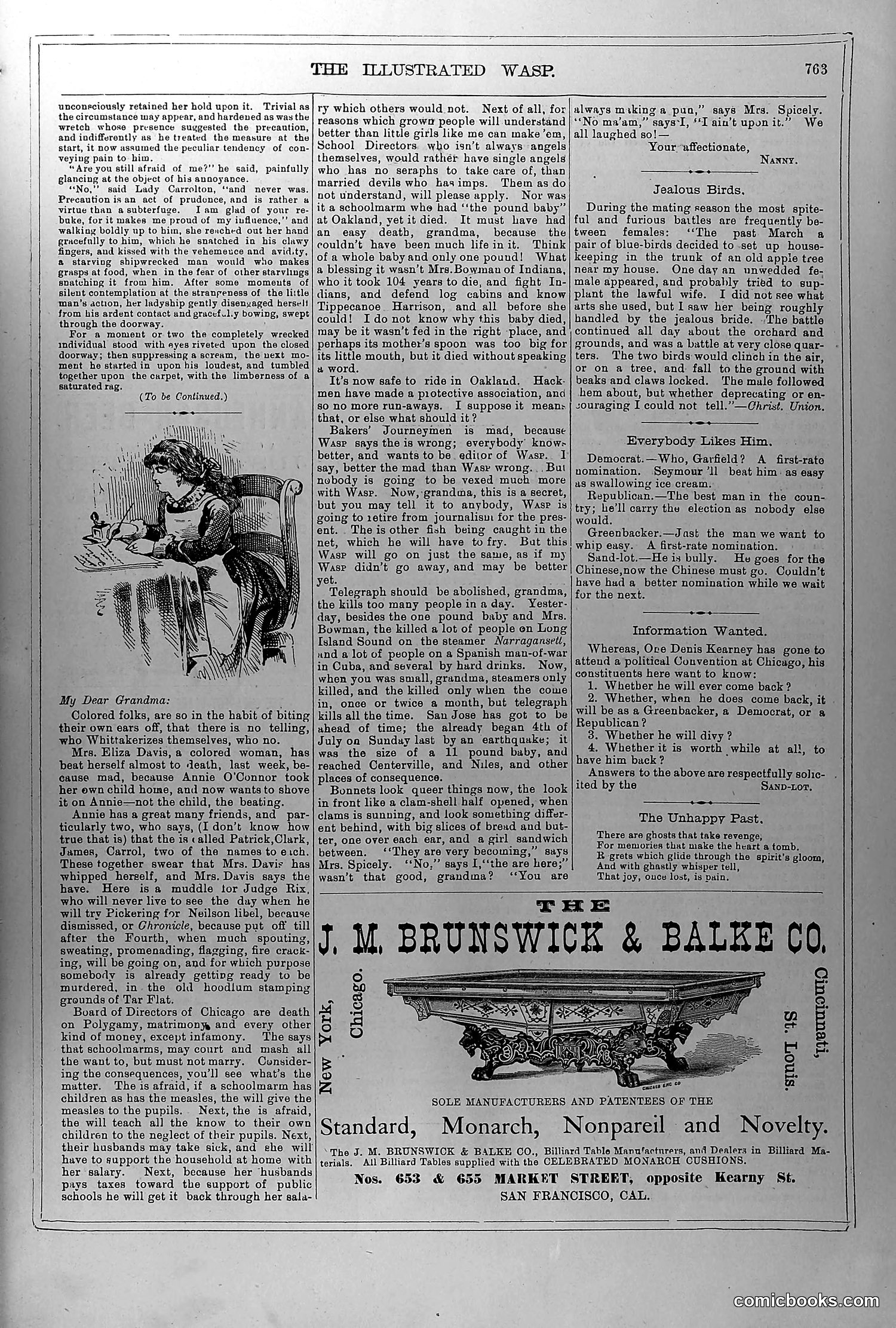
This page is primarily **text content rather than political cartoons**. It contains several advice columns and reader letters ("My Dear Grandma," "Jealous Birds," "Everybody Likes Him," "Information Wanted," "The Unhappy Past") discussing domestic and social matters—infidelity, jealousy in relationships, nominations, and personal disputes. The single illustration shows a woman holding a baby, accompanying the "My Dear Grandma" column about infant care and parenting challenges. The bottom half features a **large advertisement** for J.M. Brunswick & Balke Co., billiard table manufacturers in San Francisco. This appears to be a typical magazine page mixing advice content with advertising rather than primarily satirical political commentary.
This page is primarily **advertising and miscellaneous content** rather than political satire or cartooning. The layout consists of: - A conversational piece titled "A Chat with Mrs. Flaherty" featuring Irish-accented dialect humor about dogs and neighbors - Several brief humorous anecdotes ("A Reverend Telephone," "Ligglebillin is something in Welsh") - Multiple commercial advertisements (Vienna Concert Gardens, Anheuser Beer, pianos, watches, medicines, mattresses) - Small decorative illustrations accompanying ads The page lacks the editorial cartoons or clear political satire typical of The Wasp's satirical mission. The humor is primarily domestic/social comedy in dialect rather than social commentary. The advertisements dominate the layout, suggesting this represents the magazine's revenue model rather than its editorial content.
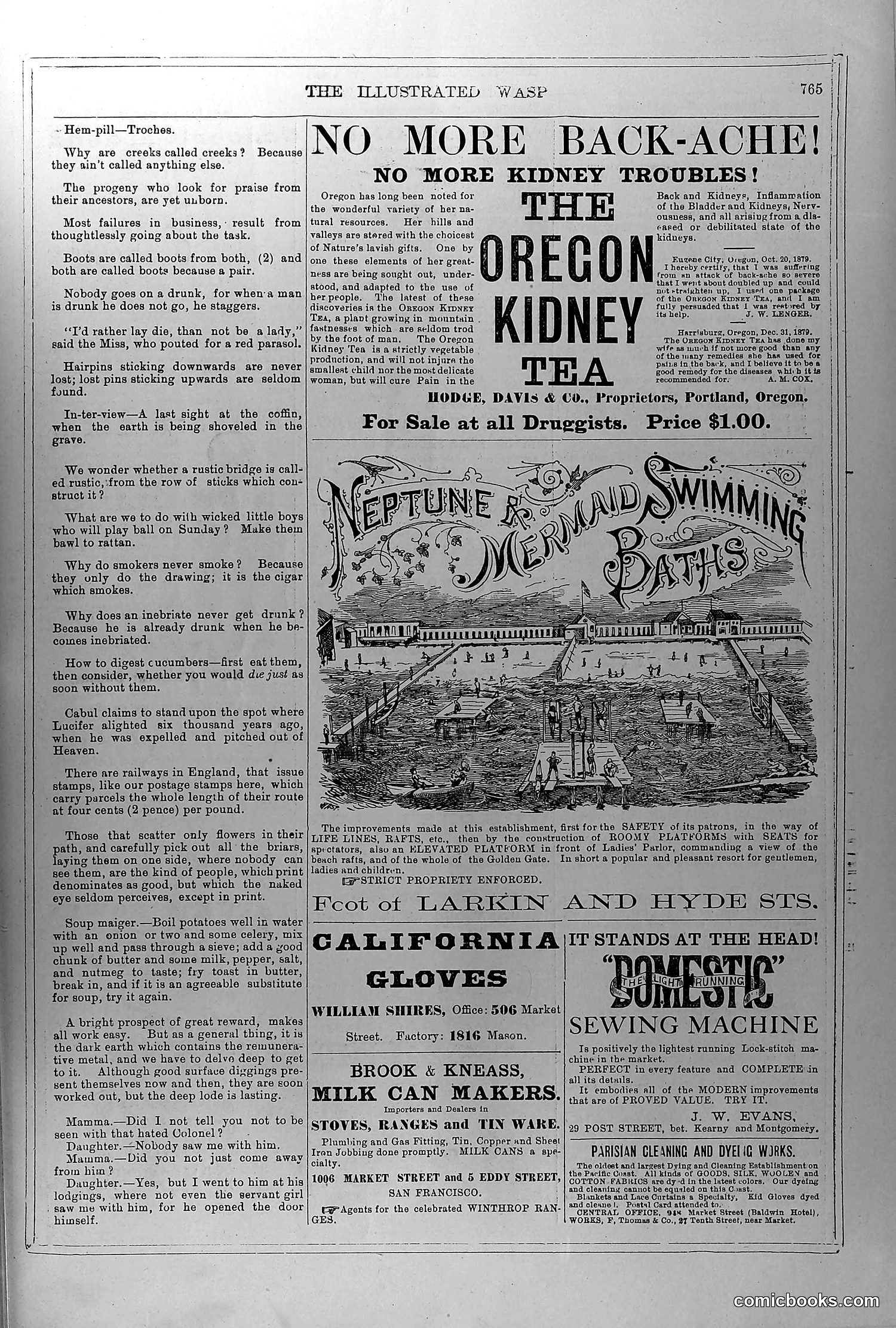
This page is primarily **advertising and humor content**, not political satire. The top section contains humorous "item" jokes—brief quips about names, business, and human behavior (e.g., "Why are creeks called creeks? Because they ain't called anything else"). These are lighthearted wordplay typical of period magazines. The main advertisements include: - **Oregon Kidney Tea** (patent medicine claiming to cure bladder/kidney issues) - **Neptune Mermaid Swimming Baths** (a bathing establishment) - **California Gloves**, **Domestic Sewing Machine**, and various San Francisco businesses A longer humorous dialogue appears at bottom between "Mamma" and "Daughter" about opening a boarding house door for a servant girl—domestic comedy rather than political content. The page reflects late-19th-century American advertising and casual humor rather than substantive satire.
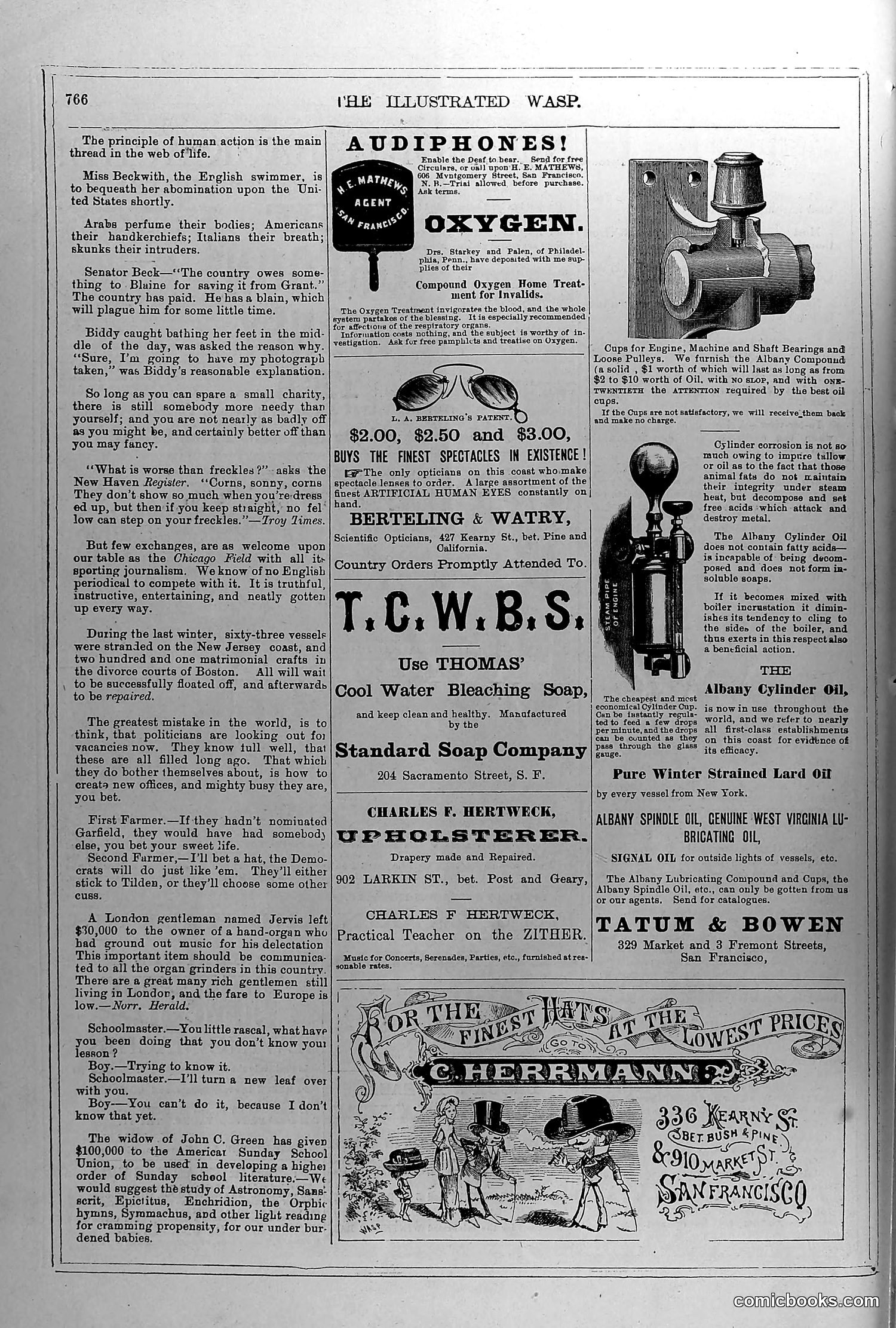
This page is primarily **advertising**, not political satire. It contains commercial notices for various products and services circa late 1800s San Francisco: - **Audiphones** (hearing aids) - **Oxygen treatments** for invalids - Spectacles by Bertreling & Watry - Thomas' Cool Water Bleaching Soap - Albany Cylinder Oil and lubricating products - Hats by C. Herrmann The only editorial content appears to be brief humorous anecdotes in the left column about politicians, swimmers, and social observations—standard filler material for satirical magazines of the era. **Bottom line:** This is a commercial/advertising page with light humor, not a political cartoon page. The satire, if any, is minimal and incidental to the business notices.
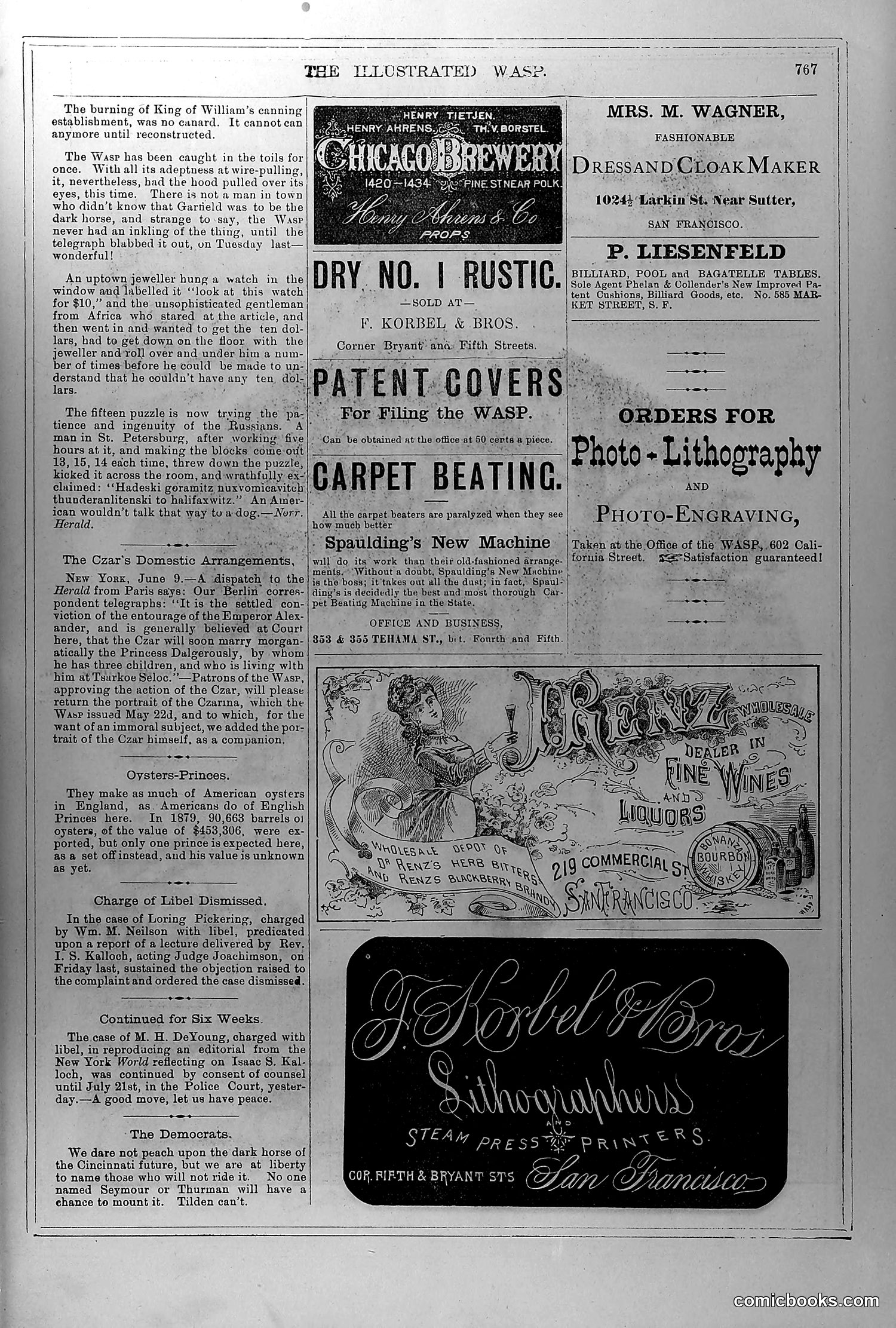
This page is primarily **advertising and miscellaneous notices** rather than satirical cartoons. The visible content includes: - Advertisements for local San Francisco businesses (brewery, dry goods, billiards supplier, dressmaker) - A small news item about catching a wasp in telegraph wires - Brief satirical snippets: one mocking Russians' puzzle-solving abilities ("Hadskendorski...wouldn't talk that way to a dog"), another about the Czar's domestic arrangements - A notice about oyster imports to England - A brief libel case dismissal The page contains **no prominent political cartoons or caricatures**. The satirical content is limited to short, minor jabs at Russians and the Czar embedded within news items. The dominant feature is commercial advertising typical of period periodicals.
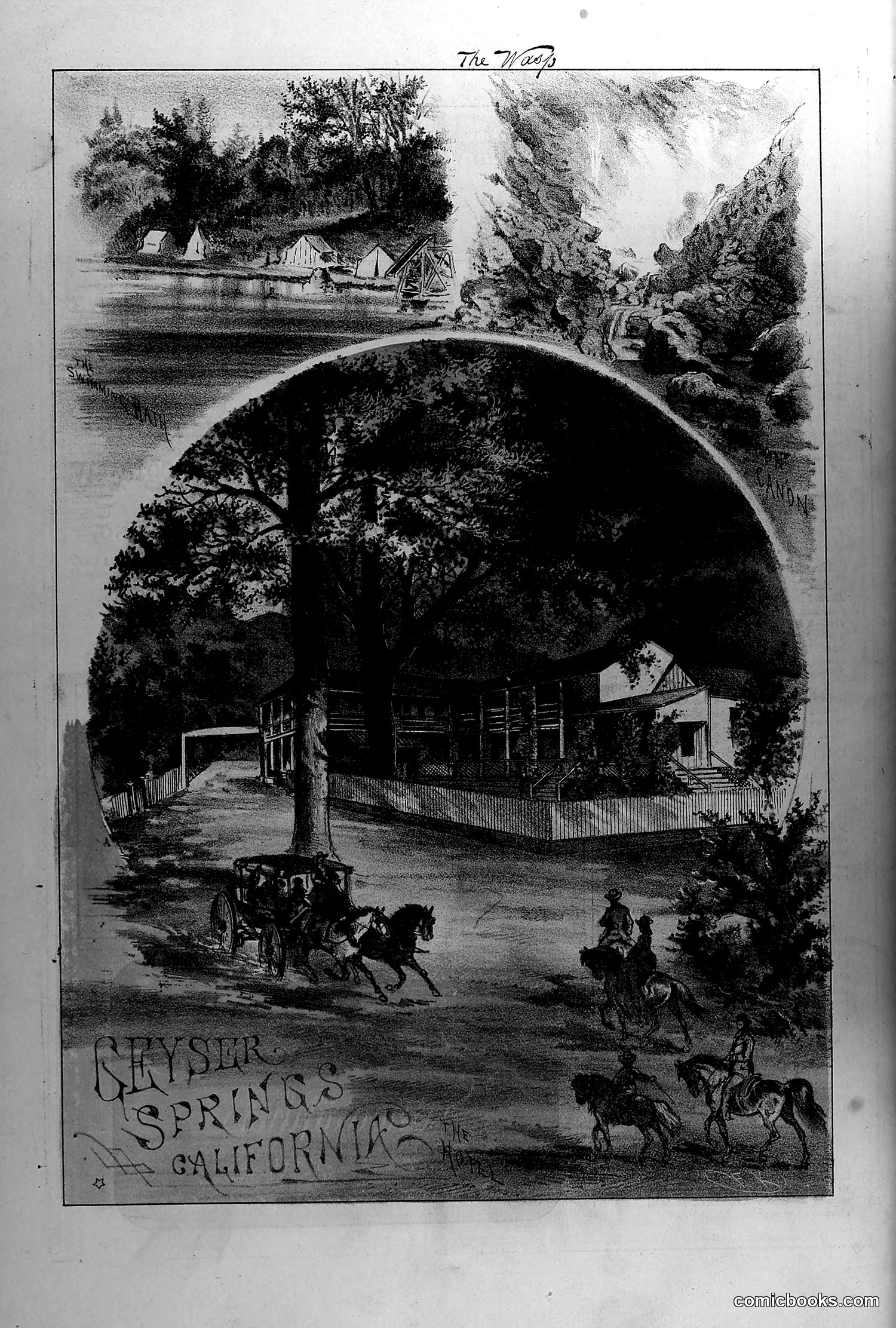
This engraving depicts a scenic resort destination in California, likely from the late 19th century. The image shows a large natural geothermal area framed by an enormous tree, with a pavilion or bathhouse structure visible beneath it. In the foreground, well-dressed visitors arrive by horse-drawn carriage and horseback, suggesting this was a leisure destination for wealthy tourists. The text identifies this as "Geyser Springs, California"—a real geothermal resort. Rather than political satire, this appears to be promotional imagery advertising the natural wonder and recreational facilities to potential visitors. The engraving style and composition emphasize the grandeur of the landscape and the genteel leisure activities available, reflecting the era's fascination with natural attractions and resort tourism.

I can see this page contains a reference scale/color checker (the gray squares on the left and the measurement ruler) rather than actual cartoon content. This appears to be a technical documentation page used in archival photography or reproduction, showing calibration tools for ensuring accurate reproduction of printed materials. The checklist squares and ruler were standard elements included when photographing historical documents to verify image quality, exposure, and scale during the scanning or microfilming process. This is not a page intended for reader content, but rather a technical artifact from document preservation work. Without visible cartoon imagery, text, or satirical content, I cannot identify specific political figures, social references, or explain any satire that might appear on *The Wasp* pages.