
A complete issue · 20 pages · 1880
The Wasp — June 12, 1880
I can see this is a measurement/reference page with Oregon Rule Co. scales displayed against a black background, but I cannot make out any cartoon imagery, satirical illustrations, or readable OCR text that would allow me to identify political figures, social references, or satirical content. The image appears to be a technical or archival photograph showing measurement standards rather than a page containing editorial cartoons or satirical commentary. Without visible cartoon artwork or legible text explaining the satirical intent, I cannot provide the historical context or explain the satire as requested. If this is meant to show a specific cartoon or article, the resolution or angle may be preventing proper identification of the content.
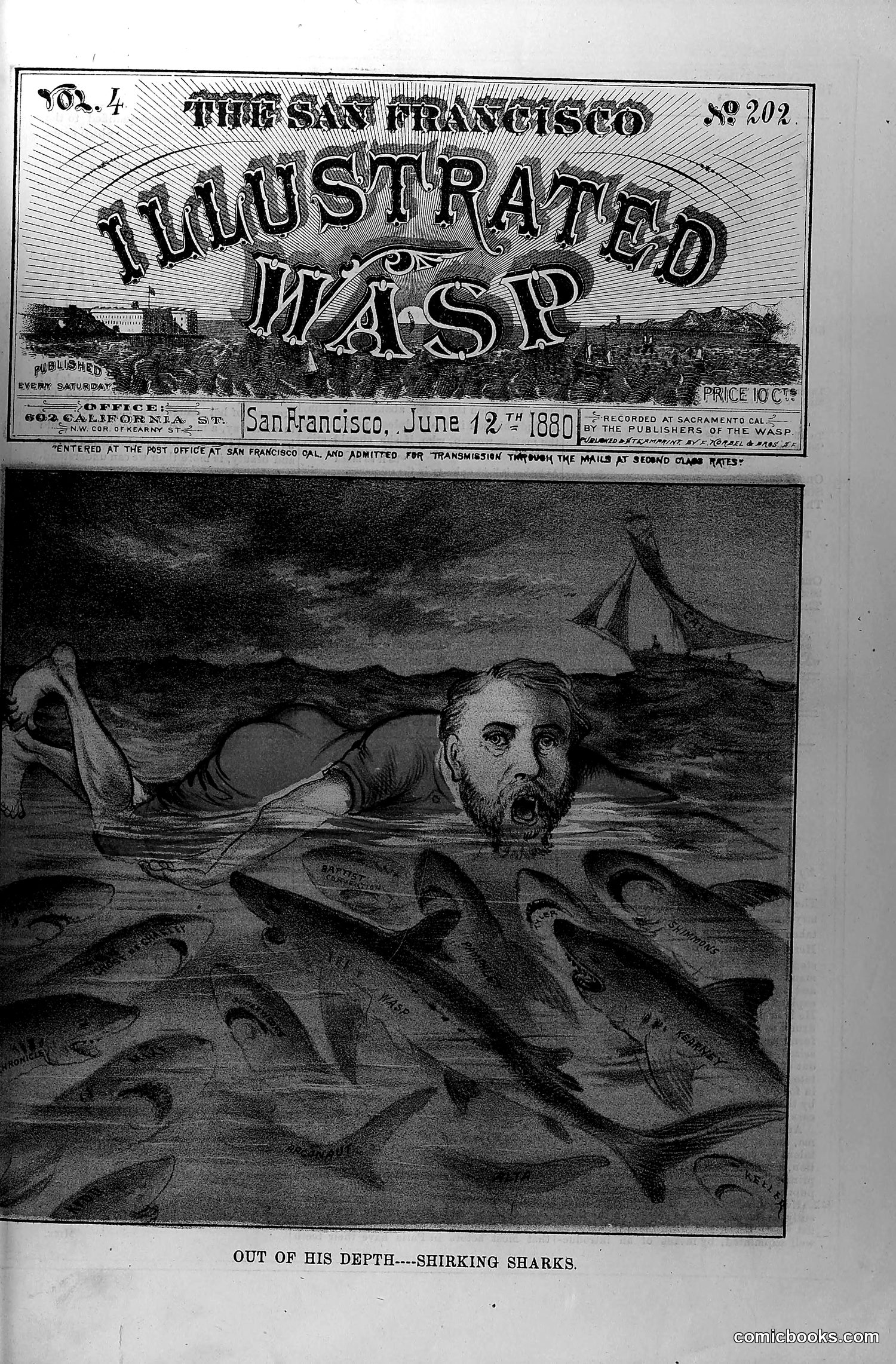
This is the cover of *The Wasp* from June 12, 1880. The illustration depicts a bearded man in the water, apparently drowning or struggling amid sharks. The caption "Out of His Depth—Shrieking Sharks" suggests political satire about someone facing dangerous circumstances beyond their ability to handle. Without additional context about San Francisco politics in 1880, the specific identity of the figure remains unclear. The "sharks" likely represent political enemies or dangerous forces. The satire appears to mock someone—possibly a public figure or politician—as incompetent or reckless for entering treacherous political waters. The dramatic, horror-tinged imagery emphasizes the peril of the situation.
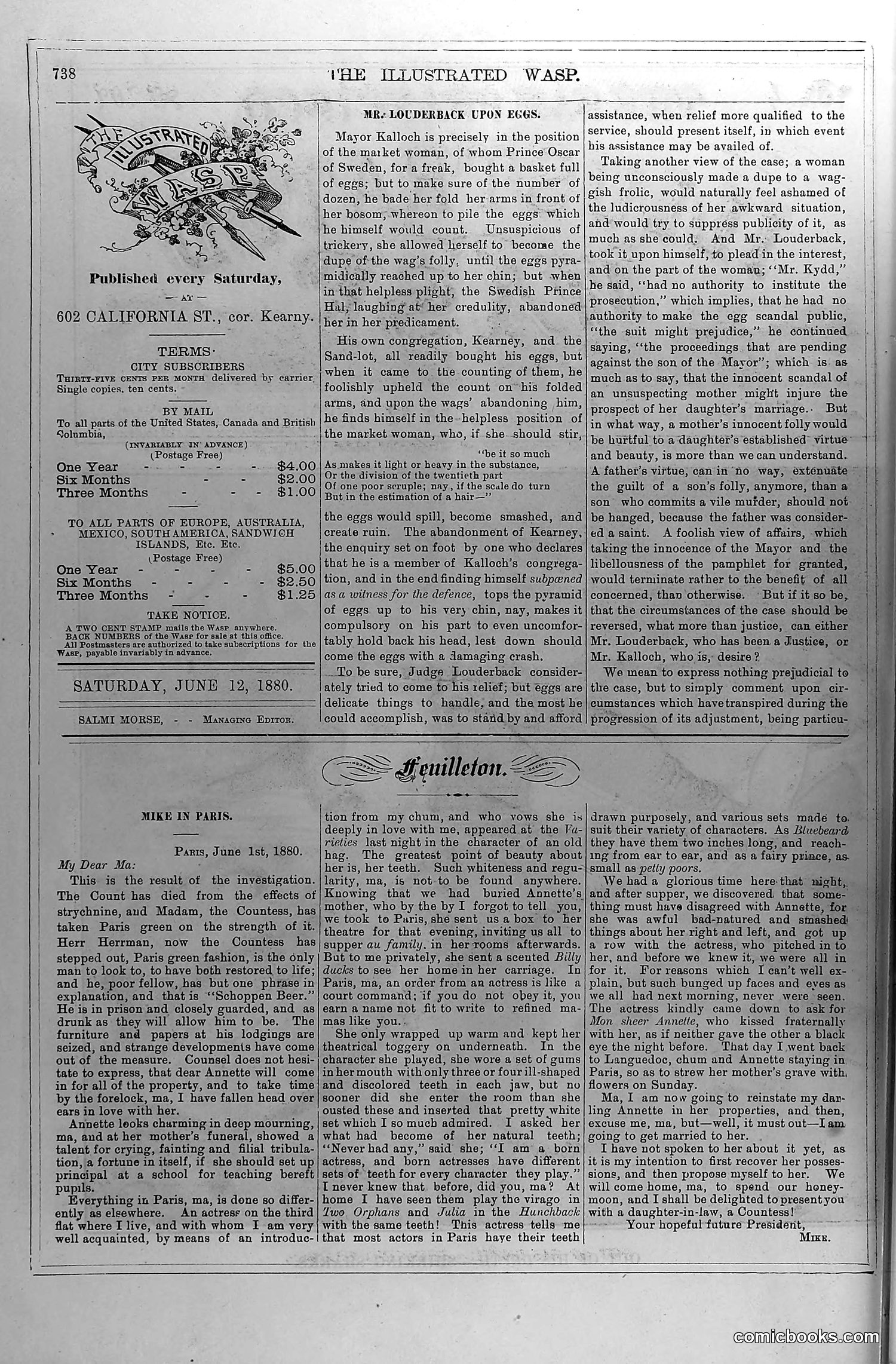
This page contains two distinct sections: **Upper Section ("Mr. Louderbark Upon Eggs"):** A satirical story mocking a man (Louderbark) who purchased eggs from a Swedish prince, then foolishly counted them repeatedly to verify the quantity. The satire criticizes his gullibility and the subsequent scandal when the eggs proved worthless—attacking both his credulity and his attempts to suppress public knowledge of his embarrassment. **Lower Section ("Feuilleton: Mike in Paris"):** A romantic narrative about an actress in Paris. This appears to be serialized fiction rather than satire or political commentary. The page primarily functions as satirical commentary on gullibility and fraud, alongside entertainment content typical of 19th-century American magazines. No specific political figures are clearly identifiable from the text provided.
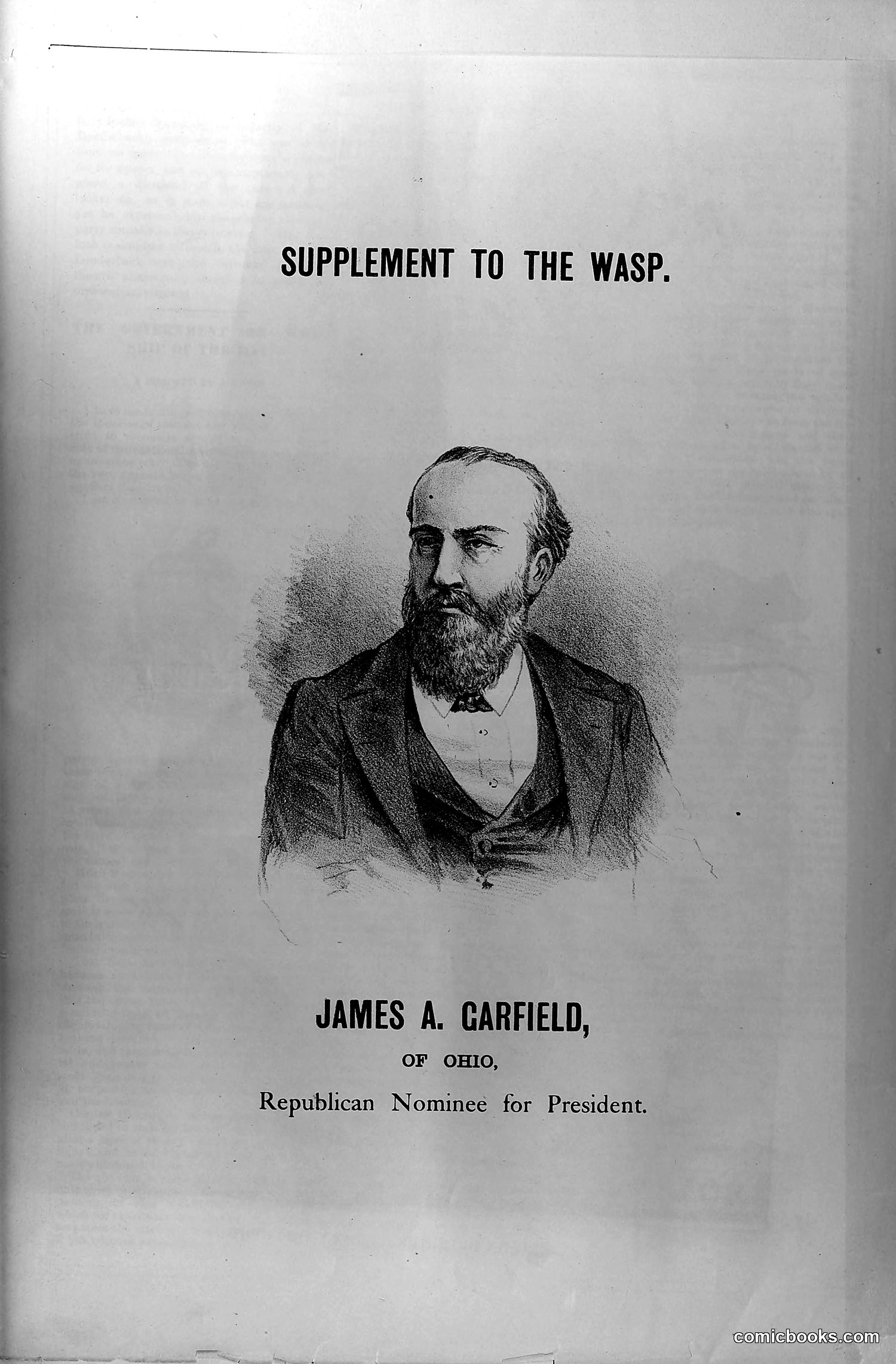
This page is a straightforward campaign supplement from *The Wasp* featuring James A. Garfield of Ohio, identified as the "Republican Nominee for President." The image is a formal engraved portrait showing Garfield as a bearded, dignified gentleman in Victorian dress—typical of 19th-century political campaign materials. Rather than satire or caricature, this appears to be a serious promotional piece designed to introduce or endorse the candidate to readers. Without additional context from surrounding pages, it's unclear whether *The Wasp* was supporting or mocking Garfield. The publication was satirical, but this particular page functions as conventional campaign promotion rather than evident political commentary or humor.
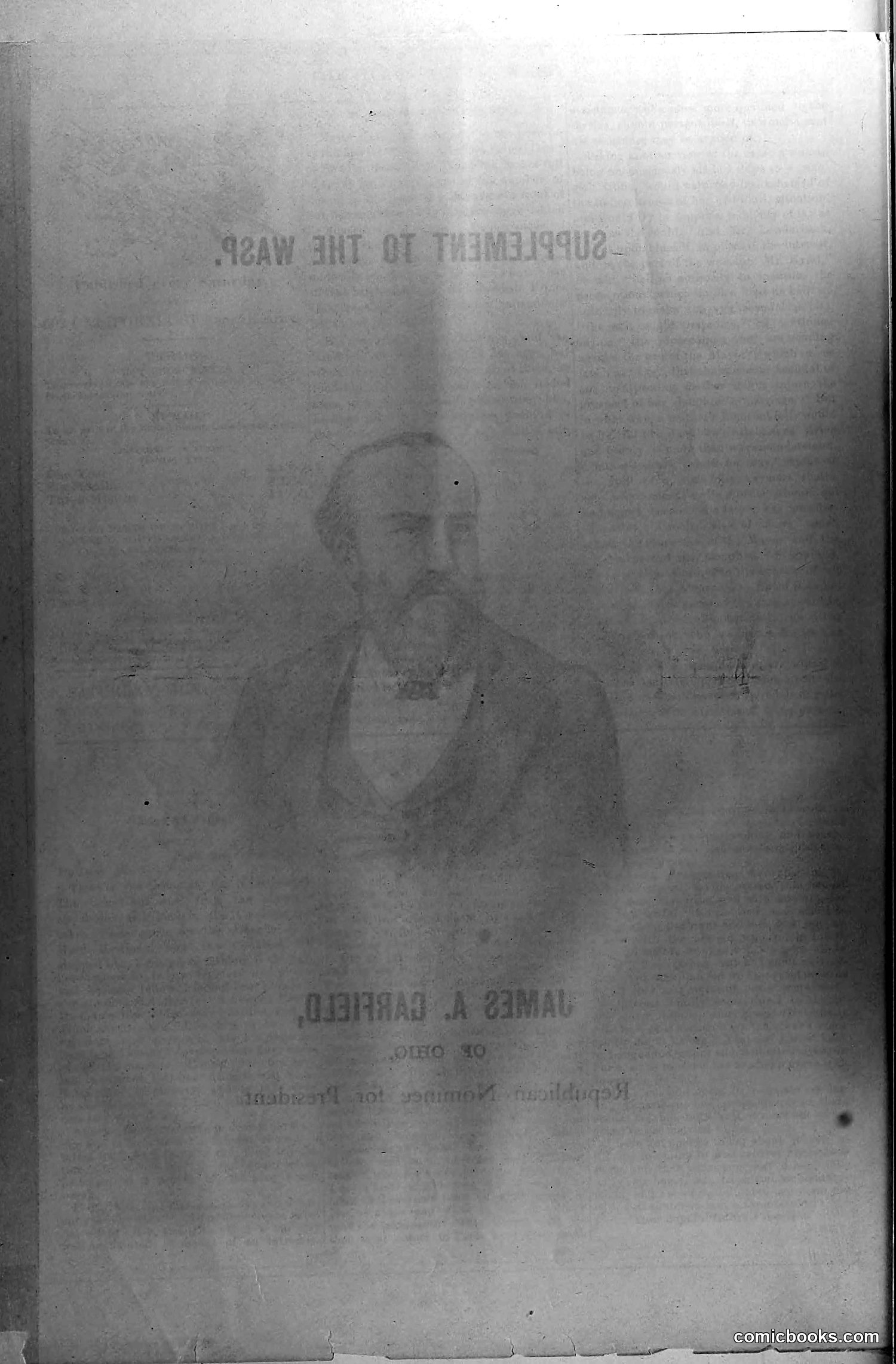
I can see this is a page from *The Wasp* magazine featuring a portrait of a bearded man in period dress, with text that appears to read "SUPPLEMENT TO THE WASP" at the top and what looks like a name attribution at the bottom (possibly "JAMES A. BARFIELD" or similar, though the OCR is unclear). However, the image quality is quite poor—very faded and low contrast—making it difficult to read the specific text clearly or discern details about the cartoon's content or satirical intent. Without being able to reliably read the accompanying text or clearly identify the figure's identity and the historical context, I cannot accurately explain what political or social commentary this page was making. To properly interpret this, a higher-quality image or clearer source text would be needed.
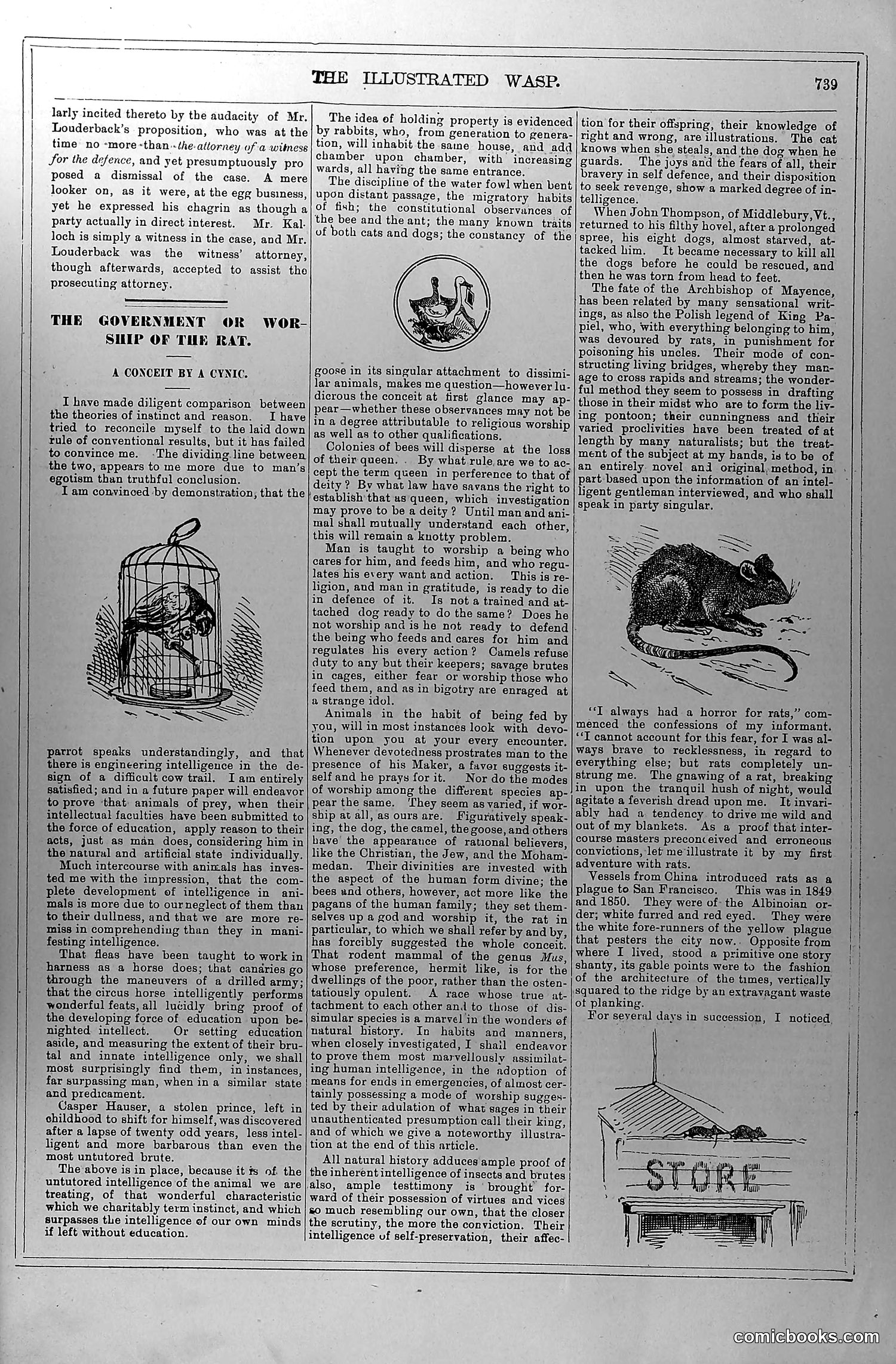
This page contains two distinct pieces: **Left side**: A brief legal notice about a dismissed case involving Mr. Louderback's proposition and property rights—appears to be satirizing a local business or legal dispute, though specific context is unclear. **Main article**: "The Government or Worship of the Rat" presents a philosophical comparison between rat and human behavior. The author argues that rats possess intelligence, trainability, and loyalty comparable to humans, and questions whether humans truly deserve their elevated status. The piece uses the rat as a vehicle for social commentary on human civilization and morality. **Illustration**: A detailed engraving of a rat appears mid-text, likely emphasizing the article's point about animal dignity. The satire targets Victorian-era assumptions about human superiority and civilization's claims to moral authority—a common Wasp theme questioning established social hierarchies.
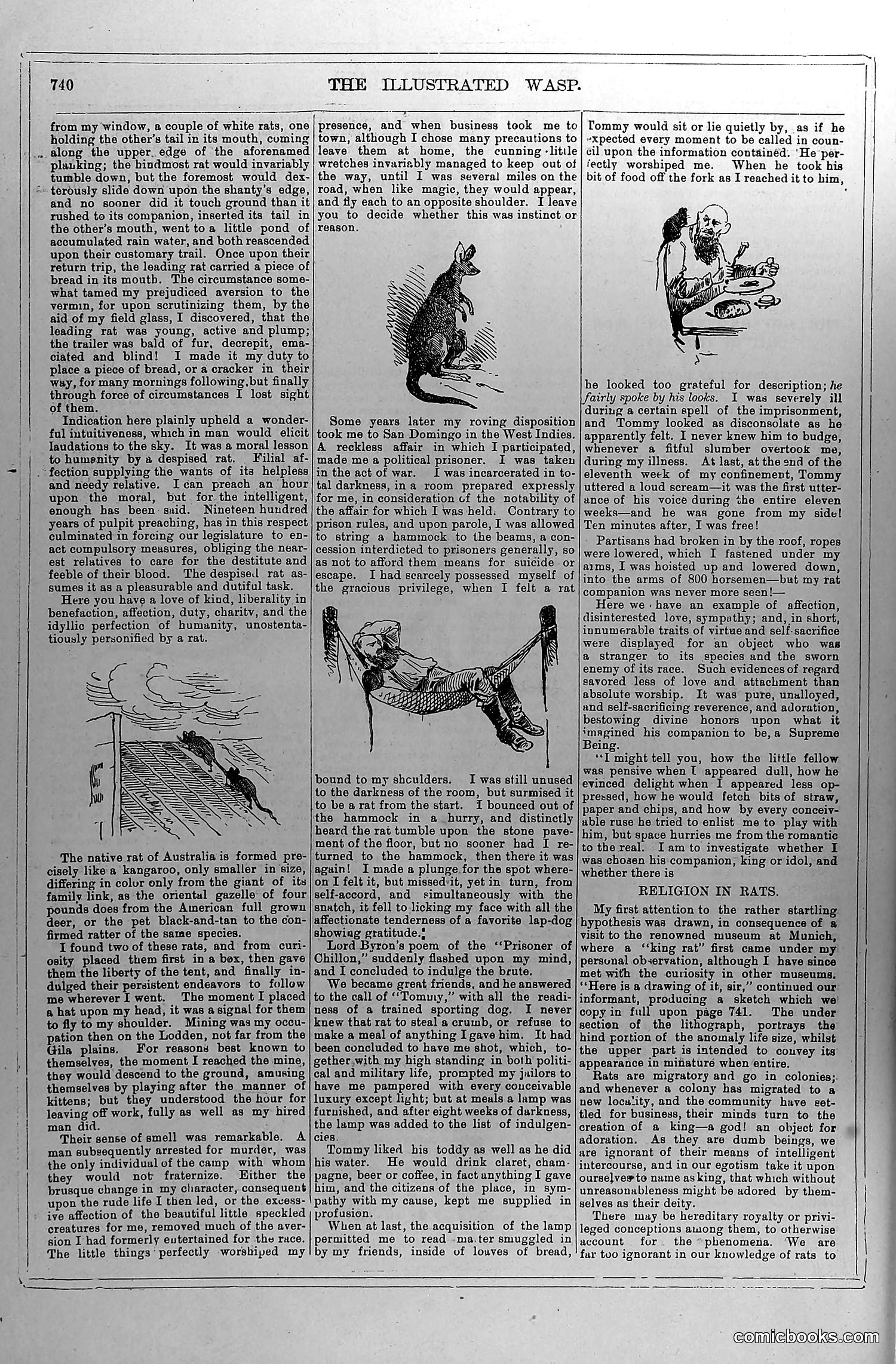
This page contains a naturalistic essay about rats, illustrated with three sketches showing rat behavior and anatomy. The text describes the author's observations of rats near his home—including white rats carrying food, and a detailed account of befriending a tame rat named Tommy. **The satire here is implicit rather than explicit.** The essay uses rats as a vehicle for social commentary on human nature. By lavishing affectionate, almost reverential language on Tommy ("idyllic perfection of humanity"), the author appears to be ironically suggesting that rats demonstrate superior qualities—loyalty, gratitude, and affection—compared to humans. This inverts typical attitudes toward vermin, mocking human pretension through contrast with animal virtue. The page functions as satirical natural history rather than political cartoon.
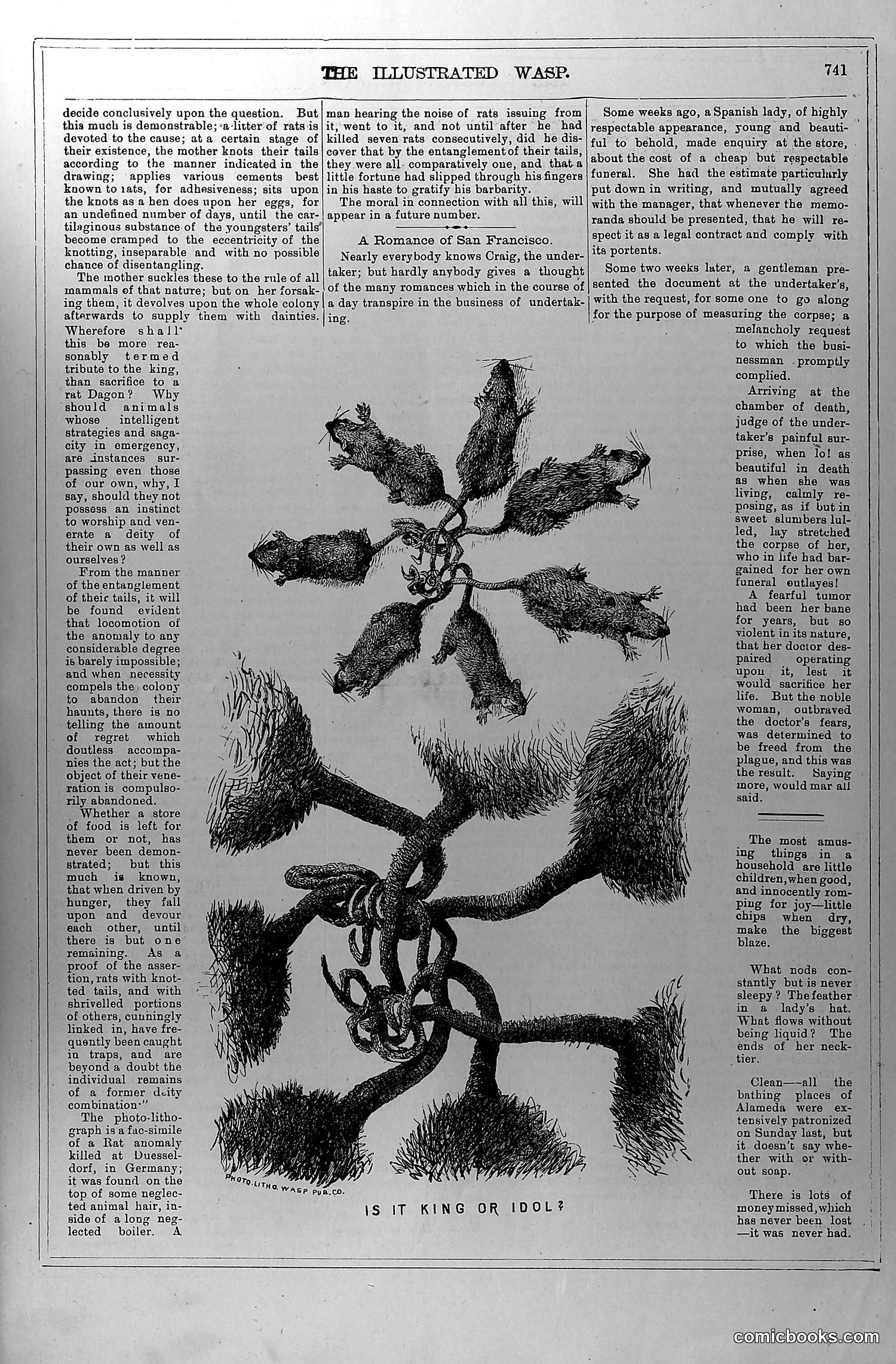
This political cartoon depicts a rat or rat-like creature perched atop an ornate pedestal, surrounded by smaller rats in worshipful poses. The caption "IS IT KING OR IDOL?" questions the nature of the creature's authority. The accompanying text discusses Craig, an undertaker in San Francisco, suggesting the cartoon likely satirizes a prominent local or national figure—possibly a businessman or politician—who commands excessive reverence or cult-like devotion from followers. The image critiques the treatment of this individual as either a legitimate authority (king) or merely an object of irrational worship (idol), implying the devotion is undeserved or absurd. The rat imagery typically symbolized corruption, disease, or parasitic behavior in period satire.
This page contains theater reviews rather than political cartoons. The main content discusses recent theatrical productions, including: **"Miss Beaudet"** — a opera praised for its charming libretto and the performance of Miss Louise Beaudet **"The Lady of Lyons"** — reviewed critically, with particular scrutiny of actor performances and dialogue quality **"Bush"** — described as a charming opera The page includes satirical criticism of theatrical performances and artistic merit. The text critiques both the quality of plays presented and the abilities of various actors, using sharp wit typical of *The Wasp's* satirical style. The reviews appear designed to entertain readers while offering pointed commentary on San Francisco's theater scene and performers of the era.
This page contains primarily **text content** rather than prominent political cartoons. The visible sections include: 1. **"Superstitions"** - an essay critiquing American superstition and spiritualism, contrasting American credulity unfavorably with German rationalism. 2. **"The Match Man"** - an obituary for "Old Mr. Jones," a figure remembered for inventing early friction matches. 3. **"Expressions of Trade Unions"** - humorous mock dialogue presenting working-class speech patterns and union worker stereotypes. 4. **Various brief satirical columns** on vaccination deaths, domestic disputes, and social incidents. The page functions as a **satirical commentary magazine** rather than cartoon-heavy publication, targeting American superstition, labor movements, and contemporary social absurdities through written wit rather than visual caricature.
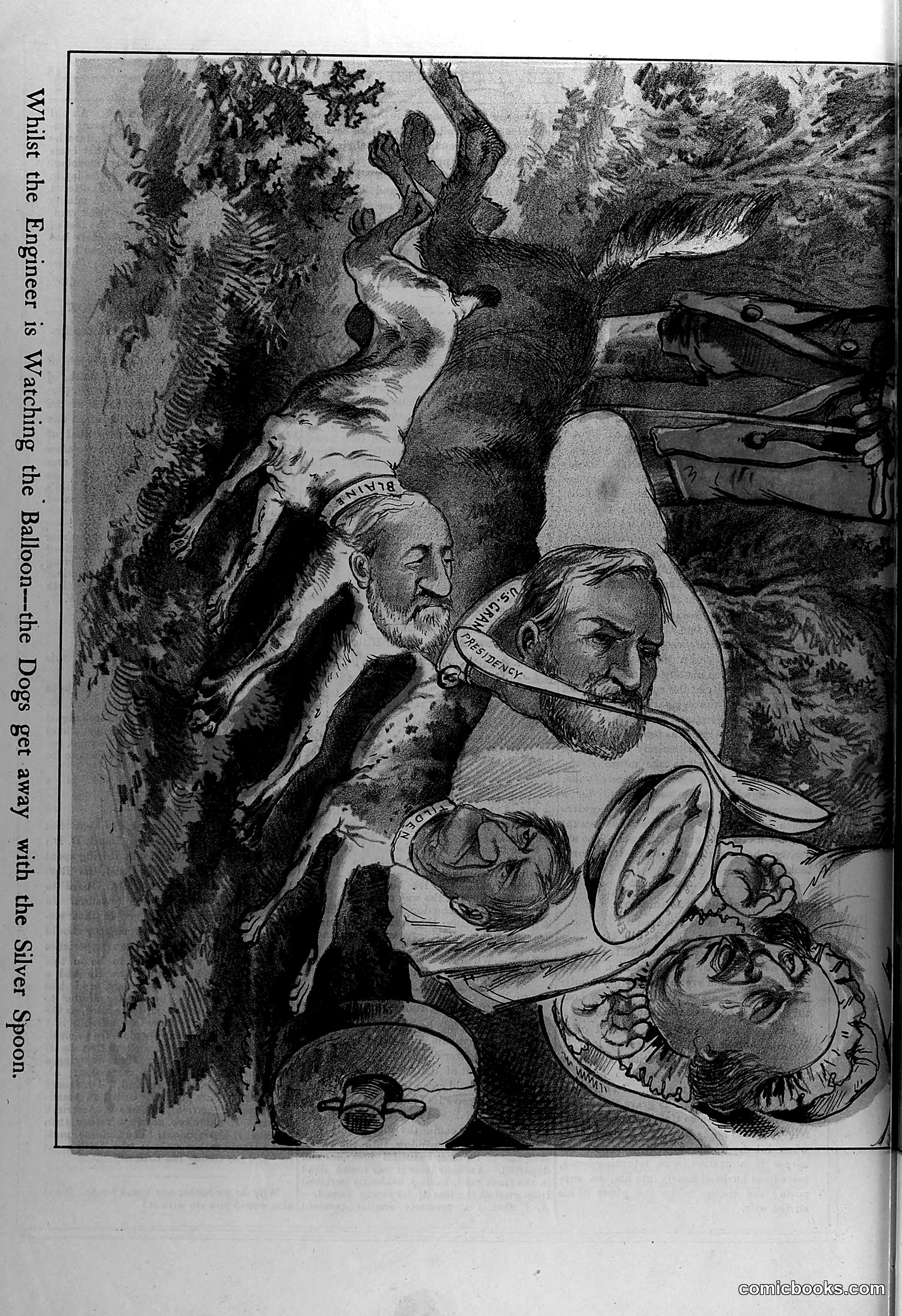
This satirical cartoon depicts a scene of distraction and theft. While attention is focused upward on a hot-air balloon (shown upper left), several figures below—depicted as "dogs" in human form wearing period clothing—are absconding with valuable goods, specifically a silver spoon visible in the lower right. The "burgess" (a town official or respectable citizen) watches the balloon, distracted from his duties. The satire critiques how authority figures become preoccupied with spectacles or distractions while criminals or opportunists exploit the gap in vigilance. The anthropomorphized dogs suggest both the "base" nature of the thieves and perhaps social commentary on lower classes taking advantage of upper-class negligence.
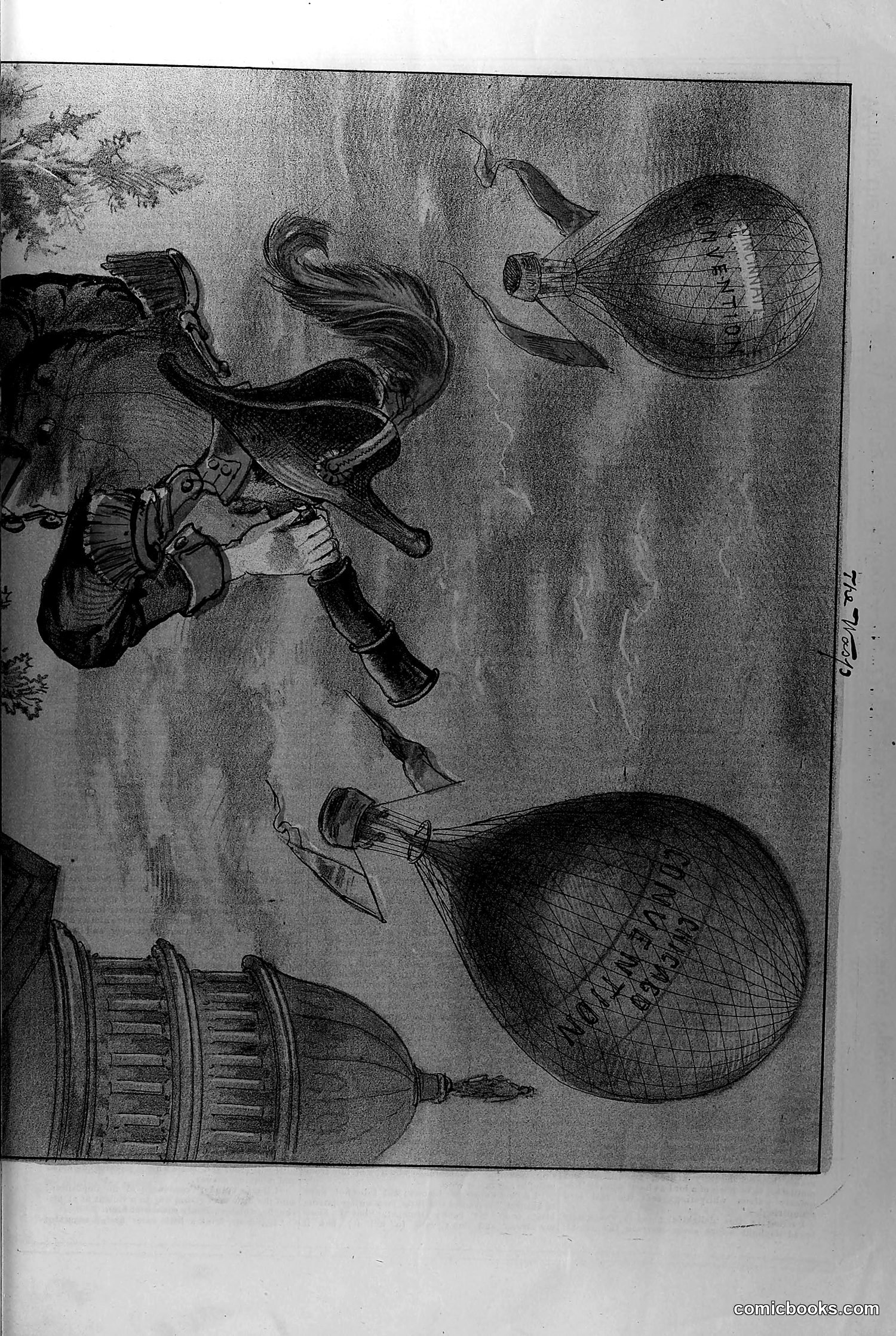
This appears to be a satirical illustration from *The Wasp* magazine featuring anthropomorphized balloons or dirigibles. The image shows what seem to be military or naval vessels depicted as inflatable craft—likely a commentary on emerging airship/balloon technology and its military applications. The central figure on the left appears to be a caricatured person in formal dress interacting with these vessels. The satirical point likely mocks either: - The feasibility or danger of early aviation/airship military development - Political figures or nations investing in this new technology - The contrast between ambitious technological dreams and practical reality Without clearer text identifying specific figures or dates, I cannot confirm which historical moment or political scandal this targets. The style suggests late 19th or early 20th-century American political satire.
This page contains serialized fiction ("Phases of History") rather than political cartoons. The text is Part XXXI of a story titled "Gleanings From Cinder, Cinders, and Char," written by Mr. Salmi Morse for *The Wasp*. The narrative appears to be a melodramatic Victorian tale involving domestic conflict, a scheming wife (Lady Carrolton), and various moral entanglements. The excerpt focuses on dialogue between characters negotiating social obligations and personal grievances—typical serialized fiction content of the era. **No political or social satire is evident on this page.** It represents *The Wasp's* literary content rather than its satirical cartooning tradition. Without seeing accompanying illustrations, the specific social commentary or humor cannot be identified.
This page from *The Wasp* is primarily **text-based rather than illustrated**. It consists of several sections: 1. **"Drama"** - A theater review critiquing Miss Neilson's performance in *Imogene*, discussing her acting technique and stage presence. 2. **"Census Explained"** - A humorous dialogue between Tom and Jim about census-taking, using colloquial language for comic effect. 3. **"Fashionable Father"** - A satirical domestic dialogue mocking upper-class pretensions and concerns about social status and propriety. 4. **Miscellaneous humor** - Brief comedic observations about social customs (calling cards, powder/balls, seasonal activities, etc.). 5. **Advertisements** - Including notices for a brewery and a medical practice. The page lacks prominent political cartooning; instead, it uses satirical writing to mock Victorian social conventions and theatrical affectation.
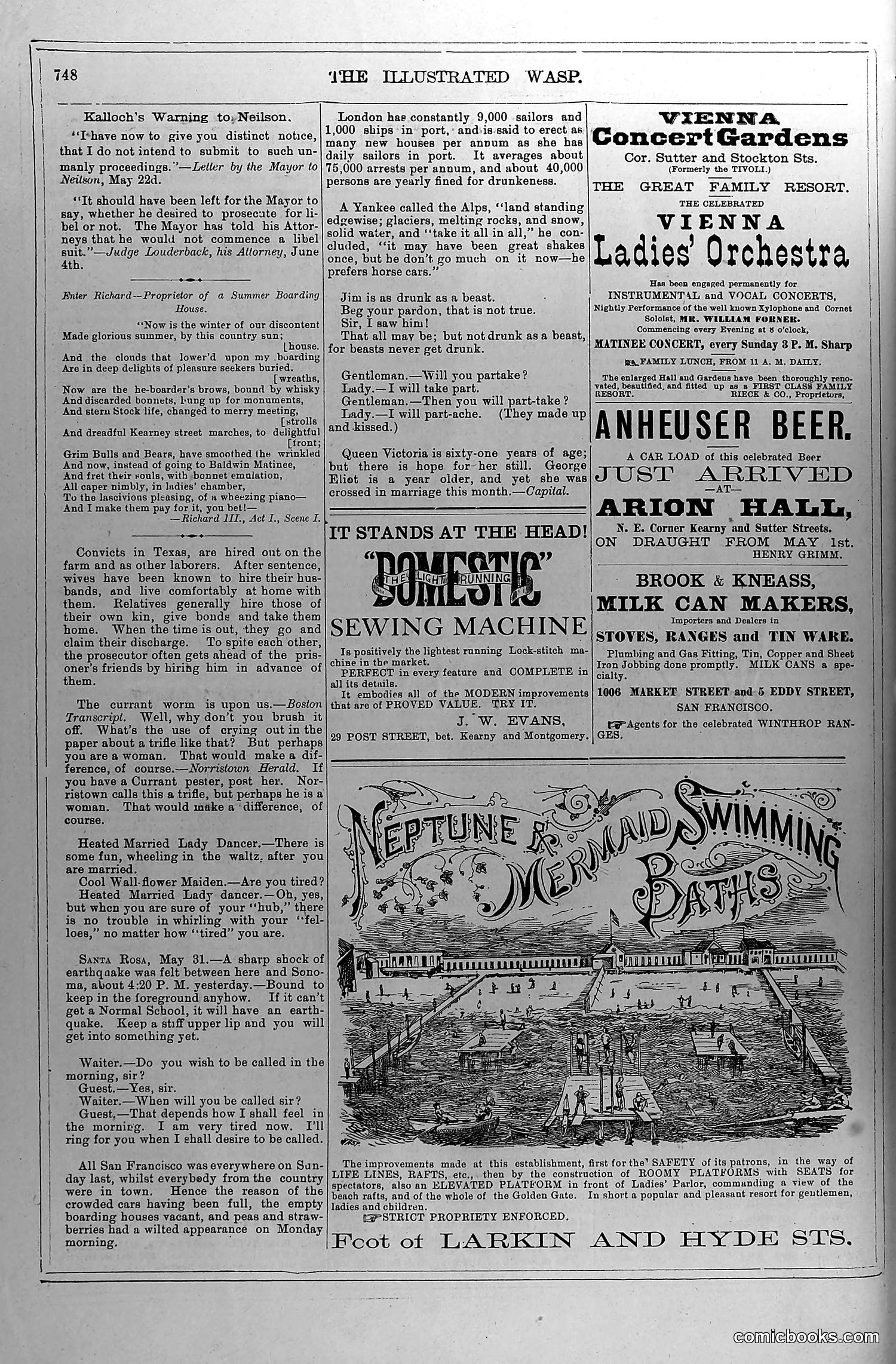
This page is **primarily advertisements** with some satirical text sections interspersed. The visible content includes: - **Vienna Concert Gardens advertisement** promoting a Ladies' Orchestra for instrumental and vocal concerts - **Anheuser Beer** advertisement announcing a carload arrival at Arion Hall - **Domestic Sewing Machine** ad claiming superiority and "proved value" - **Neptune Mermaid Swimming Baths** illustrated establishment advertisement - **Brook & Kneass** milk can makers advertisement The few satirical text pieces appear to be brief humorous anecdotes (exchanges between "Gentleman" and "Lady," commentary on drunkenness, etc.) rather than political commentary. **Overall:** This is a mixed content page typical of 19th-century satirical magazines—advertisements subsidized the publication while satirical content filled remaining space.
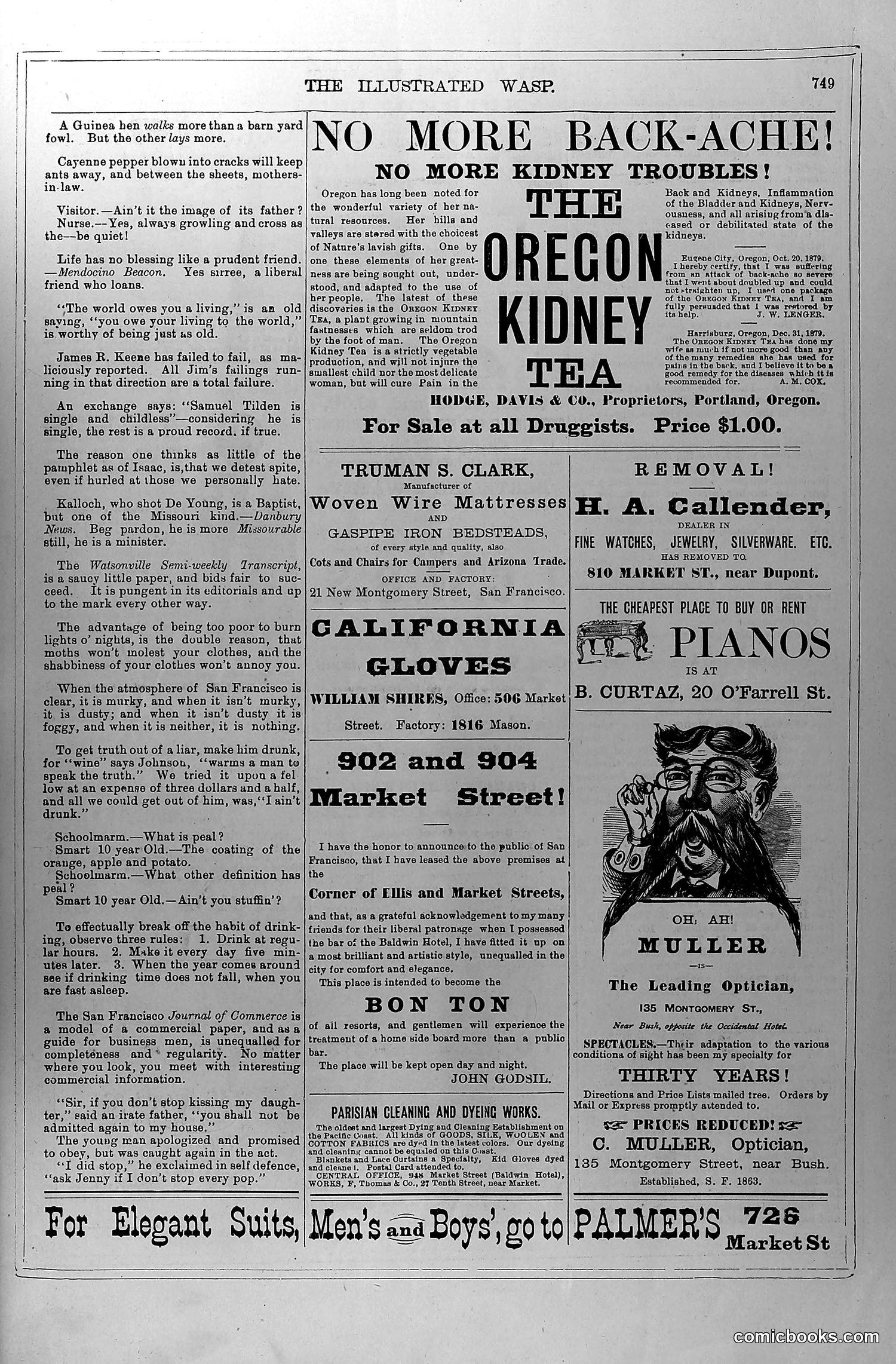
This page is primarily **advertising**, not satirical commentary. It contains various San Francisco-area business advertisements from what appears to be the late 19th century, including: - Oregon Kidney Tea (a patent medicine claiming to cure kidney and bladder ailments) - Mattresses and iron bedsteads - Pianos - California gloves - H.A. Callender's jewelry and watches - A hotel at Ellis and Market Streets The only non-advertising content consists of brief humorous anecdotes and observations in the left column—short jokes about farmers, exchanged compliments, and drinking habits—typical of *The Wasp's* satirical style, but these lack specific political targets or identifiable figures. The page does not contain political cartoons or caricatures requiring historical context to interpret.
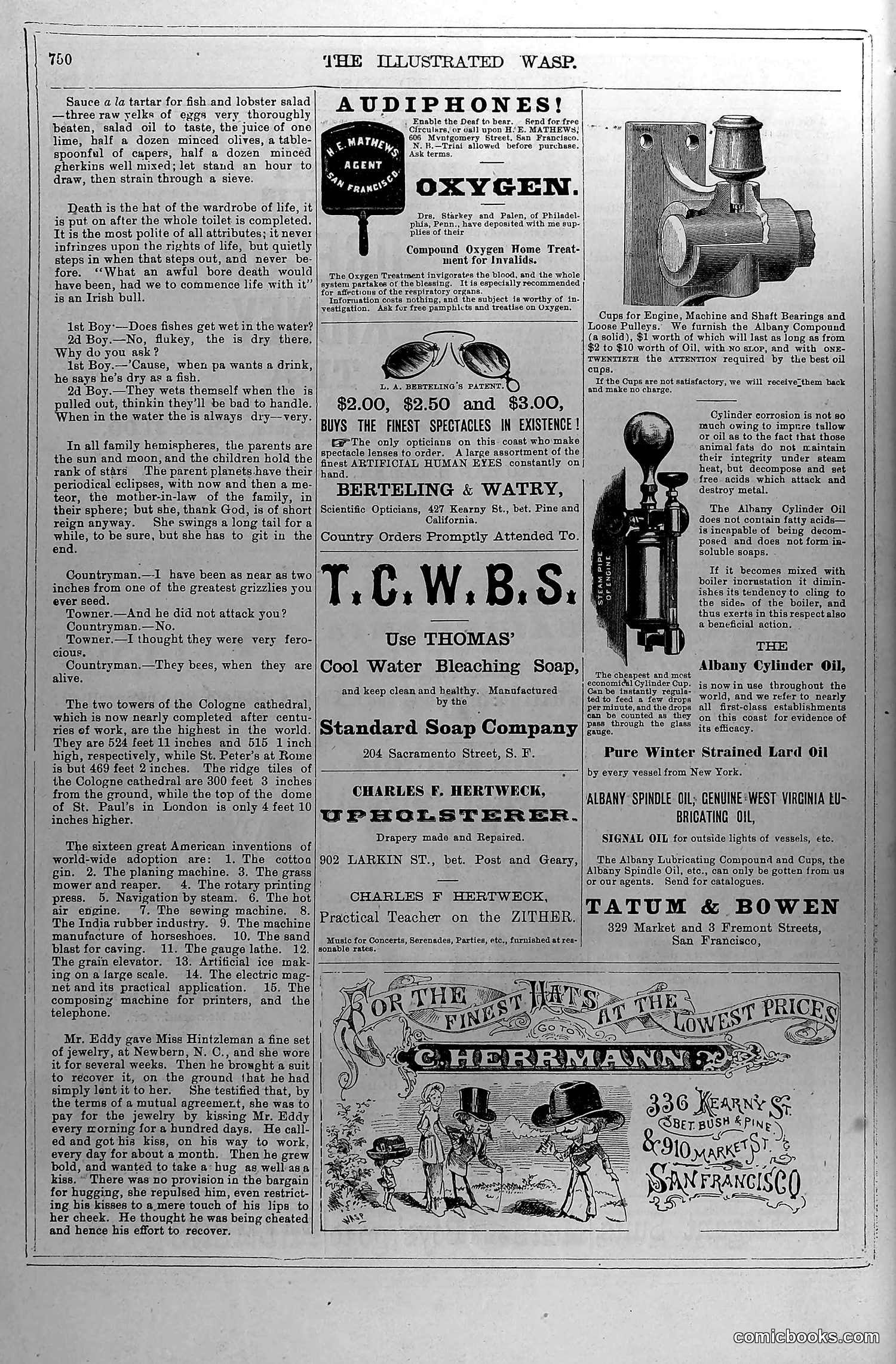
This page is primarily **advertising and miscellaneous content** rather than political satire. The main elements include: 1. **Product advertisements**: Auriphones (hearing aids), oxygen treatments, spectacles, soap, lard oil, and hats 2. **A brief humorous dialogue** at top-left about boys getting wet and fish being dry—appears to be simple wordplay rather than political commentary 3. **A story anecdote** about Mr. Eddy and Miss Hintzleman involving jewelry and mutual agreement The layout is typical of period magazines mixing editorial content with paid advertising. There are **no identifiable political cartoons or caricatures** on this particular page. The humor is domestic and light rather than satirical commentary on public figures or events.
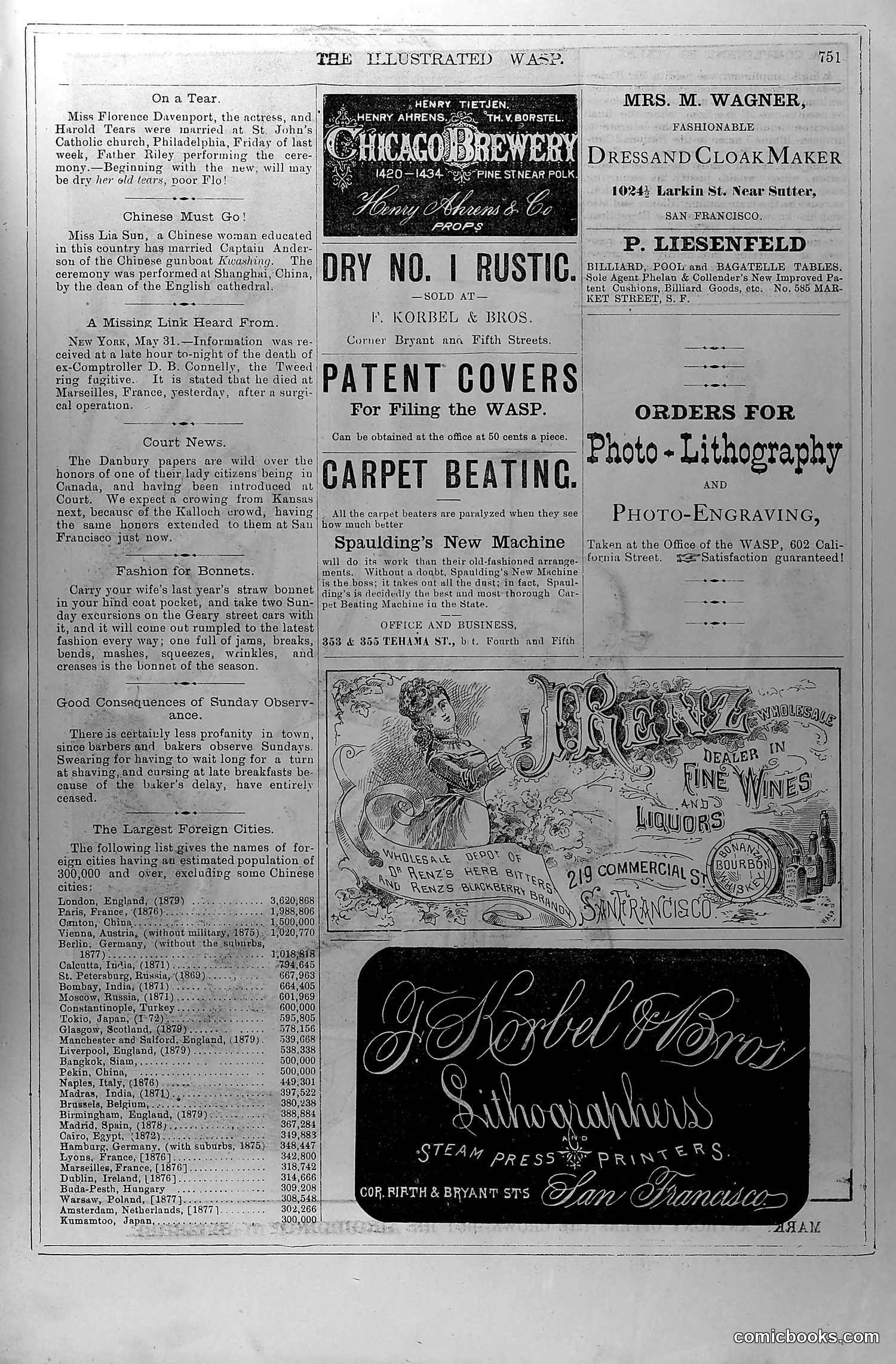
This page is primarily **advertising and miscellaneous notices** rather than political satire. The content includes: - Business advertisements (Chicago Brewery, billiard tables, dress/cloak maker) - A large decorative ad for wine and liquors dealer at 219 Commercial Street, San Francisco - Photo-lithography services advertisement - Various brief news items and social notes ("On a Tear," "A Missing Link Heard From," "Fashion for Bonnets") - A statistical table listing population figures for major foreign cities The only illustrated element is an ornamental **wine merchant advertisement** featuring decorative flourishes and cherub imagery—typical commercial art of the era, not political commentary. No political cartoons or satirical figures are present on this particular page.
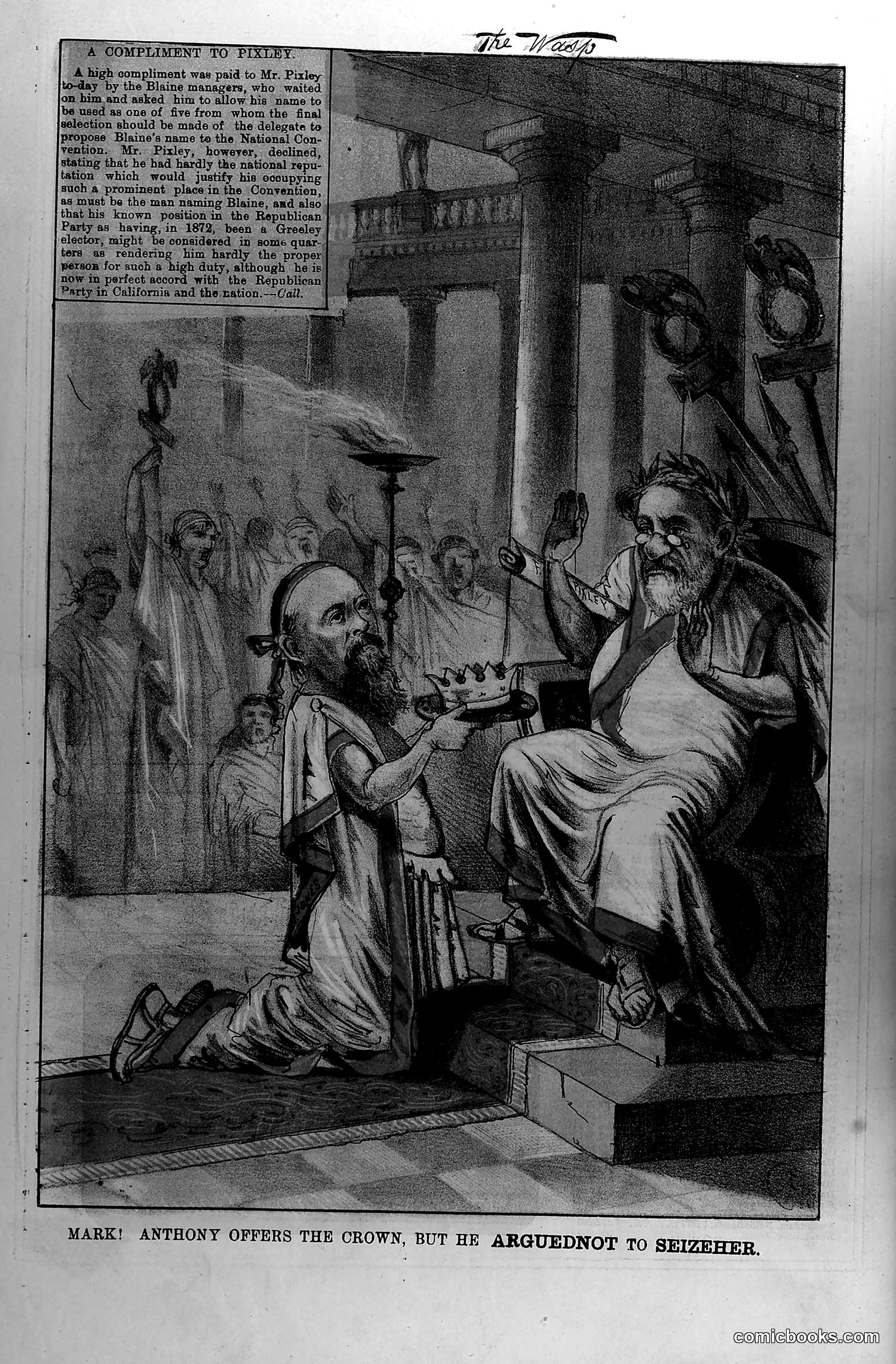
This satirical piece critiques Mr. Pixley, apparently a political figure who declined a prominent position at a Republican National Convention. The Blaine managers (supporters of presidential candidate James G. Blaine) had requested his name as one of five candidates for delegate selection, but Pixley refused, claiming insufficient justification for such prominence. The cartoon's caption references Mark Antony's famous scene from Shakespeare's *Julius Caesar*, where Antony offers Caesar the crown but Caesar refuses it. Here, the satire suggests Pixley's refusal is performative—affecting humility while actually seeking recognition, much like Antony's theatrical gesture of denial that actually increased Caesar's prestige.
I can see this is a test page or calibration sheet from *The Wasp* magazine, rather than an actual cartoon or article page. The image shows: - A color/grayscale reference chart on the left (a grid of squares in varying tones from dark to light) - Two measurement rulers—one vertical and one horizontal at the bottom - These are standard tools used in printing and photography to ensure proper exposure, color reproduction, and scaling when reproducing images This appears to be documentation or archival material rather than satirical content. Without readable text or cartoon imagery, I cannot identify any political figures, social references, or satirical points. This is likely a technical reference page used in the magazine's production process.