
A complete issue · 18 pages · 1880
The Wasp — May 29, 1880

I can see this is a scale reference photo showing Oregon Rule Co. measuring rulers against a black background with a grayscale checkerboard pattern. However, this appears to be a **technical documentation photograph rather than a page from The Wasp satirical magazine**. The image shows measurement standards used for photographic calibration—the rulers, grayscale squares, and checkerboard pattern are tools for ensuring accurate reproduction in printing and photography. No cartoon, caricature, political figures, or satirical content is visible. This looks like archival documentation or a test plate used in the publishing process, possibly from a historical periodical, but it contains no discernible editorial or satirical commentary to analyze.
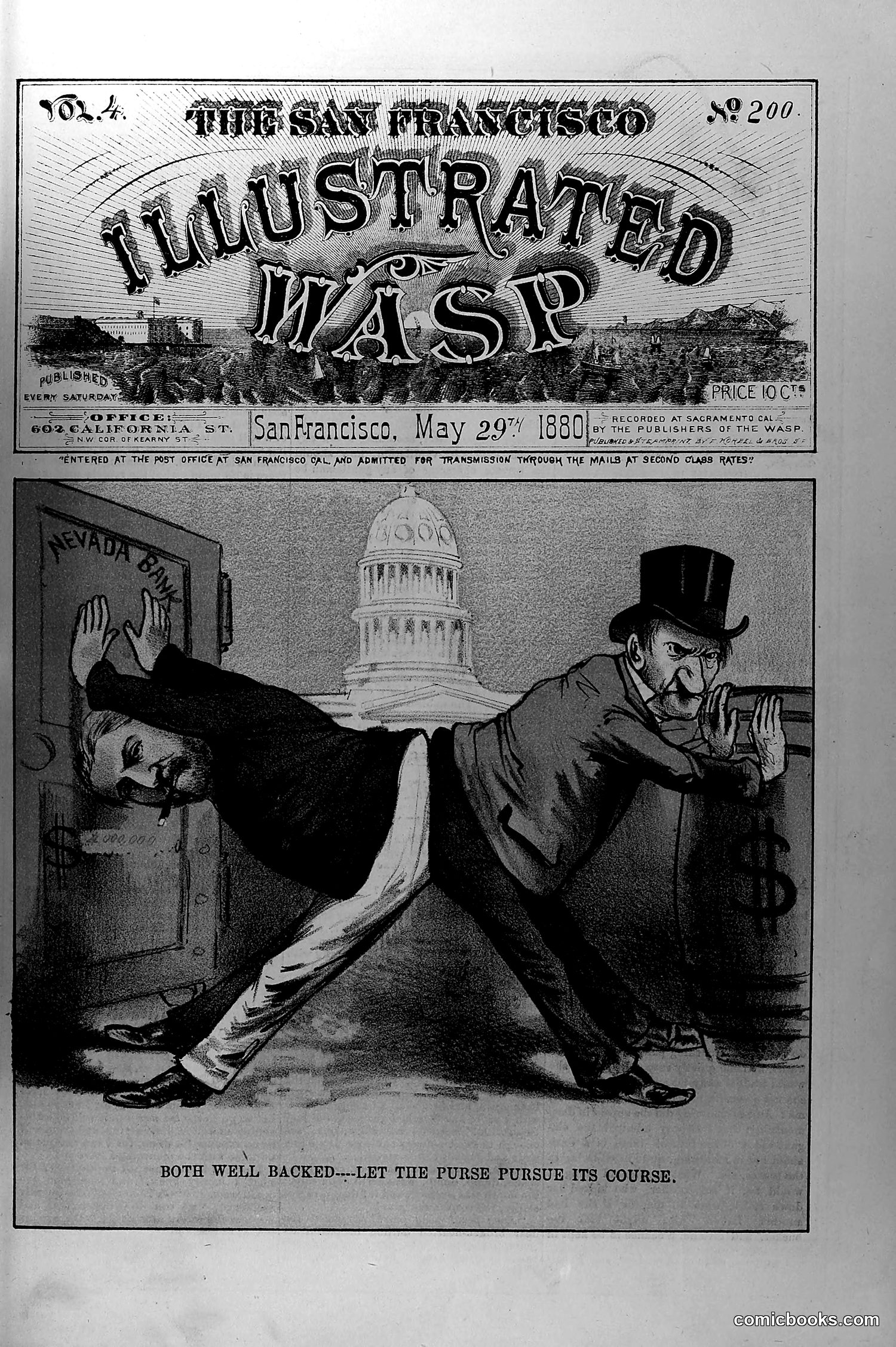
This cartoon satirizes political corruption during the 1880 presidential election era. Two well-dressed men are depicted in a physical struggle near the U.S. Capitol building. The figure on the left appears labeled "Nevada Bank," suggesting financial institutions involved in politics. The caption "Both Well Backed—Let the Purse Pursue Its Course" indicates the cartoon mocks how wealthy interests "back" political candidates and decisions. The exaggerated, violent posture suggests the satirist viewed political competition as essentially corrupt—driven by money rather than principle. The Capitol in the background emphasizes this corruption occurs at government's heart. This reflects *The Wasp's* general mission exposing San Francisco and California political scandals of the Gilded Age period.
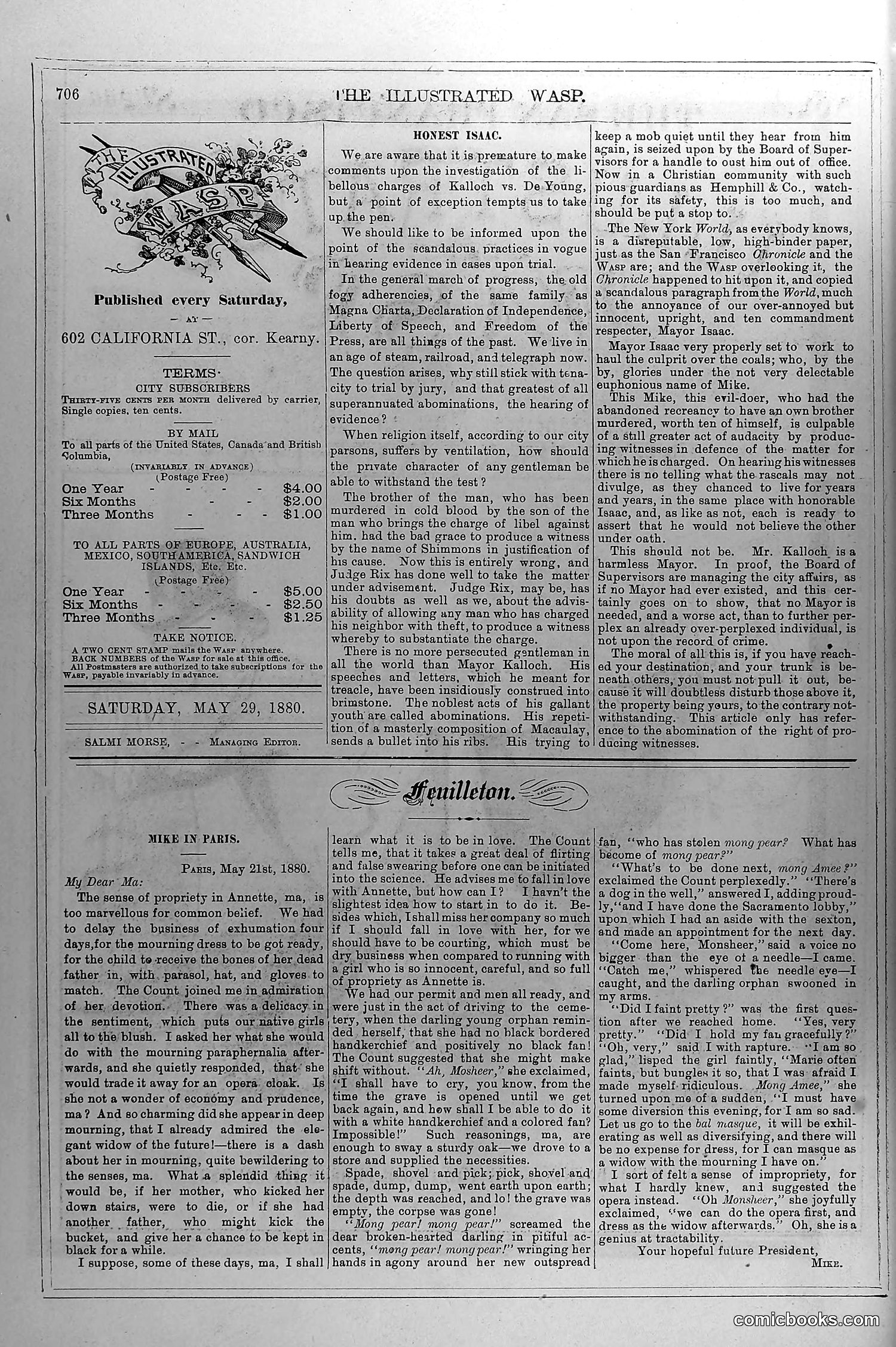
This page contains primarily editorial content rather than political cartoons. The "Honest Isaac" section addresses the investigation of "Kalloch" (likely San Francisco Mayor Isaac Kalloch) regarding evidence in a trial. The piece critiques how Kalloch, a religious leader running the city, handles witnesses and produces evidence—suggesting hypocrisy between his Christian morality and his actual conduct. The "Feuilleton" section is a serialized French story about romantic intrigue in Paris, unrelated to political satire. The masthead illustration shows a wasp, the magazine's recurring symbol of sharp social criticism. The overall content reflects The Wasp's typical blend of local political commentary and literary serialization rather than visual satire.
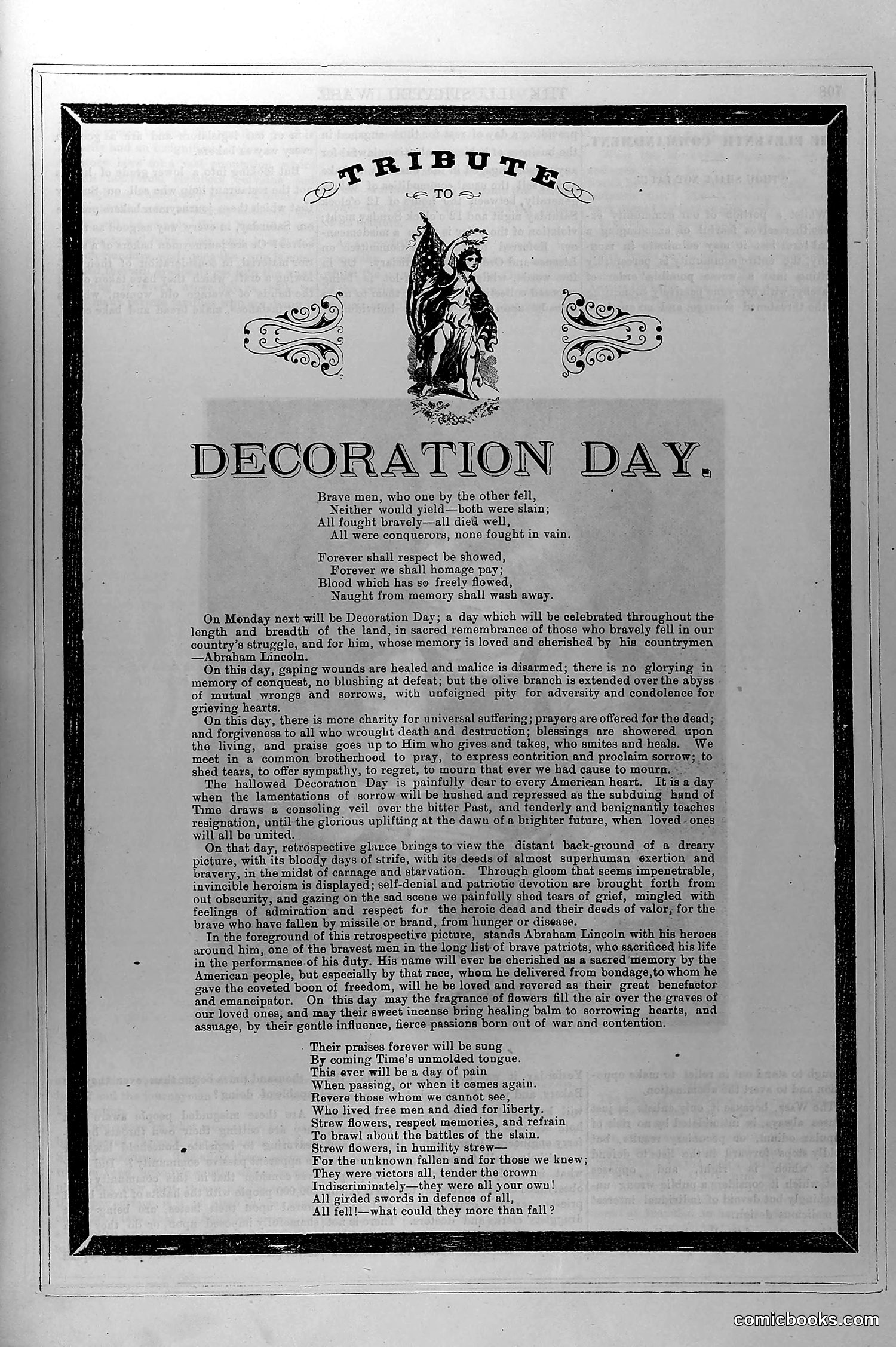
This is not a political cartoon but rather a patriotic poem and essay honoring Decoration Day (now Memorial Day). The page features an allegorical engraving of a female figure—likely Columbia or Lady Liberty—with decorative flourishes. The text celebrates fallen soldiers from the Civil War, emphasizing themes of national unity, sacrifice, and remembrance. It references Abraham Lincoln as a "great benefactor" and discusses honoring both known and unknown soldiers. The essay argues that Decoration Day provides opportunity for national healing and reconciliation after the war's bitter divisions. The closing poem urges Americans to "strew flowers, respect memories" for those who "died for liberty," framing the holiday as essential civic mourning that transcends partisan conflict and promotes patriotic devotion.
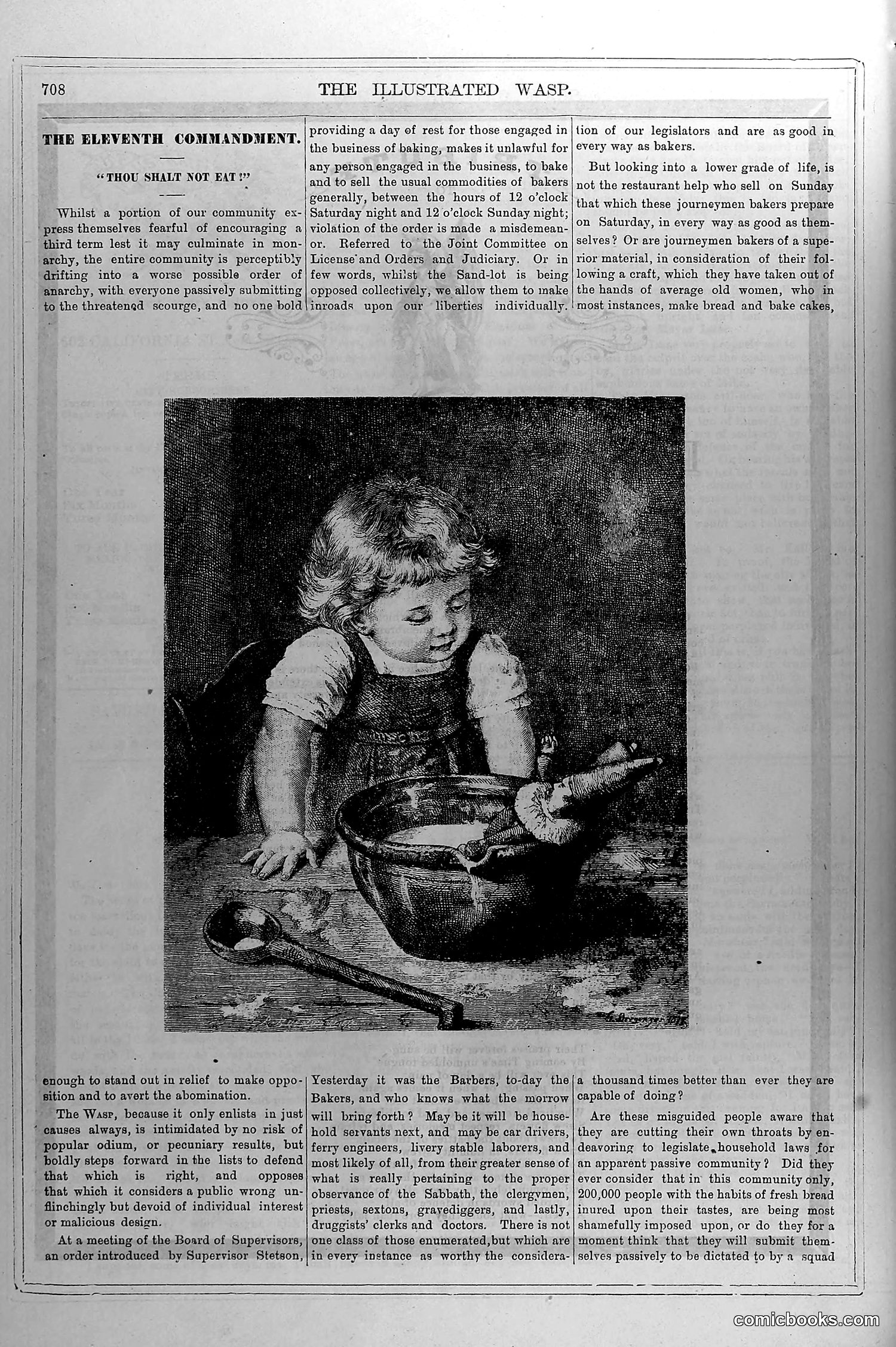
This page satirizes San Francisco's bakers and their Sunday labor practices. The headline "THOU SHALT NOT EAT!" ironically invokes religious authority to criticize a city ordinance restricting Sunday baking. The text argues that while some citizens fear anarchy from enforcing rest days, the ordinance itself represents governmental overreach. The satire suggests bakery owners and legislators manipulate religious principle to justify commercial interests—that allowing bakers to work Sundays serves profit, not piety. The engraving shows a child with baking implements, likely emphasizing the human cost of unregulated labor: families dependent on continuous bakery work, including child labor. The satire questions whether community welfare or business interests truly drive the debate.
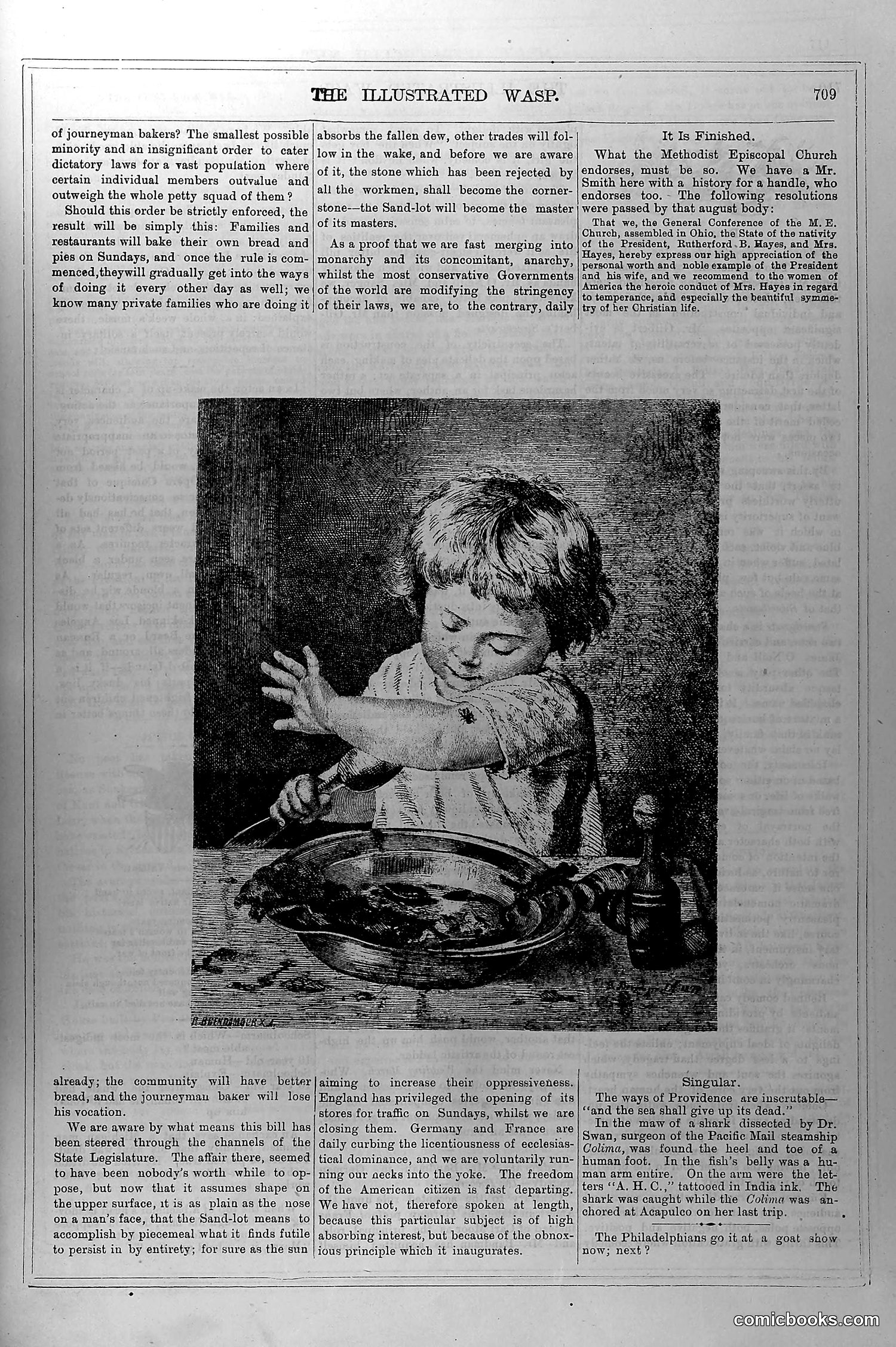
The page contains primarily text rather than political cartoons. The main illustration shows a young child eating from a plate, which accompanies a discussion about Sunday closing laws for bakeries. The text debates a proposed law preventing journeyman bakers from working on Sundays. The satirical argument suggests that if this rule passes, families would need to bake bread themselves on other days—implying the law would create inconvenience rather than protect workers as intended. The piece critiques how monopolies and "conservative Governments" claim to modify laws while actually restricting freedom. It references Germany and France as examples of nations increasingly controlling citizens' liberties. The child eating imagery likely emphasizes the practical, domestic consequences of such legislation on ordinary families.
This page consists primarily of theatrical criticism and social commentary rather than political cartoons. The small illustration labeled "The Glorious Valiant" appears to show a figure in military dress, though its specific satirical target is unclear from the image alone. The text reviews several theatrical productions, including *Sweethearts*, *The Wedding March*, and *California*, critiquing their artistic merit and construction. The critic discusses acting performances and stage design choices. The page includes miscellaneous humor items at bottom, including jokes about bachelors and a Michigan man's dream. Overall, this appears to be an arts and humor section rather than political satire—typical of *The Wasp*'s general entertainment focus during this period.
This page from *The Wasp* (May 18, 1880) is primarily **text-based editorial and news content**, not illustrated satire. The main sections include: 1. **"The Text-Book War"** — President Stone of the Board of Education discusses contract disputes over textbook supplies, defending his decisions against criticism. 2. **"Suicidal Children"** — A news report about a tragic incident on the Karlsburg-Arad Railway involving shepherd children. 3. **"Julius Caesar"** — Literary commentary on Shakespeare's historical accuracy regarding place names. 4. **"The Twenty Dollar Bakery"** and **"Returned Convicts"** — Brief political gossip items criticizing Congressman Page and Superintendent Dodge. The page contains **no visible political cartoons or caricatures**—it functions as a satirical news and opinion journal using written commentary rather than visual humor to critique local San Francisco politics and figures.
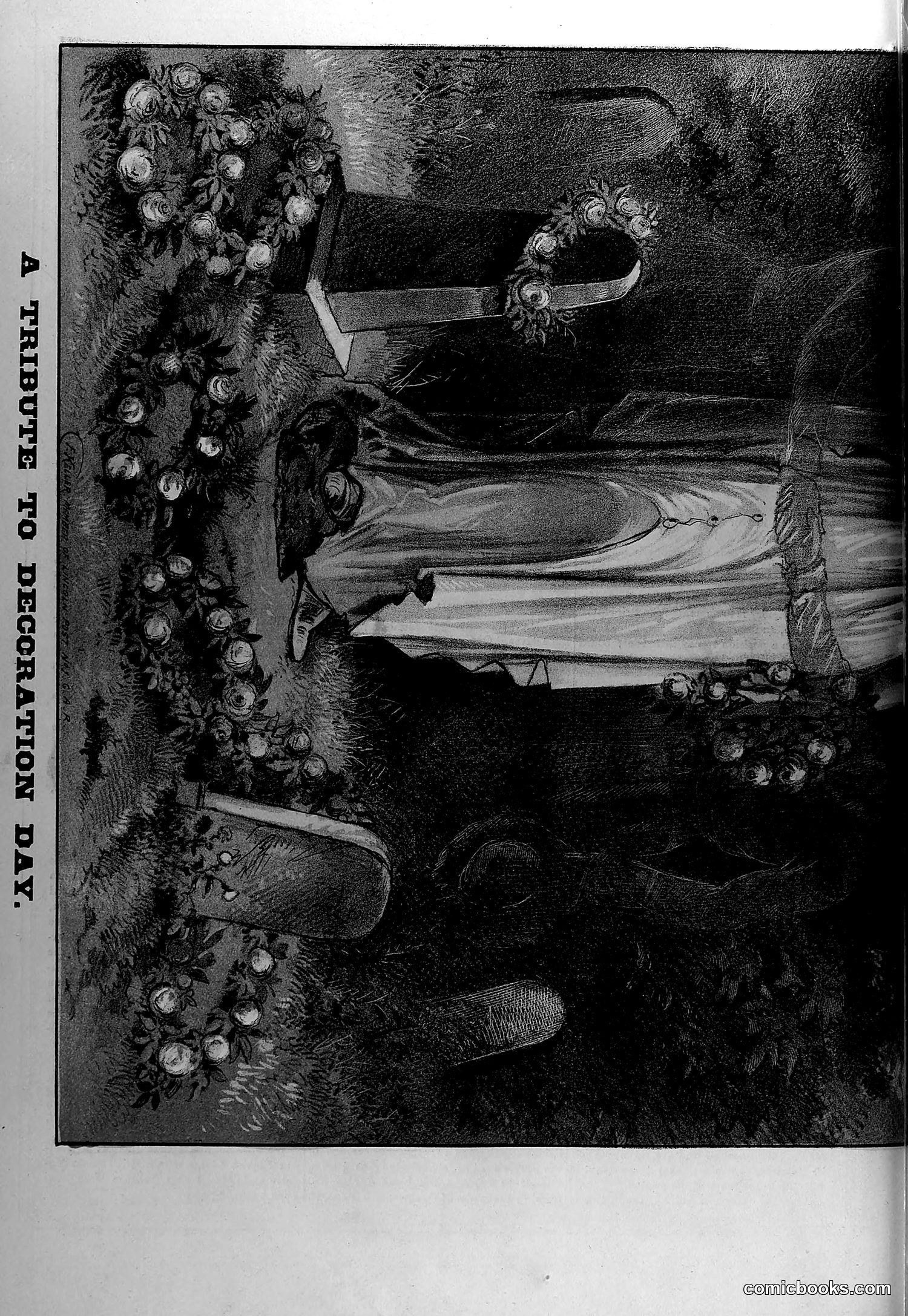
This appears to be a satirical illustration from *The Wasp* magazine depicting a degradation ceremony or public shaming ritual. The image shows figures in formal dress surrounding what appears to be a person being humiliated, with floral wreaths or garlands visible on the left side—possibly suggesting false honor or mockery of legitimate ceremonies. The title "A Tribute to Degradation Day" suggests this cartoon satirizes a specific historical event involving public disgrace or removal from office. The formal setting and ceremonial elements indicate the satire targets institutional or political humiliation. Without additional context about the specific date or figures involved, the precise political target remains unclear, though the work clearly mocks the proceedings as undignified or unjust.
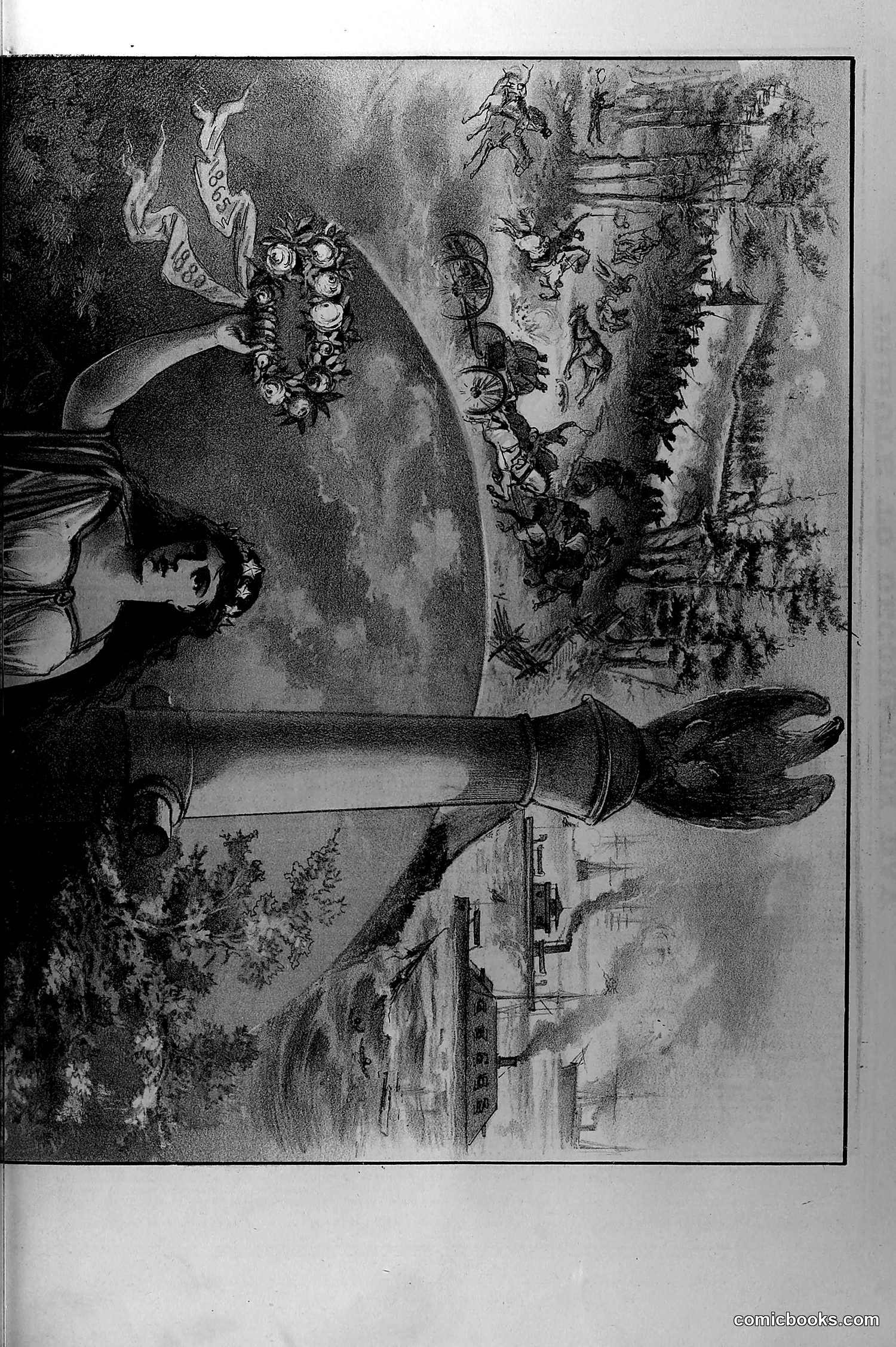
I can see this is a satirical illustration from *The Wasp* magazine, but the image quality and orientation make it difficult to read the OCR text clearly or identify specific figures with certainty. The artwork appears to show a large hand or arm on the left side, with what looks like decorative or ornamental details, gesturing toward a scene on the right containing multiple figures in various poses—some appearing to be in conflict or turmoil, with architectural elements visible below. Without clearer text or being able to definitively identify the caricatured figures, I cannot reliably explain the specific political or social references this cartoon is satirizing. To accurately explain the satire's meaning for modern readers, I would need either clearer source material or additional contextual information about the publication date and *The Wasp*'s typical targets.
This page is primarily **text-based serialized fiction**, not a political cartoon. It's "Phases of History Not Generally Given in Detail," written by Salmi Morse for *The Wasp* magazine. The narrative appears to be a **domestic comedy** involving characters including Mrs. Winslow, a niece named Nanny, and a man named Bill. The humor centers on **class and social propriety**: Mrs. Winslow is concerned with propriety and respectability, while Bill uses crude language and behaves improperly. The satire mocks **Victorian social pretensions** and the clash between working-class informality and upper-class conventions. The piece satirizes both characters—the snobbish widow and the uncouth man—rather than making specific political commentary. This appears to be **social satire rather than political commentary**.
This page is primarily **text and advertisements** rather than political cartoons. The main content consists of letters to the editor under "Interesting Reminiscences of the Late Great Struggle"—Civil War reminiscences from readers. The letters humorously describe **Northern soldiers' encounters with "Yankee" culture and customs** (referring to Northern civilians), with detailed satire about Yankee hygiene practices, food, clothing, and domestic habits. The humor derives from contrasting Southern soldiers' perspectives with Northern civilians' unfamiliar ways. The remainder is commercial advertising for products like Audiphones, oxygen treatments, and soap. **No political figures or cartoons are present.** This is a humor magazine using epistolary satire about regional cultural differences during the Reconstruction era.
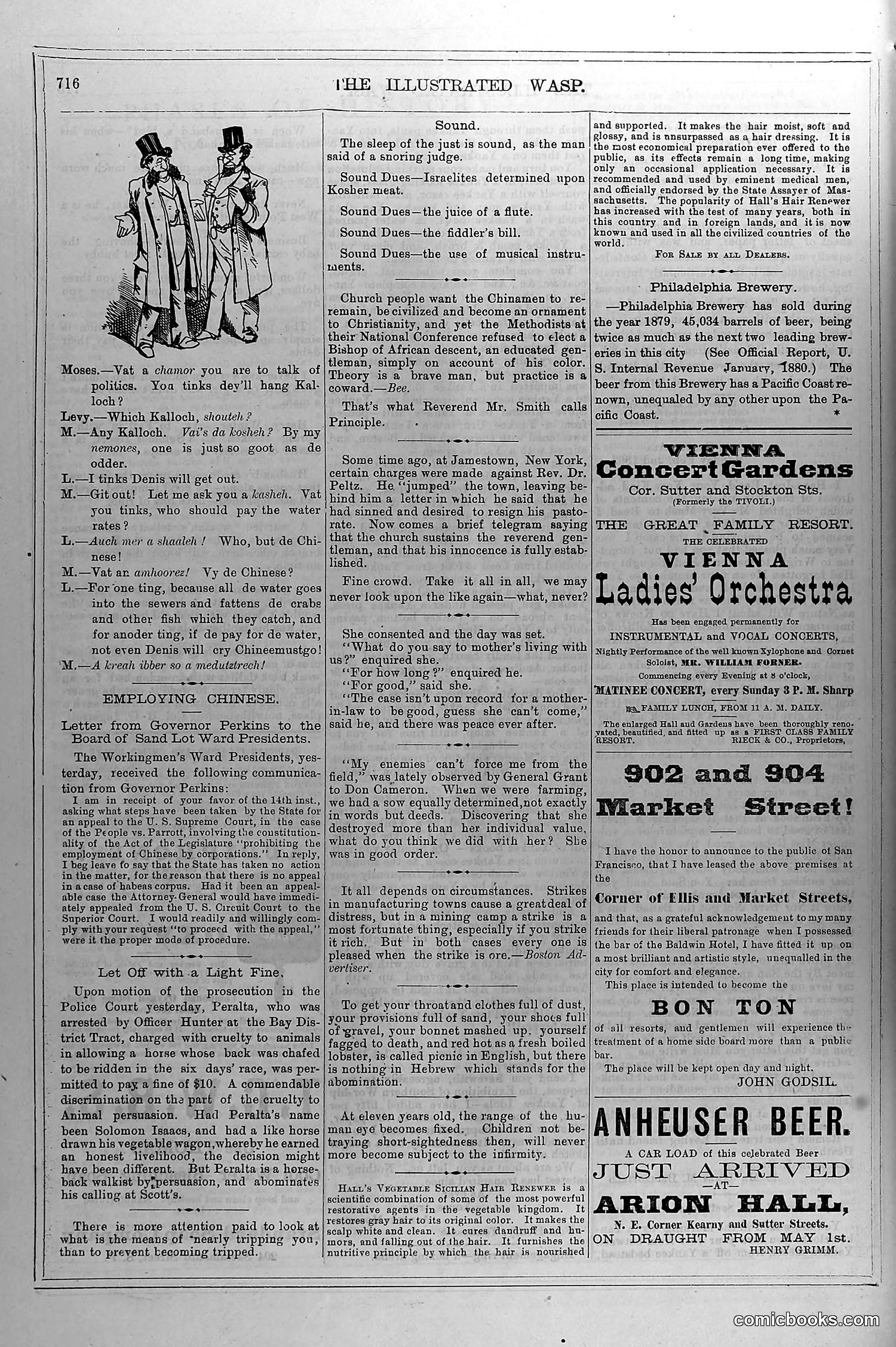
This page is primarily **advertising and miscellaneous content** rather than political satire. The illustration shows two well-dressed men in top hats discussing politics, with dialogue about "Chinamen" and various political matters. The text references debates over Chinese immigration and citizenship—a significant issue in 1880s California. The satirical content mocks arguments for and against Chinese integration into American society, with characters debating whether Chinese people should "remain civilized" or become "ornaments to Christianity." The dialogue appears to ridicule both sides of the contemporary immigration debate. The bulk of the page consists of advertisements for breweries, concert halls, and beer, with minimal political commentary. The actual satirical bite is limited to the opening dialogue section.
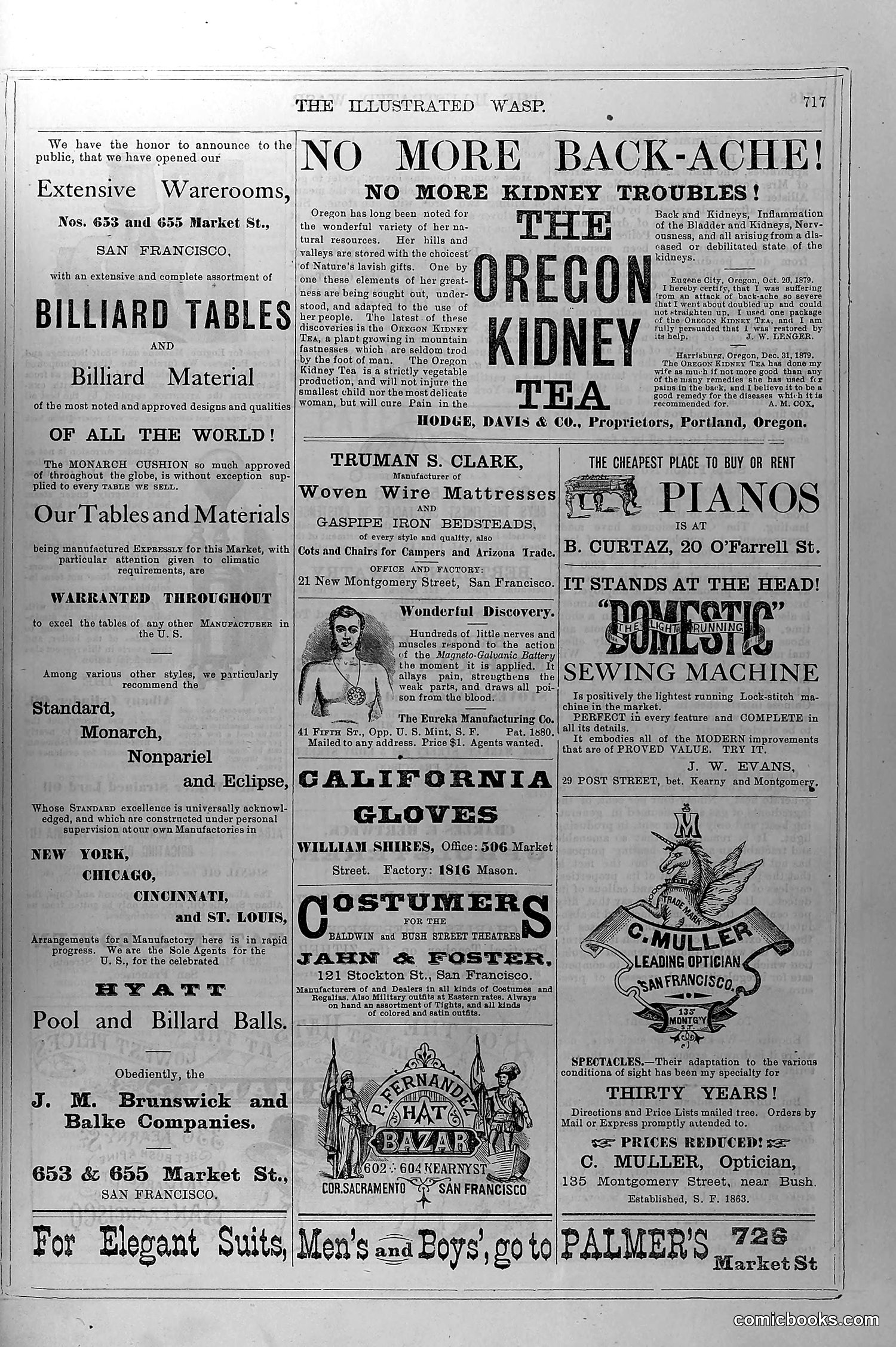
This page is primarily **advertising**, not political satire. It features various San Francisco businesses from what appears to be the late 19th century, including billiard table manufacturers, piano retailers, sewing machine sellers, and opticians. The only illustration with potential satirical intent is a **"Wonderful Discovery" image** promoting Oregon Kidney Tea—a patent medicine claiming to cure back pain and kidney troubles. The accompanying testimonials are typical of dubious medical advertising from this era, making unsubstantiated health claims. The page reflects the magazine's business model: generating revenue through paid advertisements rather than purely editorial content. There is no identifiable political cartoon or social satire present on this particular page.
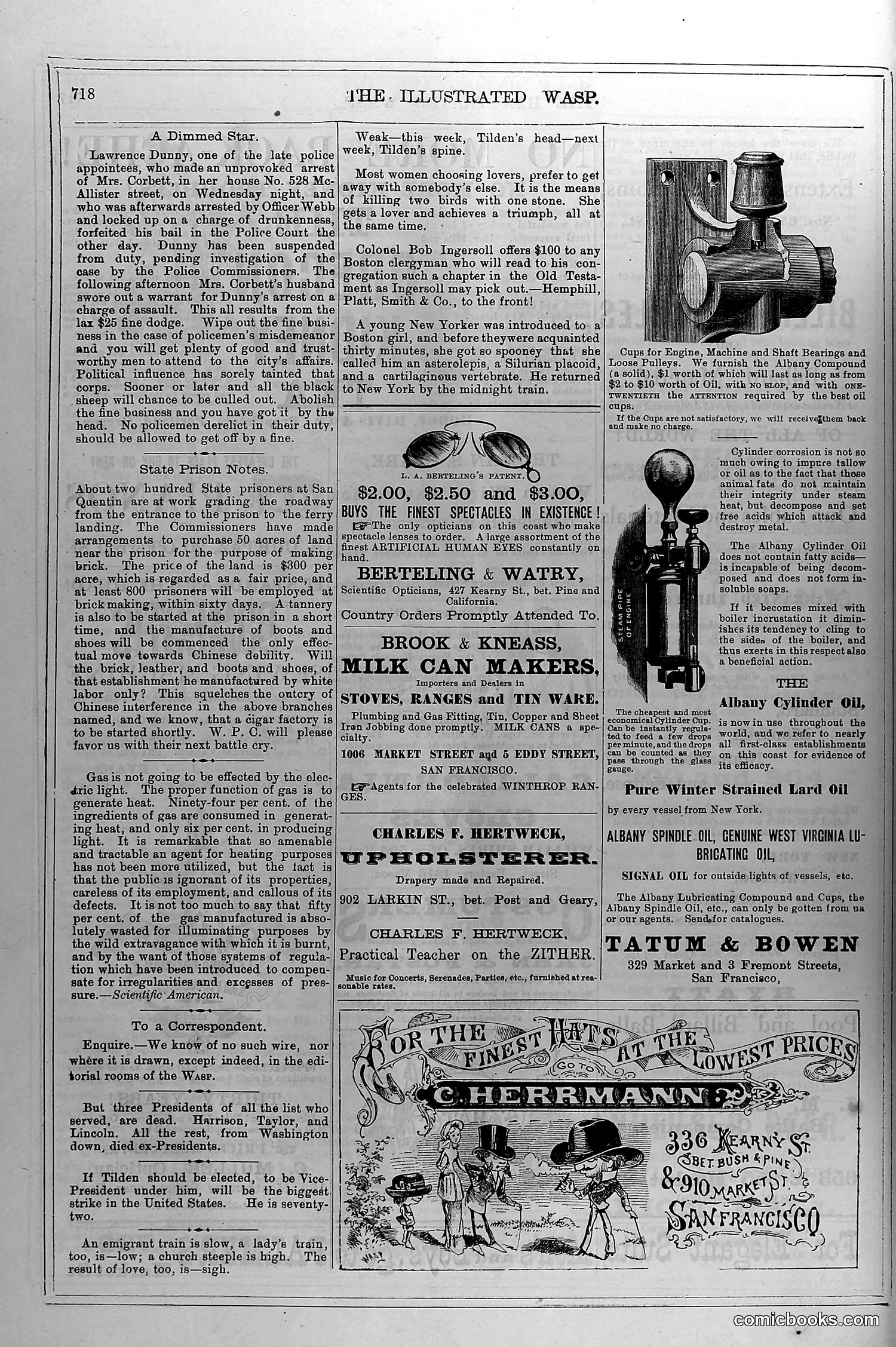
This page is primarily **advertising and editorial content** rather than political cartoon. The main satirical piece, "A Dimmed Star," discusses Lawrence Dunny, a police appointee who made an unlawful arrest of a man (Mr. Corbett), resulting in the victim's lawsuit. The article critiques how political influence enabled Dunny to avoid consequences—his bail was forfeited and he was suspended pending investigation. The satire targets **police corruption and political patronage**: the piece argues that without connections, an ordinary person would face justice, but Dunny's political backing allows him to escape accountability. The remainder consists of advertisements for spectacles, oils, stoves, and hats—typical of 1880s-90s magazines. No specific national political figures appear to be caricatured on this page.
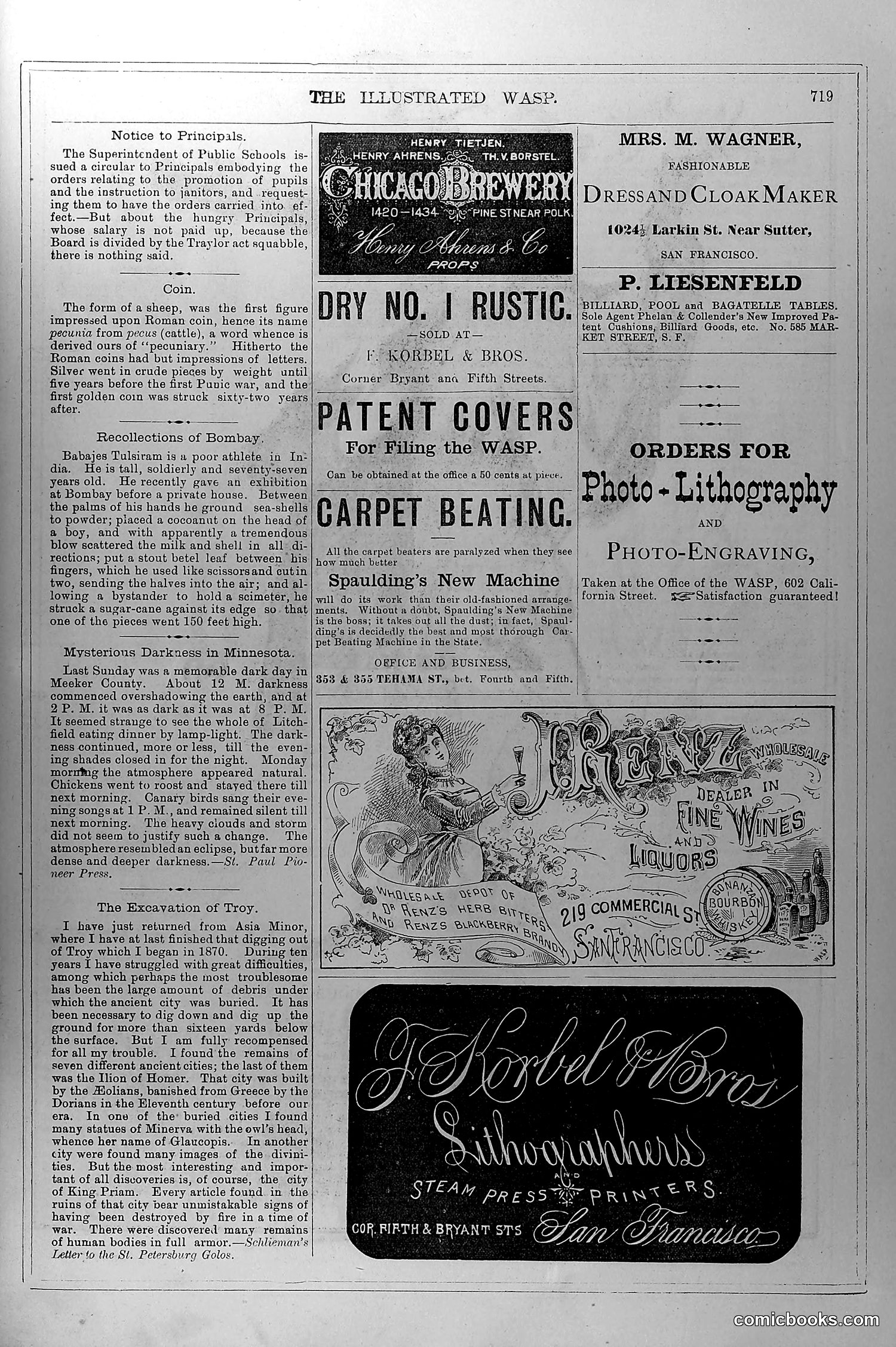
This page is primarily **advertising and notices** rather than political satire. The content includes: - **Business advertisements** for local San Francisco services: a brewery, dry goods store, dressmaker, lithography company, and wine dealer - **Editorial notices** addressing school principals about pupil promotion policies - **Three short articles**: one on Roman coins, another about an athlete from Bombay, and a third describing a mysterious darkness event in Minnesota and archaeological excavations at Troy The largest illustration is a **decorative wine merchant advertisement** featuring ornate lettering and classical imagery. There is no apparent political cartoon or satirical content on this page—it functions as a typical late-19th-century magazine's back matter mixing local notices with commercial advertisements.
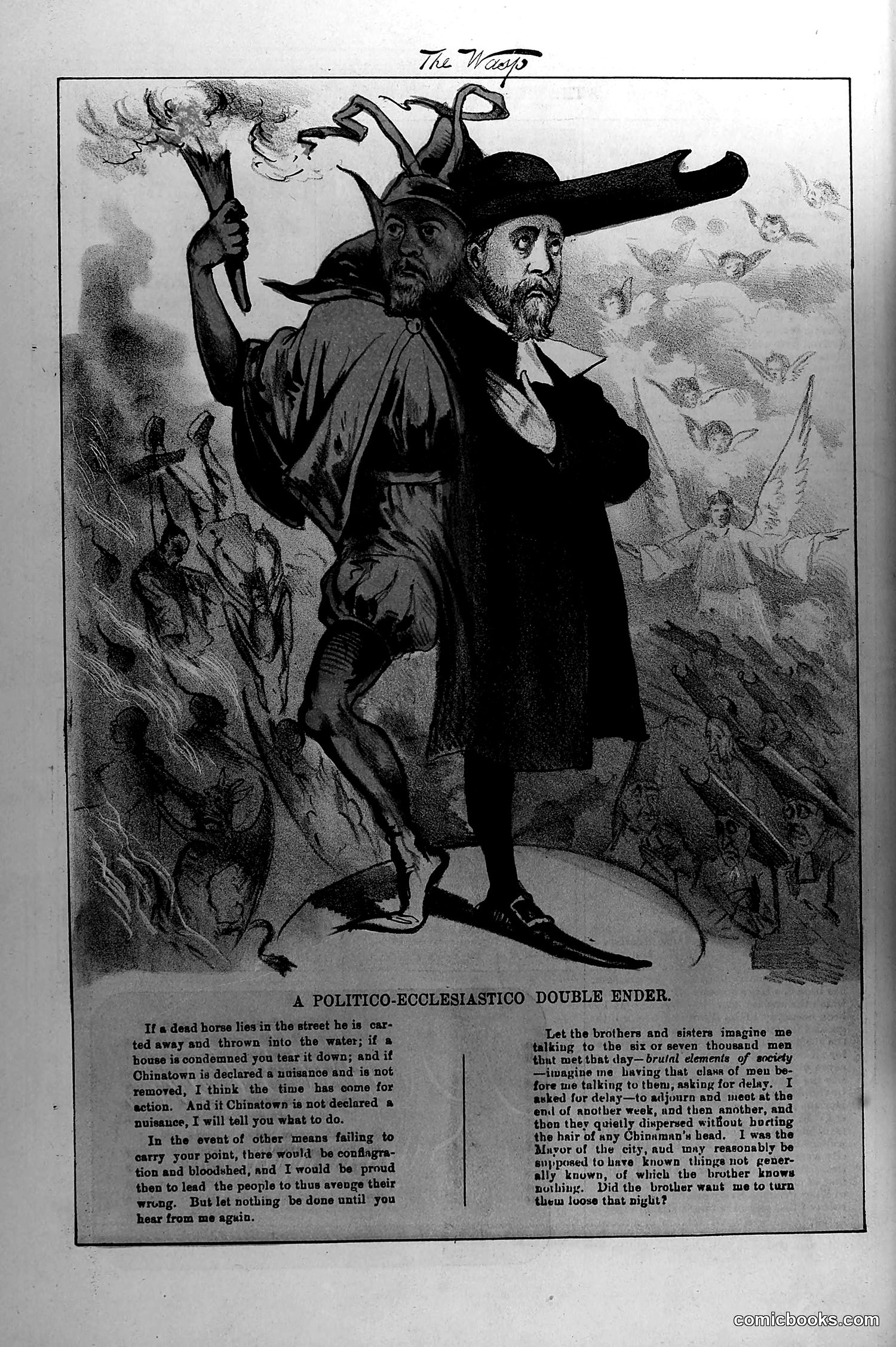
This cartoon depicts two figures wearing horned devil hats, standing back-to-back in a hellish landscape. The title suggests a critique of both political and religious hypocrisy ("double ender"). The accompanying text addresses a controversy involving Chinatown and a dead horse. One speaker discusses whether a dead horse should be removed as a "nuisance," while another complains about delay tactics and mentions "six or seven thousand men" engaged in conflict—likely referring to labor disputes or community tensions. The satire appears to target corrupt officials (political and ecclesiastical/religious) who cynically manipulate public crises for their own benefit, using inflammatory rhetoric while avoiding genuine action. The "double ender" title suggests both secular and religious authorities share blame for societal problems.

I can see this is a test or calibration page for The Wasp magazine, not an actual cartoon or article page. The image shows a standard photographic reference chart used in printing and reproduction work, featuring: - A grayscale color checker with multiple tones (the grid of squares on the left) - A measurement ruler marked from 6-11 inches (center) - A baseline ruler at the bottom This appears to be documentation of the magazine's production process rather than content meant for readers. Without visible cartoon imagery, caricatures, or satirical text on the actual page, I cannot identify political figures or explain satirical intent. This is technical apparatus, not editorial content.