
A complete issue · 18 pages · 1880
The Wasp — May 22, 1880
I can see this is a test/calibration page from a photographic document rather than actual comic content from *The Wasp* magazine. The page shows an Oregon Rule Co. ruler for scale and a grayscale test chart with various shades of gray squares—standard equipment used in archival photography and document reproduction to ensure proper exposure and color accuracy. There is no political cartoon, satirical content, or historical figures visible on this page. This appears to be a blank or calibration sheet that was photographed as part of archival documentation procedures, possibly preceding or accompanying actual *Wasp* magazine pages in a collection.
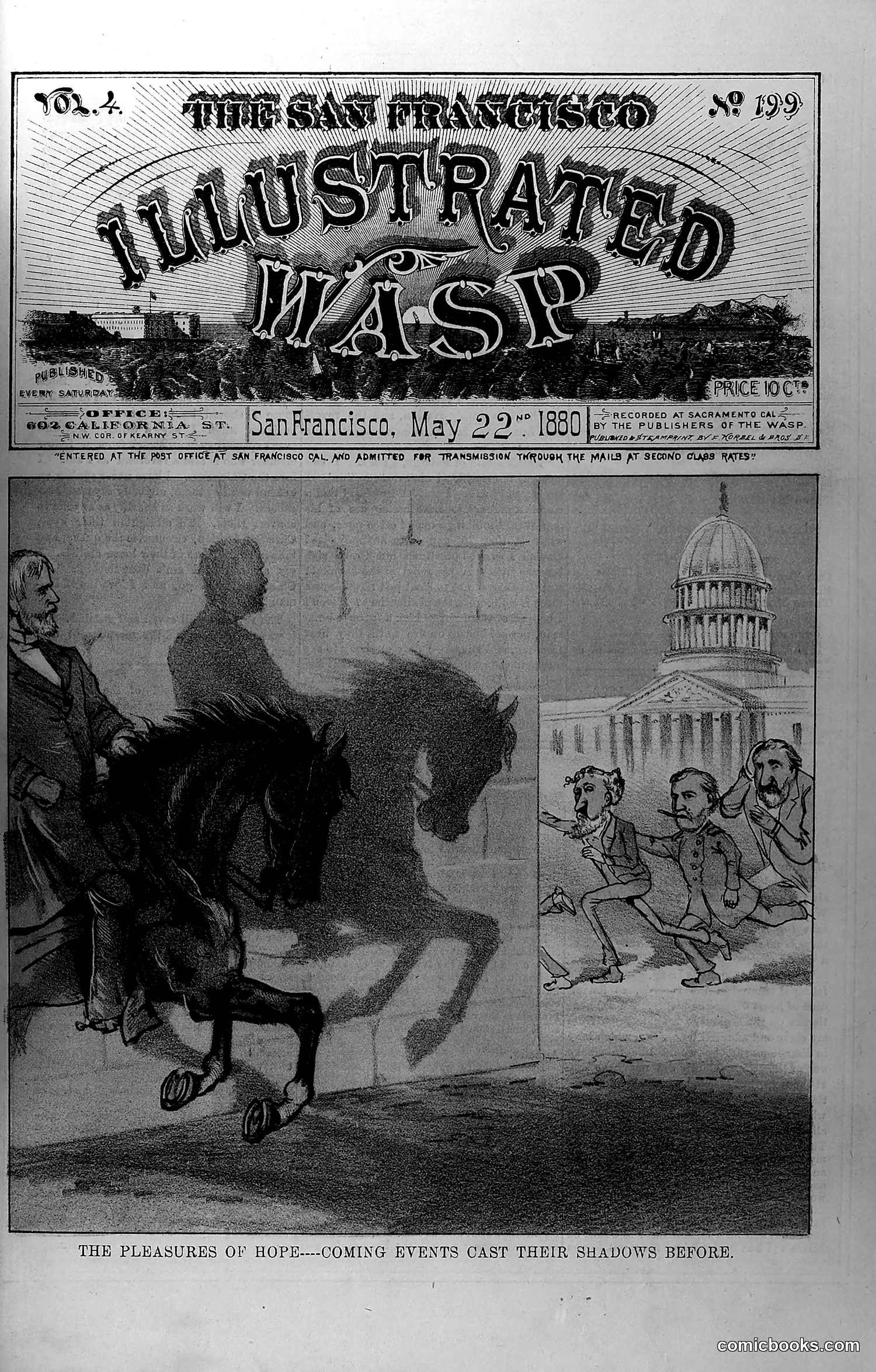
This May 22, 1880 *Wasp* cartoon uses the phrase "coming events cast their shadows before" (a common Victorian saying about premonition) to satirize political anticipation. The left panel shows a figure riding a donkey—likely representing a Democratic politician or the Democratic Party itself (the donkey being the Democratic symbol). The right panel depicts three caricatured figures near the Capitol building, appearing to be Republicans actively scheming or preparing political moves. The satire suggests that Democrats, represented by the donkey-rider, are anxiously watching Republican machinations unfold. The cartoon mocks the political tension and maneuvering of the 1880 election season, with Republicans portrayed as actively plotting while Democrats merely observe their shadows.
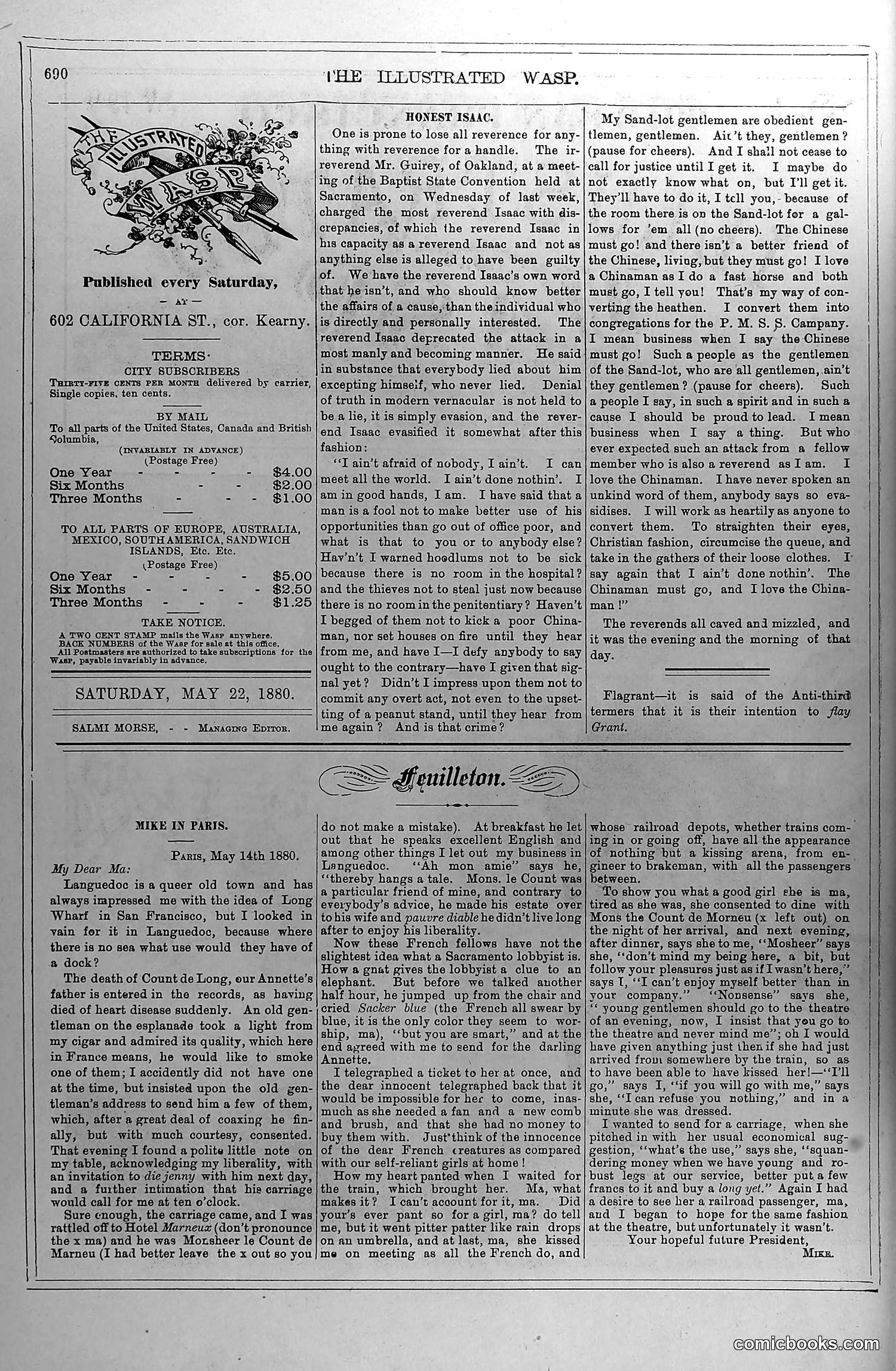
This page contains two main sections: "Honest Isaac" (an editorial) and "Mike in Paris" (a letter column). Neither section includes political cartoons in the visible image area. "Honest Isaac" addresses Reverend Isaac Guirey of Oakland, who allegedly made false accusations against another reverend named Isaac at a Baptist convention. The editorial satirizes the reverend's attack, mocking his lack of evidence and suggesting he made unsubstantiated claims—criticizing hypocritical religious figures who don't practice what they preach. "Mike in Paris" is a humorous travel letter describing the author's misadventures in Languedeo and Paris, including encounters with French customs and social etiquette. This page appears primarily devoted to editorial commentary and reader correspondence rather than visual satire.
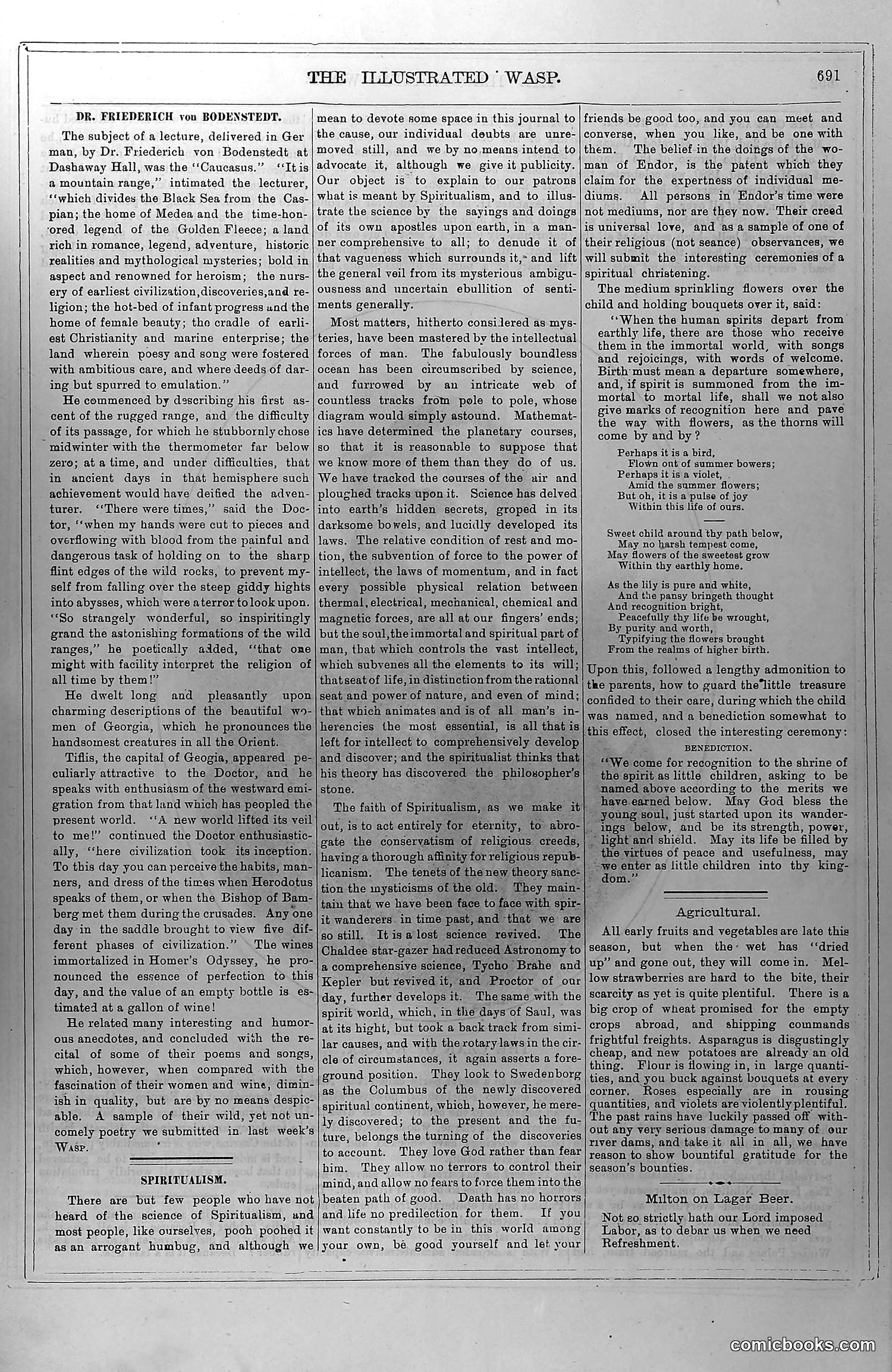
This page contains primarily **text articles rather than political cartoons**. The main pieces are: 1. **"Spiritualism"** - A lengthy essay by Dr. Friederich von Bodenestedt critiquing spiritualism as pseudoscience, arguing it contradicts rational thought and religious faith. 2. **"Agricultural"** - A brief note on seasonal produce availability and crop conditions. 3. **"Milton on Lager Beer"** - A short poetic piece (appears to be satire using Milton's classical style applied to beer). The page lacks the visual political cartoons typical of satirical magazines. Instead, it showcases The Wasp's written satirical commentary, with the spiritualism essay being the primary content—likely reflecting 19th-century debates over spiritualist movements gaining popularity despite scientific skepticism.
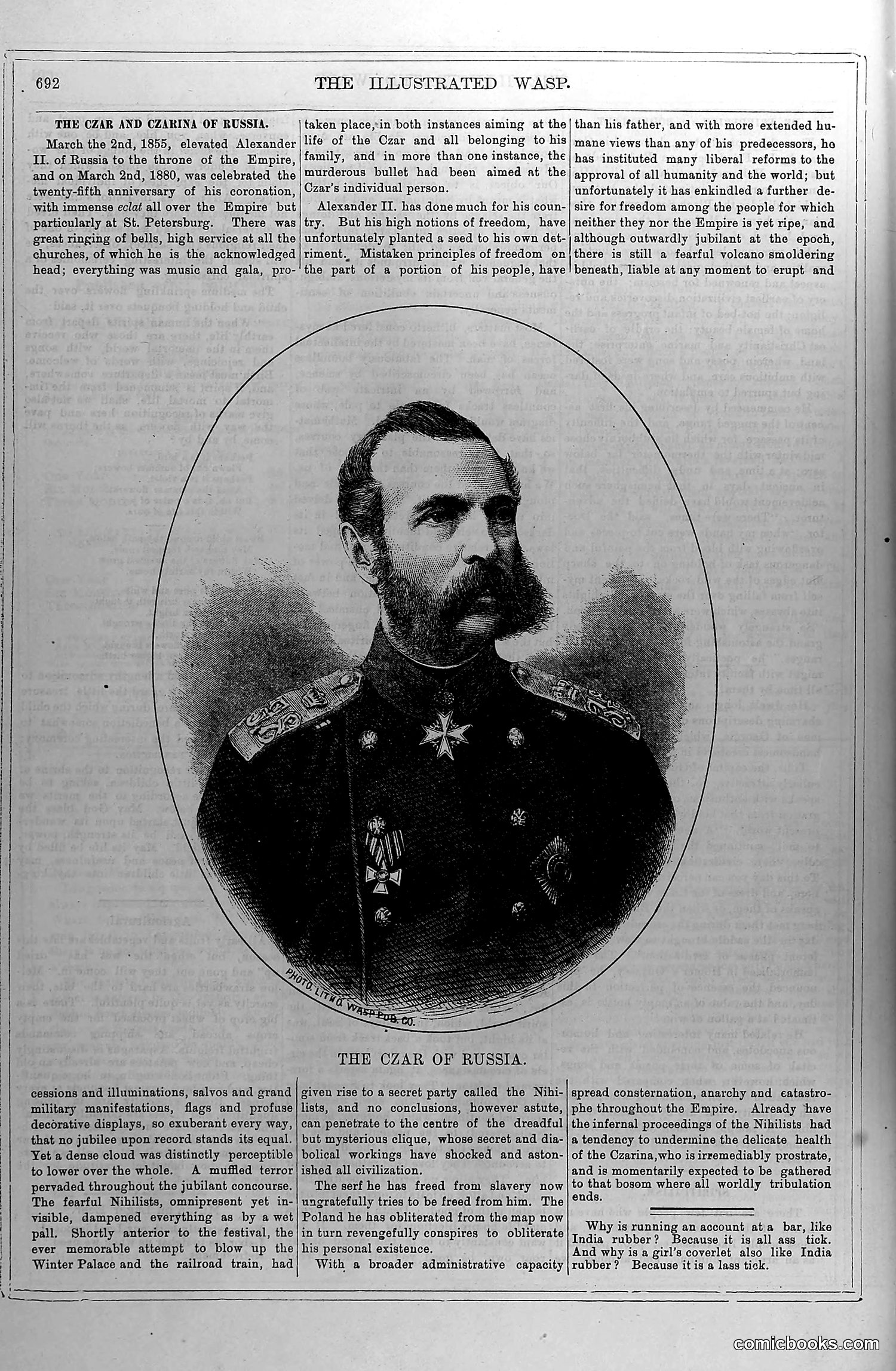
This page from *The Wasp* features a formal engraved portrait of Alexander II of Russia, labeled "THE CZAR OF RUSSIA." The accompanying text discusses his reign (beginning 1855) and recent anniversary celebrations in 1880 at St. Petersburg, marked by religious services and grand festivities. The article presents a mixed assessment: while praising Alexander II for freeing serfs and implementing reforms, it criticizes his government's contradiction—his stated commitment to freedom contrasts sharply with the secret police (Nihilists) and political repression undermining his rule. The text suggests his liberal ideals remain unrealized, with internal instability persisting despite reforms. The portrait itself appears straightforward documentation rather than satirical caricature, though the juxtaposition between the text's praise and criticism creates implicit irony about his actual legacy.
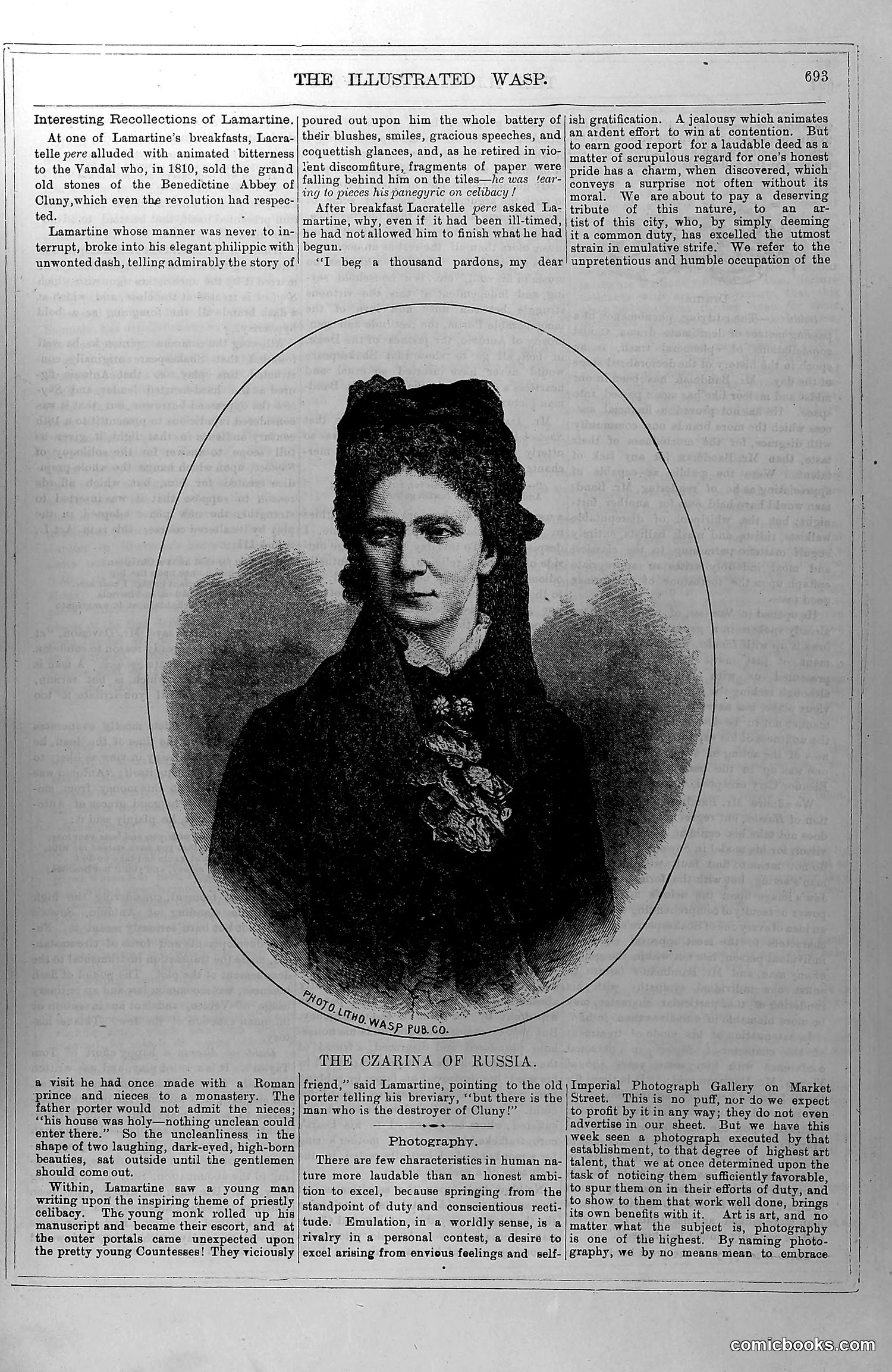
This page features a portrait of "The Czarina of Russia" with accompanying biographical text about Lamartine (a French historical figure). The portrait shows a woman in formal 19th-century dress with decorative pins and long dark hair. The text discusses Lamartine's breakfast habits and an anecdote about his encounter with a Vandal who, during the Revolution, asked forgiveness. The passage emphasizes Lamartine's dignified manner and his ability to tell stories with understated charm. The bottom section discusses photography's role in portraiture, arguing that honest, unpretentious photography represents a higher art form than flattering painted portraits. This appears to be editorial commentary rather than political satire, promoting photography as a legitimate artistic medium worthy of respect.
This page is primarily **literary criticism** rather than satire or political commentary. It discusses theatrical productions, specifically examining Shakespeare's plays and their staging. The main article critiques **Mr. Bandmann**, apparently a theater producer/actor, regarding his production choices and treatment of characters in plays like *Hamlet*, *Richard III*, and *Shylock*. The writer defends Shakespeare's artistic intentions while criticizing what appears to be overly sentimental or distorted interpretations—particularly regarding Shylock's portrayal as villainous. The critic argues producers shouldn't alter Shakespeare's character designs based on contemporary prejudices. The decorative header showing cherubs suggests this is from a Victorian-era publication focused on cultural criticism rather than political satire.
This page contains **no political cartoons**. Instead, it's a collection of short satirical prose pieces and humorous commentary typical of the magazine's editorial content. The pieces mock various targets: Grant's astrological beliefs, Sherman's military reputation, Blaine's political prospects, and Jupiter in Sherman's horoscope. There are also lighter pieces about kindergarten, fish in scripture, art criticism, and anecdotes about rings and caves. The content relies on **contemporary knowledge** of 1870s-80s political figures (Grant, Sherman, Blaine) and religious/literary references that would be obvious to period readers but require historical context today. The tone is consistently irreverent toward public figures and institutions. No illustrations are visible on this page.
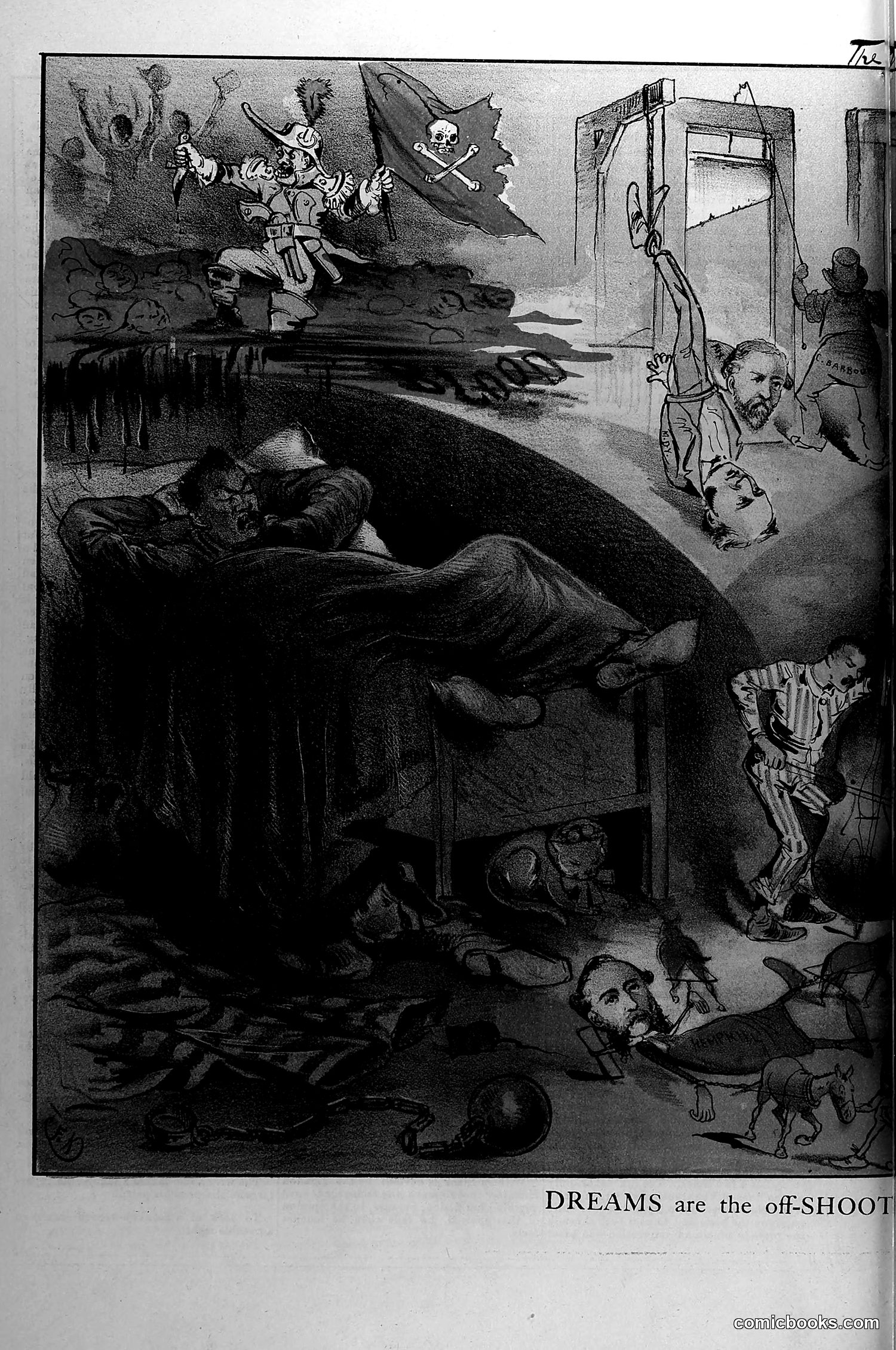
This satirical cartoon depicts a sleeping man in bed experiencing nightmarish visions. The caption "Dreams are the off-shoot" suggests dreams reflect waking anxieties. The nightmare imagery shows: - A pirate figure in the upper left with skull-and-crossbones flag - Skeletons and death imagery - Various grotesque or demonic figures surrounding the dreamer - Armed or menacing characters on the right side The satire appears to comment on anxiety, fear, or guilt—suggesting the dreamer's subconscious reveals suppressed concerns or misdeeds. Without additional context about *The Wasp* magazine's publication date or specific political moment, the exact target of this moral commentary remains unclear. The style suggests late 19th or early 20th-century American social criticism, likely mocking someone's guilty conscience or hypocrisy.
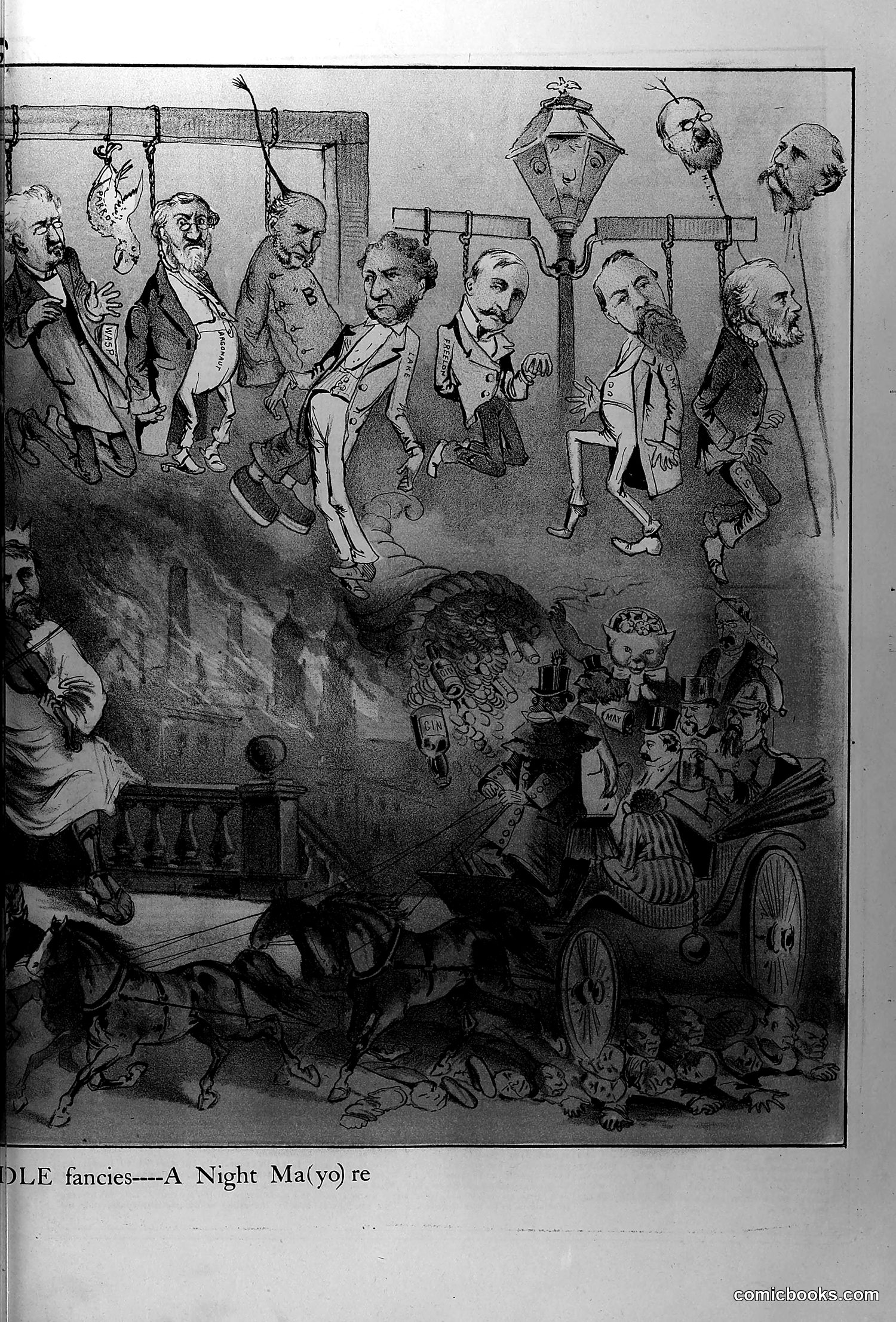
This is a satirical cartoon from *The Wasp* depicting what appears to be a nighttime political or social gathering. The title puns on "nightmare" and "Mayo," likely referencing Mayo (mayonnaise) or a political figure with that name. The upper section shows men in formal dress suspended or hanging from a rope/beam structure—suggesting they're in precarious political positions or about to face consequences. The lower section depicts a chaotic carnival or circus scene with a carriage, demons or devils, and disorderly figures, symbolizing societal chaos or moral corruption. The overall composition suggests this mocks powerful political figures being brought down to the level of common disorder and degradation, typical of *The Wasp's* irreverent satirical approach to authority and governance.
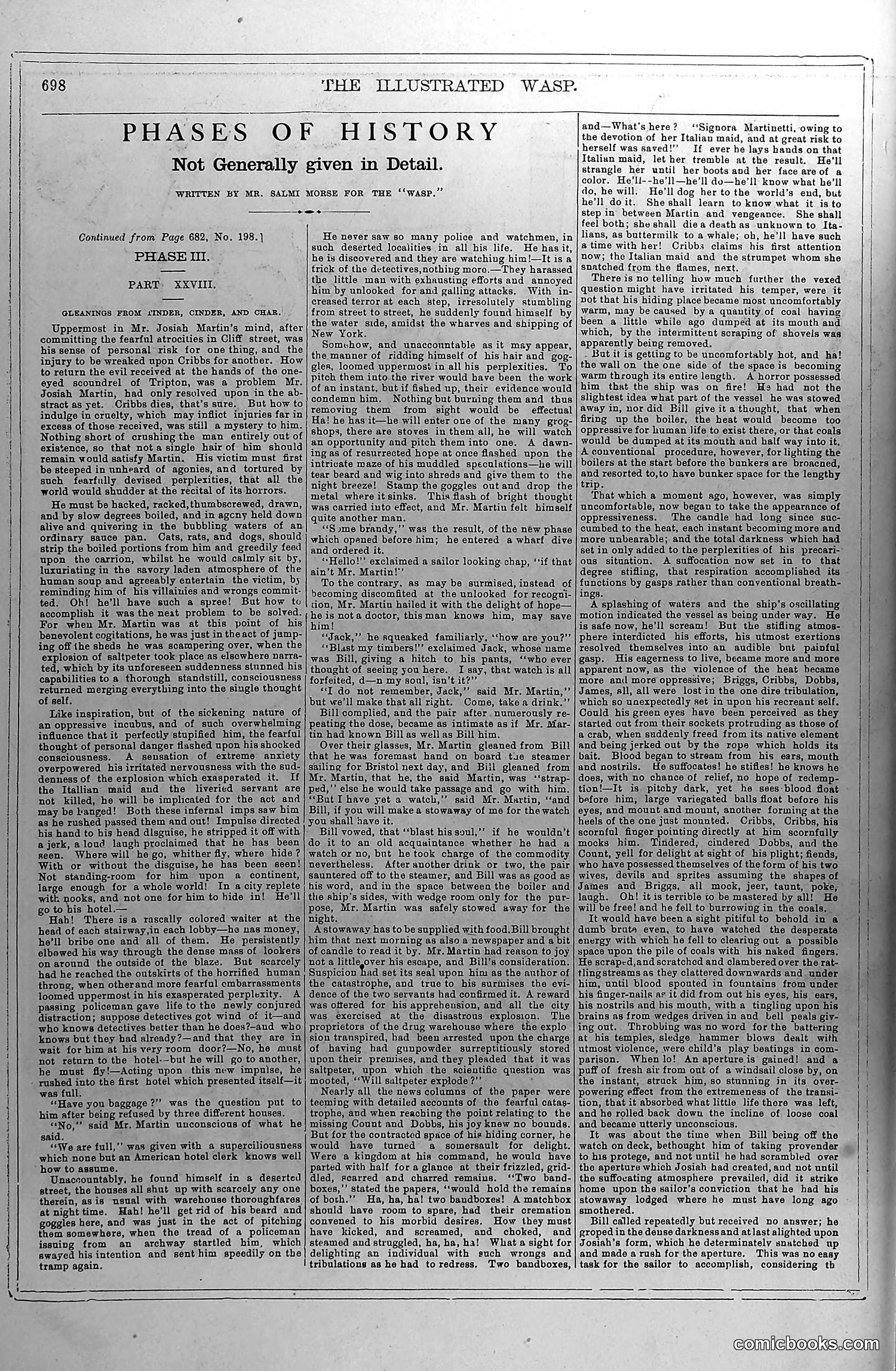
This page is primarily text—a serialized story titled "Phases of History Not Generally Given in Detail" written by Mr. Balmi Morse for *The Wasp*. The narrative focuses on Mr. Martin, an Italian immigrant, and his interactions with various characters including Bill, Jack, and others in what appears to be a working-class setting involving ships and docks. The story depicts Martin's struggles, his encounters with police and authorities, and conflicts with other workers—touching on themes of labor disputes, xenophobia toward immigrants, and maritime life. The content appears satirical commentary on San Francisco's Italian immigrant community and urban working conditions of the era, though the specific political targets remain unclear from this page alone. This is a literary rather than visual-cartoon contribution.
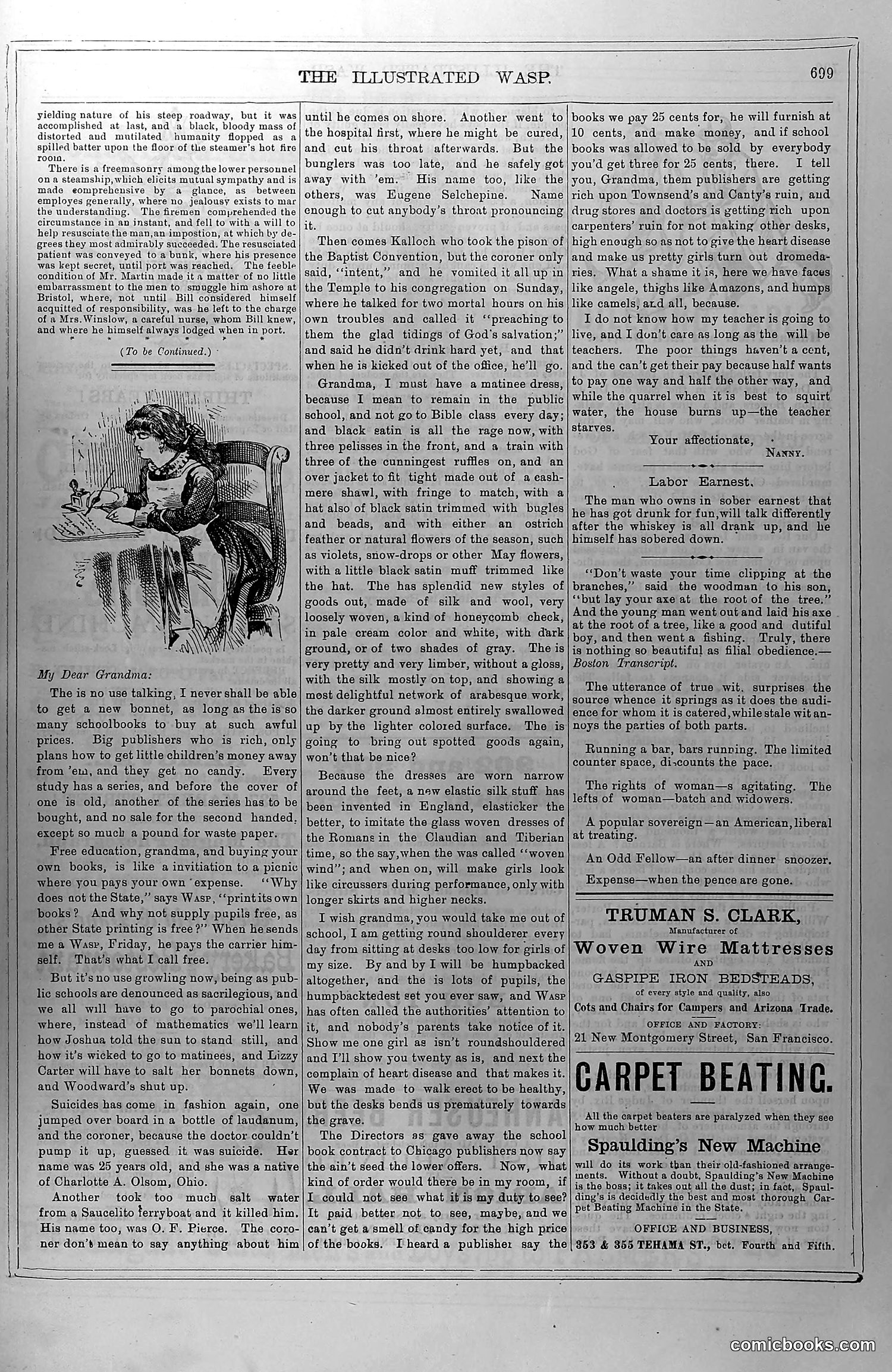
This page is primarily **text and advertising** rather than political cartoon content. The main illustrated element shows a Victorian-era woman sitting in a chair, accompanying a letter labeled "My Dear Grandma" about bonnets and children's books. The page contains several brief social commentary pieces (labeled "Labor Earnest," "An Odd Fellow," etc.) offering satirical observations on contemporary life—including critiques of education costs, women's fashion, and working conditions. The bulk of the content consists of **advertisements** for San Francisco businesses: Truman S. Clark's woven wire mattresses and gaspierre iron bedsteads, and Spaulding's carpet-beating machine. Without visible political caricatures or clear topical references, this appears to be a typical **mixed-content magazine page** blending humor, advice columns, and commercial notices rather than focused satirical commentary.
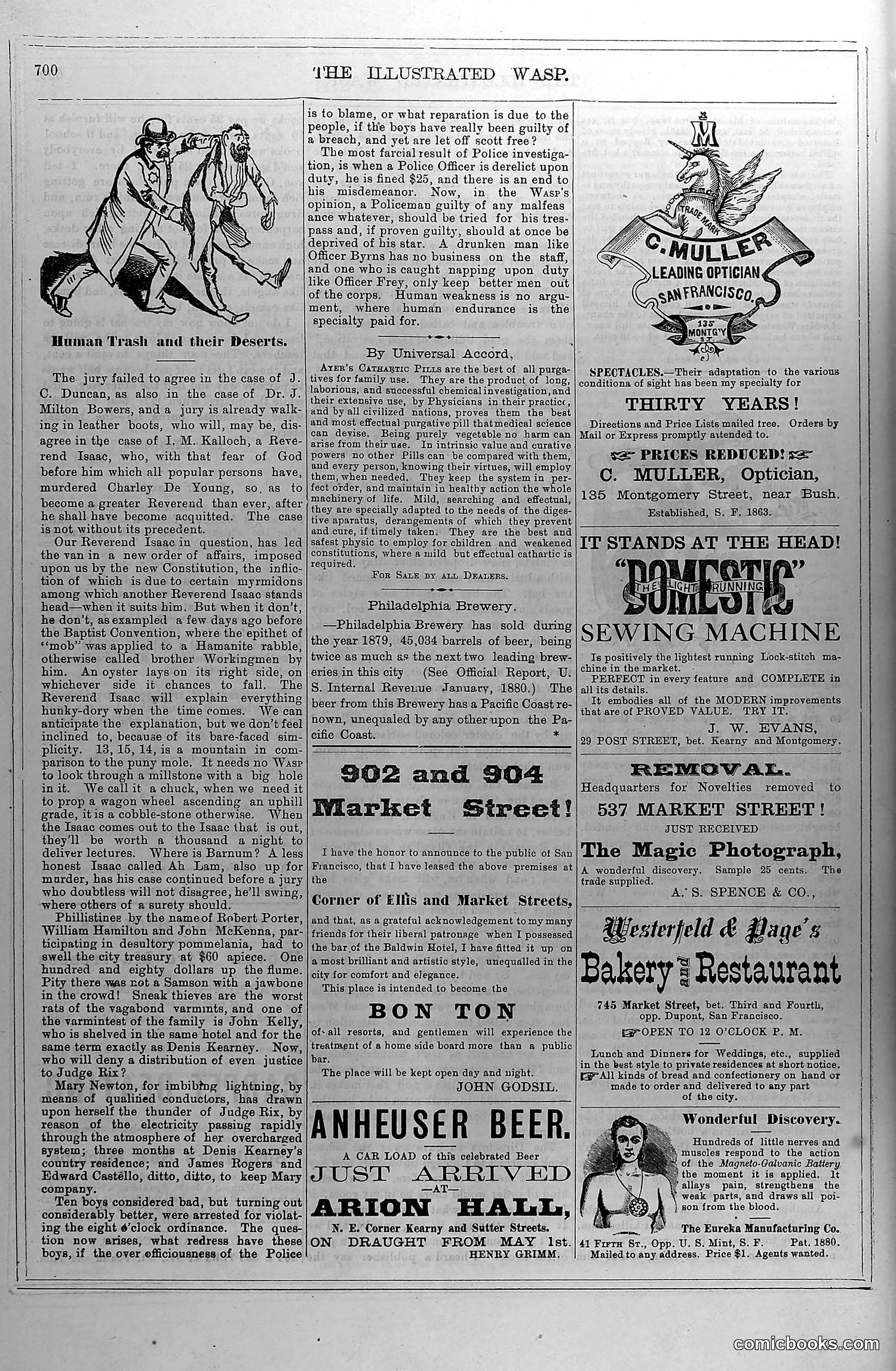
The main cartoon, titled "Human Trash and their Deserts," depicts two figures being physically ejected or dragged away. Based on the accompanying text, this critiques the San Francisco Police Department's handling of officers involved in misconduct cases. The article discusses Officer Isaac, Officer Byrns, and Officer Frey, arguing that corrupt or incompetent policemen escape accountability while honest citizens face severe justice. The cartoon appears to satirize the hypocrisy of the police system—suggesting that wrongdoing officers ("human trash") receive inadequate punishment compared to their actual crimes. The rest of the page consists primarily of advertisements and notices for local San Francisco businesses, including breweries, restaurants, and commercial establishments, typical of 19th-century satirical magazine content.
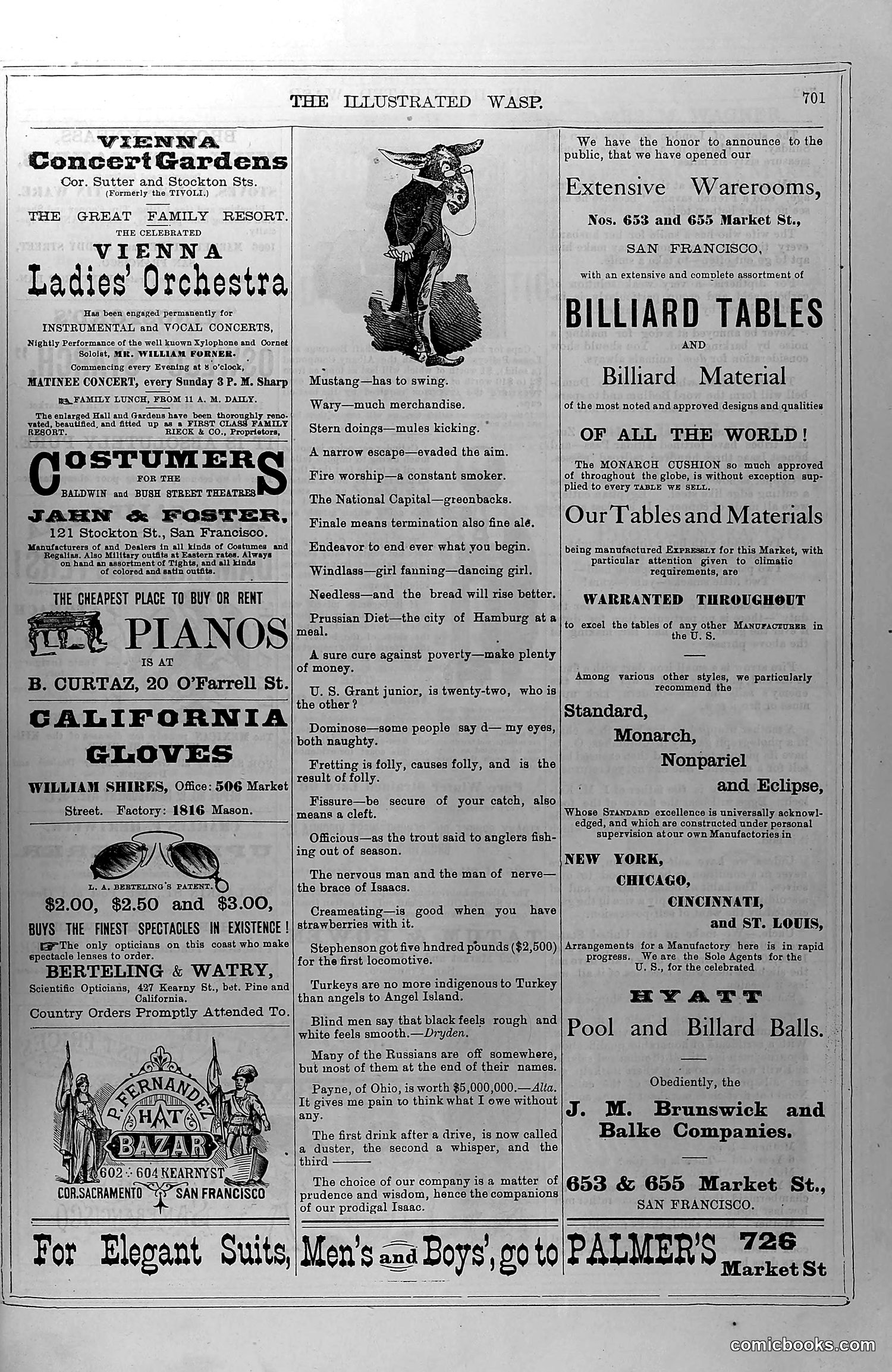
This page is predominantly **advertising content** rather than satirical cartoons. The main illustration shows a goat labeled with various humorous phrases like "Mustang—has to swing" and "Wary—much merchandise," appearing to be a visual joke or mascot image. The bulk of the page contains period business advertisements for San Francisco establishments: piano rentals, gloves, billiard tables, orchestras, and costumes. The only satirical element is the central goat cartoon, which uses animal imagery and wordplay for humor, though the specific satirical target or social commentary is unclear without additional context about what the goat represents in 1890s San Francisco society.
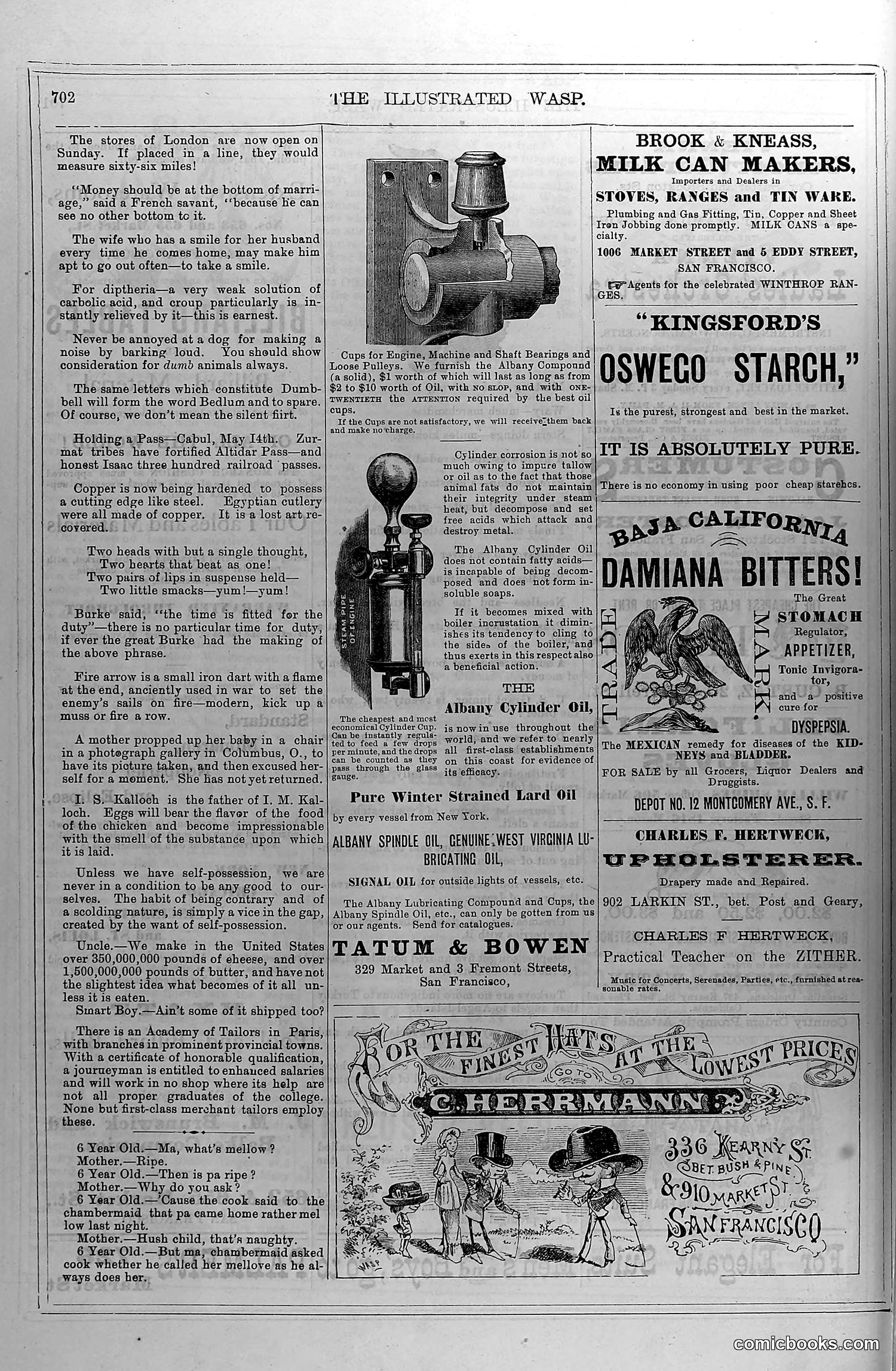
This page is primarily **advertising and miscellaneous content** rather than political satire or editorial cartoons. The visible illustrations are: - Technical diagrams of industrial machinery (cylinder oil equipment, engine caps) - A decorative advertisement for C. Herdemann's hat shop featuring Victorian-era figures in formal dress The text consists of scattered anecdotes, product advertisements (milk cans, starch, bitters, lubricating oils), and a humor column with brief jokes—typical of late 19th-century magazine filler content. There are no identifiable political figures or clear satirical commentary visible. The page represents **commercial advertising mixed with light humor**, which was standard for *The Wasp's* layout rather than focused political cartooning.
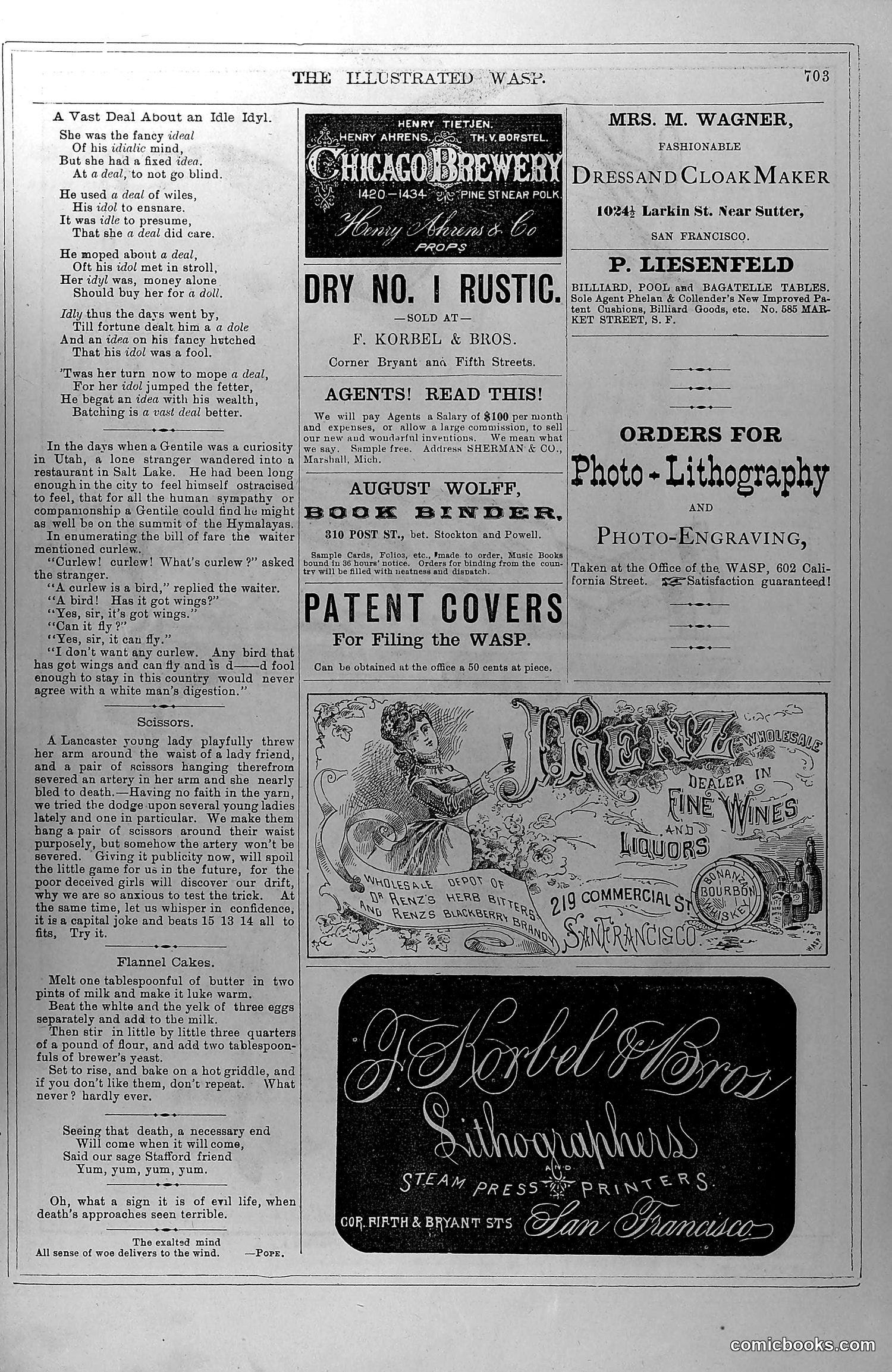
This page is primarily **advertising and miscellaneous content** rather than satirical cartoons. The left column contains poetry about "idle" behavior and anecdotes (including one about scissors causing injury and another about flannel cakes), which appear to be filler material rather than political satire. The advertisements dominate: Chicago Brewery beer, a book binder, patent covers for the magazine itself, and various San Francisco businesses (dress maker, billiards hall, lithography services, wine merchant, printers). The page lacks identifiable political figures or satirical commentary. It represents a typical late 19th-century magazine layout where editorial content and advertisements mixed freely, with advertising essentially subsidizing publication costs.
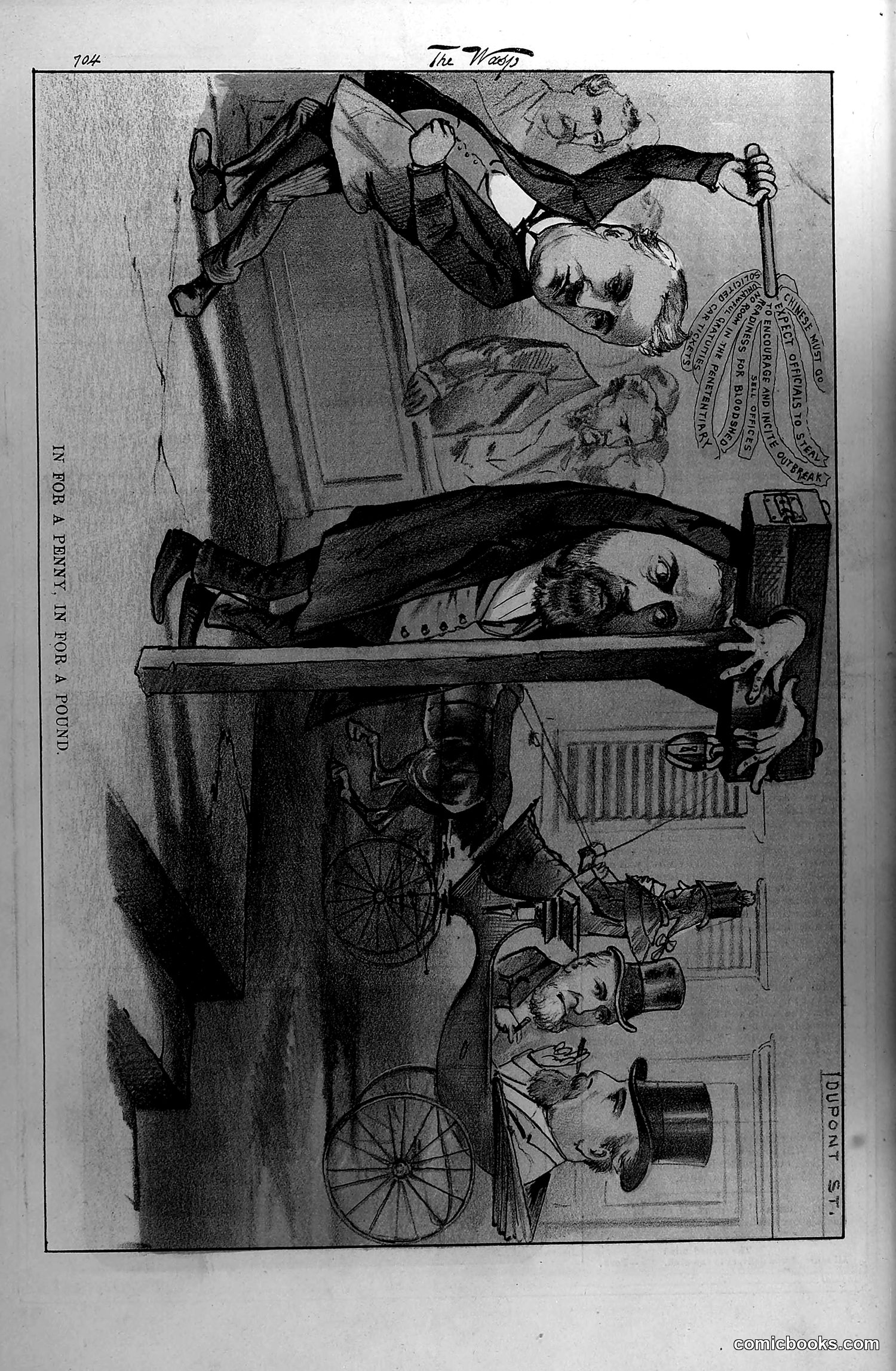
This page contains a single satirical cartoon oriented sideways. It depicts a bearded man lying on a table or platform, appearing deceased or unconscious. Above him stands another figure manipulating what appears to be a puppet or mechanical device shaped like a dog's head. The cartoon likely represents a political commentary on control or manipulation of power—a common satirical theme in 19th-century American magazines. The text references "IN FOR A PENANT [sic] IN FOR A POUND" (likely "penny for a pound"), suggesting financial or moral complicity. Without clearer identification of the specific figures or historical context from the publication date, the precise political target remains unclear, though the imagery suggests critique of political puppetry or corruption.
I can see this is a test page or calibration image for The Wasp magazine, featuring a grayscale checker pattern on the left side and measurement rulers (showing inches 6-11 vertically and 6-10 horizontally) used for photographic reproduction quality control. This is not a cartoon or editorial content page. Rather, it's a technical reference sheet used in the printing/publishing process to ensure proper exposure, contrast, and color balance when reproducing pages. The checker squares of varying gray tones allowed printers to verify their halftone reproduction was accurate before printing the actual magazine content. This type of page would typically appear in archival materials or between sections during production, not as published magazine content meant for readers.