
A complete issue · 18 pages · 1880
The Wasp — May 15, 1880

I can see this is a calibration/reference page for archival photography, not actual magazine content. The image shows two Oregon Rule Company measurement scales (vertical and horizontal) positioned on a black background with a grayscale color checker chart to the right. This is standard archival documentation used when photographing historical materials to ensure accurate reproduction of the original page's dimensions and tonal values. Without the actual cartoon or article content visible on this page, I cannot provide historical analysis of The Wasp's satirical message. To explain the political or social satire, I would need to see the actual editorial or cartoon content that appeared on the original magazine page.
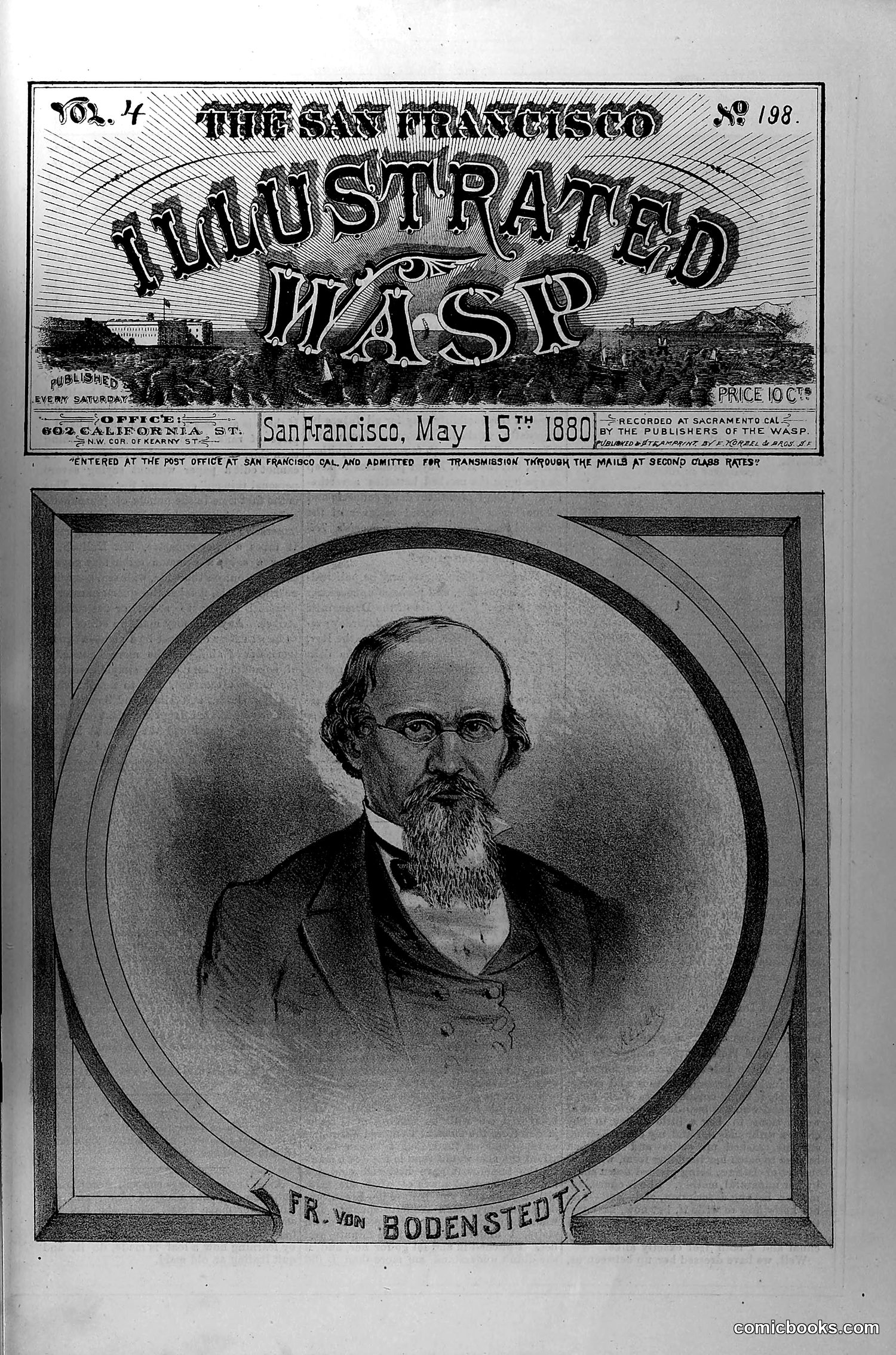
This page features a portrait of **Fr. Von Bodenstedt** (labeled at bottom), a German religious figure. The Wasp was a satirical weekly magazine published in San Francisco, and this appears to be a straightforward portrait rather than a political cartoon. Without additional context about Bodenstedt's activities or presence in San Francisco in 1880, the specific satirical intent is unclear from the image alone. The portrait's inclusion in a satirical magazine suggests he was a notable or controversial figure worthy of the publication's attention, but whether this was meant as mockery, commentary on his character, or simply topical coverage cannot be definitively determined from the visual evidence alone.
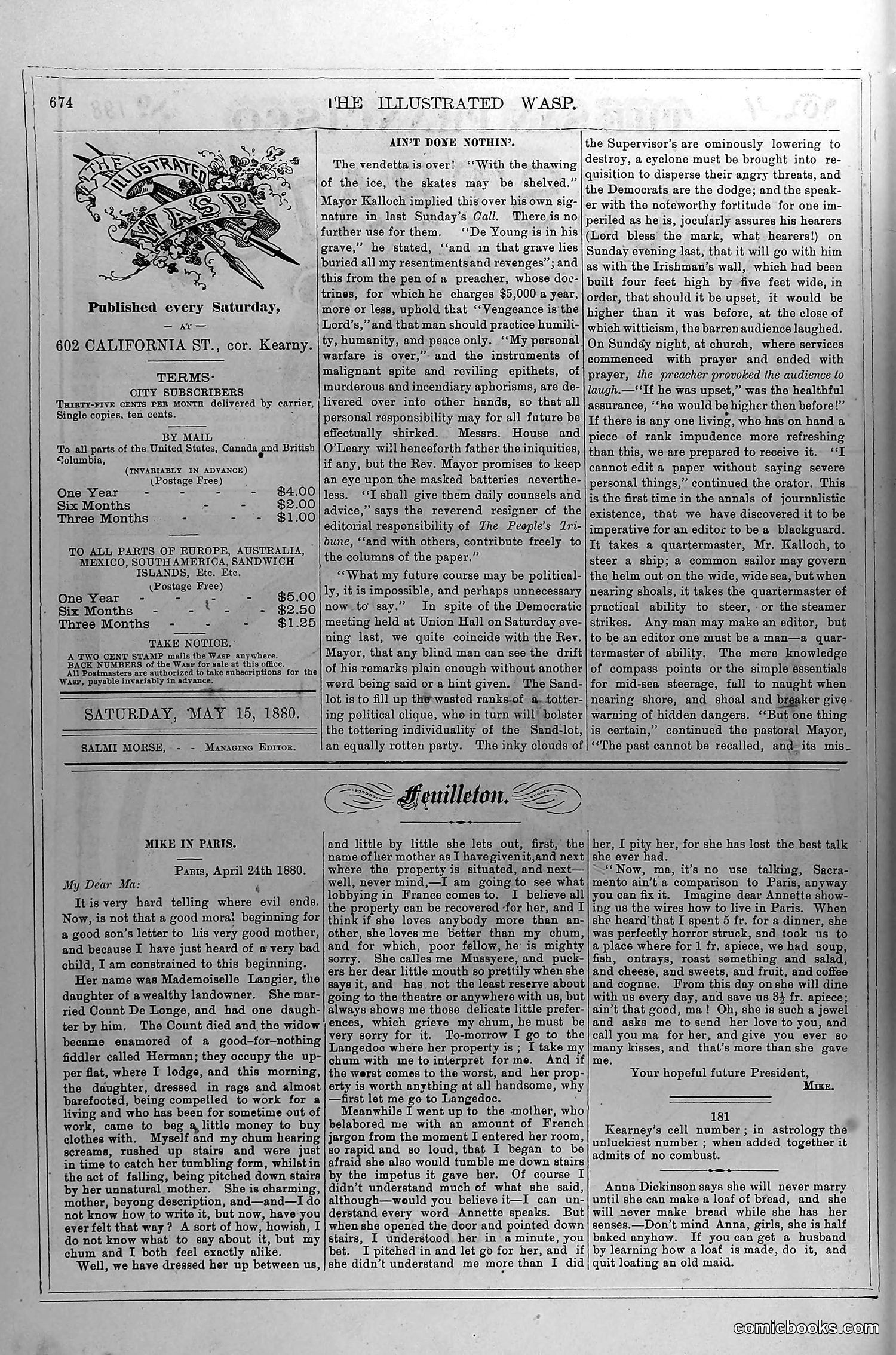
This page contains no political cartoon. Instead, it features editorial content and personal letters. The main article "Ain't Done Nothin'" critiques San Francisco's Mayor Kalloch, mocking his ineffectual leadership and tendency to blame predecessors rather than act decisively. The piece uses sharp sarcasm to attack his empty rhetoric about municipal improvements. Below is a personal letter from "Mike in Paris" dated April 1880, describing property troubles in France and social upheaval there—likely reflecting broader 1880s concerns about European instability. The page also advertises subscription rates and includes a brief humorous item about Anna Dickinson's domestic skills. This represents *The Wasp*'s typical satirical approach: political critique through commentary rather than visual caricature.
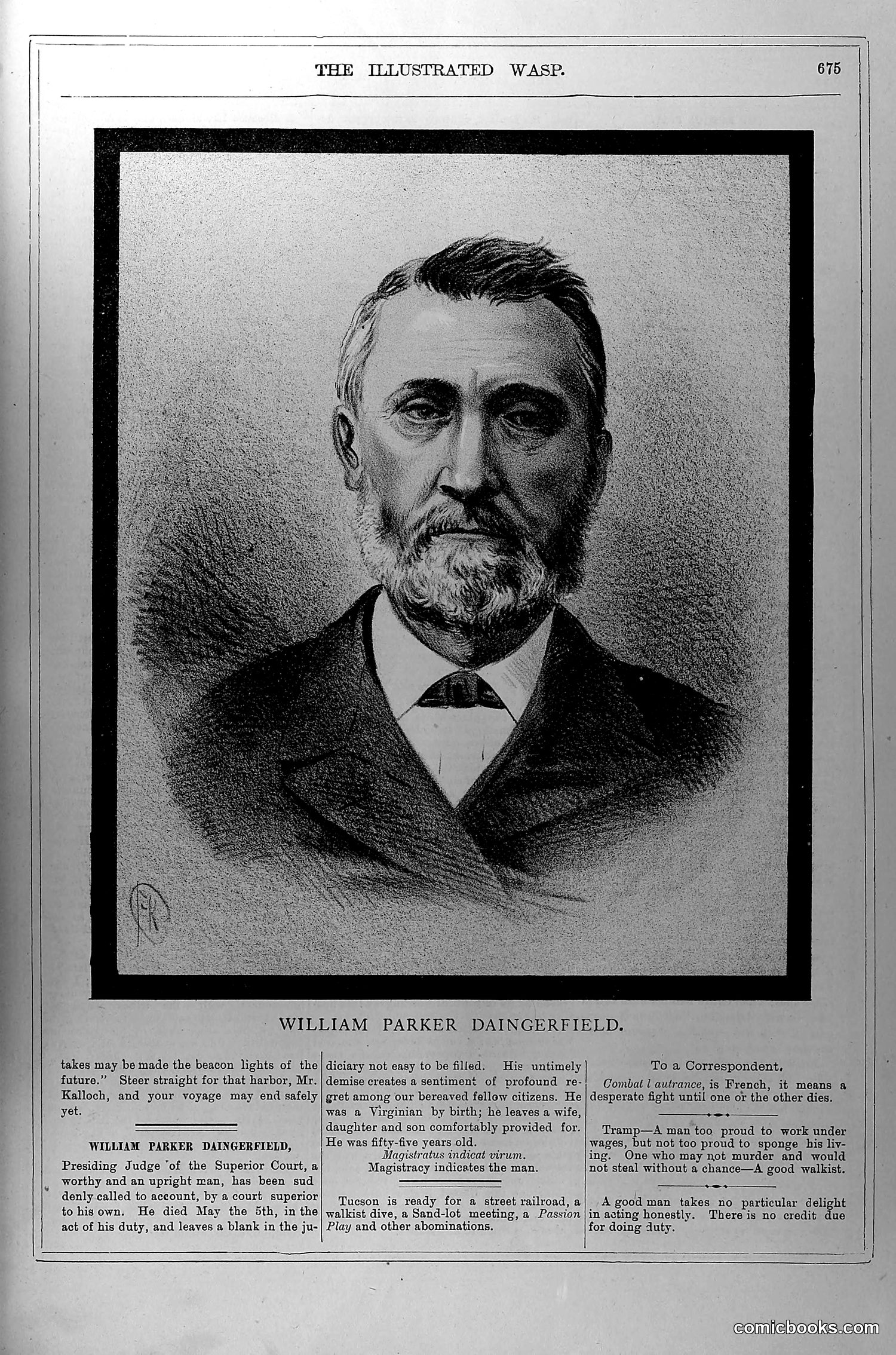
This page features a portrait and biographical entry for William Parker Daingerfield, identified as a "Presiding Judge of the Superior Court, a worthy and an upright man." The text describes him positively, noting he was called to account by a court superior and "leaves a blank in the judicial record." The accompanying commentary suggests satirical criticism: phrases like "not easy to be filled" and references to his "demeanor" creating "astonishment" among "fellow citizens" indicate the Wasp is questioning his fitness for office, despite surface-level praise. The text's tone is mockingly formal—typical Wasp technique where ostensible compliments mask harsh judgment about judicial competence or conduct. Without additional historical context, the specific incident prompting this critique remains unclear.
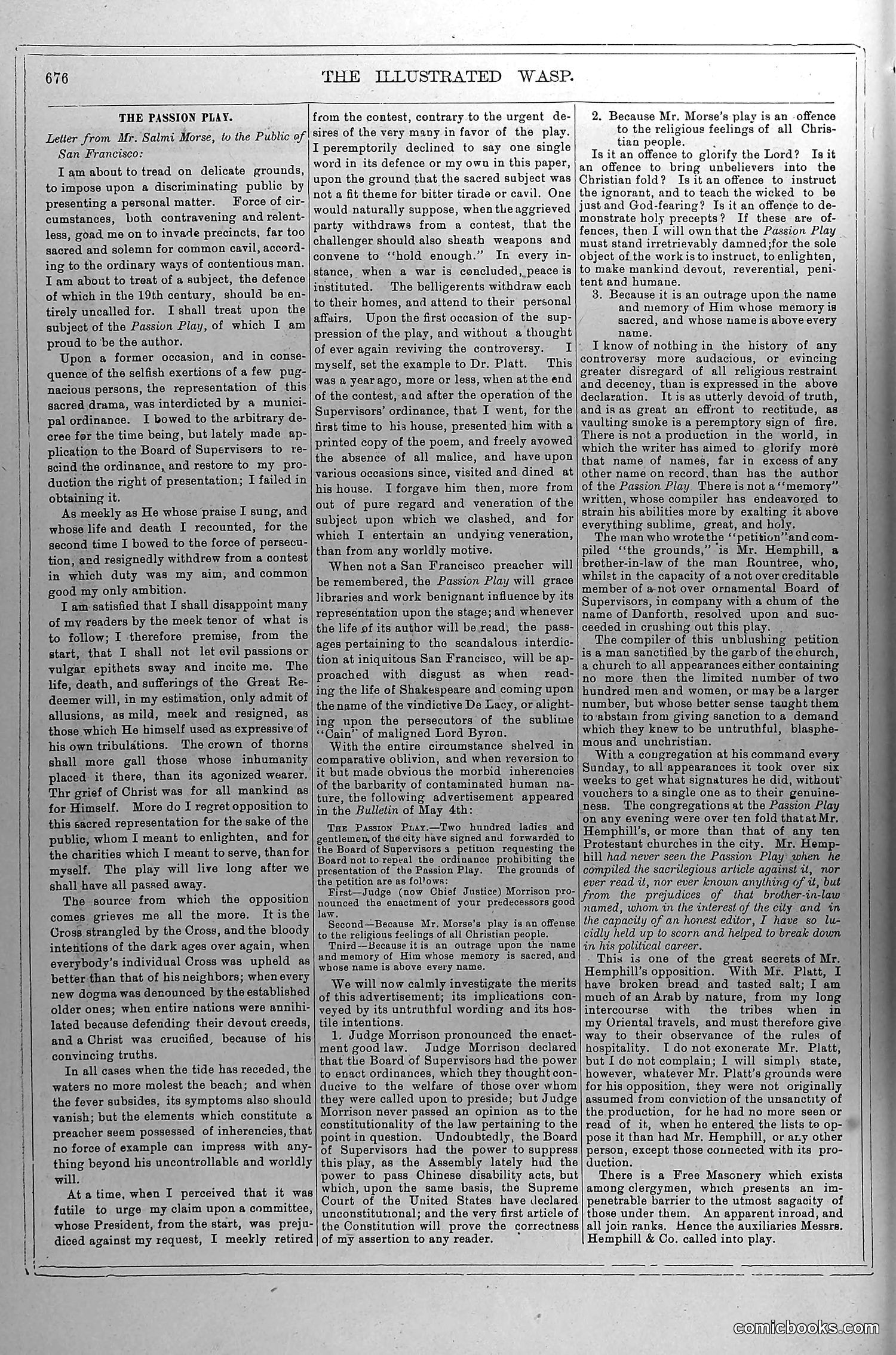
This page features a letter from Salmon Morse defending his theatrical production of "The Passion Play" against religious objections. The controversy centered on whether depicting Christ's crucifixion on stage blasphemed Christian faith. Morse argues that his play educates audiences and honors rather than mocks religious sentiment. He defends artistic freedom against what he characterizes as religious censorship, noting that opposition came from a "San Francisco preacher" and religious organizations seeking to suppress the production. The letter reveals deep 19th-century tensions over theatrical representation of sacred subjects, censorship by religious institutions, and competing claims about what constitutes respectful versus offensive religious expression. The Wasp, as a satirical publication, likely sided with artistic liberty against clerical authority.
This page is primarily **text-based editorial content** rather than a cartoon. It appears to be a long letter or essay defending the "Passion Play" (a theatrical production depicting Christ's passion) against Catholic criticism. The writer argues that: - The play promotes Christian values and shouldn't be condemned - Critics are using it as ammunition in sectarian disputes - The play's artistic merit and moral purpose are being overlooked for religious politics The piece mentions **Rev. Mr. Piatt's address** opposing the play, suggesting Protestant-Catholic tension over theatrical religious content in late 19th-century America. **No identifiable political cartoons are visible** on this page—it's primarily satirical commentary through argumentative prose rather than visual caricature.
This page is primarily a theater review essay titled "Drama," discussing actor Mr. Bandman's performance in *Baldwin* alongside Clara Morris and others. The text praises Bandman as a "great actor" capable of nuanced interpretation, particularly noting his portrayal of Hamlet-like characters. There is a small illustration at the bottom left labeled "Drama" showing what appears to be theatrical figures in classical or dramatic poses. The content is not primarily satirical or political commentary. Rather, it's a detailed critical analysis of contemporary theatrical performances and acting styles, representing The Wasp's coverage of San Francisco's cultural scene. The writing focuses on artistic merit and performance quality rather than social or political satire.
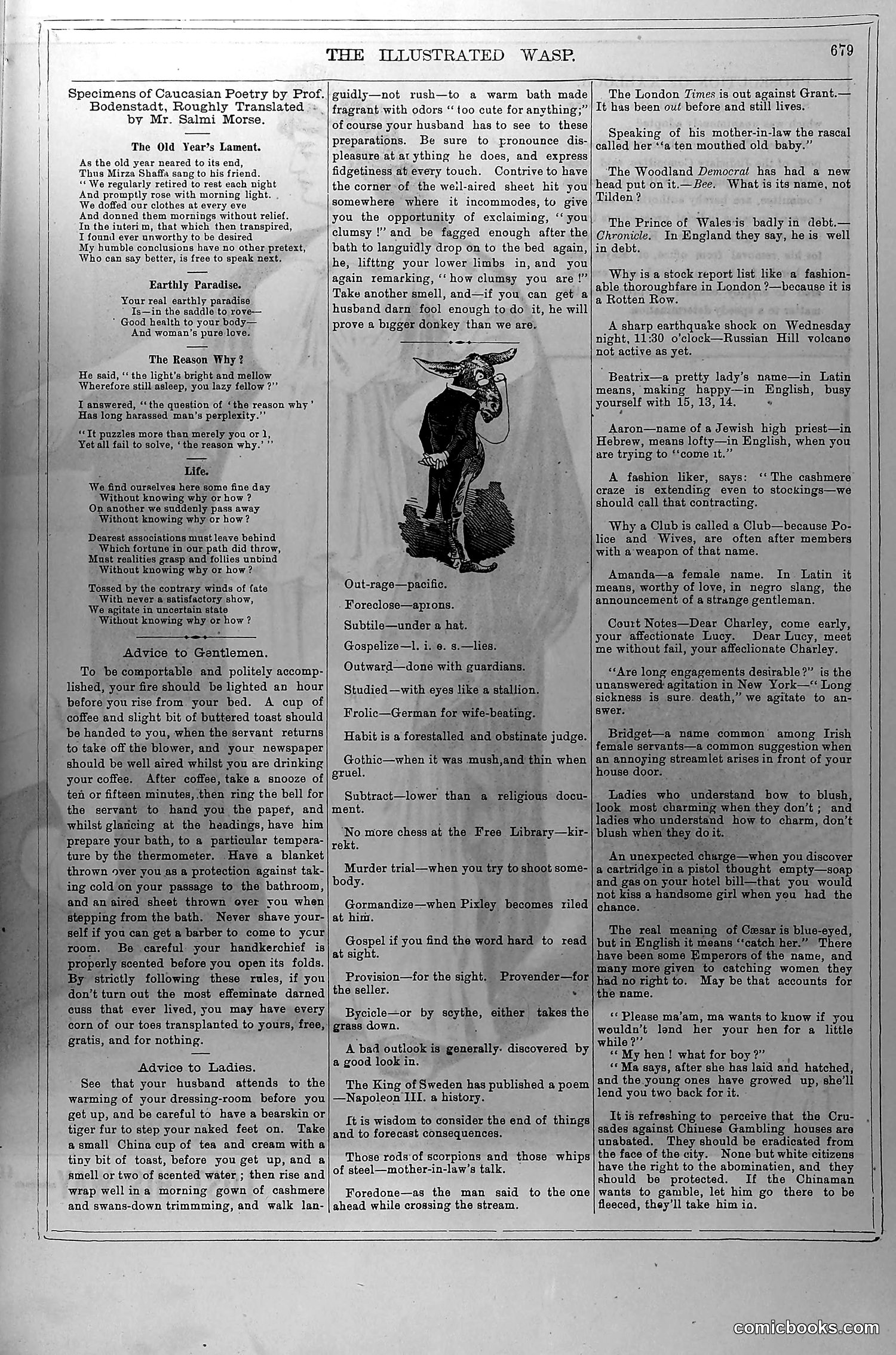
This page contains primarily **text features** rather than prominent political cartoons. The visible illustration shows a caricatured figure in formal dress, appearing to be a satirical commentary on gentlemanly behavior. The main content includes: - **"Advice to Gentlemen"** and **"Advice to Ladies"** — satirical etiquette columns mocking Victorian social conventions - Various humorous definitions and wordplay sections ("Out-raze," "Subtile," "Studied," etc.) - Social commentary on contemporary issues including Chinese gambling houses and Chinaman stereotypes The satire targets **middle-class social pretensions** and Victorian propriety through mock-advice format. The tone suggests *The Wasp* used humor to critique genteel society's artificial rules and hypocrisy, while containing period-typical racist stereotyping regarding Chinese immigrants.
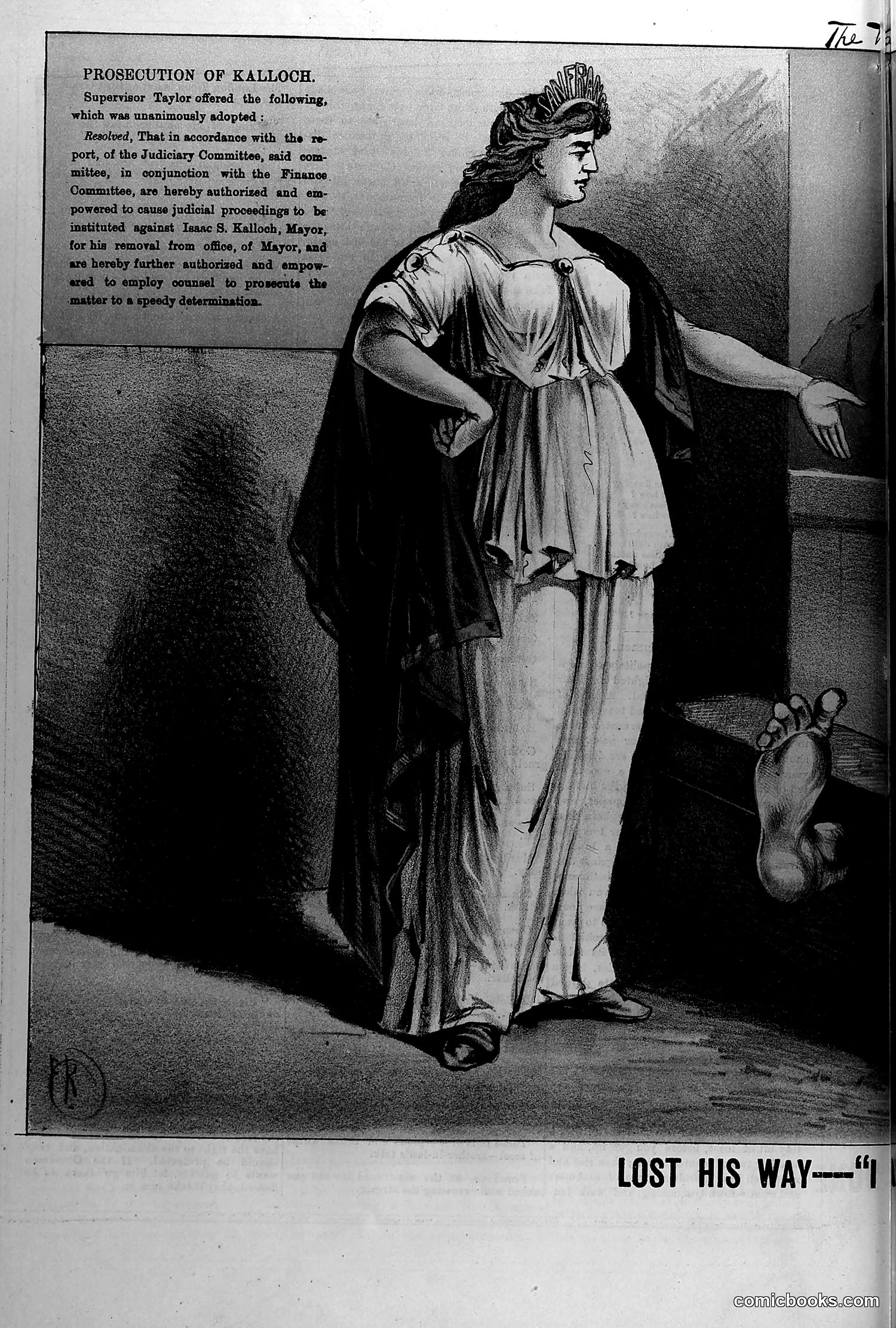
This page depicts Lady Justice (the classical female figure with crown and scales) as the central image, accompanying text about judicial proceedings against Isaac S. Kalloch, Mayor of San Francisco, regarding his removal from office. The cartoon's title, "Lost His Way—1," suggests Kalloch has strayed from proper conduct. The allegorical Justice figure represents the legal system addressing mayoral misconduct. Supervisor Taylor's proposal authorized the Judiciary and Finance Committees to pursue judicial proceedings against Kalloch. The satire criticizes Kalloch's misuse of office, using the classical Justice figure to emphasize that legal accountability should apply even to powerful municipal officials. The image reinforces that justice must be served regardless of political position.
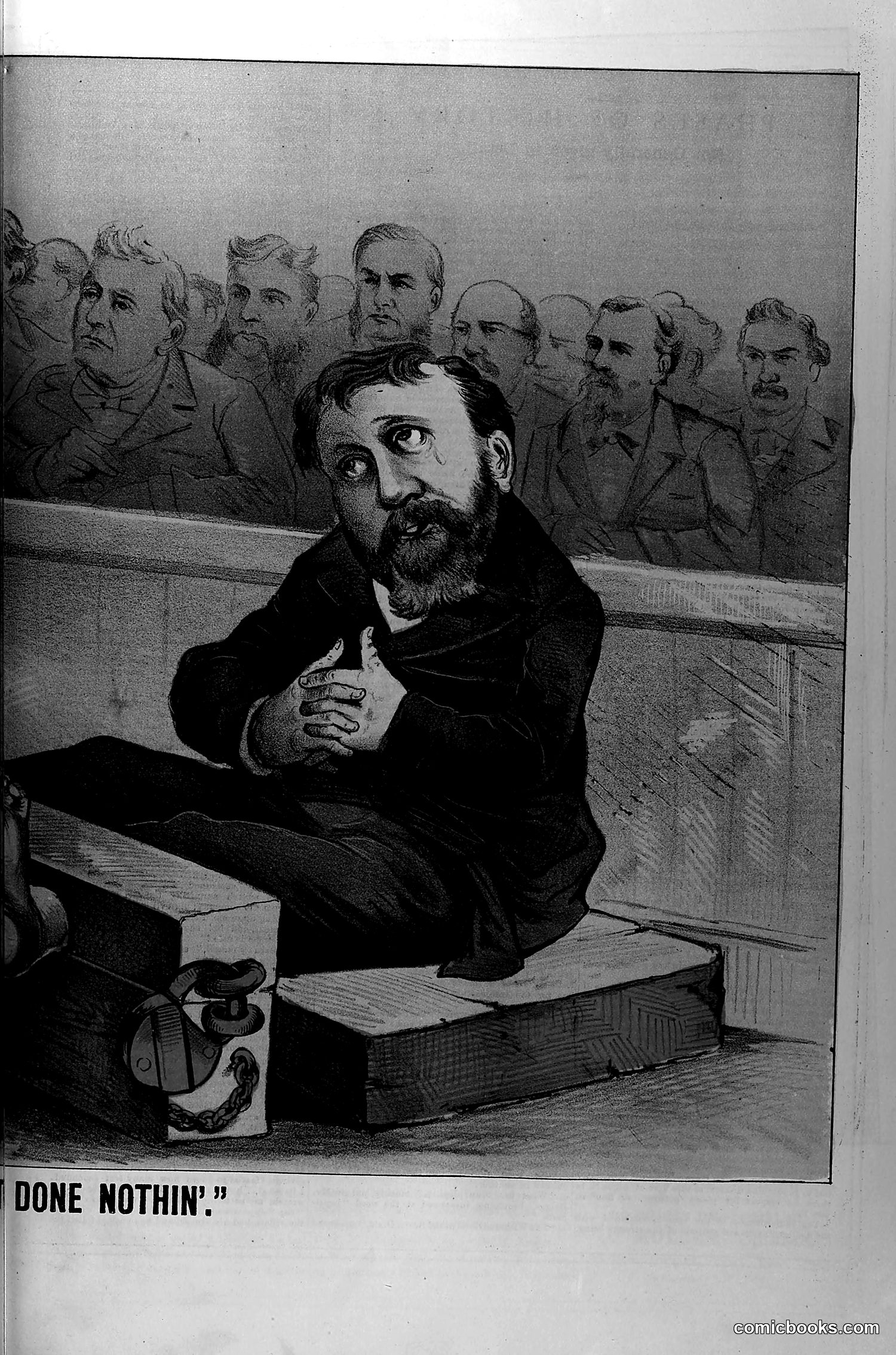
This engraving depicts a bearded man in dark clothing seated at a desk or witness stand, gesturing expressively while speaking. Behind him sits a row of stern-faced observers or judges. The caption reads "DONE NOTHIN':" suggesting the figure is defending himself against accusations of inaction or failure. The cartoon appears to be political satire from a 19th-century American context, likely critiquing a public official or political figure accused of negligence or incompetence in office. The formal courtroom-like setting and the defendant's defensive posture emphasize the seriousness of the charges. However, without additional context from *The Wasp* publication or clearer identification of the specific figure, I cannot definitively identify which politician or event this references.
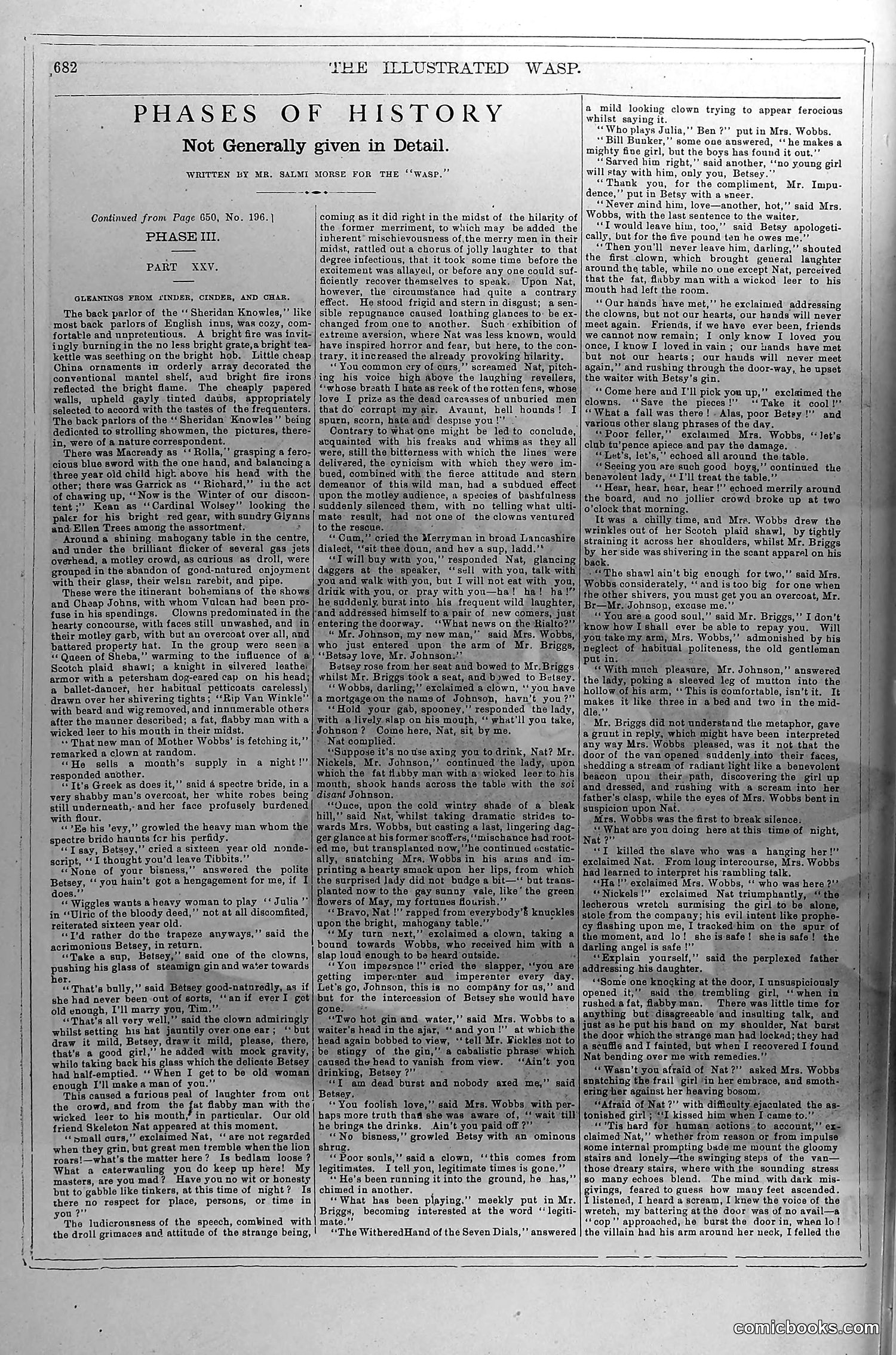
This page contains serialized fiction ("Phases of History Not Generally given in Detail") by Mr. Salmi Morse for *The Wasp*, a satirical magazine. The text appears to be a dramatic narrative involving multiple characters in what seems to be a Victorian-era theatrical or domestic setting, with dialogue between figures like Mr. Wobba, Mrs. Wobba, Betsey, Mr. Briggs, and various other characters. The narrative includes comedic exchanges and physical comedy (references to clowns, theatrical performances, and slapstick humor). Without seeing the accompanying illustration clearly, I cannot identify specific caricatures or political references. The content appears to be entertainment-focused satire rather than political commentary, typical of *The Wasp's* serialized humorous fiction.
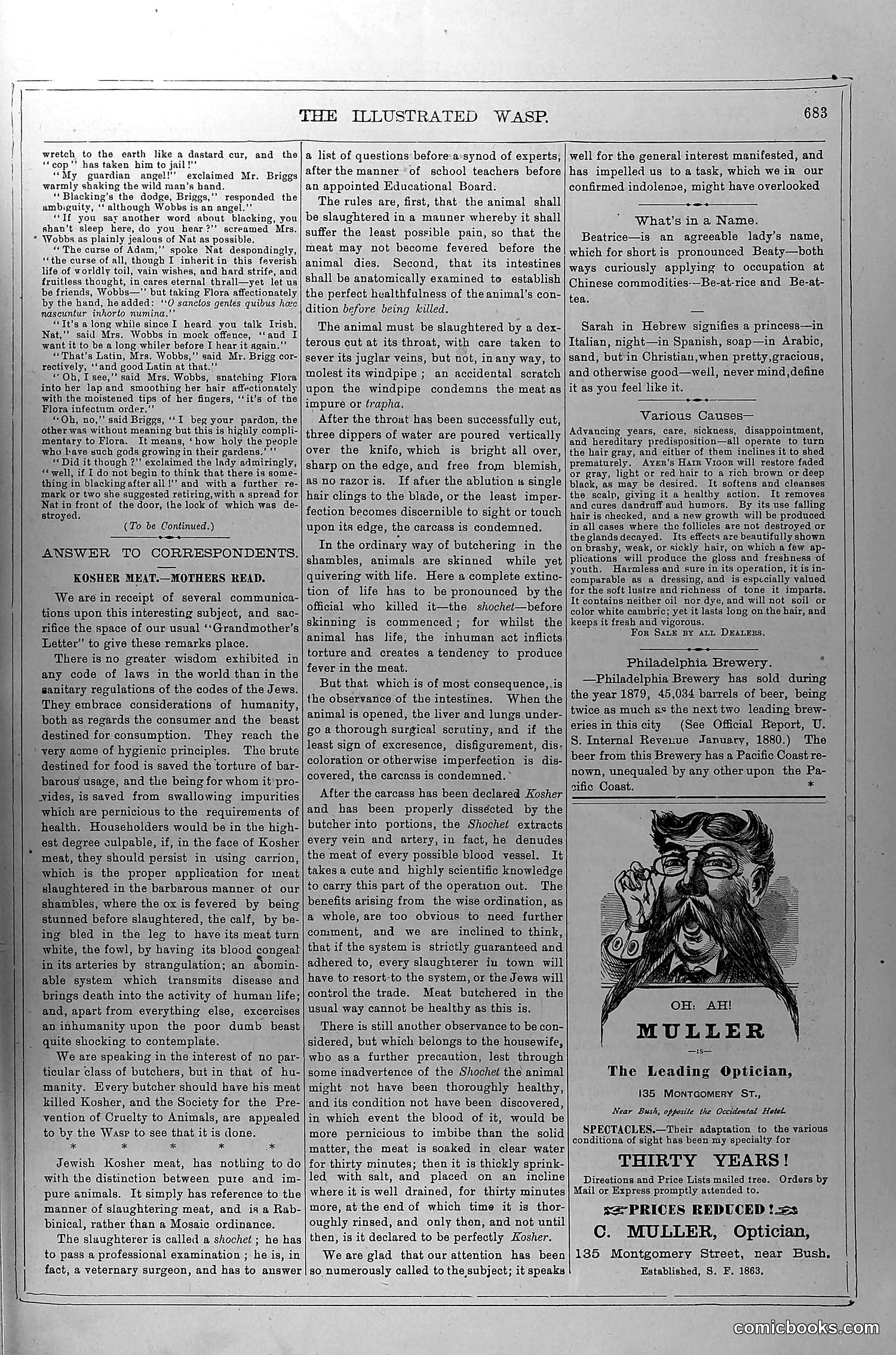
This page is primarily **text-based content** rather than political satire. It contains: 1. **"Answer to Correspondents"** section addressing two topics: - Kosher meat preparation and Jewish dietary law - Philadelphia Brewery sales figures 2. **A caricatured face illustration** labeled "OH! AH! MULLER" advertising C. Muller's optician business on Montgomery Street, San Francisco (established 1863). The exaggerated facial features appear designed to catch reader attention for commercial purposes. The page demonstrates how 19th-century satirical magazines mixed genuine advice columns, technical discussions, and advertising with humor. The Muller advertisement uses physical caricature as a marketing tactic typical of the era.
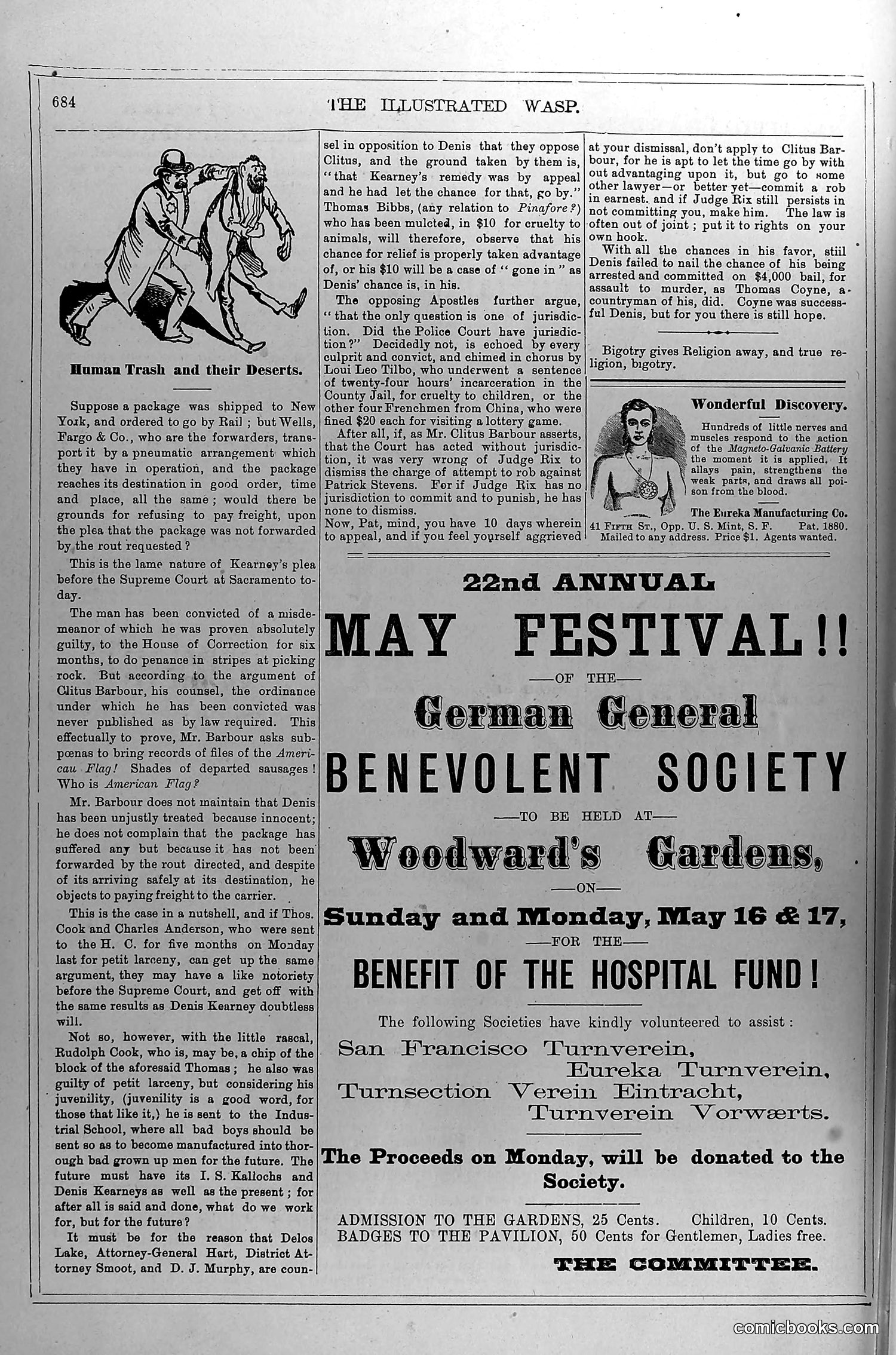
**Main Cartoon:** "Human Trash and their Deserts" depicts two disheveled figures, likely representing poor or marginalized people, walking together. The illustration appears to satirize social attitudes toward the destitute. **Primary Article:** The text discusses a legal case involving Denis Kearney (identified as "Irish Leo Tilbo"), who received a sentence for cruelty to children. The article satirizes what it presents as inconsistent judicial treatment—comparing Kearney's case to other prisoners' appeals and questioning whether justice is fairly applied. **Historical Context:** This reflects 1880s San Francisco labor politics and class tensions. The satire critiques both the legal system's handling of the poor and specific figures' conduct. **Secondary Content:** A small advertisement for "The Eureka Manufacturing Co." and a large announcement for a German General Benevolent Society festival.
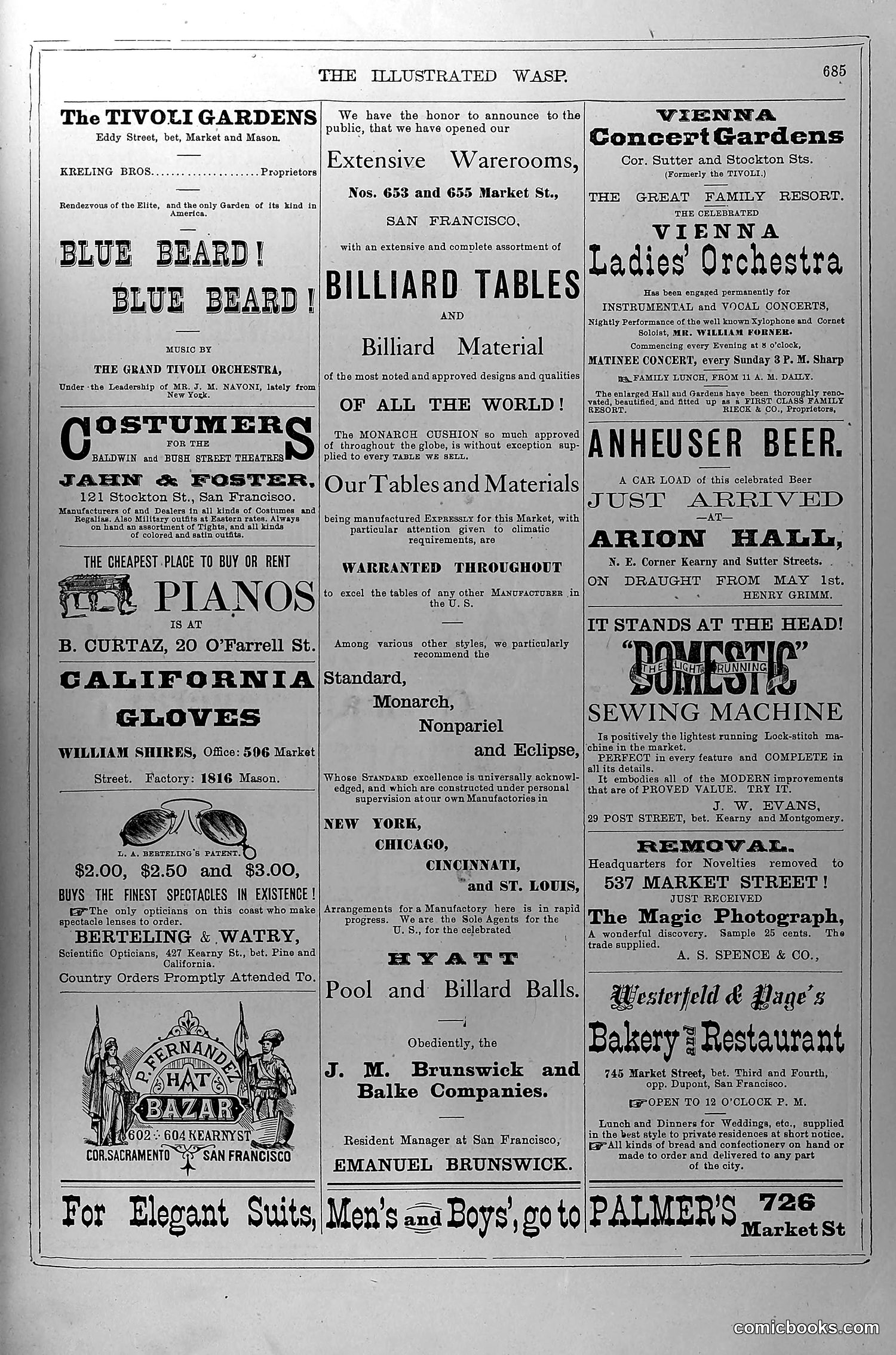
This page is primarily **advertising** rather than editorial content or political cartoons. It contains commercial advertisements for various San Francisco businesses from what appears to be the late 19th century, including: - The Tivoli Gardens (entertainment venue) - Piano sales and rentals - Billiard tables and equipment - A sewing machine ("Domestic") - Anheuser Beer - Westerfeld & Page's Bakery and Restaurant - Palmer's clothing store The only notable graphic element is a decorative "Fernando Hat Bazar" logo. There are no visible political cartoons, caricatures, or satirical content on this page that would require historical context to interpret. This represents typical revenue-generating advertising space from a period publication.
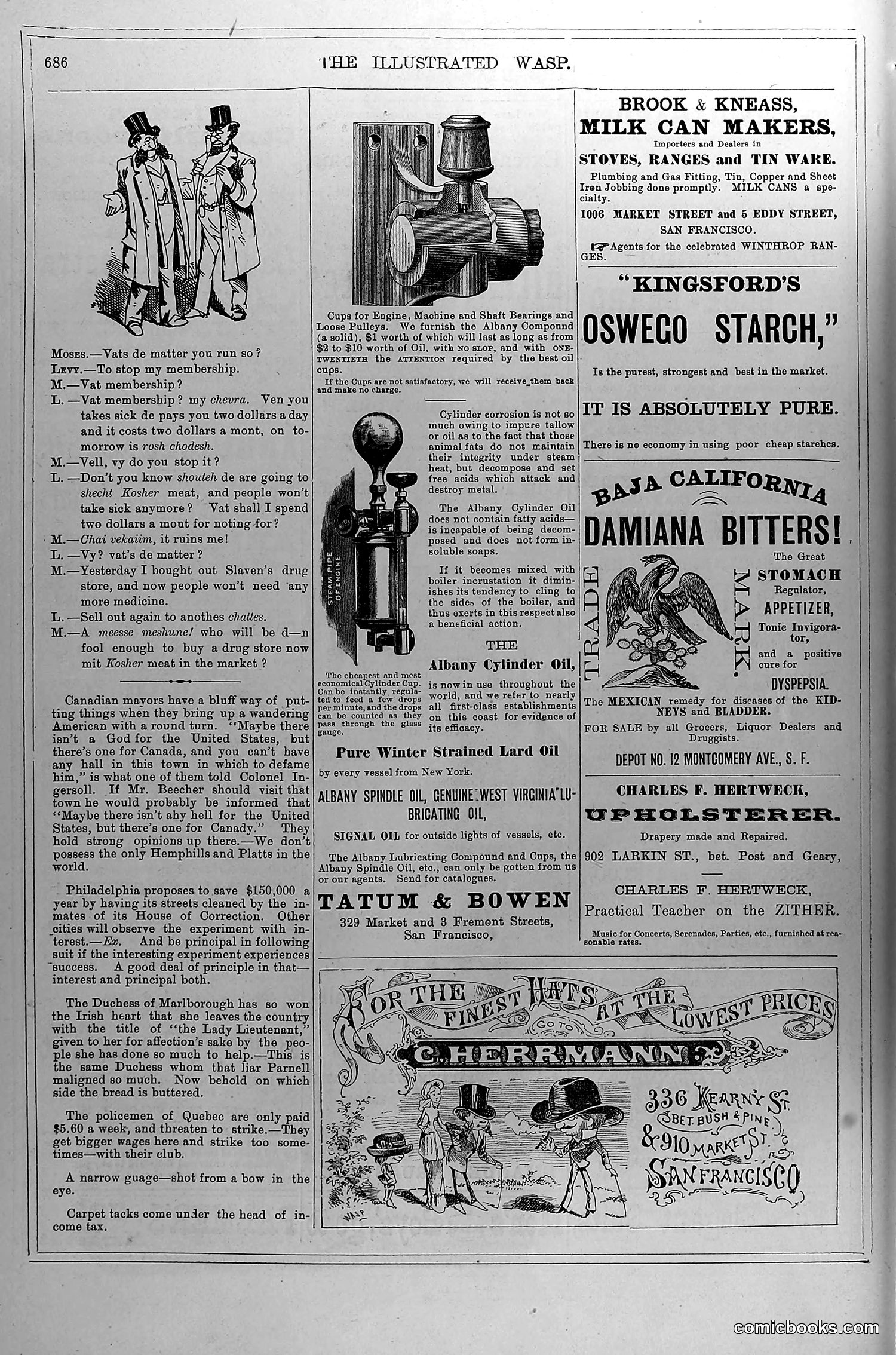
This page is primarily **advertising**, not political satire. It contains product advertisements for items like milk can makers, stoves, starch, bitters, cylinder oil, and hats—typical late 19th-century commercial content. The only cartoon element is a small dialogue labeled "Moses," showing two well-dressed men in top hats discussing membership costs and medicine. The exchange appears to be **social satire about class and pretense**—one character mocks the expense of membership clubs while another defends them, and there's a joke about buying drugs from "Slaven's drug store" instead of doctors. This reflects period anxieties about commercialization and health remedies, but lacks clear political targets. The page demonstrates how satirical magazines like *The Wasp* funded operations through extensive advertising.
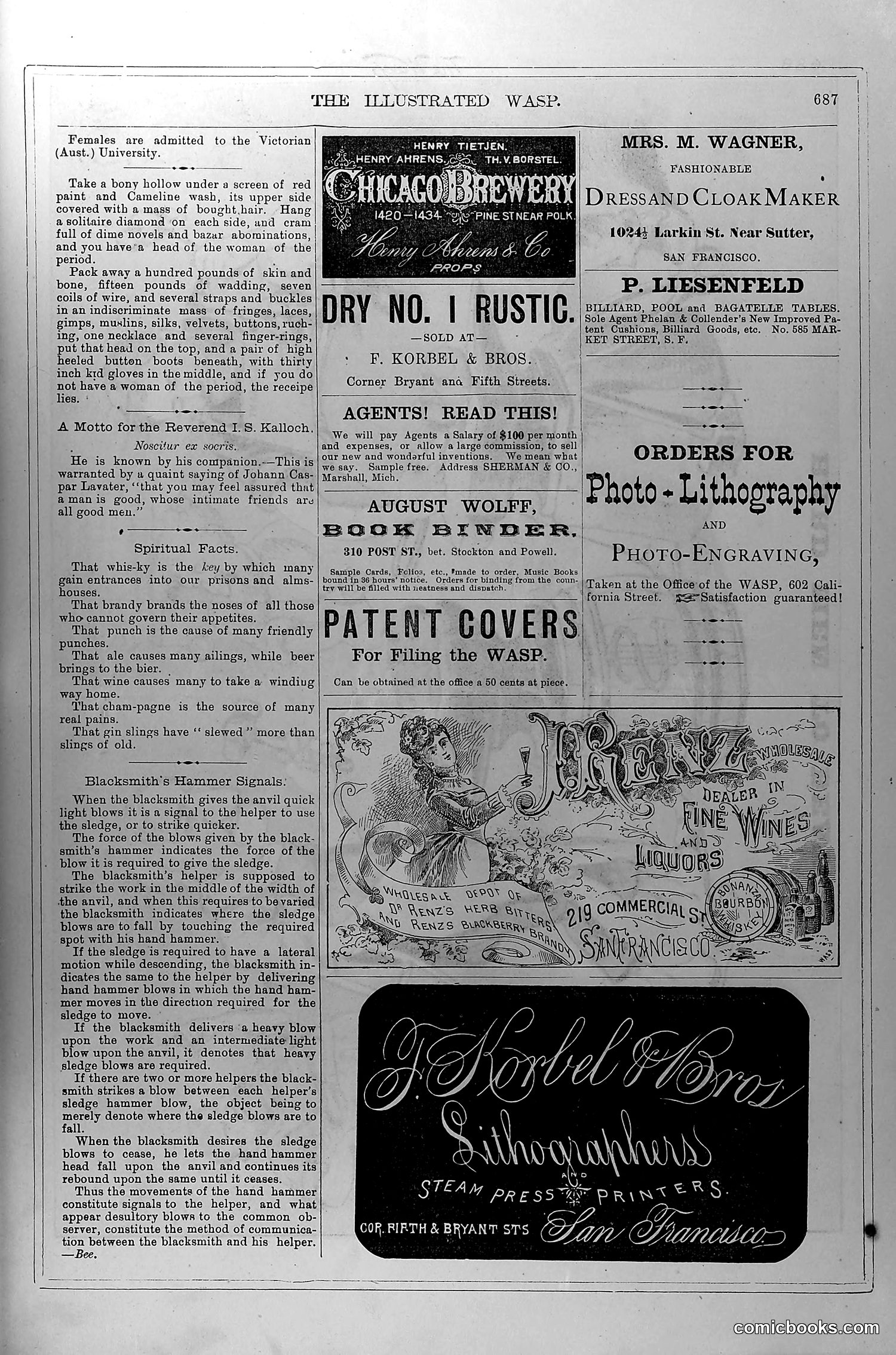
This page is primarily **advertising and filler content** rather than editorial satire or political cartoons. The main items include: - **Mrs. M. Wagner's dress and cloak-making business** (San Francisco) - **P. Liesenfeld's billiard and pool hall** advertisement - **Photo-lithography and photo-engraving services** - **August Wolff's book-binding business** - **Patent covers for filing the WASP** (the magazine itself) - **Hentz & Krentz liquor dealer advertisement** (with decorative illustration) - **Ford, Morrell & Company Steam Press Printers** (with ornamental logo) The "Spiritual Facts" section offers satirical folk wisdom about alcohol and human behavior, a common Wasp feature. No identifiable political figures or specific events are referenced on this page.
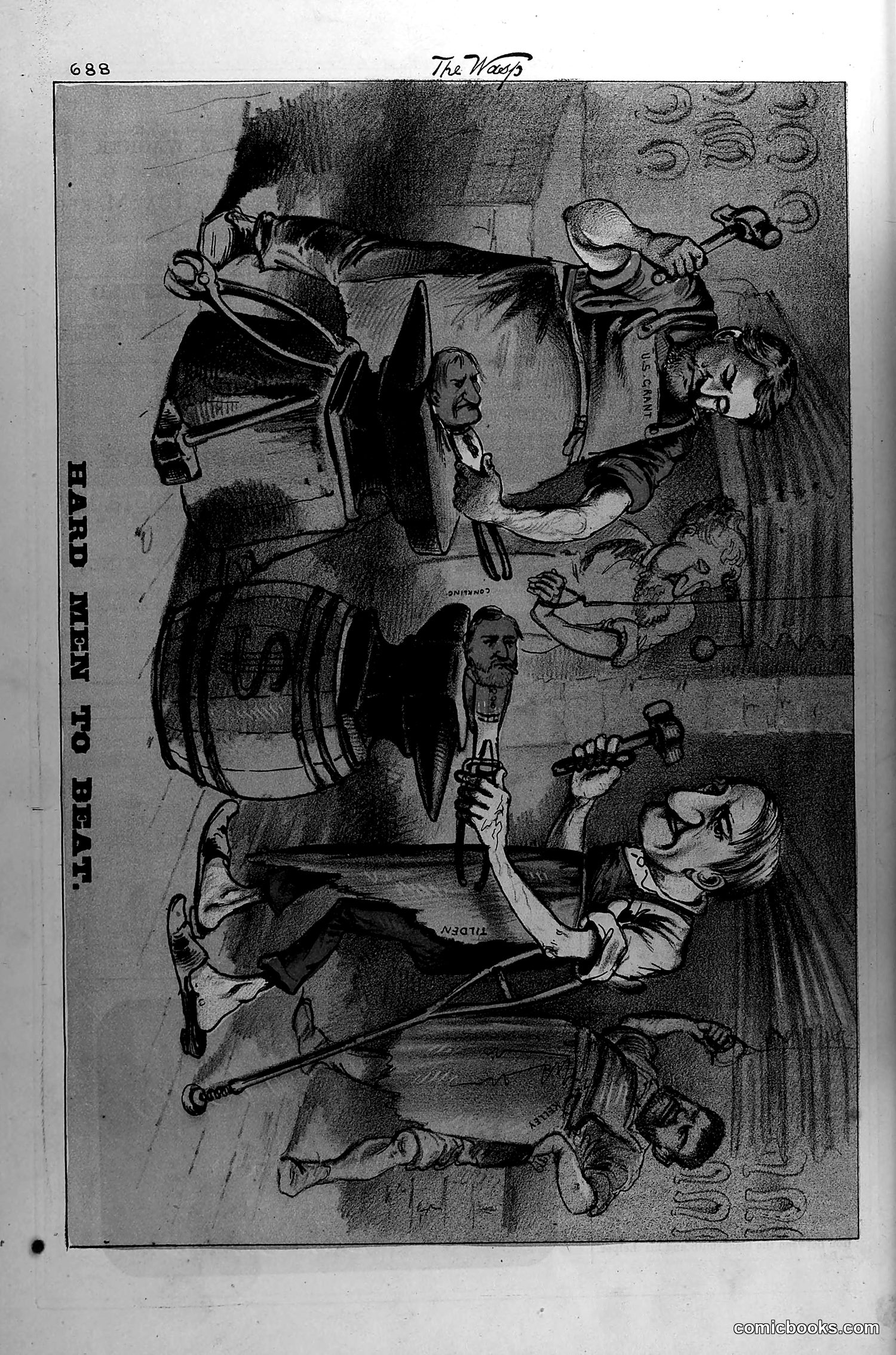
This political cartoon depicts several figures struggling with what appears to be a large nutcracker or mechanical device labeled to represent a difficult political challenge facing the next U.S. president. The exaggerated caricatures and their straining postures suggest the cartoon is mocking political figures' inability to solve a major issue of the era. Without clearer identification of the specific figures or legible labels in the image, the exact political controversy remains unclear. The "hard nut" likely references a significant policy problem—possibly related to labor, monopolies, or another pressing issue of The Wasp's publication period. The satire suggests incompetence or futility in addressing this challenge.

I can see this is a test page or calibration sheet for The Wasp magazine, featuring a color reference chart (the grid of gray/white squares on the left) and measurement rulers. This appears to be a production or archival document rather than an actual editorial or cartoon page from the publication. The color chart was likely used to ensure consistent reproduction quality across print runs, while the rulers provided scale reference for photographers and printers. This is a technical page documenting the magazine's production processes rather than satirical content meant for readers. Without visible editorial material, cartoon illustrations, or political commentary, I cannot identify specific figures, events, or satirical points on this particular page.