
A complete issue · 18 pages · 1880
The Wasp — May 1, 1880
I can see this is a measurement/scale reference page from The Wasp magazine, showing an Oregon Rule Co. ruler positioned against a black background with a checkerboard pattern of gray and white squares to its right. However, I cannot make out any cartoon imagery, satirical figures, or legible text content that would allow me to identify specific political or social references, caricatures, or the intended satire. The checkerboard pattern appears to be a color reference chart rather than editorial content. Without being able to read accompanying text or identify clear cartoon elements, I cannot reliably explain what this page means to a modern reader. This may be a technical/production page rather than a content page from the magazine.
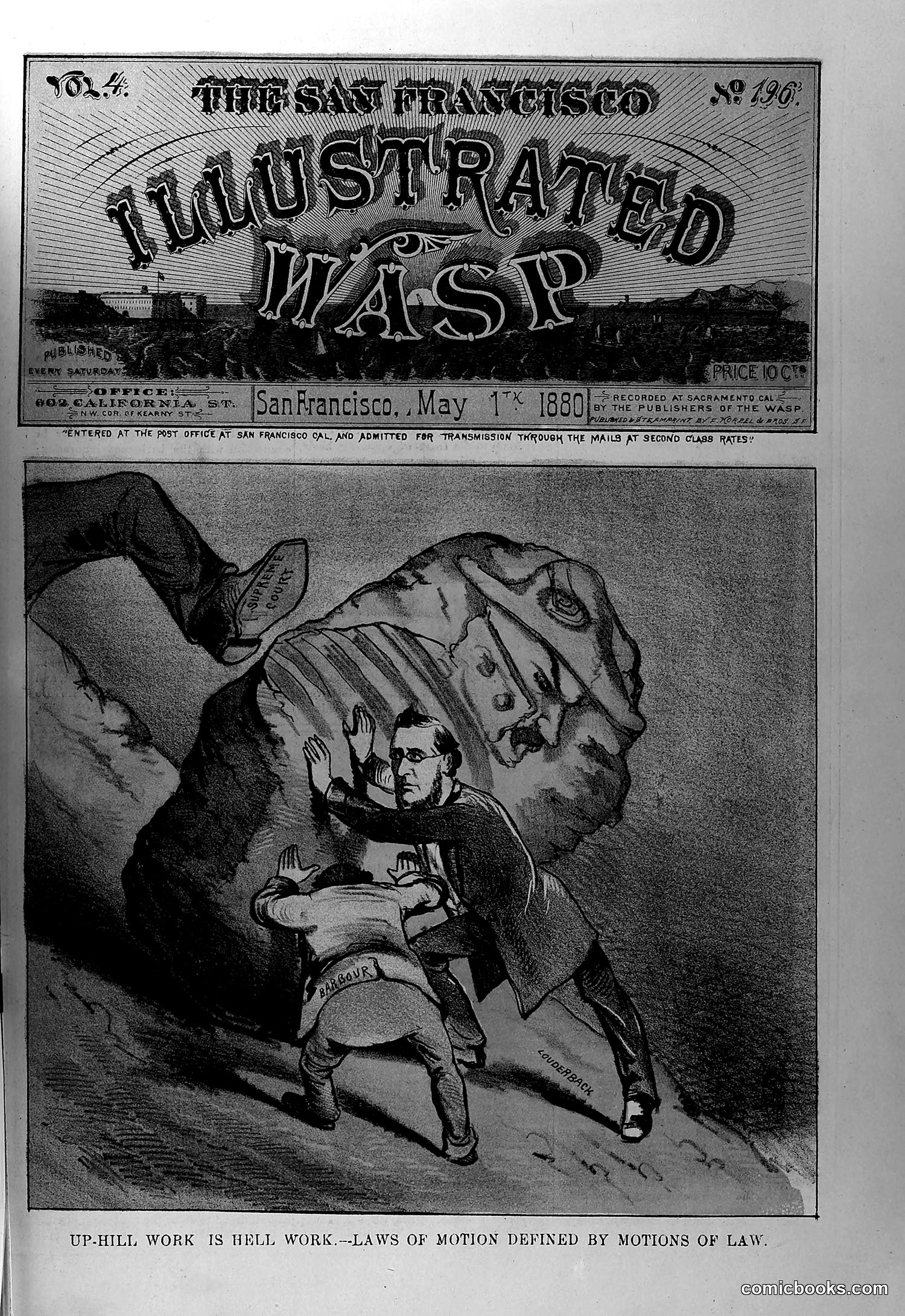
**The Image:** The cartoon depicts a small man being crushed beneath an enormous boulder labeled "MONOPOLY." A figure in formal dress stands nearby observing. The caption reads: "UP-HILL WORK IS HELL WORK.—LAWS OF MOTION DEFINED BY MOTIONS OF LAW." **The Satire:** This is commentary on **monopolistic business practices** and their crushing effect on ordinary workers or small businessmen. The "laws of motion" pun suggests that legal systems and court rulings ("motions of law") were being manipulated to benefit monopolies over individuals. The impossible "up-hill work" represents the futile struggle against concentrated corporate power during California's Gilded Age—a period when railroad and mining monopolies dominated the economy and politics.
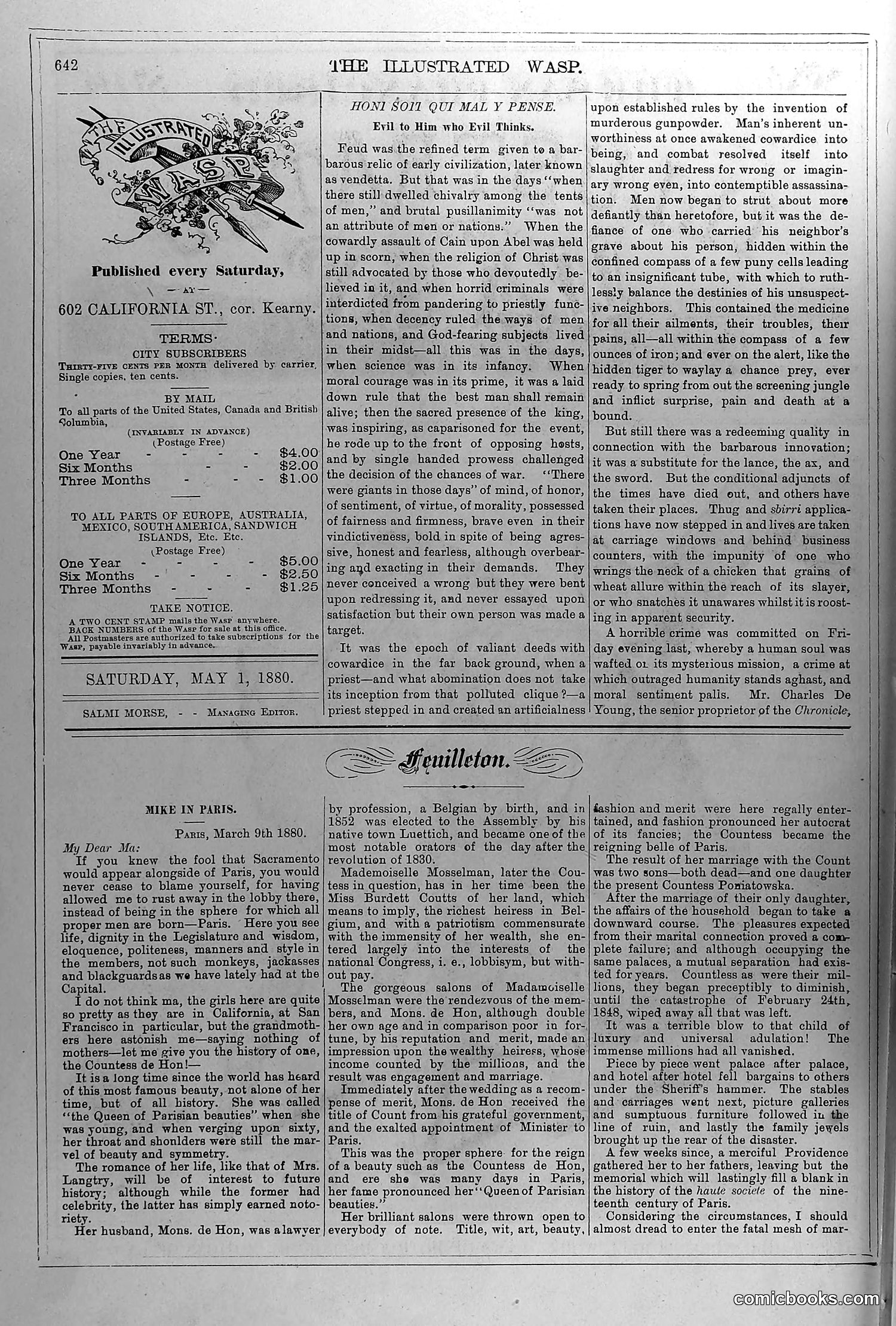
This page contains no political cartoon. Instead, it features: 1. **Masthead and publication information** for The Wasp, a San Francisco satirical weekly 2. **"Feuilleton" section** – a serialized essay titled "Mike in Paris" 3. **Social commentary** about Parisian high society, specifically discussing Mademoiselle Stockman (described as Belgian-born) and her salon life among French nobility The "Mike in Paris" piece appears to satirize American perspectives on European aristocracy and salon culture, mocking pretension around fashion, beauty, and social hierarchy among French nobles and wealthy foreigners. The tone is gossipy rather than overtly political—typical light satire for the magazine's society pages rather than hard-hitting editorial cartooning.
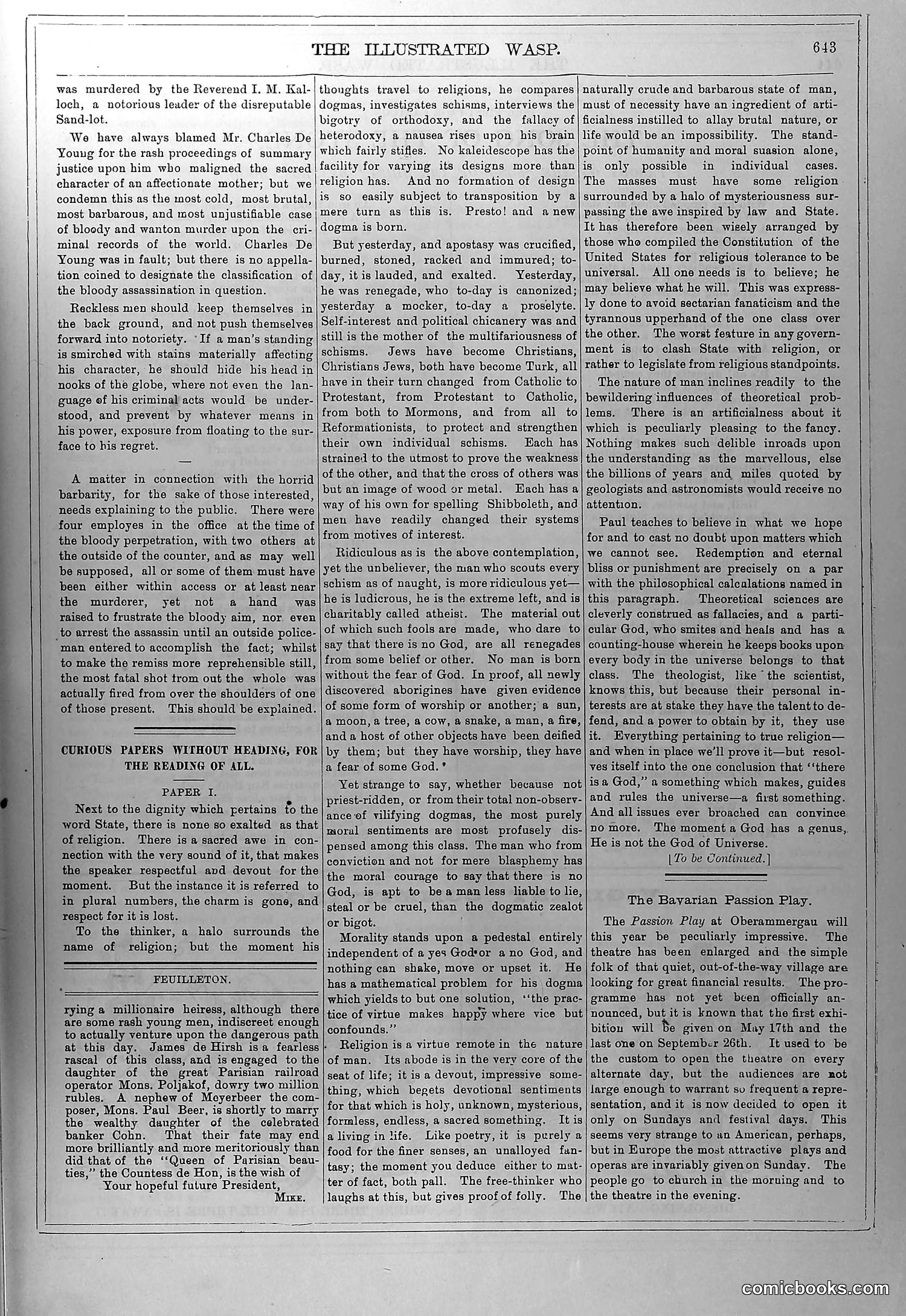
This page is primarily **text-based editorial content** rather than illustrated satire. It contains three article sections: 1. **"Curious Papers Without Heading, For the Reading of All"** - A lengthy editorial attacking religious dogmatism and intolerance, arguing that belief in God doesn't require sectarian doctrine. 2. **"Paper I"** - Continuing the religious critique, arguing that morality doesn't depend on religious adherence. 3. **"The Bavarian Passion Play"** - A brief note about an upcoming theatrical production in Oberammergau, discussing its financial success and Sunday performances. The page lacks political cartoons or caricatures. Instead, it showcases *The Wasp's* satirical approach through **polemical written argument** on 19th-century religious and social issues.
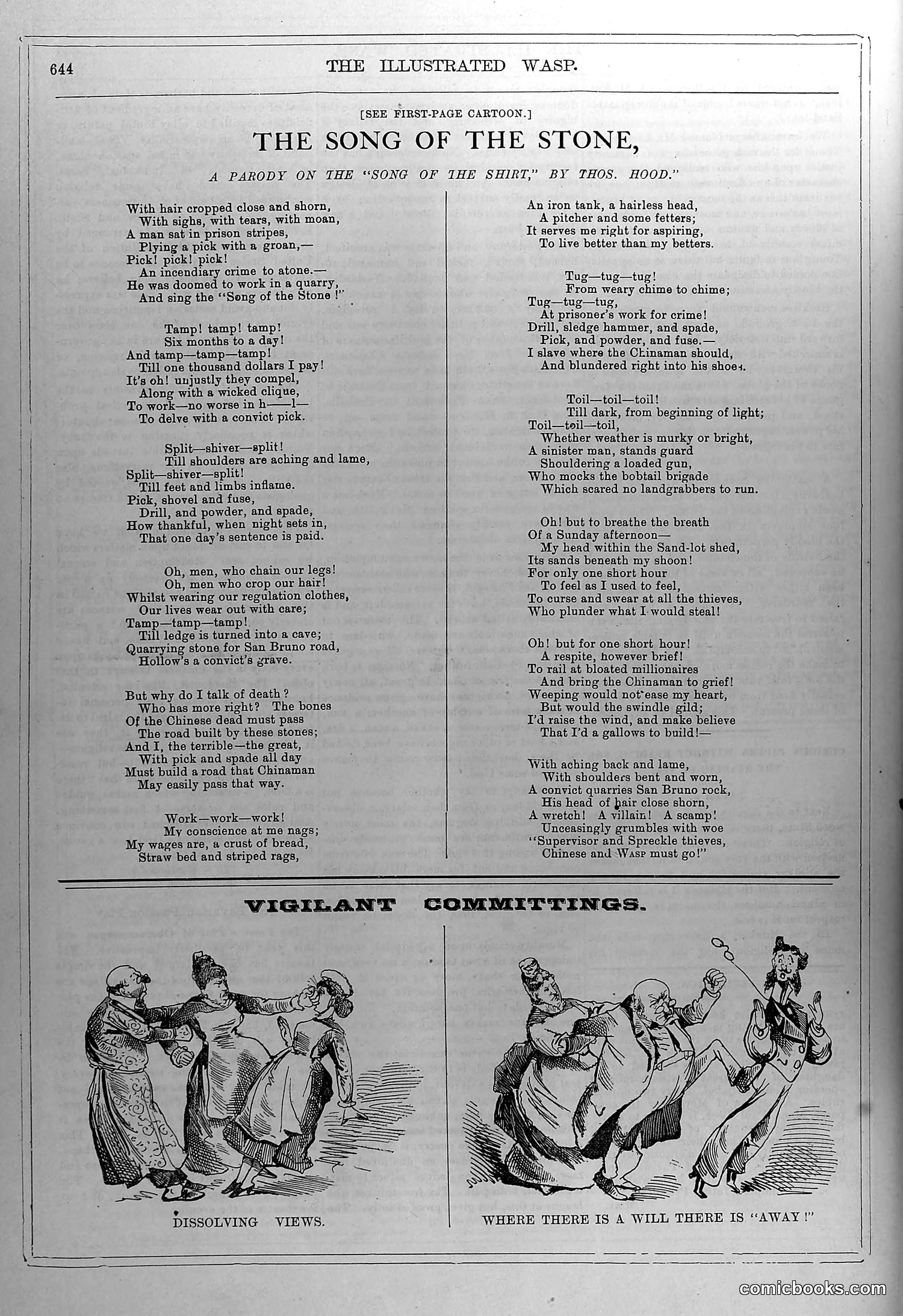
This page from *The Wasp* contains a parody poem mocking convict labor in California quarries, particularly the construction of the San Bruno Road. The poem satirizes the brutal conditions—prisoners breaking rocks, earning pittance wages, enduring harsh treatment from guards and supervisors. The two cartoons below titled "Vigilant Committings" appear to mock vigilante justice committees. "Dissolving Views" (left) shows figures in confrontation, while "Where There is a Will There is 'Away'" (right) depicts what appears to be chaotic or violent scenes, likely criticizing how vigilante groups dispensed their own brutal justice outside legal channels. The satire targets both prison labor exploitation and extrajudicial violence in California society.
This page consists primarily of **text content rather than political cartoons**—it contains two distinct sections: 1. **"The Watch and the Turkey"**: A humorous anecdote about a Mexican judge whose wife sends him a watch via a porter, which gets stolen. The story satirizes judicial incompetence and the wife's clever manipulation of the court proceedings. 2. **"A Wasp of Brains"**: An anecdote describing a wasp's hunting strategy, followed by miscellaneous short jokes and quips about various topics (lawyers, summer activities, fashion, etc.). The page functions as **satirical commentary through humor rather than visual caricature**. Without accompanying illustrations visible, the satire relies on narrative wit targeting institutional figures (judges, lawyers) and human folly—typical of *The Wasp's* approach to social criticism.
This page from *The Wasp* consists primarily of theatrical reviews and notices rather than political cartoons. The small decorative header illustration is ornamental, not satirical commentary. The content discusses performances at San Francisco theaters, including reviews of *New Men and Old Acres* at the Baldwin Theatre and mentions of *Femme à Papa* at the Théâtre Variétés. The reviews critique acting performances, particularly praising certain actresses' refined emotional range while criticizing overwrought theatrical styles. A notice at the bottom announces that the theater staff will receive a complimentary lunch from restaurateurs Patil & Chabot—a practical rather than satirical item. The page reflects *The Wasp's* role as a cultural commentary publication covering entertainment alongside its political satire, though this particular page emphasizes theatrical criticism over social or political mockery.
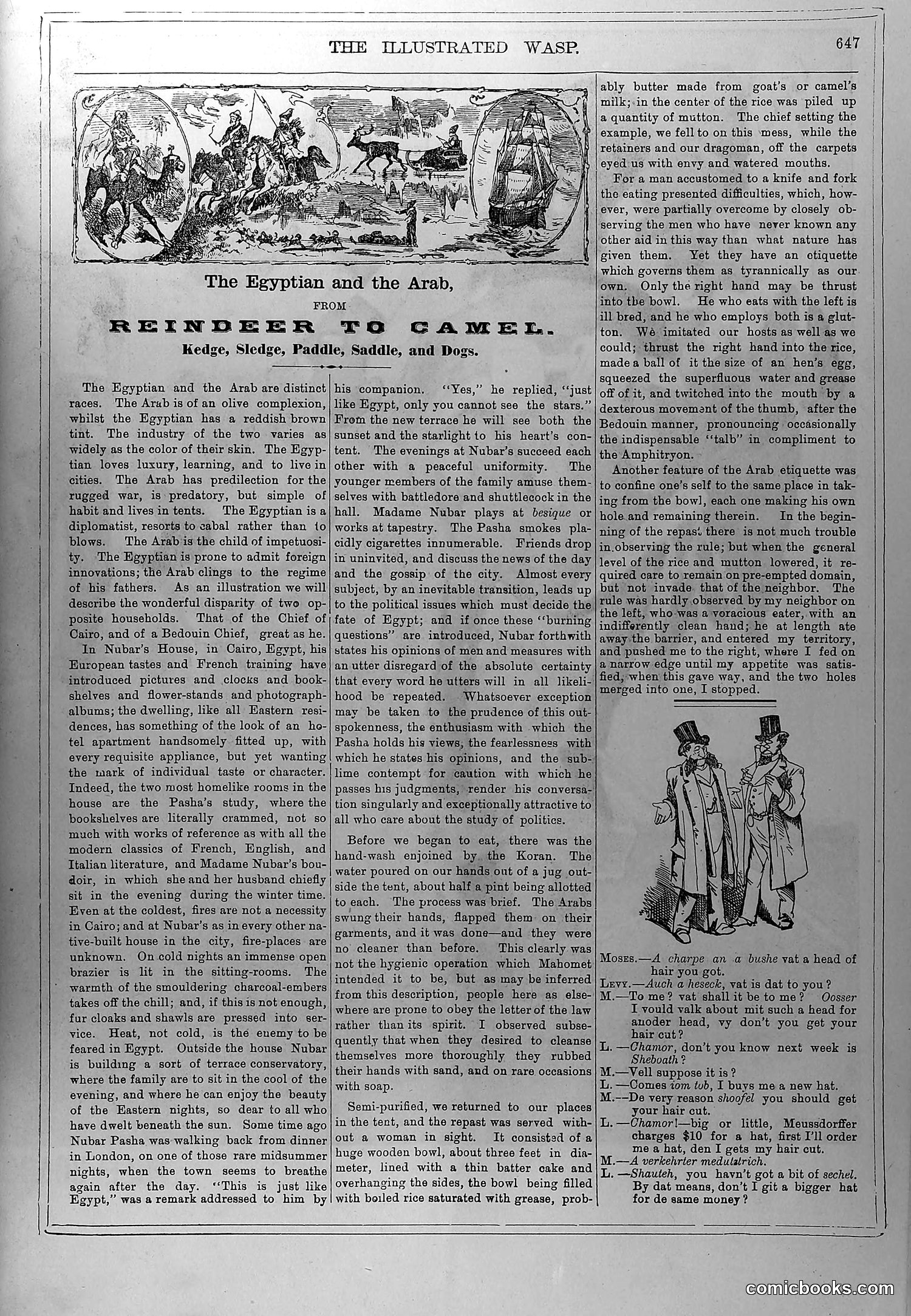
This page contains a literary article titled "The Egyptian and the Arab, from Reindeer to Camel," contrasting the two cultures through their habits and customs. The piece describes physical differences, lifestyle practices, and social behaviors—such as eating etiquette, hygiene customs, and domestic arrangements. The small illustrated vignette at bottom right shows two figures in period dress (labeled "Moses" and "Levy") engaged in dialogue about obtaining a hat, with one character offering to cut the other's hair for payment. This appears to be travel literature or ethnographic commentary rather than political satire. The page reflects 19th-century attitudes toward non-Western cultures, documenting perceived behavioral differences in a manner typical of the era's orientalist writing.
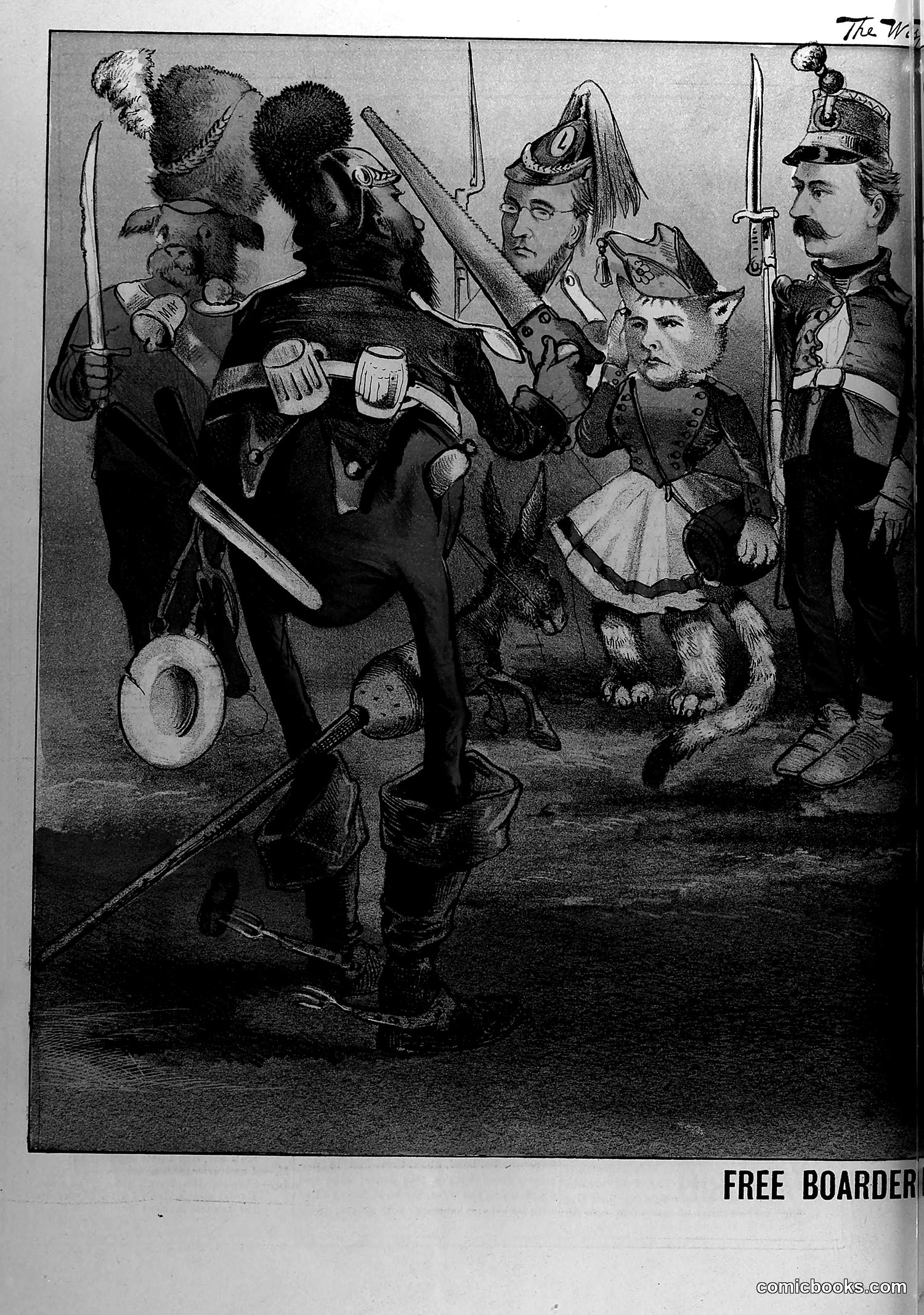
This satirical cartoon depicts military figures as animals—likely representing European military powers or leaders. The figures wear distinct military uniforms with spiked helmets (characteristic of Prussian/German military dress) and carry weapons. The title "FREE BOARDER" suggests commentary on military occupation or unwanted military presence—perhaps critiquing a foreign power's involvement in another nation's affairs, or satirizing the burden of military expansion. The anthropomorphic treatment is typical of *The Wasp*'s visual style, reducing political figures to animal caricatures for mockery. Without clearer identifying labels or date information visible, the specific historical event or figures remain unclear, though the military regalia suggests this relates to late 19th or early 20th-century European geopolitics.
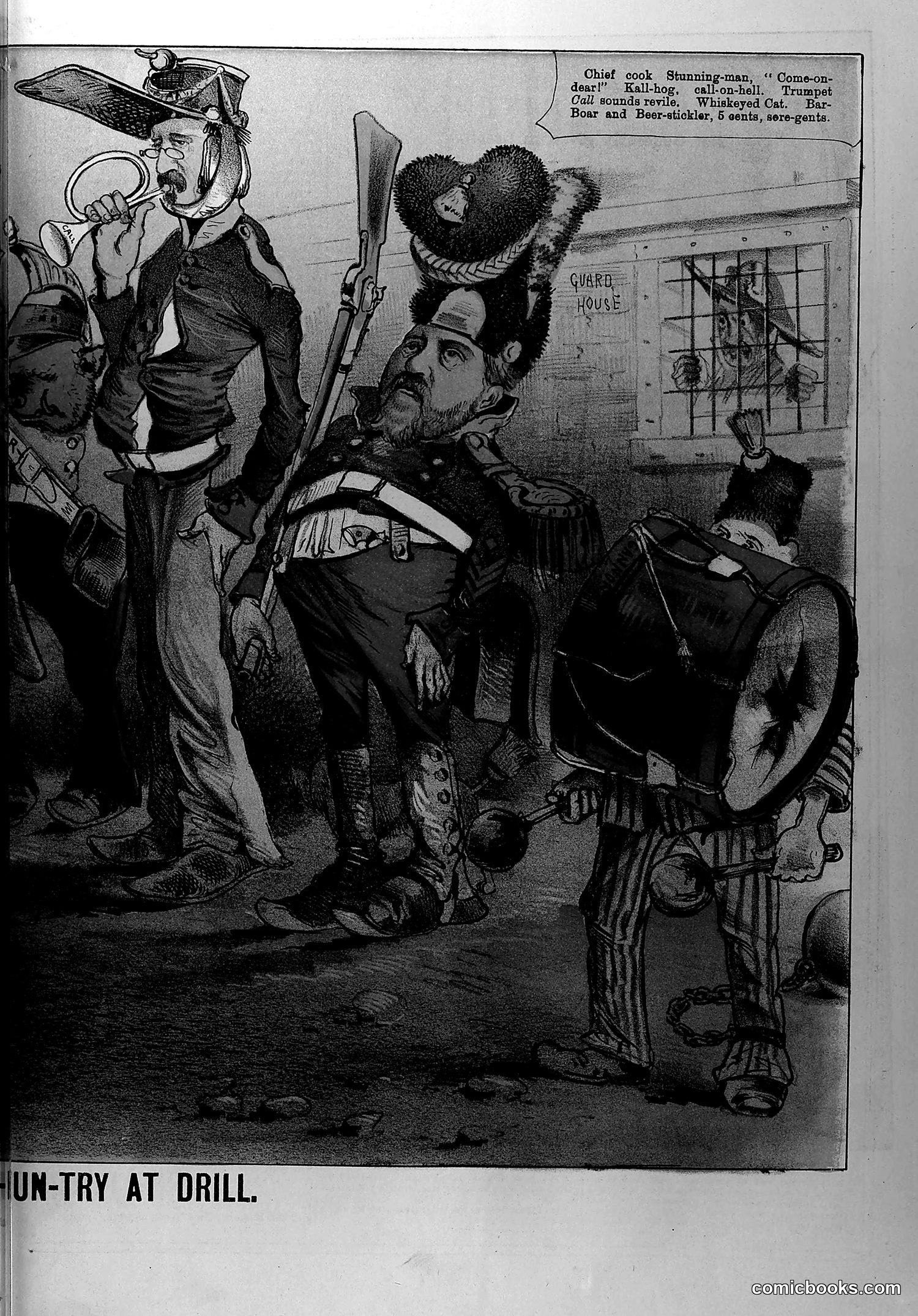
This satirical cartoon mocks military incompetence or poor training discipline. The central figure is a bearded military officer in uniform with epaulettes, appearing to conduct or oversee drill exercises. A bear sits atop his head as a hat, suggesting absurdity or chaos. The caption text lists various animals and sounds—"Chief cook," "Shunning-man," "Rail-hog," "Call-on-hall," "Trumpet Call," "Whiskeyed Cat," "Boar," and "Beer-stickler"—which appear to be mocking military ranks or drill commands rendered as animal noises, emphasizing disorder rather than proper military procedure. The "Guard House" visible in the background suggests military discipline is breaking down entirely. The satire critiques either incompetent military leadership or the general chaos of a particular military organization or training exercise.
This page consists almost entirely of serialized fiction titled "Phases of History Not Generally given in Detail," written by Mr. Salmi Morse. The content is a narrative story about James Martin, a young man dealing with romantic and family conflicts, particularly involving Mrs. Josiah Martin and their complex relationship dynamics. There are **no political cartoons or satirical illustrations** visible on this page. The only other content is a brief section titled "The Oldest Vessel," which discusses the HMS Shop Wasp, a historical naval vessel launched in 1812. This appears to be a typical interior page from The Wasp magazine focused on literary serialization rather than satirical commentary or visual humor.
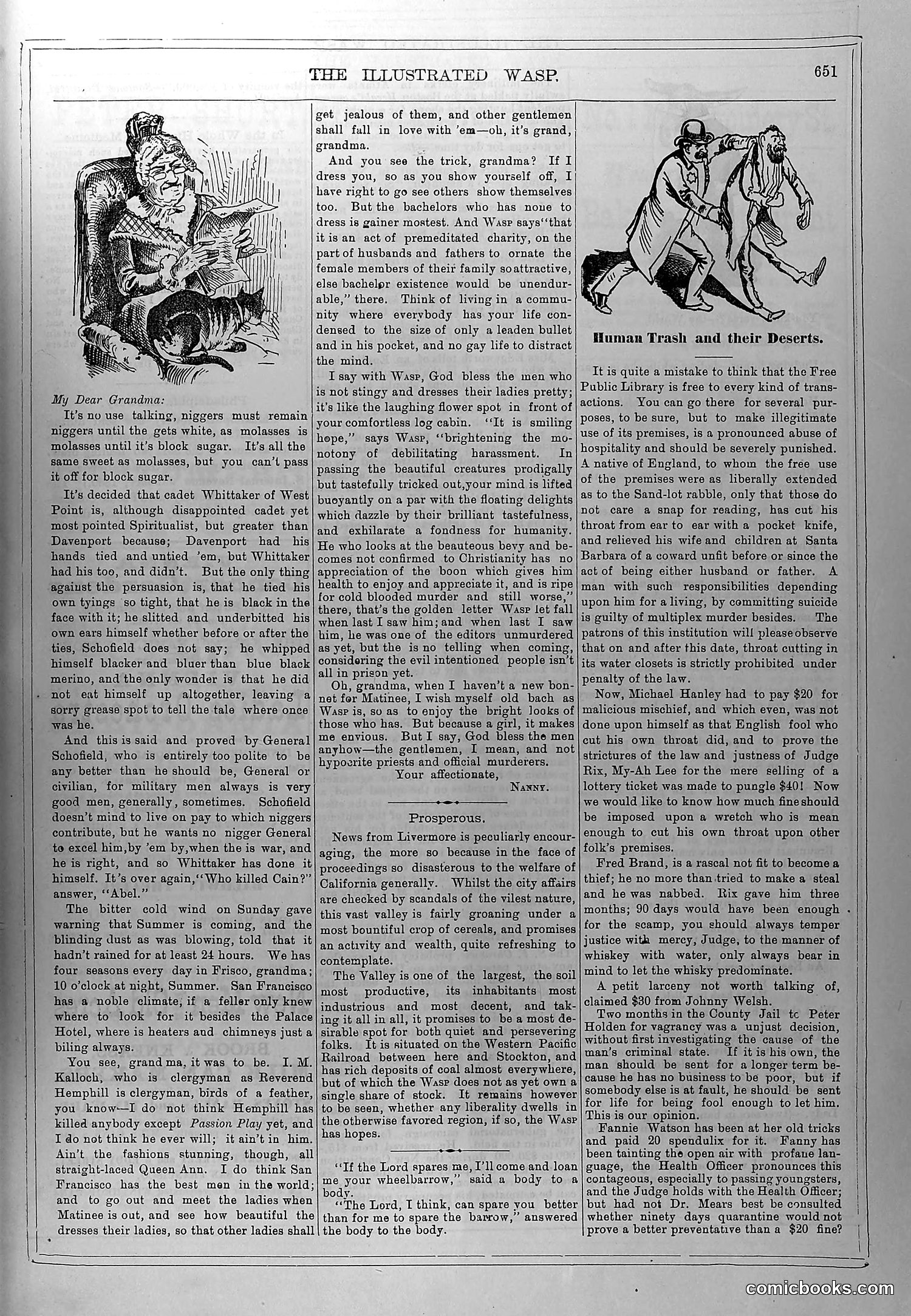
This page contains two distinct sections: **Left illustration and letter ("My Dear Grandma"):** A satirical letter defending working-class men's appearance and dignity. The writer argues against the grandmother's apparent criticism of "niggers" (using period language) who don't dress formally, contending that poor men deserve respect and shouldn't be mocked for their appearance. The letter defends the dignity of laborers and criticizes class-based social judgment. **Right illustration and articles:** The top cartoon titled "Human Trash and their Deserts" appears to depict criminal or disreputable figures. Below are articles about the Free Public Library, crime, and various scandals involving theft and murder. The page overall reflects 19th-century American social commentary on class divisions, morality, and criminality, mixing defense of working-class dignity with sensationalized crime reporting typical of the era's satirical press.
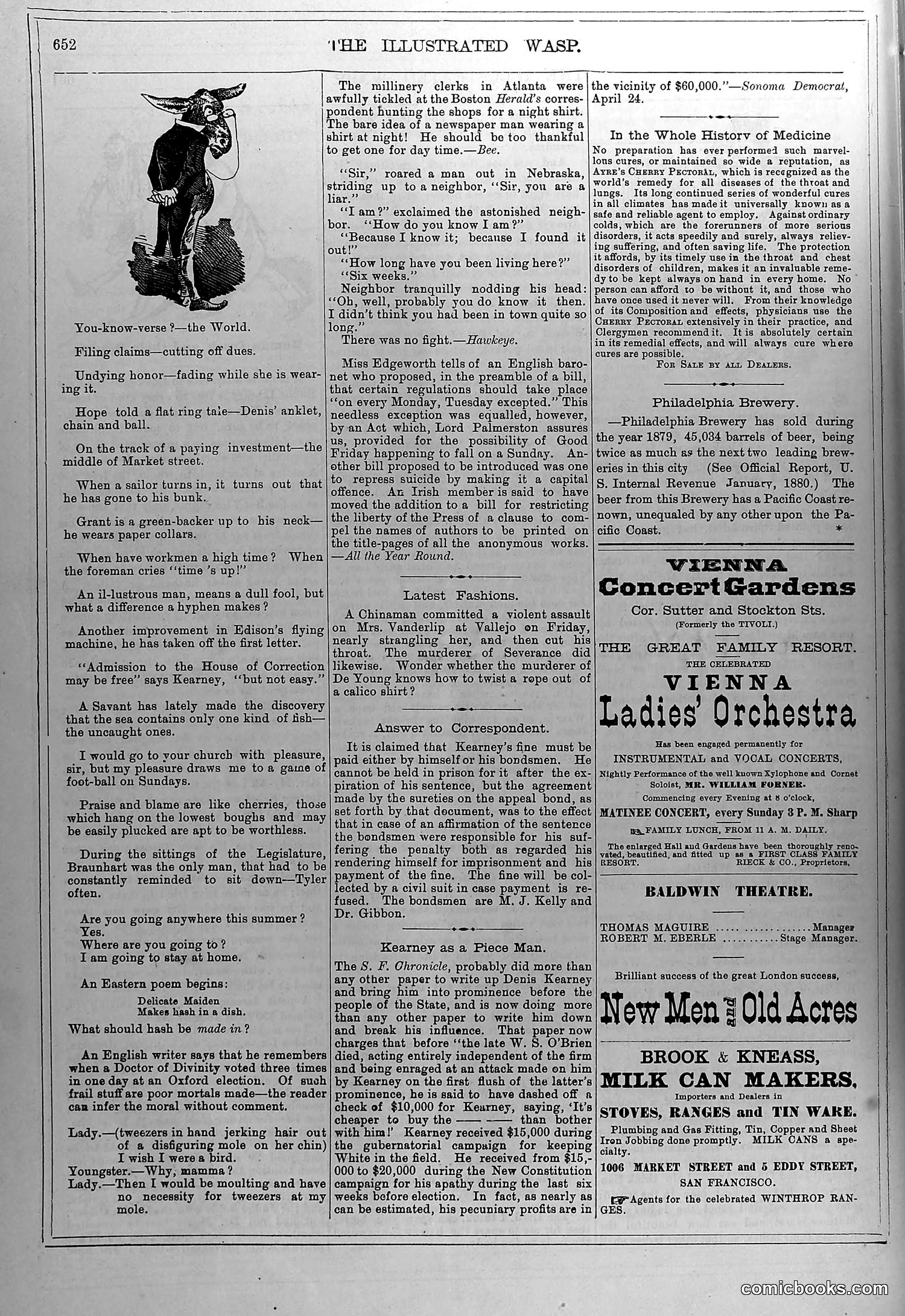
This page contains primarily **advertisements and miscellaneous content** rather than political cartoons. The small illustration at top-left ("You-know-verse?—the World") shows a caricatured figure, but lacks sufficient context to identify specific satire targets. The bulk of the page features **advertisements** for Philadelphia Brewery, Vienna Concert Gardens, Baldwin Theatre, and various San Francisco merchants. Interspersed are **brief humorous anecdotes and jokes**—including exchanges about mistaken identity in Nebraska, wordplay about tailors, and commentary on social customs (church attendance, summer plans). The "Answer to Correspondent" section discusses Denis Kearney's fine for contempt of court, suggesting **labor politics** as background context, though the specific satirical point remains unclear from this excerpt alone.
This page is primarily **advertising and announcements** with no visible political cartoons or satirical illustrations. The content includes ads for: - Peter Short (merchant tailor) - Tivoli Gardens and "The Little Duke" theatrical production - Various San Francisco businesses (bakery, piano rental, glove manufacturer, optician, oil suppliers) The only substantive editorial content appears to be a column of short anecdotes and observations about human nature—including stories about a Chicago man obsessed with a number combination, a German traveler in Africa, and incidents at churches and boarding houses. These brief tales appear designed as **humorous social commentary** on human folly and eccentricity, but without accompanying illustrations, their satirical intent is difficult to assess. The page functions primarily as a **commercial publication** rather than as political or social satire.
This page is primarily **advertisements and miscellaneous content** rather than political satire. The visible material includes: **Advertisements:** - "Domestic" sewing machine (top right) - Kingsford's Oswego Starch - Baja California Damiana Bitters (patent medicine) - C. Muller, optician - Charles F. Hertweck, upholsterer and zither instructor - C. Herrmann hats (bottom) **Editorial content** includes brief humorous pieces ("Anti Sly-Lark," "Have Wails Ears?," "Established Beliefs") and advice columns ("How to Treat Friends," "Bachelor Entertainments," "A Wooden-Legged Pheasant"). The page lacks prominent political cartoons or social satire targeting specific figures or events. It appears to be a typical late 19th-century magazine page mixing local San Francisco advertising with light entertainment content.
This page is primarily **advertising content**, not satire or political commentary. It consists of: 1. **Patent medicine ads** (H.T. Helmbold's Compound Fluid Extract Buchu) claiming to cure bladder, kidney, and various other diseases—typical 19th-century snake oil marketing 2. **Local San Francisco business advertisements** for a brewery, book binder, billiard tables, dressmaker, and lithography services 3. **One decorative illustration** (bottom center) depicting a cherub or angel figure with ornate lettering advertising a wine and liquor dealer at 219 Commercial St., San Francisco The page reflects *The Wasp's* business model: generating revenue through ads rather than editorial content. There is no identifiable political cartoon or satirical commentary visible—just period commercial advertisements typical of 1880s-1890s publications.
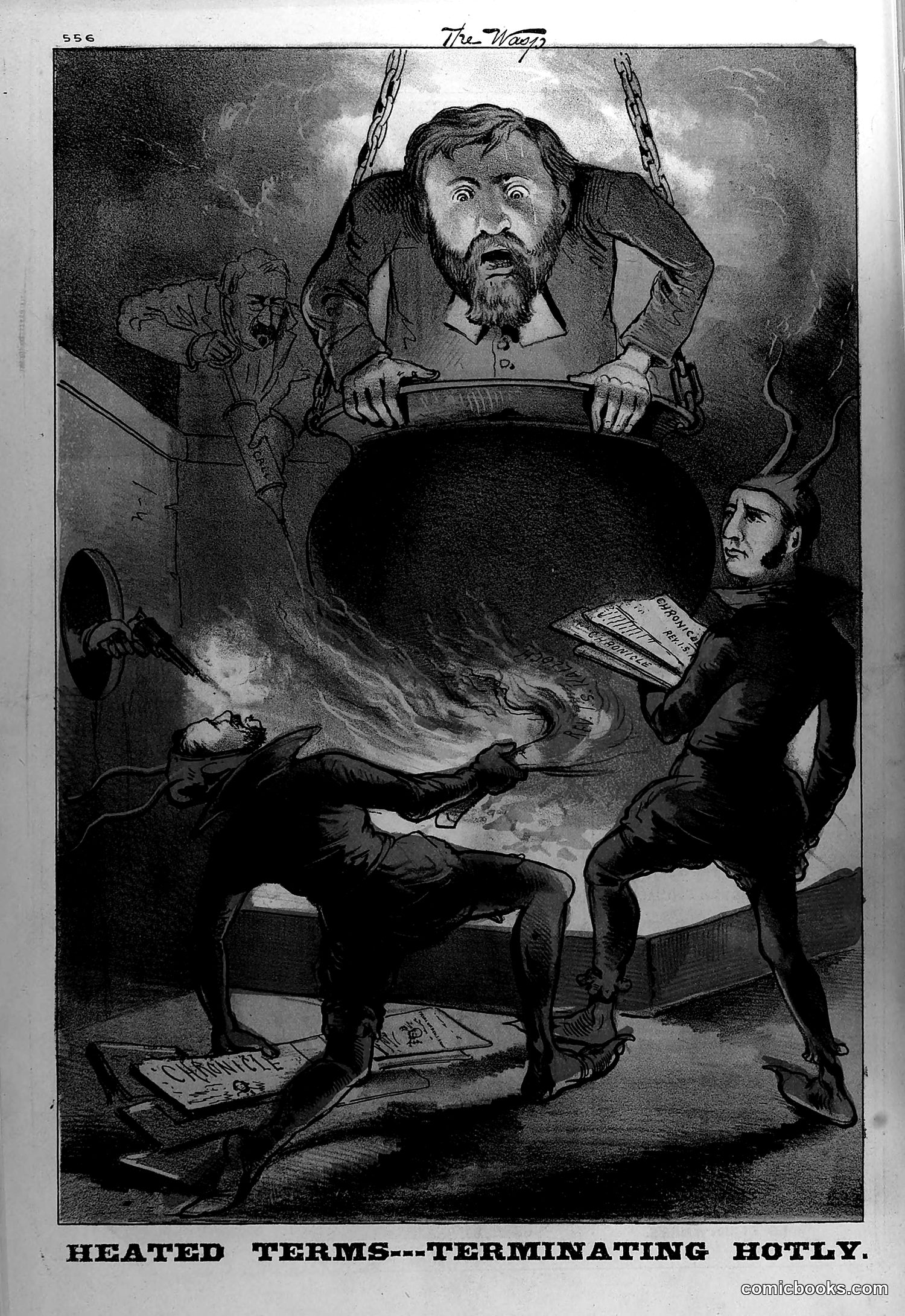
This satirical cartoon depicts a heated argument, with a bearded man suspended in a swing or chair above, his expression contorted in anger or distress. Below him are two demonic or devil-like figures engaged in what appears to be a violent confrontation, with papers scattered around them (possibly labeled documents or newspapers). The title "Heated Terms—Terminating Hotly" suggests a dispute escalating to a breaking point. The infernal imagery and grotesque figures indicate this represents a dispute between morally questionable parties or political adversaries. The suspended figure above may represent public opinion or authority caught between warring factions. Without additional context about The Wasp's publication date and specific political events, the exact figures and controversy referenced remain unclear.

I can see this page contains a measurement scale/calibration chart with grayscale squares of varying tones arranged in a grid pattern, alongside a ruler marked with numbers 6-11. This appears to be a **test or calibration page** rather than editorial or advertising content from *The Wasp* magazine. These types of pages were commonly included in publications for quality control purposes—helping printers verify that their reproduction process maintained proper contrast and tonal range. The grayscale patches and ruler allowed technicians to check whether images and text were printing at acceptable clarity levels. Without visible cartoon content, satirical figures, or readable OCR text on this particular page, I cannot identify specific political or social commentary intended by the magazine.