
A complete issue · 18 pages · 1880
The Wasp — April 24, 1880

I can see this is a measurement scale reference page from *The Wasp* magazine, but the image quality and angle make it difficult to discern specific cartoon content or satirical figures with confidence. The page shows Oregon Rule Co. measuring scales (visible on the rulers), which suggests this may be a technical reference page or advertisement rather than a political cartoon page. Without being able to clearly read any text or identify distinct caricatures or political references in the image, I cannot reliably explain what satire or social commentary this page contains. To provide accurate historical context for a modern reader, I would need a clearer, straight-on image that shows the actual cartoon artwork and accompanying text more legibly.
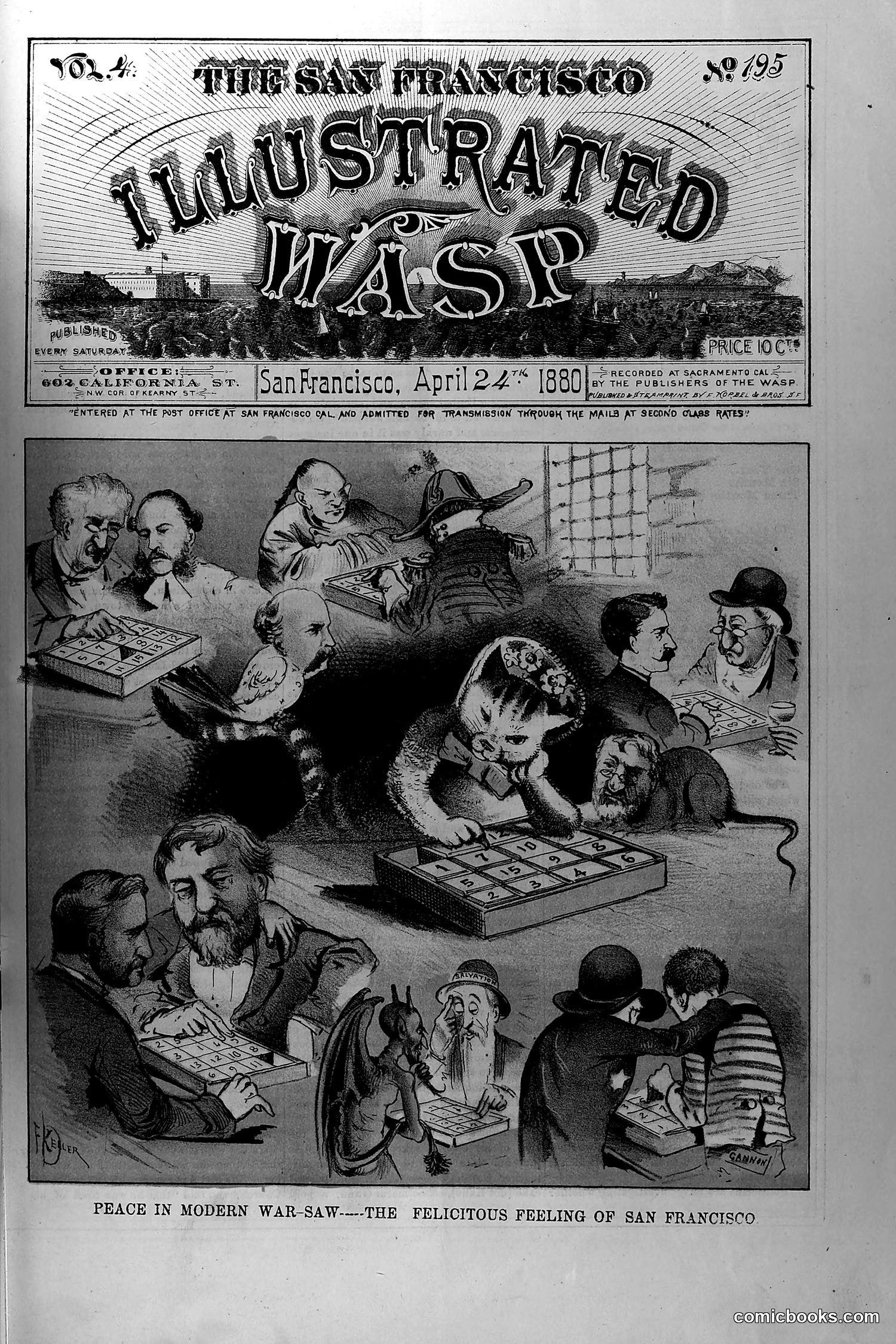
This satirical illustration, titled "Peace in Modern War-Saw—The Felicitous Feeling of San Francisco," depicts various San Francisco citizens engaged in gambling games (lottery-style boxes and cards visible). The caricatured figures appear to represent different social classes and ethnicities, all happily participating in gaming activities. The satire likely mocks San Francisco's widespread gambling culture and its normalization across society. The subtitle's pun on "Warsaw" (referencing recent conflicts) suggests irony: while cities experienced actual warfare, San Francisco's residents pursued their own "peaceful" battle through gambling. The cartoon critiques how gambling had become woven into civic life, presented here as a universal, cross-class activity worthy of both leisure and concern. The piece satirizes public vice presented as civic pastime.
The masthead cartoon depicts a wasp—the magazine's emblem—in a characteristic aggressive posture, ready to sting. This represents the publication's satirical mission. The main content critiques California's 1880 Legislature, condemning it as disgraced and ineffective. The text attacks the recently passed "Workingmen's Party" charter bill, calling it unconstitutional and harmful. The satire argues the legislature has wasted time on "ridiculous enactments" while accomplishing little substantive good. The article also covers "The Severance Horror"—a documented murder case involving a widow's servant in Richmond, England, found boiled and dismembered in a chest. The coverage uses this sensational true crime to illustrate broader social anxieties about servant reliability and household mysteries during the era.
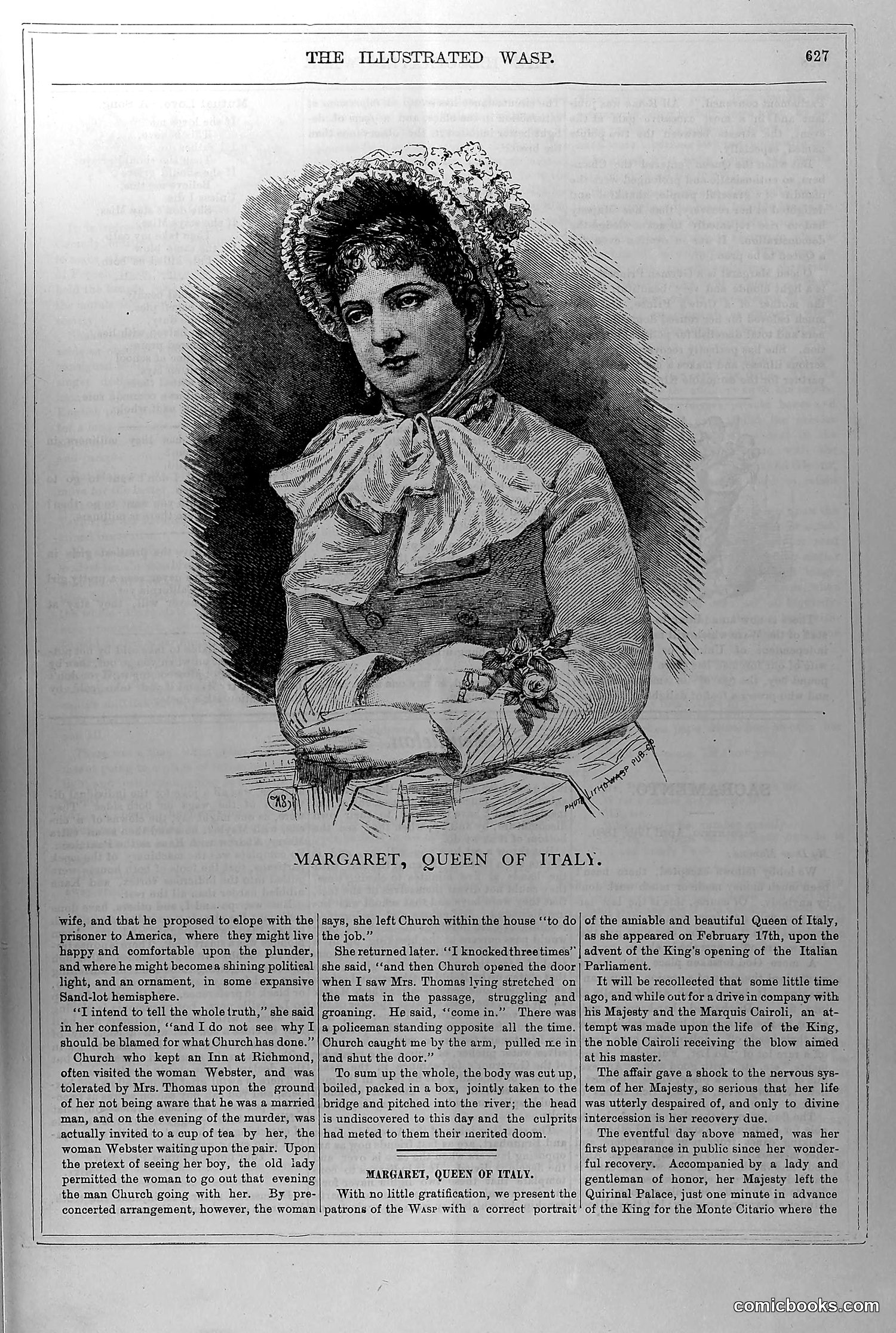
This page from *The Wasp* features a portrait and biographical narrative about Margaret, Queen of Italy. The text describes a dramatic scandal involving the Queen, a woman named Webster, and a clergyman named Church. According to the account, Webster and Church conspired to elope; when discovered, Church murdered Webster and disposed of her body in a river. The article emphasizes the Queen's involvement in the aftermath—apparently she intervened to help Church escape, allowing him to leave church undetected. The satire appears to mock the Queen's complicity in covering up the crime and her attempt to use her royal position to obstruct justice, suggesting aristocratic privilege enabled the concealment of serious criminal acts.
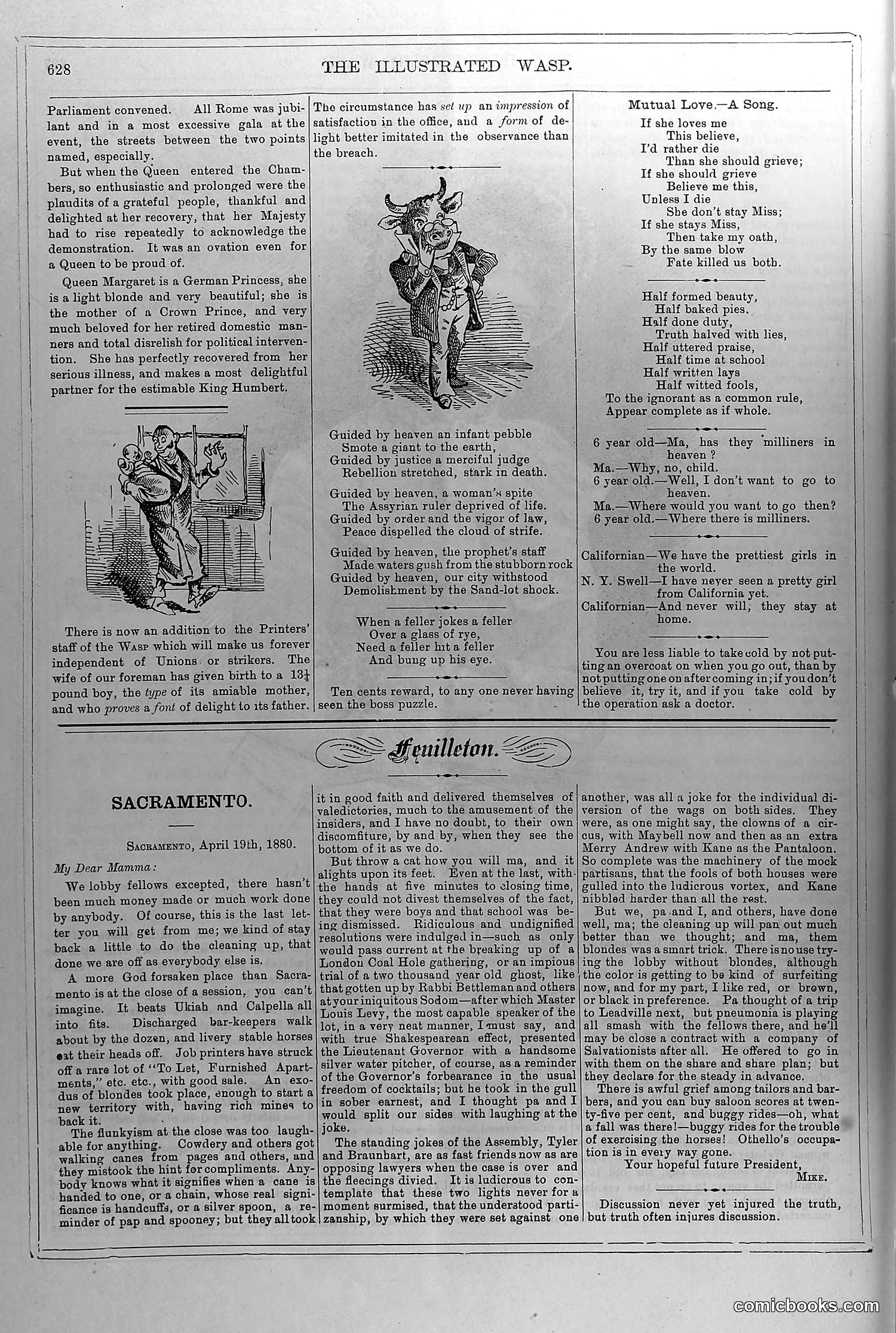
This page contains mixed content from an 1880 satirical magazine. The upper section discusses Queen Margaret, a German Princess and Crown Prince's mother, praising her discretion and avoiding political interference—likely commentary on proper royal conduct during a politically tense period. The central illustration depicts a grotesque horned figure (possibly representing a political opponent or social problem), though the specific target is unclear without additional context. The lower section includes a letter from Sacramento discussing local mining operations, labor disputes, and political machinations—particularly regarding the "Coal Hole gathering" and Assembly members Tyler and Braunhardt, presenting them as opportunistic politicians playing both sides for personal gain. The page primarily offers satirical social and political commentary typical of 1880s California journalism.
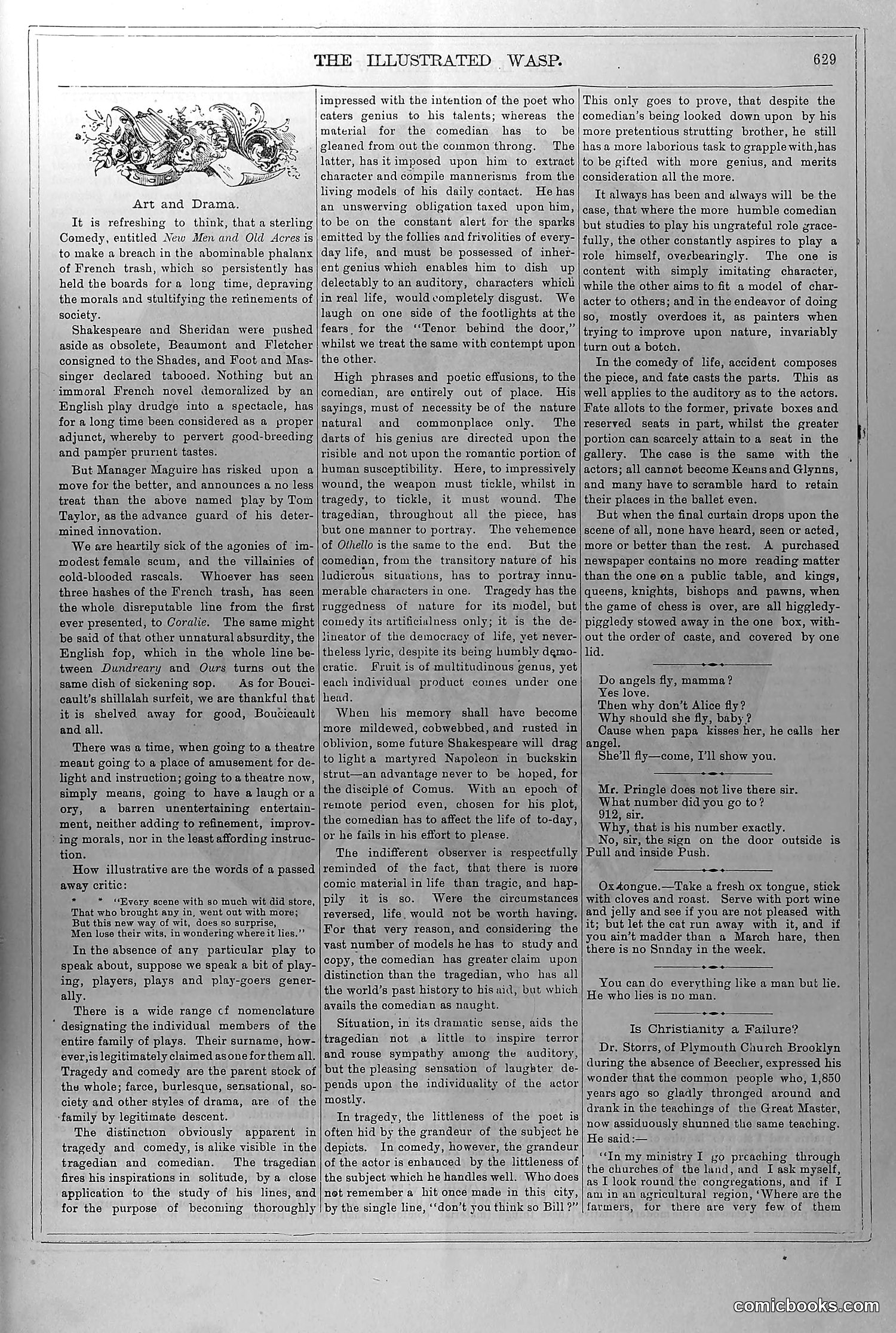
This page is primarily **text-based editorial content**, not a political cartoon. The articles discuss theater criticism and religious topics rather than satirizing specific political figures or events. The main pieces include: 1. **"Art and Drama"** - critiques comedians' performances, arguing that while tragedians receive praise, comedians face unfair prejudice. It debates whether comedy requires less skill than tragedy. 2. **"Is Christianity a Failure?"** - reports on Dr. Storrs of Plymouth Church Brooklyn, who challenged prevailing religious teaching, questioning whether Christian instruction adequately reaches rural populations. The page reflects *The Wasp's* broader editorial mission of social commentary through written argument rather than visual satire on this particular issue.
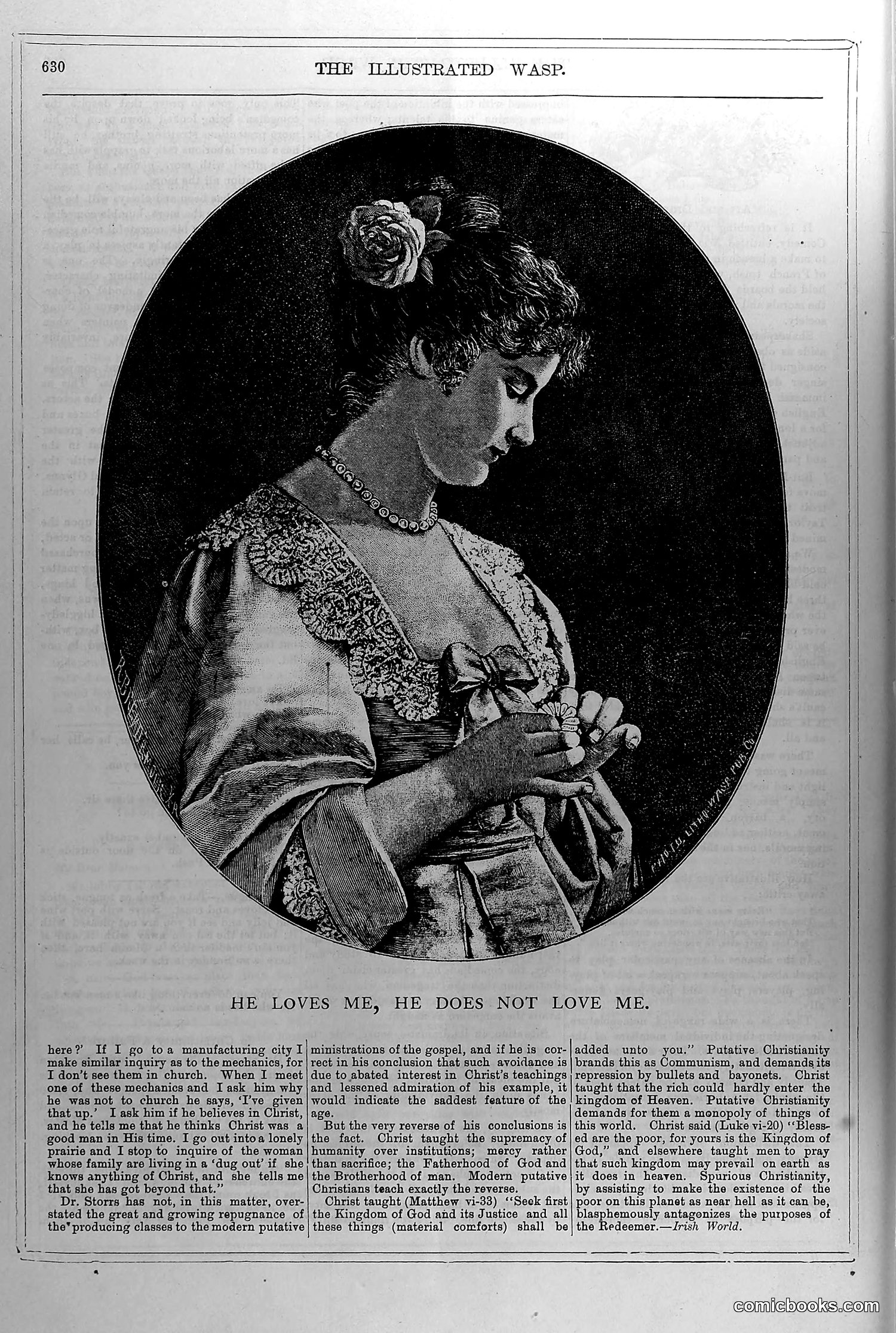
This page from *The Wasp* satirizes Christian hypocrisy regarding wealth and social class. The illustration shows an elegantly dressed woman with jewelry and lace, captioned "HE LOVES ME, HE DOES NOT LOVE ME"—a reference to the fortune-telling game of plucking flower petals. The accompanying text criticizes a wealthy Christian man who avoids church and claims to follow Christ's teachings while neglecting the poor. The satire contrasts his claimed faith with his actual behavior: he won't associate with working-class Christians and shows no concern for the disadvantaged. *The Wasp* mocks the contradiction between professed Christian values (loving one's neighbor, caring for the poor) and the actual practices of affluent believers who use religion selectively to justify material comfort and class distinction.
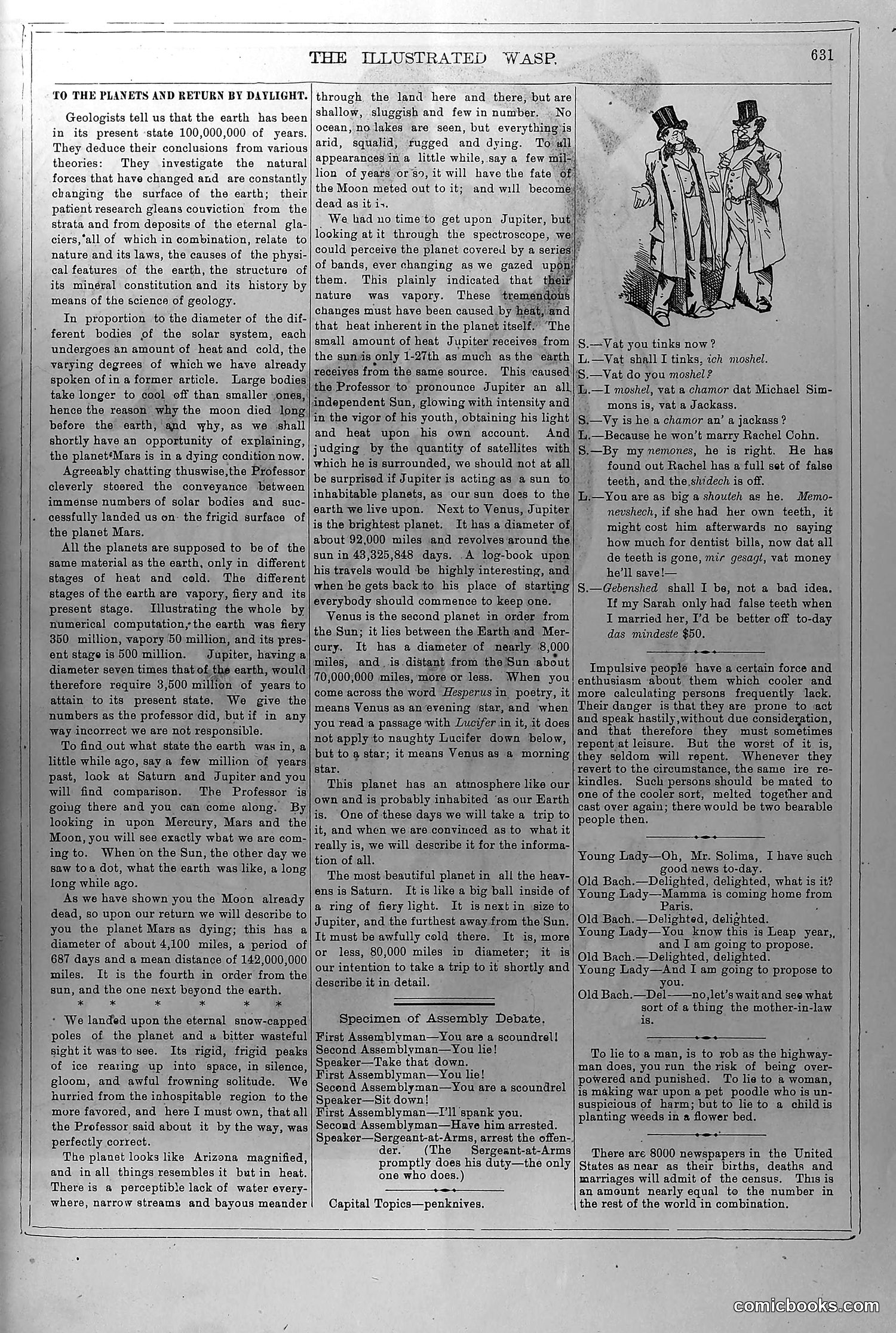
This page combines a long scientific essay about planetary conditions with a satirical dialogue section titled "Specimen of Assembly Debate." The **cartoon illustration** (upper right) shows two well-dressed men in top hats engaged in conversation, typical of Victorian-era political satire imagery. The **Assembly Debate section** mocks legislative proceedings through absurdist dialogue where speakers make nonsensical statements ("You are a scoundrel!" / "You lie!") and a sergeant-at-arms must maintain order. This satirizes the chaotic, pointless nature of political debate. The **final "Capital Topics" note** cynically observes that American newspapers report deaths and marriages as frequently as births—suggesting society's morbid preoccupation with mortality and social scandal. The overall tone critiques both scientific pretension and governmental incompetence through juxtaposition and dark humor.
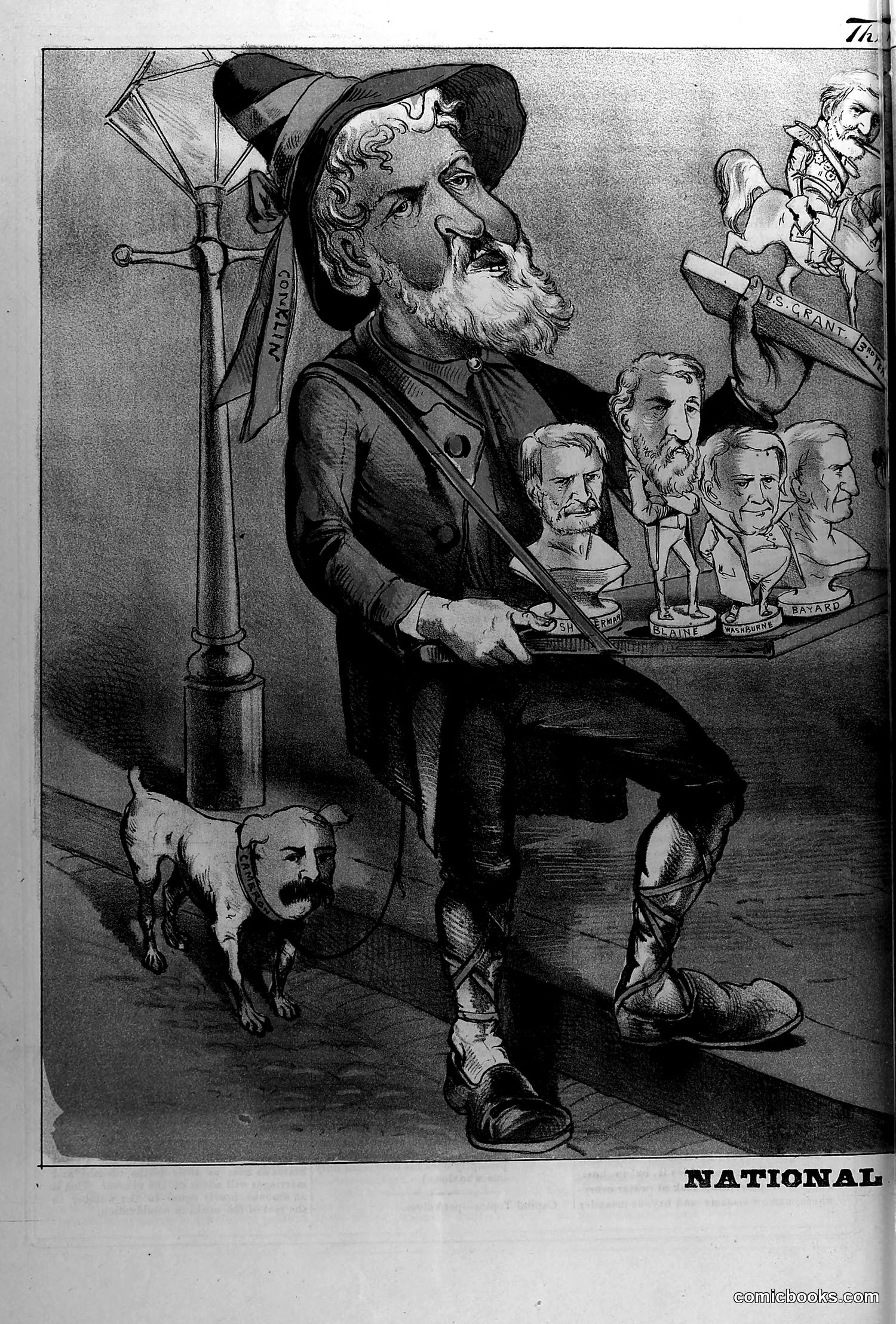
This appears to be a satirical caricature from *The Wasp*, likely from the late 19th century. The central figure is a large, bearded man in a hat holding what appears to be a weather vane or similar device, with a dog at his feet. To his right are several small busts or heads on pedestals, suggesting political figures or personalities he controls or manipulates. The cartoon satirizes political patronage and manipulation—the central figure appears to be a political boss or kingmaker controlling multiple politicians (represented by the busts). The weather vane suggests he shifts direction with political winds. The specific identities of the figures remain unclear without additional caption text, but the commentary criticizes corrupt political influence and the puppet-like nature of party politics during this era.
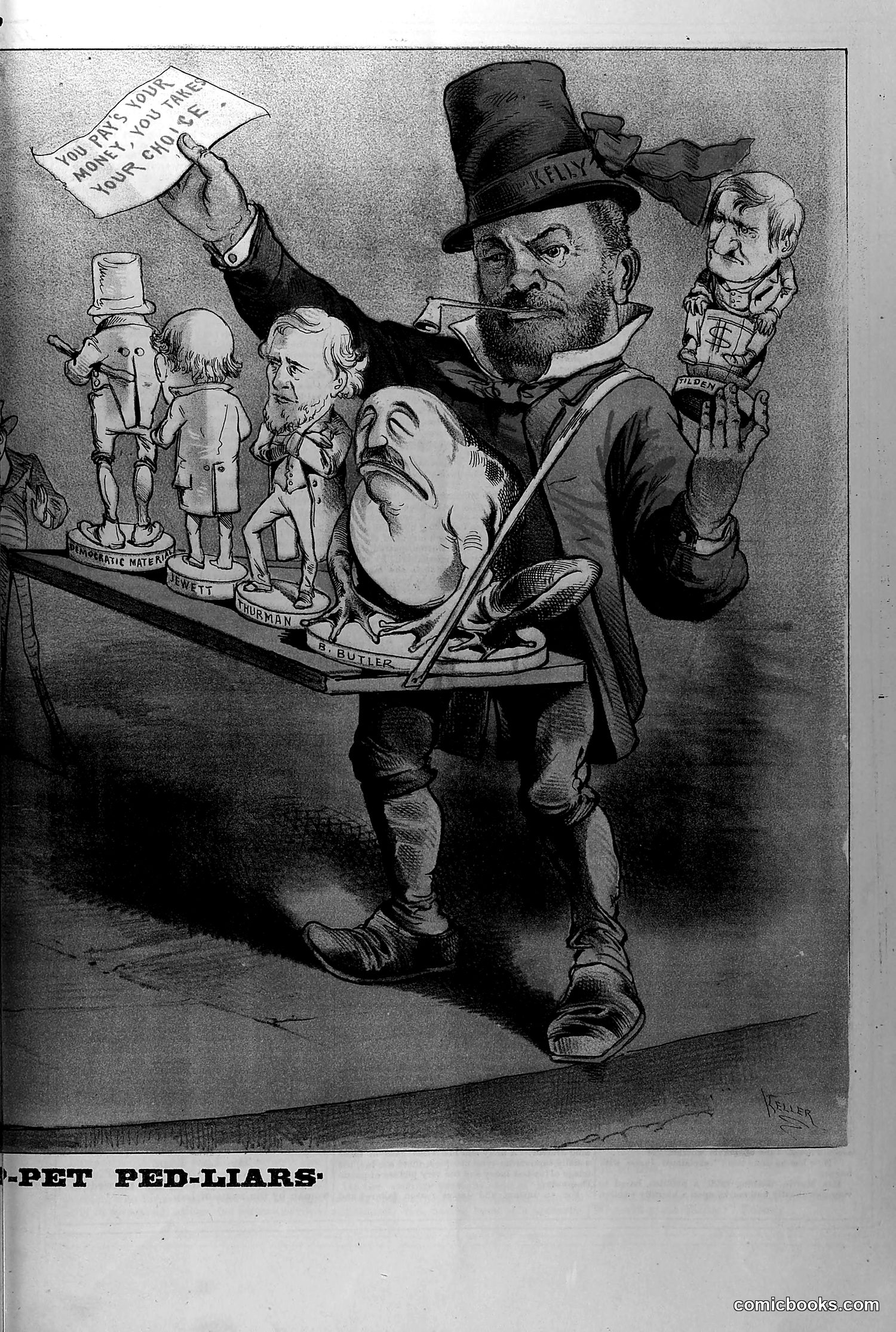
This cartoon satirizes political corruption through the metaphor of a puppet show. A large bearded figure (labeled "KELLY" on his hat) operates a platform of smaller puppet-like politicians. The sign he holds reads "YOU BUY YOUR VOTES / HOW YOU LIKE / YOUR CHOICE?" — suggesting vote-buying and electoral manipulation. The smaller figures appear to represent various political operatives or candidates, depicted as grotesque caricatures controlled by the central "Kelly" figure. The title "Pet Ped-Liars" (playing on "peddlers") suggests these are fraudulent politicians who peddle influence and lies. The cartoon criticizes political machine control and corruption, wherein one powerful figure manipulates lesser politicians like puppets, implying they lack autonomy and serve corrupt interests rather than constituents.
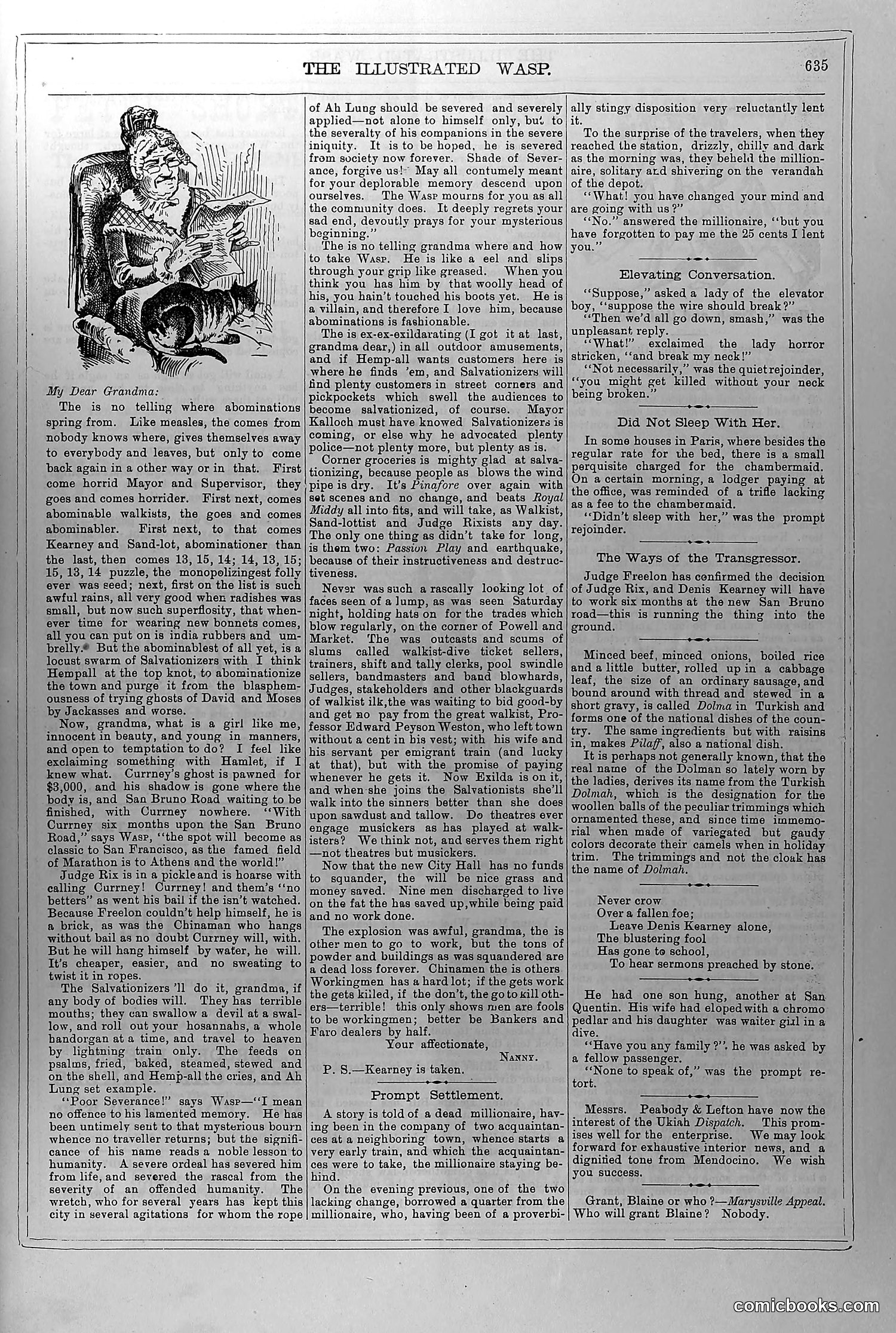
This page contains **satirical fiction and letters** rather than political cartoons. The main illustration depicts a woman in period dress, accompanying a story titled "My Dear Grandma." The narrative mocks **Salvation Army activities and hypocrisy**, describing how the organization sends members into neighborhoods under the guise of charity work. The satire suggests Salvationists are actually infiltrating homes as thieves and confidence artists—"pickpockets which swell the audiences become saleswomen of course." The piece attacks the **moral pretense of religious charitable organizations**, implying their public piety masks criminal intent targeting the poor and vulnerable. Other brief items discuss urban crime, mining accidents, and social scandals typical of The Wasp's satirical coverage of San Francisco life. The tone is cynical commentary on institutional corruption and class exploitation.
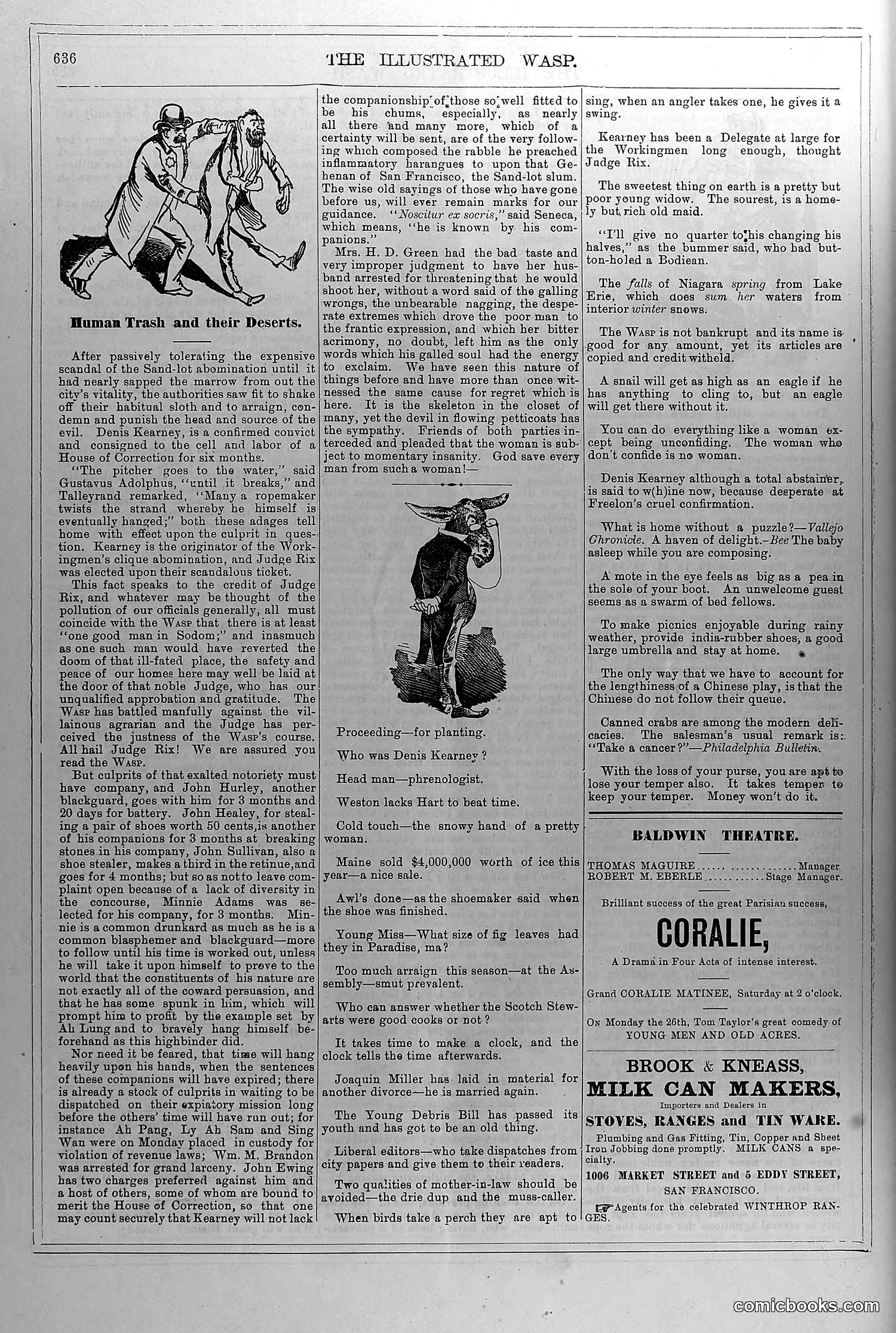
The page contains two illustrations labeled "Human Trash and their Deserts" and "Proceeds—for planting." The first cartoon depicts caricatured figures in ragged clothing, likely representing vagrants or social undesirables. The accompanying text discusses Denis Kearney, a prominent anti-Chinese labor activist, and criticizes various "undesirable" individuals sentenced to the House of Correction. The second illustration shows a figure being hanged, titled "Proceeds—for planting," suggesting violent retribution or execution as consequence. The satire appears to target both criminal elements and labor agitators of 1880s San Francisco, reflecting the publication's conservative stance on crime, punishment, and social disorder. The tone is harshly punitive rather than sympathetic to the marginalized. The remainder is advertisements and theater notices.
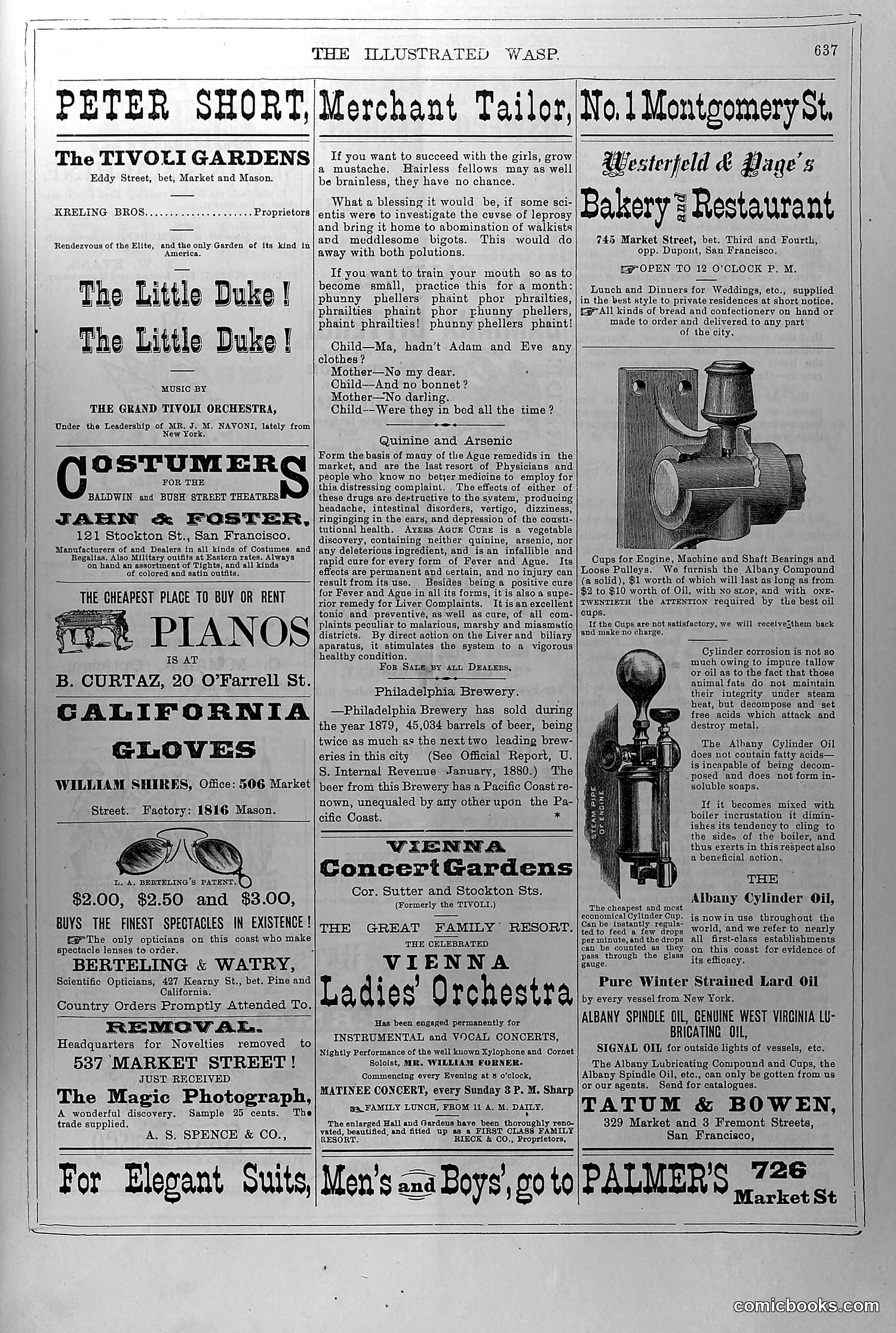
This page is primarily **advertising**, not political satire. It contains commercial advertisements for San Francisco businesses from what appears to be the 1870s-1880s, including: - Peter Short's tailoring services - Tivoli Gardens (a local entertainment venue) - Piano rentals - Gloves and other goods - The Vienna Concert Gardens (described as "The Great Family Resort") - Various oils and industrial products There is **no political cartoon visible** on this page. The illustrations shown are product advertisements—images of mechanical devices (appears to be industrial equipment like cylinders or pumps) and a globe—not satirical commentary. While *The Wasp* was known for political satire, this particular page serves as a revenue-generating advertising section rather than editorial content.
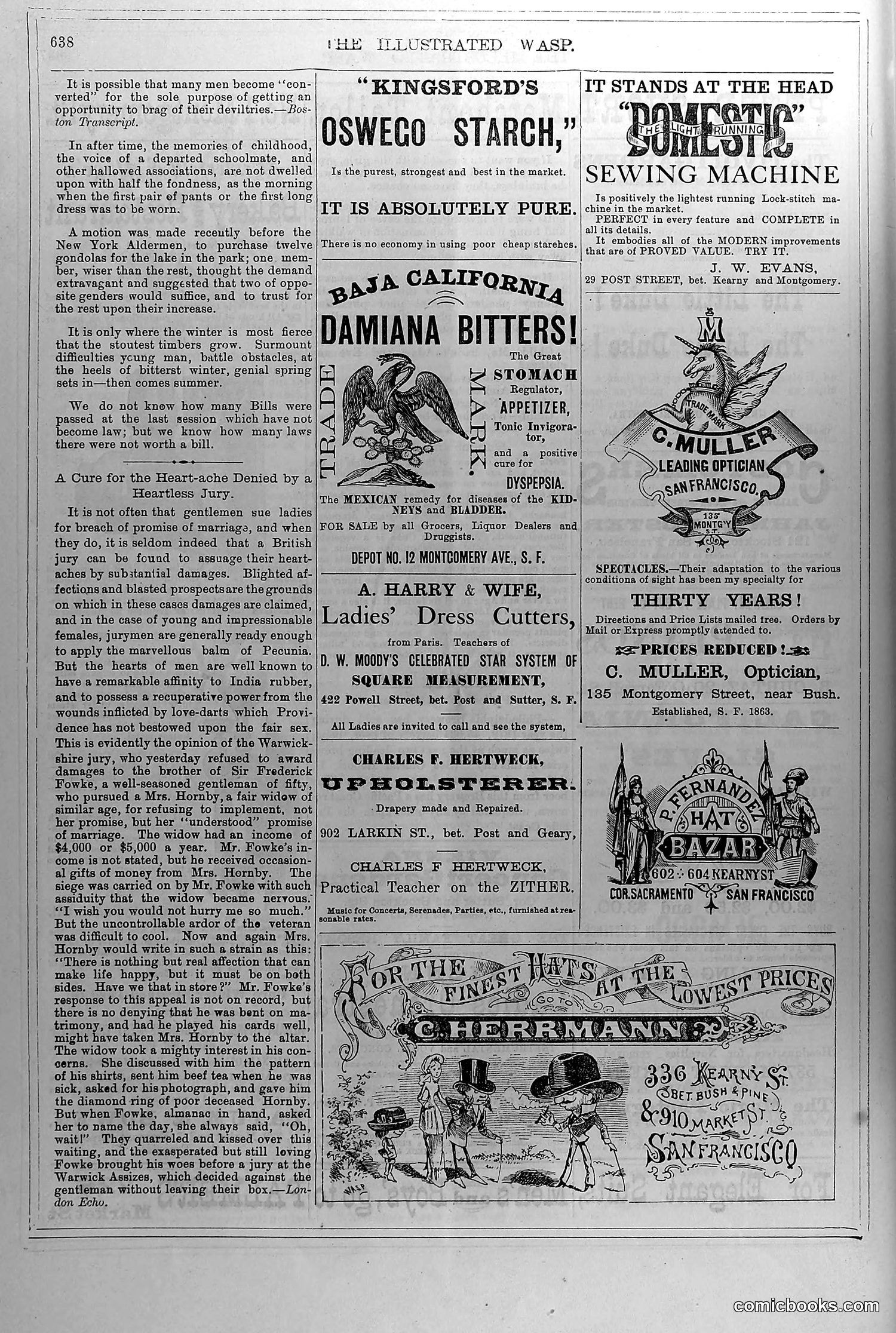
This page is primarily **advertising**, not satire or political commentary. It contains Victorian-era product advertisements for: - Kingsford's Oswego Starch - Domestic sewing machines - Baja California Damiana Bitters (a patent medicine) - C. Muller optical services and spectacles - Ladies' dress cutting services - An upholsterer - Hat retailers The left column contains miscellaneous editorial content—anecdotes about heartache cures and legal matters—unrelated to the advertisements. There are **no political cartoons or caricatured figures** on this page. The decorative illustrations (eagle, cherub, ornate typography) are typical commercial artwork of the period. This appears to be a standard magazine back page devoted entirely to paid advertisements and filler content.
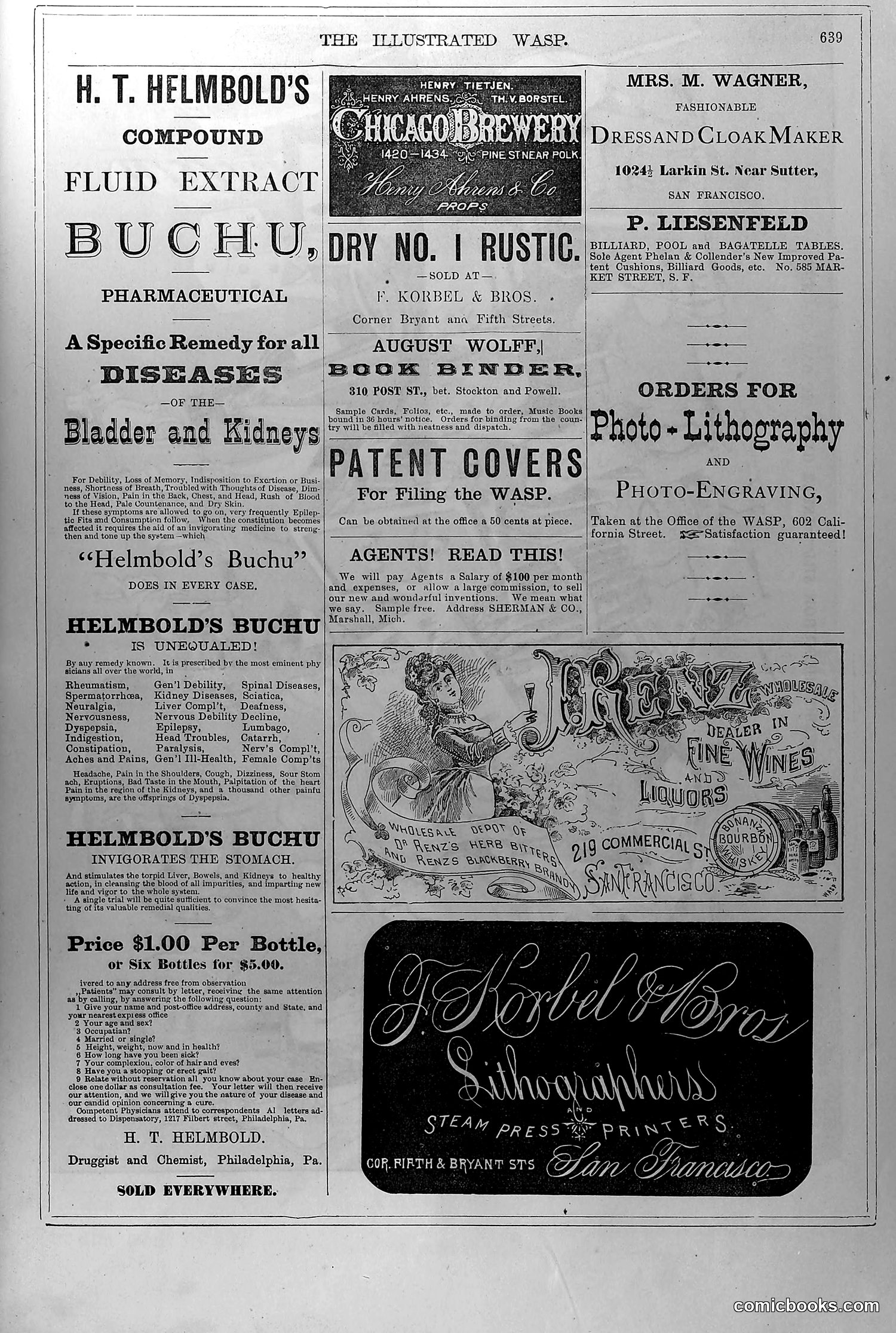
This page is primarily **advertising content** rather than political satire or editorial cartoons. It features multiple advertisements typical of late 19th-century publications: - **H.T. Helmbold's Buchu** — a patent medicine claiming to cure bladder and kidney diseases - **Chicago Brewery** — beer advertisement - **Dress and cloak maker**, billiards supplier, book binder, and photo-lithography services — local San Francisco businesses - **G. Korbel Bros. Lithographs** — featuring an ornate illustration of wines and liquors The decorative imagery (cherubs, flourishes) was standard advertising design of the era. The patent medicine ad is notable for its exaggerated health claims — typical of unregulated 19th-century pharmaceutical marketing before FDA oversight. No political commentary or satire is evident on this page.
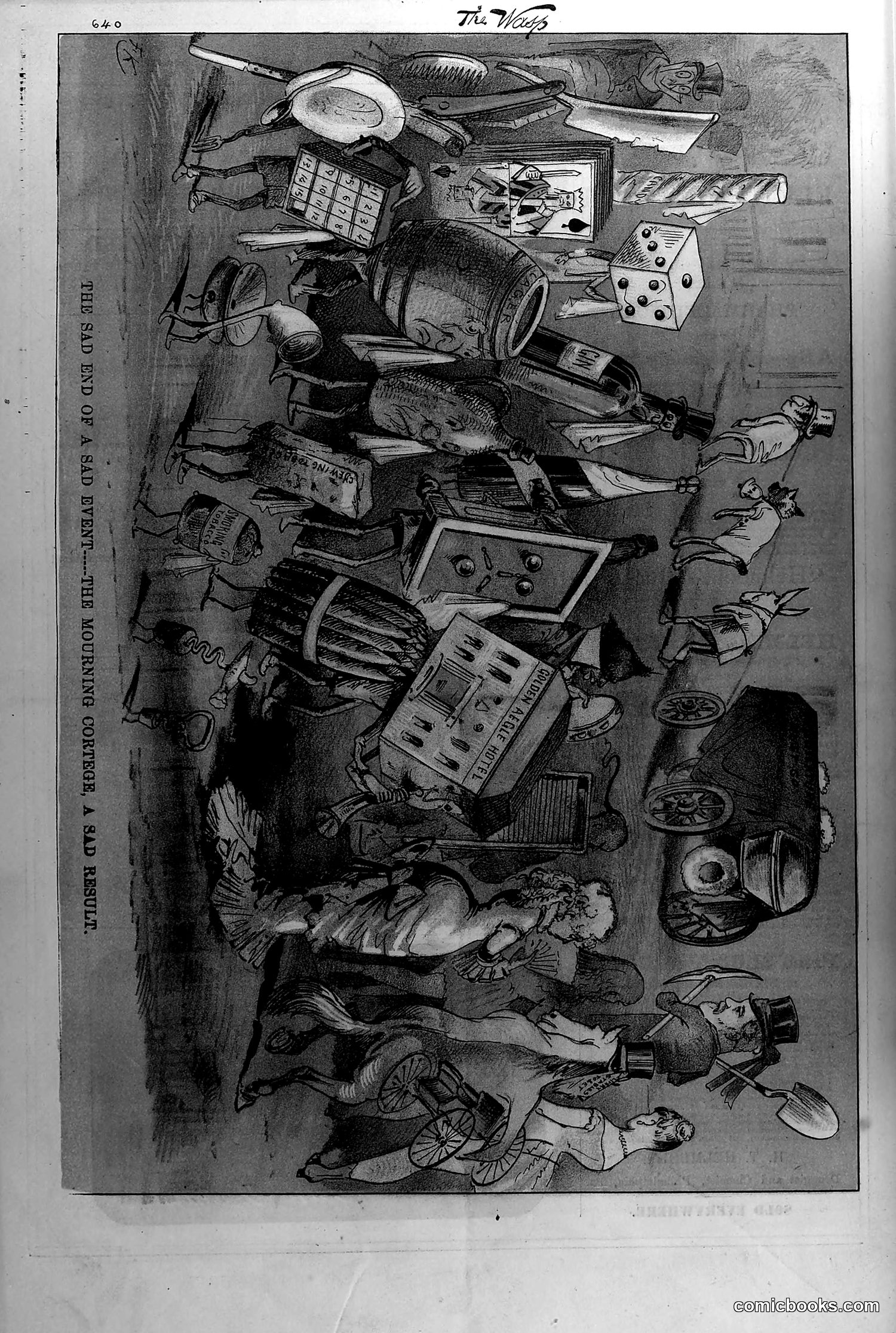
This appears to be a satirical illustration from *The Wasp*, likely from the late 19th century, titled "A Good Euthanasia for a Sad Event—First-Rate Sentiment—And a Benefit." The cartoon depicts a chaotic pile of figures and objects rendered upside-down, suggesting disorder or moral inversion. The style suggests social or political commentary on contemporary events, though specific identities are unclear from the image alone. The satirical title hints at criticism of some public sentiment or policy presented as beneficial, when the cartoon argues otherwise. The composition—with figures stacked and inverted—employs visual metaphor common to Victorian-era satirical magazines to mock what *The Wasp* considered misguided public opinion or policy. Without clearer identification of the specific figures or historical context, the precise target remains uncertain.

I can see this is a test/calibration page from *The Wasp* magazine rather than an actual cartoon or editorial content. The page shows a color checker chart (the grid of gray squares on the left) and a measurement scale (the ruler showing numbers 6-11 on the right), with ruler markings at the bottom. These are standard tools used in archival photography and reproduction to ensure accurate color balance, exposure, and scale when digitizing or photographing documents. This page would have been included in the original publication materials or added during later archival processes to maintain quality control for reproduction purposes. There is no political cartoon, satire, or editorial content to analyze on this particular page.