
A complete issue · 18 pages · 1880
The Wasp — April 10, 1880

I can see this is a measurement/calibration page from The Wasp magazine, featuring Oregon Rule Co. rulers for photographic documentation purposes. However, the image quality and angle make it difficult to discern specific cartoon content or satirical illustrations clearly enough to provide reliable interpretation. The page appears to contain a checkerboard or grid of tonal reference squares (used in photography), alongside measurement rulers. This suggests the page may be part of archival documentation rather than a finished satirical cartoon meant for readers. Without being able to read text clearly or identify specific figures with confidence, I cannot accurately explain what political or social satire this page contains. I can only confirm this appears to be from The Wasp's production materials.
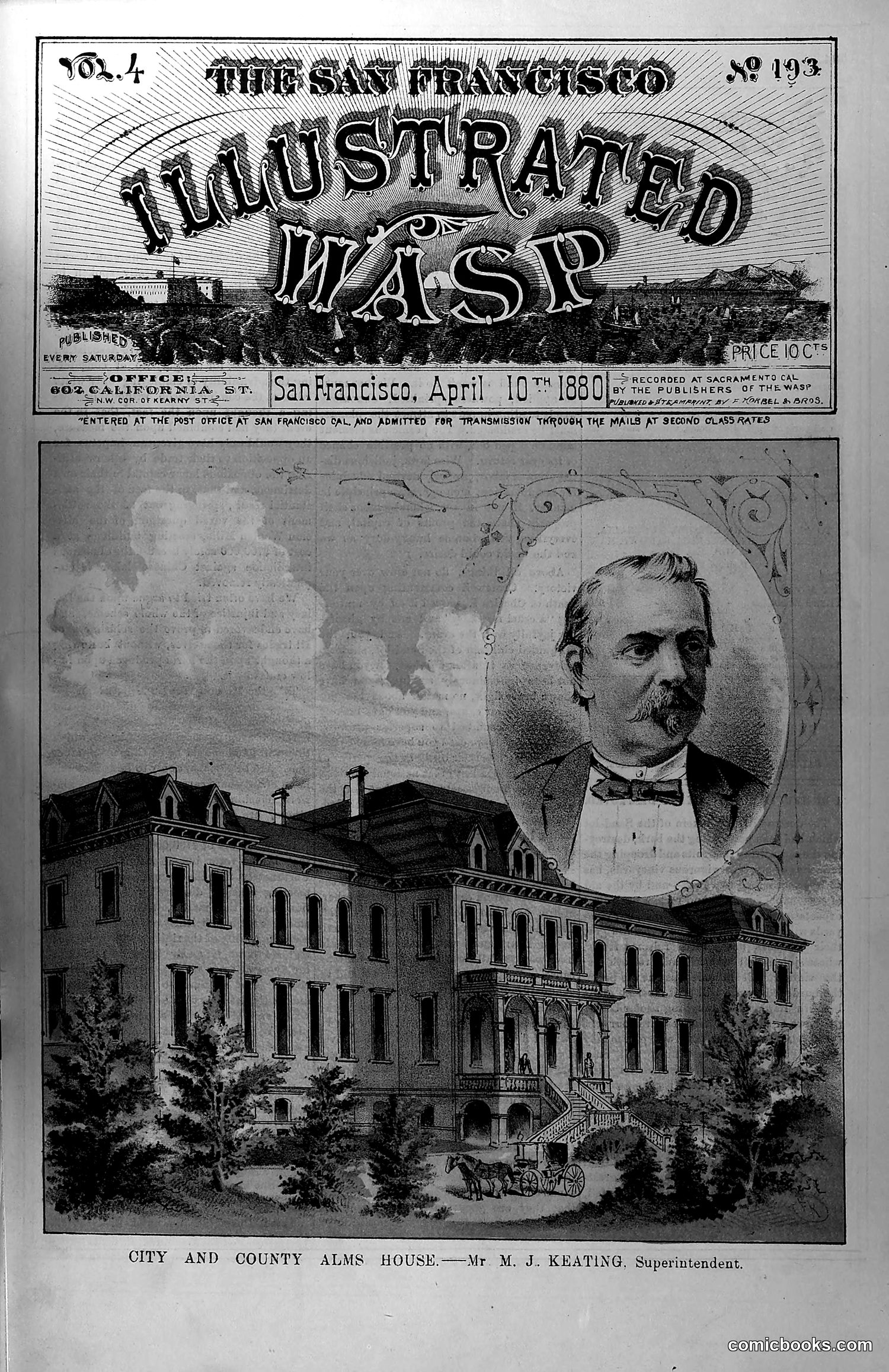
This page features an engraved portrait of **Mr. M. J. Keating**, identified as Superintendent of the City and County Alms House, alongside an illustration of the institutional building itself. Rather than satire, this appears to be a **laudatory or documentary feature** showcasing the alms house (a public poorhouse/welfare institution). The formal portrait and architectural rendering suggest the magazine is highlighting Keating's administration of this facility—likely either praising its operations or documenting the institution's importance to San Francisco's social welfare infrastructure. Without accompanying article text, the specific purpose—whether celebratory, investigative, or critical—remains unclear, though the respectful presentation suggests approval.
The page's masthead cartoon depicts **a wasp attacking a fly**, symbolizing the magazine's satirical mission to sting targets of criticism. The main article, "A Destructive Phylloxera Destroyed," addresses California's **phylloxera plague ravaging vineyards**. The text uses this agricultural crisis as extended metaphor for social problems, arguing that persistent threats (like the pest or social ills) require decisive action and shouldn't be merely concealed. A secondary piece, "A Futile Relapse," critiques a **British Colonial official's dismissal of patriotic concerns** as mere "symptoms" of discontent, suggesting authorities are dangerously ignoring legitimate grievances. The satire targets both **agricultural mismanagement and governmental complacency**—equating pest control with addressing social injustice. The magazine argues authorities must address root causes rather than superficially manage crises.
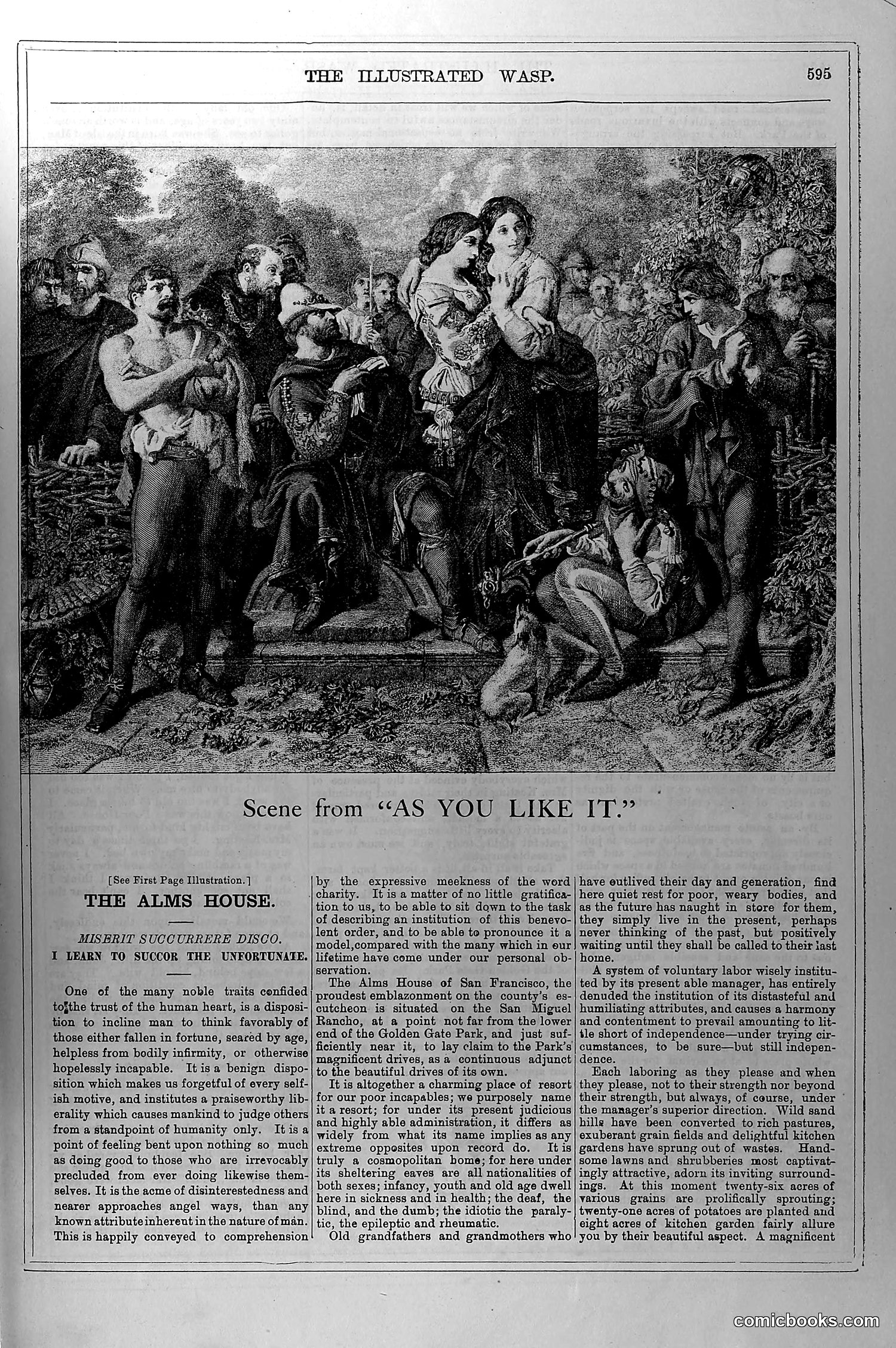
This page features an illustration captioned "Scene from 'As You Like It'" depicting Shakespeare's play. The accompanying article, "The Alms House: Miserit Succurrere Disco" ("I Learn to Succor the Unfortunate"), discusses San Francisco's almshouse on San Miguel Rancho. The text describes the facility's management of poor and vulnerable populations—the blind, deaf, elderly, infirm, and mentally ill—praising its administration and improvements. It details recent agricultural and infrastructure developments: twenty-one acres of sprouting grain, kitchen gardens, and potato cultivation. Rather than satirizing specific figures, this appears to be earnest social commentary celebrating institutional care for San Francisco's indigent population, presented through the literary reference and accompanying advocacy article.
This page consists almost entirely of **text articles rather than political cartoons**. The single illustration shows an elderly woman's profile in simple line drawing. The articles discuss **charitable institutions and social welfare**, particularly describing conditions at what appears to be a poorhouse or almshouse. They criticize the treatment of poor residents while praising the benevolent management of facilities like the Alma House. The content emphasizes **moral arguments about charity and institutional care** for destitute populations—orphans, elderly widows, and mentally disabled individuals. The articles highlight both deplorable conditions elsewhere and examples of humane treatment. The illustrated woman's portrait likely accompanies one of the welfare narratives, possibly representing an actual resident or beneficiary discussed in the text.
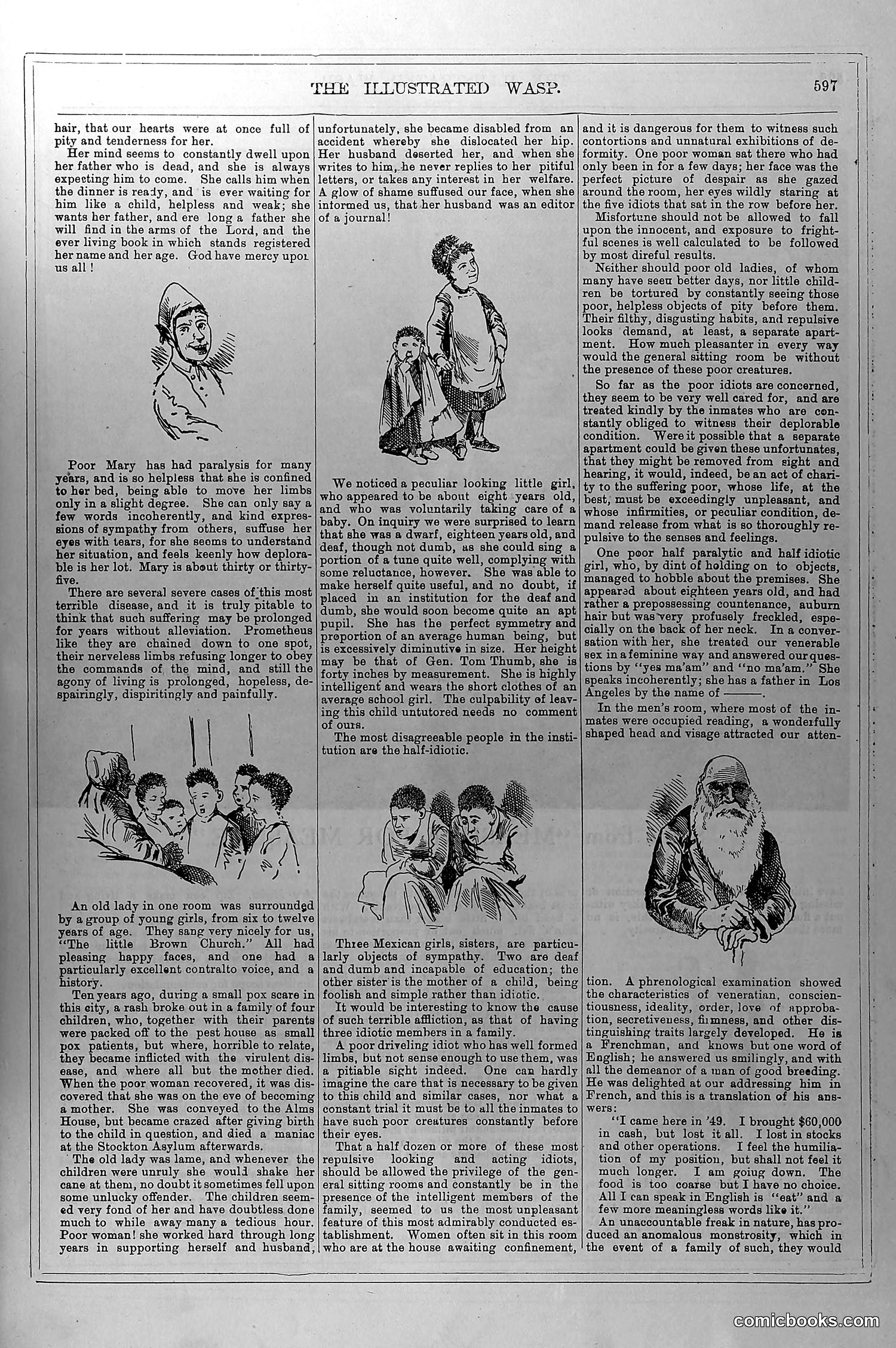
This page documents conditions at what appears to be a San Francisco charitable institution or poorhouse. The text and accompanying engravings criticize the treatment of vulnerable residents—particularly disabled elderly women and children. The satirical critique focuses on: 1. **Poor Mary**: A paralyzed woman confined to bed for thirty years, described as neglected and hopeless. 2. **Institutional conditions**: The piece attacks the inadequate care given to residents, particularly "half-idiots" and disabled individuals. 3. **Specific cases**: Mexican deaf sisters, an elderly woman surrounded by young girls, and other vulnerable figures are presented as evidence of institutional negligence. The satire's point appears to be exposing systemic failure—calling out the inhumane conditions and arguing that charitable institutions are failing their most vulnerable charges. This is social reform journalism disguised as satire, targeting institutional neglect rather than political figures.
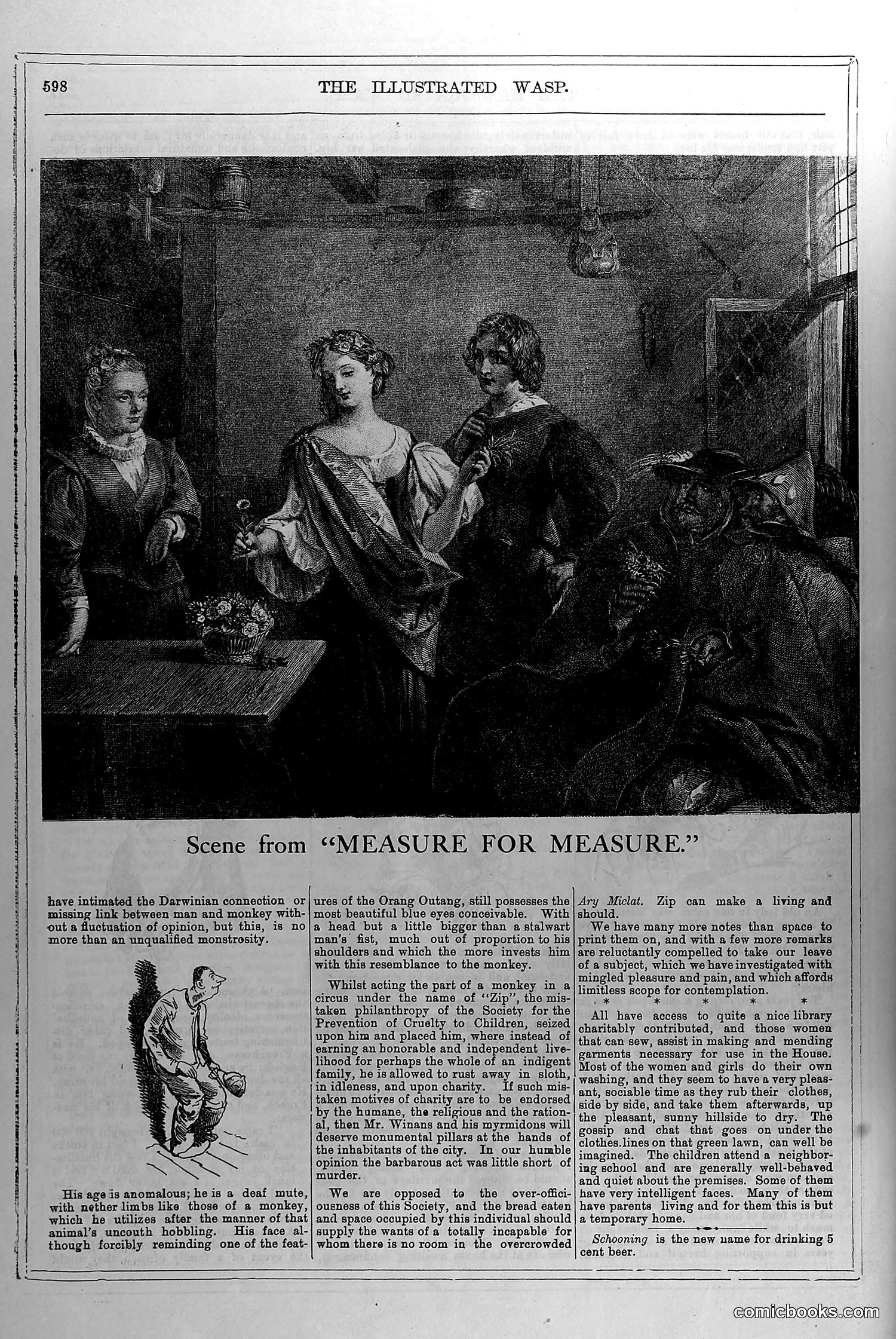
This page features a scene illustration from Shakespeare's "Measure for Measure" at the top, depicting period-costumed figures in what appears to be a dramatic confrontation. The text below discusses a monkey that the Society for the Prevention of Cruelty to Children had seized and placed in their care. The satire criticizes the Society's perceived overreach—the author argues they focus excessively on minor animal welfare issues while ignoring serious human suffering in overcrowded tenements. The critique appears to be that the organization prioritizes charitable publicity (caring for a "Zip" monkey) over addressing genuine poverty and neglect among city children. The author questions whether such theatrical charity efforts represent genuine compassion or merely self-serving organizational expansion.
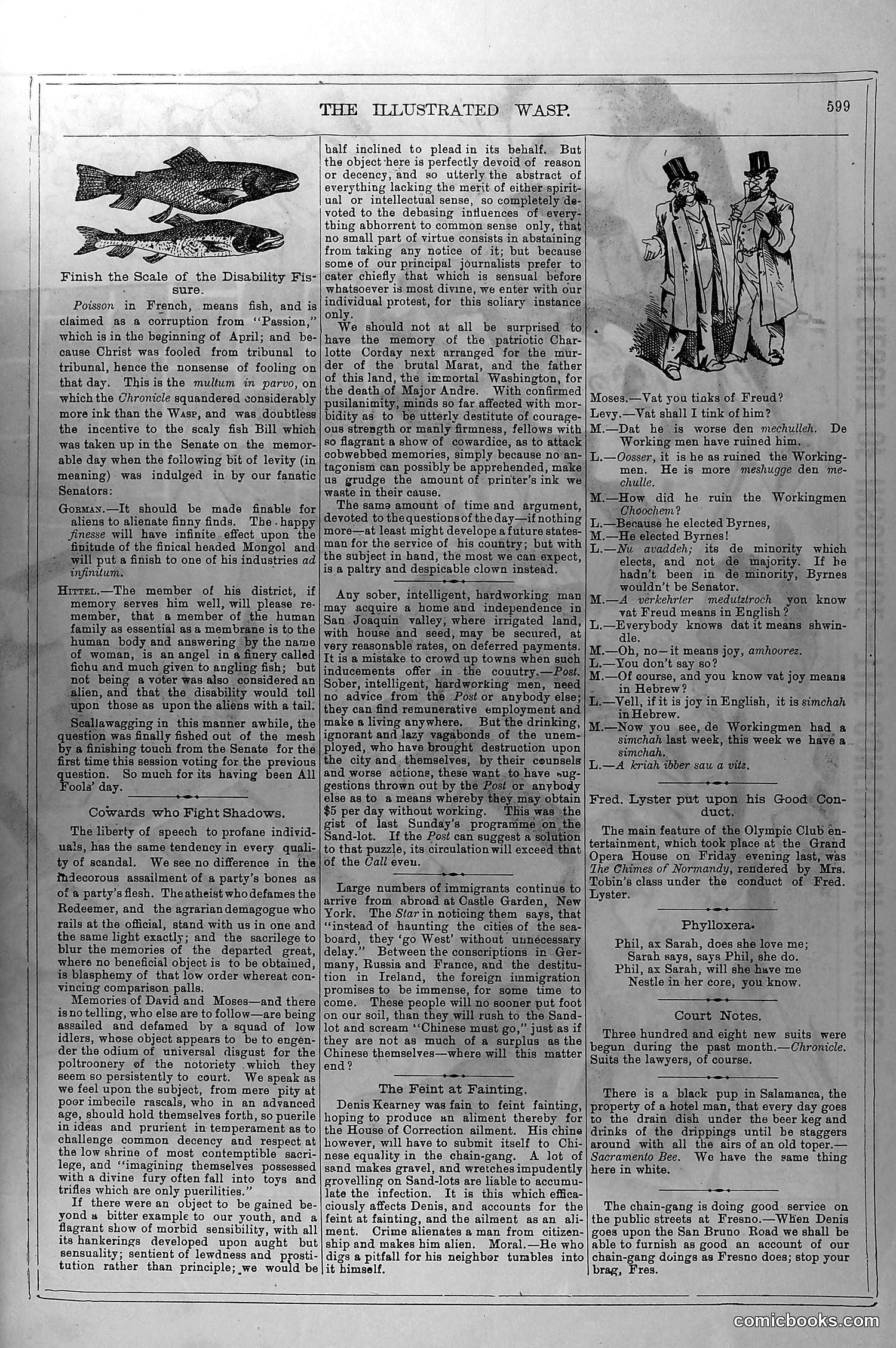
This page contains satirical commentary and several sections rather than a single unified cartoon. The main illustration shows two well-dressed men in Victorian-era clothing having a conversation. The dialogue beneath—featuring "Moses," "Levy," "Osser," and "Choochem"—appears to be ethnic satire using Yiddish-inflected English, mocking Jewish characters and stereotypes common to 19th-century American humor. Below are various sections including "Court Notes," "Cowards who Fight Shadows," and commentary on political/social issues. The text discusses voting rights, immigrant populations arriving at Castle Garden, and criticism of various public figures and policies. The satire reflects period prejudices against Jewish immigrants and broader social anxieties about immigration and voting power—characteristic of American satirical magazines of this era.
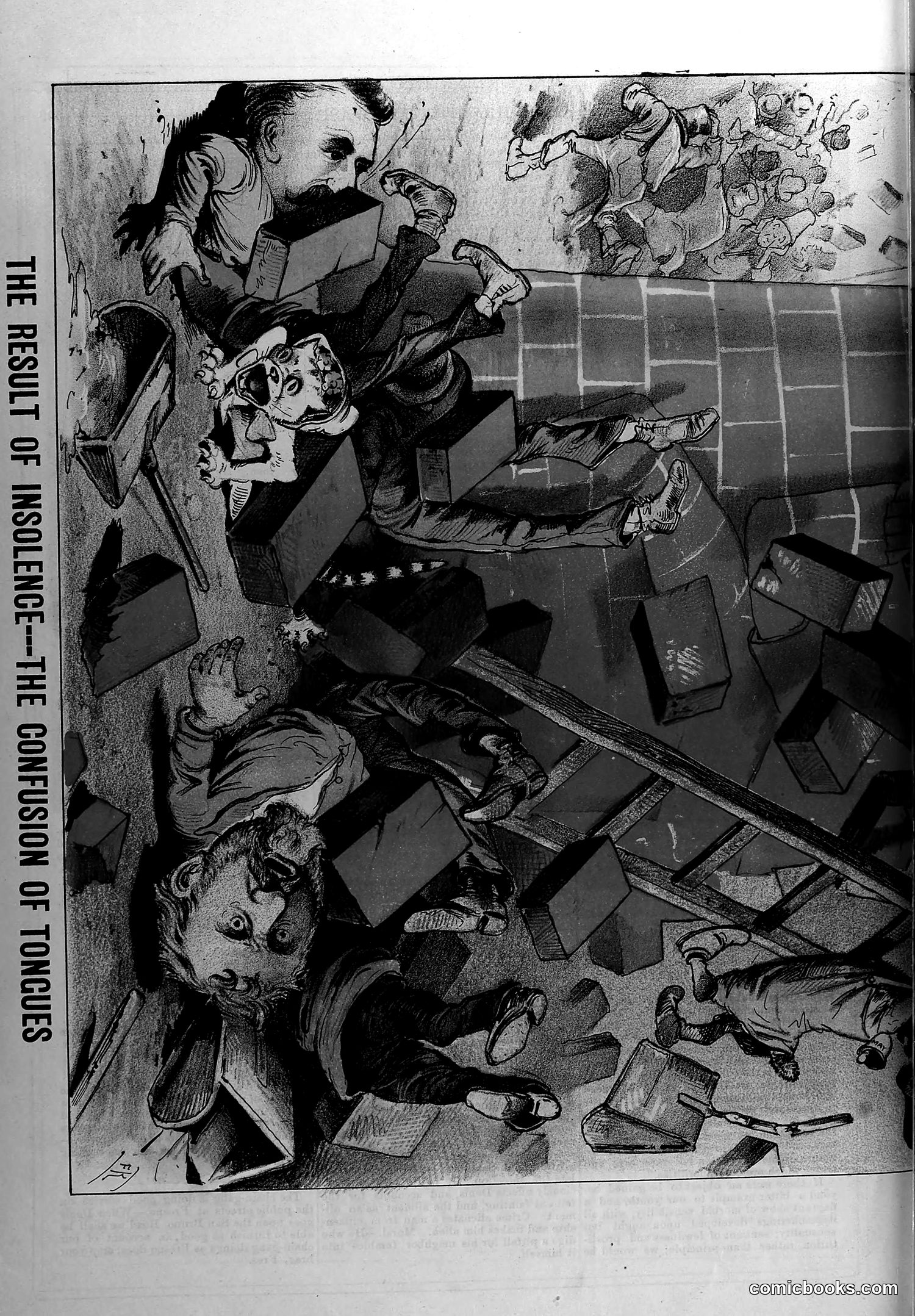
This satirical cartoon depicts a figure (likely a political or business leader) surrounded by chaos and destruction. The title suggests consequences resulting from arrogant behavior ("insolence"). The scene shows: - A well-dressed man appearing distressed amid disorder - Multiple fallen or struggling figures below - Scattered documents and boxes - What appears to be a collapsing structure or "towers" The imagery suggests financial collapse, scandal, or political downfall. The "concourse of towers" likely refers metaphorically to powerful institutions or the wealthy elite. The cartoon satirizes how arrogance or misconduct leads to dramatic public failure, with ordinary people suffering the consequences alongside the implicated figure. Without specific dates or captions, the exact historical event remains unclear, but the theme critiques corruption and accountability.
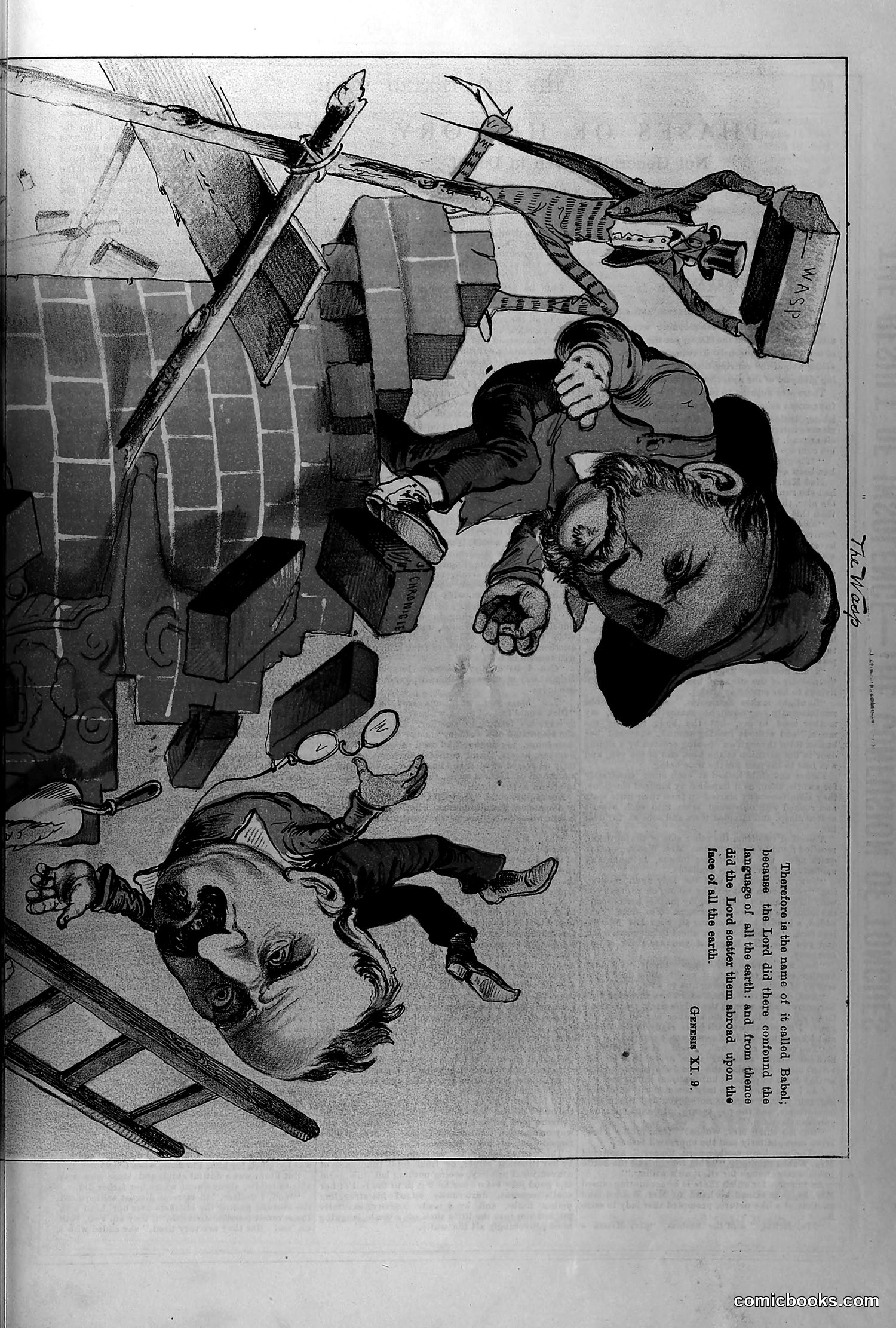
This appears to be a satirical cartoon from *The Wasp* magazine depicting what looks like a violent or chaotic scene with multiple figures. The image shows exaggerated caricatures in a physical altercation or tumultuous situation, rendered in the sharp, grotesque style typical of 19th-century political satire. Without being able to clearly read the caption text or identify specific individuals with certainty, I cannot definitively explain which political figures or events this references. The style suggests commentary on political conflict, possibly involving multiple parties in confrontation. The theatrical exaggeration and physical comedy are characteristic of *The Wasp*'s approach to mocking political opponents. To accurately identify the specific figures, events, and satirical point, I would need either clearer text or additional historical context about the publication date.
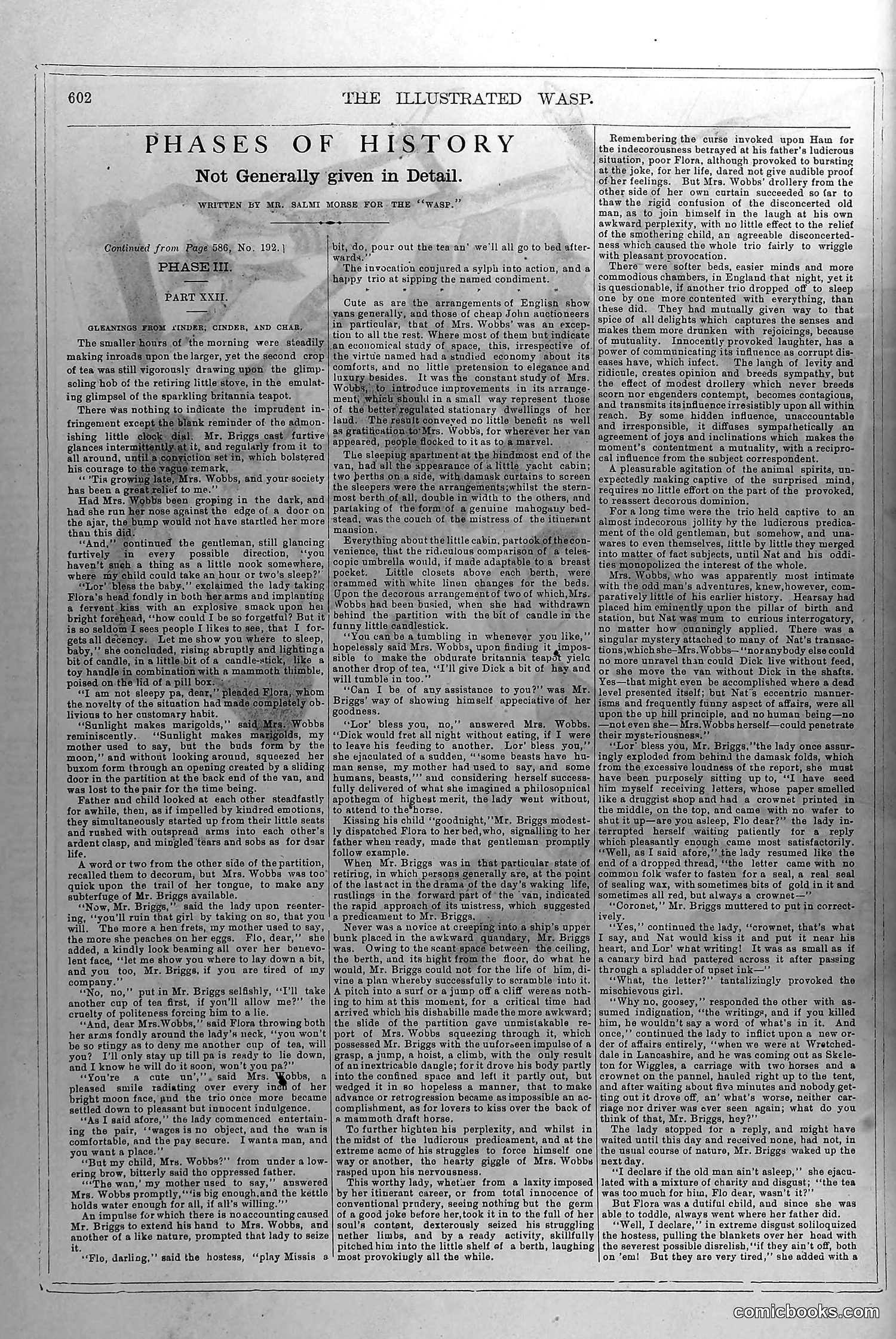
This appears to be a **serialized fiction story** rather than a political cartoon. The page is titled "PHASES OF HISTORY: Not Generally given in Detail" and is labeled "PART XXII: GLEANINGS FROM CINDER, CINDER, AND CHAR." The text describes a domestic scene involving characters named Mrs. Wobbs, Mr. Briggs, and others in what appears to be a satirical narrative about class relations and household dynamics. The story mocks Victorian social pretensions through dialogue about servants, sleeping arrangements, and social awkwardness. This is **humorous social satire** rather than political commentary—it targets middle-class Victorian manners and domestic absurdities. Without seeing accompanying illustrations, the specific visual jokes remain unclear, but the text suggests satirizing genteel pretension and social climbing of the era.
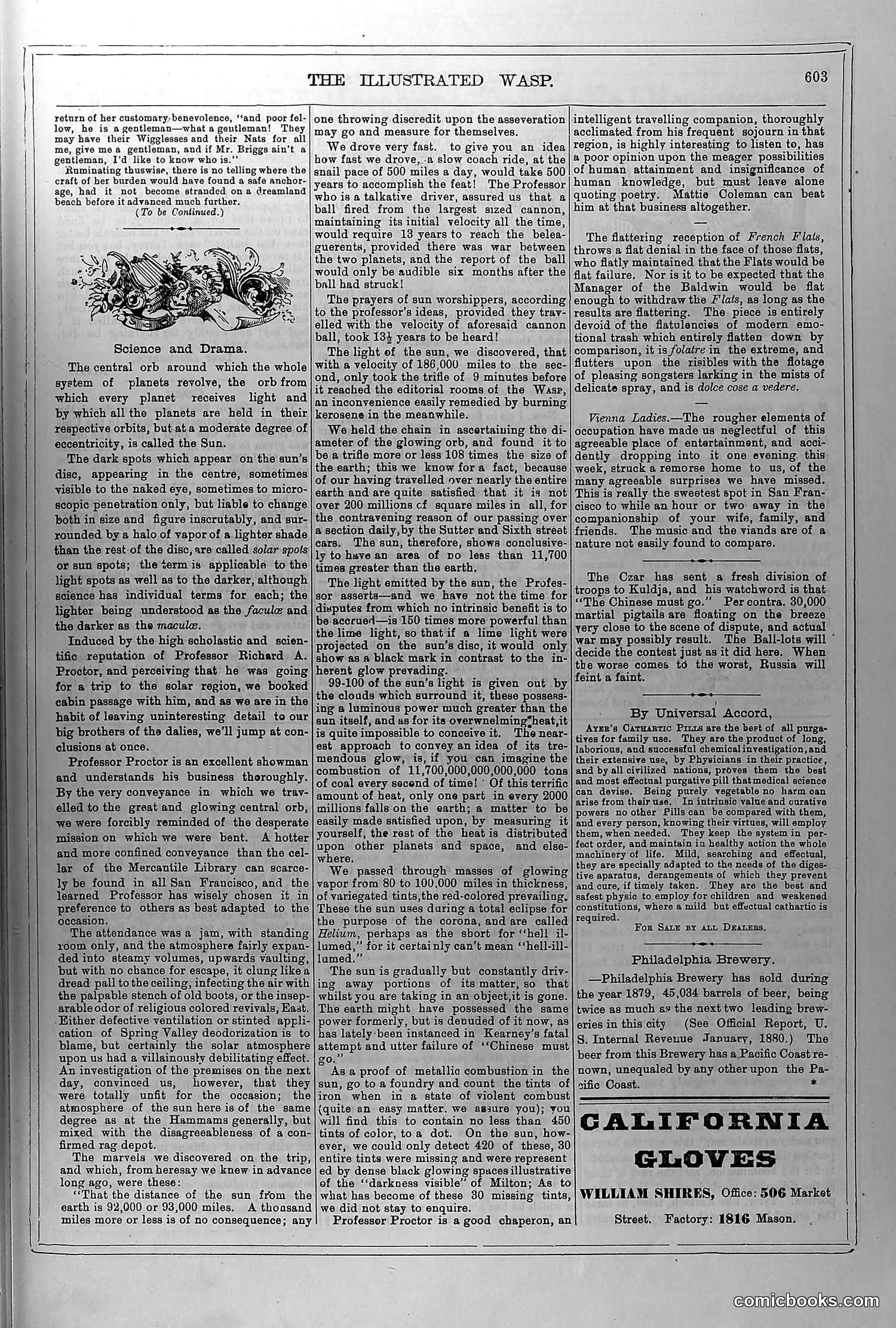
This page is primarily **text-based**, containing two distinct sections: 1. **"Science and Drama"** - A lengthy article describing Professor Richard A. Proctor's presentation about travel through the solar system. The piece humorously contrasts the professor's scientific lectures with theatrical embellishment, discussing calculations about planetary distances and light intensity. 2. **Advertisement section** - Including notices for "California Gloves" by William Shires and "Philadelphia Brewery." The page contains **no political cartoons or caricatures**. Instead, it's a satirical article poking fun at how Professor Proctor dramatizes scientific material for public audiences—treating his educational presentations as entertainment theater rather than pure science. The humor lies in this tension between scientific accuracy and showmanship.
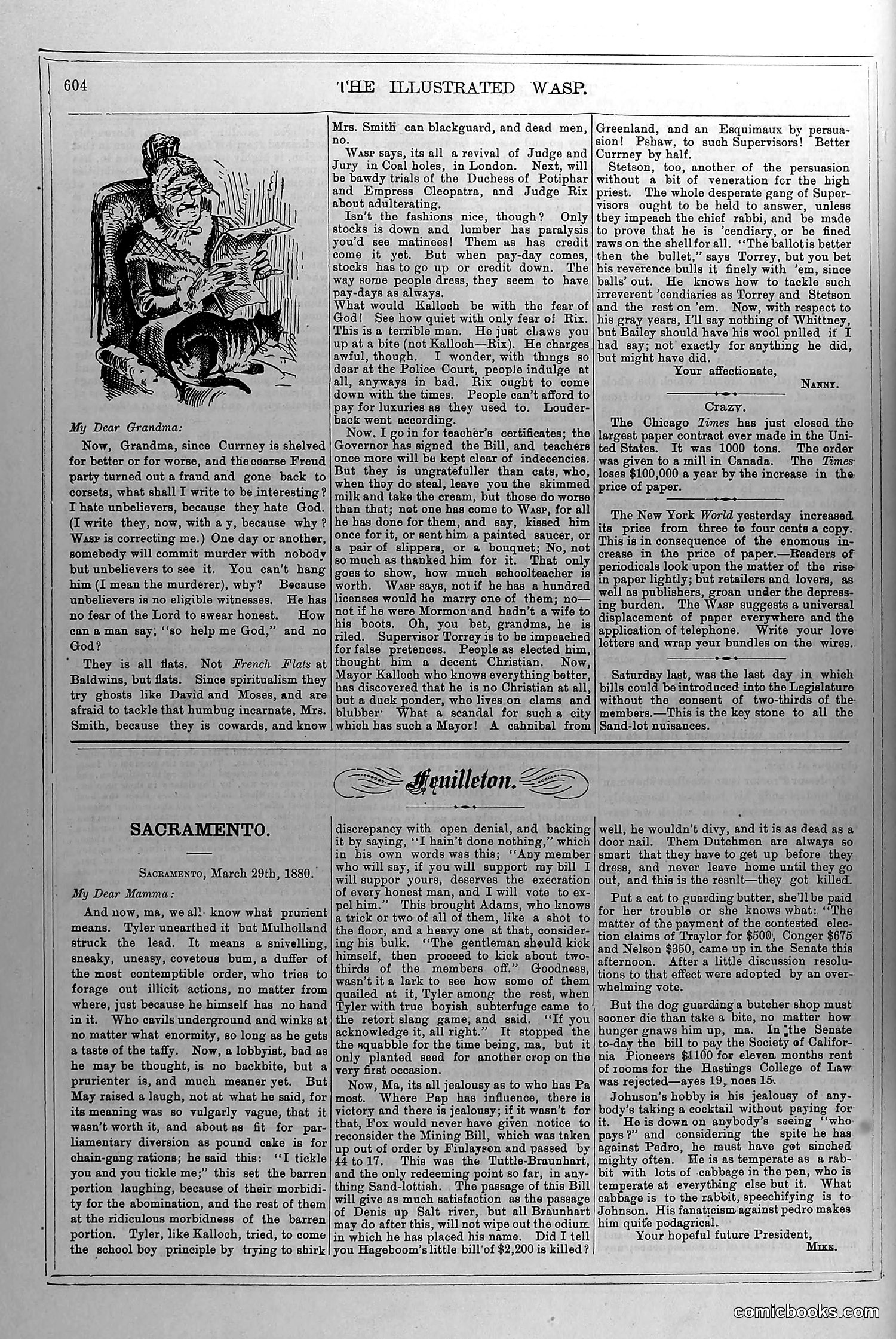
The page contains three sections: a satirical letter column addressing local San Francisco figures, a small illustration of what appears to be a beggar or street character, and a "Feuilleton" section with letters about Sacramento and other matters. The main cartoon (upper left) depicts a ragged, hunched figure in tattered clothing—likely representing poverty or urban decay. The accompanying letter critiques "Judge and Mrs. Smith" regarding their treatment of those in need, sarcastically praising their "blackguard, and dead men" approach. References to "Kalloch" (likely Mayor Isaac Kalloch) and complaints about municipal corruption and mismanagement suggest this page mocks San Francisco's leadership's indifference to poverty and justice. The tone is bitterly ironic throughout.
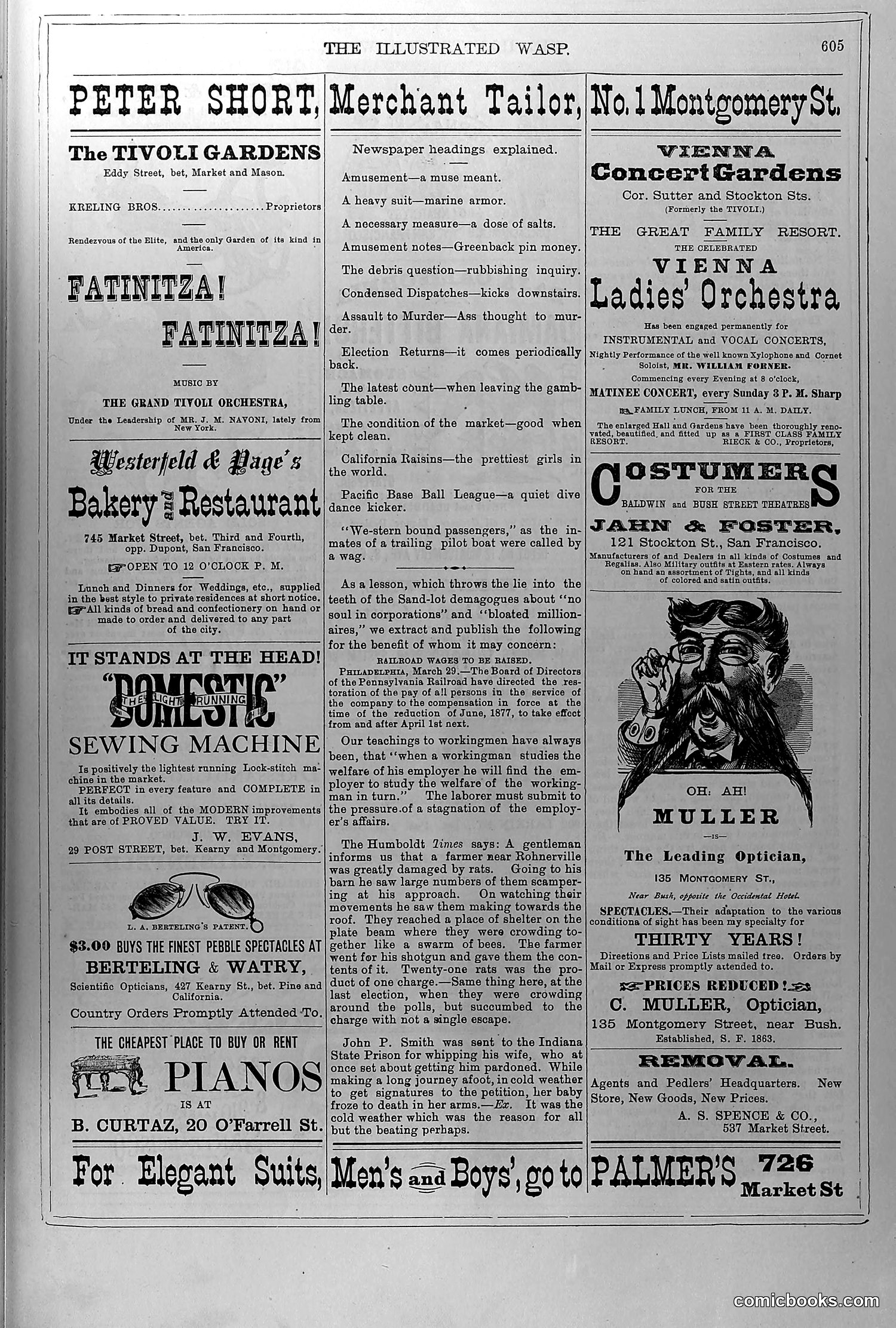
This page is predominantly **advertising and business listings** for San Francisco establishments (bakeries, theaters, opticians, piano sellers, tailors, orchestras, etc.), typical of late 19th-century magazine revenue. The only notable visual element is a **caricatured face labeled "OH, AH! MULLER"** — apparently promoting an optician's business. The exaggerated facial features (large nose, wild hair/beard) follow period conventions of comedic advertising rather than political satire. The page includes a section titled **"Newspaper headings explained,"** which offers humorous definitions of news terminology (e.g., "Amusement — a muse meant"), providing mild editorial commentary on journalism itself. Overall, this represents a **commercial/filler page** rather than substantive satire or political cartooning.
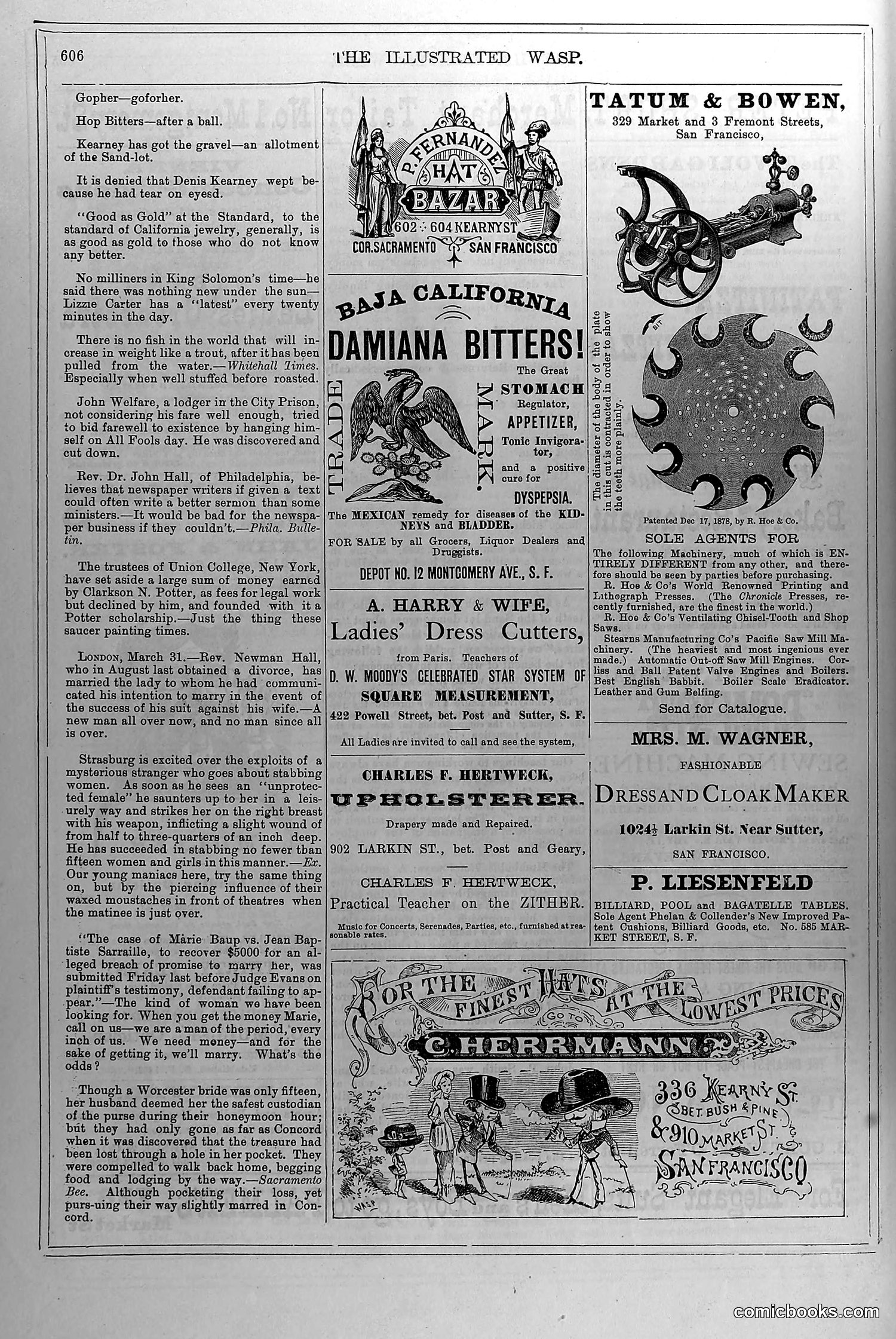
This page is primarily **advertising**, not political satire. It contains multiple commercial advertisements from 1870s San Francisco businesses, including: - Hat dealers (Hernandez Hat Bazaar, C. Herrmann) - Patent medicine (Damiana Bitters, a "cure" for kidney/bladder diseases) - Dress services (Ladies' dress cutters, seamstresses) - Billiard tables and other goods The only satirical content appears to be brief gossip items in the left column—anecdotes about local San Francisco figures (Kearney, Welfare, Rev. Hall, etc.) presented as social commentary. These reference minor scandals and character flaws of unnamed or barely-identified individuals. The page reflects The Wasp's dual nature: a satirical magazine that relied heavily on advertising revenue to sustain operations.
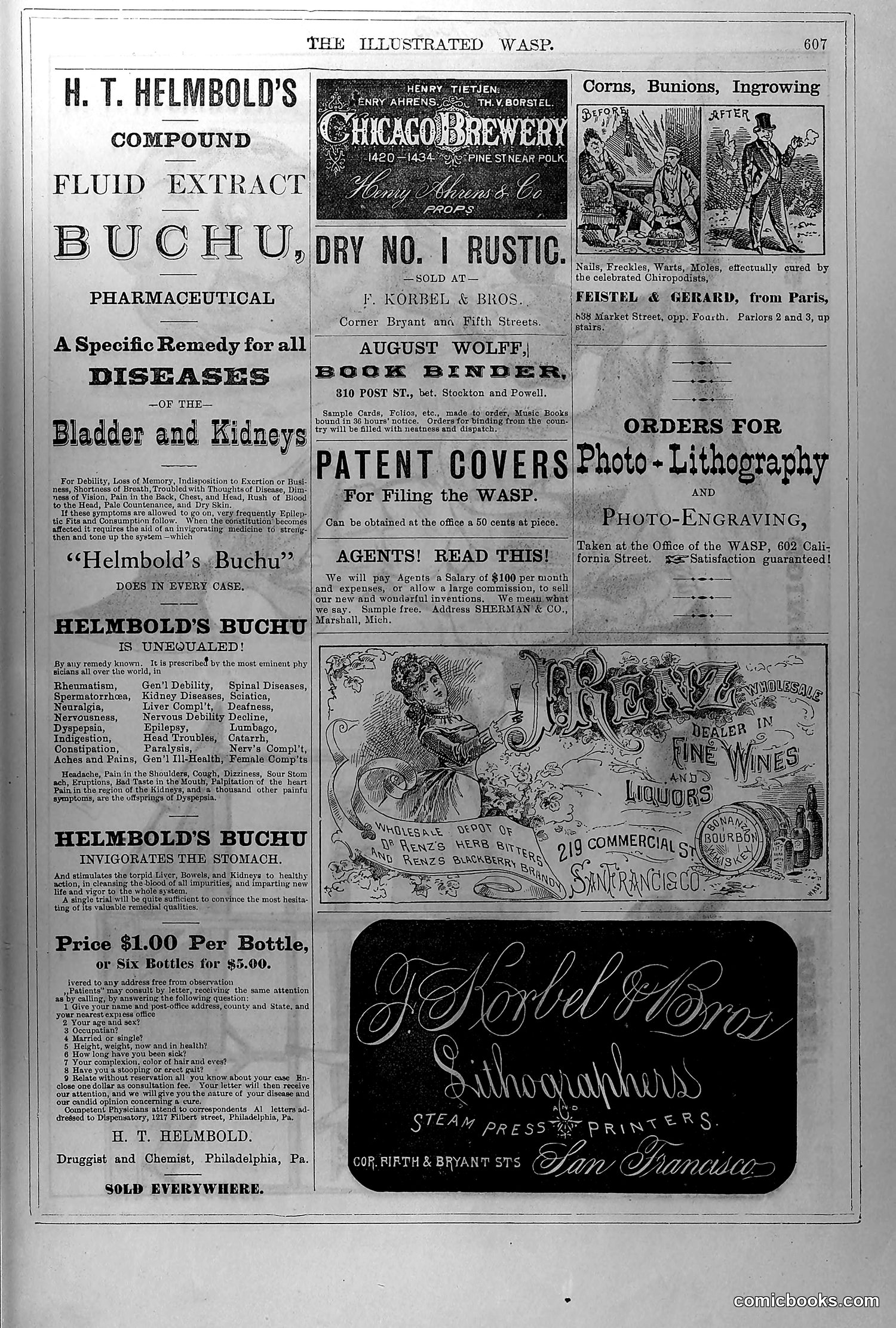
This page is primarily **advertising**, not satire or political commentary. It consists almost entirely of period advertisements for patent medicines and services typical of late 19th-century publications: - **Helmbold's Buchu**: A supposed cure-all for bladder, kidney, and various ailments, priced at $1.00 per bottle - **Corns and bunions treatment** by Fristel & Gérard (Paris) - **Chicago Brewery** advertisement - **Book binding, photo-lithography, and printing services** - **Wine and liquor merchant** (S. Brodsky) The only potentially satirical element is the ironic juxtaposition of dubious medical claims with commercial services, which was common in The Wasp. However, the page functions primarily as a revenue-generating advertisement section rather than editorial satire.
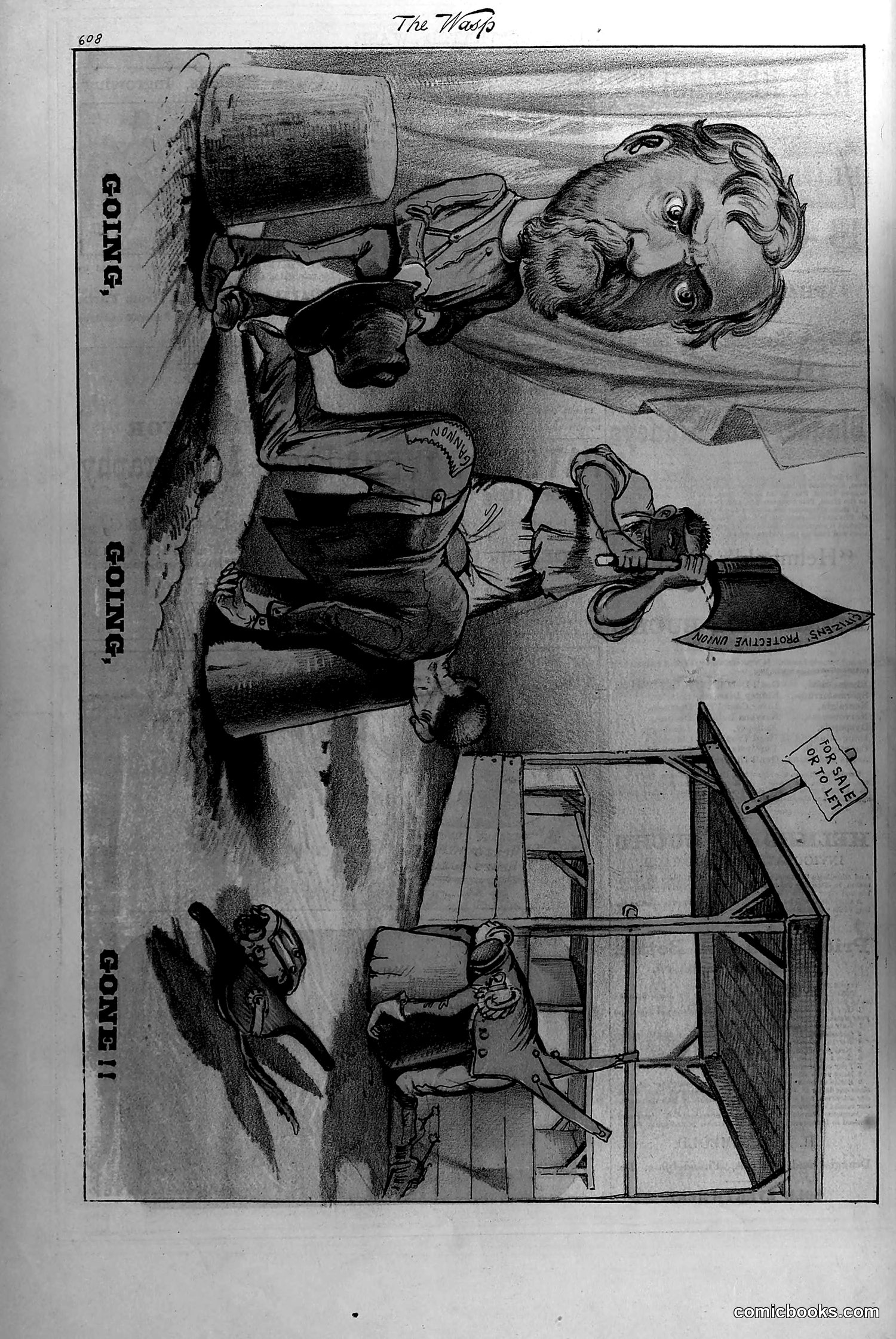
This page presents a three-panel satirical comic divided vertically by the label "COMING" repeated on the left margin. The cartoons appear to depict scenes related to cooking or food preparation, with exaggerated caricatures characteristic of late 19th/early 20th-century satire. The top panel shows a figure pouring from a large vessel. The middle panel depicts someone at what appears to be a stove or cooking apparatus. The bottom panel shows a smaller figure in a kitchen setting. Without clearer text or visible date information, the specific political or social references remain uncertain. The satire likely targets contemporary political figures or social issues through the cooking metaphor, but identifying the precise targets and intended meaning requires additional context unavailable from this image alone.

I can see this is a test page or calibration sheet for The Wasp magazine, not an actual cartoon or article page. The image shows: - A color reference chart (the grid of varying gray squares on the left) - A measurement ruler (the vertical scale marked 6-11 inches) - Horizontal measurement scales along the bottom and left edges - A mostly blank white page above This appears to be a technical reference page used in the magazine's printing or reproduction process, rather than editorial content. Without visible cartoon artwork, caricatures, or satirical imagery on this particular page, I cannot identify specific political or social references that would be present on an actual Wasp content page.