
A complete issue · 18 pages · 1880
The Wasp — April 3, 1880

I can see this is a measurement/scale photograph from what appears to be an archival document, but the image quality and angle make it impossible for me to discern any cartoon content, political figures, or satirical messaging that would be present on a Wasp magazine page. The photo shows Oregon Rule Co. rulers/scales against a black background with a grayscale reference chart, which appears to be a documentation or cataloging photograph rather than a readable reproduction of the magazine page itself. Without being able to read the actual cartoon or text clearly, I cannot identify figures, explain references, or interpret the satire as requested. A higher-quality, direct scan of the magazine page would be necessary to provide the analysis you're asking for.
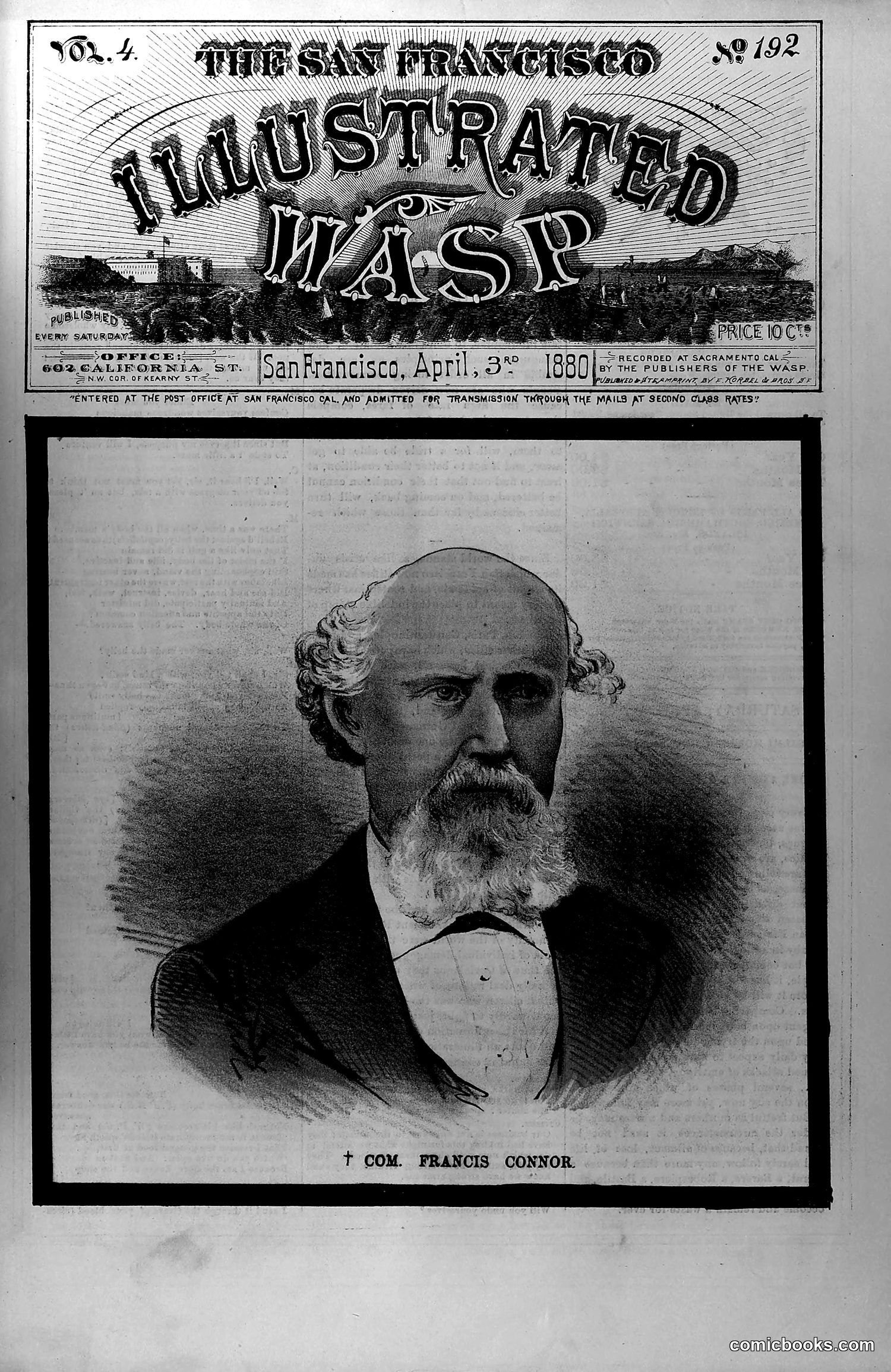
This cover features a portrait of **Com. Francis Connor**, a U.S. Navy Commodore. The Wasp was a San Francisco-based satirical publication known for political and social commentary. Without additional OCR'd text from the article itself, the specific satire directed at Connor is unclear from the image alone. However, The Wasp typically mocked political figures, military officials, and prominent citizens through caricature and editorial commentary. Connor's formal naval dress and dignified pose suggest the magazine may have been either praising or—more likely, given The Wasp's satirical nature—critiquing his public conduct or policies during this period. The specific grievance or joke requires the accompanying article text to determine.
This page is primarily **text-based content** rather than political cartoons. The masthead and decorative header are visible, but the main content consists of: 1. **Subscription information** and publication details for the satirical magazine 2. **A lengthy article titled "Rome and Her Rats at the Point of Battle"** by Salmi Morse, the Managing Editor The article appears to be **social commentary** comparing San Francisco's urban problems (disease, crime, poverty) to Rome's historical decline. It uses metaphorical language about "rats" and "diseases" affecting the city, likely criticizing municipal governance and social conditions in 1880s San Francisco. The right column contains what appears to be **verse or dialogue**, though the exact satirical target remains unclear from this excerpt alone.
This page contains two distinct sections: **"To Our Sand-Lot Brethren"** appears to be a satirical letter addressing working-class political activists (the "Sand-Lot" likely refers to San Francisco's Sand Lot movement). It mocks their radical rhetoric while cautioning restraint, suggesting they should prove their fitness for political power through discipline rather than inflammatory behavior. **"Sacramento"** discusses California state politics and land/mining disputes. The letter critiques what appears to be corrupt or incompetent governance, mentioning various legislative proposals and political maneuvering around railroad interests and water rights. The overall tone is satirical commentary on state and local politics, targeting both radical workers and establishment politicians for their respective failings. The specific figures and bills referenced are unclear without additional historical context.
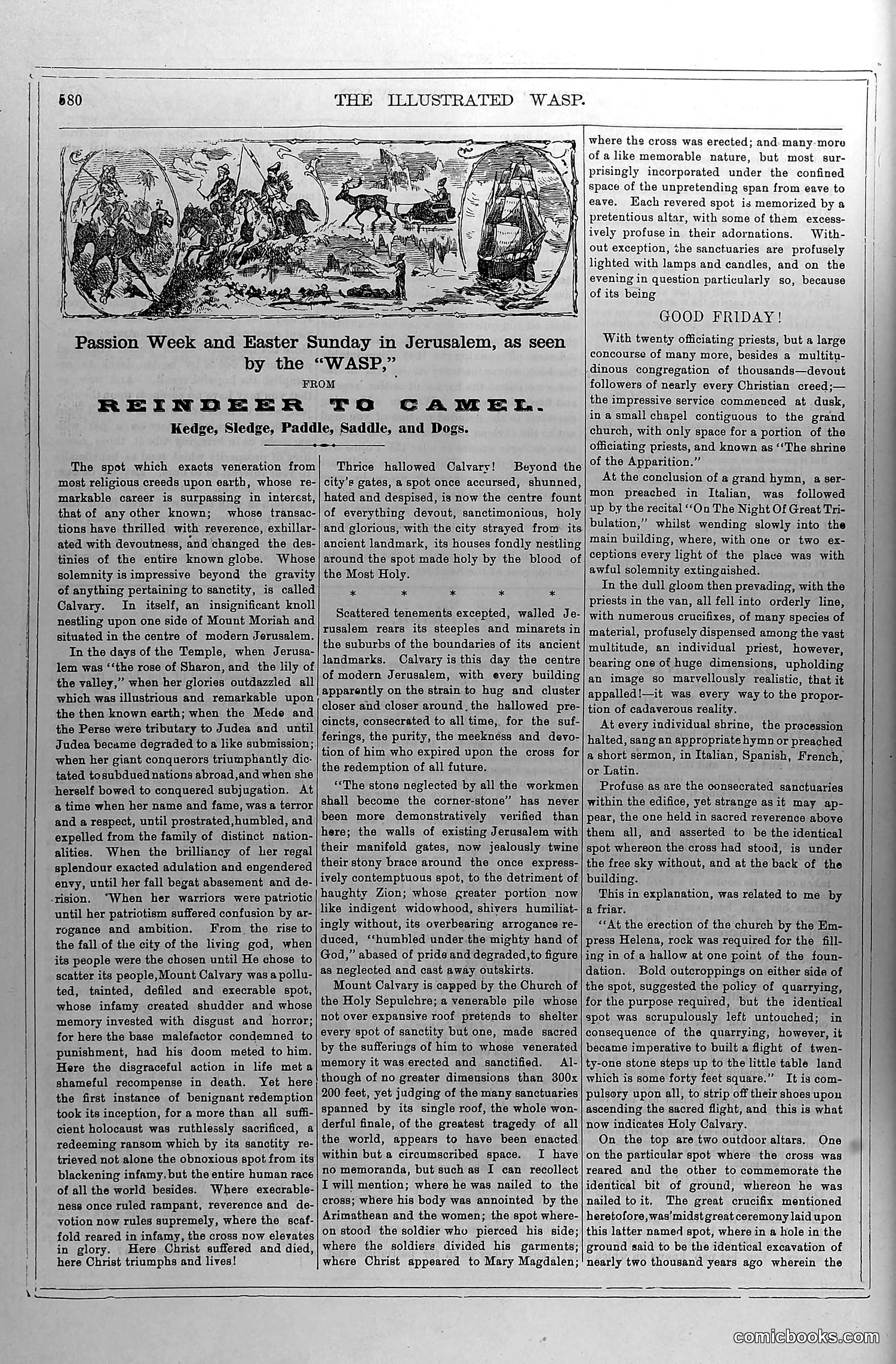
This page contains **no political cartoon or satire**. Instead, it features a lengthy earnest article titled "Passion Week and Easter Sunday in Jerusalem, as seen by the 'WASP,'" describing religious sites and ceremonies in Jerusalem. The decorative header illustration shows scenes of Jerusalem's holy sites and a ship, but these are documentary rather than satirical. The text discusses Calvary, the Church of the Holy Sepulchre, and various sacred locations, treating the subject with reverence rather than mockery. This appears to be a **travel narrative or religious journalism piece** rather than typical Wasp satirical content, suggesting the magazine occasionally published serious reportage alongside its usual political humor.
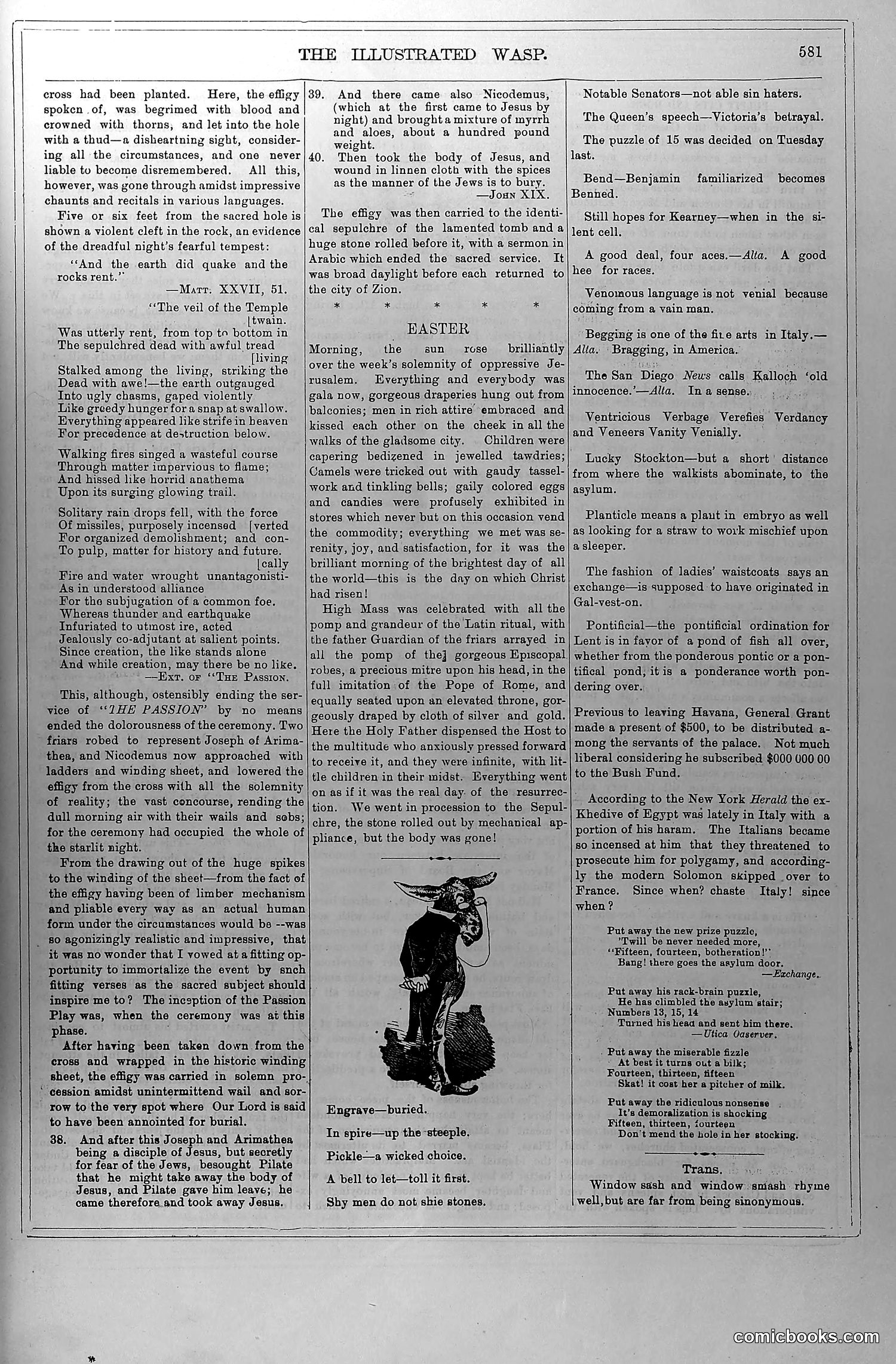
This page contains primarily **literary and editorial content** rather than political cartoons. The main sections include: **"Easter"** — A lengthy passage describing Easter morning celebrations, emphasizing the resurrection of Christ and religious ceremony. The text appears satirical in tone, mock-solemnly describing "the day on which Christ had risen." **Single illustration**: An engraved figure labeled "Engrave—buried" showing what appears to be a demon or devil-like creature, likely accompanying the Easter narrative. **Right column**: Miscellaneous society notes, puzzle answers, and brief quips about contemporary figures and social matters, including references to General Grant, Egyptian politics, and fashion commentary. The page functions as a **satirical magazine section** mixing religious commentary with social gossip rather than presenting coherent political cartooning.
This page contains theater criticism rather than political cartoons. The main illustrated element appears to be a small decorative drama emblem at the top of the middle column. The text reviews theatrical productions, particularly criticizing "The War," described as "a great blab" presented at the French Flats at the Baldwin theater. The reviewer attacks the play as lacking conventional structure—neither tragedy, drama, melodrama, nor comedy—and suggests it cannot be called a comedy despite its attempted humor. The critique focuses on theatrical merit and artistic execution, praising actors' skill while condemning the play's fundamental weakness. A secondary review discusses "Mayor's Office," another theatrical performance deemed a failure due to poor execution and lack of audience sympathy, with criticism directed at both the artist and performers. This is primarily literary criticism rather than visual satire.
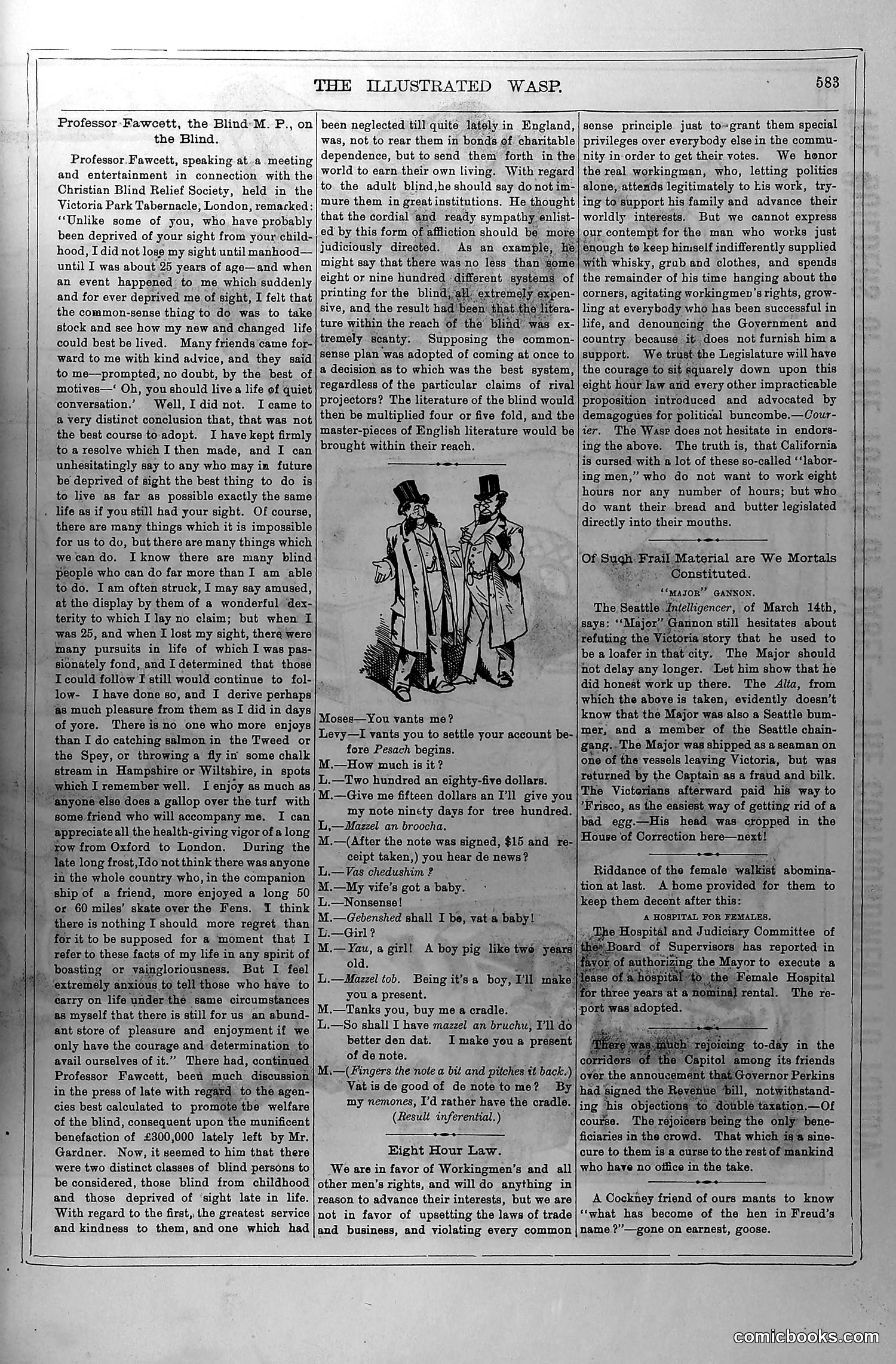
This page contains a conversation-based cartoon featuring two gentlemen in top hats and overcoats. The dialogue concerns a financial dispute: one figure (Moses) owes the other (Levy) money—specifically "$250 and an additional fifteen dollars"—for what appears to be a business transaction. Levy is demanding settlement, while Moses attempts various evasions and excuses. The satire targets contemporary attitudes toward Jewish businessmen and money-lending. The stereotypical names and the focus on haggling over financial obligations reflect late-19th-century antisemitic tropes common in American satirical publications. The cartoon presents the negotiation as inherently comedic, relying on ethnic caricature rather than substantive social or political critique.
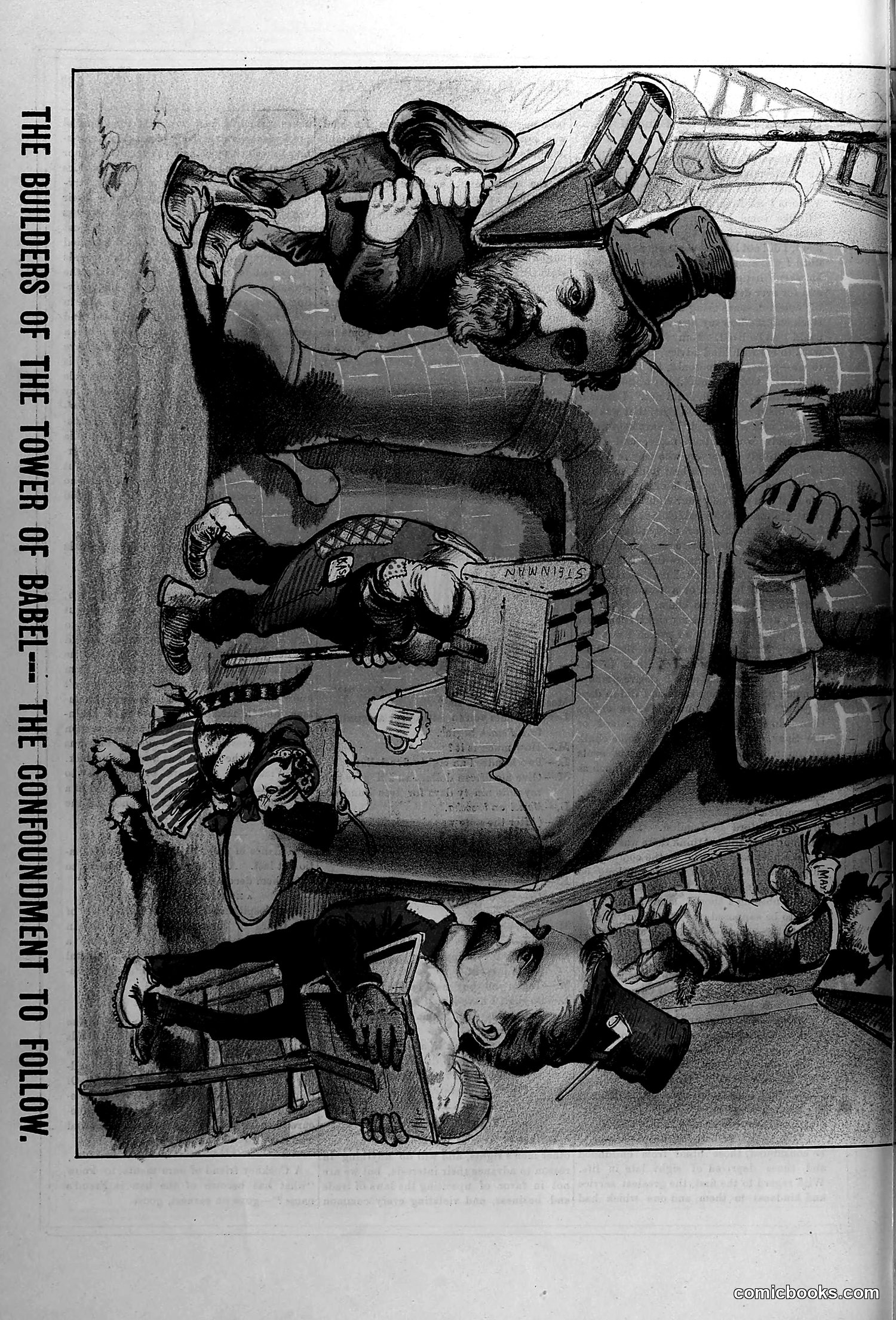
This political cartoon satirizes corruption and mismanagement in government construction projects. The title references the Biblical Tower of Babel, where workers spoke different languages and couldn't communicate, leading to chaos—here used as metaphor for governmental dysfunction. The image depicts multiple figures (likely politicians and bureaucrats) in a construction site, appearing to work at cross-purposes. One holds what appears to be architectural plans labeled "MURNSILS" (likely a misspelling in OCR). The scattered, disorganized scene suggests incompetence, waste, and lack of coordination in public works. *The Wasp* was a satirical publication known for attacking political corruption. Without clearer dates or specific labels, the exact scandal referenced remains unclear, though this appears to critique Gilded Age government inefficiency.
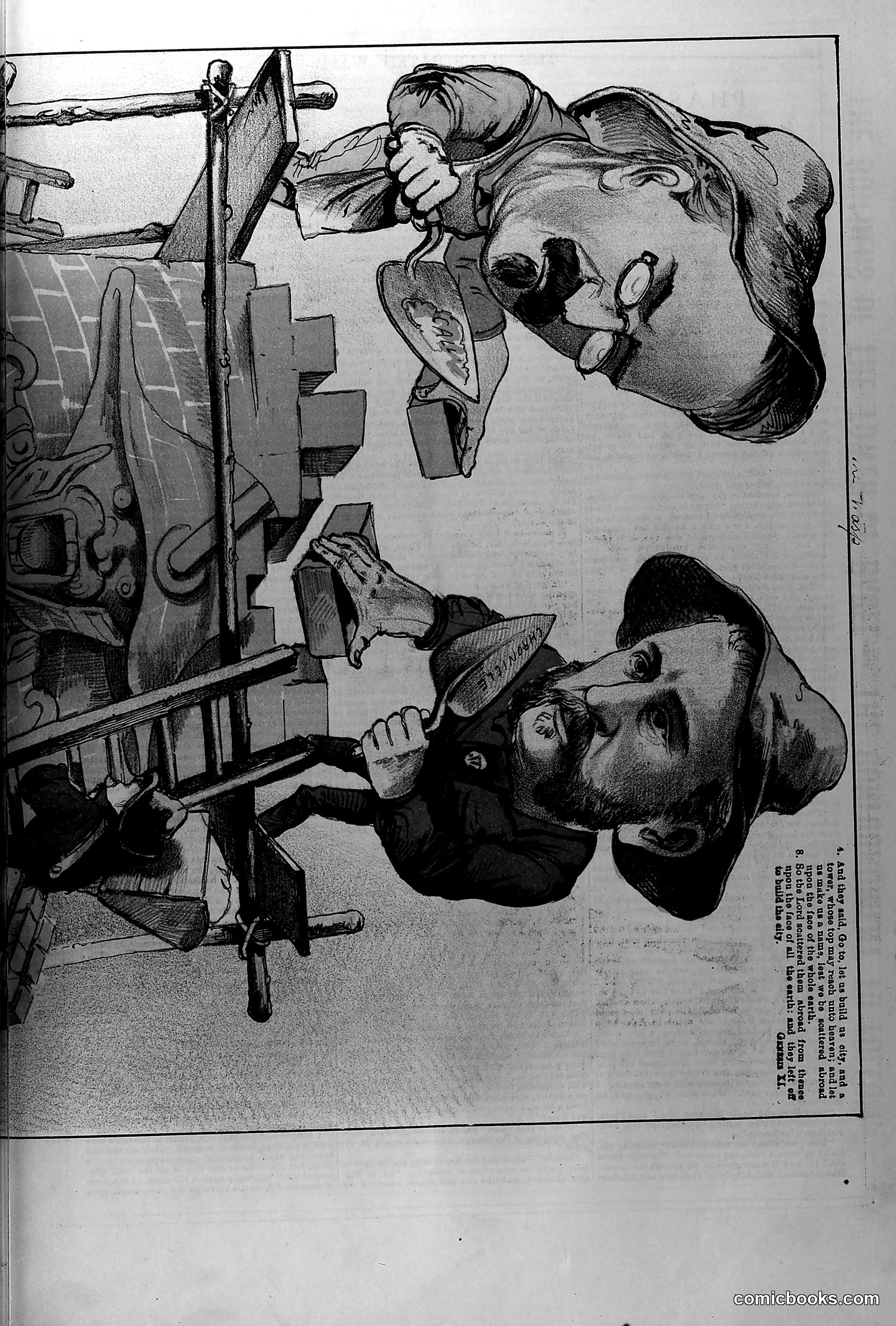
I can see this is a political cartoon from *The Wasp* magazine, but the OCR text provided is blank or illegible, making it difficult to identify the specific figures and historical context with certainty. The image shows two caricatured figures in what appears to be an industrial or mechanical setting. The exaggerated facial features and caricature style suggest this is satirical commentary on particular individuals or groups. One figure appears to be working with mechanical equipment or tools. Without legible text identifying the subjects and without being able to read any caption or accompanying text clearly, I cannot confidently explain who these figures represent, what specific political or social situation is being satirized, or what the cartoon's point of critique is intended to be. To provide accurate historical context, I would need either clearer OCR text or additional identifying information.
This page is primarily text rather than a cartoon. It's a serialized story titled "Phases of History: Not Generally given in Detail," written by Mr. Salmi Morse for *The Wasp*. The narrative appears to be a melodramatic tale involving characters named Nat, Flora, Briggs, and others in what seems to be a domestic drama with elements of class conflict and moral tension. The story deals with themes of social aspiration, disappointment, and romantic entanglement among working and middle-class characters. Without seeing accompanying illustrations clearly, the specific satirical targets remain unclear, though the serialized format suggests this was *The Wasp's* regular fictional contribution to the magazine's satirical content.
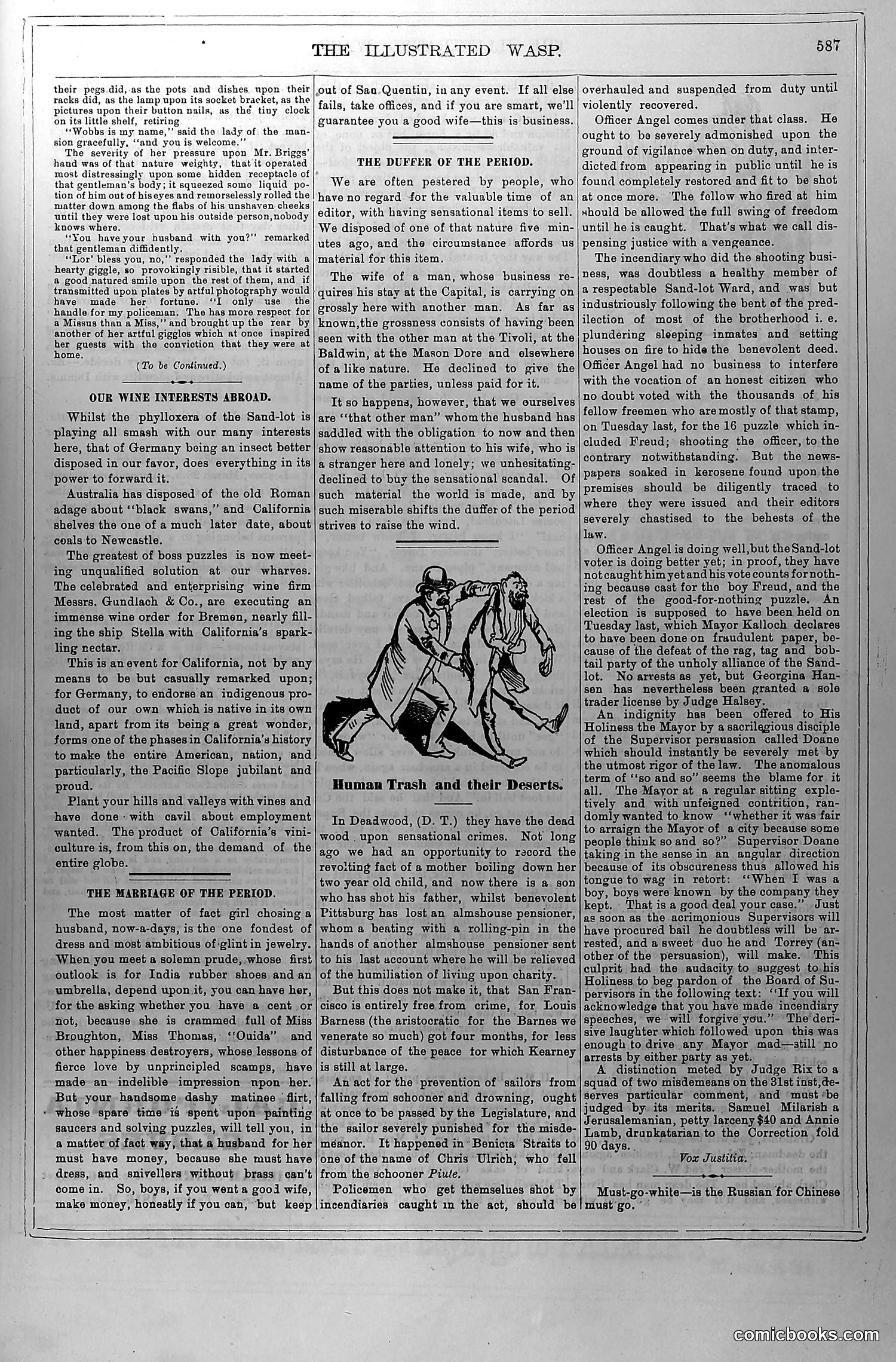
The cartoon depicts two figures engaged in what appears to be a physical altercation or struggle. Based on the accompanying article, this illustrates a dispute in Deadwood, Dakota Territory involving a woman who boiled down her dead child's body and a man named San Francisco Louis (a transient) who had shot her father. The satire critiques both the brutal frontier conditions and the legal system's handling of such cases. The article discusses how Judge Rix and Mayor Kellogg debated whether to punish various parties involved, highlighting the chaos of frontier justice where serious crimes—infanticide, murder, desecration of remains—received inconsistent legal treatment. The cartoon's title sarcastically refers to how the frontier "deserved" such brutal inhabitants and incidents.
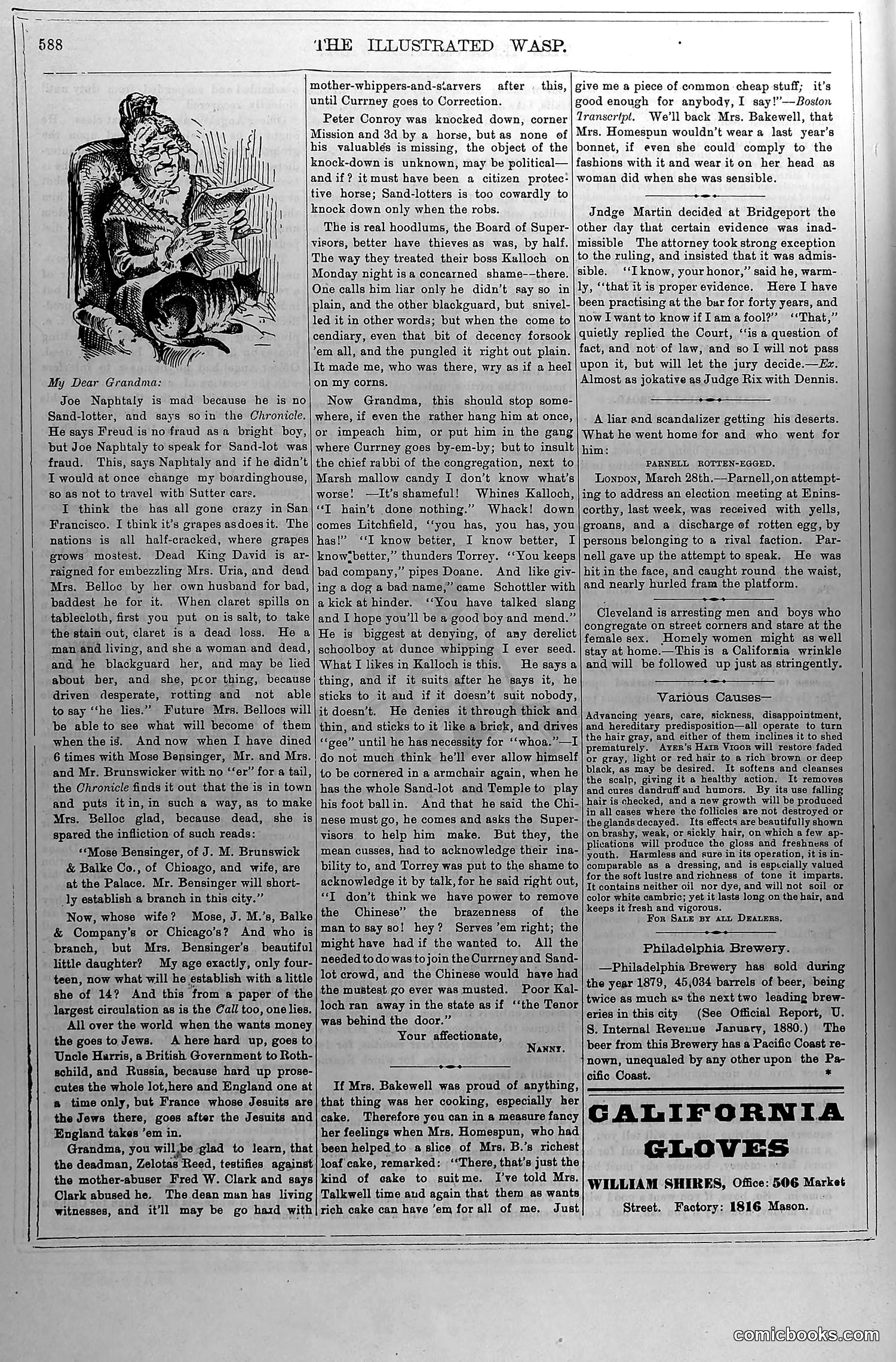
The main cartoon depicts an elderly woman scolding a young man in what appears to be a domestic confrontation. Based on the accompanying letter titled "My Dear Grandma," the satire concerns **Joe Naphtaly**, who is "mad" and accused of being a "sand-lotter" (apparently a derogatory term). The letter criticizes Naphtaly's association with **Freud** and his supposed influence on local youth. The cartoon mocks what the writer sees as misguided modernist ideas corrupting young people in San Francisco. The grandmother figure represents traditional values being challenged by contemporary influences. The satire suggests anxiety about psychological theories and their perceived dangers to respectable society and family authority. The page also contains unrelated advertisements and advice columns typical of satirical magazines of this era.
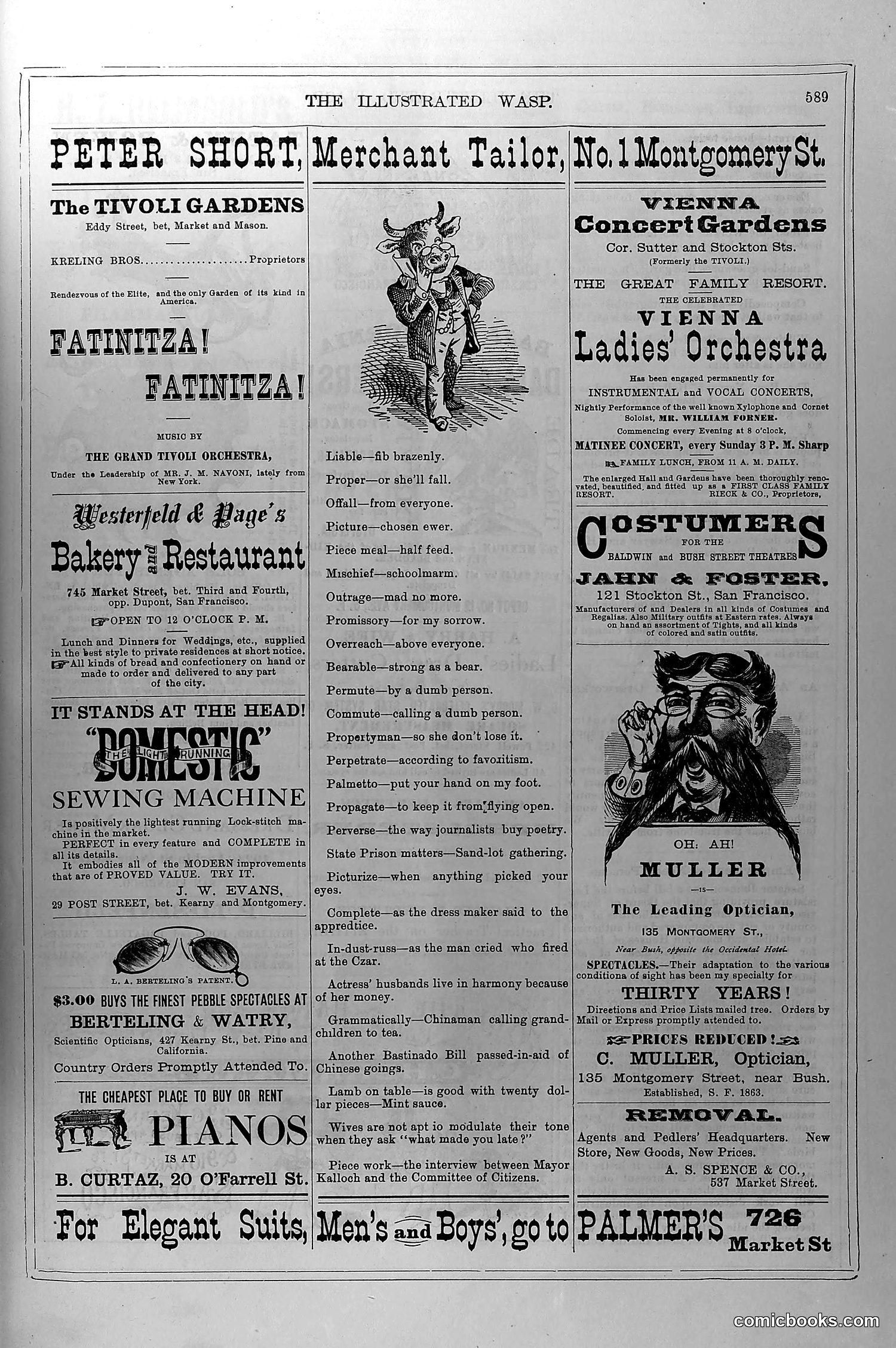
This page is predominantly **advertisements and business listings** for San Francisco establishments (bakeries, restaurants, optical shops, piano dealers, tailors, etc.), typical of late 19th-century periodical pages. The only satirical content is a **central illustration of an anthropomorphic bull in formal dress**, accompanying wordplay definitions. This appears to be a humorous vocabulary exercise playing on word meanings—"Liable—fib brazenly," "Proper—or she'll fall," etc.—rather than political satire. The bull figure is stylized caricature but lacks clear identification of a specific public figure. The page reflects The Wasp's mixed format: combining local advertising revenue with light humor rather than sustained political commentary. Without additional context about The Wasp's contemporary focus, the specific satirical intent remains unclear.
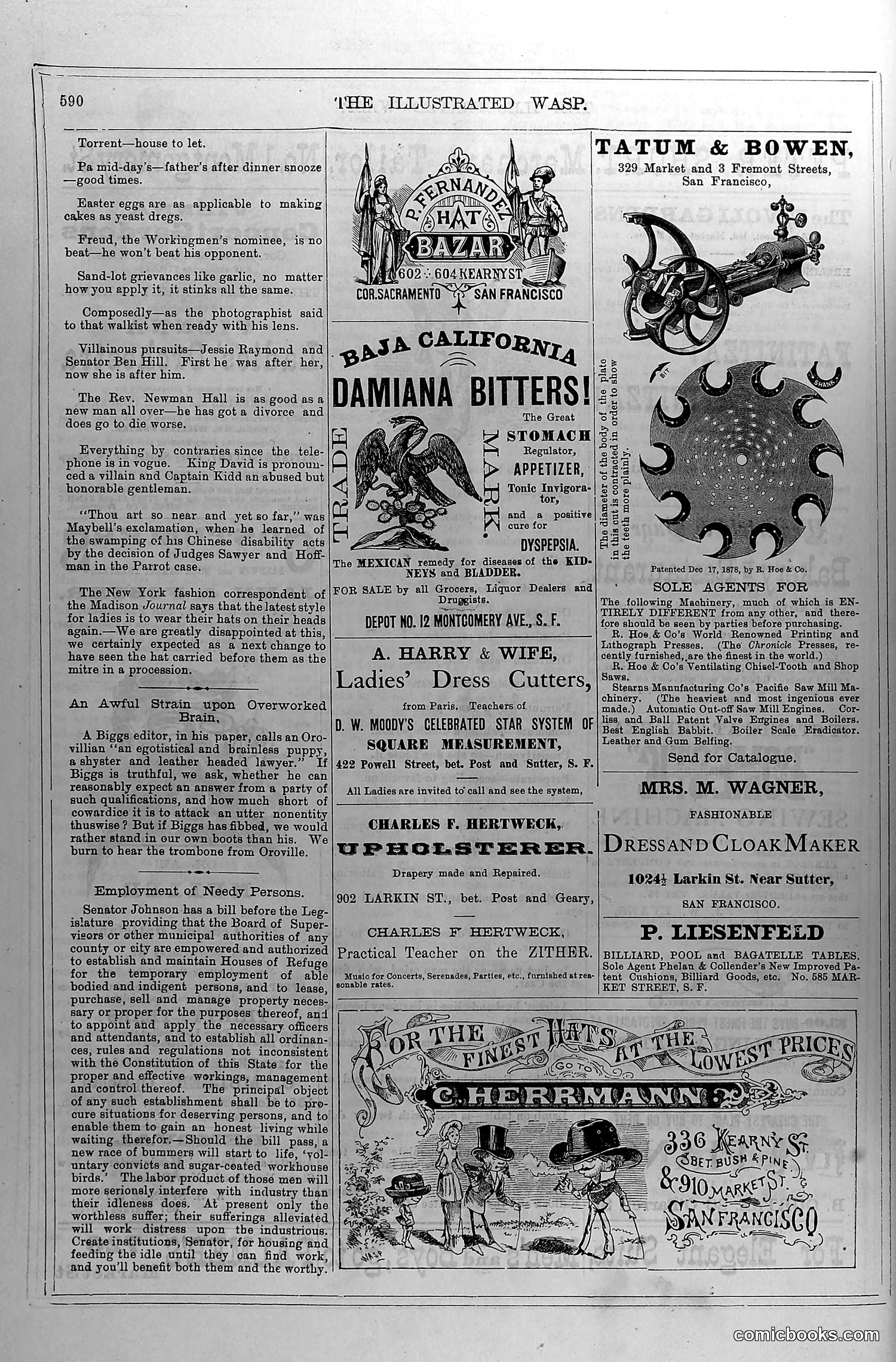
This page is primarily **advertising and notices** rather than satirical content. The left column contains brief social commentary items (about a torrent house, Easter eggs, and various local figures), but lacks accompanying cartoons explaining their context. The right side features commercial advertisements for San Francisco businesses: a hat bazaar, Damiana Bitters (a medicinal product), dress cutters, an upholsterer, and a hat merchant. The only substantial cartoon shows **C. Herrmann's hat shop** with illustrated figures. Without clearer visual satirical elements or historical context about the mentioned figures (Senator Johnson, Jessie Raymond, Senator Ben Hill), the specific political targets remain unclear. The page functions primarily as a commercial vehicle rather than political satire.
This page is **primarily advertising** from a late 19th-century American magazine. The dominant left column promotes "Helmboldt's Buchu," a patent medicine claiming to cure bladder and kidney diseases, rheumatism, and various ailments. The price ($1.00 per bottle) and sweeping health claims are typical of unregulated quackery from this era. Other advertisements include a Chicago brewery, a book binder, a photo-lithography service, and F. Korbel & Bros. wine merchant. The only cartoon appears to be a decorative wine merchant's advertisement featuring classical figures—not political satire. This page reflects the magazine's mixed revenue model: satirical editorial content subsidized by patent medicine and commercial advertisements typical of the period.
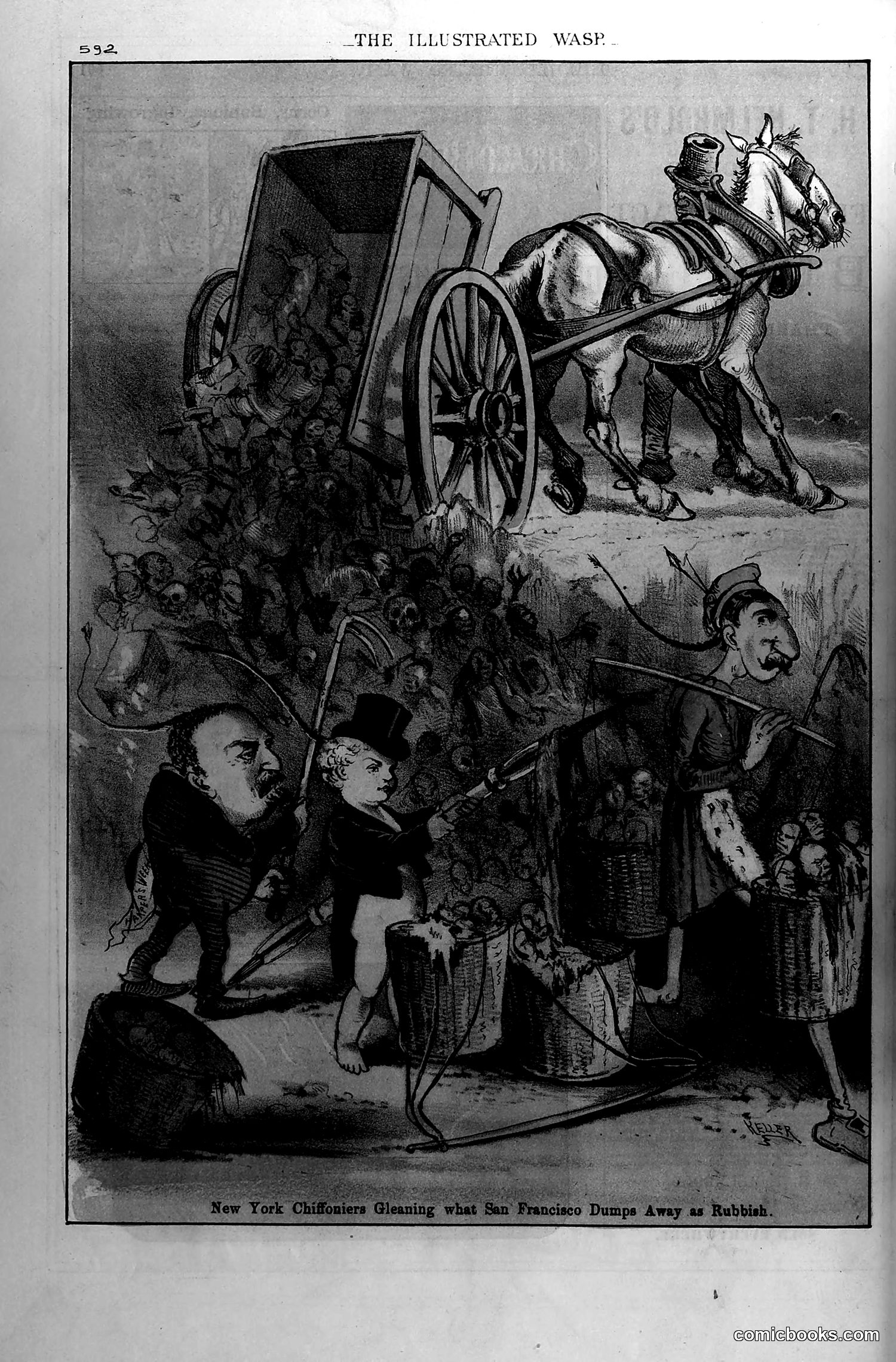
This satirical cartoon depicts **New York City politicians as scavengers collecting San Francisco's refuse**. The caption reads: "New York Chiffoniers Gleaning what San Francisco Dumps Away as Rubbish." The image shows well-dressed men (likely representing NYC political figures or businessmen) gathering garbage and waste from a dump cart, literally portrayed as trash collectors. The caricatured figures appear to be mining refuse for valuables or reusable materials. The satire suggests New York was adopting or copying San Francisco's cast-off ideas, policies, or practices—treating them as worthless scraps. It's a pointed insult implying NYC politicians lacked originality, desperately salvaging from what other cities discarded. The dehumanizing depiction as garbage workers reinforces the contemptuous tone of the critique.

I can see this page contains a color test chart (the grid of grayscale squares on the left) and measurement rulers, which appears to be a technical calibration or documentation page rather than editorial cartoon content. The checkered pattern with varying tones is a standard tool used in photography and printing to ensure accurate color reproduction and exposure. There is no visible satirical cartoon, political commentary, or recognizable figures on this page. This appears to be a technical/archival page from *The Wasp* magazine's production materials rather than published editorial content. Without OCR text matching visible comic or satirical imagery, I cannot identify specific political or social references intended for readers.