
A complete issue · 18 pages · 1880
The Wasp — March 27, 1880

I can see this is a measurement/documentation page from what appears to be an archival or publication context, showing an Oregon Rule Co. ruler (0-5 inches) and a checkerboard pattern of grayscale squares to the right, likely a color or tone reference chart. However, **I cannot identify any political cartoon or satirical content** on this page. This appears to be a technical documentation or calibration page rather than editorial content from *The Wasp* magazine itself. The checkerboard pattern and ruler suggest this may be a reproduction guide or archival reference sheet. Without visible cartoon imagery, caricatures, or satirical text to analyze, I cannot provide the historical interpretation you've requested. If this is from *The Wasp*, the actual cartoon content is not visible in this image.
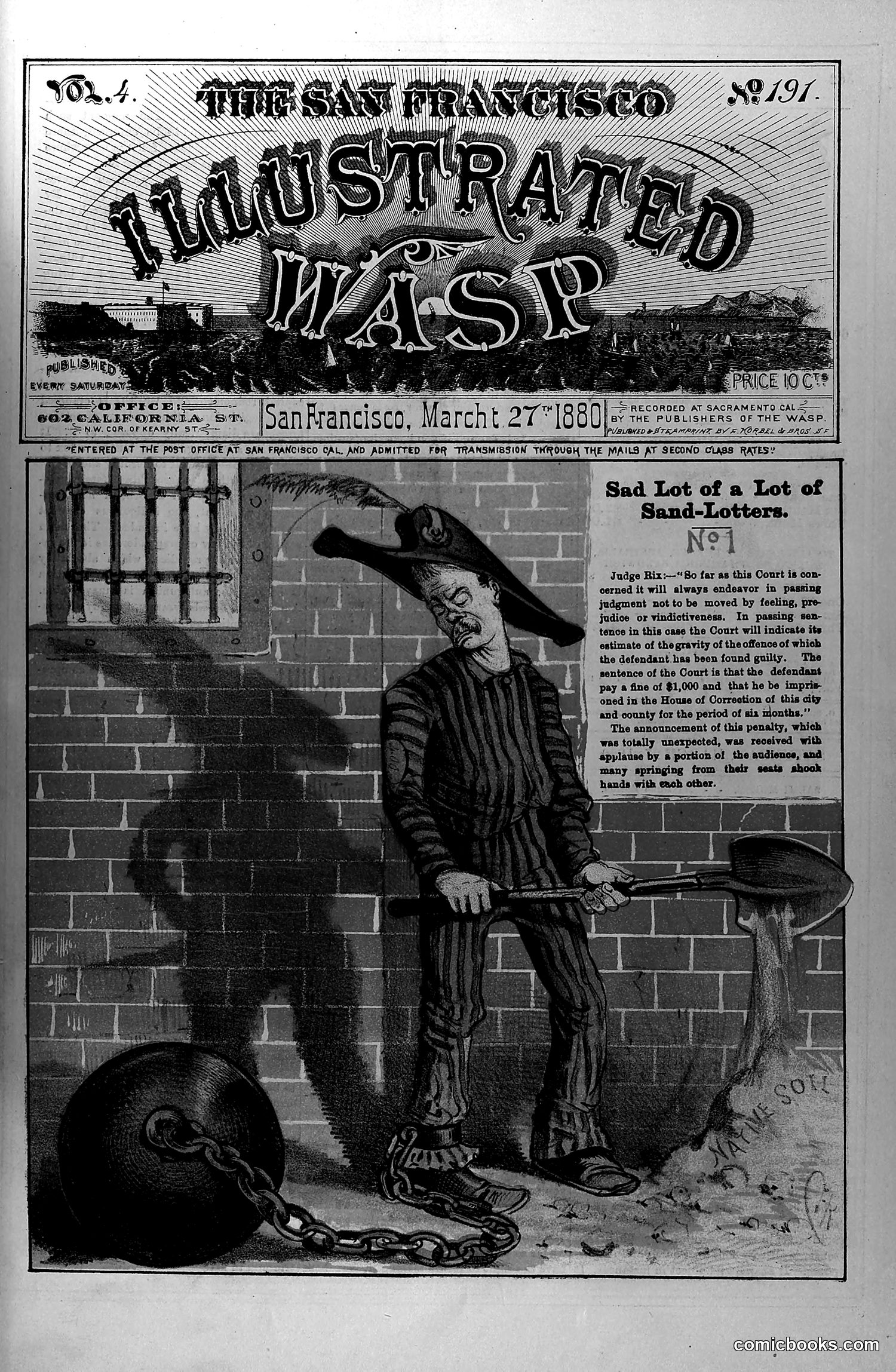
This satirical illustration depicts a prisoner in a cell, chained and holding a shovel—apparently a "sand-lotter" (someone using public sand lots). The accompanying judge's quote describes sentencing: a $1,000 fine and six months imprisonment in the House of Correction. The cartoon mocks what appears to be harsh judicial punishment for sand-lot activity, likely referring to political gatherings or labor organizing on San Francisco's public sand lots, which were controversial in 1880. The "sad lot" pun plays on the double meaning of "lot" (both land parcels and misfortune). The image ridicules either the severity of the sentence or the criminalization of public assembly itself—suggesting the punishment is disproportionate to the offense.
The main article, "The Universal Sufferings from Universal Suffrage," argues against expanding voting rights. The author contends that universal suffrage has failed because the poor and ignorant masses cannot be trusted to govern wisely. The piece criticizes Republican claims that majority rule protects liberty, arguing instead that uneducated voters are easily manipulated and that unrestricted suffrage produces tyranny and oppression. The satire targets Republican Reconstruction-era ideology by presenting suffrage expansion as disastrous, claiming foreign peasants and "alien" populations lack the judgment for self-governance. This reflects late-19th-century anti-democratic sentiment and xenophobia opposing broader voting rights—particularly relevant to post-1880 debates over immigrant participation in American politics.
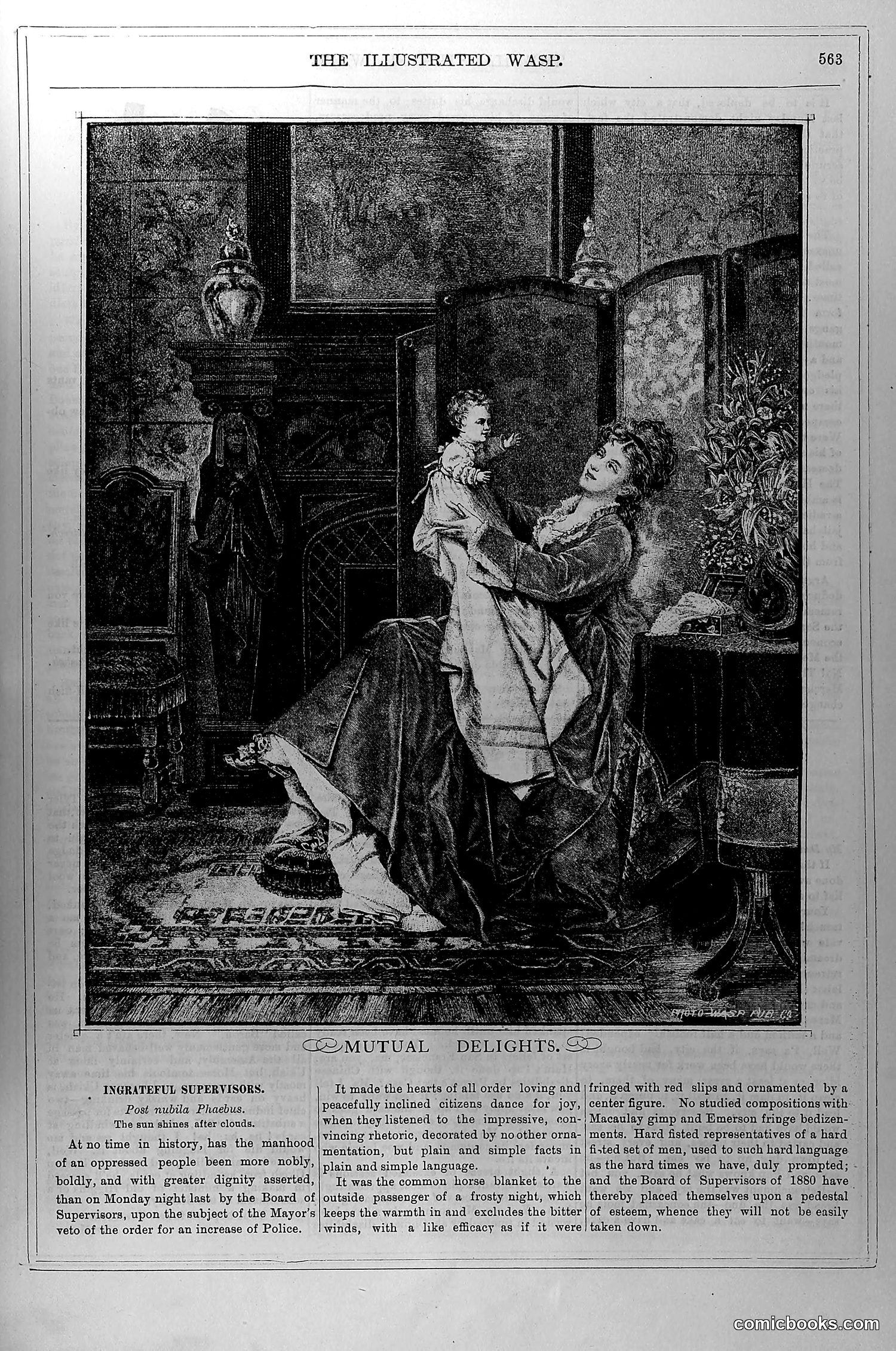
This satirical illustration critiques San Francisco's Board of Supervisors regarding a police force increase. The image shows an elegantly dressed woman holding a child, gazing upward in apparent contentment or admiration. The accompanying text sarcastically praises the Supervisors as "ingrateful" for rejecting the Mayor's veto on expanding the police. The satire suggests that while citizens danced joyfully upon hearing this news, the Supervisors' actions actually served self-interested purposes rather than public good. The "mutual delights" title ironically juxtaposes the Supervisors' self-satisfaction with citizens' genuine but misplaced happiness. The cartoon satirizes municipal corruption and suggests the Supervisors prioritize their own interests over honest governance.
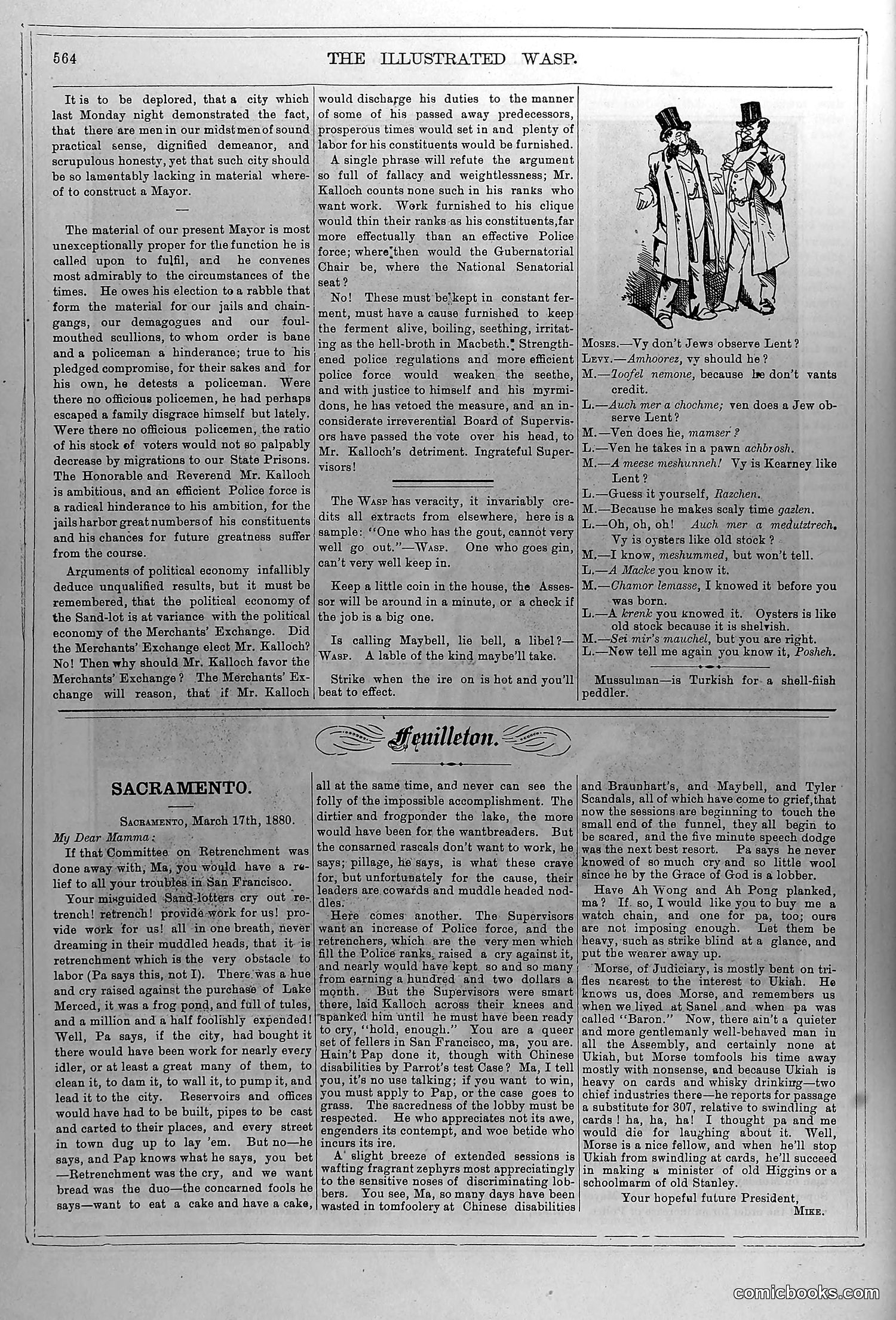
This page contains political commentary and a satirical dialogue rather than a traditional cartoon. The main illustrated section shows two figures in top hats engaged in conversation—likely political figures of 1880. The left column criticizes a city mayor for lacking material substance and practical sense in fulfilling civic duties. The text argues the mayor is inadequate, citing his inability to address infrastructure and jail conditions, and his reliance on ineffective police force. The right column presents a witty dialogue mocking Jewish observance of Lent and other cultural practices, using stereotypical characterizations common to period satire. The "Feuilleton" section below discusses Sacramento politics and retrenchment policies, criticizing government spending and police expansion during economic difficulty.
This page contains three separate short articles rather than political cartoons. The visible content includes: 1. **"Art and Drama"** - A discussion defending "Bohemian" artistic types against criticism, arguing bohemians possess merit and shouldn't be judged solely by conventional standards. 2. **"All Insane"** - A brief note about Herman Gan, a Finnish immigrant, being adjudicated insane. It also mentions the Mayor's veto of a police force increase and Board of Supervisors overriding it. 3. Commentary on labor issues and social problems affecting working classes. The page appears primarily satirical in tone, defending unconventional lifestyles while criticizing bureaucratic decisions and social hypocrisy. Without visible illustrations, the satire relies on textual argument rather than visual caricature.
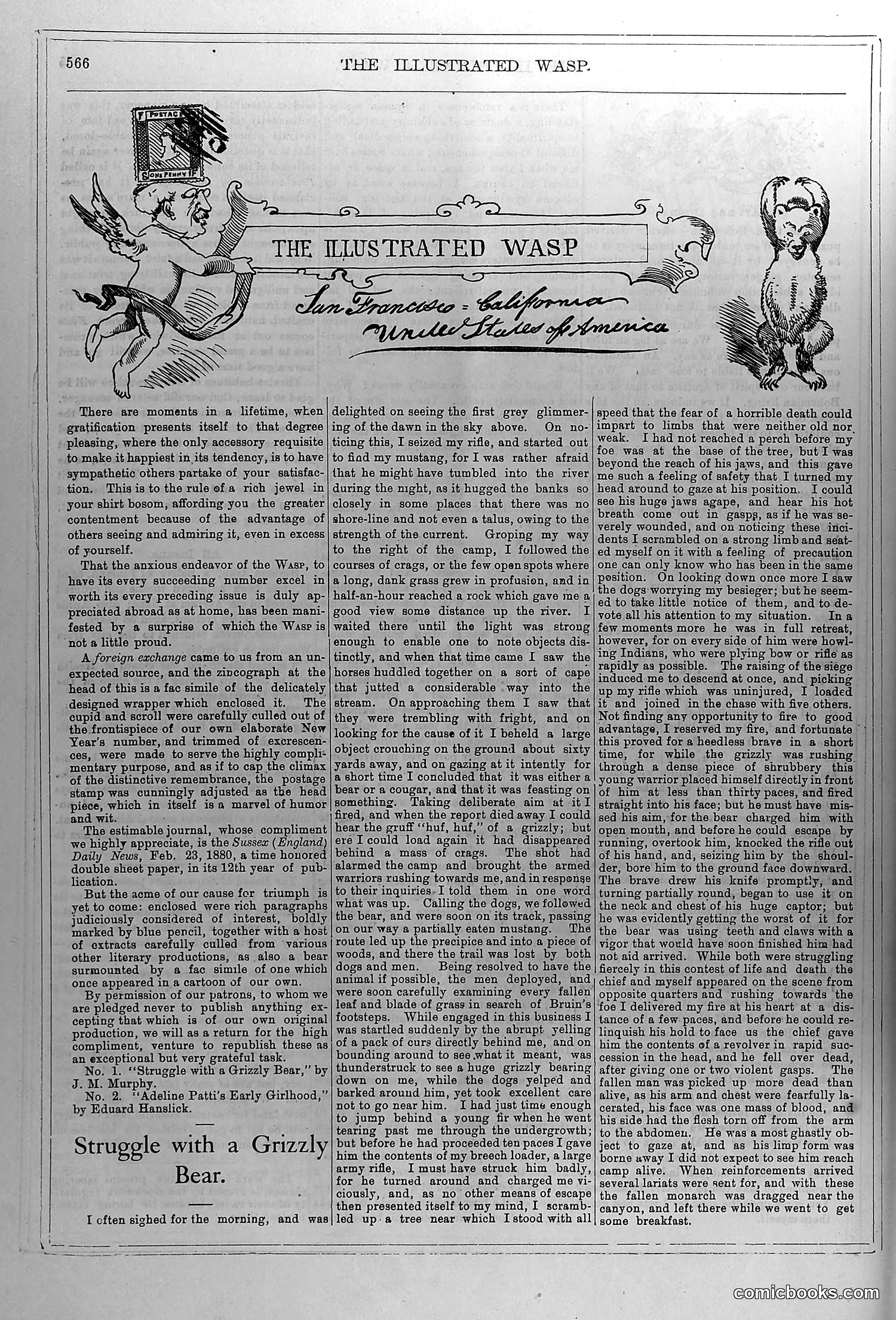
This page from *The Wasp* (a San Francisco satirical magazine) features two distinct elements: **Header Illustration**: Decorative mastheads with mythological/classical figures frame the title, a common Victorian design convention for magazines. **Main Article**: "Struggle with a Grizzly Bear" by J.M. Murphy—an adventure narrative about encountering a grizzly bear while prospecting in California. The author describes a harrowing encounter where he narrowly escapes the animal's attack, ultimately killing it with gunfire and a revolver. **Context**: This appears to be a straightforward adventure story rather than political satire. *The Wasp* often mixed satirical commentary with entertainment content. The grizzly-bear narrative reflects California's frontier history and the popular 19th-century fascination with wilderness adventure tales. No specific political figures or satirical commentary are evident on this particular page.
This page is primarily **text-based memoir content**, not a political cartoon. It presents an autobiographical account by or about Adelina Patti, a celebrated 19th-century opera singer, recounting her childhood in America and Europe. The narrative discusses her family's theatrical background, her father Salvatore Patti (an Italian singer and manager), her musical training, and early performances. It mentions her siblings' careers in opera and references specific venues and productions. **No clear satire or political commentary is evident.** This appears to be a straightforward biographical feature in *The Wasp* magazine, likely included for reader interest in a prominent public figure of the era rather than for satirical purpose.
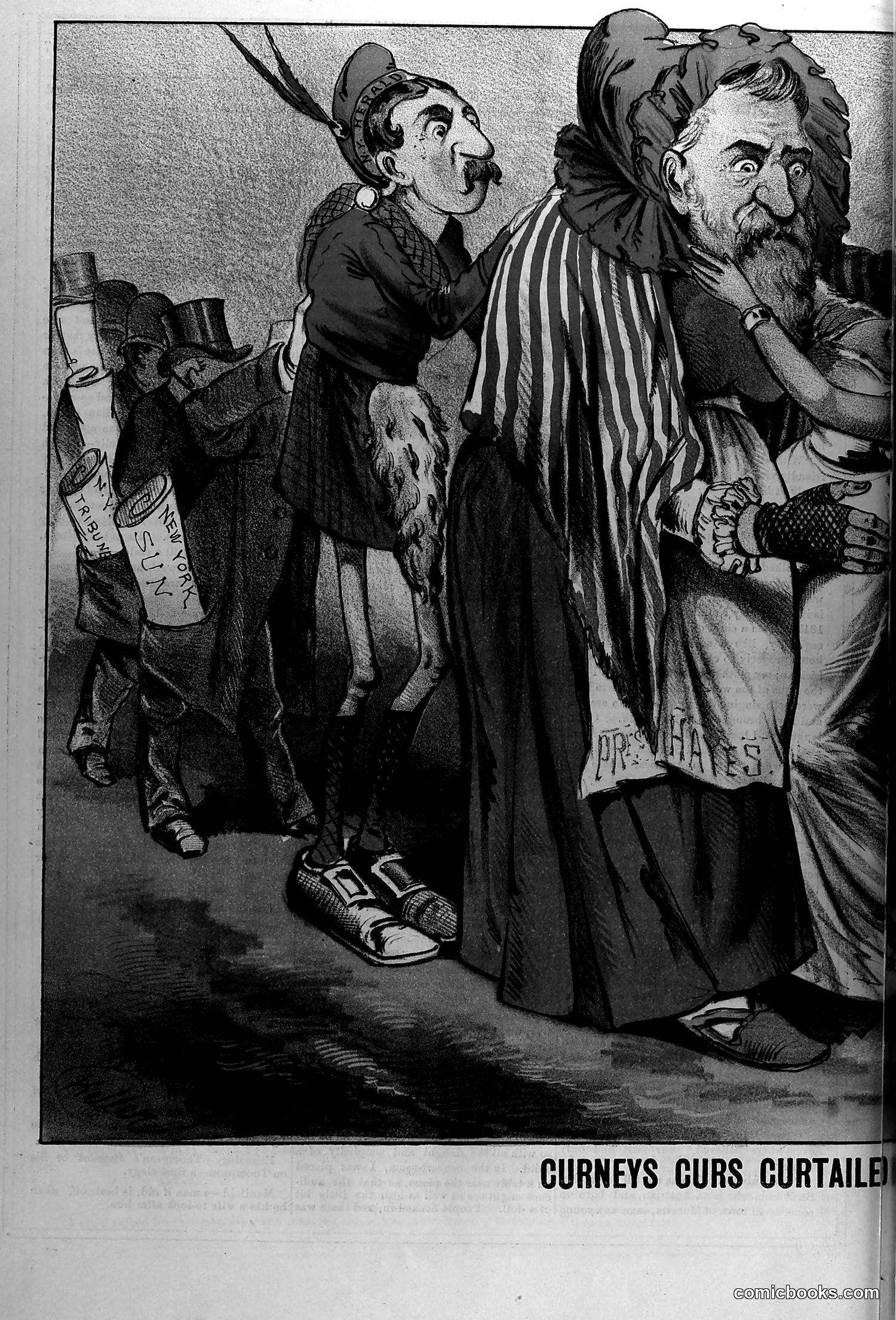
This satirical cartoon depicts what appears to be a confrontation involving figures associated with the Curney political faction or organization. The left figure wears a cap and holds what looks like a bottle labeled "Poison" or similar, while the right figure—a bearded man with an angry expression—wears striped clothing and appears to be a caricatured authority figure. The title "Curneys Curs Curtailed" suggests the cartoon mocks the curtailing or defeat of Curney's followers or associates. The poisoned bottle imagery indicates accusations of corruption or malicious intent. Without additional historical context from *The Wasp* publication's era, the specific political figures and incident referenced remain unclear, though this appears to be commentary on local political conflict.
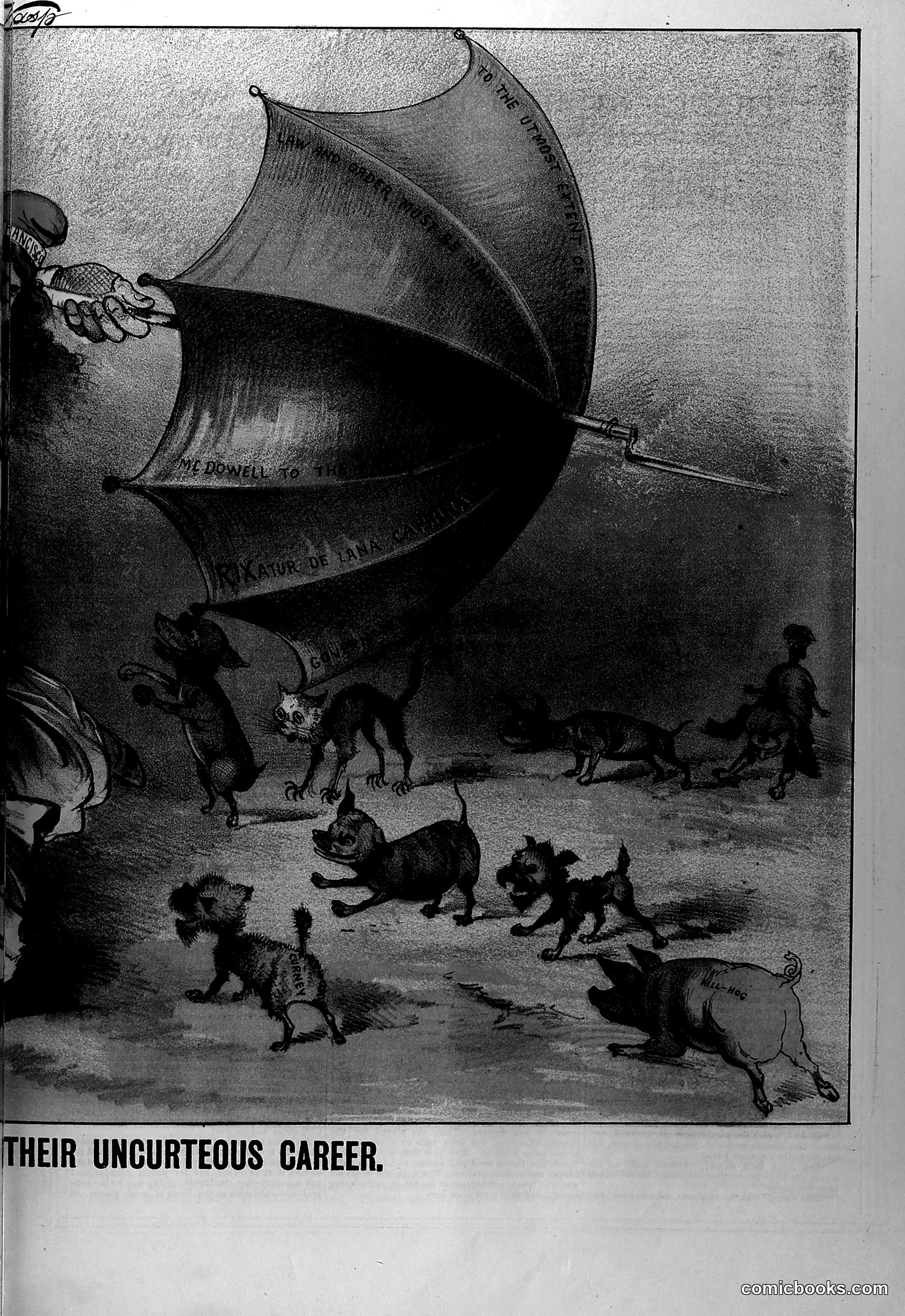
This political cartoon depicts a large umbrella or parasol being held by a figure on the left, beneath which numerous small dogs scatter in apparent disarray. The umbrella bears partially legible text that appears to reference political or social entities (the OCR is unclear on exact wording). The satire critiques powerful figures or institutions using dogs as metaphors for followers, subordinates, or those affected by their authority. The "uncurteous career" referenced in the caption suggests the cartoon condemns aggressive, rude, or heavy-handed conduct by those in power. Without clearer text on the umbrella or additional context about *The Wasp* magazine's publication date, I cannot identify the specific political figures or events targeted. The visual metaphor clearly suggests criticism of authoritarian behavior and its chaotic effects on those beneath such power.
This page contains serialized fiction rather than political cartoons. The text is titled "PHASES OF HISTORY" and subtitled "Not Generally given in Detail," written by Mr. Salmi Morse for The Wasp. This appears to be Part XXI of an ongoing narrative story, continuing from page 564. The content describes dramatic domestic conflict involving a Count and Countess, featuring themes of jealousy, infidelity, and emotional manipulation. The text references Italian characters and settings. Rather than satirizing specific politicians or current events, this piece represents The Wasp's use of serialized melodramatic fiction as entertainment content—likely appealing to readers through sensational relationship drama rather than topical political commentary. The page is text-heavy with minimal visual elements visible.
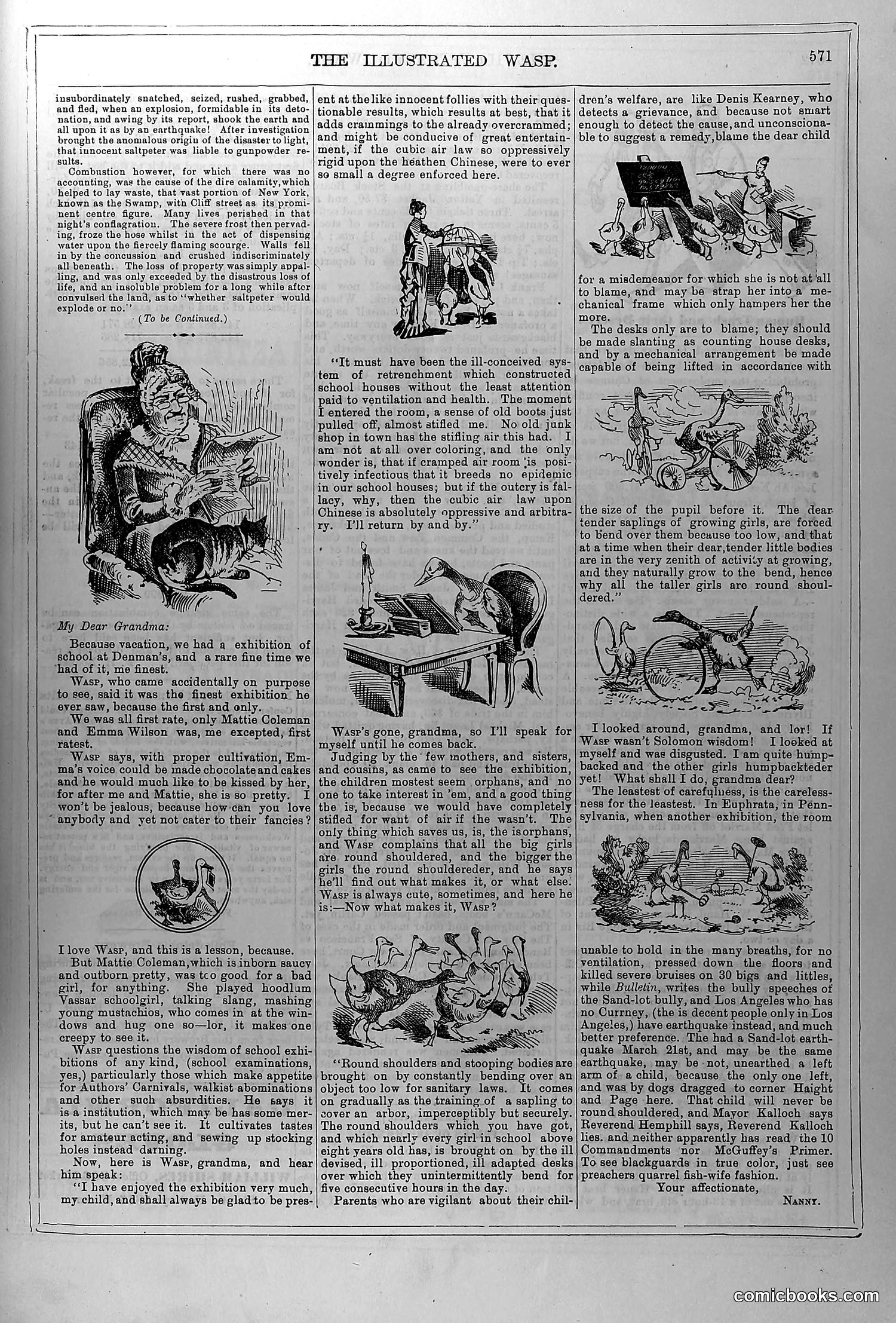
This page contains a letter titled "My Dear Grandma" describing a school exhibition visit. The writer discusses seeing Wasp, a young girl with apparent intellectual disabilities, and notes her limited social skills and round shoulders. The satirical commentary critiques both Wasp herself and contemporary attitudes toward disability. The letter writer appears condescending, questioning whether Wasp could "make chocolates and cakes" or perform domestic labor. The text suggests Wasp lacks typical feminine accomplishments and social graces. The accompanying illustrations show various scenes of daily life and children at play. The satire targets both the subject's perceived inadequacies and the society that defines worth through narrow standards of femininity and productivity. The piece reflects period attitudes toward disability and gender expectations, presented here for mockery or critique.
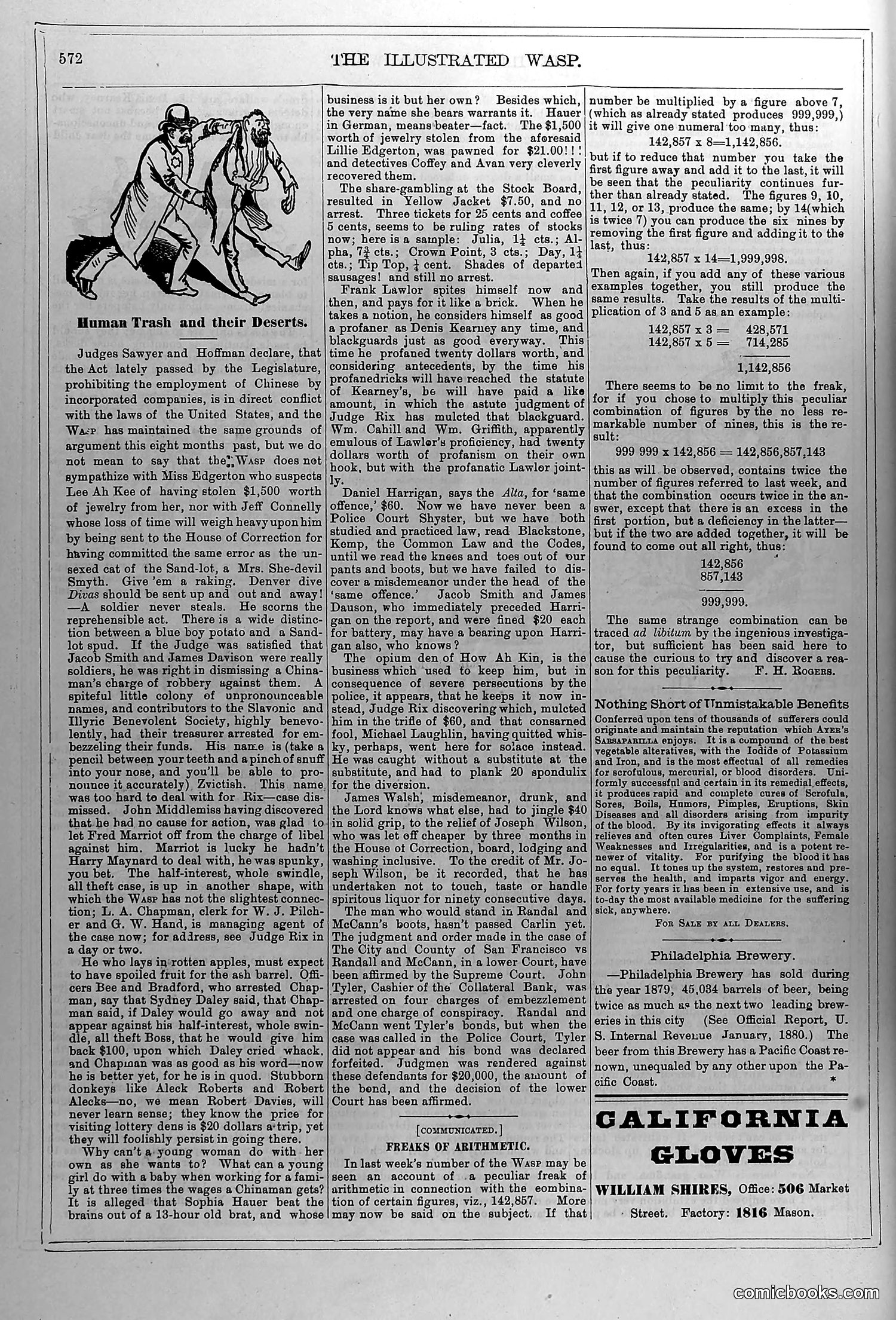
This page contains primarily text articles rather than illustrated cartoons. The main piece, "Human Trash and Their Deserts," discusses various criminal cases and legal proceedings. It appears to be satirical commentary on the justice system, mentioning judges Sawyer and Hoffman, and criticizing enforcement of Chinese labor laws and their monopoly impact. The articles reference specific individuals involved in theft, embezzlement, and fraud cases—names like Lee Ah Koe, Jeff Connelly, and Jacob Smith appear throughout. The tone is mockingly critical of both the criminals and the legal system's handling of these matters. At page's bottom is an advertisement for California Gloves by William Shires and a note about Philadelphia Brewery's 1879 sales figures. The content is primarily journalistic rather than visually satirical.
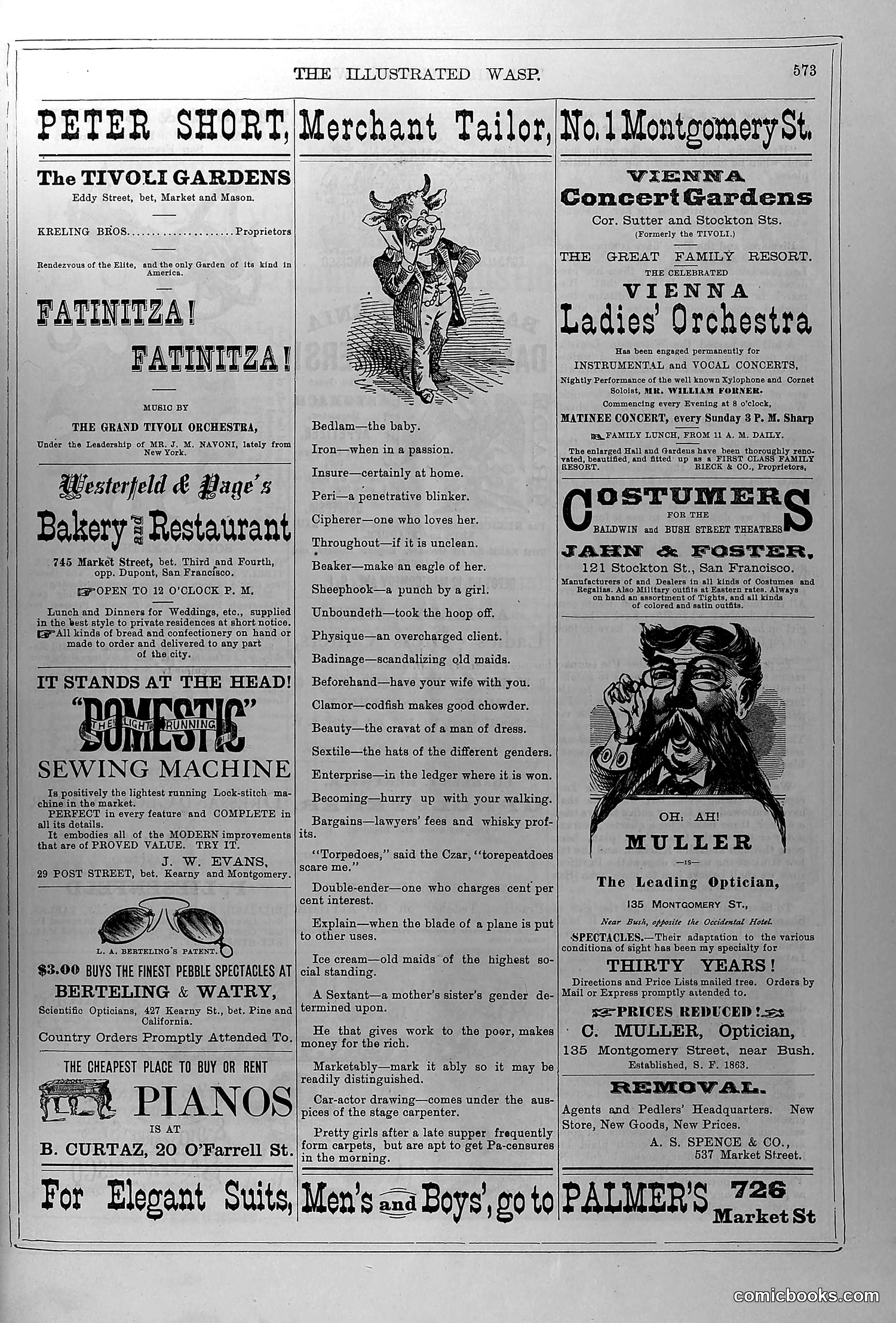
This page is primarily **advertisements and business listings** for San Francisco establishments (bakeries, tailors, opticians, piano rentals, etc.), typical of a late 19th-century satirical magazine's revenue model. The central cartoon depicts a caricatured figure labeled "Bedlam—the baby," illustrated as a grotesque, demon-like creature in formal dress. This image accompanies a satirical **glossary of slang terms** (Bedlam, Iron, Cold, Faint, etc.), where each word receives a humorous definition. "Bedlam" literally means madness or chaos, suggesting the cartoon's subject represents some form of disorder or foolishness. Without additional historical context about what specific person or event "the baby" references, the precise satirical target remains **unclear**, though the hostile caricature style indicates social or political ridicule was intended.
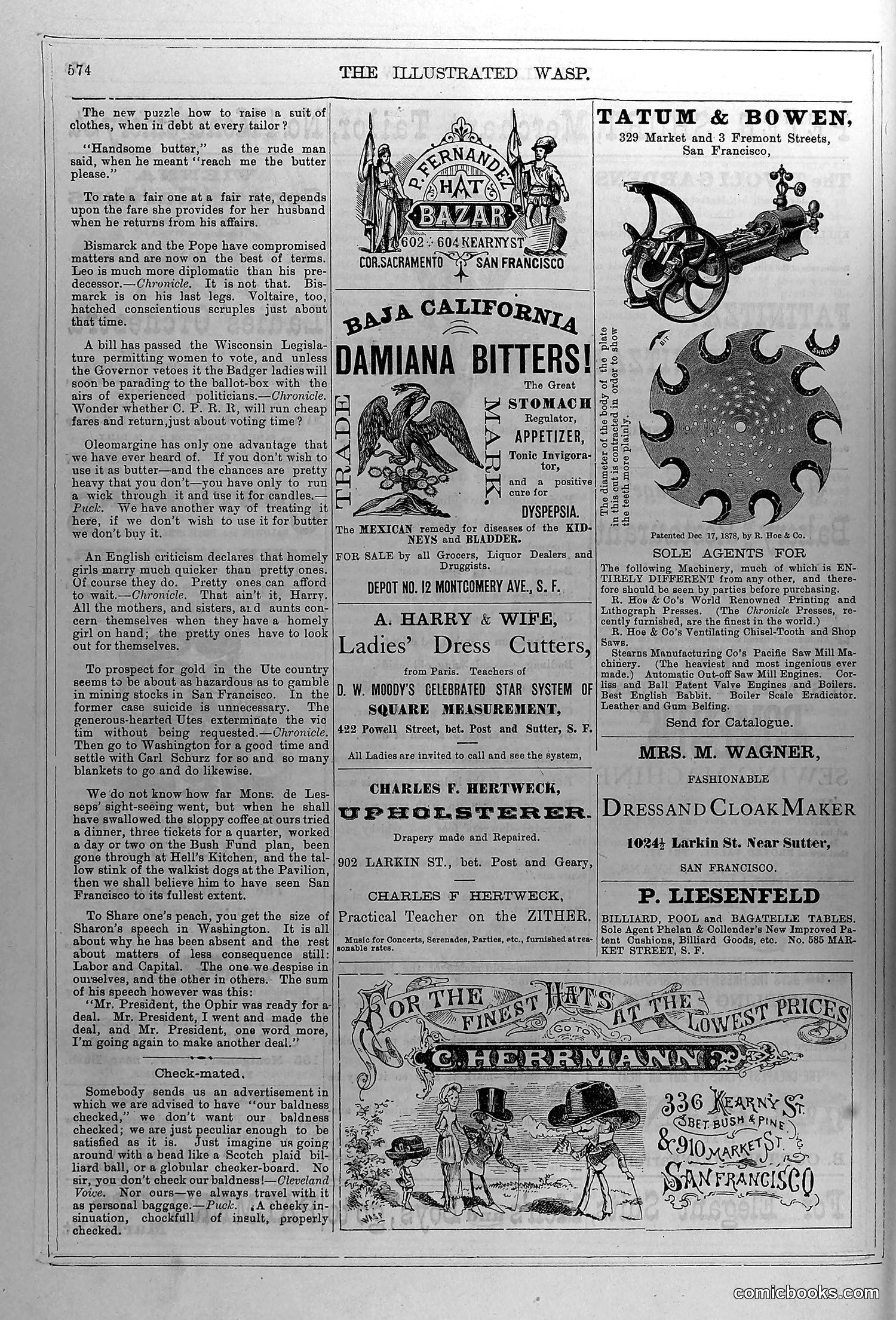
This page is primarily **advertising and notices** for San Francisco businesses (late 1800s), with minimal political cartooning. The visible content includes: - Multiple commercial advertisements (Damiana Bitters tonic, dress cutters, upholsterers, art dealers) - Short satirical editorial items about Wisconsin legislation, Chicago's water supply, and San Francisco society - A brief joke about "Check-mated" regarding travel luggage customs The **only cartoon imagery** shows decorative emblems for businesses and a small illustration with C. Herrmann's art shop advertisement. The satire targets **local issues**: lazy politicians, gambling habits, and absurd social customs. Without specific dates or named political figures, the exact references remain unclear, though the tone suggests mocking San Francisco's civic governance and upper-class pretension.
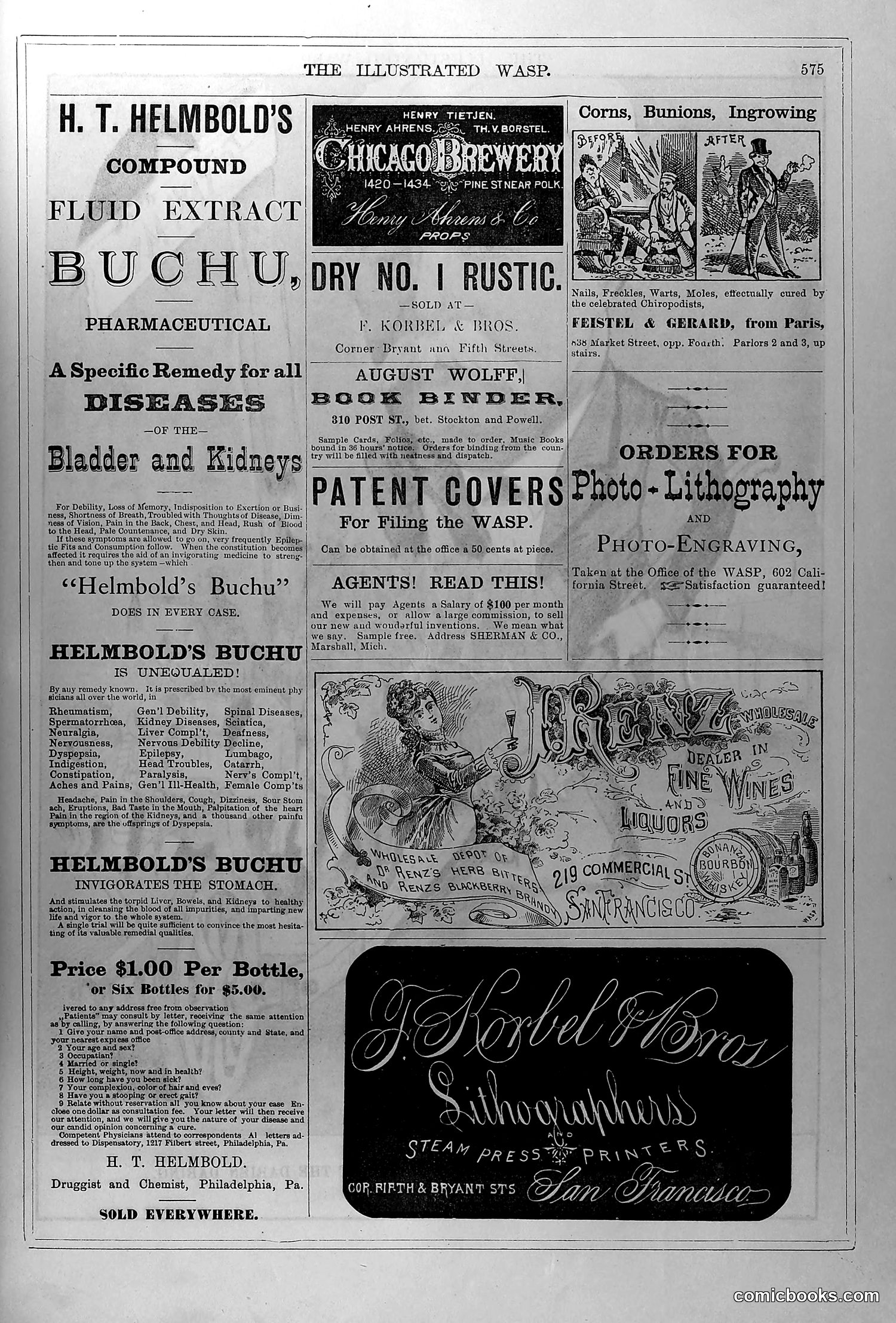
This page is **primarily advertising**, not political satire or editorial cartooning. It contains patent medicine ads (Helmhold's Buchu), local San Francisco business advertisements (Chicago Brewery, book binder, photo-lithography services), and commercial notices from the 1880s-90s era. The only illustration with narrative content is a decorative wine merchant advertisement featuring classical allegorical figures (Bacchus-style imagery) promoting "Fine Wines and Liquors" from San Francisco—standard commercial art of the period, not satire. The page demonstrates how 19th-century satirical magazines like *The Wasp* sustained themselves through advertising revenue rather than editorial content alone. No political figures or contemporary events appear to be referenced.
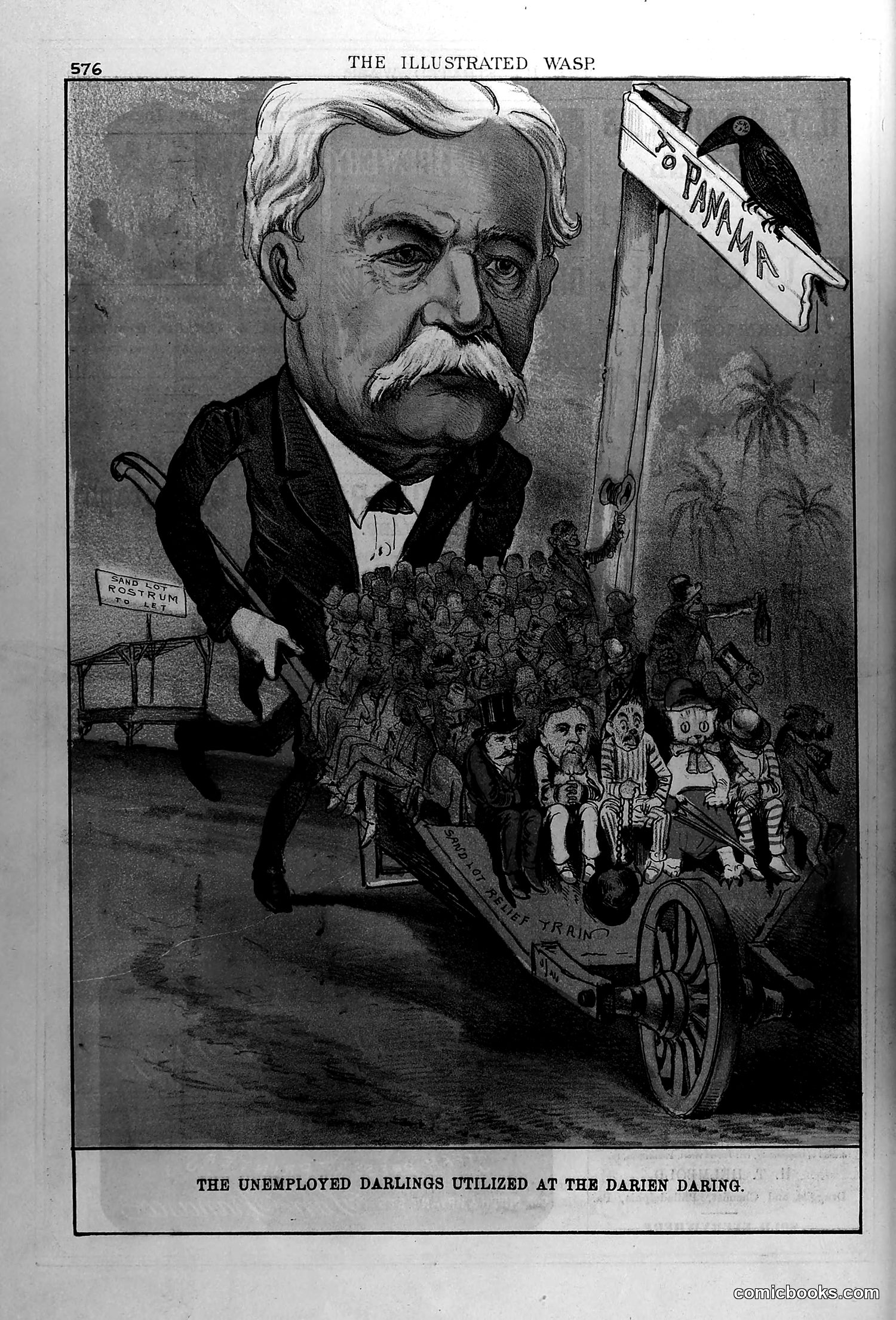
This is a political cartoon from *The Wasp*, a satirical magazine. The central figure is a caricatured man with distinctive facial hair, depicted as a giant presiding over a crowd of small figures in what appears to be a wheeled cart or vessel labeled "RING." The caption reads: "THE UNEMPLOYED DARLINGS UTILIZED AT THE DARIEN DARING." The cartoon satirizes someone's exploitation of unemployed people for what the publication views as frivolous purposes (the "Darien Daring" appears to be some kind of spectacle or event). The giant figure looming over the crowd suggests manipulation or control, while the crowd of "unemployed darlings" are portrayed as being utilized for entertainment or profit rather than meaningful employment. The "TO PANAMA" banner and palm trees in the background suggest colonial or imperial themes. Without additional context, the specific individual and event remain unclear.

I can see this page contains a calibration/test strip for photographic reproduction rather than editorial cartoon content. The image shows a grayscale reference chart with numbered squares (ranging from light to dark gray tones) positioned next to measurement rulers. This type of test chart was used in early-to-mid 20th century printing and publishing to ensure accurate tonal reproduction when photographing pages for reproduction. This appears to be a technical page from *The Wasp* magazine's printing/production process rather than a page containing satirical cartoons or editorial content meant for readers. Without visible cartoon imagery or OCR'd article text, I cannot identify specific political figures, social references, or satire.