
A complete issue · 18 pages · 1880
The Wasp — March 12, 1880
I can see this is a page from *The Wasp* with an Oregon Rule Co. measurement scale and what appears to be a grayscale test pattern or color chart on a black background. However, the image quality and resolution make it impossible to discern any actual cartoon content, figures, caricatures, or satirical illustrations that would allow me to identify political or social commentary. The OCR text provided is blank, offering no textual clues about the page's content or subject matter. Without being able to clearly see illustrated figures, read accompanying text, or identify specific historical references, I cannot accurately explain what satire or jokes this page contains. The reproduction appears to be a test or reference image rather than a readable cartoon page.
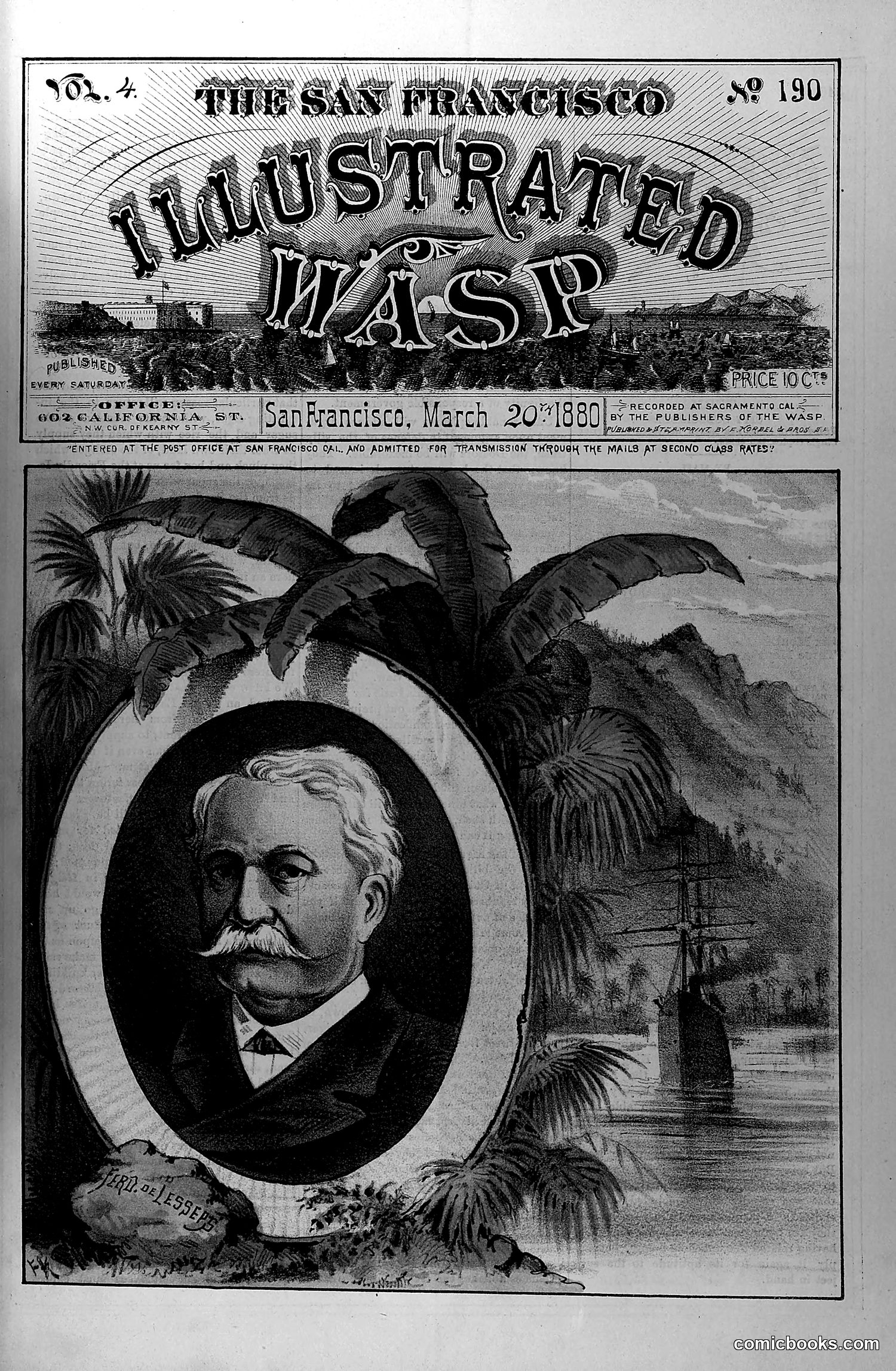
This cover features a portrait of a distinguished gentleman with a prominent mustache, framed by an ornate oval border decorated with palm fronds and tropical scenery including water and mountains. The specific identity of the figure is unclear from the image alone, though the elaborate tropical framing suggests this person had significant connections to colonial or international affairs. The Wasp was known for satirizing prominent San Francisco businessmen and politicians. Without additional context from the article text or clearer identifying marks, I cannot definitively state who this represents or what particular scandal or achievement prompted the satirical treatment. The ornate presentation suggests someone of considerable status being mocked by the publication.
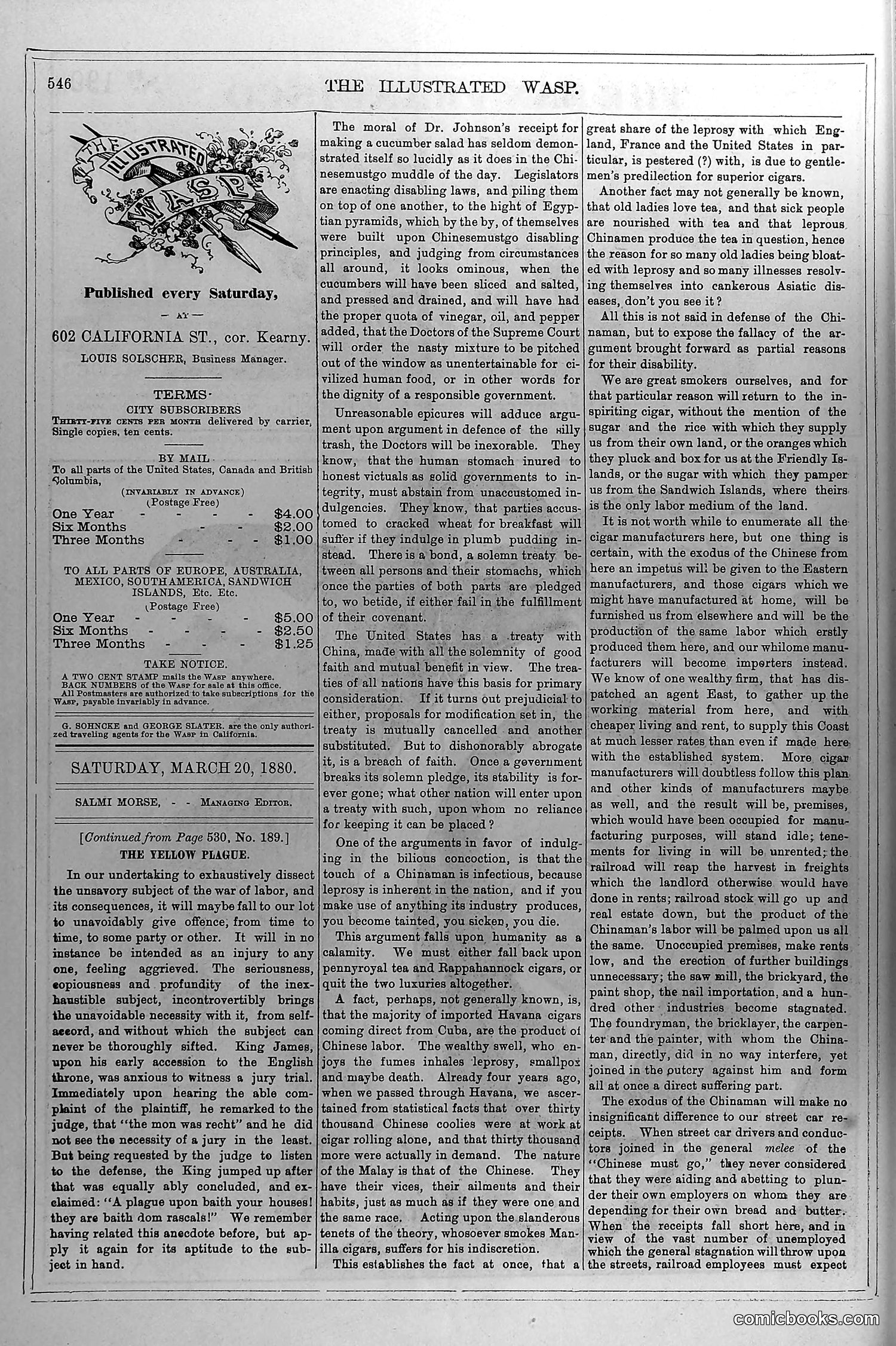
The masthead shows *The Wasp's* logo—a wasp attacking what appears to be a Chinese figure's face. This reflects the magazine's satirical stance on Chinese immigration, a volatile political issue in 1880s California. The main article, "The Opium Plague," attacks Chinese laborers and opium use, but does so in a way that exposes anti-Chinese hysteria. The text sarcastically references arguments used against Chinese immigrants—that they were diseased, immoral, and economically destructive—while also questioning their validity. The piece appears designed to critique both actual social problems AND the xenophobic scapegoating of Chinese workers during this period of intense labor competition and nativist sentiment in California.
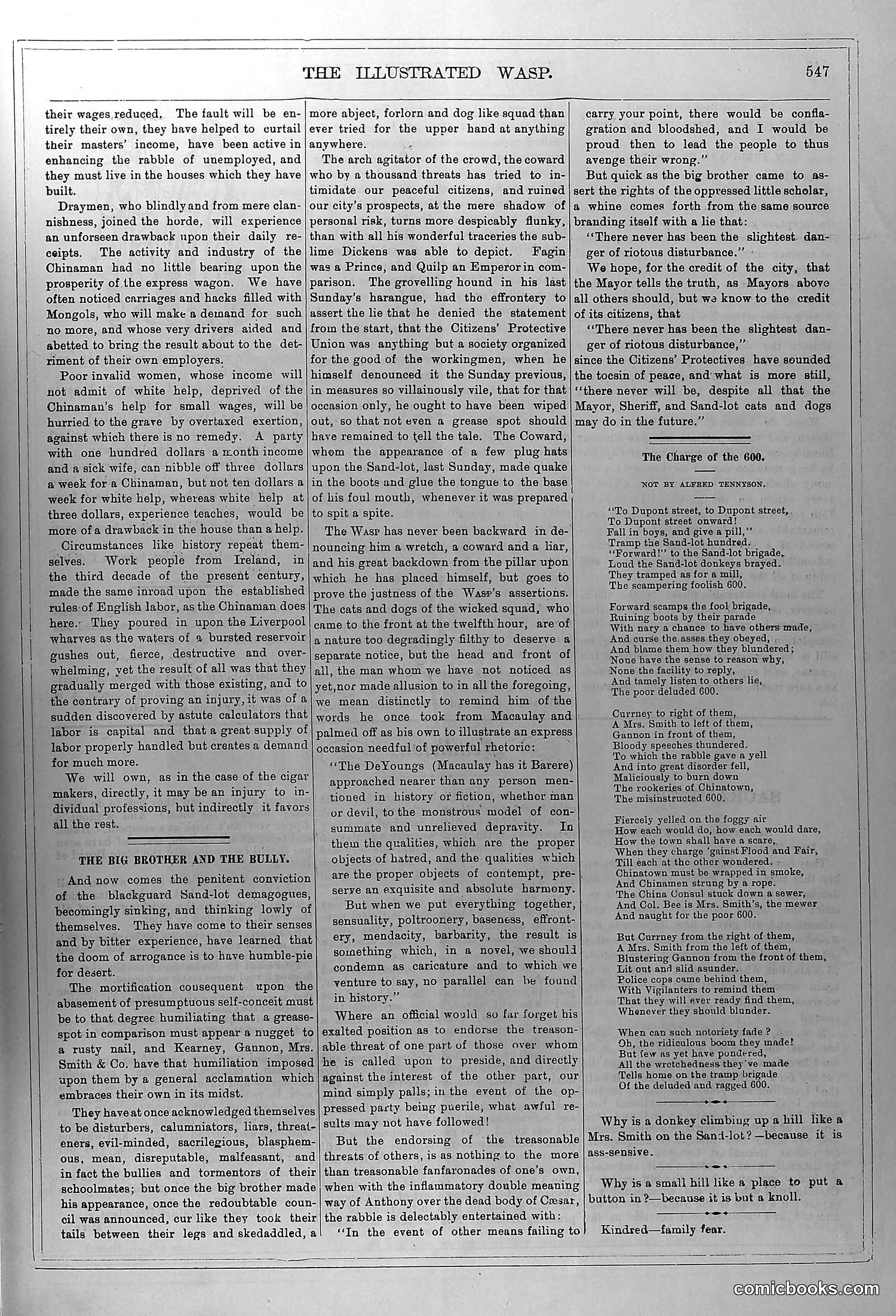
This page contains two distinct sections: a lengthy political article titled "The Big Brother and the Bully" attacking the treatment of workers and the poor, and a separate poem titled "The Charge of the 600" (a satirical reference to Tennyson's "The Charge of the Light Brigade"). The main article criticizes wealthy employers and political figures for exploiting laborers, particularly immigrants and women, while maintaining hypocritical moral standards. The piece accuses them of reducing wages, forcing workers into poverty, and using class status to avoid accountability. "The Charge of the 600" appears to mock San Francisco's police or civic authorities through military parody. The page is primarily textual satire rather than illustrated cartoons, using sarcasm and political commentary to critique economic inequality and labor exploitation in late 19th-century America.
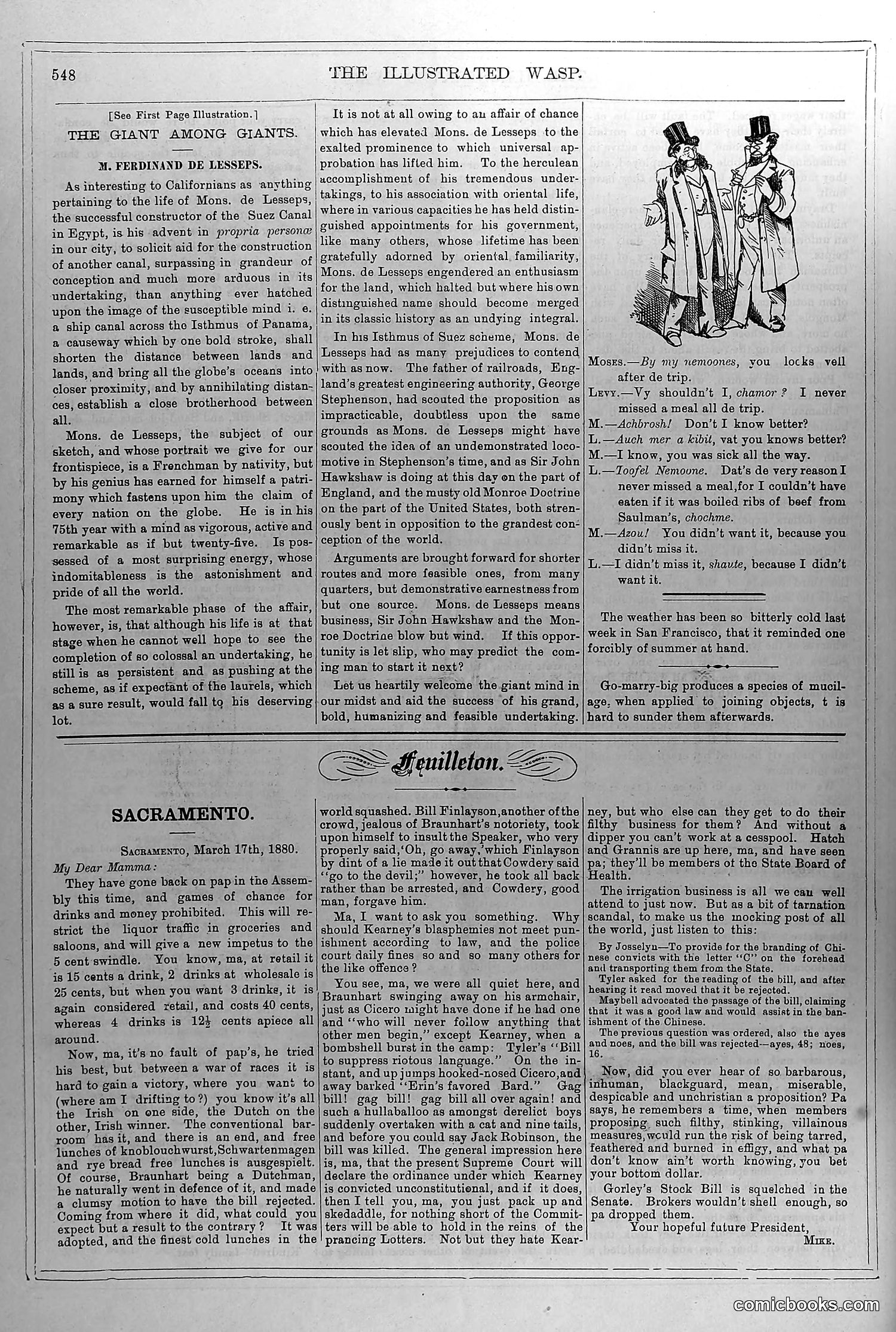
The page features two main sections: **Top Section - "The Giant Among Giants"**: A biographical sketch of M. Ferdinand de Lesseps, the French engineer famous for constructing the Suez Canal. The text praises his accomplishments and notes he's undertaking a major project (likely the Panama Canal attempt, though not explicitly named here). The accompanying illustration shows two men in period dress, presumably depicting Lesseps. **Bottom Section - "Sacramento"**: A letter dated March 17, 1880, discussing California state politics, liquor licensing, and railroad business. It references specific political figures and disputes over monopolies and corporate practices in Sacramento. The page is primarily text-based satirical commentary rather than visual political cartoons, typical of 19th-century satirical magazines.
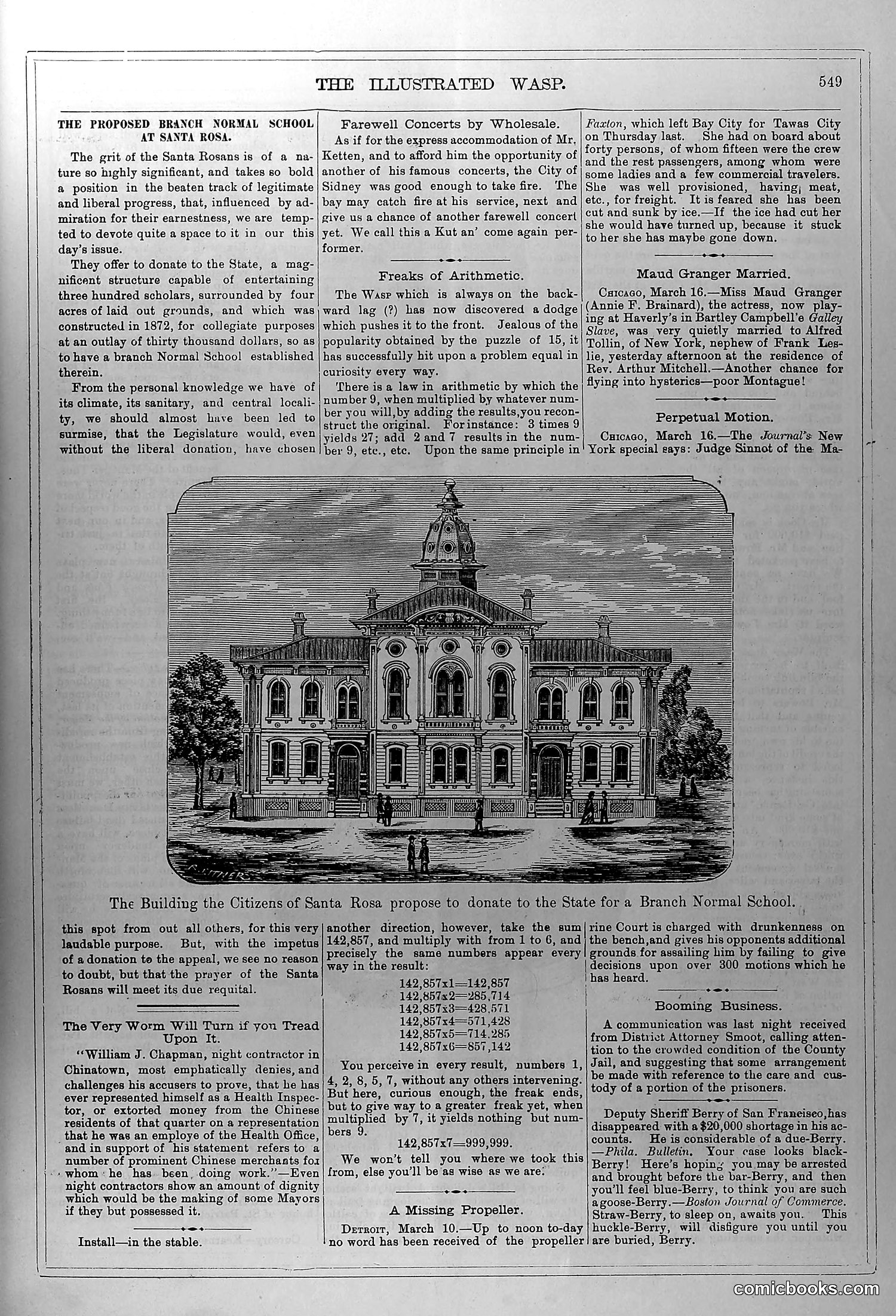
This page is primarily **news and society content rather than political satire**. The main illustration shows an ornate public building with a cupola, identified as "The Building the Citizens of Santa Rosa propose to donate to the State for a Branch Normal School." The surrounding text discusses various topics including: - The Santa Rosa Normal School proposal - Farewell concerts by a musician named Kelsten - A mathematical puzzle about the number 9 - Local society news (Maud Granger's marriage in Chicago) - Brief items about court cases and missing property There is **no clear political cartoon** on this page. Instead, it functions as a typical issue of a regional satirical magazine, mixing civic boosterism (the school building), social announcements, and miscellaneous local gossip with the occasional humorous commentary on contemporary life.
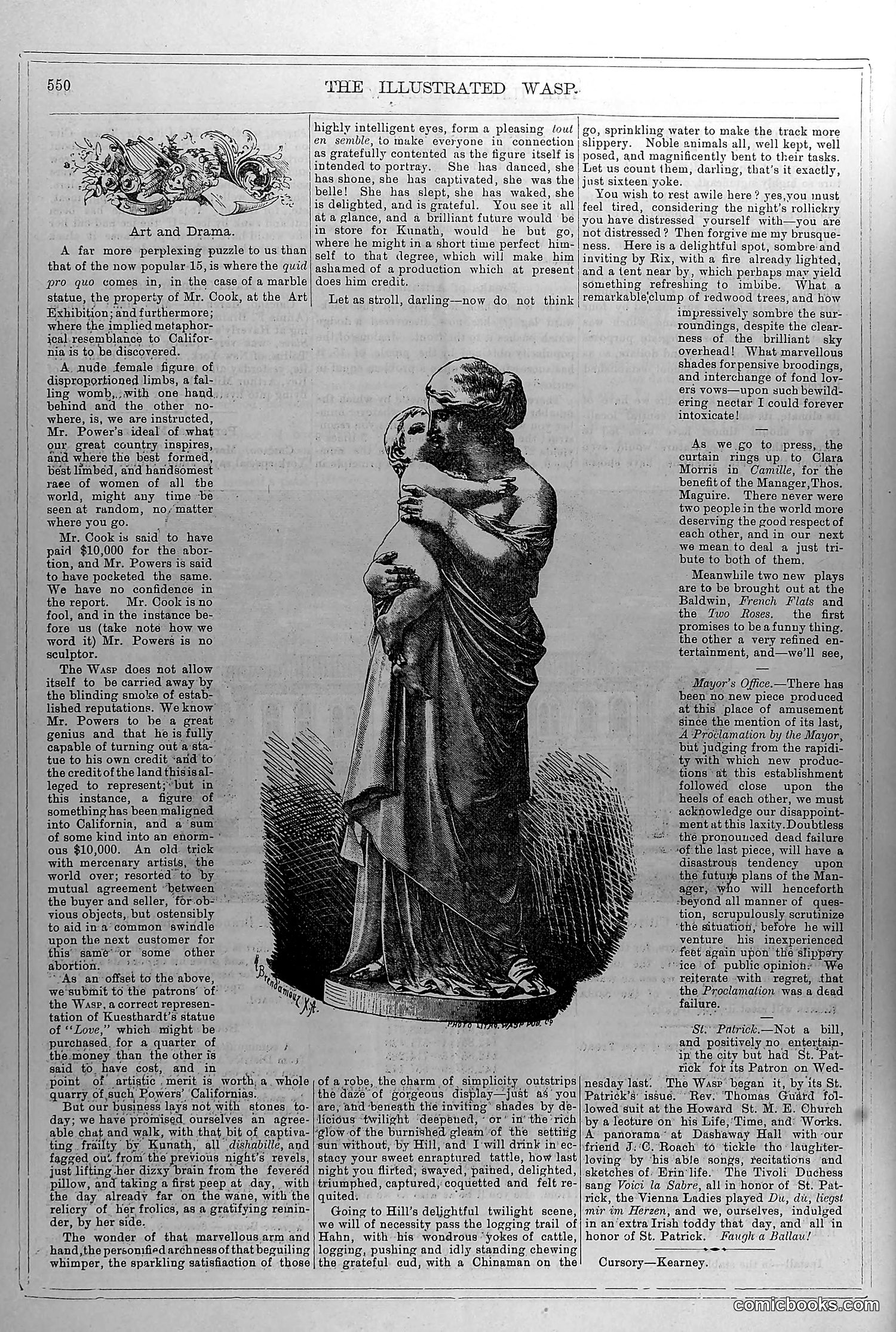
This page from *The Wasp* contains a satirical arts column rather than a political cartoon. The text mocks what appears to be a disputed art exhibition involving Mr. Cook and Mr. Powers, likely California-based artists or promoters. The column ridicules their competing claims: Cook allegedly paid $10,000 for a marble statue's "abortion," while Powers pocketed the same sum. The author suggests this is "an old trick with mercenary artists"—implying fraud or collusion to swindle a buyer. The accompanying classical female statue illustration likely represents the disputed artwork itself. The satire targets art-world duplicity and the gullibility of wealthy patrons, attacking both artistic pretension and financial dishonesty in Gilded Age cultural commerce.
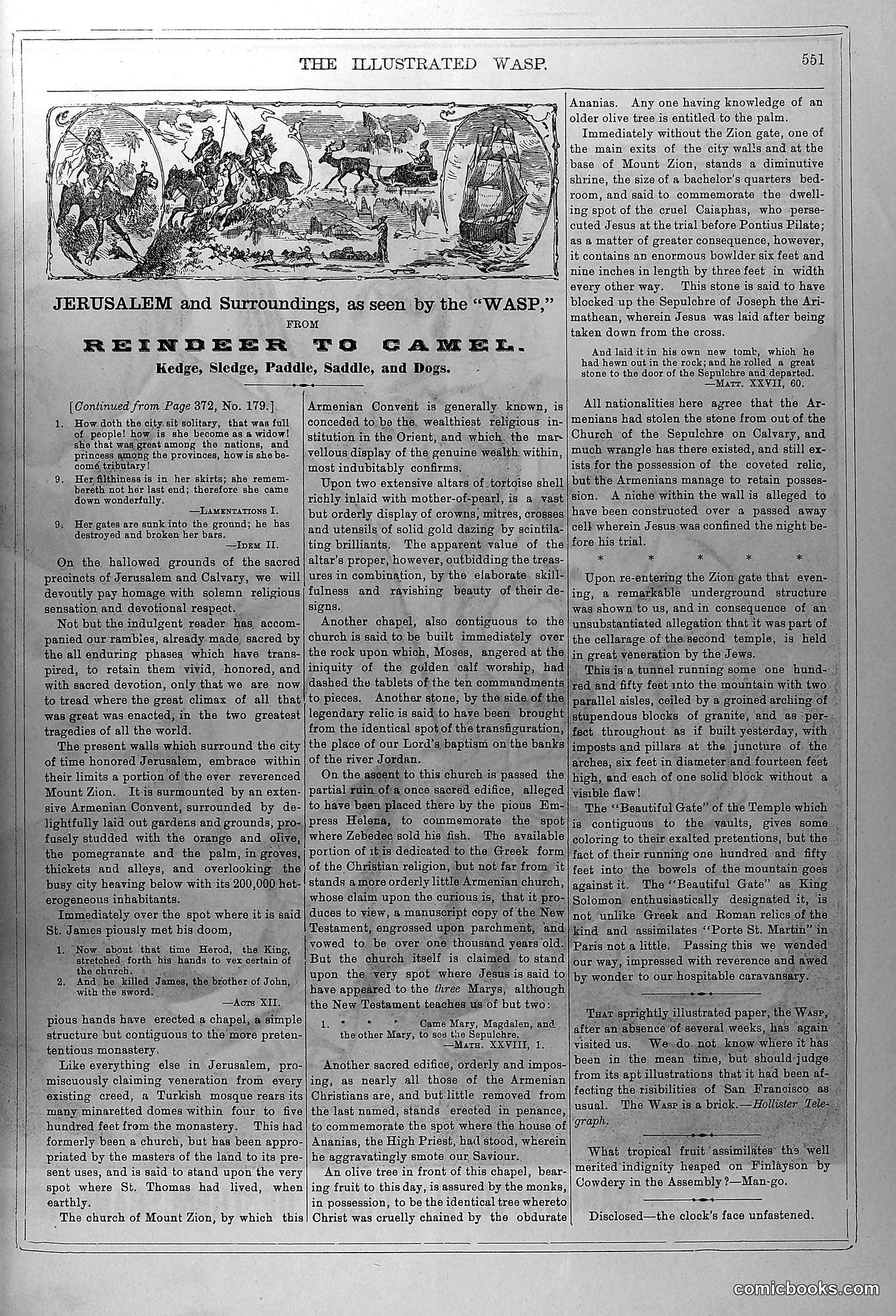
This page is primarily **descriptive travel writing, not political satire**. It's titled "Jerusalem and Surroundings, as seen by the 'WASP,' from Reindeer to Camel" and describes a journey to Jerusalem with transportation methods ranging from reindeer to camels. The text discusses Jerusalem's sacred sites—churches, convents, and gates—with particular attention to the Armenian Convent and various religious structures. It includes historical details about Jesus's trial location and descriptions of the city's architecture and religious significance. The decorative header illustration shows Jerusalem's landscape and religious monuments in a woodcut style typical of Victorian-era travel publications. This appears to be a **travel journalism feature** rather than political commentary—The Wasp functioning here as a general-interest illustrated magazine covering world destinations and culture.
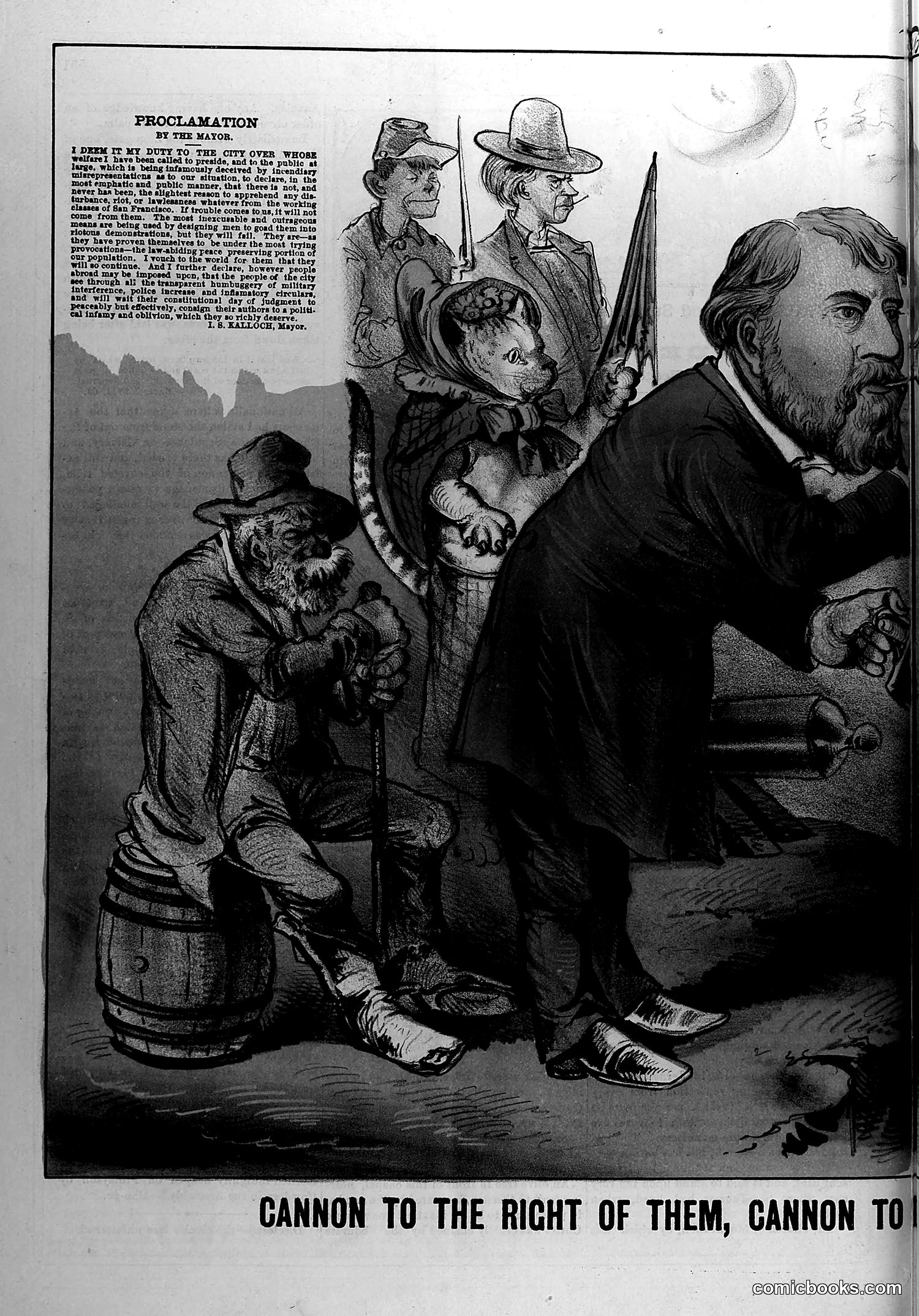
This satirical cartoon critiques San Francisco's mayor (likely from the 1870s-80s based on *The Wasp* publication period) regarding treatment of the working poor and Chinese immigrants. The "Proclamation" text denounces military misuse against citizens and calls for addressing poverty, disease, and poor sanitation in working-class neighborhoods. The visual depicts caricatured figures—including what appears to be Chinese immigrants (drawn with offensive stereotypical features characteristic of period anti-Chinese sentiment) alongside working-class San Franciscans. The caption "CANNON TO THE RIGHT OF THEM, CANNON TO" (likely referencing "Charge of the Light Brigade") suggests the mayor's rhetoric masks indifference or violence toward vulnerable populations. The satire exposes a gap between mayoral proclamations and actual municipal protection for marginalized communities.
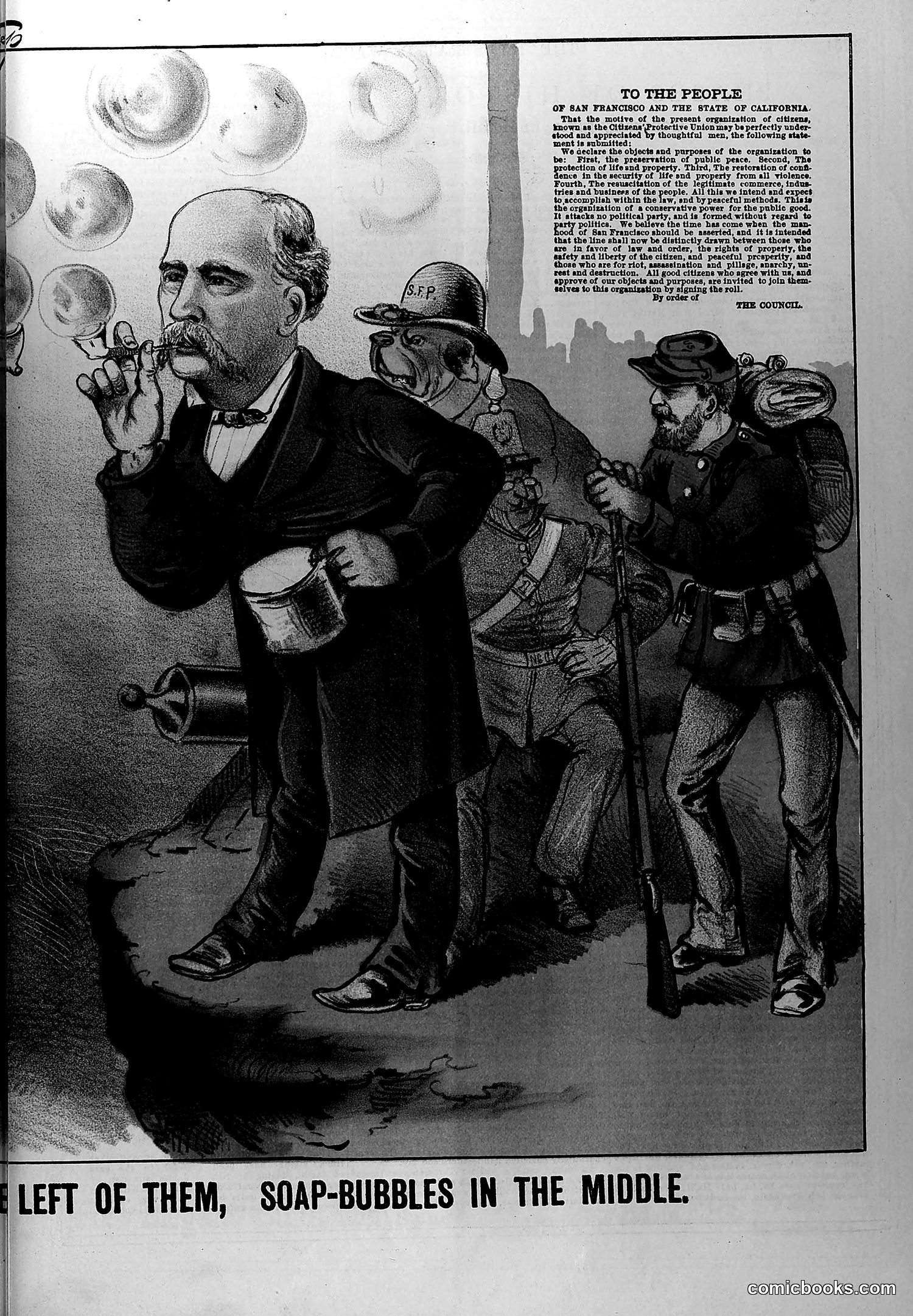
This satirical cartoon from *The Wasp* depicts three figures: a well-dressed man in the center blowing soap bubbles labeled with what appear to be promises or proclamations, flanked by two uniformed officials (likely police or security, marked "S.F.P." for San Francisco Police). The headline "LEFT OF THEM, SOAP-BUBBLES IN THE MIDDLE" suggests the cartoon critiques empty political rhetoric—the central figure's "soap-bubbles" represent hollow promises or deceptive speech intended to distract from substantive issues. The accompanying text references the "Citizens' Protective Union" and concerns about public peace, law, and order, suggesting this attacks a political organization or leader offering illusory solutions to San Francisco's civic problems while the uniformed authorities stand by.
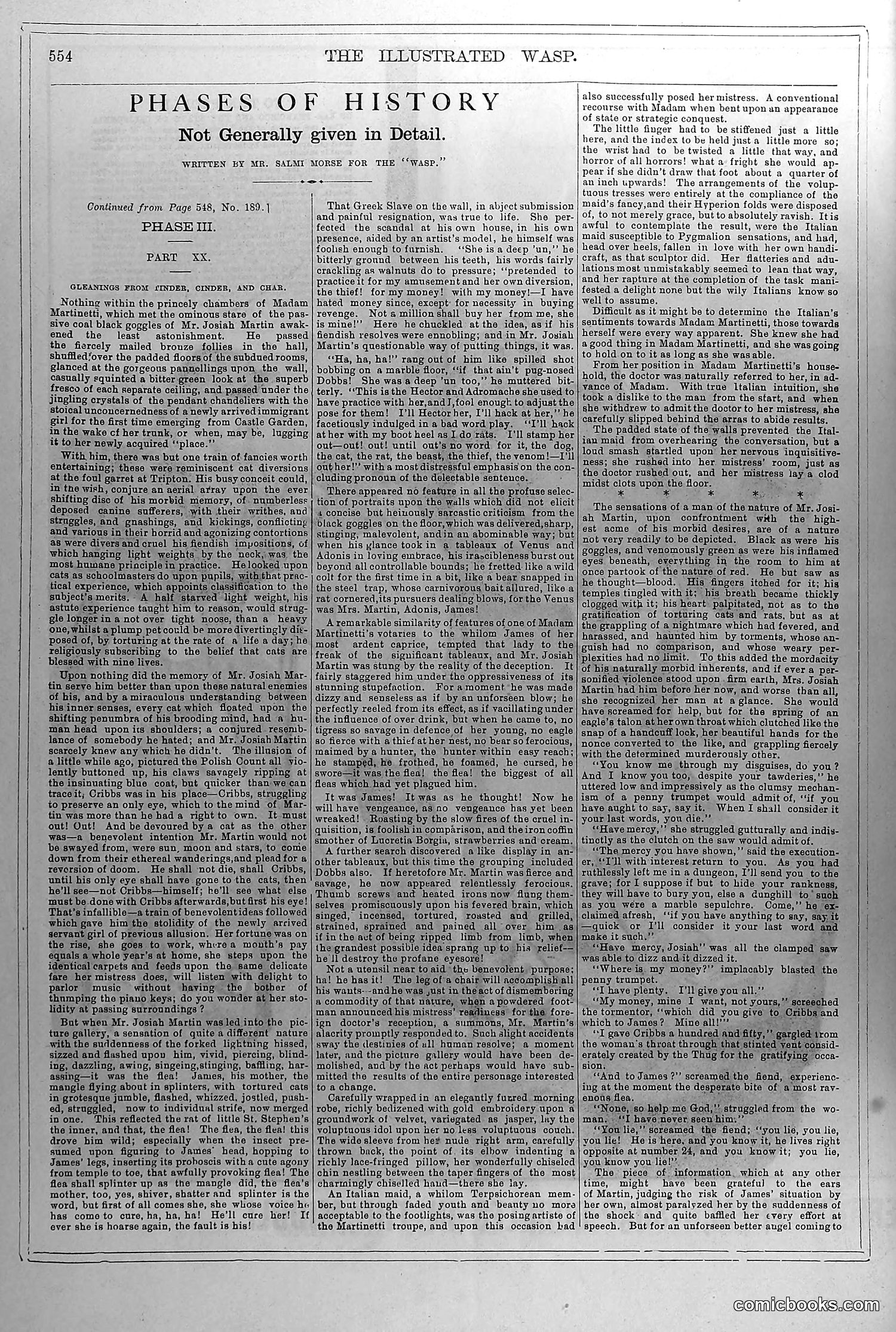
This page from *The Wasp* contains a serialized story titled "Phases of History: Not Generally given in Detail," written by Salmi Morse. The text occupies the entire visible page—there are no cartoons or satirical illustrations visible in this image. The narrative appears to be a dramatic tale involving classical or historical figures, with references to Greek slaves, Median characters, and elaborate descriptions of domestic intrigue and confrontation. The writing style is Victorian melodrama with ornate language. Without accompanying illustrations on this particular page, the satire's specific targets and visual jokes are not apparent. The page functions primarily as serialized fiction rather than visual political commentary typical of satirical magazines.
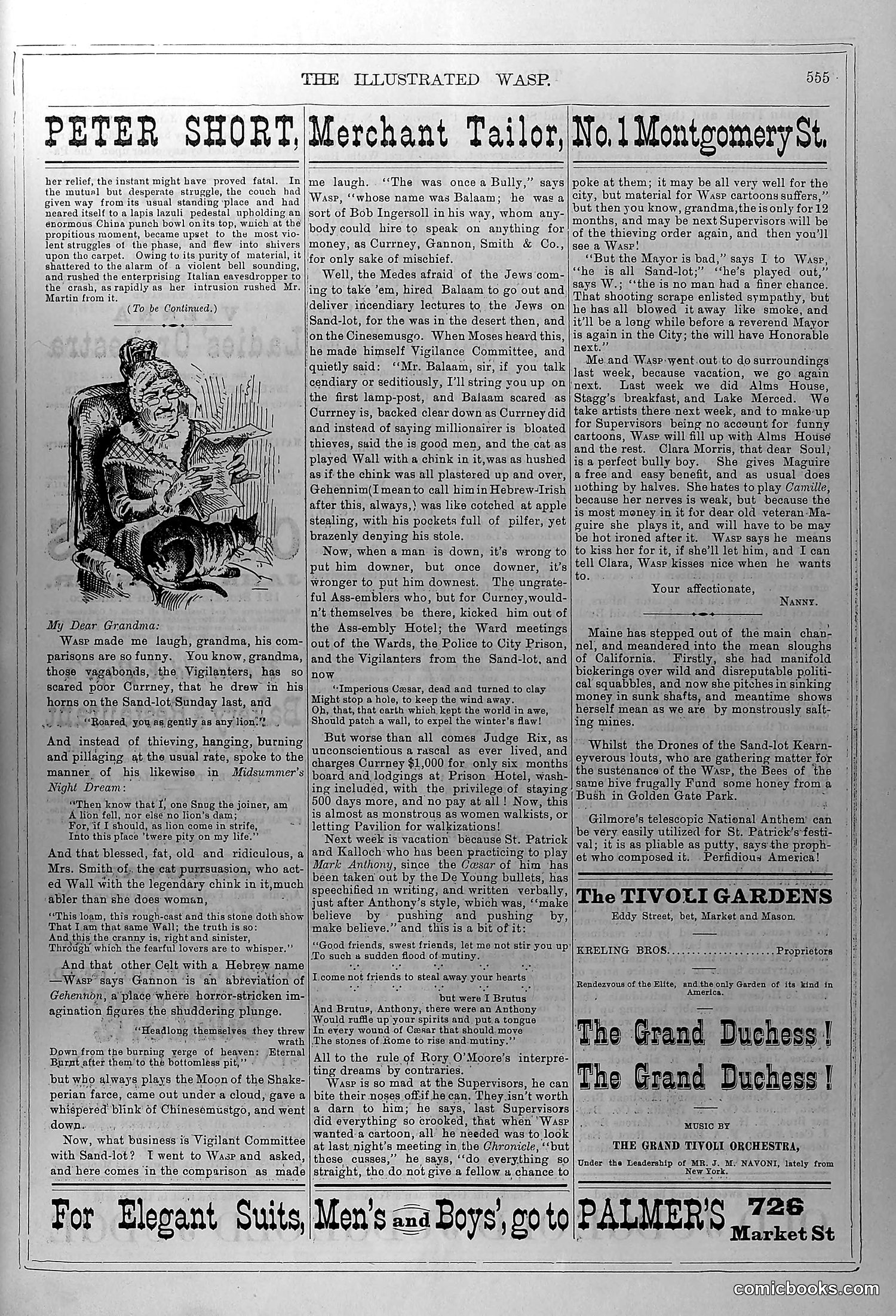
This page contains a satirical letter to "Grandma" signed by "Nansy," discussing San Francisco politics and local figures. The accompanying illustration depicts what appears to be a confrontational scene between two men. The text references Judge Ritz and Curney, apparently corrupt officials involved with the Sand-Lot movement (a labor/populist organization). The letter sarcastically comments on their activities—charges against Curney, false imprisonment, and general misconduct. The satire targets municipal corruption and what the author views as unjust treatment of prisoners. References to "Supervisors," "City Prison," and specific monetary figures ($1,000 bail) suggest real local scandals from this era of San Francisco politics. The tone is mocking indignation at perceived official malfeasance and hypocrisy.
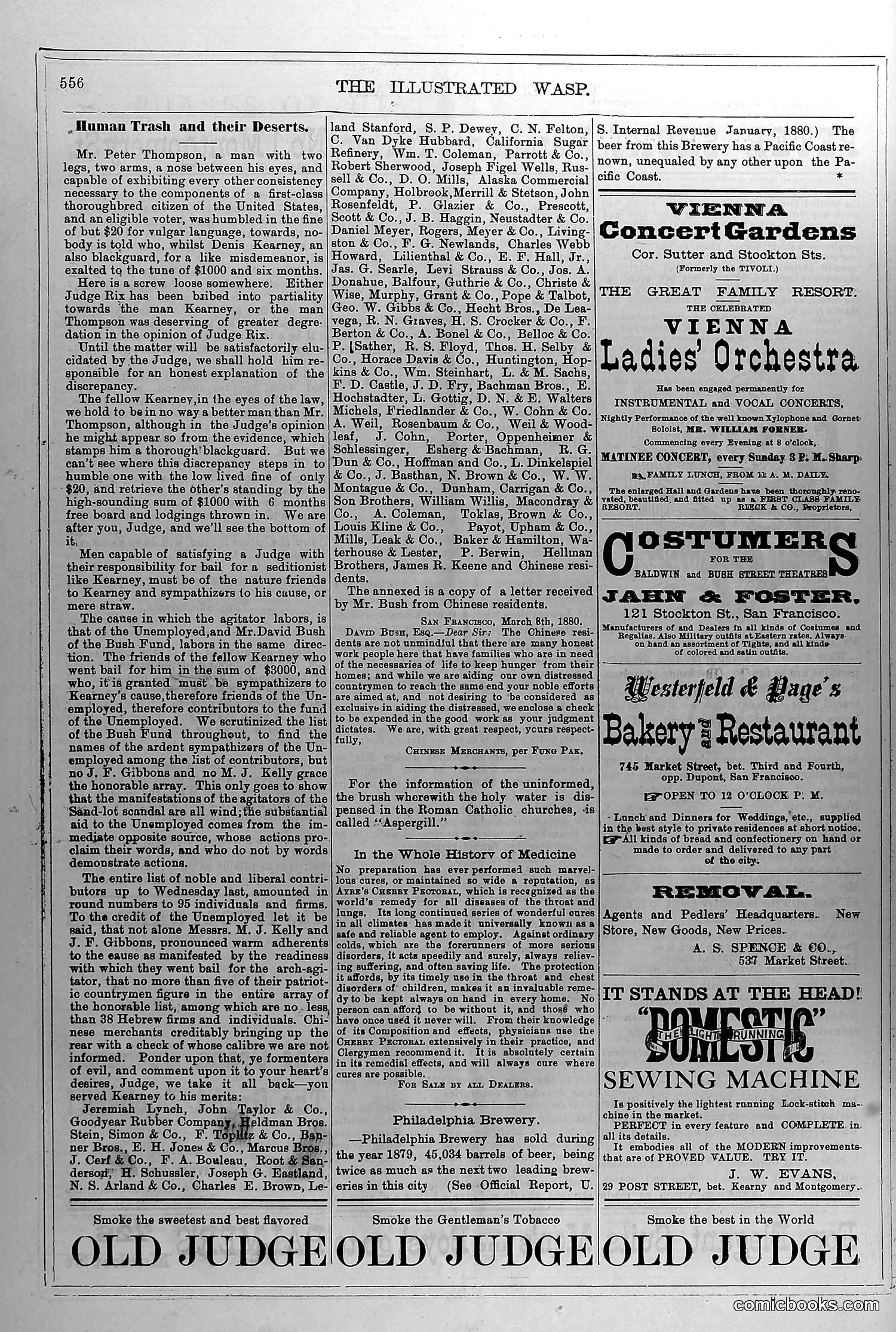
This page is **primarily advertising and notices**, not a political cartoon. It contains multiple business advertisements for 1880s San Francisco establishments: - Vienna Concert Gardens (music venue) - Vienna Ladies Orchestra (musical performances) - Westerfeld's Page Bakery & Restaurant - Costumers for Baldwin and Bush Street Theaters - Removal/relocation notices - Sewing machine advertisement - Brewery advertisements The only substantive editorial content is a letter regarding Chinese residents seeking aid and an article about medicine preparation. The page serves as a commercial directory rather than satirical commentary. The repeated "Old Judge" tobacco advertisements at the bottom were standard period advertising, not editorial satire. Without visible political cartoons or caricatures on this particular page, no satirical targets can be identified.
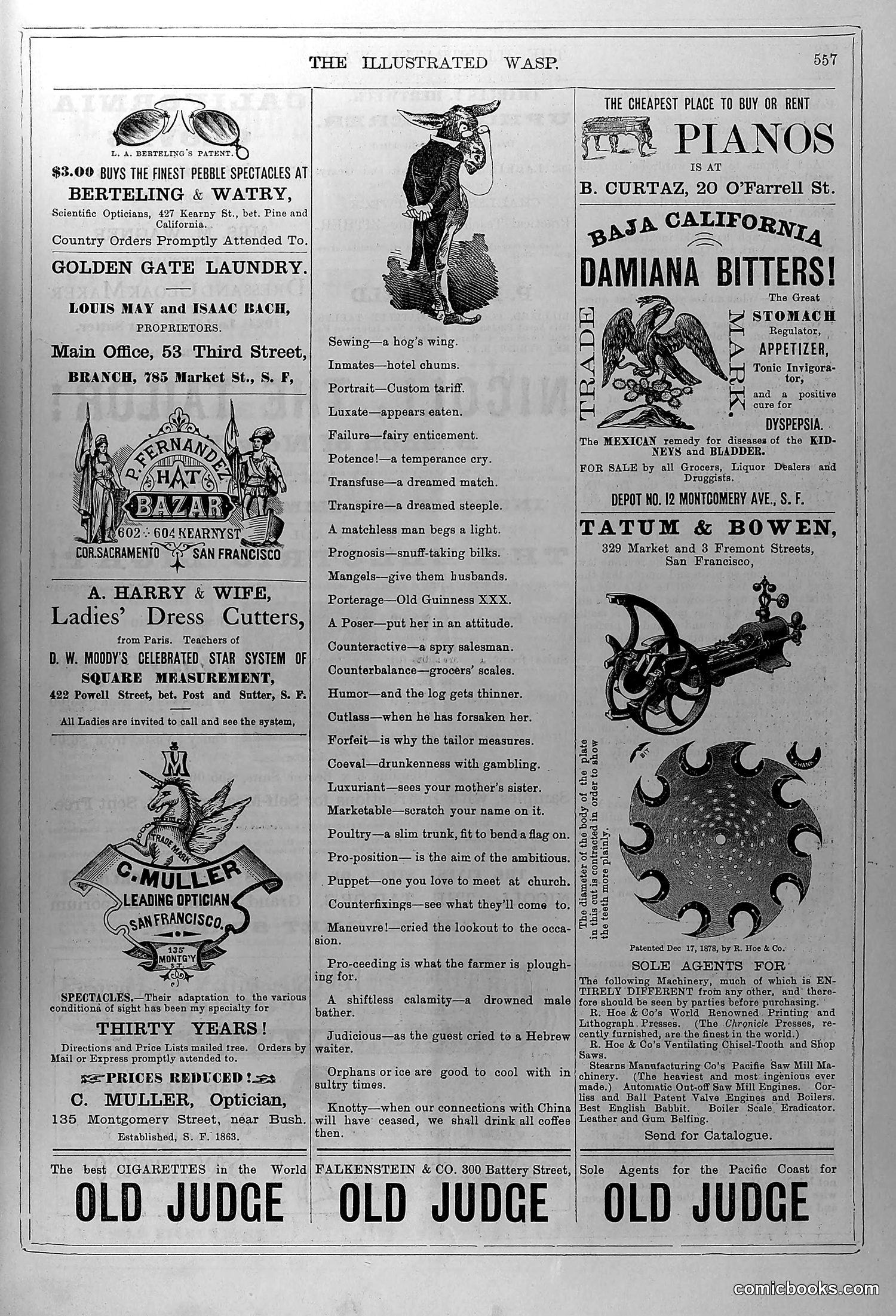
This page is **primarily advertisements** with one central illustration. The main cartoon depicts a goat standing upright with exaggerated features, labeled "Sewing—a hog's wing" at top. Below it are various word definitions presented as satirical jokes—seemingly wordplay exercises mocking pretentious or absurd terminology of the era. Examples include "Inmates—hotel chums," "Locuste—appear eaten," and "Failure—fairy enticement." The humor appears to target verbose or misleading language in contemporary society. The page also contains numerous business advertisements for San Francisco merchants (pianos, laundry, optical services, cigarettes), reflecting The Wasp's role as a commercial publication. The central cartoon's exact satirical target remains **unclear without additional context**, though the wordplay suggests mockery of linguistic affectation.
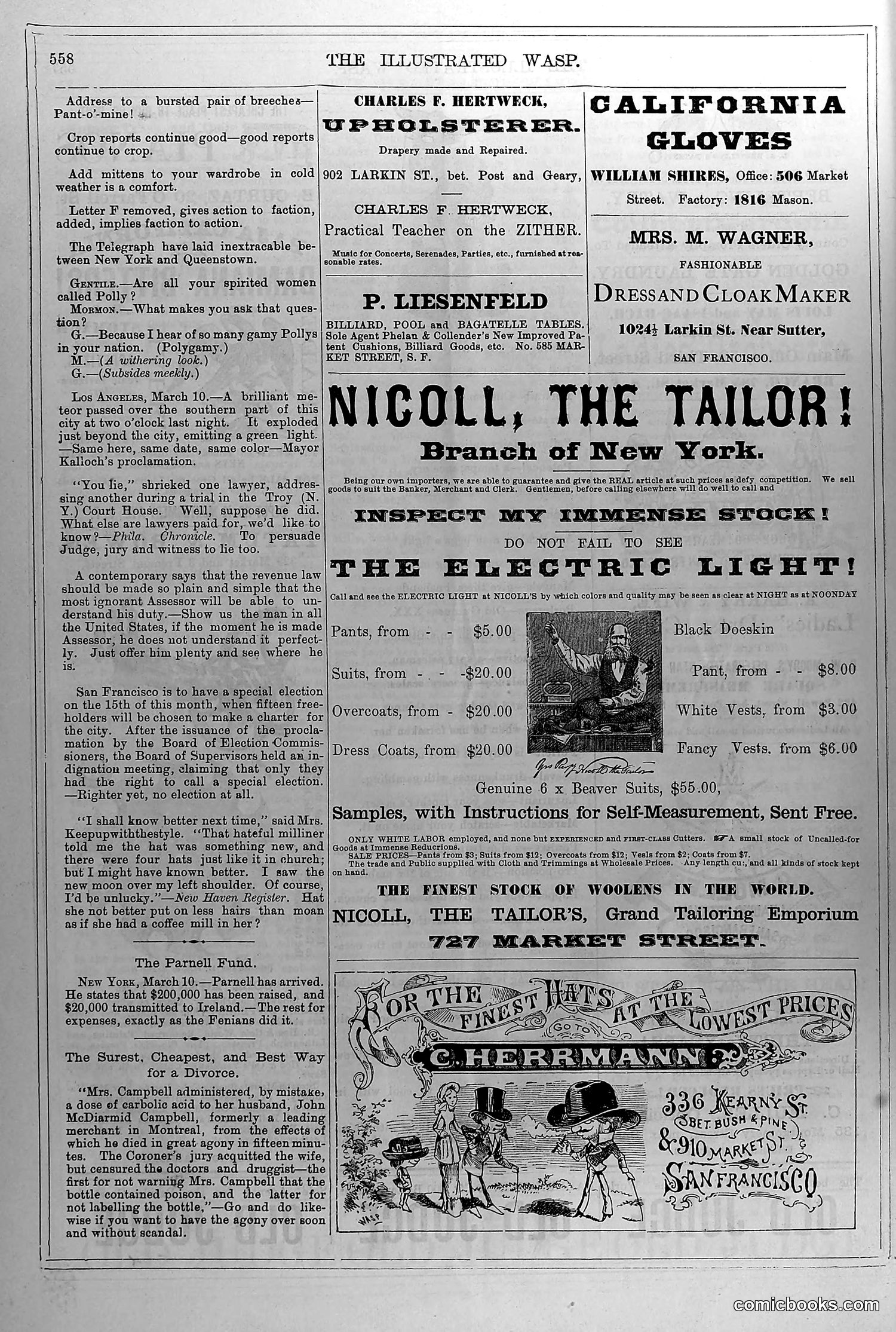
This page is primarily **advertising and miscellaneous content** rather than political satire. The dominant features are commercial advertisements for San Francisco businesses: upholsterers, tailors (Nicoll), dress makers, and hatters (C. Herrmann). The small news items scattered around the ads include a brief **meteor sighting in Los Angeles**, a comment on **revenue law simplicity**, and a story about **Mrs. Campbell's accidental poisoning case**—topics of general interest rather than political satire. The cartoons present—particularly the illustrated hatmaker's advertisement—are decorative commercial art, not satirical commentary. This appears to be a typical page from a magazine mixing editorial content with paid advertisements, typical of 19th-century publications.
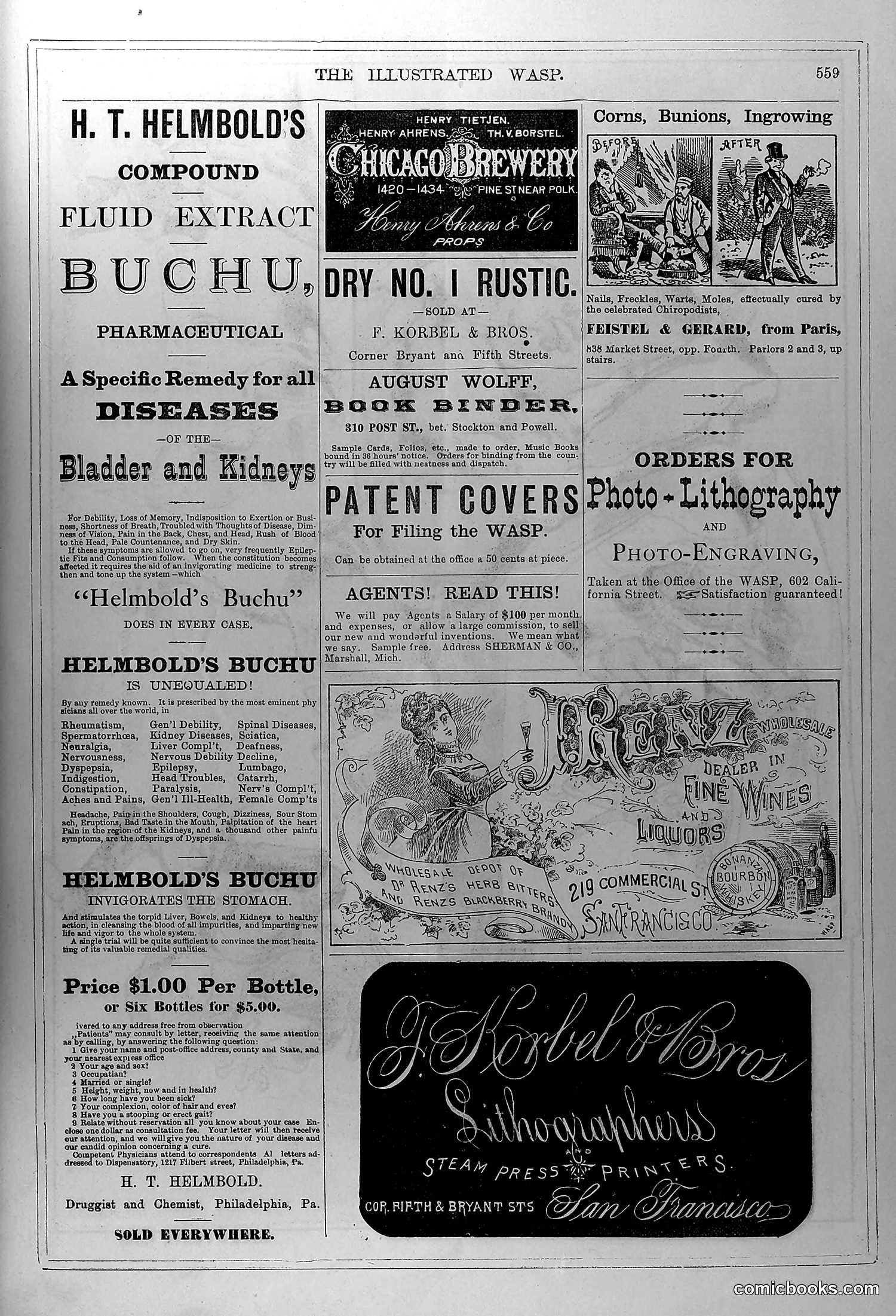
This page is primarily **advertising**, not political satire. It contains multiple commercial advertisements from the late 19th century, including: - H.T. Helmbold's Buchu, a patent medicine claiming to cure bladder and kidney diseases - A Chicago brewery advertisement - A book binder's business notice - Photo-lithography services - A wine and liquor dealer in San Francisco - A steam press printing company The only visual element is a decorative trade card illustration for the wine/liquor dealer featuring ornamental lettering and classical imagery—typical commercial art of the era. There is **no political cartoon or satire present** on this page. It represents how *The Wasp* magazine generated revenue through advertisements, interspersed with its actual satirical content elsewhere in the publication.
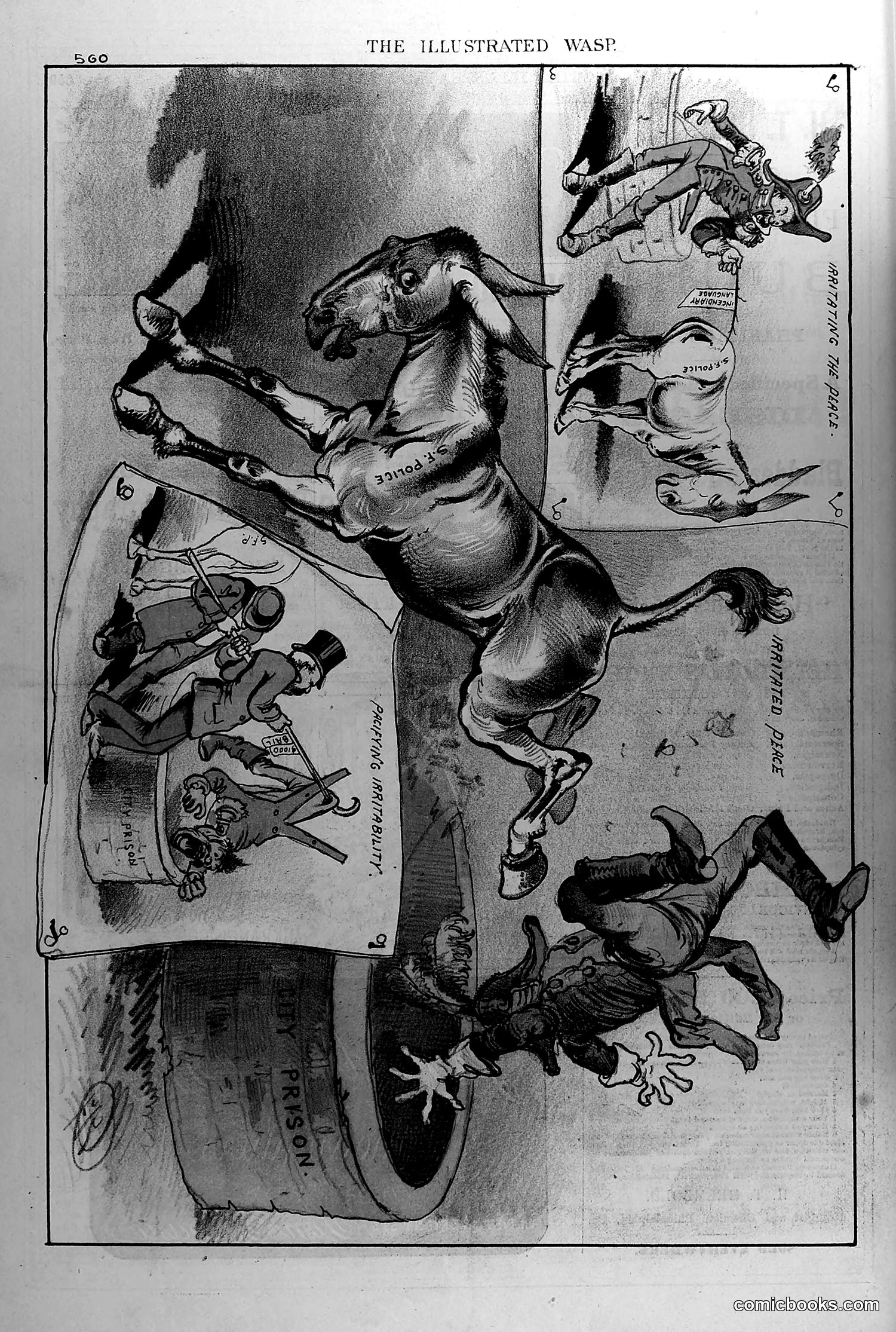
This page from *The Wasp* satirical magazine features exaggerated caricatures in a chaotic, violent scene. The central image shows a large figure (appearing to represent a political or public figure) being thrown or bucked violently, with smaller figures tumbling around. The style suggests late 19th-century American political satire. The text references are unclear from this reproduction, but the composition indicates commentary on political upheaval, loss of control, or a dramatic reversal of fortune for someone in power. The cartoonist uses physical comedy and grotesque exaggeration—typical of *Wasp*'s approach—to mock what appears to be a public scandal or political crisis. Without clearer text or dated context, the specific figures and events referenced remain uncertain.

I can see this is a test page or calibration sheet from *The Wasp* magazine rather than an actual editorial cartoon or article. The image shows a color/tone reference chart - a grid of grayscale squares in varying shades from dark to light - positioned next to measurement rulers (both horizontal and vertical). This type of technical reference material was commonly included in periodicals to ensure accurate reproduction quality during the printing process. There is no political cartoon, satirical content, or identifiable figures visible on this page. It appears to be documentation material used for quality control in the magazine's production rather than editorial content intended for readers.