
A complete issue · 18 pages · 1880
The Wasp — March 13, 1880

I can see this is a measurement reference page with Oregon Rule Co. rulers and a grayscale color chart against a black background. This appears to be a technical documentation or calibration page rather than a satirical cartoon or editorial content from The Wasp magazine. The page shows: - Two vertical measurement rulers marked 0-5 inches - A horizontal ruler at the bottom - A grid of grayscale squares for color/tone reference This type of page was commonly included in publications for photographic reproduction purposes, allowing printers to standardize tonal values and scale when reproducing images. Without visible cartoon artwork or satirical content, I cannot identify political figures, social references, or satirical intent on this particular page.
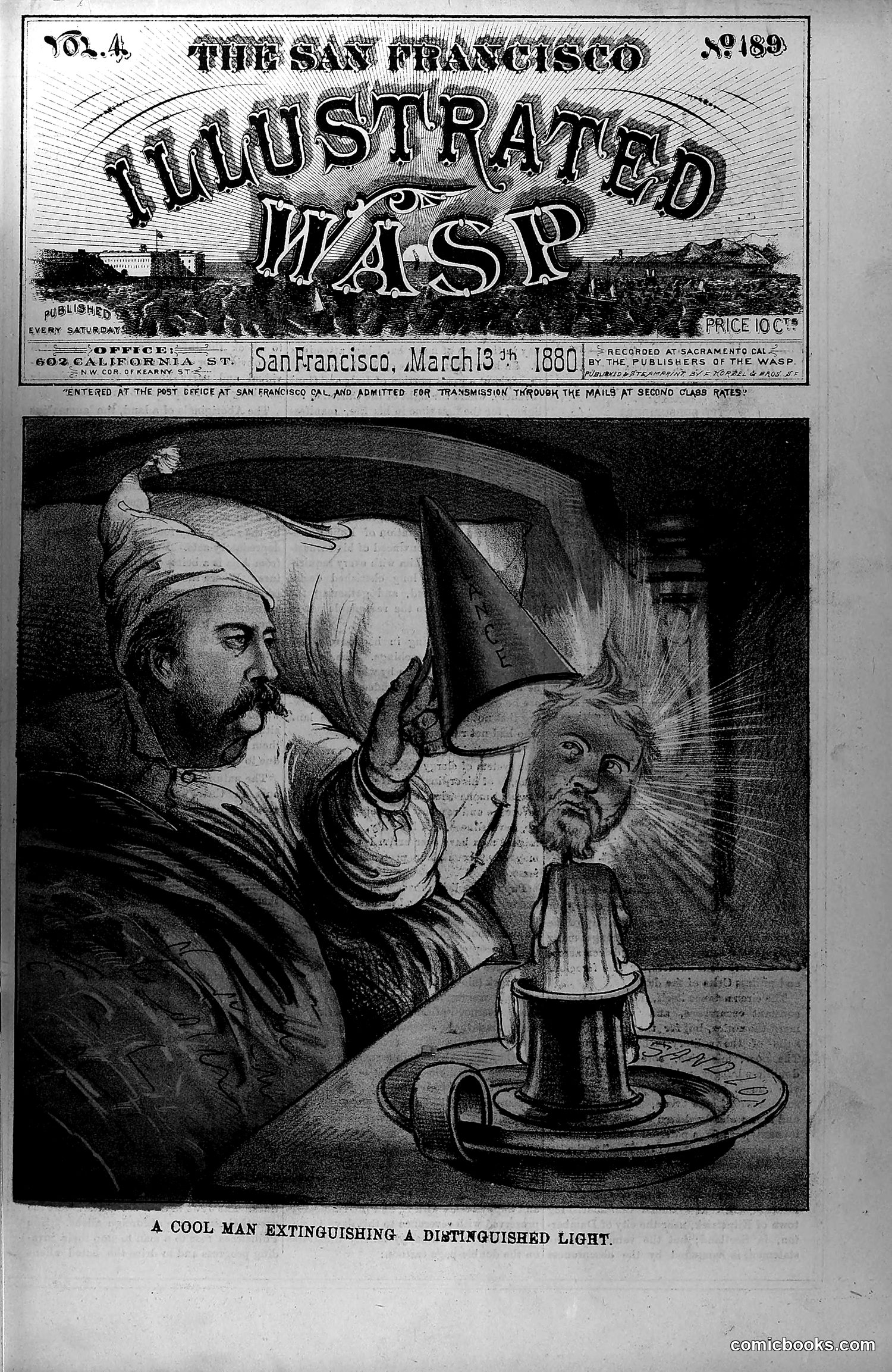
**The Cartoon: "A Cool Man Extinguishing a Distinguished Light"** This political satire depicts a bearded man (identity unclear from image alone) calmly snuffing out a candle that has a human head emerging from its flame. The "distinguished light" likely represents a prominent political or social figure being deliberately obscured or eliminated from public prominence. The phrase "cool man" suggests the figure performs this suppression with calculated indifference rather than passion. Without additional context about 1880 San Francisco politics, the specific target remains uncertain, but the cartoon clearly critiques someone in power extinguishing the visibility or influence of another notable person—likely commenting on political corruption, censorship, or the abuse of authority during California's Gilded Age.
This page is primarily **editorial and advertising content**, not a political cartoon. The main feature is an article titled "ST. PATRICK, The Patron Saint of Ireland," which discusses St. Patrick's legendary history and his veneration in Irish culture. The text praises Patrick's "unremitting" travels and teachings, noting his popularity among Irish clans. However, it then pivots to criticize Irish immigrants in America, describing them as prone to "violence," "barbarity," and susceptibility to superstition—characterizing them as "inborn" aggressors. The piece concludes with anti-Chinese rhetoric, comparing Irish prejudices to hostility toward Chinese immigrants, suggesting both groups face discrimination. **The satirical intent appears to mock Irish-American identity while simultaneously using xenophobic language toward Asian immigrants.**
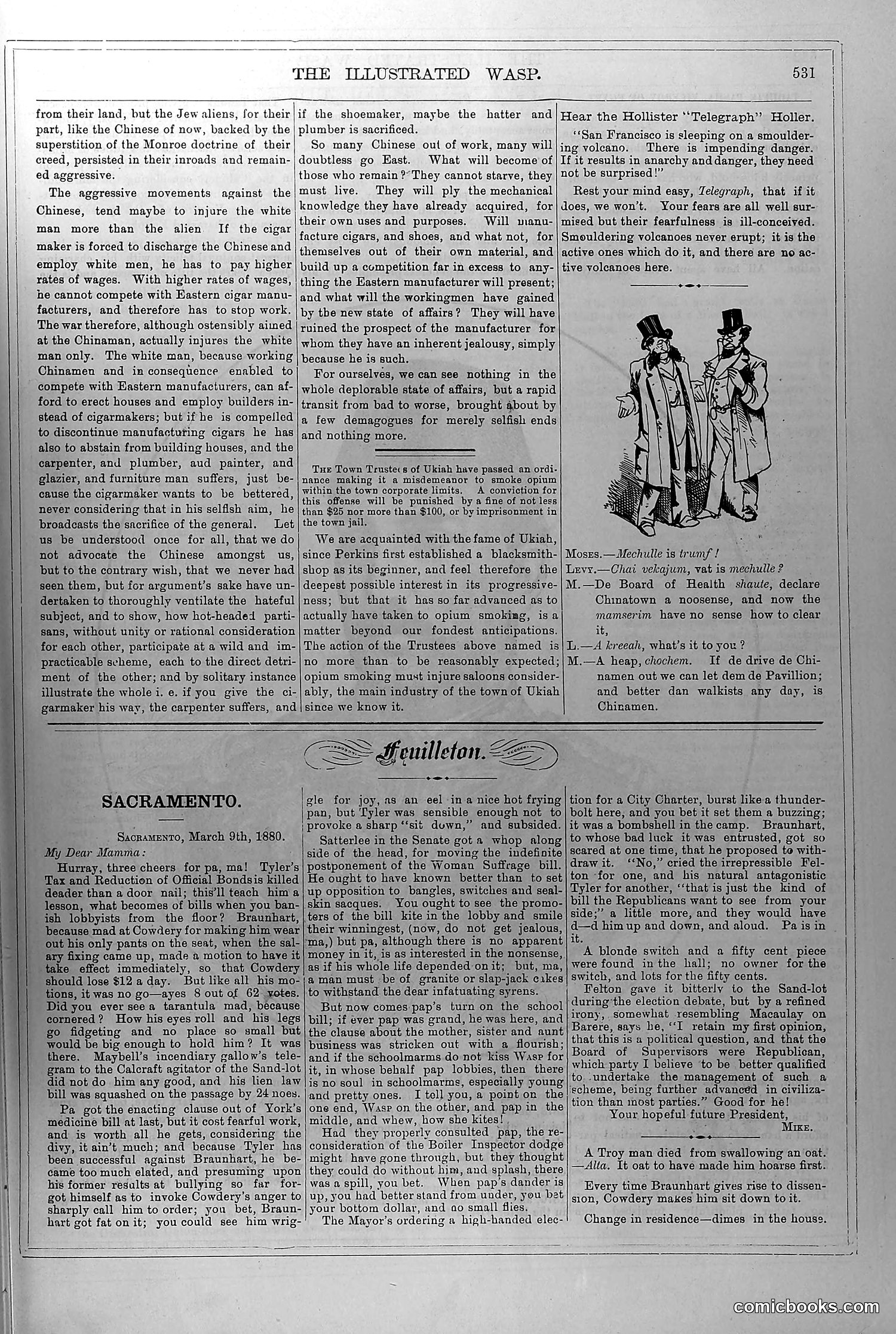
This page contains two distinct sections: **political commentary** (top) and **social satire** (bottom labeled "Feuilleton"). The **top section** discusses Chinese labor and manufacturing in California, arguing that employing Chinese workers at lower wages forces white laborers out of jobs. The satire criticizes how this creates economic resentment while defenders claim Chinese workers simply fill necessary roles—portraying the debate as cyclical and intractable. The **bottom section** ("Sacramento") satirizes local politics and a specific bill, mocking what appears to be legislative absurdity. The dialogue between characters (Moses, Levy, M.) employs ethnic stereotypes common to 1880s American satire. The **illustration** shows two well-dressed gentlemen in top hats, though their specific identities are unclear from the image alone. The overall tone reflects *The Wasp*'s anti-Chinese sentiment, a dominant theme in California journalism of this era.
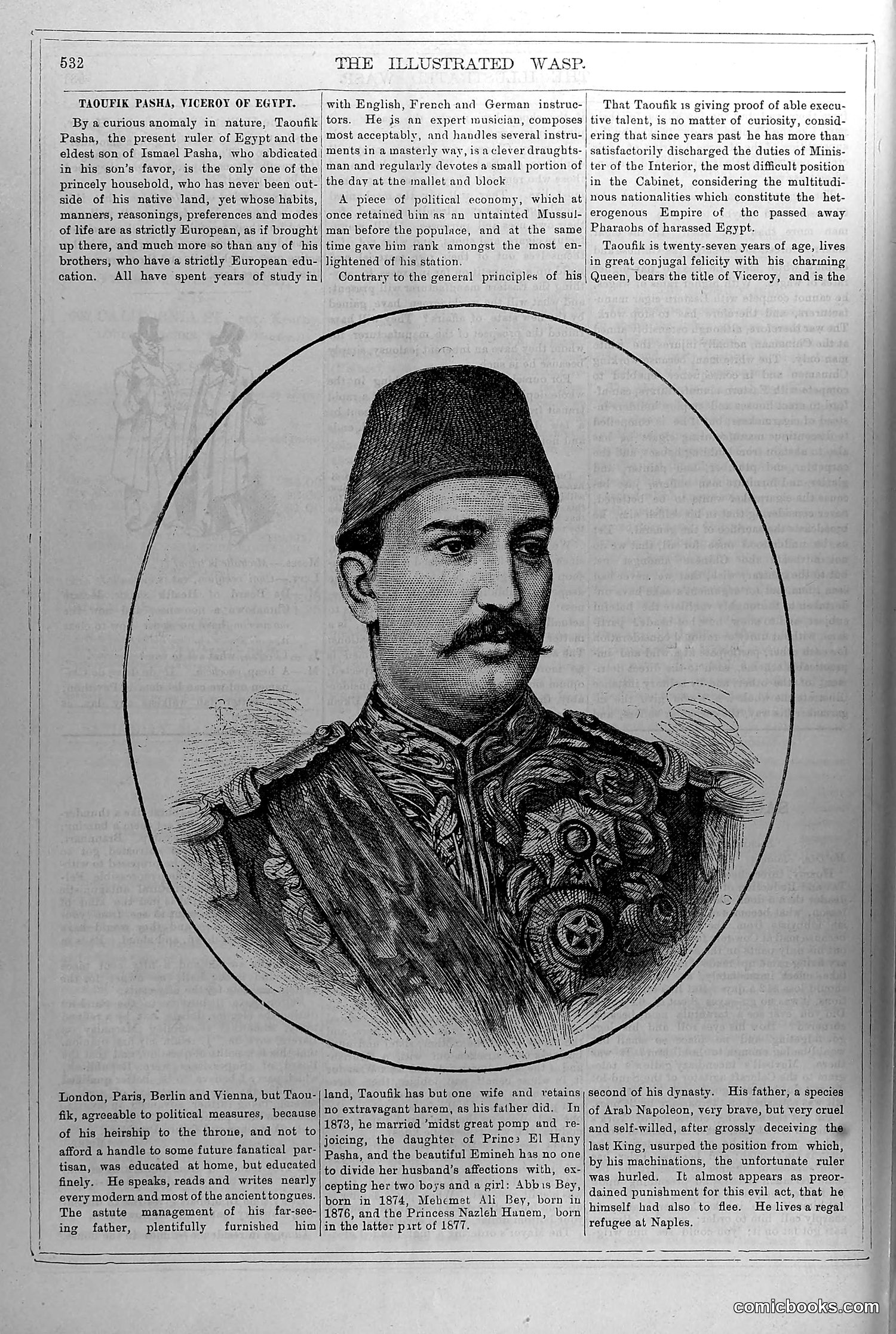
This page features a biographical portrait and article on **Taoufik Pasha, Viceroy of Egypt**. The engraved portrait shows him in military dress with medals and a Ottoman-style fez. The text describes Taoufik as an anomaly: despite being Egypt's ruler, he is European in education and habits, having studied abroad with his brothers. The article presents this as notable—his Europeanization contrasts with his position governing Egypt during the Ottoman Empire. The satire appears subtle: the piece highlights the contradiction of a nominally Egyptian leader who is thoroughly Western in outlook, living among Egypt's diverse populations. This reflects 19th-century Western perspectives on colonial leadership and cultural "fitness" to rule non-European territories. The article emphasizes his musical talents and administrative competence, though contextual irony about his actual autonomy may be intended.
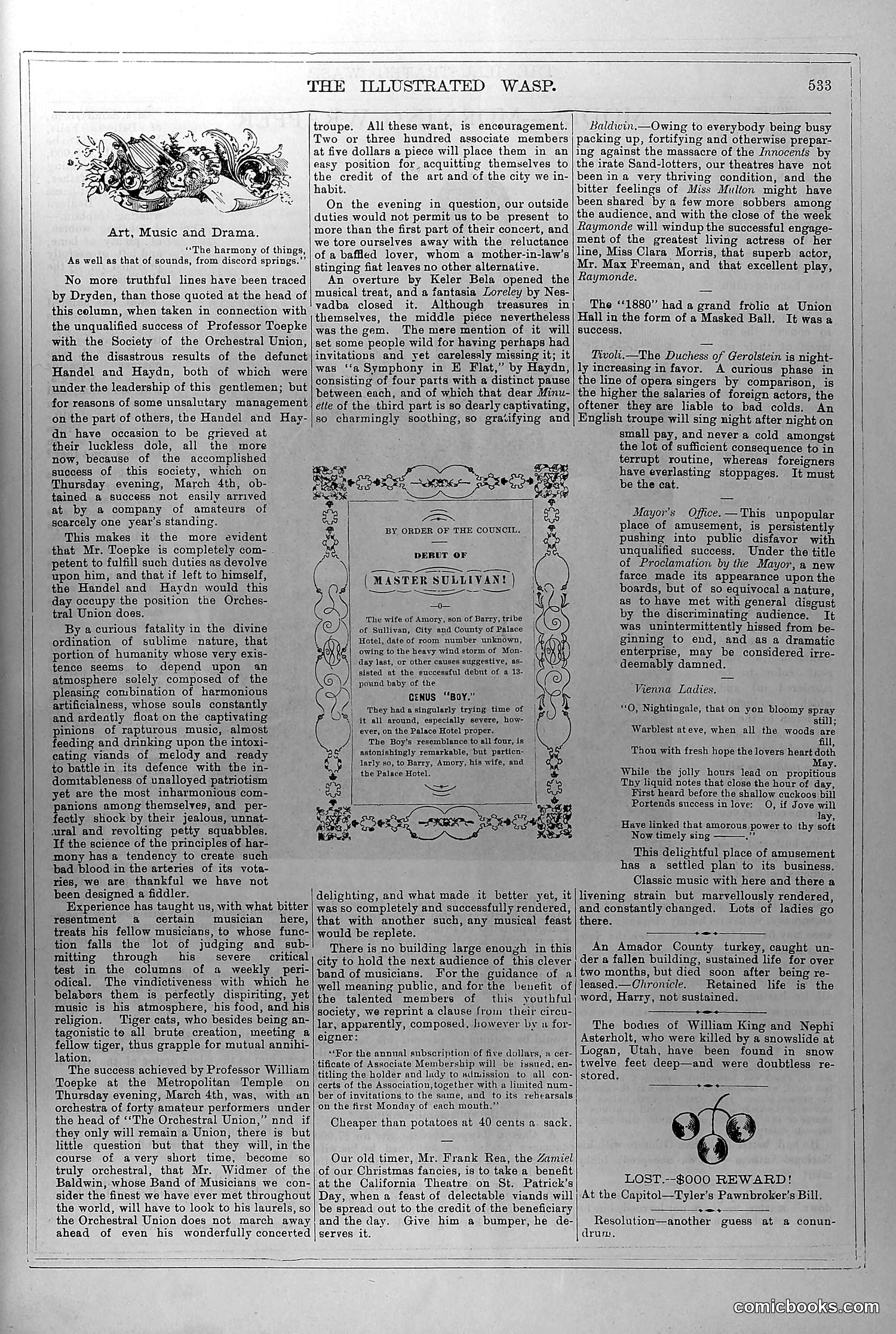
This page is primarily **editorial and review content** rather than political satire. It contains theater and music criticism discussing recent performances by the Orchestral Union, including concert reviews and commentary on amateur musical societies. The main illustrated section features "**Master Sullivan**" - likely referencing **Sir Arthur Sullivan**, the celebrated composer. The decorative box includes biographical information about Sullivan and appears to be a profile or tribute piece. The page also contains society gossip items ("Vienna Ladies," "Mayor's Office," "Amador County turkey") typical of 19th-century satirical magazines, plus advertisements ("LOST—8000 REWARD!"). The satire here is **mild social commentary** rather than sharp political critique—mocking pretentious amateur musicians and city bureaucratic absurdities common to the era.
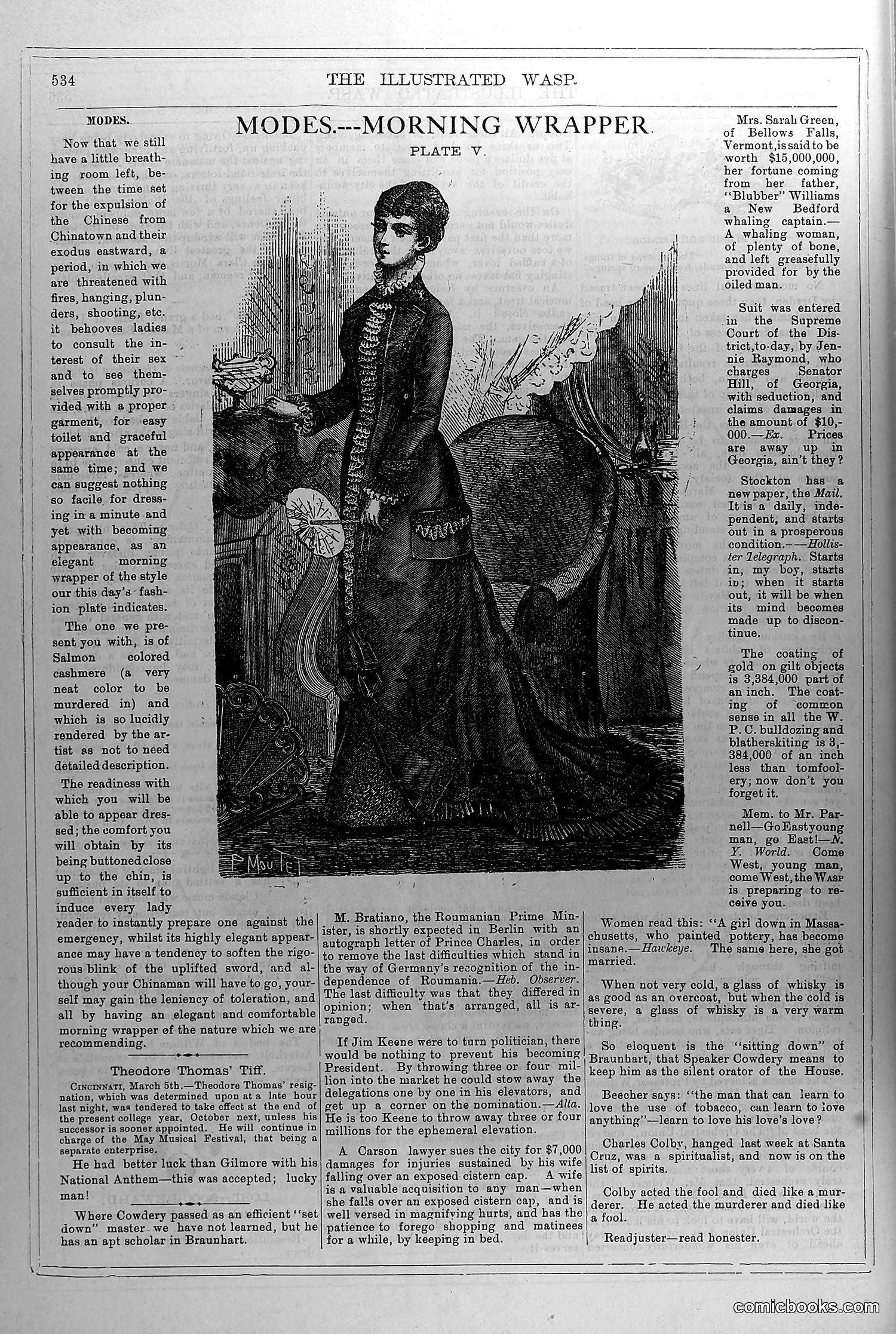
This page features a fashion illustration titled "Modes—Morning Wrapper, Plate V," showing a woman in an elegant salmon-colored cashmere morning gown. The accompanying text discusses practical dressing for the current period (apparently during Chinese expulsions from Chinatown), emphasizing that fashionable women can look elegant while remaining prepared for emergencies. The page also contains unrelated brief news items and gossip, including notes about Mrs. Sarah Green of Vermont's fortune, a lawsuit about damages, and various social commentary. The satirical magazine uses the fashion plate as its main visual content, with sidebar commentary typical of period society journalism. No specific political cartoon is present on this page—it's primarily a fashion-focused issue with miscellaneous news tidbits.
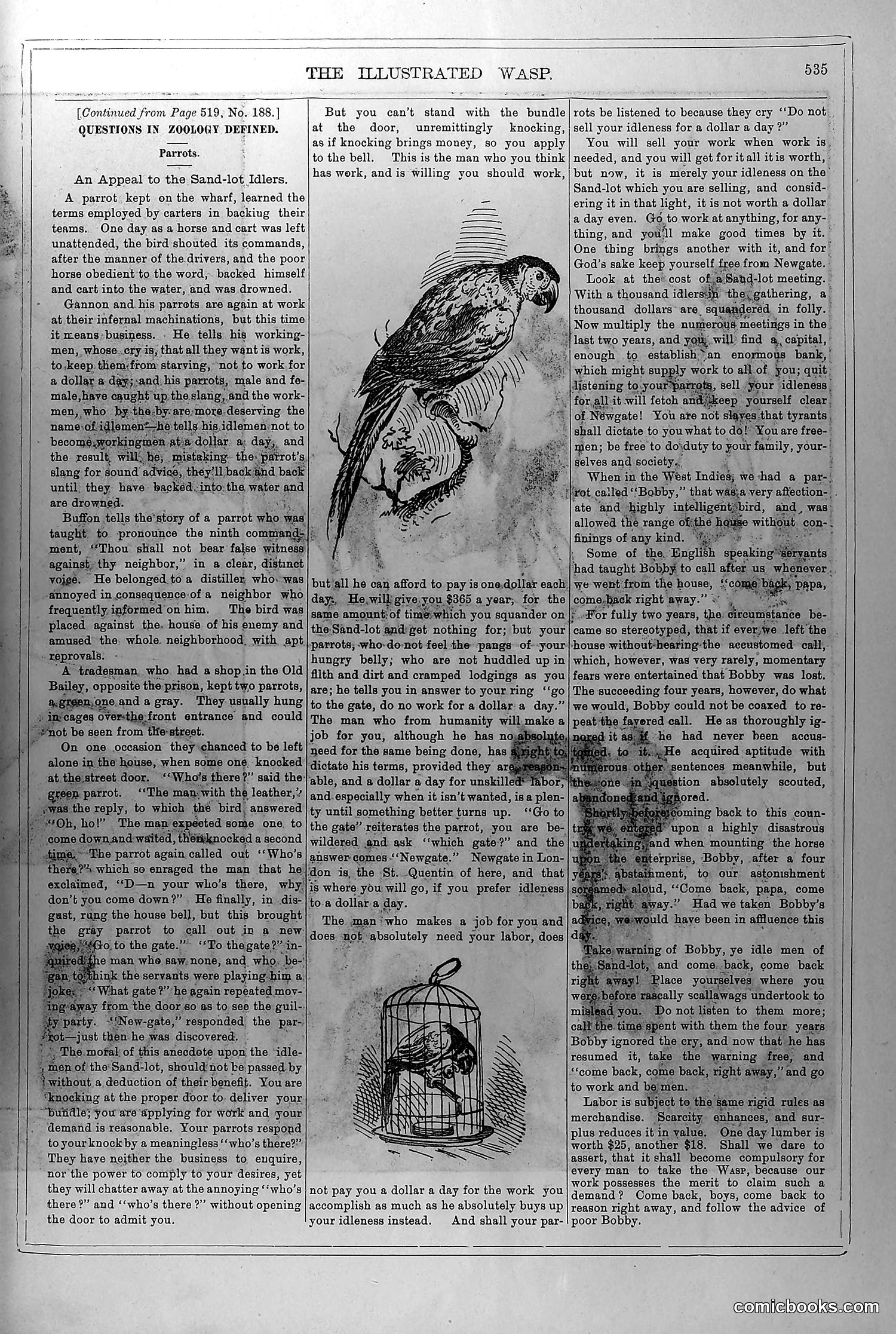
This page presents a satirical essay about working-class idleness, using a parrot anecdote as its framing device. The text criticizes "Sand-lot Idlers"—unemployed men gathering in public spaces—arguing they refuse honest work while expecting charity. The illustrations show a parrot and a birdcage. The parrot story illustrates the essay's central complaint: a bird taught to say "Who's there?" becomes so associated with the phrase that it refuses other commands, symbolizing workers who blame circumstances for unemployment rather than accepting available jobs. The satire targets labor's excuses, arguing that workers claiming jobs don't pay enough actually prefer idleness. The author advocates strict discipline: workers should either accept low wages or face consequences. This reflects 19th-century anti-labor sentiment blaming poverty on moral failing rather than systemic economic conditions.
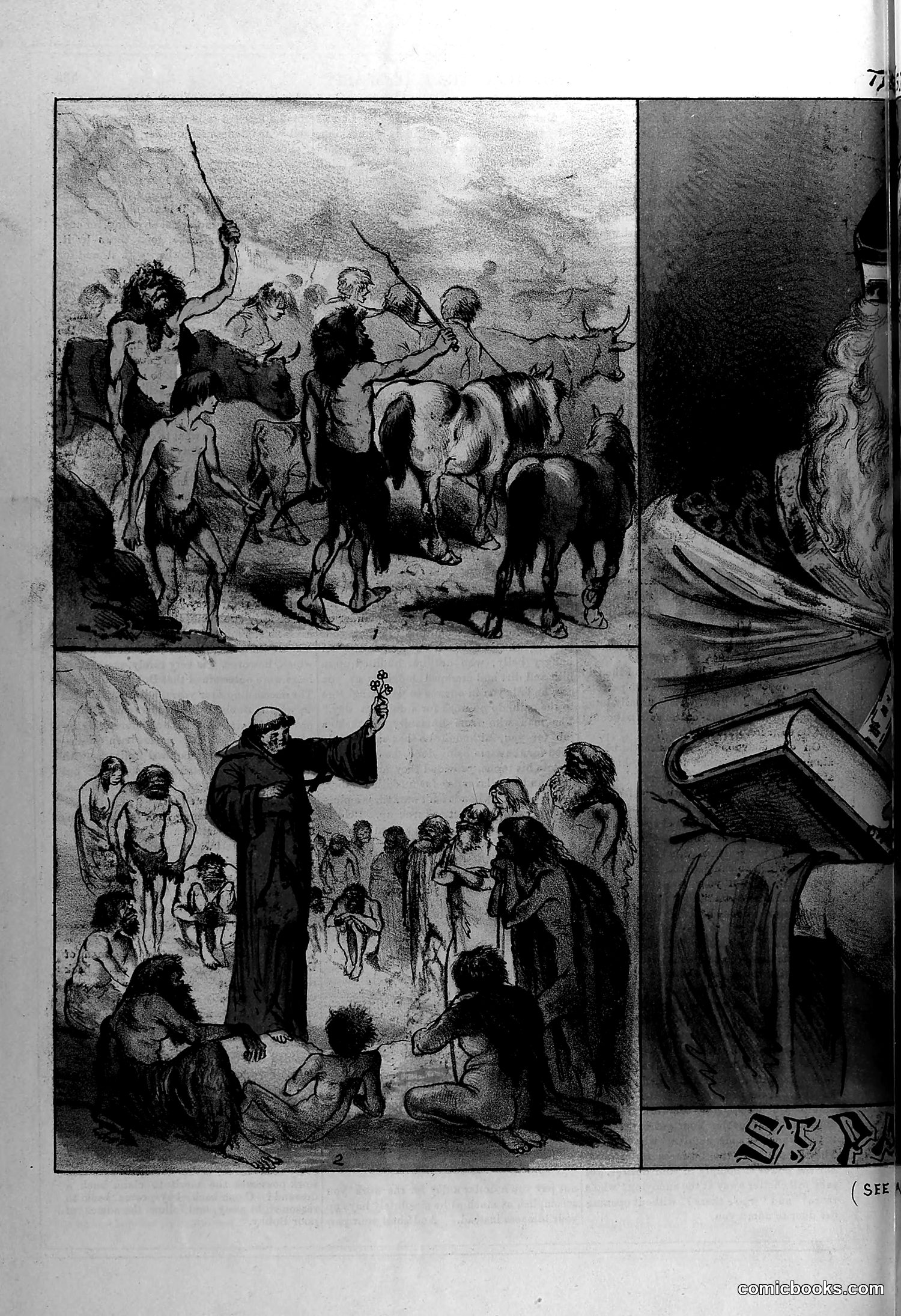
This page from *The Wasp* contains two satirical engravings, likely from the 19th century, depicting religious and moral critique: **Top panel**: Shows figures with animal heads (appearing to be satyrs or demonic creatures) wielding weapons or tools in a chaotic scene, suggesting depravity or wickedness. **Bottom panel**: A robed religious figure (priest or bishop, identifiable by vestments and cross) gestures toward a crowd of poor and afflicted people, including children and the infirm, appearing to preach or bless them. The juxtaposition suggests *The Wasp's* satirical attack on institutional religion—contrasting the clergy's spiritual authority with either hypocrisy or ineffectiveness in addressing suffering. The specific figures and referenced events remain unclear without additional context or caption text, but the message critiques the gap between religious pretense and social reality.
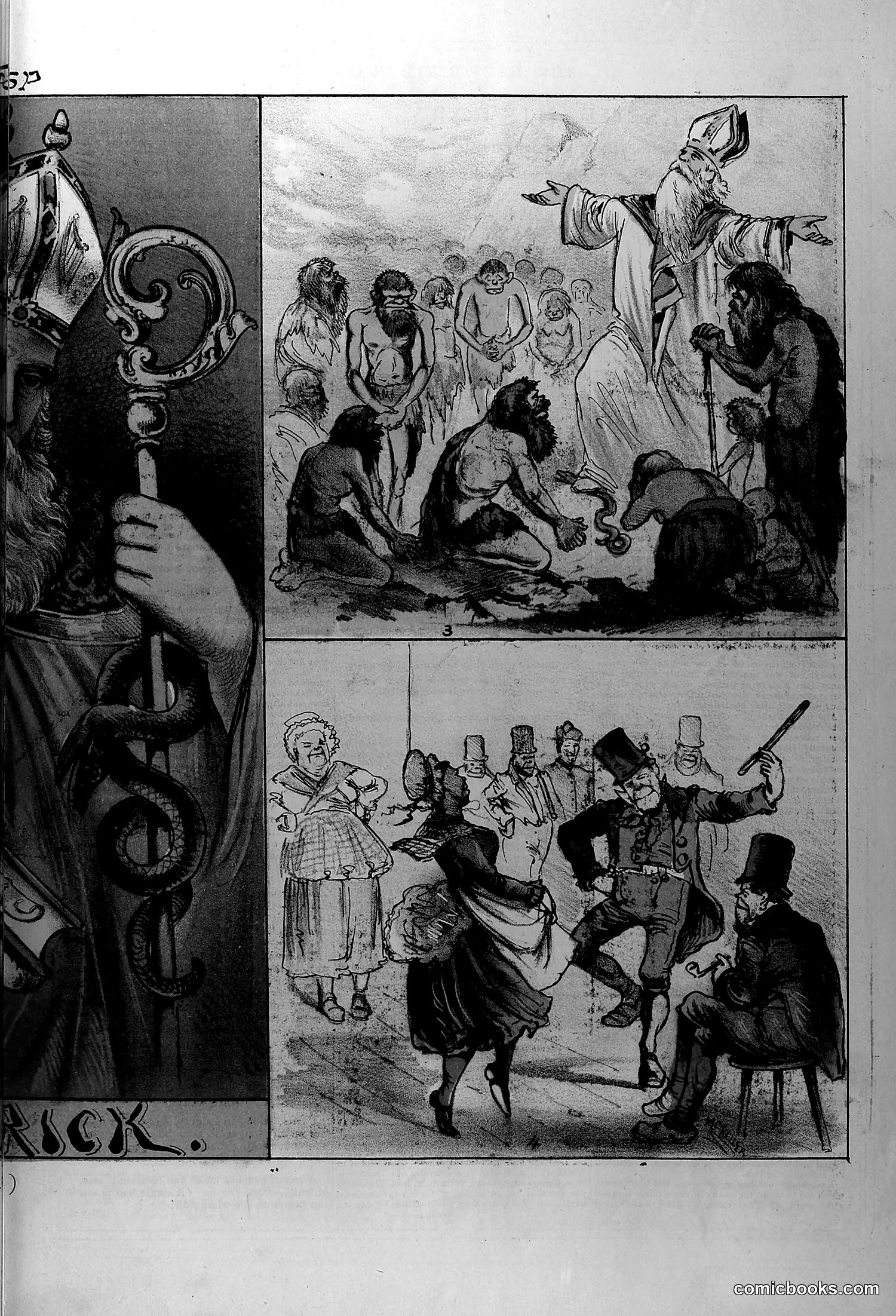
This satirical page from *The Wasp* magazine appears to depict a religious or spiritual authority figure (left panel) presiding over two contrasting scenes. The upper panel shows what appears to be a primitive or ritualistic gathering with numerous figures in various states of undress, suggesting comparisons between organized religion and "primitive" practices. The lower panel depicts well-dressed Victorian-era figures in social interaction, implying commentary on hypocrisy between public civility and private behavior, or between supposedly "civilized" modern society and the activities of the religious establishment shown above. The ornate staff or ceremonial object on the left likely represents religious authority. Without visible OCR text identifying specific figures or the publication date, the exact political targets remain unclear, though the satire appears to critique religious institutions and social hypocrisy.
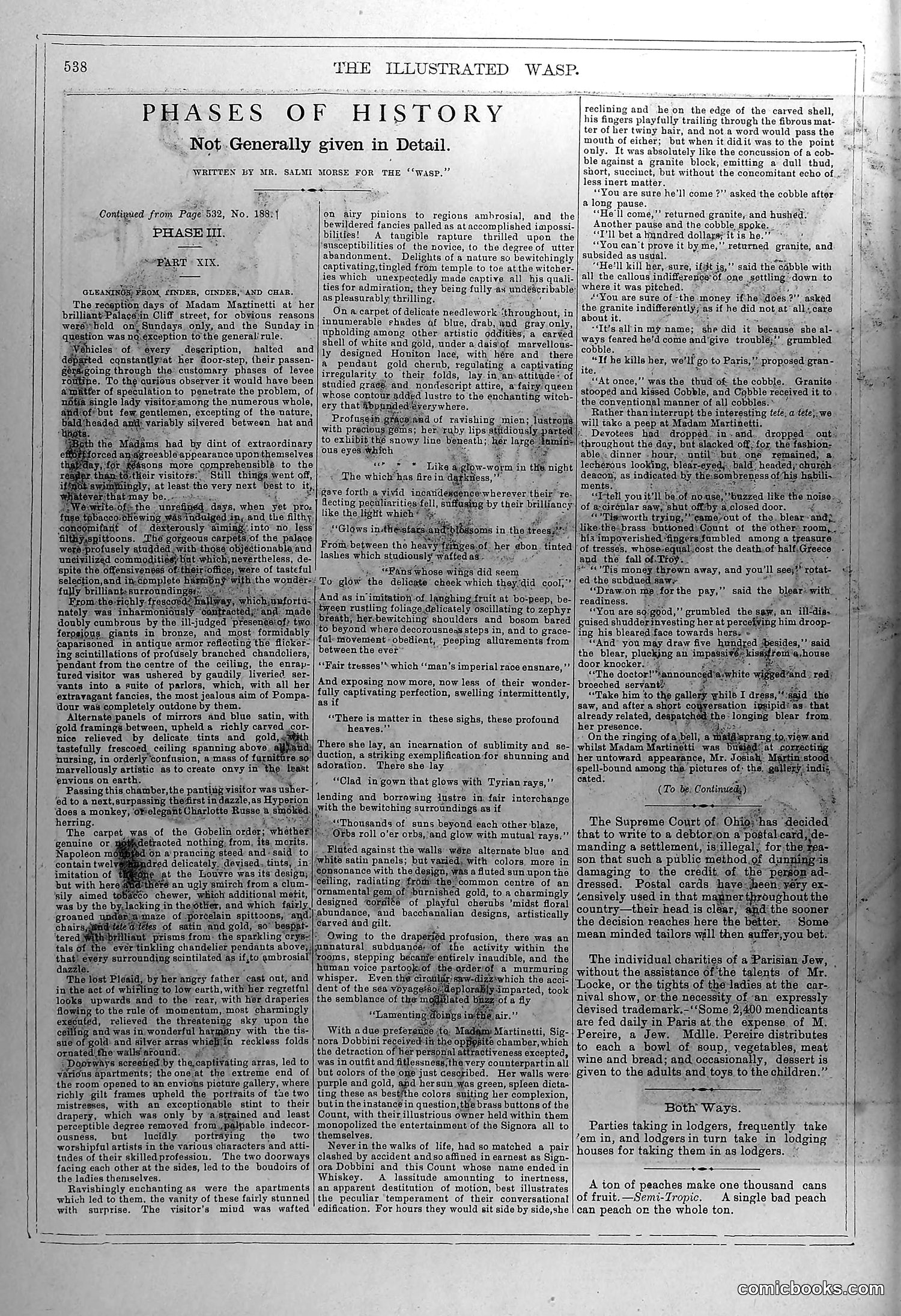
This page from *The Wasp* is primarily **text rather than cartoon content**—it's a historical essay titled "Phases of History: Not Generally given in Detail," written by Salmi Morse for the magazine. The piece discusses various historical observations and anecdotes, including references to palace architecture, artistic patronage, and social customs. The page includes some satirical commentary embedded in the narrative—for example, discussions of courtly excess and absurd social conventions—but lacks the visual political cartoons typical of *The Wasp*'s satirical approach. The content appears focused on cultural and historical critique rather than immediate political targets. Without accompanying illustrations, the satire operates through written wit alone.
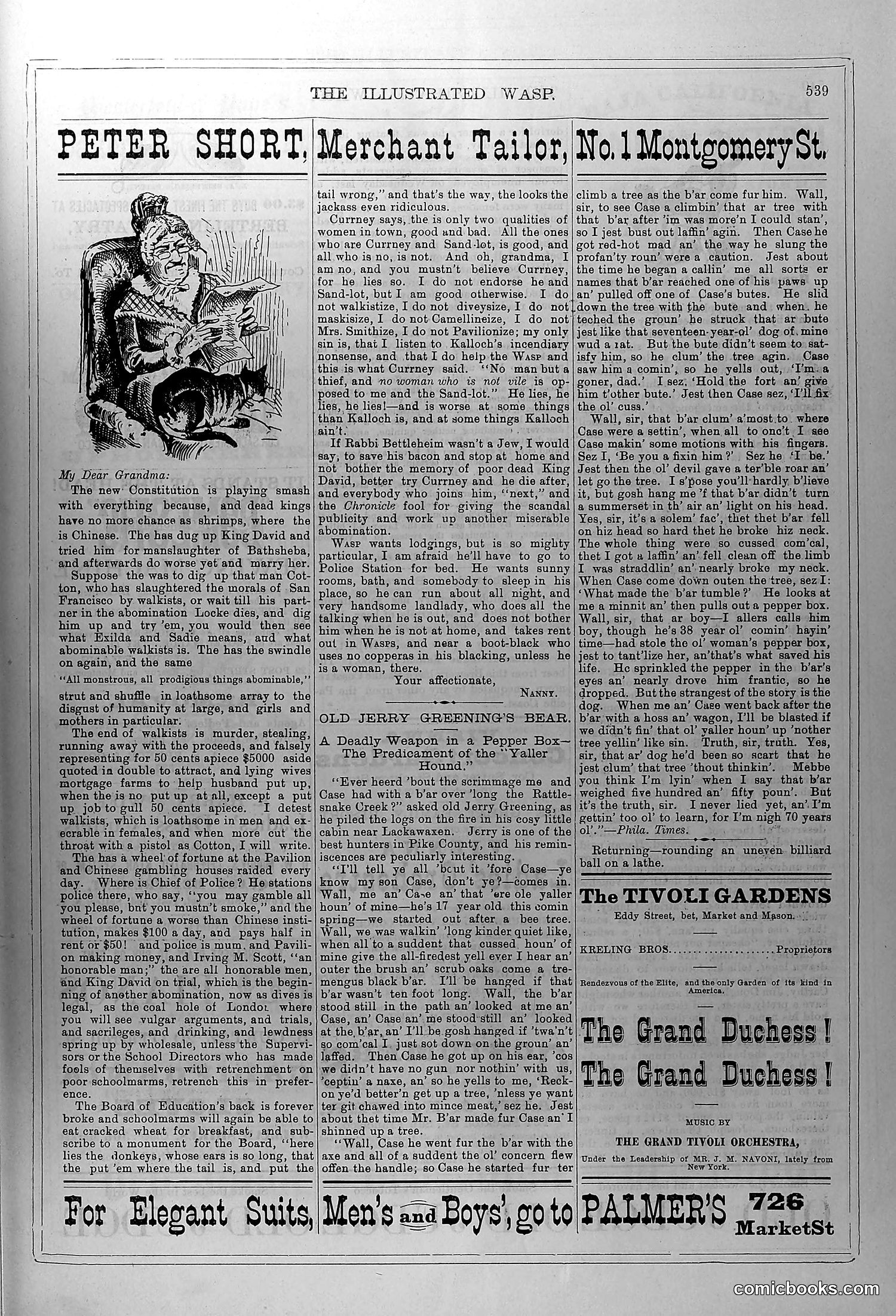
This page contains a satirical letter titled "My Dear Grandma" mocking someone named **Currey** (likely a local San Francisco figure), presented as correspondence from a character named **Nansy**. The letter ridicules Currey's pretensions and alleged moral failings, including references to questionable business dealings and personal conduct. The accompanying illustration depicts an elderly woman, presumably the "grandmother" recipient. Below is an advertisement section featuring **"Old Jerry Greening's Bear,"** describing a dangerous hunting anecdote involving a man named **Case** and a bear encounter in Pike County. The page is primarily **satirical journalism and advertising rather than editorial cartooning**. Without additional historical context about Currey's identity and local scandals, the specific targets of ridicule remain unclear to modern readers.
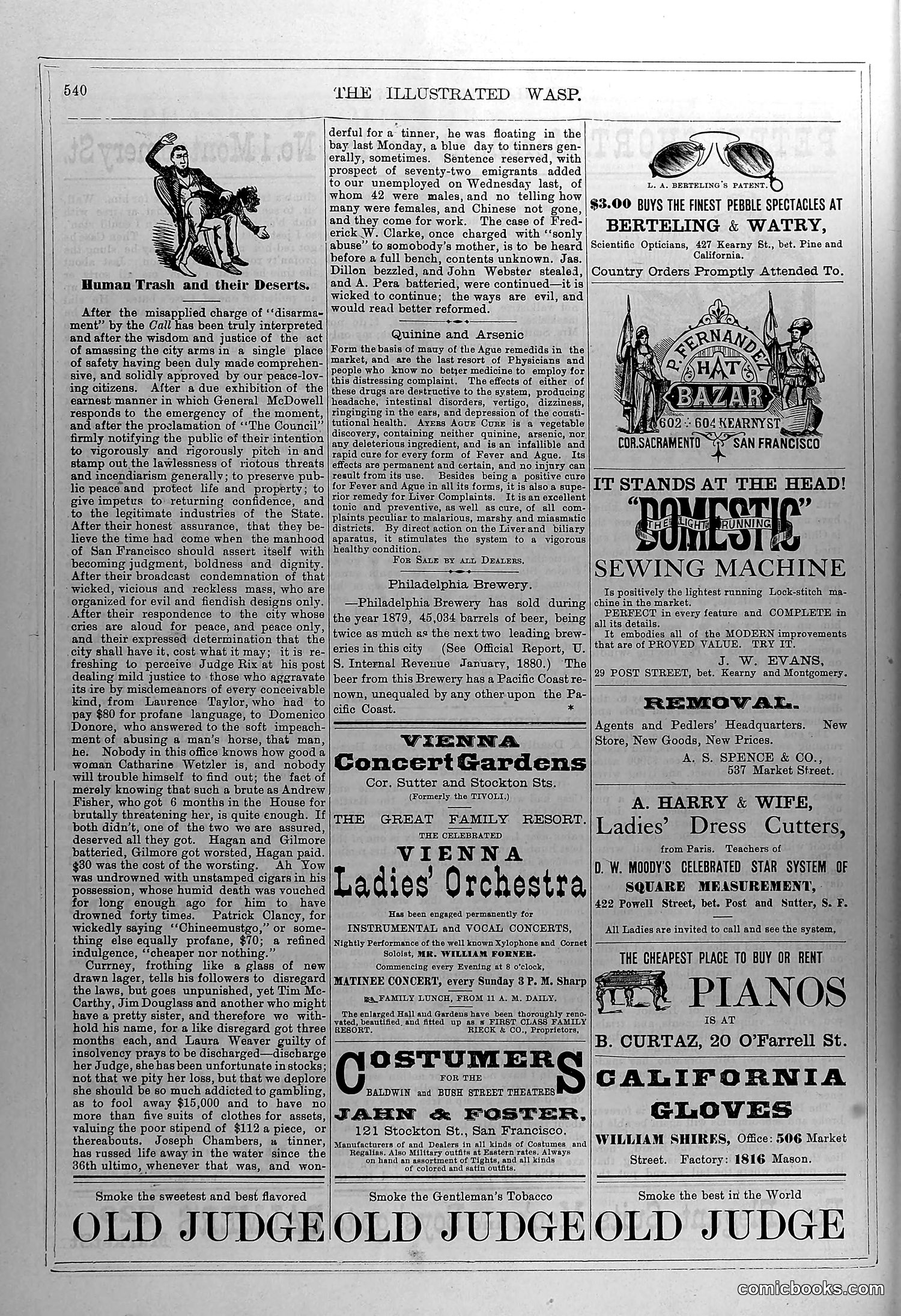
This page is primarily **advertising**, featuring various San Francisco businesses (pebble spectacles, hat bazaar, sewing machines, pianos, gloves, tobacco). The only substantive editorial content is a brief section titled **"Human Trash and their Deserts,"** discussing a judicial case involving General McDowell and "The Council," criticizing what the writer calls their unjust handling of public finances and dealings with the unemployed. The piece advocates for rigorous oversight of city leadership and legitimate industry development. A separate article on the **Philadelphia Brewery** notes its substantial beer production (45,034 barrels in 1879). The page reflects typical late-19th-century *Wasp* content: local political criticism mixed with commercial advertising targeting San Francisco's middle-class readers.
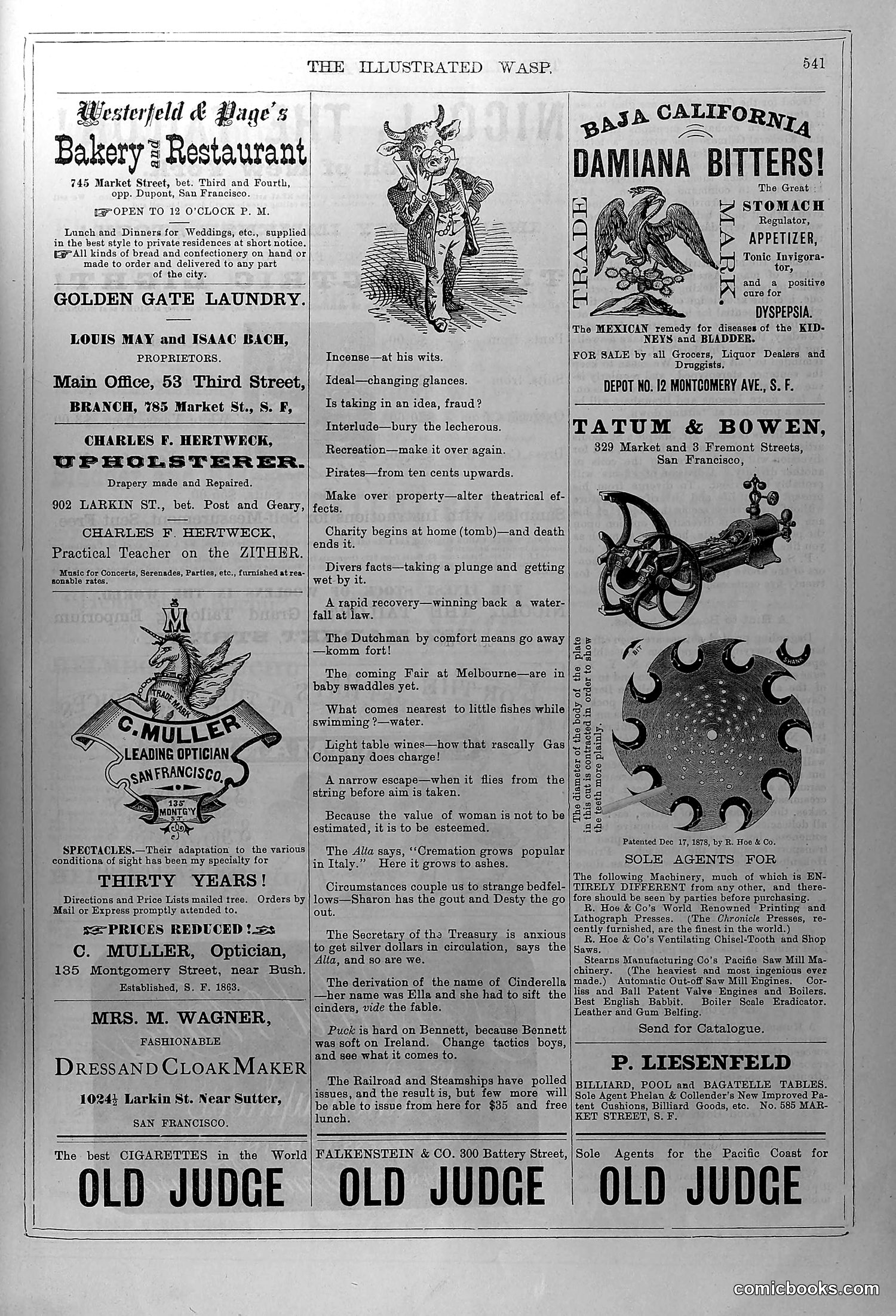
This is primarily an **advertising page** from The Wasp magazine (page 541), featuring San Francisco businesses and patent medicines typical of the late 19th century. The central cartoon depicts a **cow wearing a suit and hat**, labeled "Incense—at his wits" and "Ideal—changing glances." This appears to be satirical commentary on fraudulent or absurd patent medicines and consumer gullibility, a common Wasp target. The accompanying text snippets ("Is taking in an idea, fraud?" "Interlude—bury the lecherous") suggest mockery of dubious commercial claims. Most of the page contains legitimate advertisements for local services (bakeries, opticians, dress makers) interspersed with quack remedy ads like "Damiana Bitters" for kidney/bladder ailments—reflecting actual 19th-century snake-oil marketing practices that The Wasp regularly ridiculed.
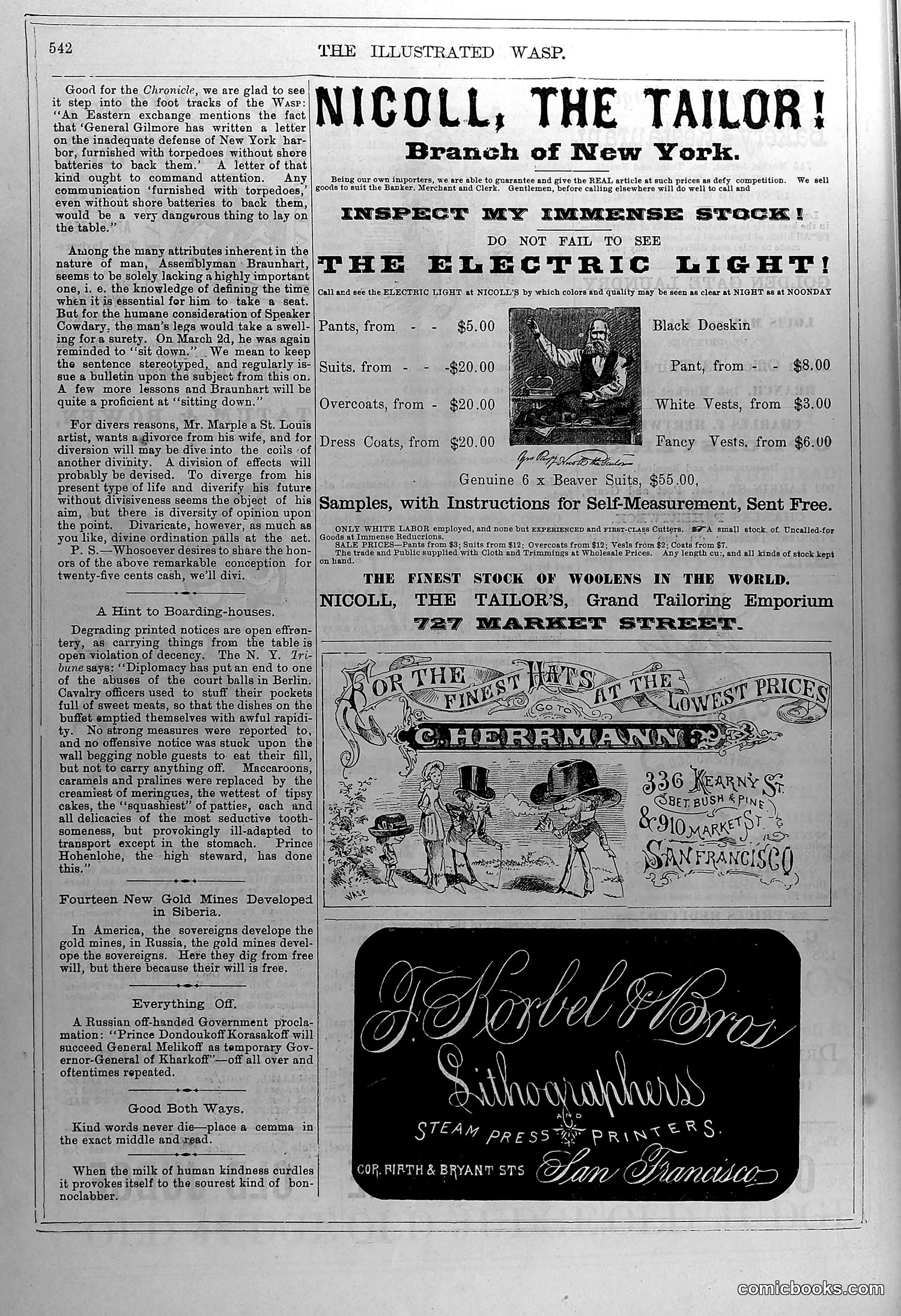
This page is primarily **advertising**, not political satire. The dominant feature is a large advertisement for "Nicoll, The Tailor" in New York, promoting clothing items (pants, suits, overcoats, dress coats, vests) with prices ranging from $5-$55. Below that is another advertisement for "C. Herrmann" hats in San Francisco, and a business card for "G. Sorkel Bros. Lithographers Steam Press Printers," also in San Francisco. The left column contains brief editorial snippets about various topics (Chronicle reporting, Speaker Gould's legs, diving artists, and Russian gold mines), but these are disconnected filler pieces, not coordinated satire. **This is essentially an advertising page with minimal satirical content.**
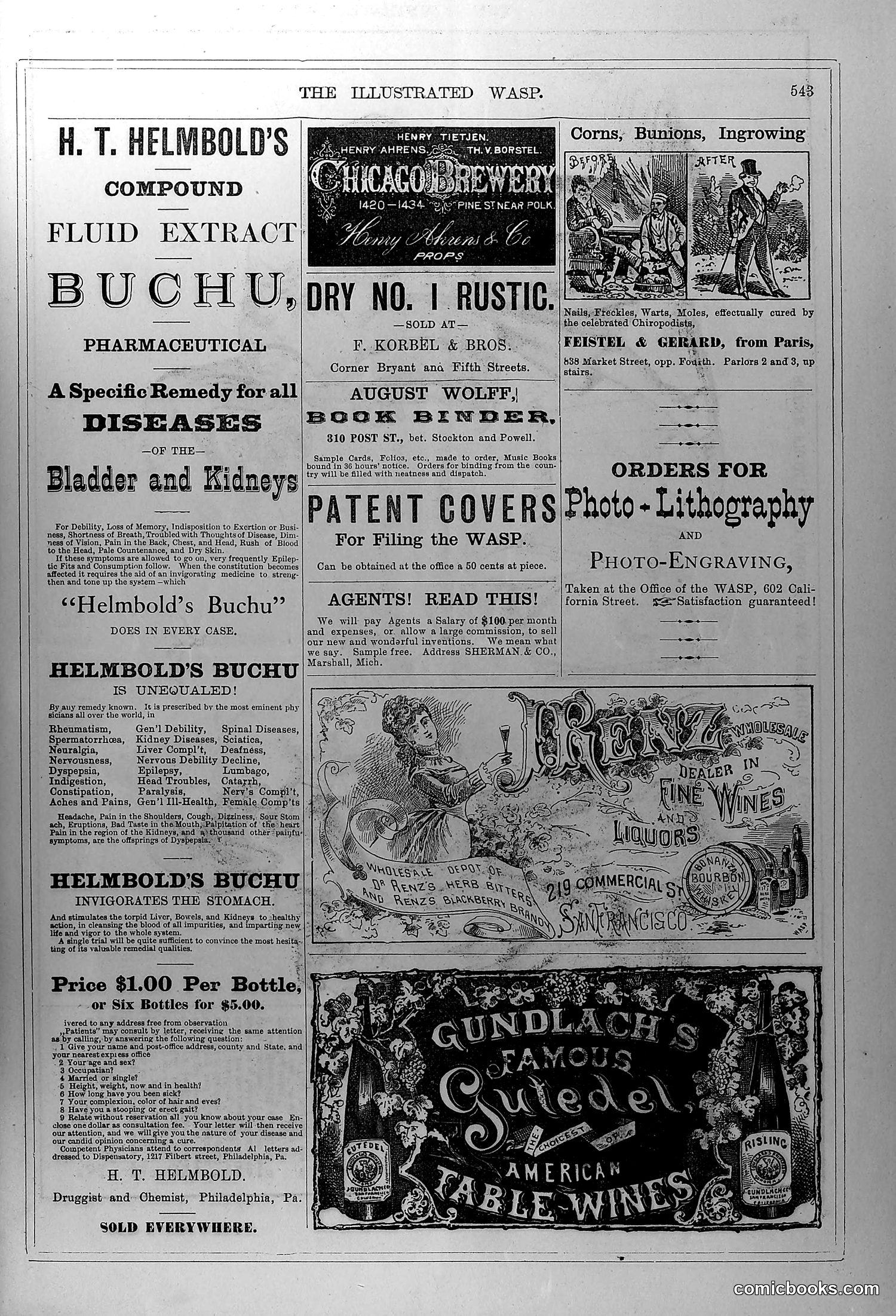
This is primarily an **advertising page** rather than satirical content. The dominant feature is a large advertisement for **H.T. Helmbold's Compound Fluid Extract Buchu**, a patent medicine claiming to cure bladder and kidney diseases. The ad lists numerous ailments it allegedly treats (rheumatism, nervous debility, epilepsy, etc.) and costs $1.00 per bottle. Surrounding this central ad are various other period advertisements: Chicago Brewery beer, a book binder, photo-lithography services, and wine/liquor vendors including what appears to be Gundlach's Sautedel wine. **No political satire or cartoon commentary is visible on this page.** It represents typical late-19th-century magazine advertising, notable primarily for the era's aggressive patent medicine marketing making extravagant, unsubstantiated health claims—practices that would later be regulated.
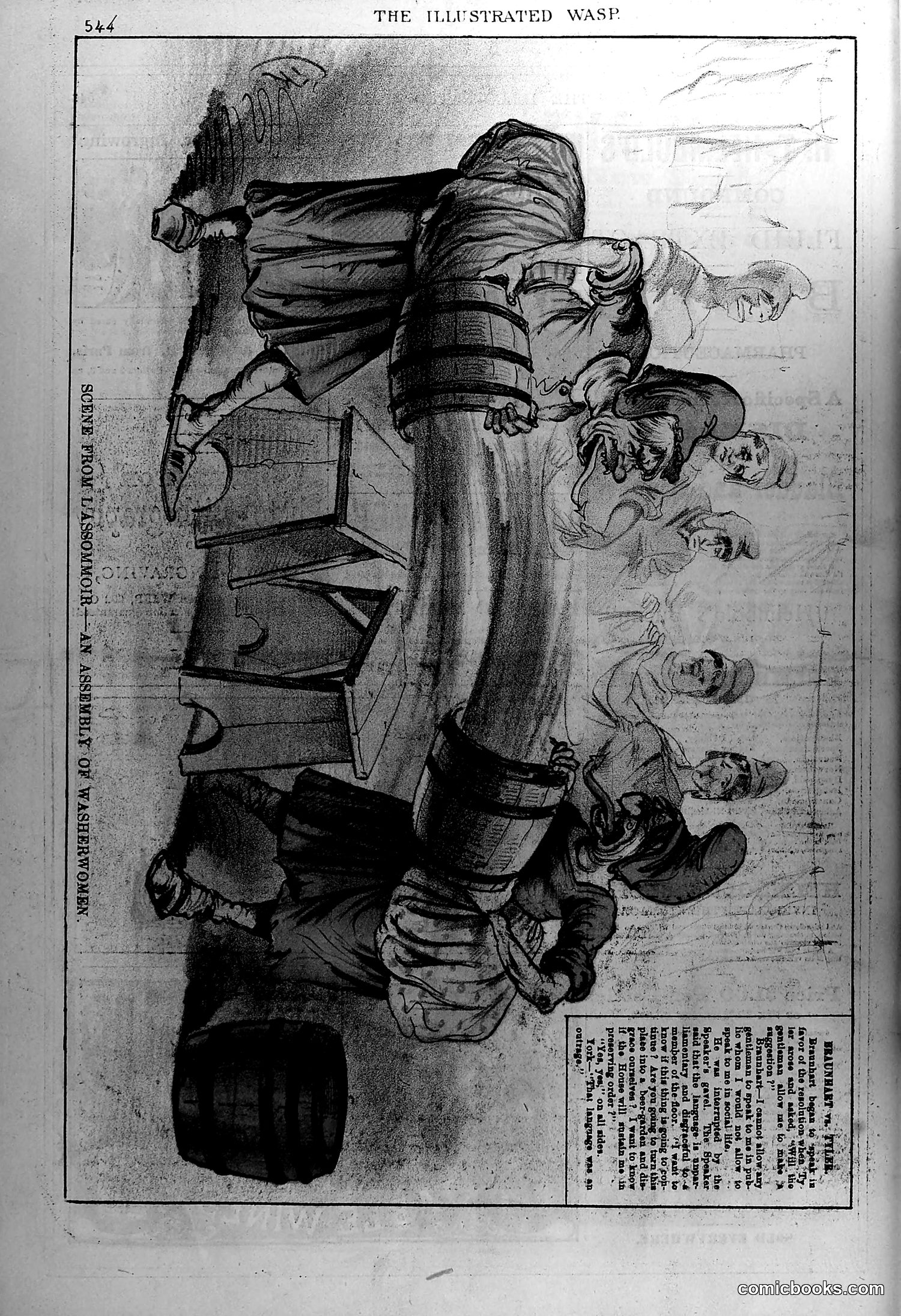
This appears to be a satirical political cartoon printed sideways (requiring rotation to read properly). The central figure is a rotund man in formal dress carrying what looks like a large barrel or container, surrounded by smaller caricatured figures with exaggerated facial features. The text block in the lower right likely provides context, but is too small to read clearly in this reproduction. Based on the style—late 19th/early 20th century American satire—this likely mocks a politician or public figure, possibly commenting on corruption, patronage, or financial misconduct, with the barrel potentially representing money, spoils, or illicit goods being distributed among associates. Without legible text, specific identification remains uncertain.

This image shows a calibration chart or test pattern rather than a political cartoon. The page displays a grayscale checkerboard pattern (roughly 4x6 squares) arranged in varying tones from dark to light, along with a measurement ruler marked from 6-11 inches on the right side. There's also a horizontal measurement scale at the bottom showing increments from 6-10. This appears to be a **photographic reference chart** used in document reproduction and archival work—likely included as a quality-control standard when scanning or microfilming The Wasp magazine issues. It's not editorial content meant for readers, but rather a technical tool to ensure accurate image capture and tone reproduction during the digitization process.