
A complete issue · 18 pages · 1880
The Wasp — March 6, 1880

I can see this is a measurement reference page from what appears to be an archival or documentary photograph, showing Oregon Rule Co. and U.S.A. rulers with a grayscale color chart (the small squares on the right). This is a **calibration/documentation page**, not editorial content from The Wasp magazine itself. This type of page was commonly inserted into historical document collections to provide standardization for photographic reproduction—allowing future viewers to verify accurate color rendering, scale, and image quality of the actual magazine pages photographed. There is no cartoon, satire, or political content visible here to analyze. This is purely a technical/archival tool page.
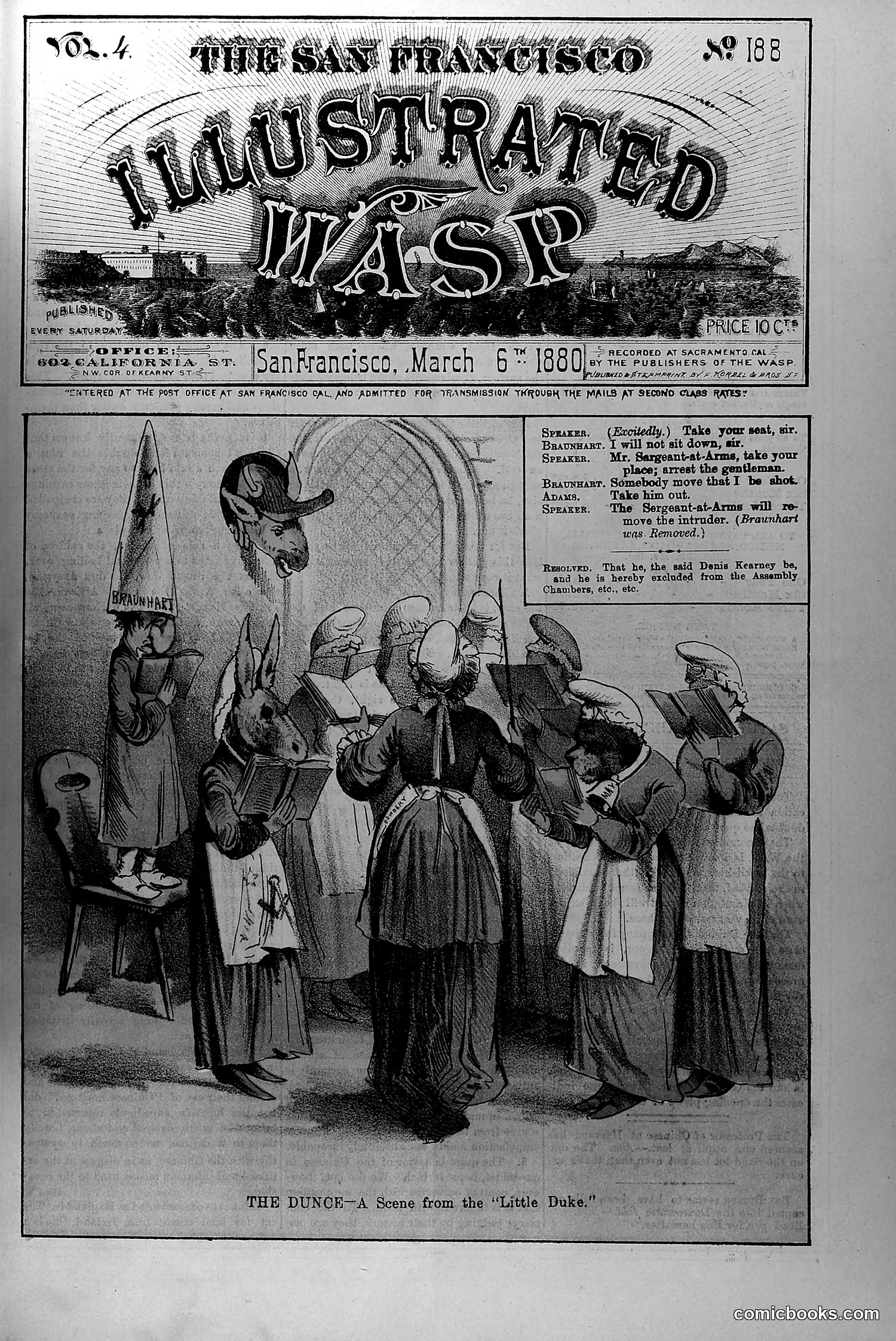
This satirical illustration depicts a classroom scene where several figures in period dress hold papers, apparently representing a legislative or political assembly rather than an actual school. The caption references "The Little Duke," likely a theatrical production or political allegory. The scene appears to mock political incompetence or foolishness among elected officials or legislators. The figure suspended above (labeled "Braunhau") and the dialogue snippets about removing an "intruder" suggest satirical commentary on parliamentary procedure disruptions or the expulsion of a member. The "dunce" title implies the seated figures are being portrayed as intellectually inferior or incompetent. Without clearer identification of specific 1880 political events or figures, the exact targets remain unclear, though this appears to critique San Francisco's local political leadership as foolish or inept.
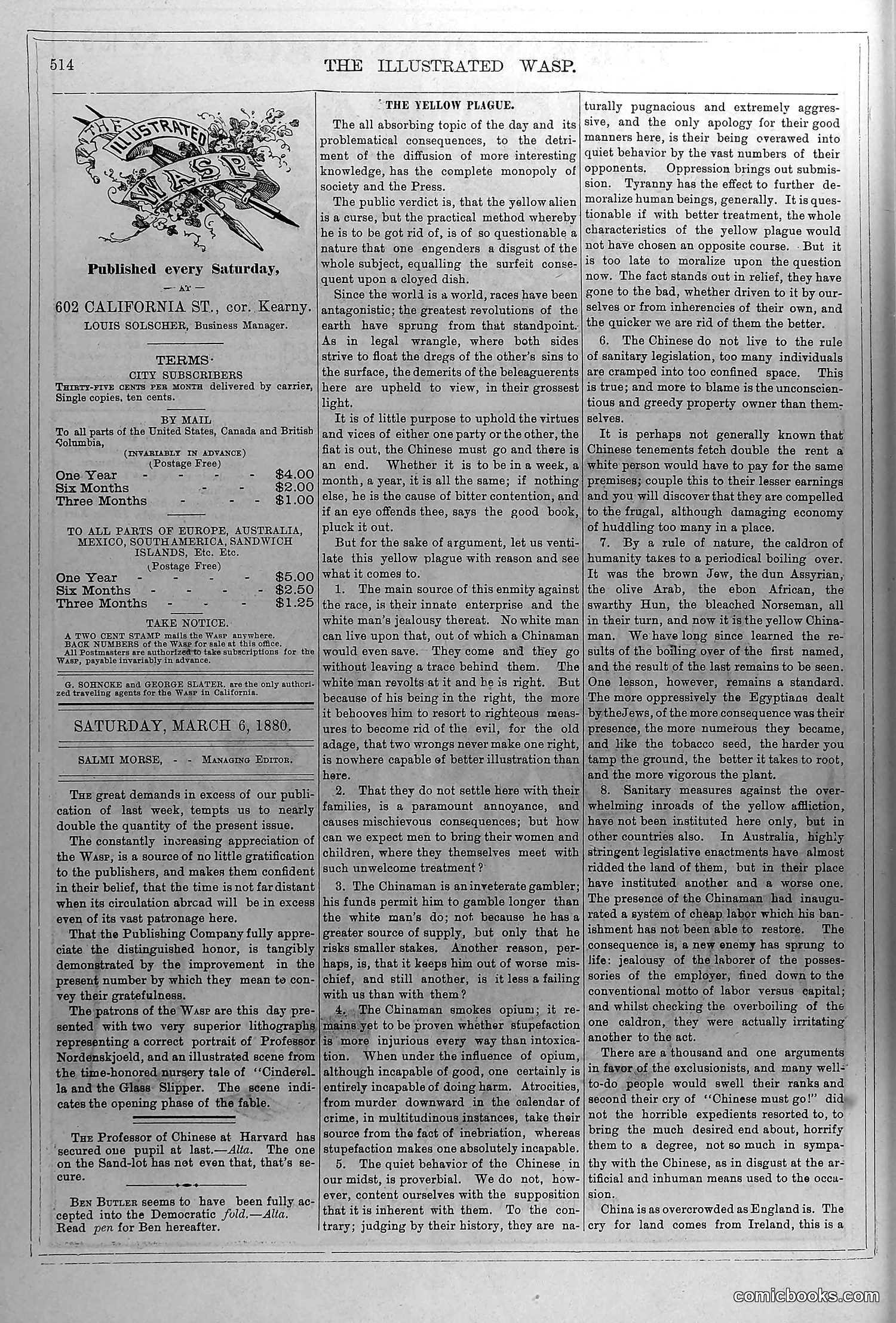
This page contains no political cartoon. Instead, it features the magazine's masthead and publishing information, followed by an editorial titled "The Yellow Plague." The piece discusses Chinese immigration to America as a social problem. The editorial argues against Chinese settlement, claiming they create overcrowding, resist assimilation, and undercut labor wages. The author uses inflammatory language ("yellow plague," "yellow alien") while attempting a veneer of reasoned argument. The text reflects late-19th-century anti-Chinese sentiment that was widespread in California. The Wasp was explicitly satirical, but this article appears to represent genuine xenophobic views rather than satire—typical of American publications during the period of Chinese Exclusion Act debates.
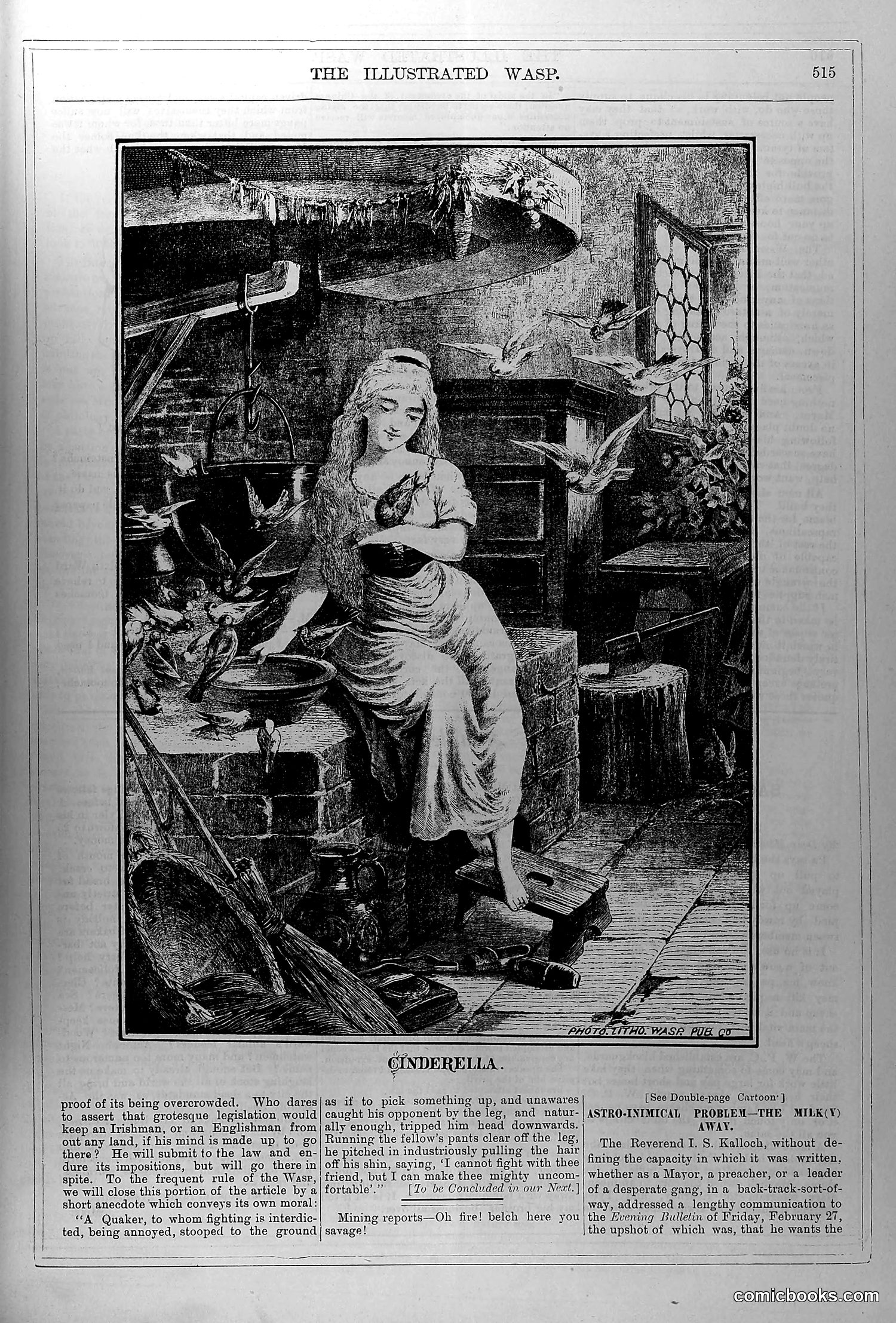
This page presents an illustration titled "Cinderella" depicting a woman in domestic servitude, surrounded by household labor tools and refuse. The accompanying text discusses Irish and English laborers, legal injunctions, and disputes over wages and working conditions. The satire appears to conflate the fairy-tale character Cinderella—known for suffering oppression before her transformation—with the real conditions of working-class servants and laborers in late 19th-century America. The text references disputes about "picking something up" and references to "the leg," suggesting commentary on labor exploitation and poor treatment of workers. The cartoon likely critiques either specific labor disputes of the era or broader class exploitation, using the Cinderella narrative to mock the idea that downtrodden workers might ever achieve their "happily ever after."
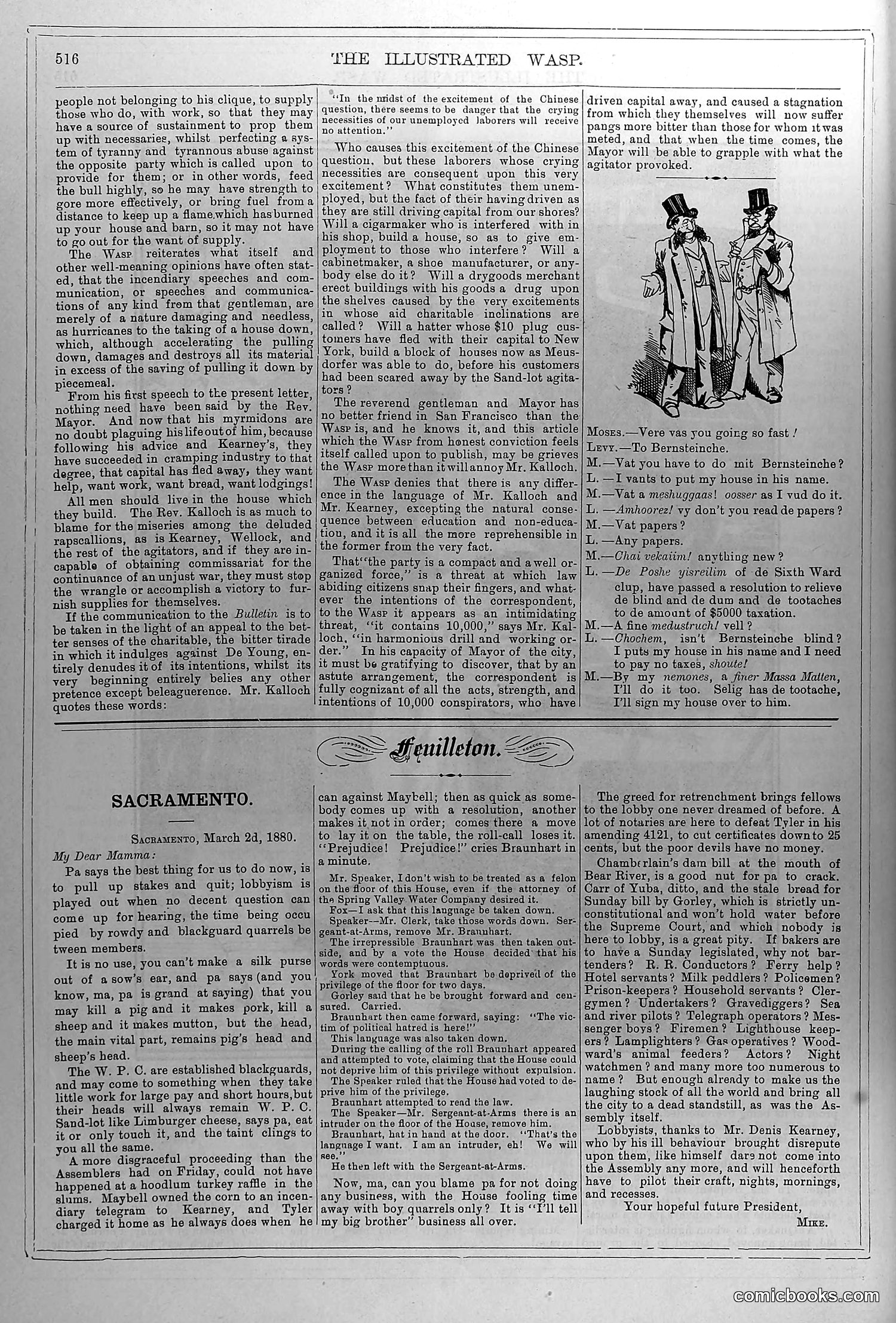
The page contains two main sections: **Top Section**: A dialogue cartoon featuring two well-dressed men (labeled "Moss" and "Levy") discussing San Francisco real estate and housing construction. The satire mocks rapid urban development—one character brags about building speed while the other complains about property speculation driving costs up. This reflects 1880s California boom-town anxieties about developers and speculators. **Bottom Section**: "Sacramento" letter from "Mike" discussing California state politics, particularly legislative quarrels and bureaucratic absurdities. References include disputes over water rights and House privileges. The satire targets both urban development greed and Sacramento political dysfunction—common Wasp themes critiquing California's rapid growth and governmental incompetence.
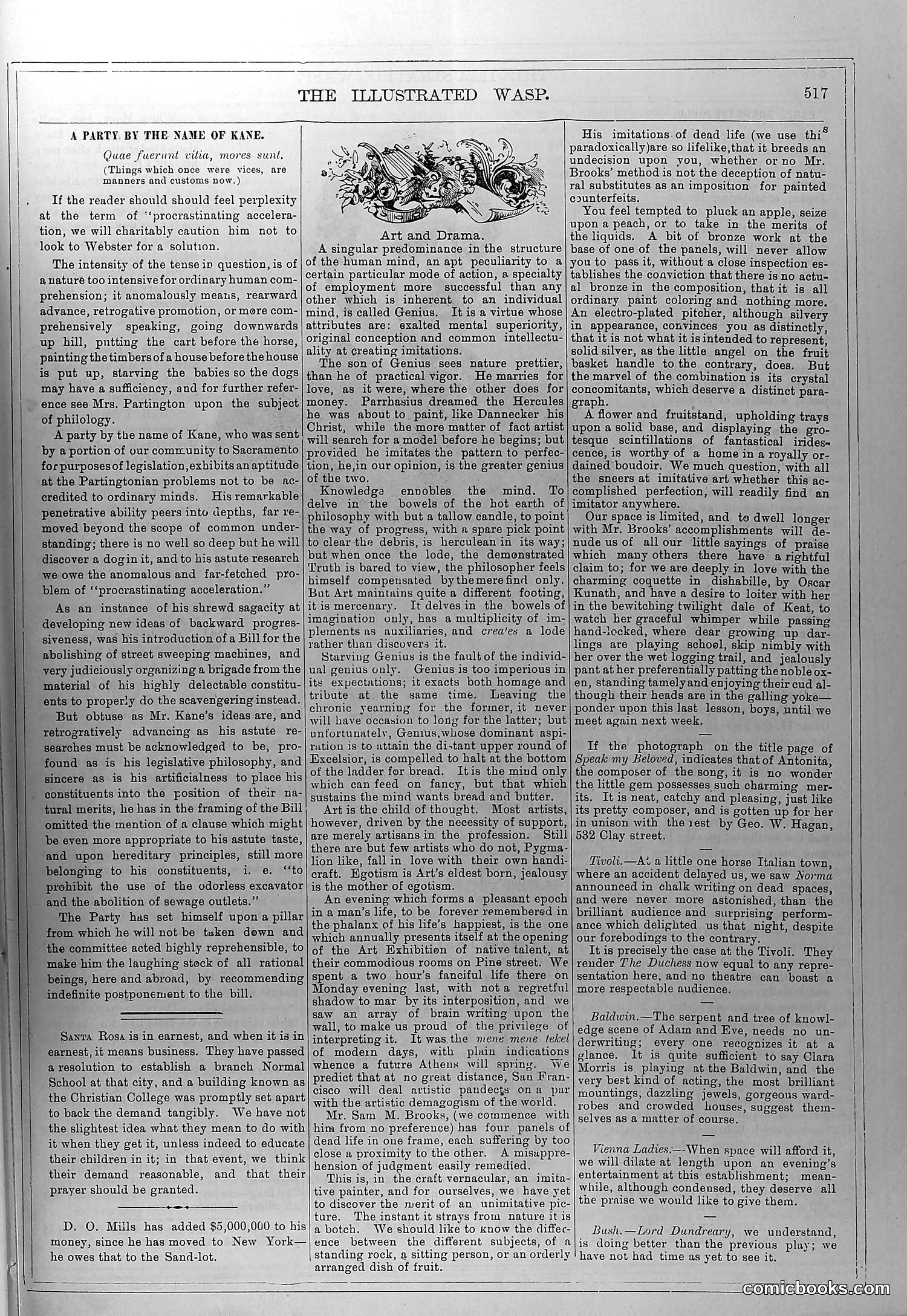
This page consists primarily of **text articles and social commentary** rather than political cartoons. The content includes: 1. **"A Party by the Name of Kane"** — A satirical essay critiquing someone named Kane's pretentious social gathering and philosophical pretensions, mocking his claims to intellectual sophistication while actually being mediocre. 2. **"Art and Drama"** — A longer article discussing genius, artistic merit, and social hypocrisy in San Francisco's cultural scene. It critiques wealthy patrons and society figures who claim sophistication but lack genuine understanding. 3. **Brief notices** about local cultural events and personalities (Santa Rosa, Baldwin, Vienna Ladies). The satire targets **nouveau-riche pretension and intellectual charlatanism** in San Francisco society — common Wasp themes attacking social climbers masquerading as cultured sophisticates.
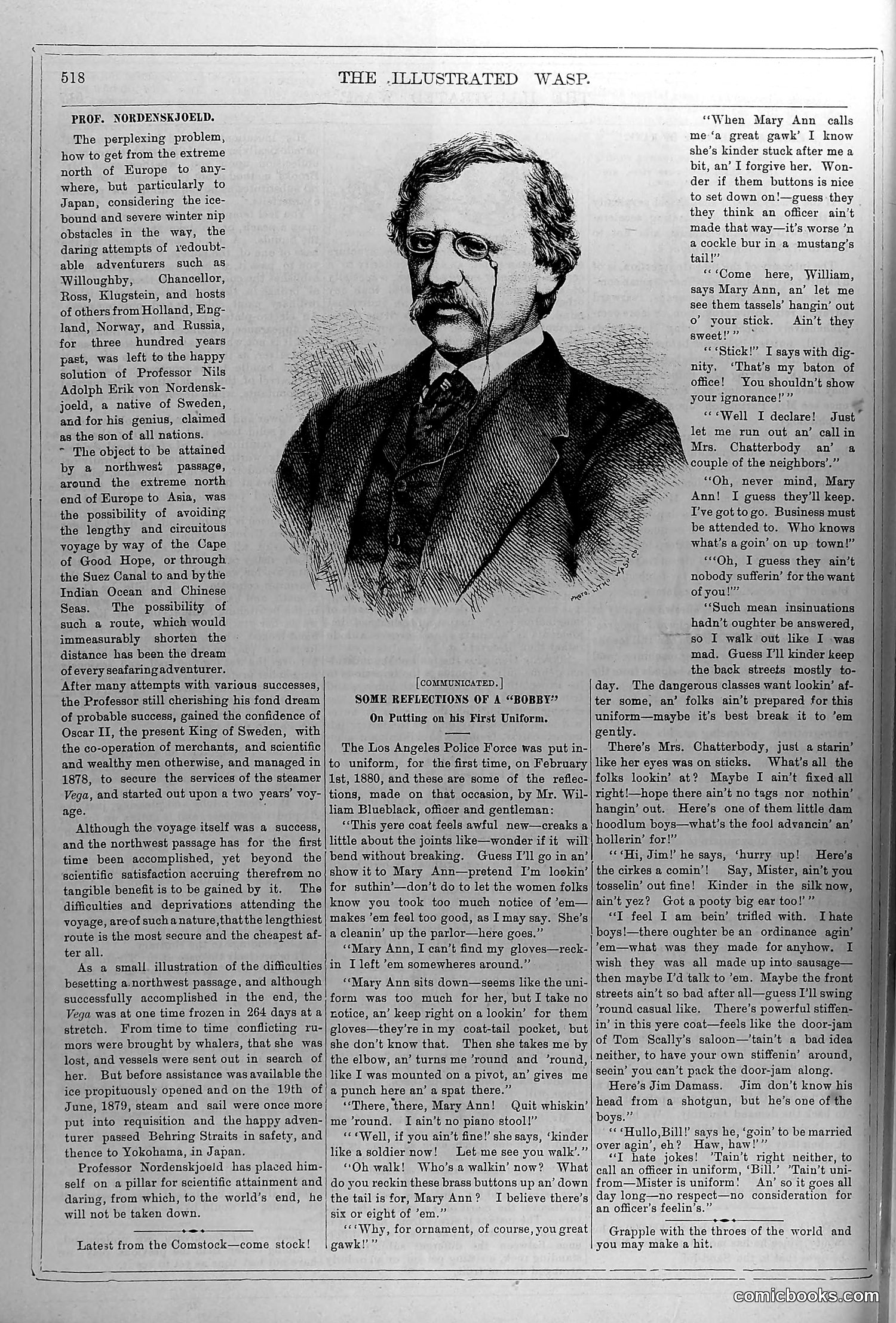
The page features a portrait of **Prof. Nordenskjöeld**, a Swedish explorer, accompanying an article about attempted arctic passages to Asia. The text discusses his three-hundred-year legacy seeking a northwest route around Europe's north, including efforts by historical figures like Willoughby and Chancellor. The article celebrates Nordenskjöeld's recent successful voyage with Oscar II (Sweden's king), which accomplished the northwest passage—a major geographical achievement ending centuries of failed attempts. The right column contains unrelated humorous dialogue ("Some Reflections of a 'Bobby'") featuring casual banter between police officers and civilians in working-class dialect, typical of The Wasp's satirical humor targeting everyday social interactions and authority figures.
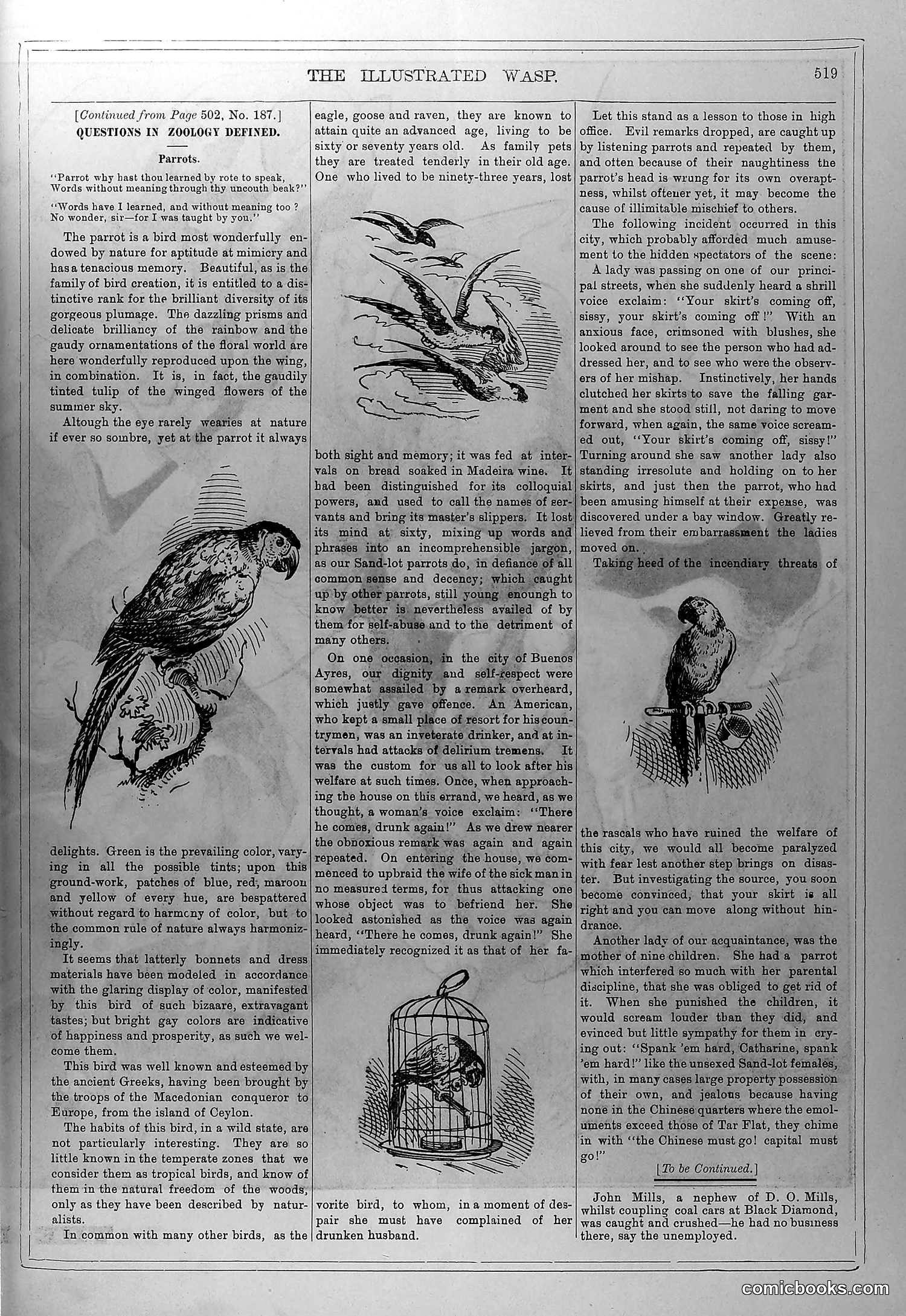
This page is primarily educational rather than satirical. The text discusses parrots' remarkable ability to mimic human speech and their intelligence, illustrated with three detailed engravings of parrots in various poses. The main satire appears in the anecdotes embedded within the text. One story mocks a drunk American in Buenos Aires whose parrot learned his slurred, profane speech—creating embarrassment when the bird repeated the man's vulgar language in public. Another anecdote ridicules a woman who tried using her parrot's "outsized vocabulary" as social camouflage, only to be humiliated when the bird exposed her pretense. These narratives satirize human vanity and the foolishness of owners who expect parrots to reflect their own refinement while failing to control what the birds actually learn. The humor lies in parrots' honest mimicry betraying human pretense.
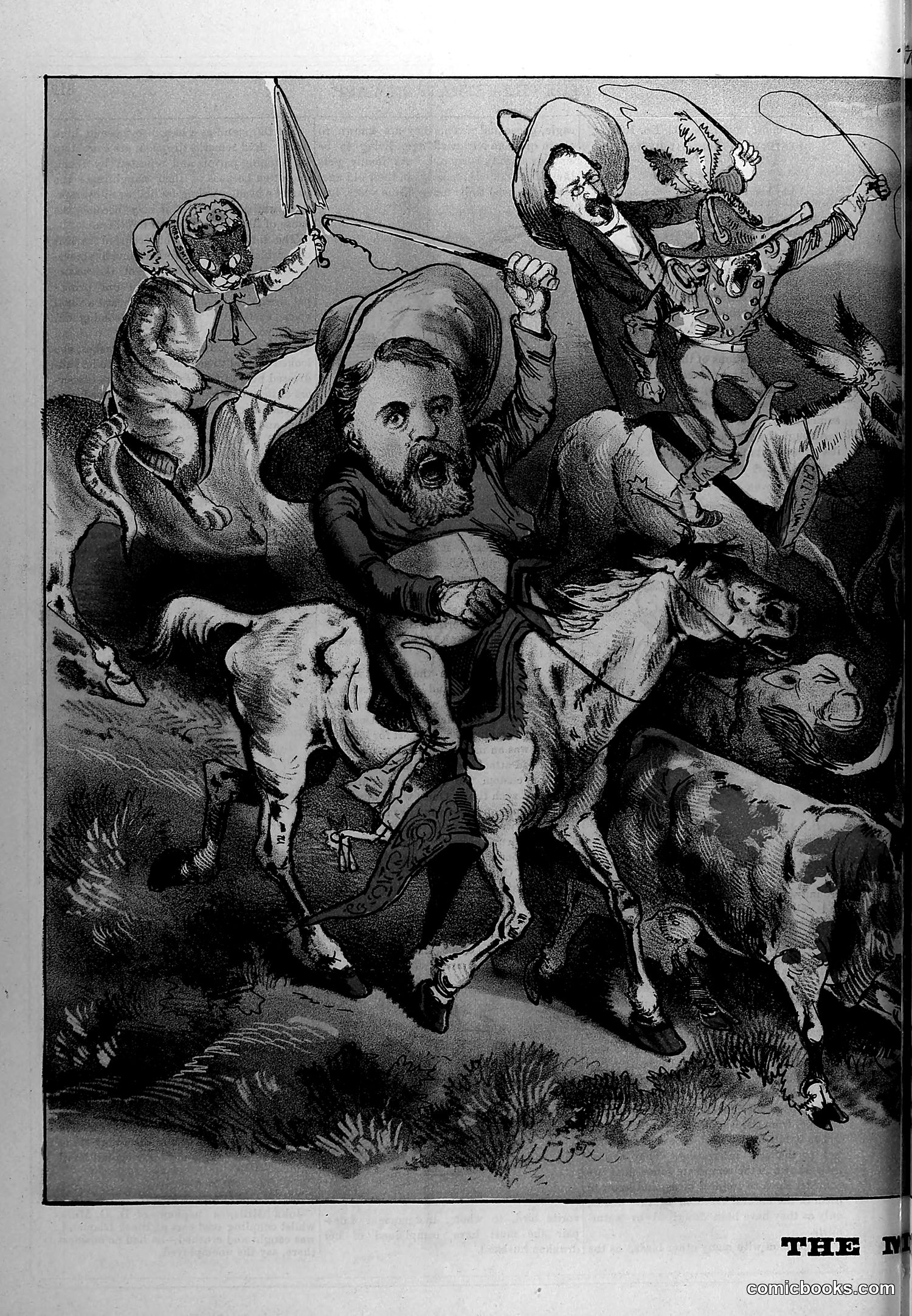
This appears to be a satirical engraving from *The Wasp* magazine, though the OCR text provided is blank, making full interpretation difficult. The image depicts a bearded man being attacked by small figures and animals. The scene suggests political ridicule through caricature—a common *Wasp* tactic. The man's distressed expression and the surrounding assailants (appearing demon-like or mischievous) indicate he represents a specific political or public figure being mocked. The dogs and attacking figures likely symbolize opposition forces or public criticism. Without readable text identifying the subject, I cannot specify which political figure this targets or the exact historical context. The style and technique suggest 19th-century American satirical cartooning. The theatrical violence typical of *Wasp* illustrations suggests commentary on contemporary political conflict or scandal, but specific identification requires the OCR text or additional context.
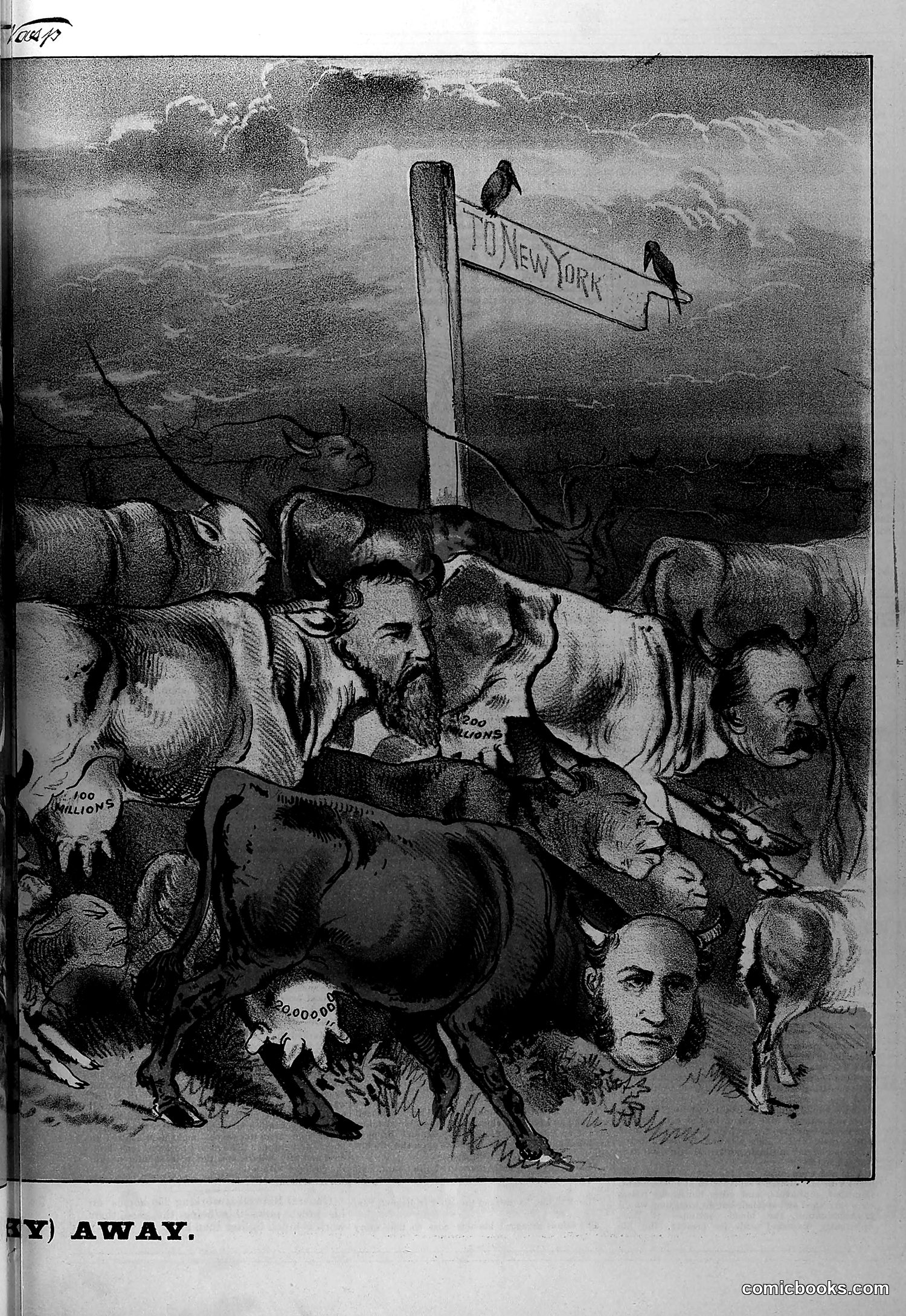
This is a satirical cartoon titled "Away" depicting a crowd of caricatured men (likely wealthy or political figures based on their dress) clustered below a signpost marked "NEW YORK." Two birds perch on the signpost, apparently departing. The satire appears to mock New York's elite or establishment figures, suggesting they should leave or are being driven away. The birds—traditionally symbols of freedom or escape—reinforce this "away" theme. Labels visible on some figures reference "100 MILLIONS," suggesting wealth or financial power is being critiqued. The cartoon likely comments on New York politics, corruption, or unpopular policies, using the departure imagery to suggest these figures should vacate their positions. Without more specific historical context or clearer facial identifications, the exact political event referenced remains unclear.
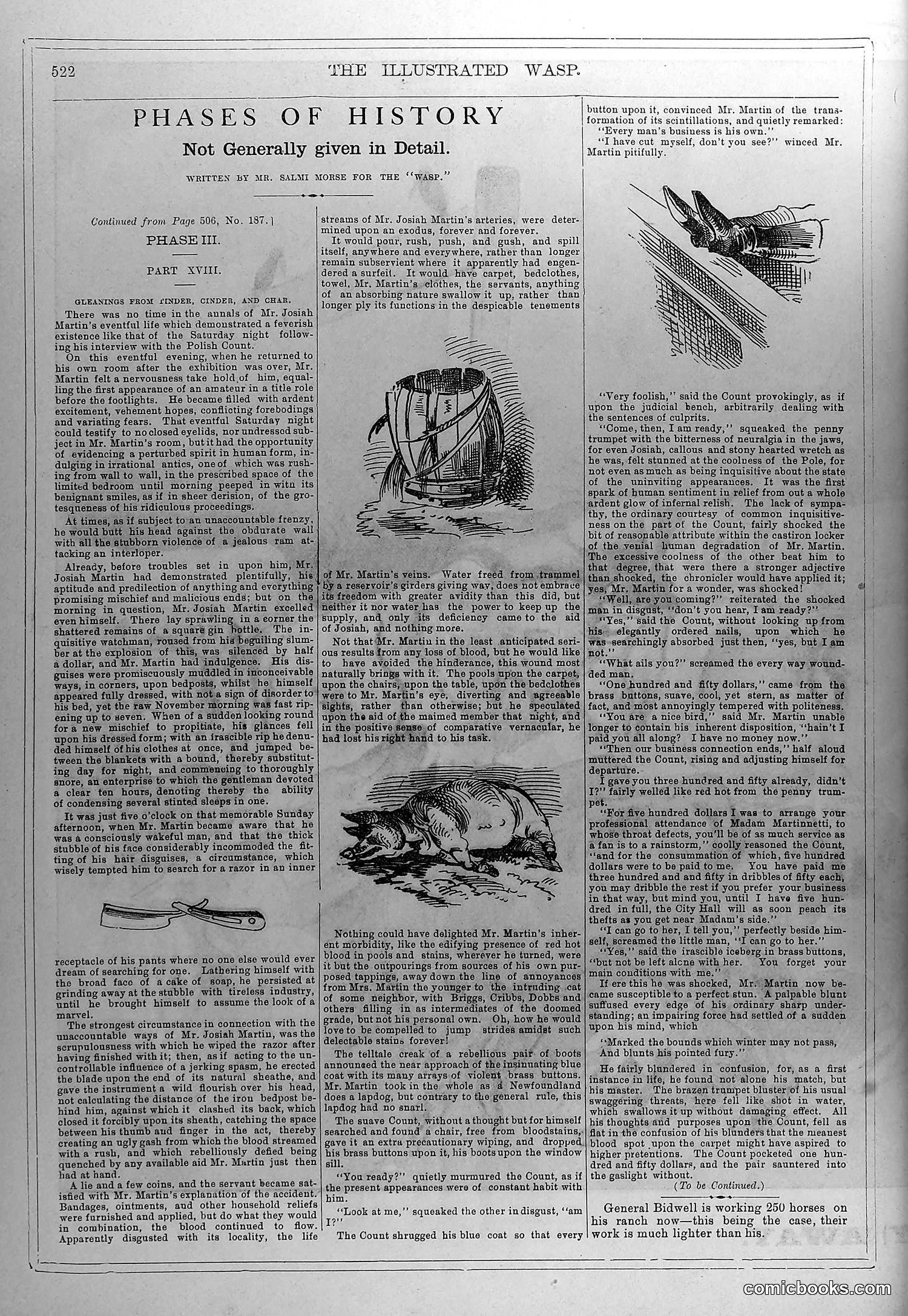
This page continues a serialized satirical narrative titled "Phases of History" by Salmi Mobre, focusing on Mr. Josiah Martin's exploits. The illustrations depict Martin in various comedic situations—including what appears to be a wasp attacking him and Martin discovering money. The text narrates Martin's escalating misadventures involving a Polish Count character. The satire centers on Martin's gullibility and the Count's manipulation of him through flattery and schemes. The humor derives from Martin's desperate financial circumstances and his increasingly ridiculous attempts to recover lost money or secure new wealth. The narrative appears to be social satire mocking working-class desperation and the con-artist schemes that exploit it. The specific references to clothing, currency ("fifty dollars"), and lodging ground the story in recognizable urban American life, likely late 19th century.
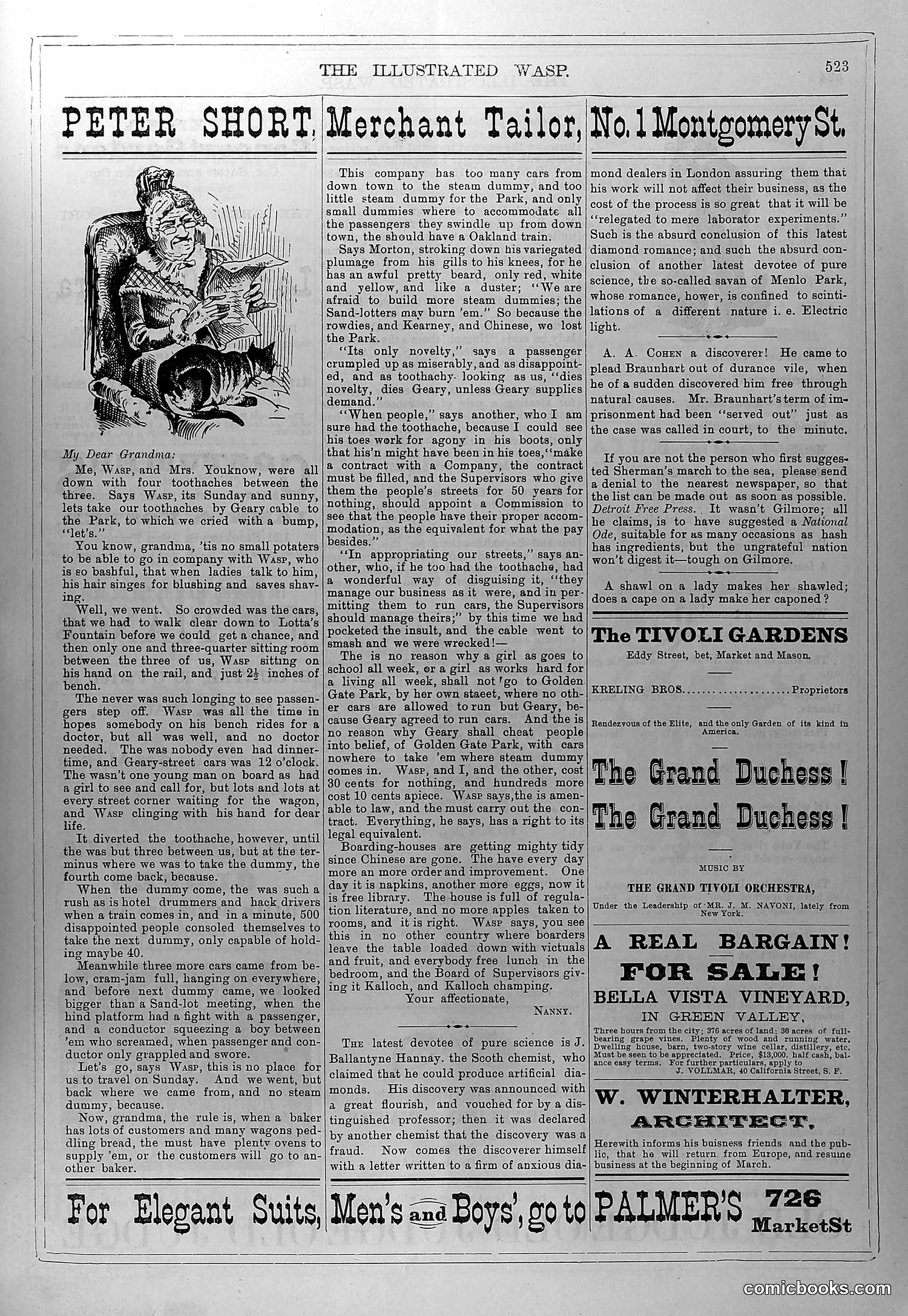
This page is primarily **advertising and miscellaneous content** rather than political satire. The main illustration shows an elderly woman labeled "My Dear Grandma" in a domestic scene—likely illustrating a humorous letter about local transit complaints. The text describes grievances about San Francisco's cable cars, steam dummies, and overcrowding. The cartoon humorously depicts complaints from riders about discomfort and transportation inefficiency. However, this is **social criticism of municipal services rather than political satire** of major figures or events. The remainder consists of advertisements for tailors, gardens, real estate, and other businesses. The page doesn't target specific politicians or contain the sharp political commentary typical of *The Wasp*'s satirical work.
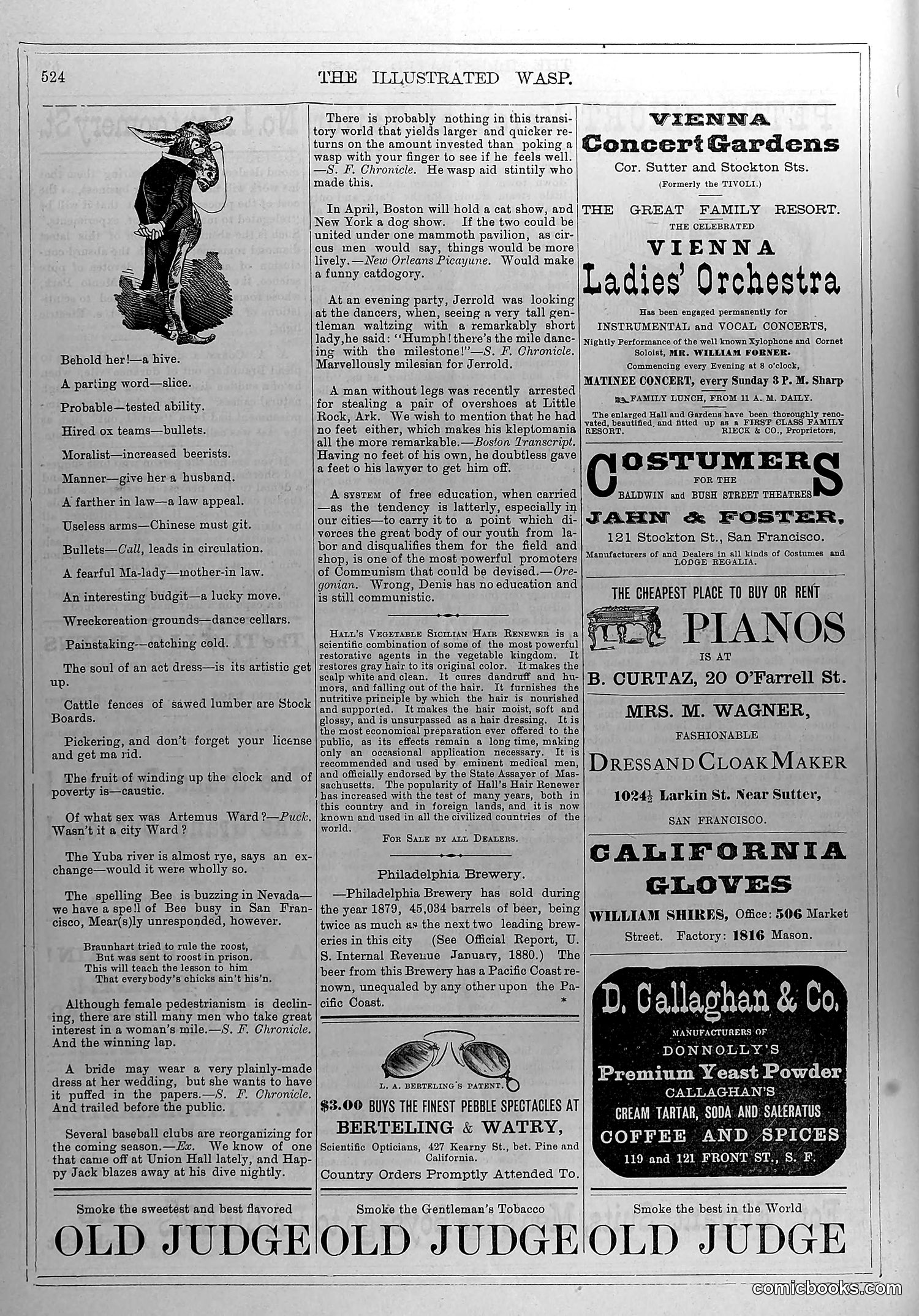
This page is primarily **advertising and humor definitions** rather than political cartoons. The single illustration shows a goat standing upright—labeled "Behold her!—a hive." The surrounding text consists of satirical one-liners defining words through humorous associations (e.g., "Probable—tested ability," "Hired ox teams—bullets"). The goat cartoon appears to be a visual pun or joke, though its specific reference is unclear without additional context. It may lampoon a specific public figure or social situation known to contemporary readers, but the IMAGE alone doesn't identify who "her" refers to. The page is dominated by period advertisements for pianos, costumes, hair products, and other goods—typical of late 19th-century magazine layouts. The satirical content is modest and relies heavily on readers' contemporary knowledge.
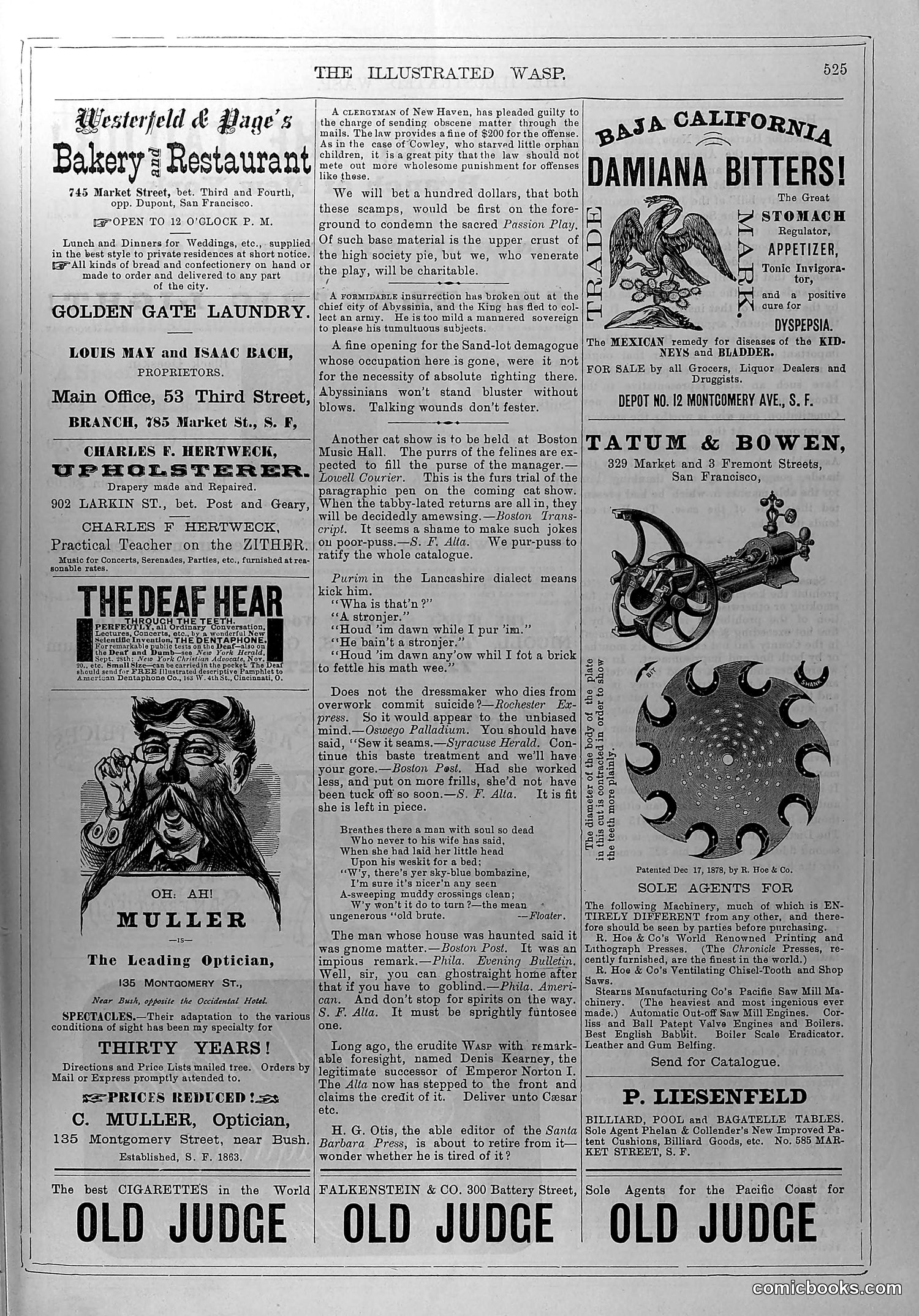
This page is primarily **advertising**, not political satire. It contains commercial notices for San Francisco businesses including a bakery, laundry, optician, and various patent medicines like "Damiana Bitters" and "Raja California Bitters." The one illustrated element is a decorative **bearded face** accompanying M. Muller's optician advertisement—a generic, ornamental character rather than political caricature. The text includes brief humorous anecdotes (about felines, dreammakers, and house-haunting) but these are **filler content**, not editorial commentary. At bottom, repeated advertising for "Old Judge" cigarettes dominates. This represents a typical late 19th-century magazine layout mixing satirical publication identity with revenue-generating advertisements rather than sustained political cartooning.
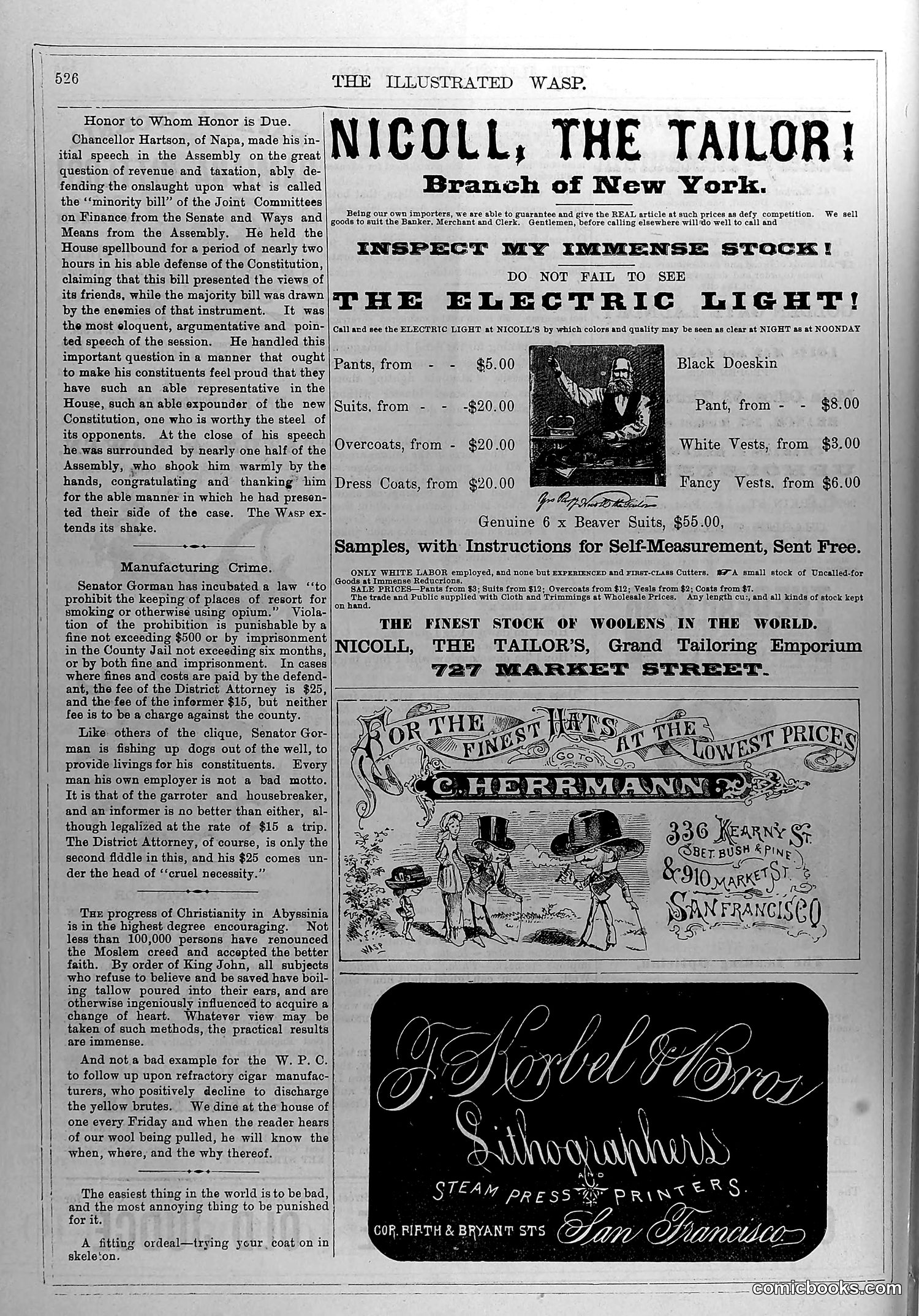
This page is primarily **advertising with minimal satirical content**. The main feature is a large advertisement for "Nicoll, the Tailor" in New York, prominently displaying clothing prices and promoting their stock with an illustration of a well-dressed man. The upper left contains a brief article titled "Honor to Whom Honor is Due," praising Chancellor Harson of Napa for his Assembly speech defending the "minority bill" regarding revenue and taxation. The text suggests this was a constitutionally principled defense that impressed colleagues. Below that is a short piece on "Manufacturing Crime" criticizing Senator Gorman's enforcement efforts against cigar manufacturers. The remaining space features additional advertisements (C. Herrmann hats, S. Corbel Bros. lithographers) and brief articles on Christianity in Abyssinia and cigar manufacturers' practices. There is **no discernible political cartoon**.
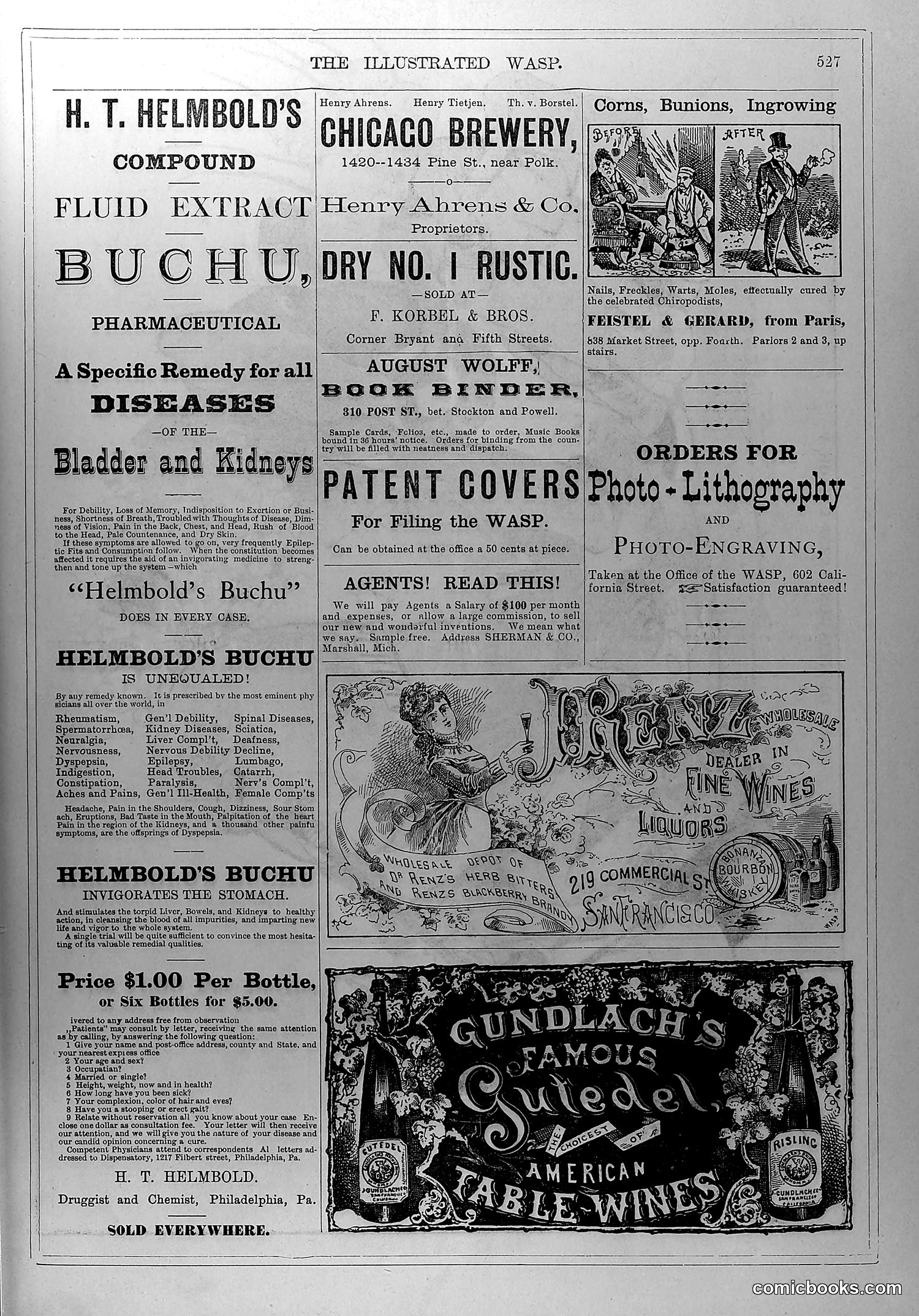
This page is primarily **advertising**, not political satire. It contains multiple commercial advertisements for patent medicines and services typical of late 19th-century publications: - **Helmbold's Buchu**: A medicinal compound claiming to cure bladder and kidney diseases - **Chicago Brewery** advertisement - **Patent covers for filing** with The Wasp newspaper - **Photo-lithography services** - **Renz's** (appears to be a wine/liquor dealer) - **Gundlach's Famous Sauterne** (wine advertisement) The page includes decorative illustrations accompanying these ads—including what appears to be a classical female figure and ornamental designs—but these are commercial artwork rather than political cartoons. No political figures, social commentary, or satirical intent is evident on this page.
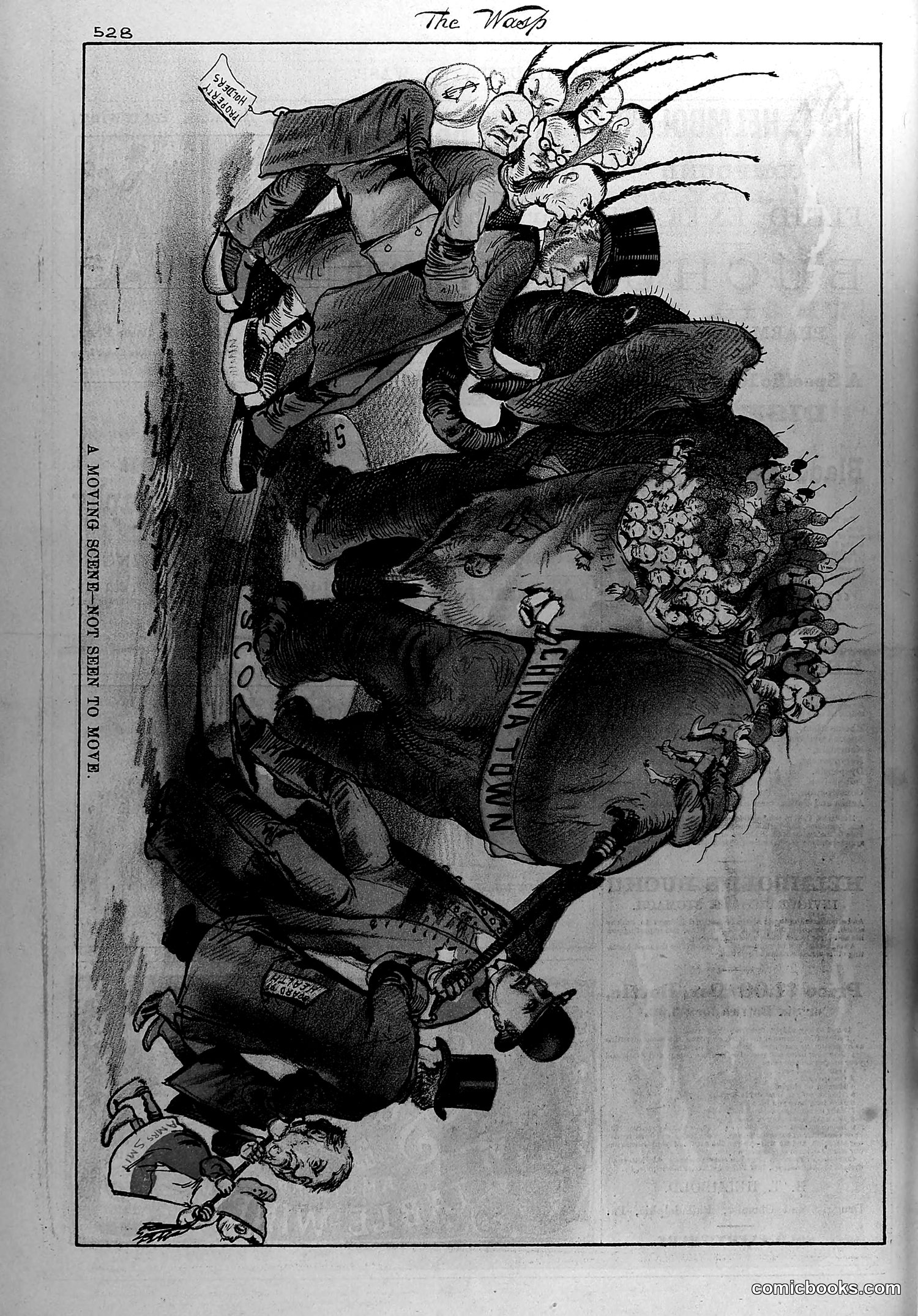
This political cartoon appears to depict a large figure (possibly representing a political leader or institutional power) carrying multiple smaller figures on its back or shoulders—suggesting they are being borne along or burdened by this larger entity. The smaller figures appear distressed or struggling, likely representing different groups or constituencies. On the right side, there's what looks like a pile or collection of objects, possibly representing wealth, resources, or consequences. The overall composition suggests social or political satire about inequality, burden-bearing, or exploitation—a powerful entity supporting or controlling weaker ones. However, without visible text identifying specific individuals or clearer contextual labels in the image, I cannot definitively identify which particular political figures, events, or movements are being satirized. The page number (528) and magazine title are visible, but specific names or dates are not clearly legible.

I can see this is a test page or calibration sheet rather than a cartoon or editorial content from *The Wasp* magazine. The image shows a color checker or grayscale reference chart with various gray squares of different tones arranged in a grid pattern on the left side, alongside a measurement ruler showing numbers 6-11. At the bottom is a standard ruler with inch markings. This appears to be documentation photography—likely used for quality control, archival purposes, or reproduction standards when scanning historical materials. It's not satirical or editorial content, but rather technical apparatus used in the digitization or archival process of the magazine itself.