
A complete issue · 18 pages · 1880
The Wasp — February 28, 1880
I can see this is a test/calibration page rather than actual magazine content. The image shows an Oregon Rule Co. ruler with measurement markings (0-5 inches) positioned against a black background with a grayscale color reference chart (displaying various gray and white squares). This appears to be a documentation photograph used for archival or reproduction purposes—likely created when the original Wasp magazine page was being photographed or scanned. The ruler and color chart served as calibration tools to ensure accurate measurements and tonal reproduction in the digitization process. This is not a cartoon or editorial content from the magazine itself, but rather a technical artifact from the preservation workflow.
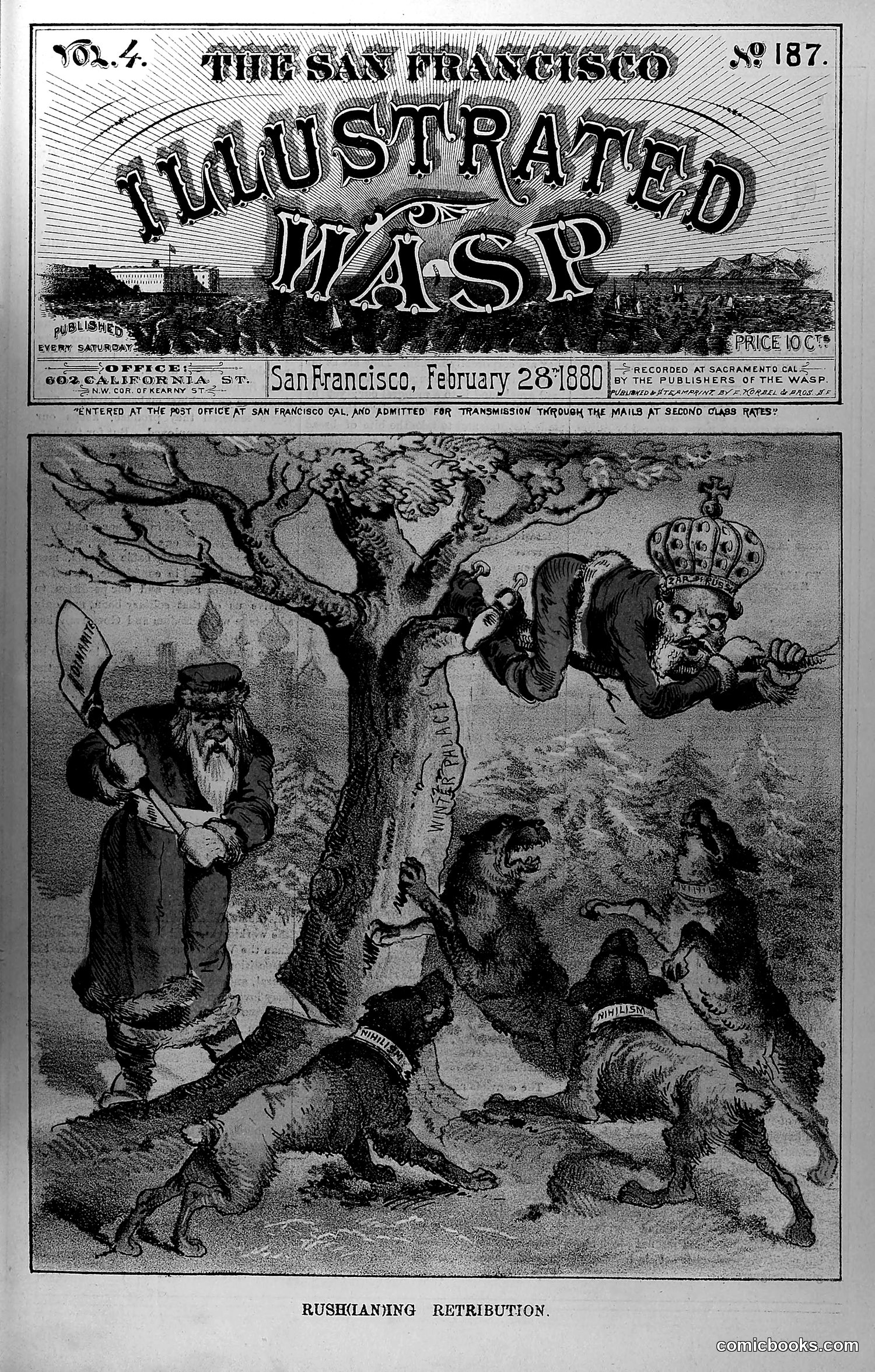
This cartoon satirizes Russian imperial aggression and geopolitical revenge. The bearded figure on the left, marked with a Russian flag, appears to represent Russia or a Russian leader. The crowned figure descending from above likely represents another European power or authority. The tree and dogs suggest a hunting or predatory scene. The title "Rushianding Retribution" (likely "Russian" with OCR error) indicates the cartoon comments on Russian retaliation or aggressive expansion. Published February 28, 1880, this likely references Russian imperial ambitions in Central Asia or Eastern Europe during that period of colonial competition. The satirical dogs and chaotic scene mock Russian military or political actions as both aggressive and somewhat comical or absurd to American observers of the era.
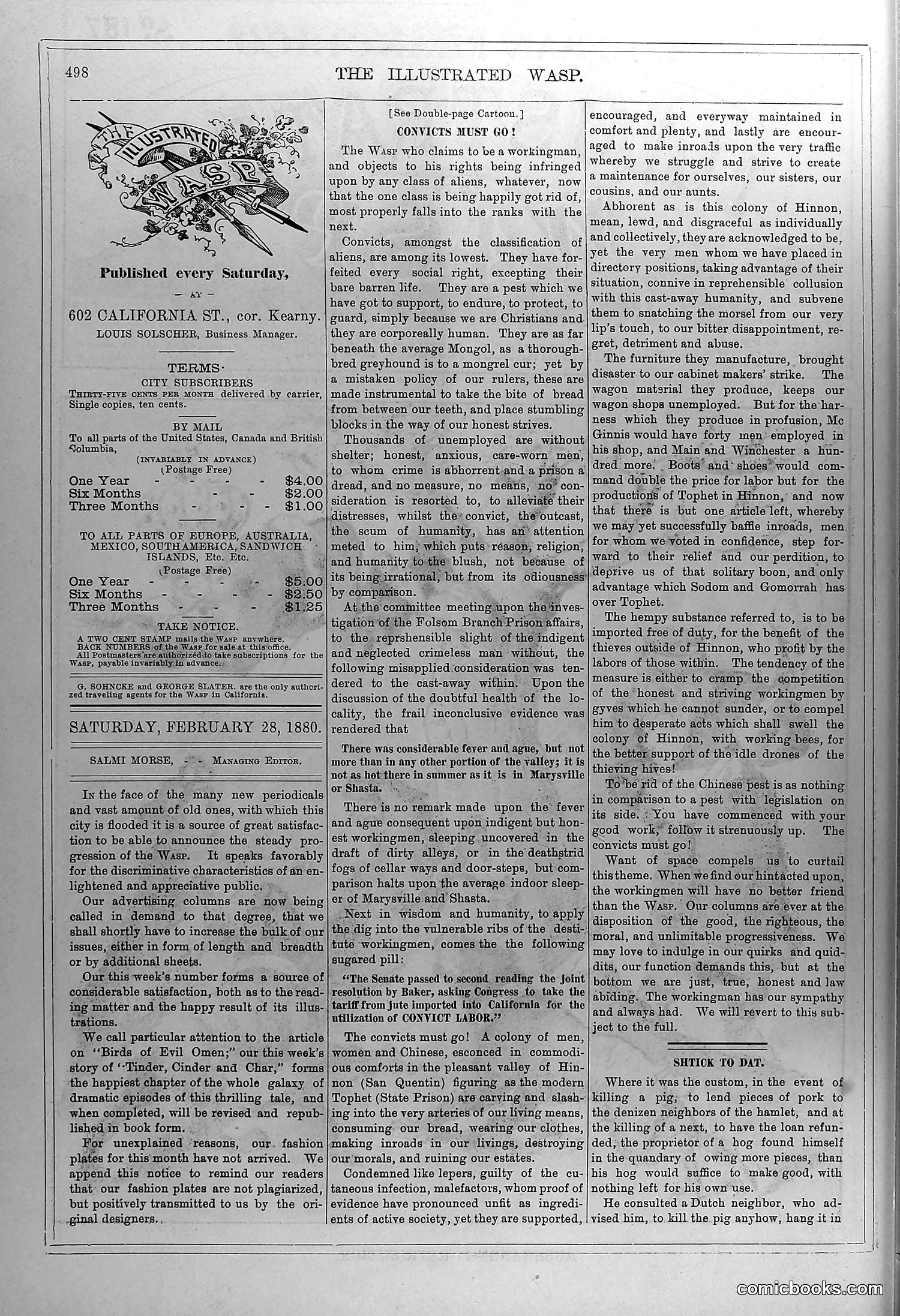
The masthead cartoon depicts a wasp attacking what appears to be a Chinese figure or representation, illustrating the magazine's anti-Chinese stance. The accompanying editorial "Convicts Must Go" argues that Chinese laborers should be expelled from California, characterizing them as "a pest" and comparing them unfavorably to other immigrant groups. The text criticizes Chinese workers as economically destructive, claiming they undercut wages and working conditions. It frames their presence as a threat to white workingmen's livelihoods and moral standards. The piece also references the Folsom Prison investigation and attempts to portray Chinese immigration as fundamentally incompatible with American society. This reflects the intense anti-Chinese sentiment prevalent in 1880s California politics and labor movements.
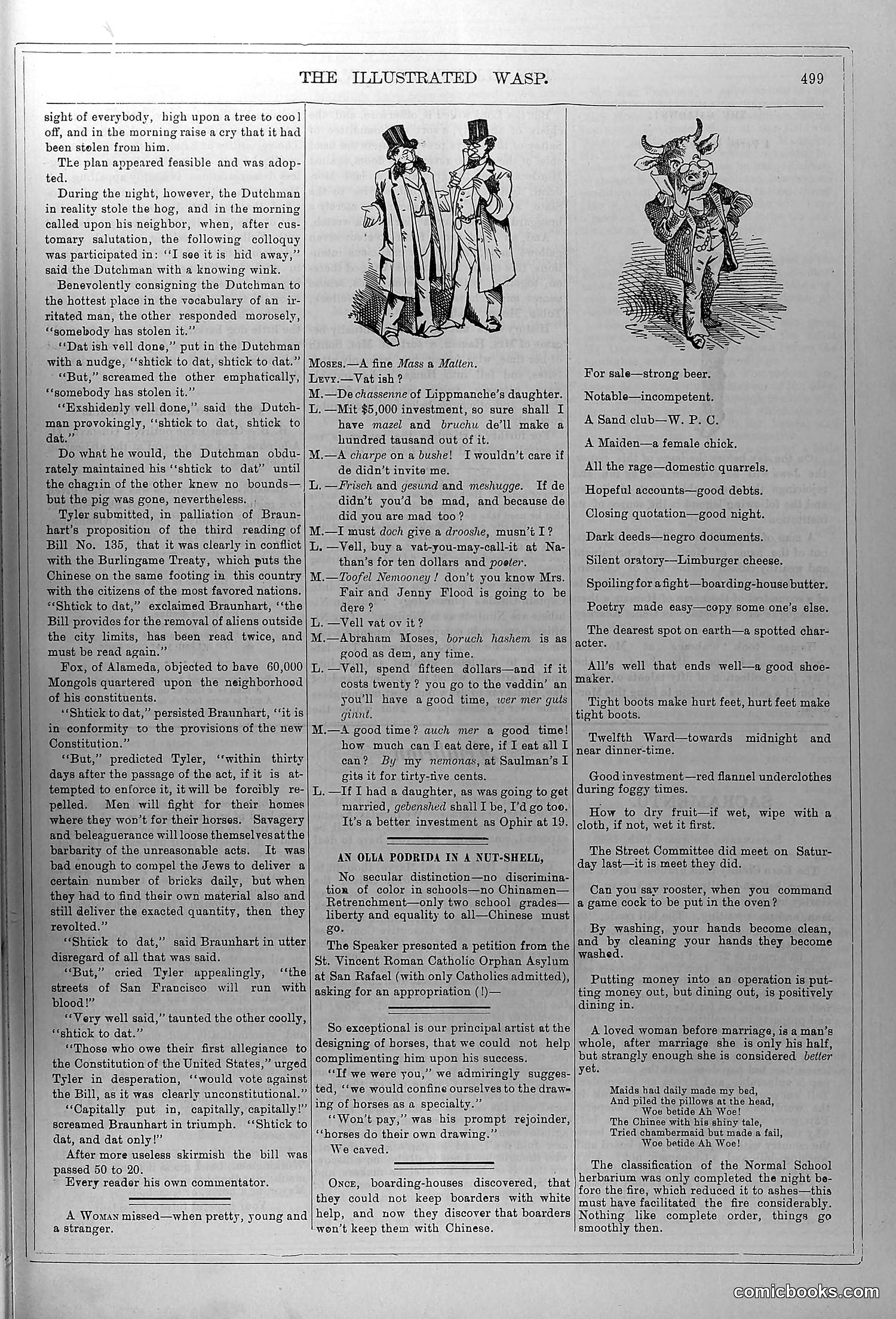
The left cartoon depicts two well-dressed men in top hats labeled "Moss" and "Levy," apparently mocking Jewish businessmen through caricature and Yiddish-influenced dialect humor. The text presents them in a stereotypical financial scheme involving beer investment and dubious business practices—reflecting common 19th-century anti-Semitic tropes portraying Jewish merchants as untrustworthy operators. The right image shows a bovine figure (labeled "For sale—strong beer"), likely satirizing the same business dealings through animal caricature. The remainder of the page contains miscellaneous satirical definitions and commentary on local San Francisco politics and social issues, including references to civic institutions and ethnic stereotyping typical of period American humor. **Note:** This content reflects deeply prejudiced historical attitudes; its inclusion here is documentary only.
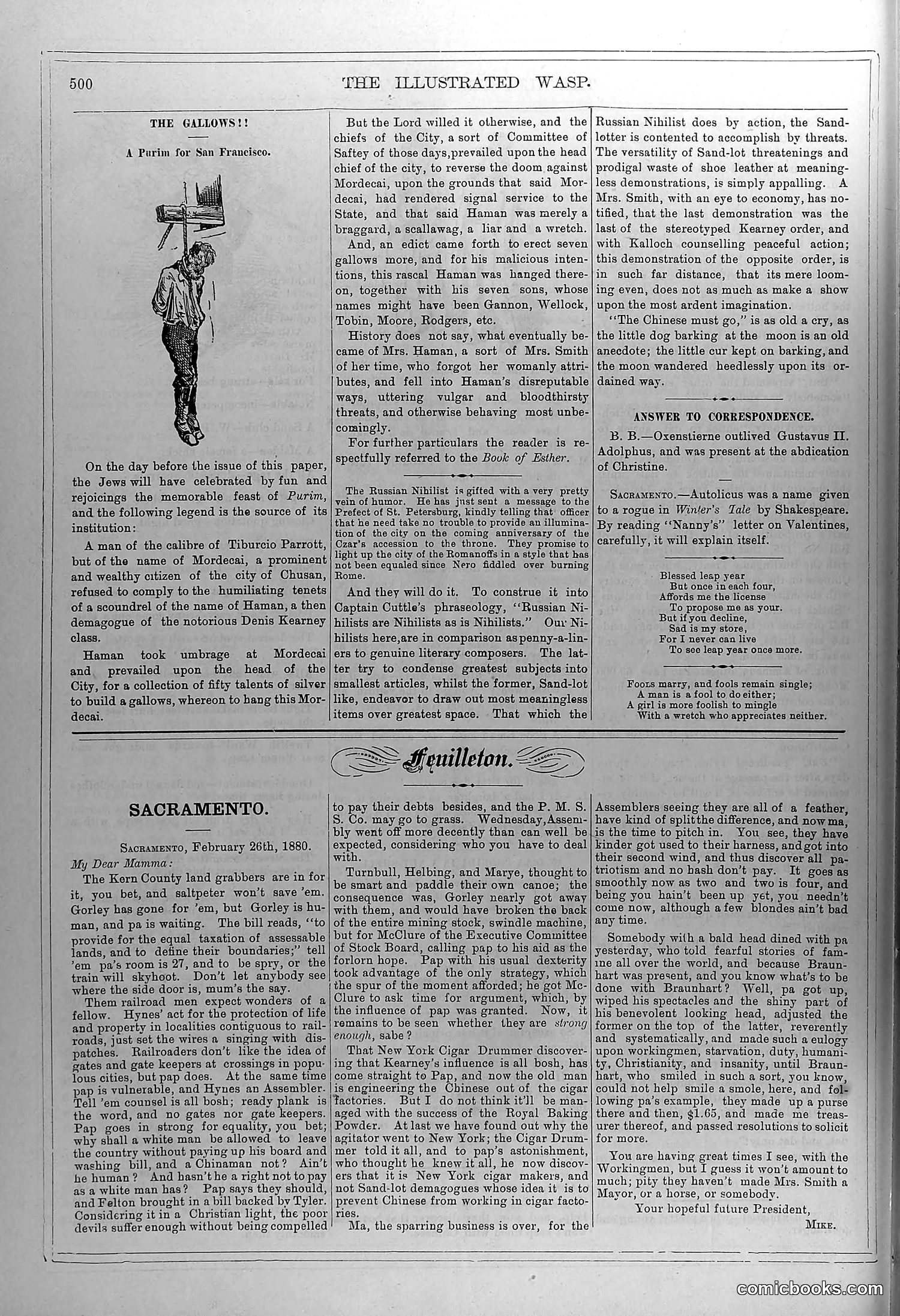
This cartoon satirizes **Denis Kearney**, leader of the notorious Kearney class, a demagogue who used inflammatory rhetoric against Chinese immigrants and wealthy citizens. The illustration shows a man hanged from a gallows, likely representing Kearney facing consequences for his agitation. The text describes how Kearney demanded the city construct gallows to hang **Mordecai Haman** (a wealthy citizen who refused Kearney's humiliating demands). The satire mocks Kearney's violent threats and authoritarian posturing—by reversing the imagery to suggest the demagogue himself deserves hanging for his "vulgar and bloodthirsty" rhetoric. This reflects *The Wasp's* opposition to Kearney's working-class movement and its extreme anti-establishment positions.
This page contains drama criticism rather than political cartoons. The main illustration shows a sleeping or reclining figure, accompanying reviews of theatrical productions. The text discusses "The Soul of an Actress," praising actor Mr. Southern's performance while critiquing the play itself as unworthy. It notes that Miss Clara Morris received applause despite the weak material. The reviews reference other productions at San Francisco theaters, including "Zsola" and "Vienna Ladies." The criticism reflects 19th-century theatrical standards—evaluating both performers' talents and play quality. The page demonstrates *The Wasp's* cultural commentary extended beyond political satire to arts criticism, assessing San Francisco's theater scene and performers' professional conduct with characteristic editorial judgment.
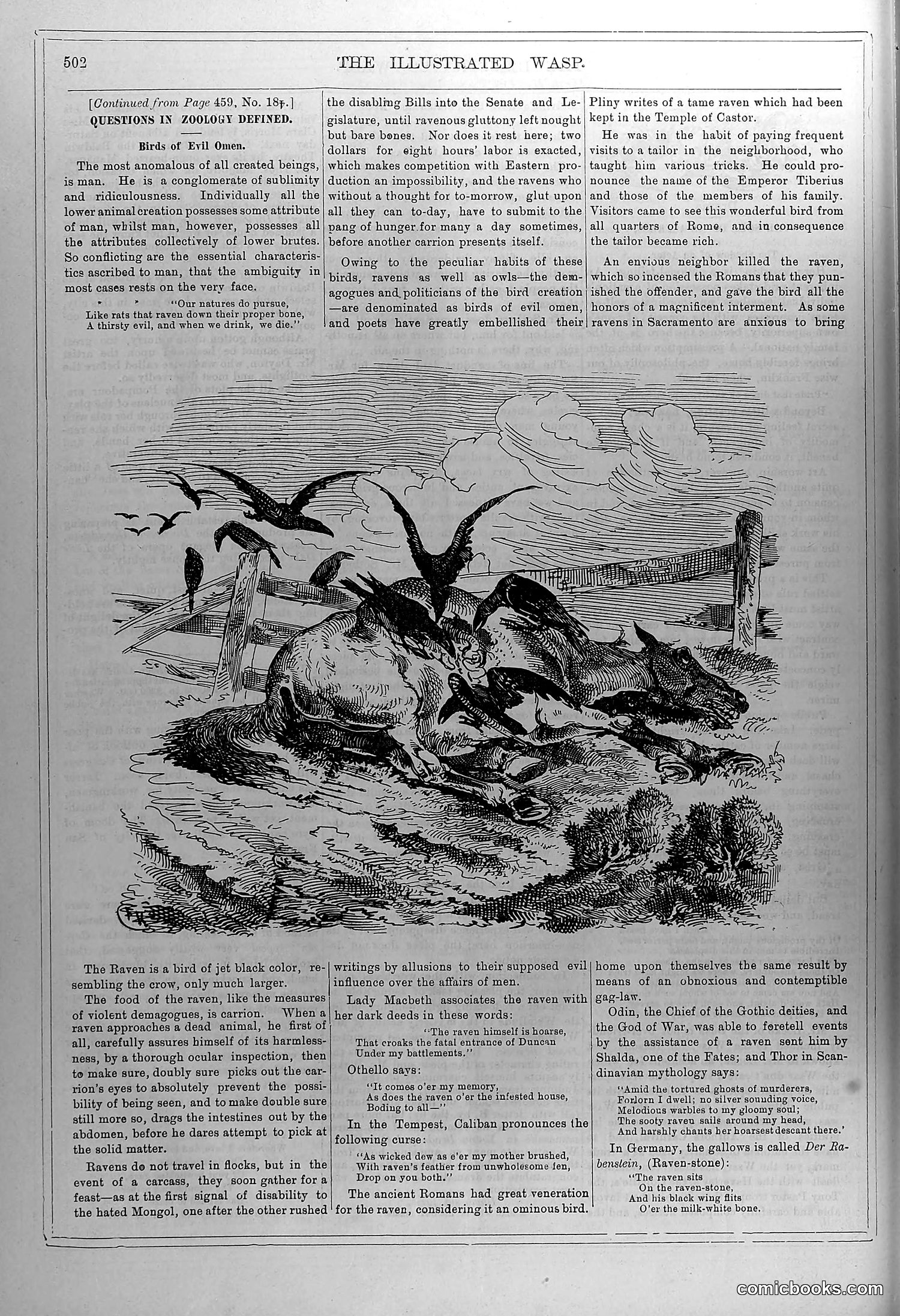
This page from *The Wasp* discusses ravens as symbols of evil in literature and mythology. The large engraving depicts ravens gathered around a dead horse or carcass in a rural landscape. The text explains that ravens are "denominated as birds of evil omen" in poetry and folk belief, citing references from *Othello*, *The Tempest*, and classical mythology. It notes the bird's association with death, disease, and misfortune across cultures—from Scandinavian to German traditions. Rather than political satire, this appears to be **cultural commentary**: an illustrated essay exploring how ravens function symbolically in Western literature and superstition. The page educates readers about the bird's dark reputation across different literary and mythological traditions, connecting folklore to canonical literary sources.
The small illustration at bottom shows two birds (appearing to be ravens or crows) in conversation, captioned "To be Continued" and titled "Unconstitutional." The accompanying article discusses a Superior Court decision regarding the "Dives Ordinance"—a local law about vagrants. The court ruled the ordinance unconstitutional because it distinguished between sexes regarding employment. The piece sarcastically critiques this legal technicality: while courts debate constitutional fine points about sex discrimination, the ordinance's core purpose—addressing vagrancy and morality—remains unaddressed. The bird cartoon likely represents ongoing legal wrangling, with the "to be continued" caption suggesting this constitutional battle will drag on indefinitely, treating serious urban problems as mere technical disputes rather than substantive issues.
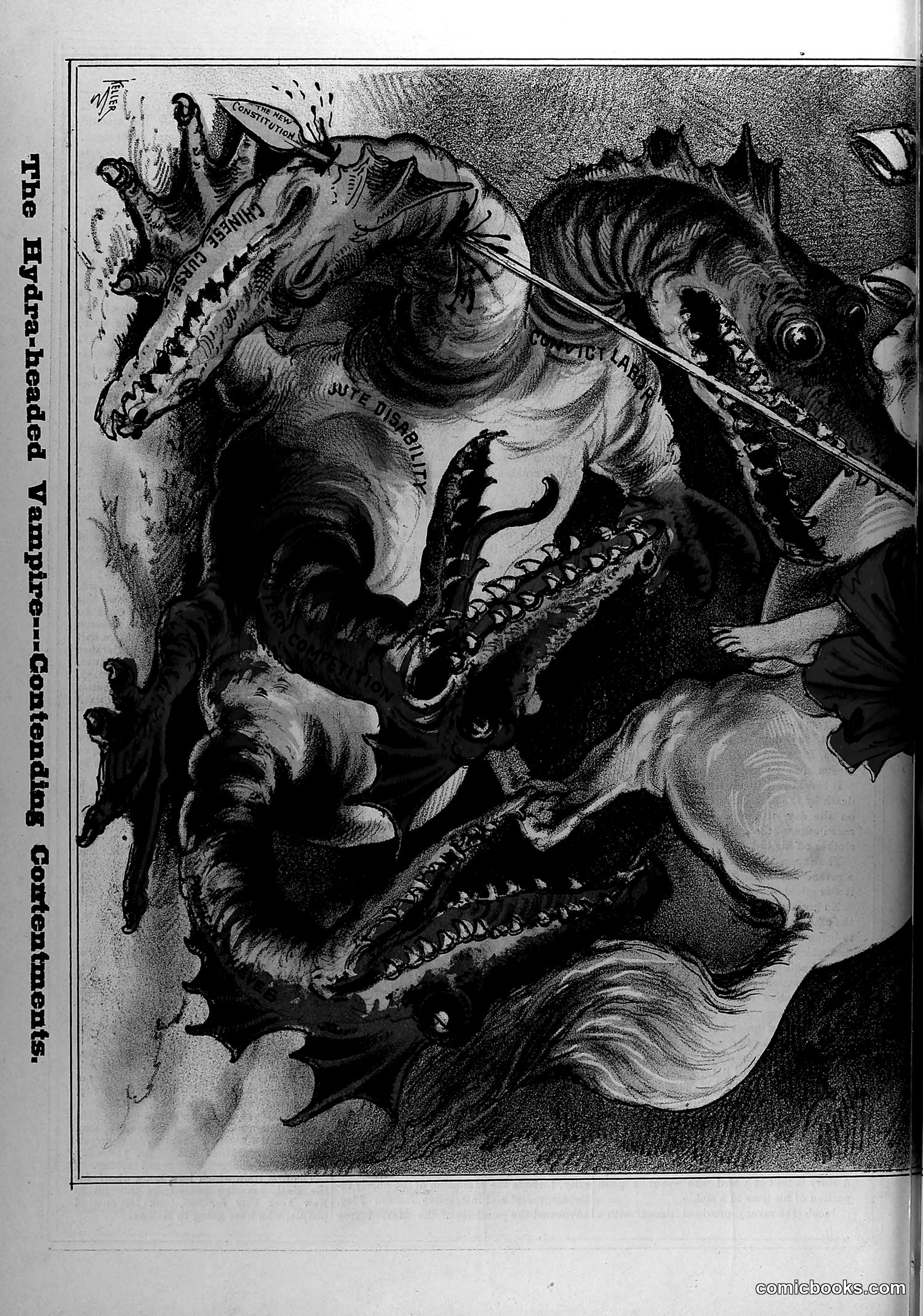
This appears to be a satirical cartoon criticizing political corruption or undesirable politicians gaining power through voting rights ("enfranchised"). The grotesque imagery depicts demonic or vampiric figures with exaggerated, monstrous features—including fangs, horns, and corpse-like characteristics—seemingly devouring or preying upon society. The text labels visible on the creatures suggest specific political references, though they're difficult to fully decipher in this reproduction. The style indicates this is late 19th-century American political satire, typical of *The Wasp* magazine's sharp commentary on contemporary politics. The central message appears to be that certain political groups or politicians are portrayed as parasitic, destructive forces feeding on the body politic—a common metaphor in Gilded Age political cartooning. Without clearer text visibility, the specific targets remain somewhat unclear.
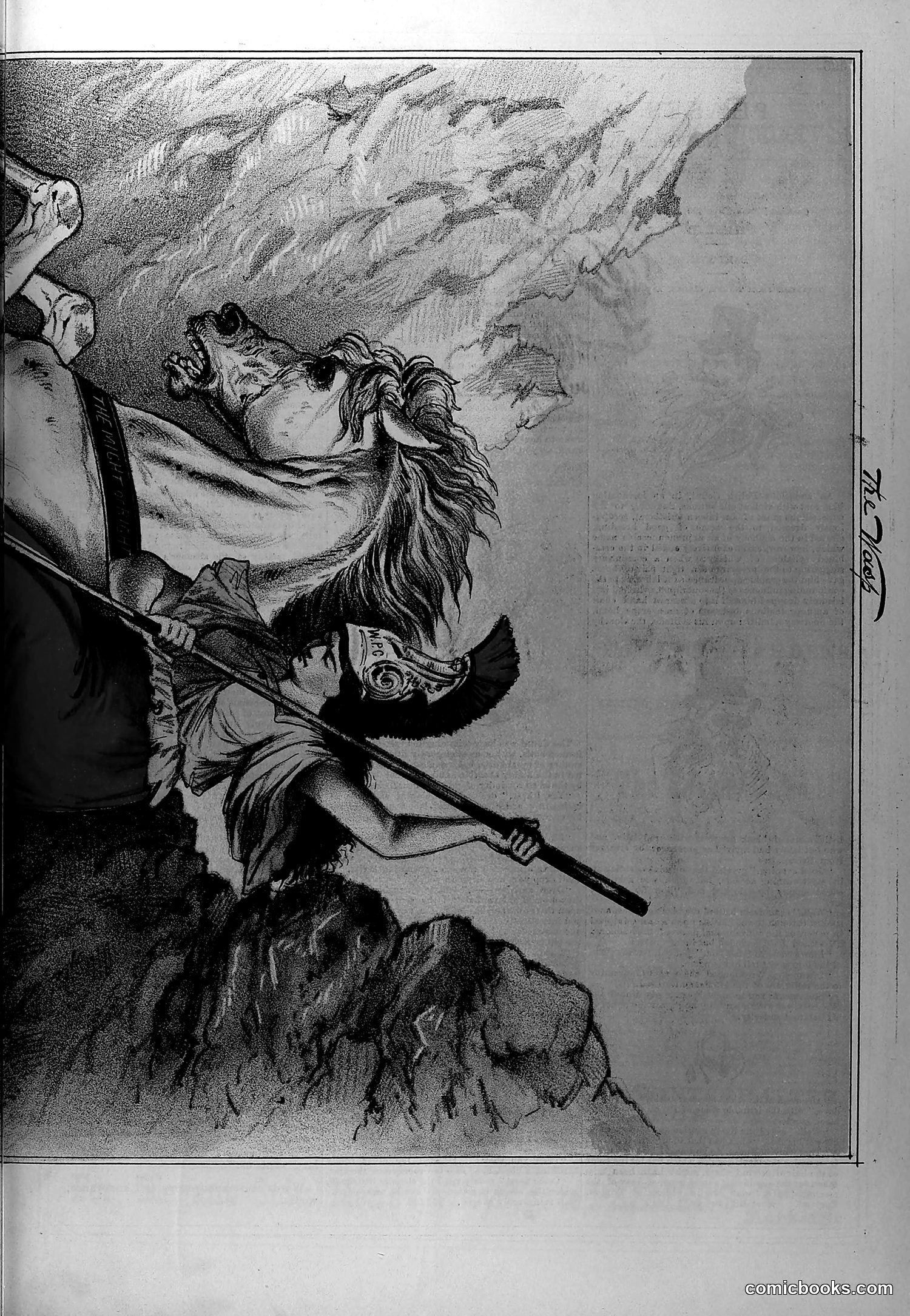
Unfortunately, the OCR text did not render on this page, making contextual analysis difficult. However, the image shows a dramatic black and white sketch of a figure with long, flowing hair wielding what appears to be a large axe or hatchet, positioned in an aggressive stance against a stormy sky background. The style and execution suggest this is political satire from *The Wasp*, likely depicting a historical or contemporary figure of significance. The weaponry and dramatic pose suggest commentary on violence, revolution, or aggressive political action. The figure's appearance—particularly the distinctive long hair—may caricature a specific person or type. Without legible OCR text or additional identifying marks, I cannot definitively state which political figure or event this cartoon satirizes. More context would be needed for accurate interpretation.
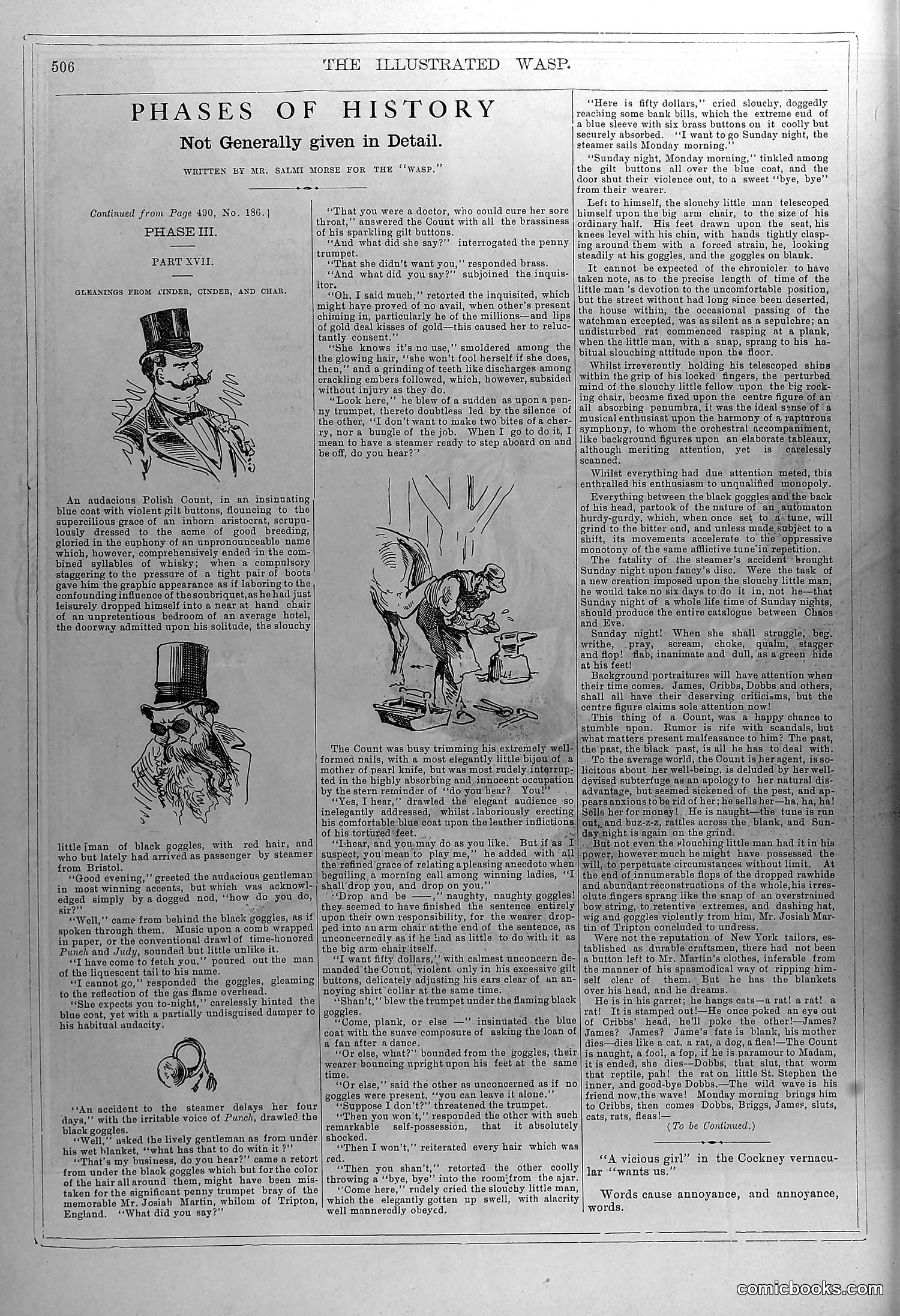
This page continues a serialized story titled "Phases of History: Not Generally Given in Detail" by Salmi Morse. The text is a satirical narrative featuring a Polish Count character wearing an "insulating blue coat with violent gilt buttons." The illustrations show a comedic encounter between this aristocratic Count and a working-class "little man of black goggles, with red hair." The satire appears to mock class pretension and social awkwardness—the Count's ornate appearance and pompous speech contrast sharply with the practical, direct manner of the common man. The dialogue and situation suggest commentary on European aristocratic pretension versus American democratic plainspokenness, a common theme in 19th-century American satire. The exact historical references remain unclear without additional context.
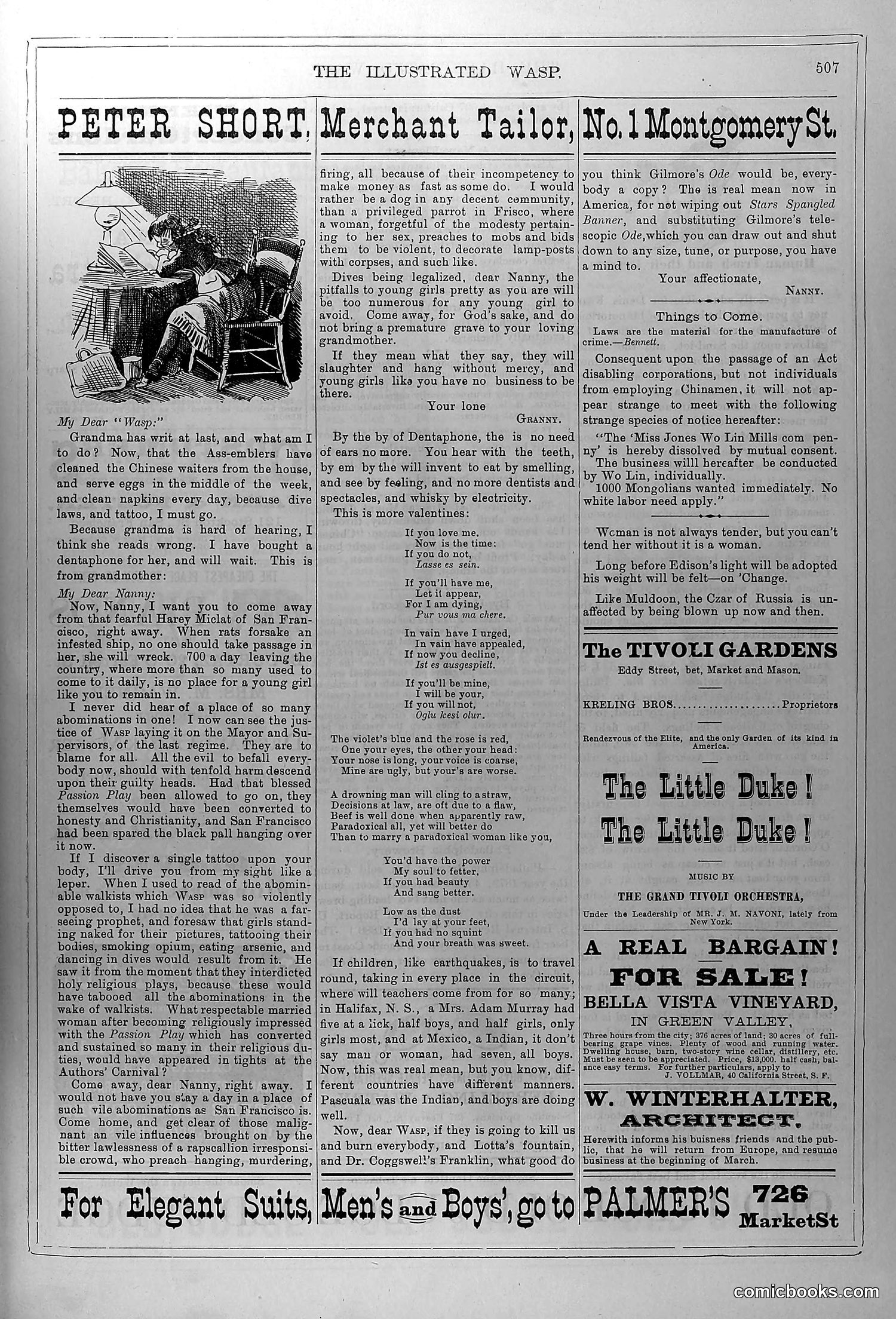
This page is primarily **text-based content** rather than a political cartoon. The main feature is a letter column titled "My Dear 'Wasp'" containing reader correspondence about San Francisco issues. The visible cartoon illustration shows what appears to be a **domestic scene with two figures** in period dress, but without clearer context from surrounding text, the specific satirical point is unclear. The page includes various **advertisements** (Palmer's suits, Tivoli Gardens, real estate) and announcement sections like "Things to Come." The letters reference **San Francisco local issues**: water supply problems, the Mayor and Supervisors' handling of plague-infested ships, and critiques of city governance. One letter discusses Chinese labor and employment regulations. Without additional historical context about specific 1890s San Francisco events referenced, precise political targets remain uncertain.
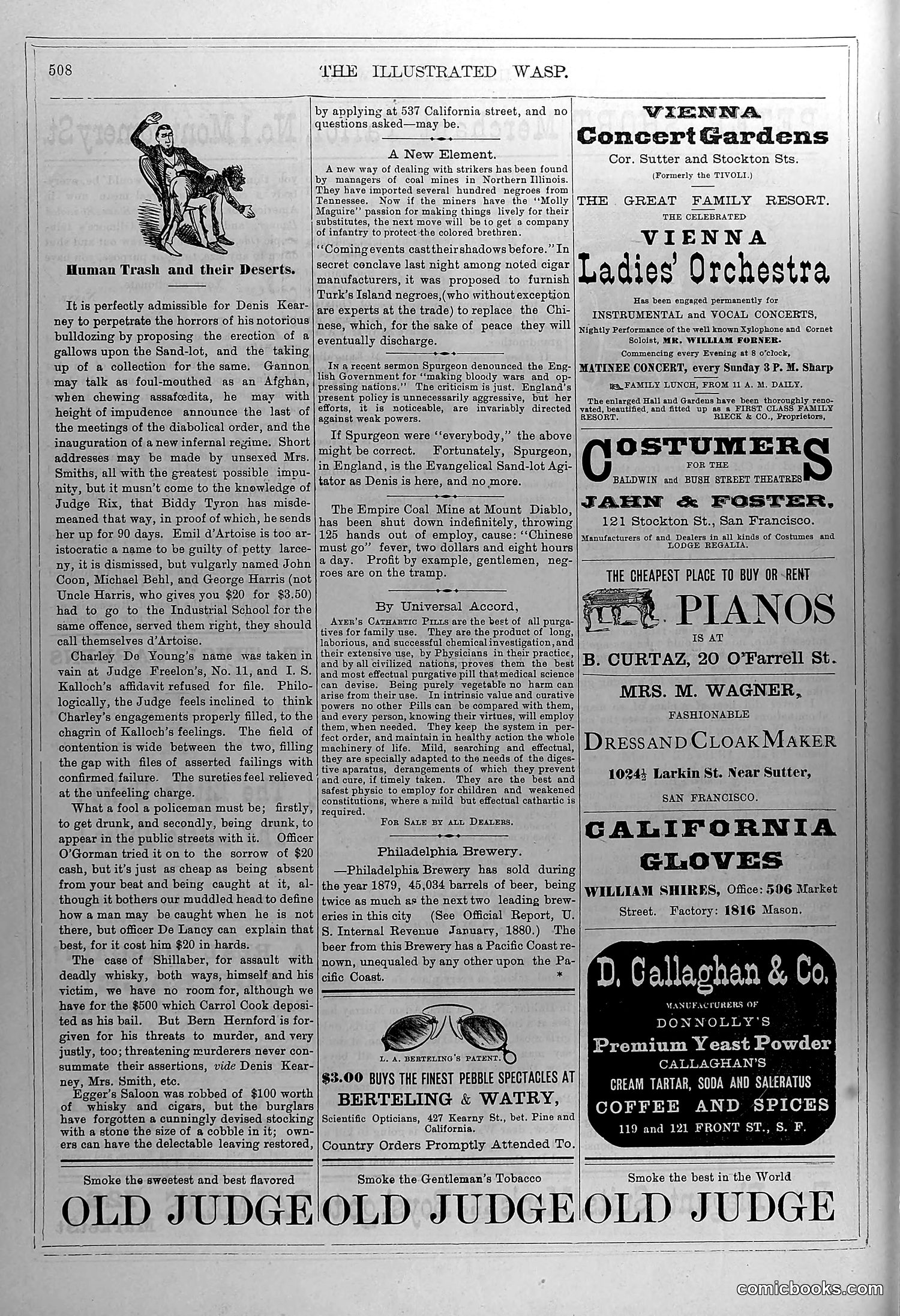
This page is primarily **advertising and editorial content** rather than political satire. The left column contains brief social commentary pieces ("Human Trash and their Deserts," "A New Element," "By Universal Accord") discussing various scandals and local issues—assault cases, labor disputes at coal mines, and brewery sales statistics. The illustration shows a caricatured figure in period dress, but the accompanying text doesn't clearly identify them as a specific political figure. The bulk of the page comprises advertisements for San Francisco businesses: concert halls, costume makers, piano dealers, and food products. Without clearer labeling or more explicit political commentary, the satirical intent remains **unclear from this particular page**.
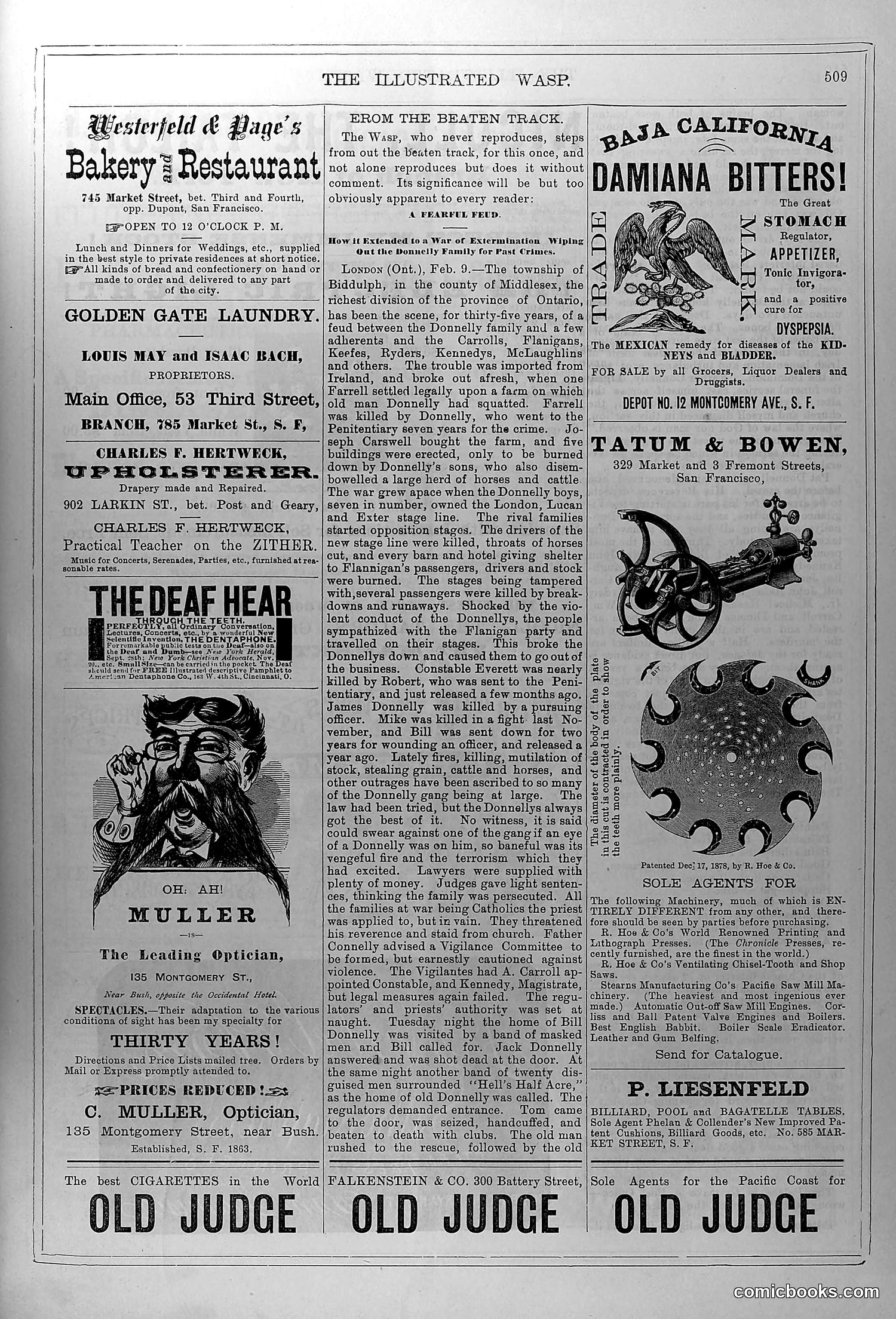
This page is primarily **advertisements** for San Francisco businesses (bakeries, laundries, opticians, printing services, and cigarettes) rather than political satire or comics. The only illustrative content includes: 1. **"The Deaf Hear Through the Teeth"** — an advertisement featuring a bearded man's face, promoting a dental/hearing device by the American Dentaphone Co. 2. **"Baja California Damiana Bitters"** — an advertisement with an eagle illustration, marketing a medicinal tonic. 3. **A mechanical device illustration** (appears to be agricultural or industrial machinery). These are commercial advertisements typical of satirical magazine revenue, not editorial cartoons. The page demonstrates how 19th-century publications funded themselves through paid advertising rather than relying solely on editorial content.
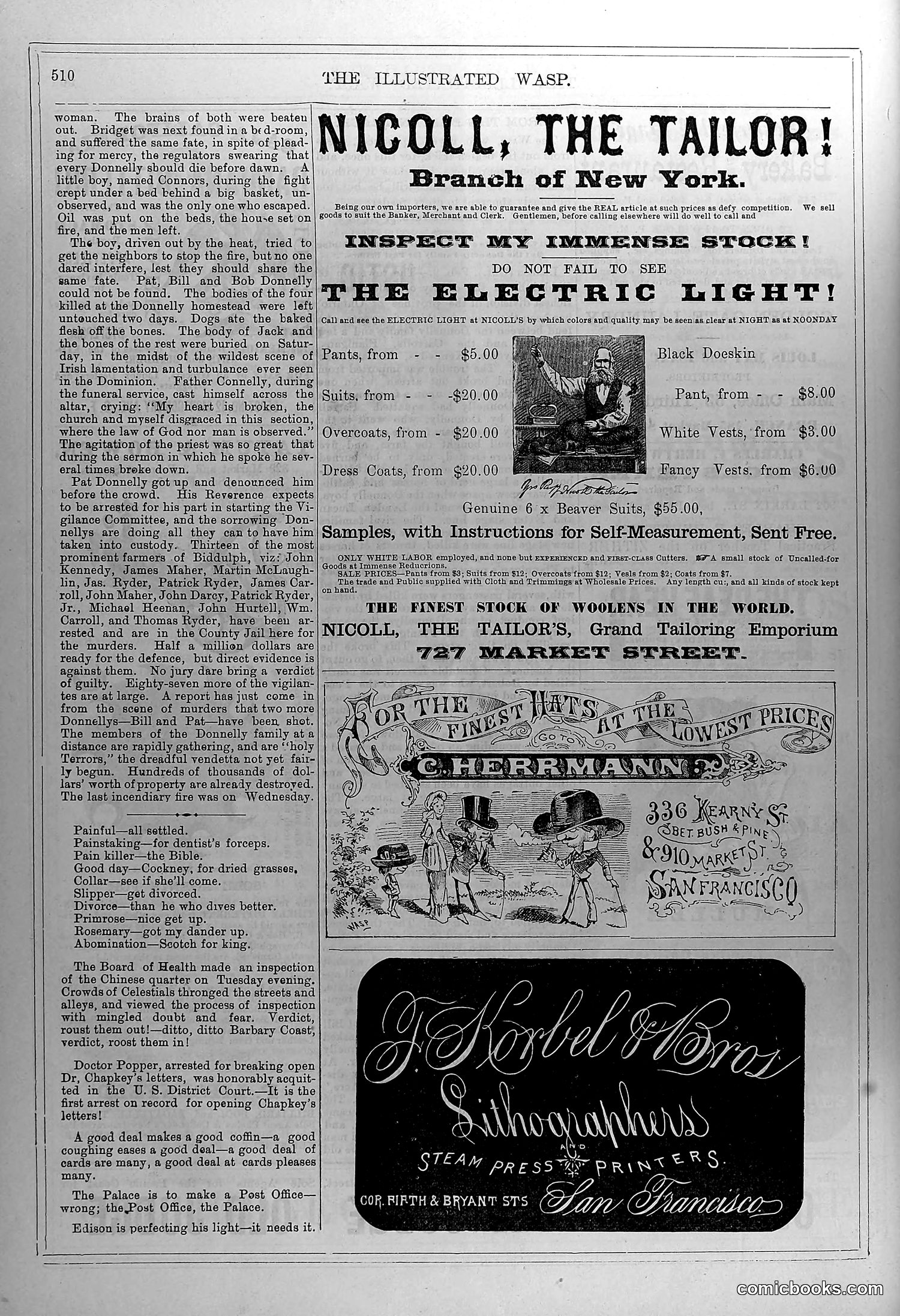
This page is predominantly **advertising**, not satire or political commentary. The main content includes: 1. **Nicoll, The Tailor** (New York branch) — a large advertisement for clothing, featuring pricing for pants, suits, overcoats, and dress coats, with claims about "ELECTRIC LIGHT" visibility of merchandise. 2. **C. Herrmann & Co.** — a hat retailer advertisement with an illustration of two men in top hats. 3. **S. Korbell & Bros.** — a Steam Press Printers business card. The page also contains **miscellaneous text items** at the bottom, including brief humorous phrases ("Painful," "Painstaking," "Good day," etc.) and news snippets about health inspections and arrests, but these are filler content rather than sustained satire or cartooning.
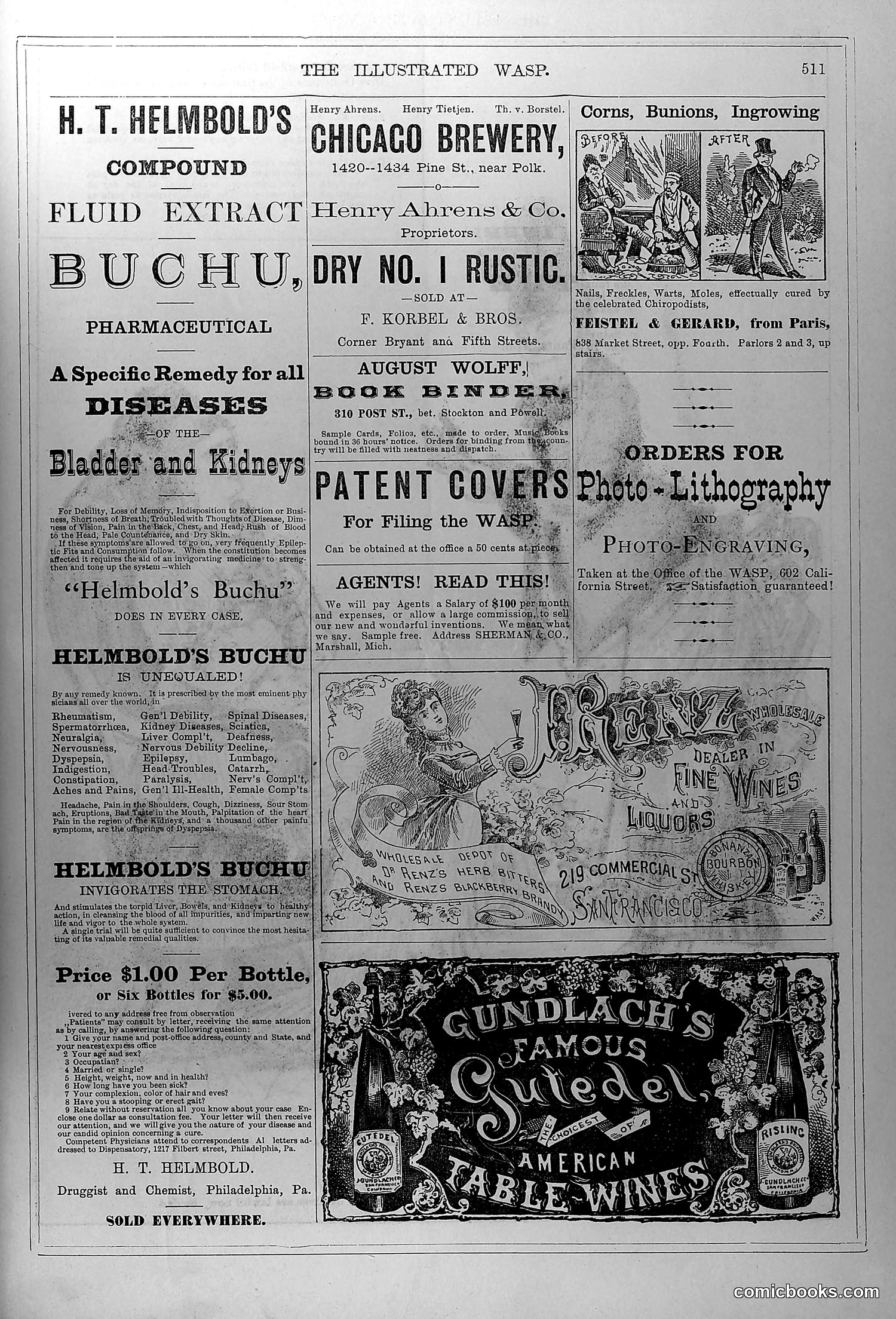
This page is primarily **advertising** rather than editorial content or political cartoons. It contains multiple patent medicine and commercial advertisements typical of late 19th-century publications. The main advertisements include: - **Helmbold's Buchu**: A patent medicine claiming to cure bladder and kidney diseases (price $1.00 per bottle) - **Chicago Brewery** and other commercial businesses - **Patent Covers** for filing documents - **Photo-Lithography services** - **Gundlach's Famous Sprudel** wine advertisement The page reflects the era's widespread use of unregulated patent medicines with exaggerated health claims. There are no identifiable political cartoons or satirical commentary visible—this appears to be a revenue-generating advertising section rather than editorial satire material.
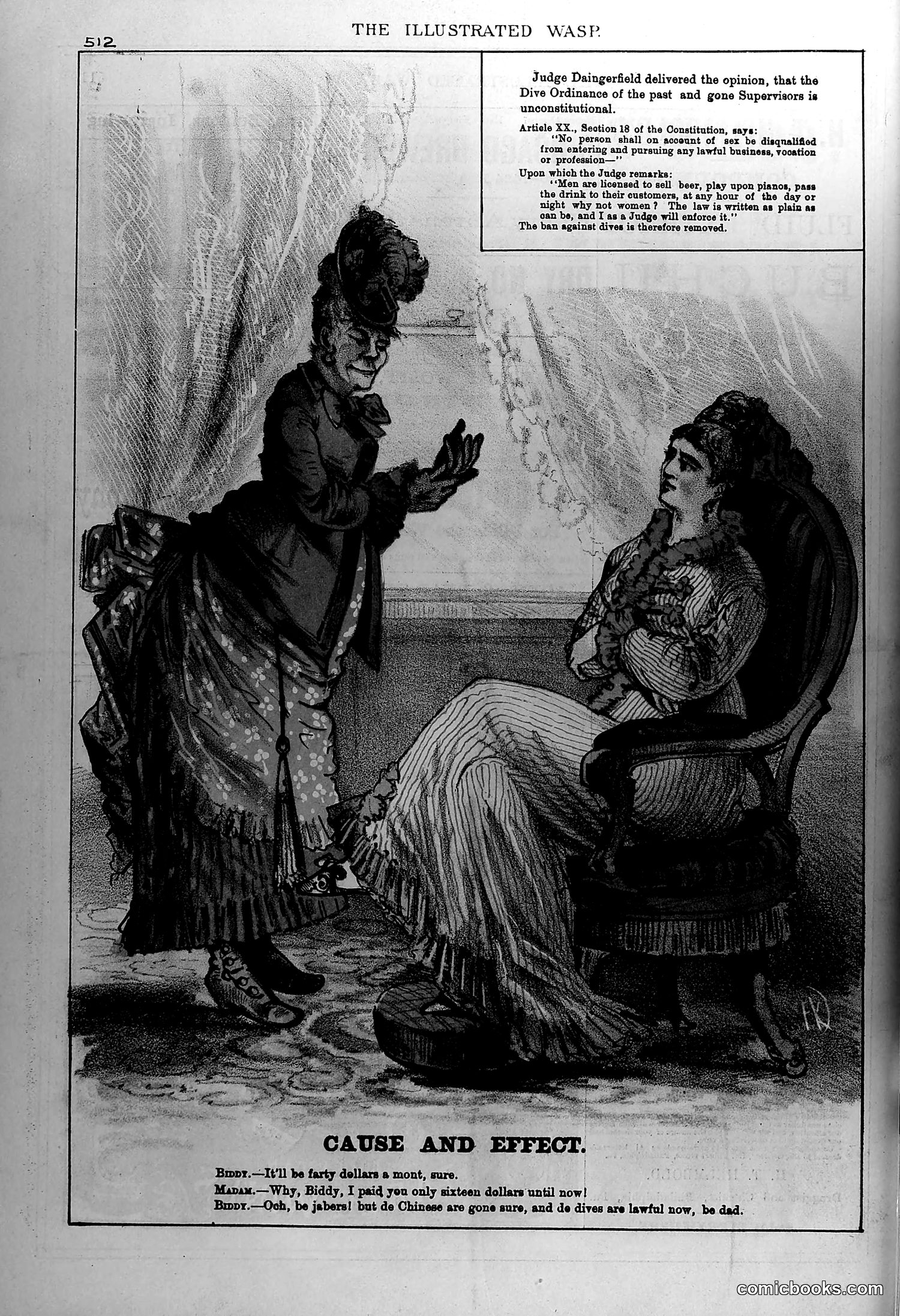
This satirical cartoon addresses a legal ruling striking down anti-dive ordinances affecting women. The text box explains Judge Daingerfeld ruled that ordinances banning women from "diving" (performing in theaters/saloons) are unconstitutional under Article XX, Section 18 of the Constitution, which prohibits sex-based discrimination in professions. The Judge's quoted remarks sarcastically highlight the law's absurdity: men can sell beer, play piano, or perform at night without restriction, yet women face bans—contradicting stated legal principles. The cartoon's "Cause and Effect" shows financial consequences: a woman (the "diver") demands payment owed since the ordinance prevented her from working, while her employer protests the lost revenue now that dives are "lawful."
This appears to be a test or calibration page rather than an editorial cartoon. The image shows a standard photographic reference chart featuring: - A grayscale checker pattern (top left) used to test tonal range and contrast in reproduction - A vertical measurement scale marked 6-11 inches - Horizontal measurement scales at top and bottom (marked 6-10) These elements are typical of archival documentation or printing quality control from early-to-mid 20th century publications. This page would have been included in magazine issues to help ensure consistent reproduction quality across print runs, not as satirical content. Without visible cartoon artwork or OCR'd text content, I cannot identify any political figures, social commentary, or satirical intent.