
A complete issue · 18 pages · 1880
The Wasp — February 21, 1880

I can see this is a calibration or test page from The Wasp magazine, featuring an Oregon Rule Co. ruler and a grayscale test pattern (a checkerboard of varying gray and white squares) against a black background. This appears to be a technical reference page rather than editorial content—likely used for printing quality control or photographic documentation purposes. The rulers and test pattern were standard tools for archival photography and reproduction work, ensuring proper exposure, contrast, and scale in reproductions. This is not a political cartoon or satirical commentary, but rather a production or archival artifact from the publication.
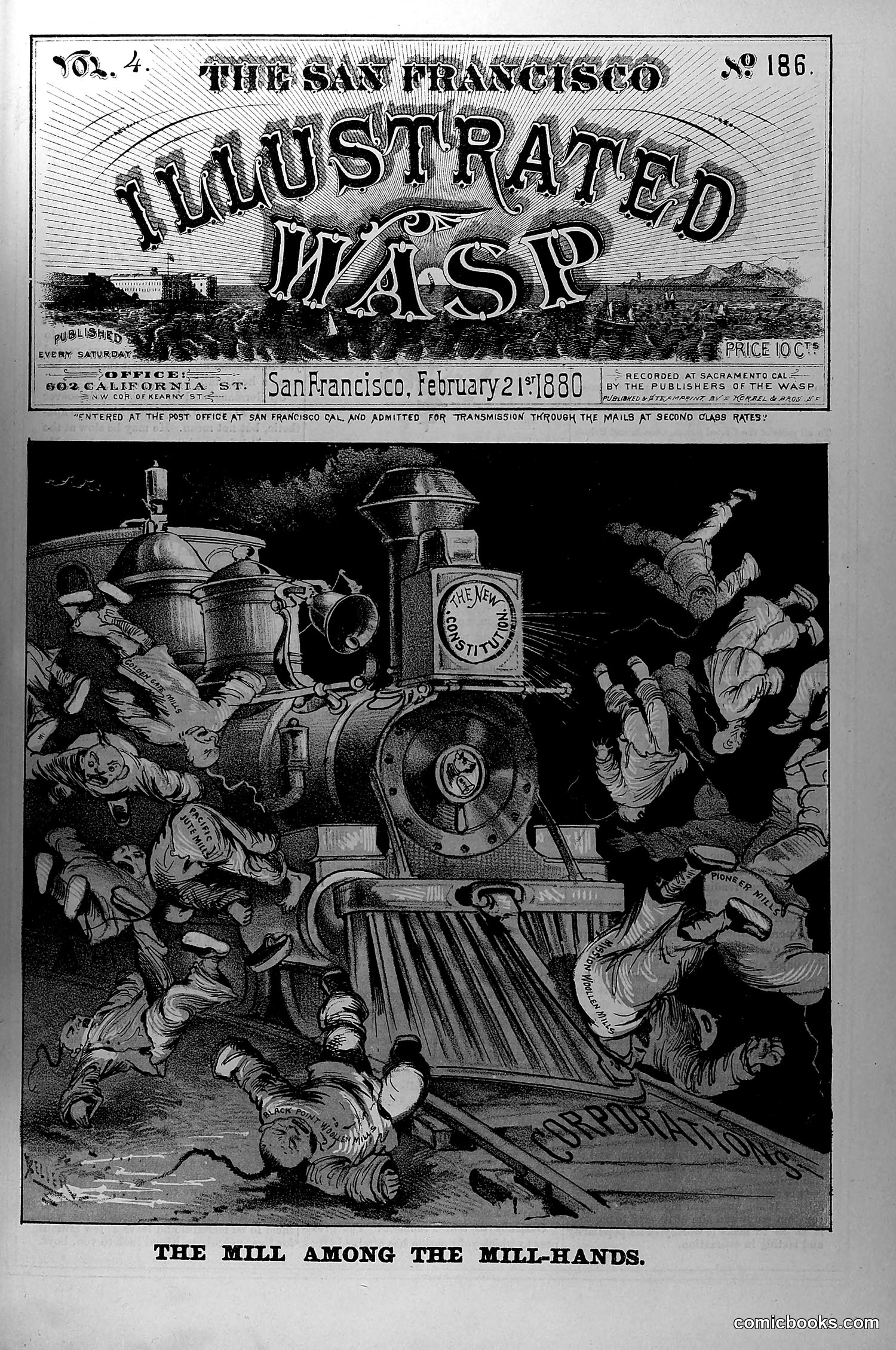
This satirical cartoon from *The Wasp* (February 21, 1880) uses a locomotive labeled "Machinery Constitution" as its central metaphor. The engine, operated by what appears to be industrial or political forces, is depicted grinding up workers—depicted as small human figures being caught in or crushed by the mechanical process. The title "The Mill Among the Mill-Hands" suggests criticism of how industrial machinery (literal or metaphorical) grinds up the laborers who operate it. This reflects 1880s anxieties about industrialization, worker safety, and whether constitutional protections favored capital over labor. The figures appear distressed, emphasizing the cartoon's message about the human cost of industrial progress and mechanization.
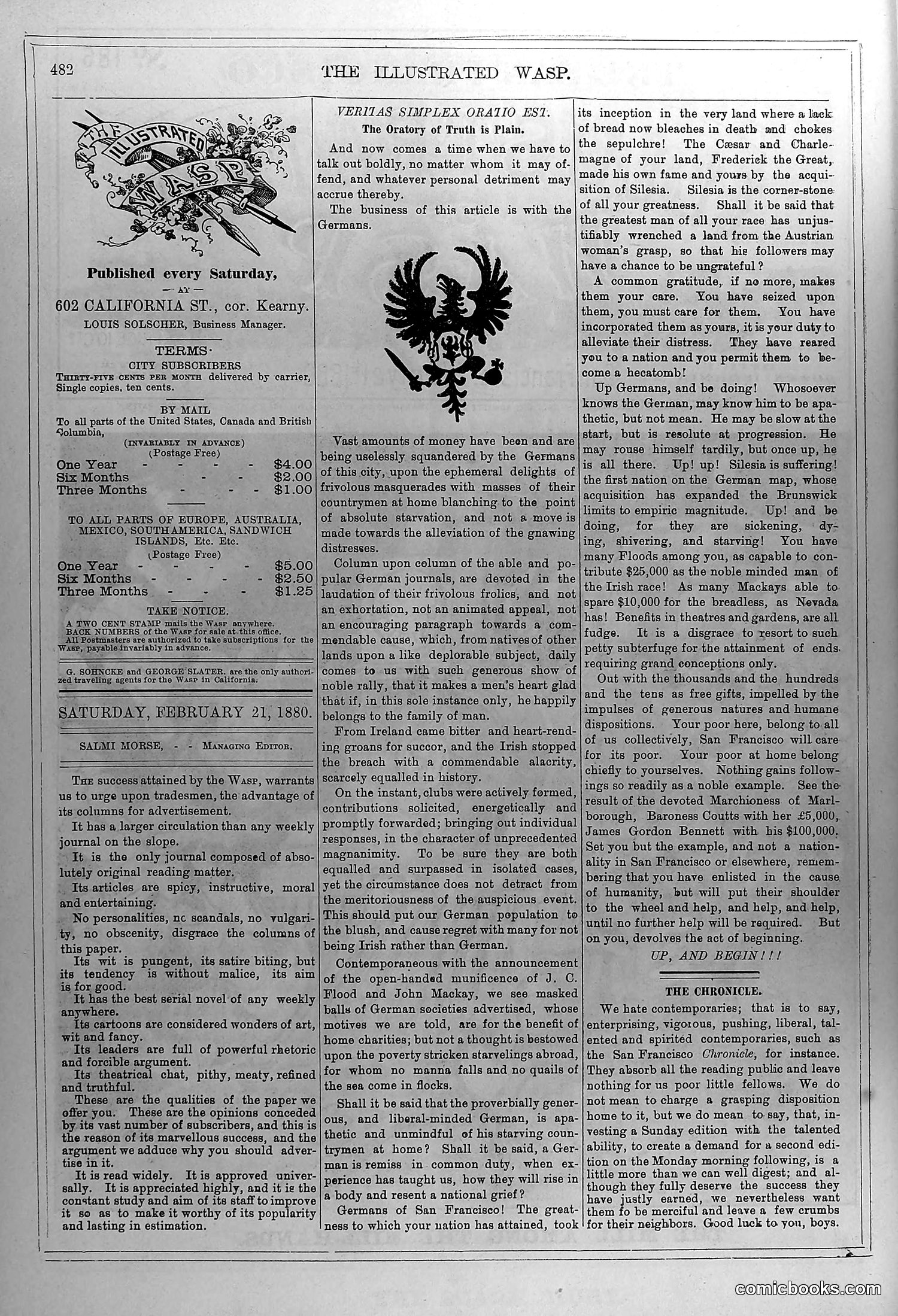
The main content is an editorial titled "VERBAS SIMPLEX ORATIO EST" (plain speech is best), addressing German immigration and perceived German dominance in San Francisco. The central image shows a **German Imperial eagle** (Prussian symbol), representing Germany or German power. The text argues that Germans are accumulating excessive wealth and influence in San Francisco, "squandering" money frivolously and behaving arrogantly. The editorial calls for Irish and other groups to unite against German economic and social dominance, framing it as a threat to the city's character. This reflects late-19th-century **ethnic tension and nativist anxieties** about German immigrant success and cultural influence in California. The satire positions Germans as threatening outsiders despite their prosperity.
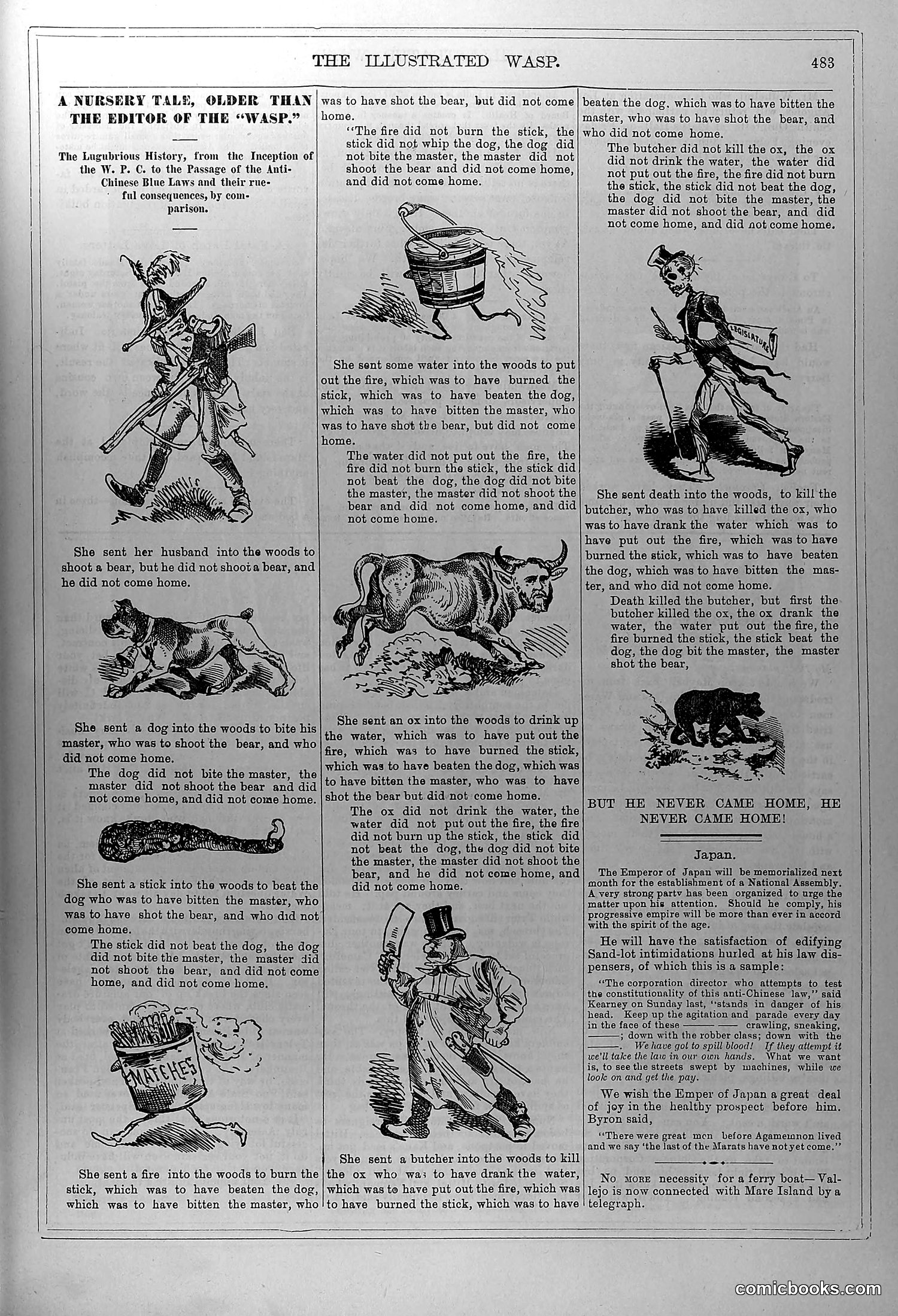
This page contains a cumulative nursery tale parodying the classic "House That Jack Built" structure. The repetitive narrative describes a husband who fails to shoot a bear, followed by escalating failed interventions (water, stick, dog, ox, butcher, death) to remedy the original failure—each action producing the opposite of its intended result. The political target appears unclear from the image alone, though *The Wasp* typically satirized California politics and public figures. The repeated refrain "he did not come home" suggests commentary on governmental incompetence or a specific failed policy where successive attempts to fix problems only compounded them. The cartoonish illustrations support this mock-heroic, absurdist humor typical of 1880s-90s American satirical magazines.
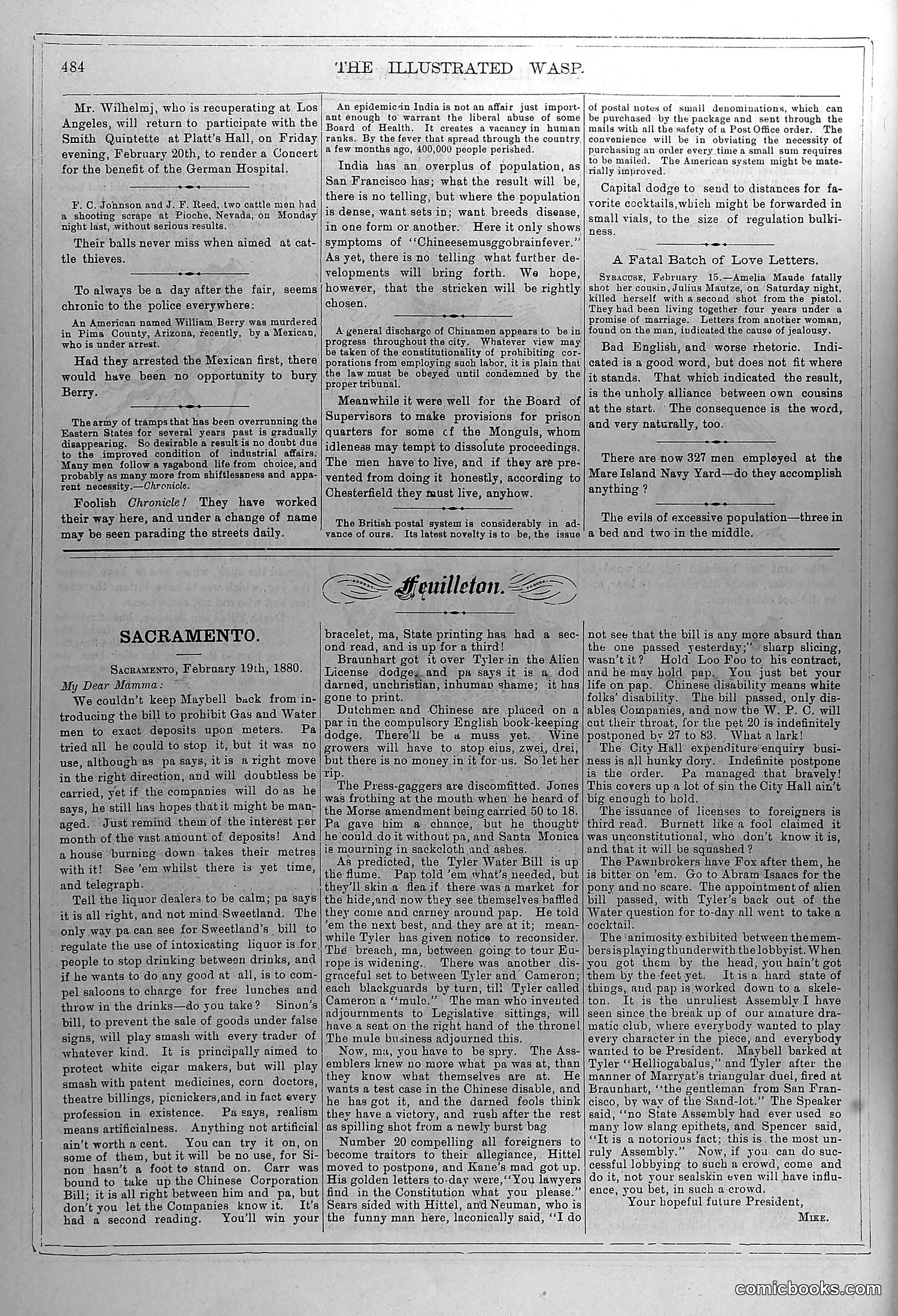
This page from *The Wasp* (February 1880) contains satirical commentary rather than visual cartoons. The main sections include: 1. **Social commentary** on Indian epidemics and overpopulation, critiquing inadequate governmental response to disease deaths. 2. **"A Fatal Batch of Love Letters"** - a humorous piece about a murder case involving Julius Mantze, mocking poor English and rhetoric in courtroom proceedings. 3. **"Feuilleton" section** - satirizing Sacramento politics and local disputes, including disputes over water bills, municipal licenses, and city hall spending with sharp jabs at various officials and their incompetence. The satire targets government inefficiency, bureaucratic absurdity, and local political corruption typical of *The Wasp's* muckraking approach to California issues.
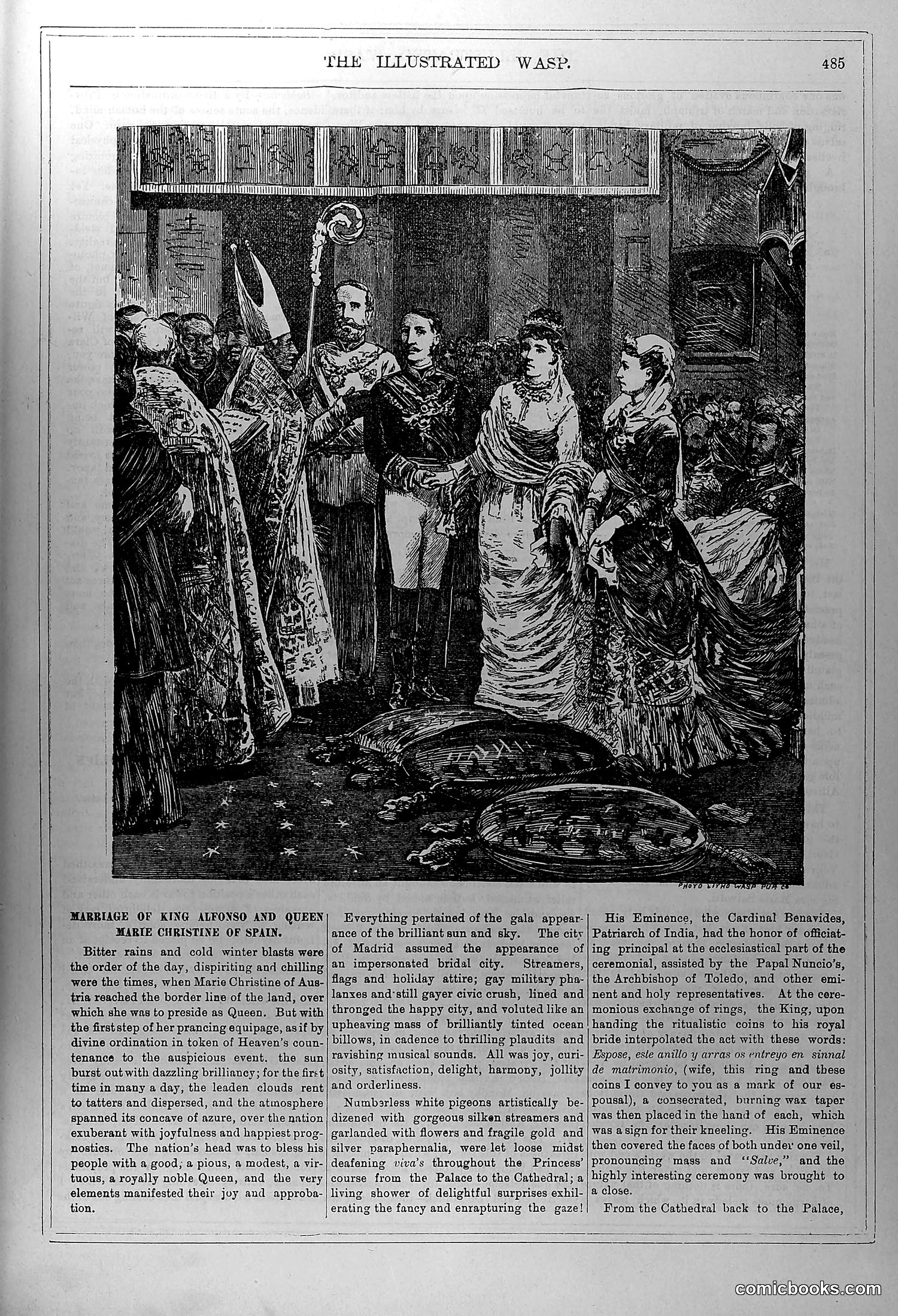
This satirical engraving depicts the royal wedding ceremony with heavy irony. The text describes an elaborate, expensive state celebration featuring religious pageantry, military displays, and civic grandeur—yet the caption and illustration suggest mockery of such ostentatious display during difficult times. The opening lines reference "bitter rains and cold winter blasts" affecting Madrid, implying the contrast between royal extravagance and common hardship. The detailed account of ceremonial splendor, ecclesiastical involvement, and aristocratic participation appears designed to highlight the disconnect between the monarchy's lavish celebration and ordinary citizens' suffering. The illustration shows the couple amid clergy and nobility in formal regalia, emphasizing the hierarchical, ornate nature of court ritual that *The Wasp* likely viewed as excessive or disconnected from popular welfare.
This page contains theater criticism and cultural commentary rather than political cartoons. The main illustrated element is a decorative header labeled "Music and Drama" featuring ornamental vignettes. The text reviews performances by Mrs. Hall McAllister and discusses a Mendelssohn concerto at the Bush Street Theatre. Critics praise Mrs. McAllister's staging choices and her interpretation of dramatic roles, noting her ability to convey emotional depth through voice and presence. The piece concludes with a serialized story section titled "Three Twelve Year-Old's of Forty Years Ago—Twenty Years Later" (Part Six: Letter Five), which appears to be fiction rather than satire. The page functions primarily as arts criticism and entertainment content rather than political satire.
This page contains primarily **text content rather than political cartoons**—specifically a serialized story titled "The Illustrated Wasp" involving dialogue between characters discussing marriage to a Marquis and family complications. The bottom section shifts to **educational/reference material**: "A Key to Certain Biblical Weights, Measures, Coins and Distances," explaining historical monetary and measurement units (shekels, talents, cubits, etc.). There is **no discernible political satire or cartoon imagery** on this page. It appears to be filler content—serialized fiction and reference material—rather than the satirical commentary typically associated with *The Wasp* magazine. The page functions as standard magazine content between advertising or political material elsewhere in the publication.
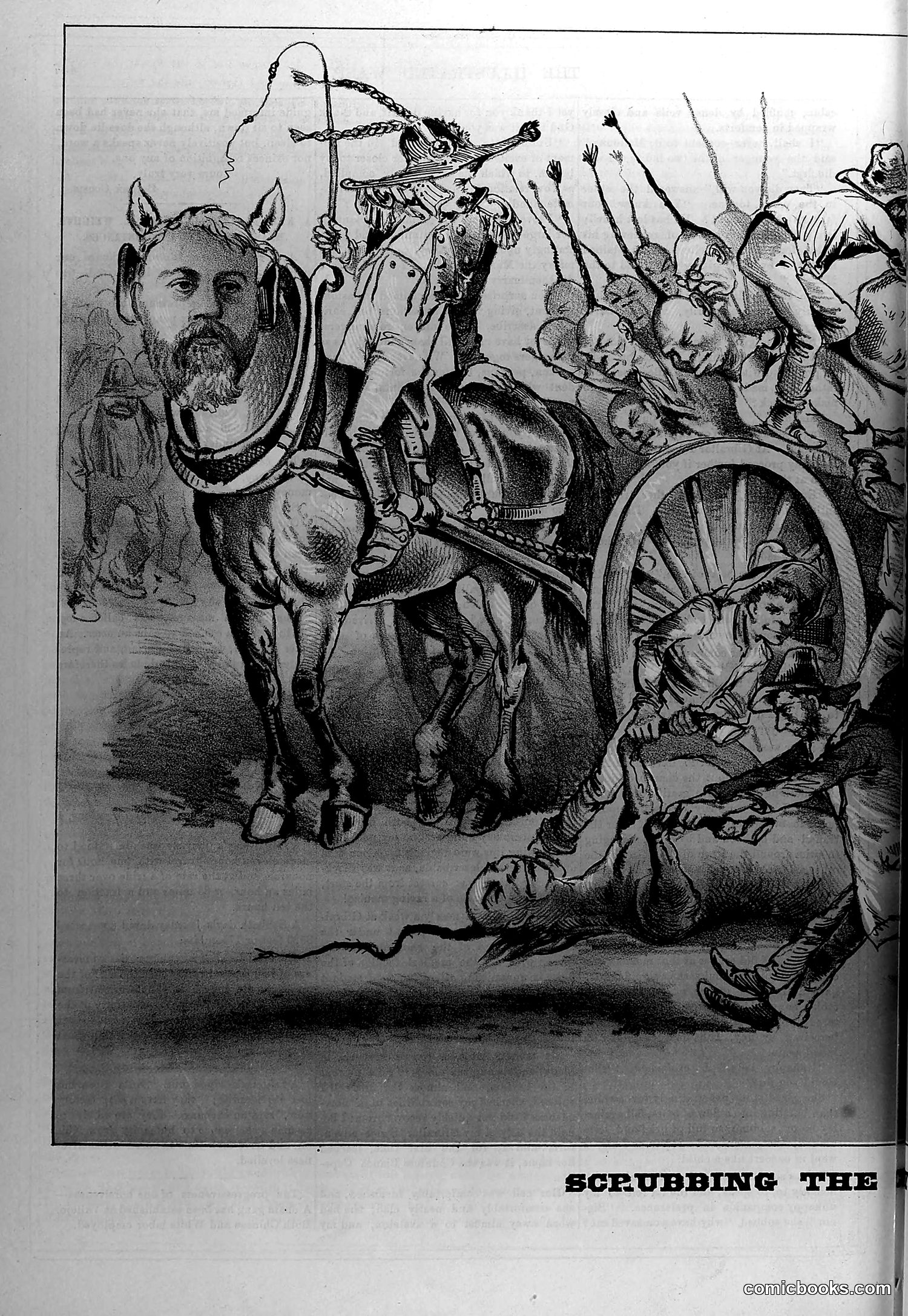
This political cartoon depicts a bearded man's head (presented as a large caricatured mask or portrait) being used as a scrubbing brush by numerous figures wielding it against a wagon wheel and ground. The title "Scrubbing The" (cut off mid-word) suggests the subject is being literally "scrubbed" or worn down through use and abuse. The style and presentation indicate this is satirical commentary on a public figure being figuratively "worn out" or destroyed through relentless criticism, labor, or political attack. The numerous small figures surrounding the scene emphasize collective action against this individual. Without the complete caption or publication date, the specific identity and historical context remain unclear, though this appears to target a prominent politician or public figure of the era.
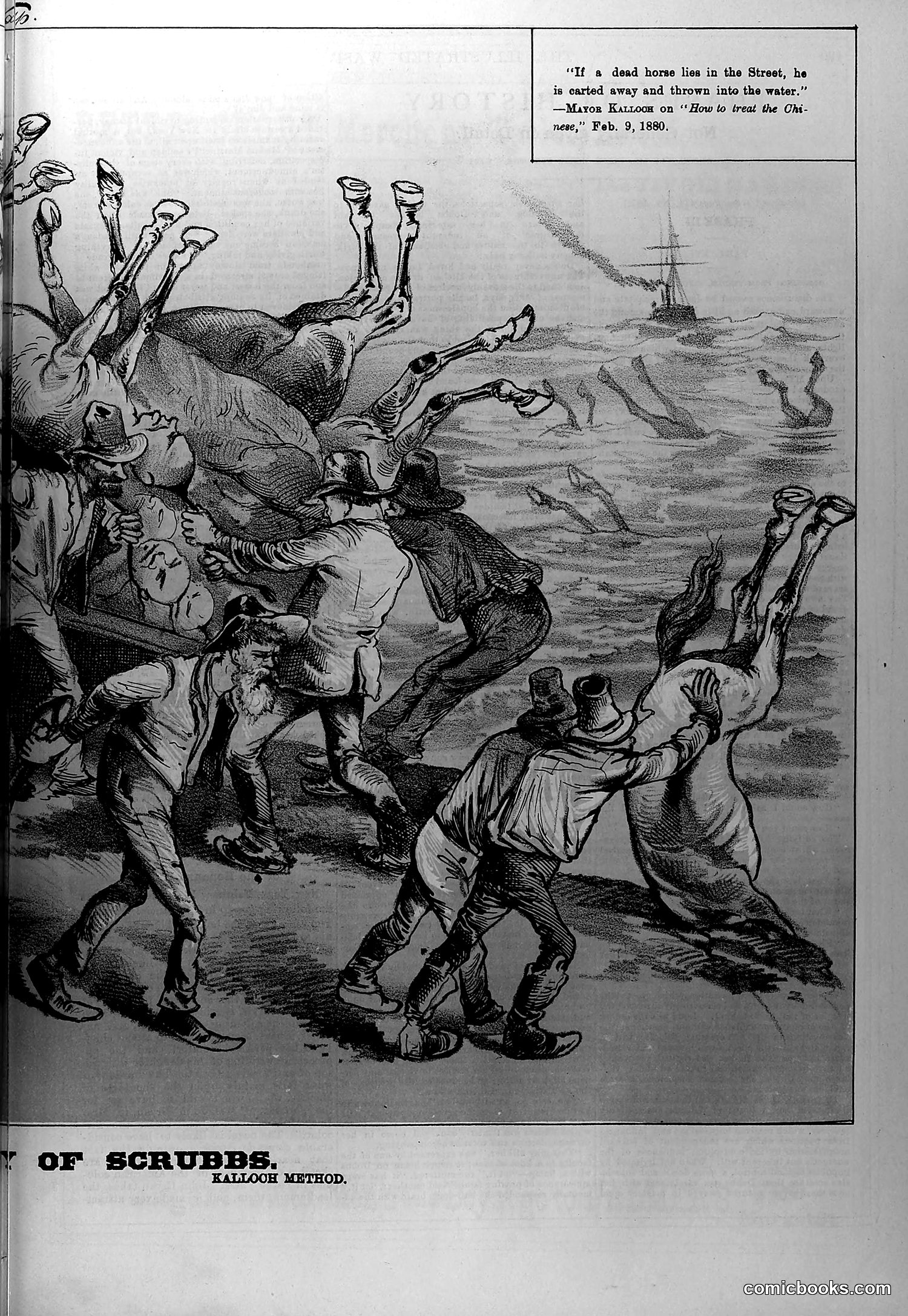
This satirical cartoon depicts men throwing a dead horse into the water—a grotesque visual pun on the phrase "flogging a dead horse" (pursuing a hopeless cause). The title references "scrubbs," likely meaning disreputable or worthless people. The quote at top from the Baron Kailoon's "How to treat the Chinese" (Feb. 9, 1880) indicates this critiques treatment of Chinese people in America. The "Kailoor Method" appears to mock a proposed solution to Chinese immigration by literally disposing of the problem—depicting the violent, dehumanizing anti-Chinese sentiment of the era through grotesque visual metaphor. The cartoon satirizes both the futility and brutality of anti-Chinese policies circulating during this period of intense xenophobia.
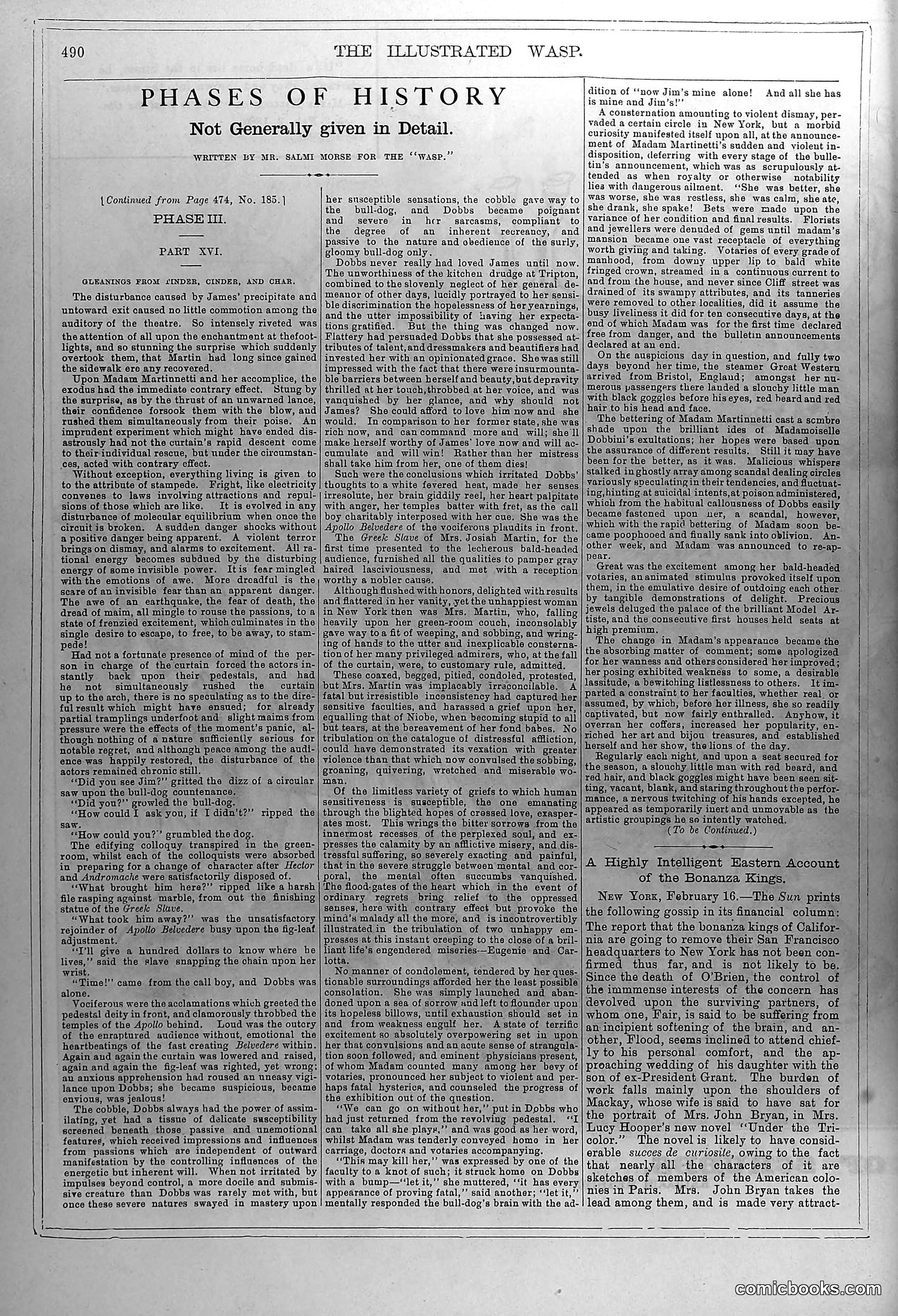
This page contains no cartoons. It is a text-only section of *The Wasp* magazine, presenting a serialized article titled "Phases of History Not Generally Given in Detail," written by Mr. Salmi Morse. The content focuses on a lengthy narrative about a domestic dispute involving a woman named Dobbs and her husband. The passage describes Mrs. Dobbs's frustrations with her marriage, her husband's infidelities, and the social circumstances surrounding their conflict. The second column includes a separate news item titled "A Highly Intelligent Eastern Account of the Bonanza Kings," reporting on California's bonanza kings' plans to remove their San Francisco headquarters to New York. This is primarily a text-driven page rather than a satirical cartoon page.
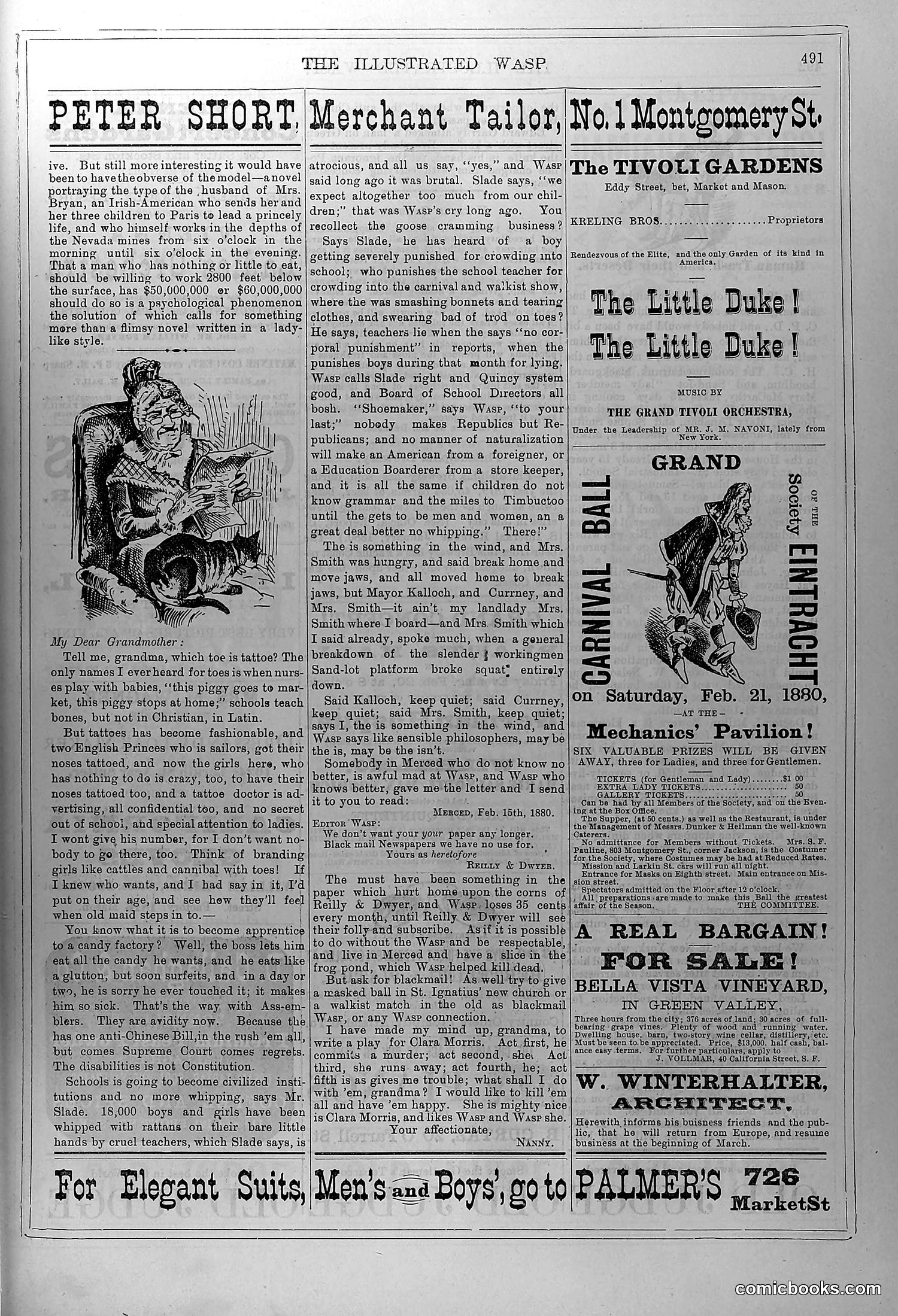
This page is primarily **advertisements and announcements** rather than political satire. The main content includes: **Key Elements:** - A merchant tailor advertisement (Peter Short, Montgomery St.) - A letter to the editor titled "My Dear Grandmother" discussing social issues like tattooing, education, and corporal punishment in schools - Multiple commercial ads for the Tivoli Gardens, a Grand Ball/Carnival, vineyard property, and architectural services **The Illustration:** The single sketch shows what appears to be a grandmother figure with a grandchild—likely accompanying the letter's domestic commentary about family life and generational perspectives. The page reflects late 19th-century San Francisco commercial culture and public discourse on education and social propriety, rather than containing pointed political cartoon satire.
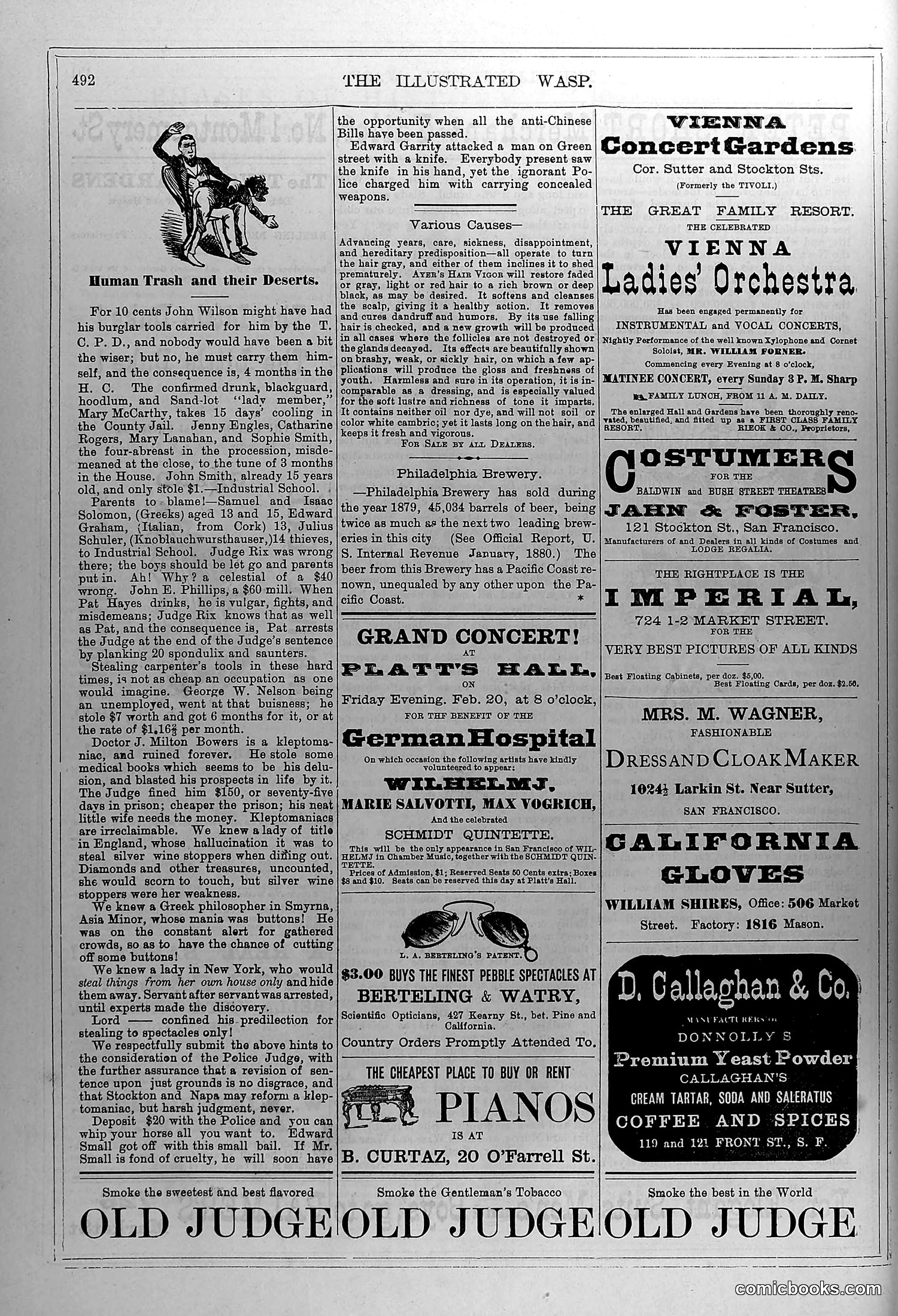
This page is primarily **advertising and notices** rather than satirical content. The left column contains a section titled "Human Trash and their Deserts," which appears to be a gossip or crime column detailing various criminal cases and social scandals from San Francisco. The only illustration is a small sketch labeled "Human Trash and their Deserts" showing a figure in ragged clothing—likely representing poverty or criminal degeneracy. The bulk of the page comprises **commercial advertisements** for music venues (Vienna Concert Gardens), costume shops, photographers, clothiers, opticians, piano rentals, and food products. This was typical of satirical publications like The Wasp, which relied on advertising revenue to fund editorial content.
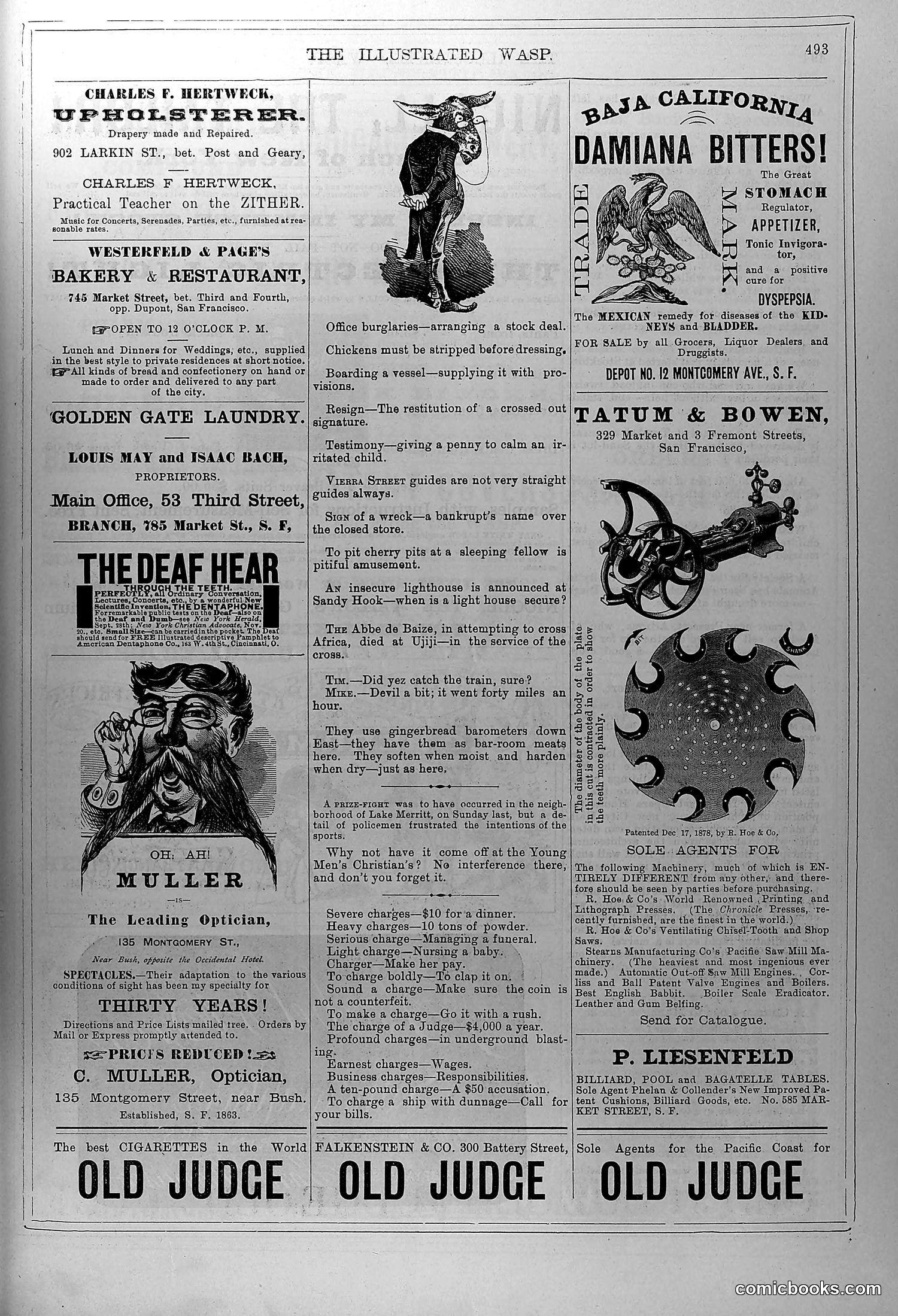
This page is primarily **advertising** for San Francisco businesses and products (bakeries, laundries, optical services, bitters) rather than political satire. The notable cartoon features **"Muller, The Leading Optician,"** depicted as a bearded man with exaggerated features touching his face. The joke appears visual rather than politically pointed—likely playing on the optician's profession by caricaturing his appearance in a humorous way. The page includes various small humorous anecdotes (cherry pits, lighthouse announcements, train speeds) that constitute light social humor rather than political commentary. The bottom third advertises **"Old Judge"** cigarettes repeatedly, suggesting this was a major advertiser. Overall, this is a **commercial/humorous miscellany page** rather than a page of political satire.
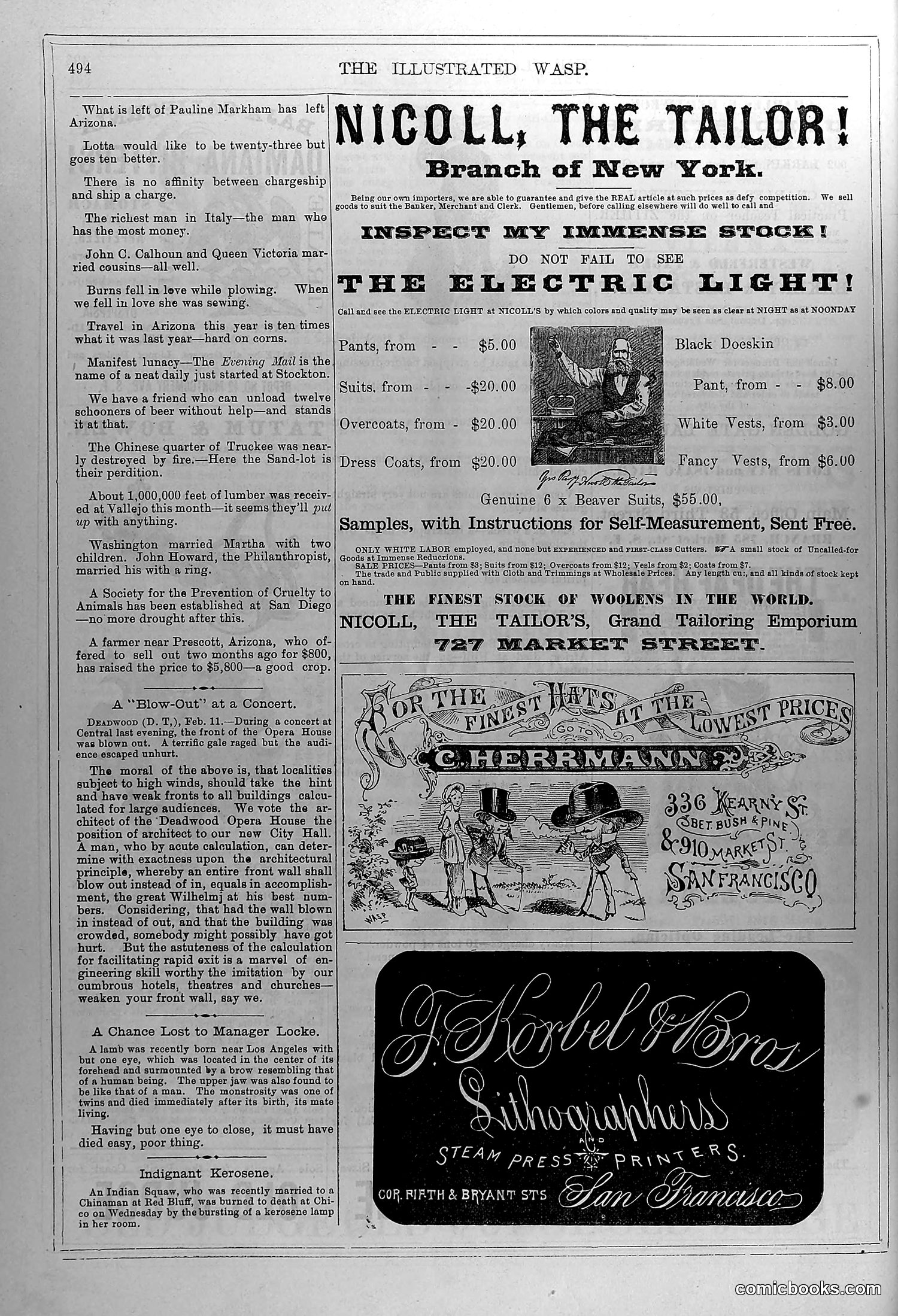
This page is primarily **advertising**, not political satire. The dominant content includes: **Main Advertisements:** - **Nicoll, The Tailor** (Branch of New York) - prominently advertised with pricing for suits, pants, overcoats, and dress coats - **C. Herrmann & Co.** - San Francisco hat seller - **S. Boreel Bros.** - Steam press printers in San Francisco **Left Column:** Contains brief humorous items and social notes typical of satirical magazines (brief jokes about money, romance, travel, etc.) rather than political cartoons. There are no identifiable political figures or satirical cartoons on this page. It represents the common practice of 19th-century magazines mixing editorial content with substantial advertising to fund publication.
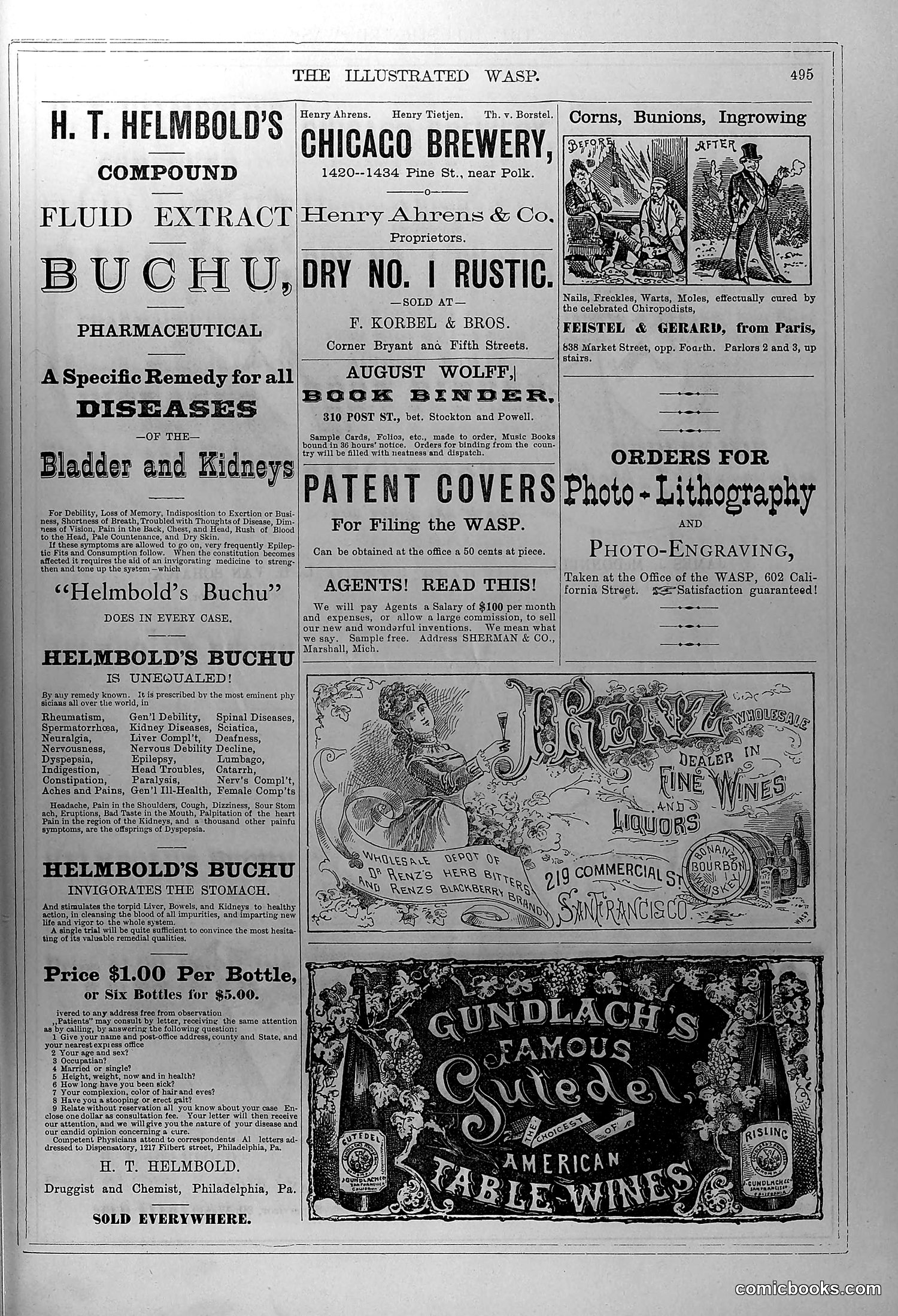
This page is primarily **advertising**, not editorial content or satire. It contains various commercial advertisements from late 19th-century San Francisco, including: - Helmboldt's Buchu (a patent medicine claiming to treat bladder and kidney diseases) - Chicago Brewery - Book binding services - Photo-lithography services - Wine and liquor merchants The single illustrated advertisement shows a cherub or cupid figure with decorative text advertising "Renz's" wine depot and "Gundlach's Famous Seckel" American table wines, both San Francisco businesses. There is **no political cartoon or satire** on this page—it's a commercial advertisement section from *The Wasp* magazine. The content reflects typical late-Victorian commercial promotion and patent medicine marketing practices.
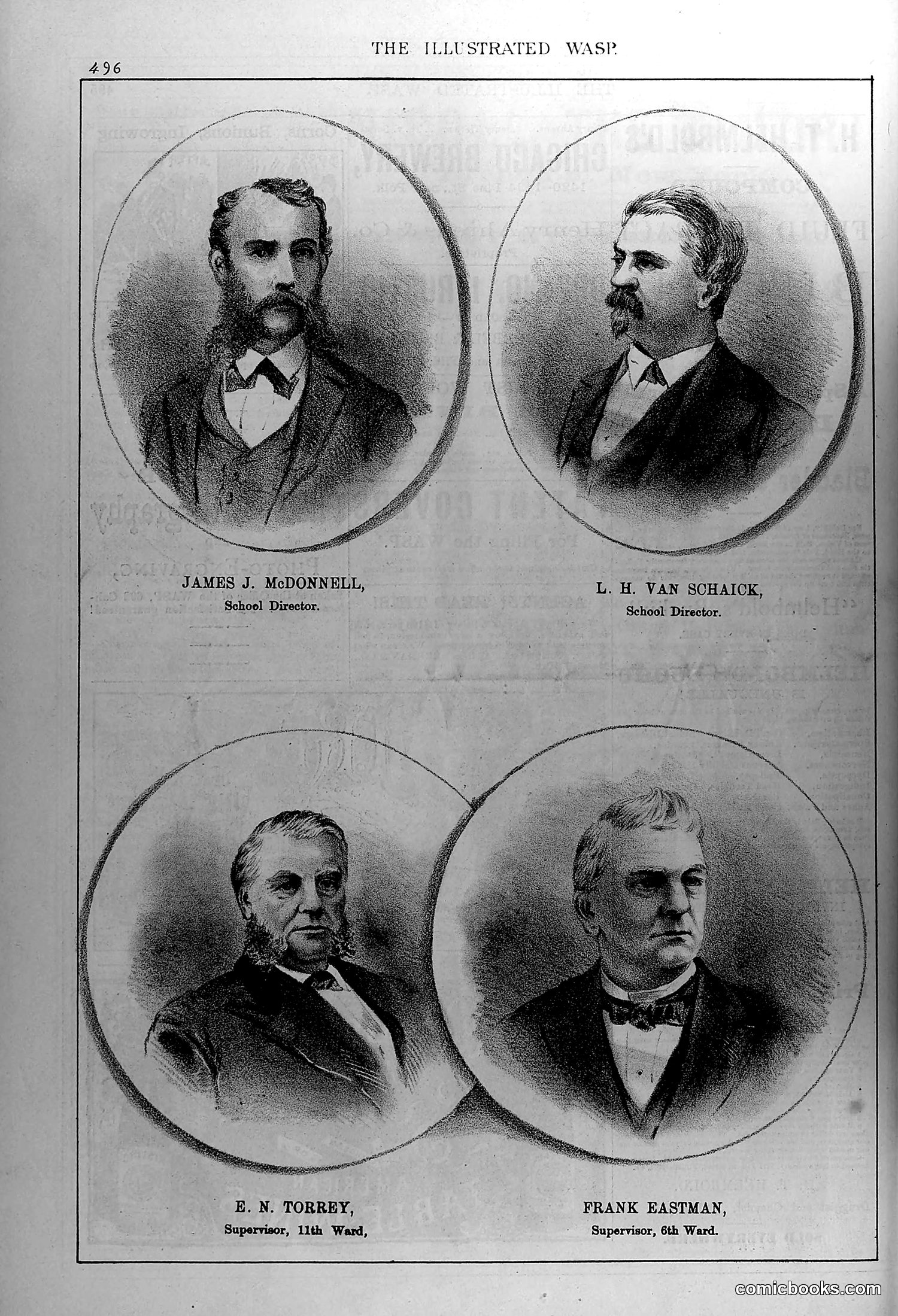
This page from *The Wasp* presents four portrait engravings of men identified as school administrators: - **James J. McDonnell** (School Director) - **L. H. Van Schaick** (School Director) - **E. N. Torbey** (Supervisor, 11th Ward) - **Frank Eastman** (Supervisor, 6th Ward) The page appears to be a straightforward roster or directory of San Francisco school officials rather than satirical commentary. Without additional context or captions indicating criticism, the portraits seem presented as factual documentation of these public administrators. *The Wasp* was known for sharp political satire, but this particular page functions more as informational content—possibly from a civic directory or administrative record section of the magazine.

I can see this page contains a **calibration chart or color reference scale** — the checkerboard pattern of varying gray tones on the left side with the measurement ruler are standard tools used in photography and printing to ensure accurate reproduction of images and text. This appears to be a **technical page rather than satirical content**. It's likely included in The Wasp magazine as a production aid or test page, not as editorial or cartoon material. The ruler and grayscale squares would help printers verify that their reproduction processes were maintaining proper contrast and clarity. Without readable OCR text or visible cartoon imagery, I cannot identify specific political references or satire on this particular page.